Vol. 24, No. 4 (2014) 140-144
http://dx.doi.org/10.6111/JKCGCT.2014.24.4.140
e-ISSN 2234-5078
Investigation of Co- and Pr-doped yttria-stabilized cubic zirconia (YSZ) single crystal grown by skull melting method
So-I Moon and Jeong-Won Seok †
Department of Gem and Precious Metals, Dongshin University, Naju 520-714, Korea (Received June 26, 2014)
(Revised July 15, 2014) (Accepted July 21, 2014)
Abstract Co-(0.7 wt%) and Pr-(2.0, 3.5 or 5.0 wt%) doped cubic zirconia (ZrO
2: Y
2O
3= 50 : 50 wt%) single crystals grown by a skull melting method were heat-treated in N
2at 1150
oC for 5 hrs. The brown colored as-grown single crystals were changed into either dark brownish green, greenish blue and light green color after the heat treatment. Before and after the heat treatment, the YSZ (yttria-stabilized zirconia) single crystals were cut for wafer form (ø7.5 mm × t3 mm). The optical and structural properties were examined by UV-VIS spectrophotometer and X-ray diffraction. Absorption by Co
2+( ≒589 nm:
Γ
8[
4A
2(
4F)] → Γ
8+Γ
7[
4T
1(
4F)], ≒610 nm: Γ
8[
4A
2(
4F)] → Γ
8[
4T
1(
4F)], ≒661 nm: Γ
8[
4A
2(
4F)] → Γ
6[
4T
1(
4F)]) and Pr
3+(≒450 nm:
3
H
4−
3P
2, ≒473 nm:
3H
4→
3P
1, ≒484 nm:
3H
4→
3P
0), change of ionization energy and lattice parameter were confirmed.
Key words Skull melting method, YSZ, Co
2+, Pr
3+, Ionization energy, Lattice parameter
스컬용융법에 의해 성장시킨 Co와 Pr이 첨가된 이트리아안정화큐빅지르코니아 (YSZ) 단결정의 연구
문소이, 석정원 †
동신대학교 보석귀금속학과, 나주, 520-714 (2014년 6월 26일 접수)
(2014년 7월 15일 심사완료) (2014 년 7월 21일 게재확정)
요 약 Co(0.7 wt%)와 Pr(2.0, 3.5 및 5.0 wt%)이 첨가된 큐빅지르코니아(ZrO
2: Y
2O
3= 50 : 50 wt%) 단결정을 스컬용융법 으로 성장 후 N
2분위기에서 1150
oC로 5시간 동안 열처리 하였다. 갈색의 단결정들은 각각 어두운 갈녹색, 녹청색 또는 밝 은 녹색으로 변화되었다. 열처리 전·후의 YSZ 단결정들을 직경 7.5, 두께 3 mm의 웨이퍼로 연마 하여 UV-VIS 분광광도계 및 XRD(X-ray diffraction)로 광학적 또는 구조적 특성 분석을 행하였다. Co
2+(약 589 nm: Γ
8[
4A
2(
4F)] → Γ
8+ Γ
7[
4T
1(
4F)], 약 610 nm: Γ
8[
4A
2(
4F)] → Γ
8[
4T
1(
4F)], 약 661 nm: Γ
8[
4A
2(
4F)] → Γ
6[
4T
1(
4F)]) 및 Pr
3+(약 450 nm:
3H
4-
3P
2, 약 473 nm:
3H
4→
3P
1, 약 484 nm:
3H
4→
3P
0)에 의한 흡수, 이온화에너지 및 격자상수 변화를 확인하였다.
1. 서 론
이트리아 안정화 큐빅지르코니아(Yttria-Stabilized Zirconia; YSZ)[1] 단결정은 안정화제(stabilizer)의 첨가 량 또는 dopant의 종류 및 첨가량에 따라 나타나는 색 상이 매우 다양하며 광학적 특성이 우수하여 주얼리산업 분야에서 다이아몬드 및 유색보석의 대용품으로[2, 3]
많이 사용되고 있다. 그 중에서 녹색은 에메랄드의 대용 품으로 많이 선호되고 있으며, 녹색의 YSZ 단결정 성장 을 위해서는 ZrO 2 와 Y 2 O 3 의 비를 약 50 : 50 wt%로 하 고 Co와 Ce를 추가적으로 첨가하게 되며[4] 청색에 가 까운 녹색을 주로 나타내게 된다. 에메랄드는 Al 3+ 자리 에 Cr 3+ 가 치환되어 녹색을 나타내며[5], 생산되는 지리 적 조건에 따라 그 색상은 청녹색에서부터 황녹색까지 매우 다양한 녹색계열을 나타난다. 그러므로 에메랄드 대용품으로 사용하기 위한 다양한 녹색 YSZ 단결정 개 발에 대한 연구는 주얼리산업분야에는 필요하다 할 수 있다. 따라서 본 연구에서는 기존 청녹색 계열의 YSZ
†
Corresponding author
†
Tel: +82-61-330-3243
†
Fax: +82-61-330-3253
†
E-mail: [email protected]
단결정 성장시 dopant로 첨가하는 Co와 Ce 대신 Co와 Pr 을 첨가하여 에메랄드 황녹색 계열을 나타내는 YSZ단 결정을 성장하고자 하였다.
2. 실험방법
출발원료는 Table 1에서와 같이 ZrO 2 와 Y 2 O 3 비를 50 : 50 wt% 로 하고, 추가로 Co 3 O 4 를 0.7 wt%로 모두 동일하게 첨가하였으며, Pr 6 O 11 는 각각 (a) 2.0, (b) 3.5, (c) 5.0 wt% 로 서로 다르게 첨가하였다. 원료는 각각 3kg 을 준비하여 스컬용융법으로 단결정을 성장시켰다.
성장시킨 단결정의 일부를 N 2 분위기 1150 o C 에서 5시간 동안 열처리하였다. 열처리 전·후 단결정들을 직경 7.5 mm, 두께 3 mm의 웨이퍼로 양면 폴리싱하여 UV-VIS 측정을 통한 광학적 특성 분석을 행하였으며, 웨이퍼로 가공된 동일부분의 단결정들을 미분쇄한 후 XRD 측정 을 통해 결정구조 분석을 행하였다.
3. 결과 및 고찰
3.1. Pr 6 O 11 첨가량에 따른 N 2 분위기 열처리 전·후 색 상 및 투명도 특성
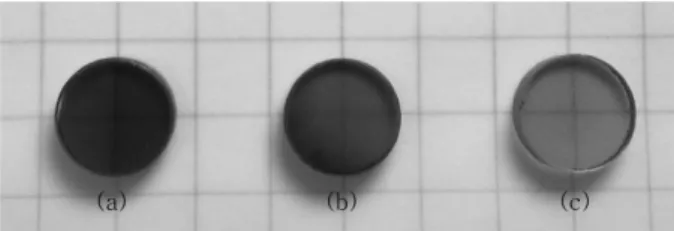
Fig. 1 은 ZrO 2 (50 wt%), 안정화제(stabilizer)인 Y 2 O 3 (50 wt%), dopant 인 Co 3 O 4 (0.7 wt%) 를 모두 동일하게 하고, 추가적 dopant로 Pr 6 O 11 을 각각 (a) 2.0, (b) 3.5, (c) 5.0 wt% 첨가하여 단결정을 성장시킨 후 직경 7.5
mm, 두께 3 mm로 가공한 웨이퍼들이며, Fig. 2는 각각 동일 부위의 단결정들을 환원분위기(N 2 ) 에서 1150 o C 로 5 시간 동안 열처리한 후 가공한 웨이퍼들이다. 열처리 전 웨이퍼 들의 색상은 옅을 갈색에서 짙은 갈색이며, 투명도는 투명에서 반투명의 양상을 보였다. 처리 후는 Pr 6 O 11 을 2.0 wt% 첨가한 샘플(a)을 제외하고 확연한 색 상 변화를 보였으며, 에메랄드와 가장 유사한 녹색은 5.0 wt% 를 첨가하여 환원열처리 한 샘플에서 보였다. (a) 의 경우는 적갈색에서 갈녹색으로 변화되었으며, (b)는 암갈색에서 녹청색으로 변화, 반투명에서 투명으로 변화 되었으며, (c)는 갈색에서 녹색으로의 변화를 보였다. 이 는 환원처리에 따른 Co 와 Pr의 원자가 변화에 따른 가 시광선 영역의 흡수 패턴 및 흡수율 변화에 기인된 결과 라 판단하여 UV-VIS 분광광도계를 통해 흡수패턴과 이 온화에너지를 측정하였으며, XRD 측정을 통한 격자상 수(lattice parameter) 변화 등의 구조적 해석을 하였다.
3.2. UV-VIS 분석
Fig. 3 과 4는 Fig. 1과 2의 샘플들을 UV-VIS 분광광도 계를 통해 투과율을 측정한 결과이다. 여기서 P 21 , P 22 및 Table 1
Composition of the starting materials
Compound Ratio (wt%)
(a) (b) (c)
ZrO
2: Y
2O
350 : 50
Co
3O
4(add) 0.7 0.7 0.7
Pr
6O
11(add) 2.0 3.5 5.0
Fig. 1. Photograph of Co
3O
4(0.7 wt%, identical) and Pr
6O
11((a)2.0, (b) 3.5 and (c) 5.0 wt%, respectively) doped YSZ single
crystal wafers before treatment.
Fig. 3. Optical transmittance spectra of Co
3O
4(0.7 wt%, identi- cal) and Pr
6O
11((a) 2.0, (b) 3.5 and (c) 5.0 wt%, respectively)
doped YSZ single crystal wafers before heat treatment.
Fig. 2. Photograph of Co
3O
4(0.7 wt%, identical) and Pr
6O
11((a) 2.0, (b) 3.5 and (c) 5.0 wt%, respectively) doped YSZ sin-
gle crystal wafers after heat treatment in N
2at 1150
oC for 5 hrs.
P 23 은 Co 2+ (3d 7 ) 가[6] 각각 Γ 8 [ 4 A 2 ( 4 F)] → Γ 8 + Γ 7 [ 4 T 1 ( 4 F)], Γ 8 [ 4 A 2 ( 4 F)] → Γ 8 [ 4 T 1 ( 4 F)] 및 (Γ 8 [ 4 A 2 ( 4 F)] → Γ 6 [ 4 T 1 ( 4 F)] 로 [7, 8] 여기(excited) 된 부분에 해당되며, 이들 흡수패턴 들은 각각 Pr 3+ 에 의한 3 H 6 → 3 P 0 , 3 H 4 → 1 D 2 및 3 F 2 →
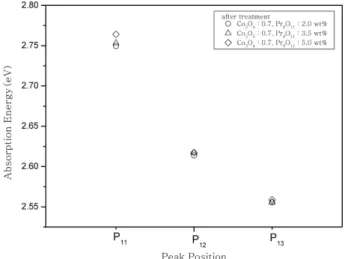
3 P 0 로의[9, 10] 여기에 의한 흡수 영역과도 일부 중복된 다. P 11 , P 12 및 P 13 은 각각 Pr 3+ (4f) 가 3 H 4 → 3 P 2 , 3 H 4 → 3 P 1 및 3 H 4 → 3 P 0 로[11, 12] 여기 된 부분에 해당되며, Fig.
4 에서와 같이 환원 열처리 후 샘플들에서만 측정되었다.
이는 스컬용융법의 단결정 성장환경에서 기인한 것이라 할 수 있다. 스컬용융법에서 단결정은 대기중에서 성장 이 되며, 이 때 dopant로 첨가된 Pr은 YSZ 내에서 Pr 4+
로 존재함을 예측할 수 있다.
Fig. 5 는 열처리 전·후 샘플들(Fig. 1과 2)의 P 21 , P 22 및 P 23 흡수대에 따른 전자전이에너지 값(eV)의 변화를 Fig. 4. Optical transmittance spectra of Co
3O
4(0.7 wt%, identi- cal) and Pr
6O
11((a) 2.0, (b) 3.5 and (c) 5.0 wt%, respectively) doped YSZ single crystal wafers after heat treatment in N
2at
1150
oC for 5 hrs.
Fig. 5. Variation of electronic transition energy in the P
21, P
22and P
23band positions of YSZ single crystals before and after
the heat treatment.
Fig. 6. Variation of electronic transition energy in the P
11, P
12and P
13band positions of YSZ single crystals after the heat
treatment.
계산하여 나타낸 데이터이다. Pr 6 O 11 이 2.0 wt% 첨가된 샘플에서 열처리 전·후 P 21 은 각각 2.12693과 2.12038 eV 였으며, P 22 는 2.03479 eV로 동일하였고, P 23 은 처리 전 에는 1.88278 eV이며, 열처리 후에는 정확한 peak position 측정이 불가능하였다. Pr 6 O 11 이 3.5 wt% 첨가된 샘플에 서 P 21 은 열처리 전에만 측정 가능하였으며 2.08403 eV, P 22 는 2.03679 eV로 동일하였고, P 23 은 처리 전·후 각각 1.87424 와 1.87085 eV였다. Pr 6 O 11 이 5.0 wt% 첨가된 샘 플에서 P 21 은 각각 2.12912와 2.10526 eV, P 22 는 2.03679 와 2.03279 eV, P 23 은 1.88107과 1.87424 eV였다. 즉 흡 수패턴들을 통해 계산된 대부분의 전자전이에너지 값은 환원 처리 후 감소되었으며, 이는 Co 3+ 가 Co 2+ 로 환원되 면서 400~550 nm 영역의 투과도가 증가[13]하여 결과적 으로 peak point가 우측으로 이동하였다 판단된다.
Fig. 6 은 열처리 후 샘플들(Fig. 2)의 P 11 , P 12 및 P 13
흡수대에 따른 전자전이에너지 값의 변화를 계산하여 나 타낸 데이터이다. Pr 6 O 11 을 2.0, 3.5, 5.0 wt%로 첨가함 에 따라 P 11 은 각각 2.74945, 2.75311 및 2.76416 eV, P 12 는 각각 2.61383, 2.61714 및 2.61714 eV, P 13 은 2.55565, 2.55565 및 2.55881 eV로의 변화를 보였다. 이 들 패턴들은 전형적인 Pr 3+ 에 의한 흡수패턴[14]들로서 Pr 6 O 11 첨가량이 증가할수록 전자전이에너지 값은 증가 되는 양상을 보였다.
3.3. XRD 분석
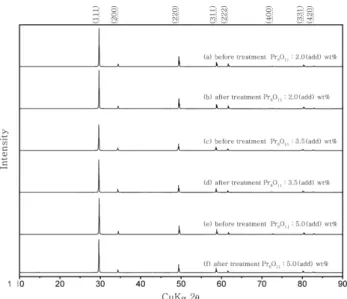
Fig. 7 은 Fig. 1과 2의 샘플들과 동일 단결정 부분들 을 미분쇄하여 측정한 XRD 데이터로서 전형적인 이트 륨 안정화 지르코니아(YSZ)의 특성을 보였다. Fig. 8은 각각의 샘플들에서 측정된 d hkl 값을 바탕으로 d hkl = a/
식에 의해 a값을 계산하였으며, a값을 다시
h 2 + k 2 + l 2
cos 2 θ에 도시 후 외삽함으로써 얻을 수 있었다. 여기서 a 값은 Pr 6 O 11 의 첨가량이 많을수록 또는 환원 열처리 후 증가함을 보였다. 이는 이온반경이 Zr 4+ (R = 0.84 Å) 에 비해 Pr 3+ (R = 1.16 Å) 또는 Pr 4+ (R = 1.00 Å) 가 크기 때 문이며, Pr 4+ → Pr 3+ 또는 Co 3+ (R = 0.65 Å) → Co 2+ (R = 0.82 Å) 로 환원되면서 dopant의 이온반경이 증가한 때문 이라 판단된다.
4. 결 론
ZrO 2 와 Y 2 O 3 비를 50 : 50 wt%로 하고 추가적 dopant 로 Co 3 O 4 와 Pr 6 O 11 을 첨가하여 YSZ 단결정을 스컬용융
법으로 성장시켰다. Co 3 O 4 는 0.7 wt%로 일정하게 첨가 하였으며, Pr 6 O 11 은 각각 (a) 2.0, (b) 3.5 및 (c) 5.0 wt% 로 변화시켰다. 성장시킨 단결정들의 일부는 N 2 분위 기 1150 o C 에서 5시간 동안 열처리하였으며, 처리 전·후 색상, 투과도 및 격자상수(lattice parameter) 값 비교분 석을 위해 UV-VIS 및 XRD측정을 행하였다. 환원 열처 리 전·후 색상은 (a)의 경우 적갈색 → 갈녹색, (b)는 암 갈색 → 녹청색, (c)는 갈색 → 녹색으로의 변화를 보였 다. 이들의 발색 메커니즘 규명을 위해 UV-VIS 분광광 도계로 투과도를 측정하였으며, Co 2+ 의 Γ 8 [ 4 A 2 ( 4 F)] → Γ 8 + Γ 7 [ 4 T 1 ( 4 F)], Γ 8 [ 4 A 2 ( 4 F)] → Γ 8 [ 4 T 1 ( 4 F)] 및 Γ 8 [ 4 A 2 ( 4 F)] → Γ 6 [ 4 T 1 ( 4 F)] 로 여기에 의한 흡수패턴과 Pr 3+ 의 3 H 4 → 3 P 2 ,
3 H 4 → 3 P 1 및 3 H 4 → 3 P 0 로 여기에 의한 흡수패턴이 측정 되었다. Pr 3+ 에 의한 흡수패턴은 환원열처리 된 샘플들에 서만 측정이 되었으며, 이는 스컬용융법으로 단결정 성 장시 dopant로 첨가된 Pr이 YSZ 내에서 Pr 4+ 로 존재함을 알 수 있는 결과이다. Co에 의한 peak point는 Co 3+ → Co 2+ 로 환원되면서 전반적으로 우측으로 이동하는 변화 를 보였으며, Pr에 의한 peak point는 Pr 4+ → Pr 3+ 로 환 원되면서 전반적으로 좌측으로 이동하는 변화를 보였다.
XRD 측정을 통해 계산된 a값은 Pr 6 O 11 의 첨가량이 많아 질수록 또는 환원 열처리 후 증가함을 보였다. 이는 dopant 로 첨가된 Co 및 Pr이 각각 3+ → 2+로 4+ → 3+
로 환원됨에 따른 이온반경의 증가에 기인한 결과라 판 단된다.
References