Effect of Soil Respiration on Light Fraction-C and N Availability in Soil Applied with Organic Matter
Byong-Gu Ko, Chang-Hoon Lee*, Myung-Sook Kim, Gun-Yeob Kim
1, Seong-Jin Park, and Sun-Gang Yun Soil and Fertilizer Division, NAS, RDA, Wanju 55365, Republic of Korea
1
Climate Change and Agroecology Division, NAS, RDA, Wanju 55365, Republic of Korea
(Received: June 28 2016, Revised: September 9 2016, Accepted: October 27 2016)
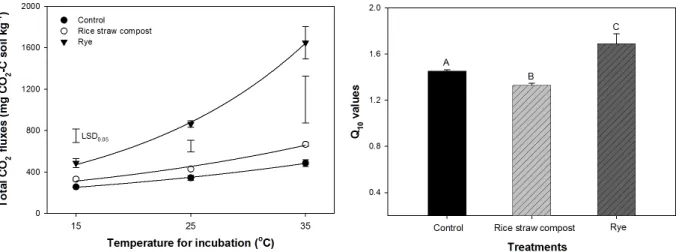
Soil respiration has been recognized as a key factor of the change of organic matter and fertility due to the carbon and nitrogen mineralization. In this study, we evaluated the effect of soil respiration on the light fraction-C and inorganic N content depending on temperature in soil applied with organic matter. Soil respiration was calculated by using total CO 2 flux released from soil applied with 2 Mg ha -1 of rice straw compost and rye for 8 weeks incubation at 15, 25, 35°C under incubation test. After incubation test, light fraction and inorganic N content were investigated. Rye application dramatically increased soil respiration with increasing temperature. Q 10 value of rye application was 1.69, which was higher 27% than that of rice straw compost application. Light-C and NO 3 -N contents were negatively correlated to soil respiration. Light-C in rye application more decreased than that in rice straw compost with temperature levels. These results indicate that temperature sensitivity of soil respiration could affect soil organic mater content and N availability in soil due to carbon availability. Also, light fraction would be useful indicator to evaluate decomposition rate of organic matter in soil under a short-term test.
Key words: Soil organic matter, Soil respiration, Light C fraction
Changes of total CO
2fluxes and Q
10values in soil applied with rice straw compost and rye under closed chamber condition.
1)
*Corresponding author: Phone: +82632382453, Fax: +82632383822, E-mail: [email protected]
§