유기질비료 시용과 콩과 사료작물의 혼파에 따른 총체밀과 트리트케일의 생산성과 단위면적당
유기 한우 사육능력 추정*
1)
조 익 환**
Estimation of Productivity and Organic Hanwoo Carrying Capacity per Unit Area of Whole Crop Wheat and Triticale by Application of
Organic Fertilizer and Legumes-Mixed Sowing
Jo, IK-Hwan
This study was conducted to estimate organic Hanwoo carrying capacity when whole crop wheat and triticale as winter forage crops were grown on different applying sources (no fertilizer, organic fertilizer or cattle slurry), and mixed sowing in combination with hairy vetch and forage pea at the level of 50% cattle slurry application during the period of 2009~2011. The experimental plots were consisted of 5 treatments. Each treatment was triplicates and allocated in the randomized complete block design. For whole crop wheat, annual mean dry matter (DM) yield was significantly (P<0.05) higher for fertilizer application treatments than for no fertilizer treatment, and crude protein (CP) yield was significantly (P<0.05) higher for forage pea and hairy vetch-mixed sowing treatments than for no fertilizer and organic ferilizer treatments. Mean CP, total digestible nutrients (TDN) and relative feed value (RFV) contents of legumes-mixed sowing treatments was significantly (P<0.05) higher than those of other treatments. As diets replaced with 70% whole crop wheat were provided for 450kg of Hanwoo heifers, legumes-mixed sowing treatments could raise more heifers than organic fertilizer and no fertilizer treat- ments. For triticale, annual mean DM, CP and TDN yields were significantly (P<
0.05) higher for fertilizer application treatments than for no fertilizer treatment, and CP content of legumes-mixed sowing and cattle slurry application treatments was significantly (P<0.05) higher than that of other treatments. When 450kg of Hanwoo heifers were fed on diets replaced with 70% triticale, it was estimated that legumes-
* 본 논문은 2011년 대구대학교 학술연구비로 수행된 과제임.
** 대구대학교 동물자원학과([email protected])
mixed sowing treatments at the level of 50% cattle slurry application could rear average 3.3~3.4 heads/ha/year, which was significantly (P<0.05) higher than no fertilizer treatment (2.5 heads/ha/year). It was indicated that DM yields of whole crop wheat and triticale were much more effective in cattle slurry application than organic fertilizer, and Legumes-mixed sowing at the level of 50% cattle slurry application rather than whole crop wheat or triticale alone increased yields per unit area and nutritional value such as CP content. In conclusion, it is conceived that whole crop wheat or triticale produced in the manner above can be used instead of grains imported as dietary protein sources in the organic Hanwoo feeding regimen.
Key words : cattle slurry, mixed sowing with legumes, productivity, feed value, organic hanwoo carrying capacity, winter forage crops.
Ⅰ. 서 론
최근 우리나라는 여러 국가들과 자유무역협정 체결로 값싼 축산물의 수입이 급증함에 따라 경쟁력이 약한 지역축산물은 생산기반의 붕괴 위험에 처해있고 또한 2011년에는 구 제역발생 등으로 소비자들의 불신이 증가되고 있으며 정부에서는 2014년부터는 동물복지 형 농장을 한우에게도 적용할 예정으로 있어 고부가가치의 안전축산물 즉, 유기한우쇠고기 생산기술체계 확립이 무엇보다도 필요한 시점이다. 더욱이 한우와 같은 초식가축도 농후사 료 위주의 사양에 익숙하여 이들 곡류를 대부분 해외수입에 의존하고 있는데, 최근에 곡류 최대 수출국이 이상 고온과 가뭄 등으로 작황이 현저하게 감소되어 재고량이 감소하고 유 류가 인상으로 수송비용의 증가에 의한 생산비 과다로 생산기반이 취약한 한우 농가는 더 욱 어려움에 처해 있으며 또한 조사료마저도 수입하여 사용되거나 혹은 저질 조사료인 볏 짚의 의존도가 50% 이상 차지하고 있어 급증하는 수입산 축산물과의 가격 경쟁력에서 크 게 뒤져 국내 한우산업 존립의 문제까지 대두되고 있다. 이러한 현실에서 양질의 유기 조 사료자원 특히 답리작이나 동 사료작물 확보에 의한 생산비절감과 유기 축산물 생산에 의 한 고 부가치가 무엇보다도 필요하다.
현재 남부지역을 기반으로 가축의 기호성과 생산성이 유리하여 대표적인 동계 사료작물 로 알려진 청보리는 기후환경의 제약 등으로 중북부 지역에서는 재배지역이 적어 호밀 재 배가 일반적이지만 이들은 사료가치와 기호성이 다소 낮아 대체 동계 사료작물의 필요성 이 요구되고 있다(Ryu et al., 2006). 트리트케일은 우리나라 논의 산성토양에서 재배가 용이 하며 생산성도 밀보다 높으며 유기질비료 특히 질소질 비료에 대한 이용효율이 높아 적은 시비량에도 효과가 크게 나타나 유기 조사료자원으로 알려져 있다(Kampenstein-Machan et al., 1994; Sylevster-Bradley, 1999; Bavec and Bavec, 2007).
2012년 이후부터는 가축분뇨의 해양투기가 전면 금지됨에 따라 가축분뇨처리를 위한 다
각적인 해결방안의 모색되는데, 친환경적으로 발효된 가축분뇨와 같은 유기질 비료를 시용 하게 되면 토양 미생물 활동으로 토양입자를 입단화하여 보수성, 보비력 등 토양의 물리 ․ 화학적 성질을 개선시키며(Denef, 2001; Reynolds et al., 2002), 화학비료를 연용하여 작물을 재배해 오던 토양에도 작물의 생육이 향상된다고 보고되고 있다(Recel, 1994).
한편 조사료원의 다양성 확보와 양질의 조사료 생산을 위해 일찍부터 유럽 국가들은 화 본과 사료작물과 콩과 사료작물을 혼파 재배하여 단파의 경우보다 조단백질수량을 높이고 도복을 방지하며 정착율이 높이는 잇점을 활용하여 왔다(Osman and Osman, 1982). 특히 이 들 두 작물의 혼파는 근계분포의 차이로 토양수분이나 양분을 효율적으로 이용할 수 있고 병충해를 저감시킴과 동시에 대기 중에 있는 질소를 고정하여 화본과 작물에 공급하기 때 문에 토양의 비옥도까지 증진시킬 수 있다는 장점도 있다(Drew et al., 2005).
우리나라에서도 1년생 콩과 사료작물인 hairy vetch 혹은 forage pea가 내한성이 강해 중 북부지방에서는 재배되고 있는데, 이들은 토양에서의 높은 질소 고정능력과 건물생산성이 많은 것으로 잘 알려져 있다(Lee and Park, 2002; Lee, 2007). 또한 이러한 콩과 작물은 단백 질 함량이 높고 사료가치와 기호성도 높아 조사료 품질 개선 작물로 이용되기도 한다(Seo et al., 2000; Kim et al., 2004). 아울러 월동 후에는 초기생육이 빨라 잡초발생을 억제시키는 효과가 뛰어나 제초제의 사용량을 줄일 수 있으며 토양에 환원 시 분해속도가 빨라 후작물 에 질소를 비롯한 무기영양성분을 적절하게 제공할 수 있어 친환경농업자재로써도 손색이 없는 것으로 알려져 있다(Lee and Lee, 2006; Lee, 2007).
따라서 본 연구에서는 동계 사료작물로 재배되는 총체밀과 트리트케일에 유기질비료와 가축분뇨를 시용하고 콩과작물을 혼파 재배하여 작물의 생산성과 사료가치를 평가함으로 써 양질의 조사료를 확보하며 단위면적당 유기한우 사육능력을 추정하고자 실시하였다.
Ⅱ. 재료 및 방법
본 연구는 2009년 10월부터 2011년 5월까지 경북 경산시 대구대학교 동물자원학과 실습 포장에서 수행되었는데, 공시초종으로 밀(‘금강’)과 트리트케일(‘신영’)을 각각 200kg/ha 씩 파종하여 무비구, 유기질 비료(T-N : 2.3%, P2O5 : 2.28%, K2O : 14.5%) 100% 시용구, 액상 우분뇨(T-N : 0.07%, P2O5 : 0.02, K2O : 0.64%) 100% 시용구(100kg N/ha), 액상우분뇨 50%
시용에 hairy vetch(‘Hungvillosa’) 혼파구 및 액상우분뇨 50% 시용에 forage pea(‘Ruby’) 혼파 구 등 5처리하여 3반복 난괴법으로 배치하였다. 혼파 구에서는 주초종(밀 혹은 트리트케일) 은 ha 당 160kg을 파종하였고 콩과작물(hairy vetch 혹은 forage pea)은 ha 당 20kg을 2009년 에는 10월 13일과 2010년에는 10월 15일에 파종하였으며 수확일은 각각 2010년 5월 11일과 2011년 5월 26일이었다. 이들 토양의 이화학적 특성은 Table 1과 같다.
Table 1. Chemical characteristics of the soil at experimental sites
Year pH(1:5) EC
(dS/m)
Available P
2O
5(mg/kg)
T-N (%)
O.M (%)
CEC Ca
2+K
+Mg
2+(cmol
+/kg)
2009 5.89 0.75 239.8 0.17 3.01 24.5 17.10 3.75 3.33
2010 5.60 0.60 274.98 0.16 2.33 27.1 20.84 3.84 2.08
한편 생초수량을 얻기 위해서는 수확 시 지상에서 5cm 높이로 예취하여 측정하였고 건 물함량은 각 시험구마다 500g 정도를 채취하여 65℃ 순환열풍건조기에서 48시간 건조시킨 다음 건물율을 계산하고 이를 기준으로 하여 단위면적당의 건물 수량을 산출하였다. 건조 된 시료는 Wiley mill로 분쇄하여 일반성분은 AOAC법(1990)으로, ADF와 NDF 함량은 Georing과 Van Soest법(1970)에 의해 분석하였다. 또한 ADF와 NDF함량으로 부터 TDN(total digestible nutrients)과 RFV(relative feed value)는 Nahm(1992)과 Linn과 Martin(1989) 등의 계 산식에 의하여 구하였다. 한편 얻어진 조단백질 함량과 가소화 양분총량(TDN)은 건물수량 과 곱하여 단위면적당 조단백질 수량과 가소화양분총량 수량을 구하였다. 이들 조단백질과 가소화양분 총량 수량은 한우사양표준(RDA, 2007)에 의거 한우 암소 약 450kg이 일일 증체 400g 목표로 하여 1일 각각 426.3g과 3.479kg을 기준으로 조단백질과 가소화양분 총량 수량 에 의한 단위면적당 연간 한우 사육능력을 평가하였다(Jo, 2003; Ryu et al., 2006).
본 실험의 결과는 SAS package program(Version 8. 01, USA, 2005)을 이용하여 유의성을 검정하였고, 처리 평균간의 비교는 5% 수준의 최소유의차 검정(LSD test)으로 하였다.
Ⅲ. 결과 및 고찰
1. 사초 생산성 및 사료가치비교1) 사초 생산성 비교
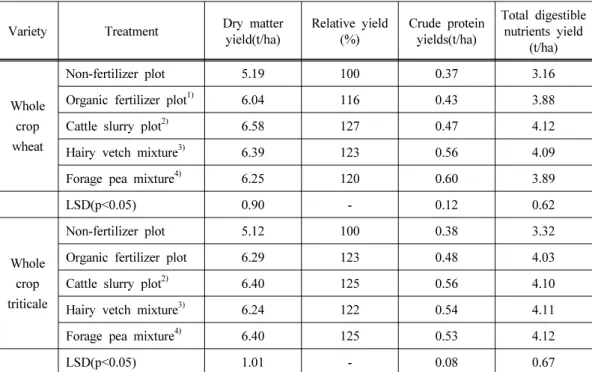
2010년부터 2011년까지 질소공급원으로 액상우분뇨의 시용 및 콩과 사료작물의 혼파가 총체밀과 트리트케일의 건물, 조단백질 및 가소화 양분(TDN) 수량에 미치는 영향을 나타낸 것은 Table 2이다.
총체밀의 2년(2010~2011) 평균 연간 건물수량은 무비구가 5.19톤/ha로 다른구에 비해 유 의하게 낮았으며(p<0.05), 처리구 즉 유기질 비료, 액상우분뇨, hairy vetch 혼파구 및 forage pea의 혼파구(6.04~6.58톤/ha)간에는 유의적 차이가 나지 않았다. 조단백질(CP) 수량은 forage pea(0.60톤/ha)와 hairy vetch 혼파구(0.56톤/ha)는 무비구(0.37톤/ha)와 유기질비료 시용구
(0.43톤/ha) 보다는 유의적으로 높았고 가소화양분총량(TDN) 수량은 무비구가 3.16톤/ha로 유의하게 낮았고, 시험구는 3.88~4.12톤/ha의 범위를 보였다. 총체밀의 경우와 마찬가지로 총체트리트케일의 2년 평균 연간 건물수량도 시험구는 6.24~6.40톤/ha의 범위로 무비구의 5.12톤/ha로 유의하게 높았다(p<0.05), 조단백질 수량도 시험구(0.48~0.56톤/ha)가 무비구(0.38 톤/ha)보다 유의하게 높았고(p<0.05), 액상우분뇨 시용구가 유기질비료 시용구보다 대체로 높은 경향을 나타내었으며 TDN 수량도 시험구는 4.03~4.12톤/ha의 범위로 무비구의 3.32톤 /ha 보다 유의하게 높았다(p<0.05).
Table 2. Effects of applying of cattle slurry and mixed sowing with legumes on dry matter, crude protein and total digestible nutrient yields of whole crop wheat and triticale in 2010~2011
Variety Treatment Dry matter
yield(t/ha)
Relative yield (%)
Crude protein yields(t/ha)
Total digestible nutrients yield
(t/ha)
Whole crop wheat
Non-fertilizer plot 5.19 100 0.37 3.16
Organic fertilizer plot
1)6.04 116 0.43 3.88
Cattle slurry plot
2)6.58 127 0.47 4.12
Hairy vetch mixture
3)6.39 123 0.56 4.09
Forage pea mixture
4)6.25 120 0.60 3.89
LSD(p<0.05) 0.90 - 0.12 0.62
Whole crop triticale
Non-fertilizer plot 5.12 100 0.38 3.32
Organic fertilizer plot 6.29 123 0.48 4.03
Cattle slurry plot
2)6.40 125 0.56 4.10
Hairy vetch mixture
3)6.24 122 0.54 4.11
Forage pea mixture
4)6.40 125 0.53 4.12
LSD(p<0.05) 1.01 - 0.08 0.67
Note : 1) Application plot of chemical phosphate and potassium fertilizer, 2) Application plot of cattle slurry 100 kg N/ha, 3) Cattle slurry 50% plot(Forage crop 160kg/ha + hairy vetch 20kg/ha), 5) Cattle slurry 50% plot(Forage crop 160kg/ha + forage pea 20kg/ha).
일반적으로 유기농업은 무경운 혹은 농자재 투입의 감소가 효과적이라고 알려져 있는 데 이에 대해 Bavec과 Bavec(2007)은 트리트케일이 밀 보다도 적은 질소시비량에서도 수 량증가 폭이 훨씬 높아 저투입에 의한 유기농업에 적합한 작물이라 하였다. 또한 Ewert와 Honermeier(1999)와 Ginuta와 Motzo(2004) 등은 질소질 비료에 대한 건물생산성의 반응 혹 은 질소이용효율은 트리트케일이 밀보다 훨씬 높다고 보고하였는데 본 연구에서도 총체트
리트케일이 밀보다도 무비구에 비해 유기질 비료 혹은 가축분뇨 시용구에서 더욱 높은 수 량 즉 질소이용효율을 나타내고 있다. 한편 Jo(2012) 등은 경북지역에서 동계사료작물로서 총체 호밀의 연간 건물수량은 6.89~7.13톤/ha이었고 보리에서는 5.50~5.53톤/ha이었다고 보 고하였는데, 본 연구에서는 총체밀(6.04~6.58톤/ha)과 트리트케일(6.24~6.40톤/ha)의 건물수 량이 호밀보다는 비교적 낮았지만 청보리 보다는 약 0.5~0.87톤/ha 높았으며 콩과작물과의 혼파의 경우에는 조단백질 수량이 호밀과 밀보다도 월등하게 높은 것으로 나타나 콩과 작 물의 혼파가 화본과 작물의 낮은 단백질 함량의 공급원과 호밀의 대체 작물로서의 가능성 을 시사하였다.
2) 사료가치 비교
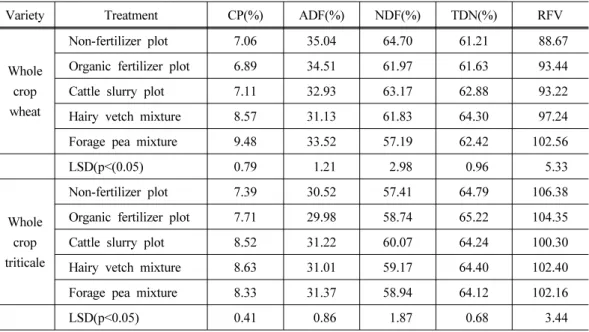
질소공급원으로 액상우분뇨 시용 및 콩과작물의 혼파가 총체밀과 트리트케일의 사료가 치에 미치는 영향은 Table 3과 같다.
Table 3. Effects of applying of cattle slurry and mixed sowing with legumes on nutritive values of whole crop wheat and triticale in 2010~2011
Variety Treatment CP(%) ADF(%) NDF(%) TDN(%) RFV
Whole crop wheat
Non-fertilizer plot 7.06 35.04 64.70 61.21 88.67
Organic fertilizer plot 6.89 34.51 61.97 61.63 93.44
Cattle slurry plot 7.11 32.93 63.17 62.88 93.22
Hairy vetch mixture 8.57 31.13 61.83 64.30 97.24
Forage pea mixture 9.48 33.52 57.19 62.42 102.56
LSD(p<(0.05) 0.79 1.21 2.98 0.96 5.33
Whole crop triticale
Non-fertilizer plot 7.39 30.52 57.41 64.79 106.38
Organic fertilizer plot 7.71 29.98 58.74 65.22 104.35
Cattle slurry plot 8.52 31.22 60.07 64.24 100.30
Hairy vetch mixture 8.63 31.01 59.17 64.40 102.40
Forage pea mixture 8.33 31.37 58.94 64.12 102.16
LSD(p<0.05) 0.41 0.86 1.87 0.68 3.44
총체 밀의 2년 평균 조단백질(CP) 함량은 콩과작물 혼파구(8.57과 9.48%)가 가장 높았고 액상우분뇨구(7.11%), 무비구(7.06%) 및 유기질 비료구(6.89%) 순으로 유의하게 낮아졌다 (p<0.05). 또한 콩과작물 혼파구의 ADF와 NDF 함량은 무비구와 유기질 비료구 보다 유의 하게 낮았으나, TDN 함량과 RFV는 반대로 유의하게 높았다(p<0.05). 총체 트리트케일의 3 년 평균 조단백질 함량도 콩과작물 혼파구와 액상우분뇨구가 각각 8.33~8.63과 8.52%로 유
기질비료구(7.71%)와 무비구(7.39%) 보다 유의하게 높았고(p<0.05), ADF와 NDF 함량도 유 의적 차이는 인정되지 않았지만 유사한 경향을 나타내었다. 한편 TDN 함량과 RFV는 반대 로 유기질비료구와 무비구가 다소 높게 나타났다.
Jo(2012) 등은 경북지역에서 생산성이 높은 동계작물인 호밀의 3년 평균 조단백질 함량, ADF, NDF 및 TDN 함량이 각각 6.7~7.4, 37.36~38.12, 67.71~69.25 및 58.79~59.25%로 사료 가치가 낮아 이들보다 영양가치가 높은 청보리(각각 6.95~9.23, 29.04~30.72, 53.36~56.34 및 64.63~65.6%) 등의 재배를 권장하고 있지만, 본 연구에서 총체밀과 트리트케일이 콩과작물 과 혼파 시에 청보리와 거의 유사한 수준을 나타내고 있어 청보리 재배가 불가능한 지역이 나 기후에서는 이들 재배로 사료가치 향상을 도모할 수 있음을 알 수 있었다.
3) 조단백질과 TDN 수량에 의한 단위면적당 한우 사육능력
질소공급원으로 액상우분뇨 시용 및 콩과작물의 혼파가 총체밀과 트리트케일의 조단백 질 및 TDN 수량에 의한 단위면적 당 연간 한우 사육능력을 나타낸 것은 Table 4이다.
Table 4. Effects of applying of cattle slurry and mixed sowing with legumes on carrying capacity per unit area for organic Hanwoo, as 450kg Hanwoo heifer with 400g average daily gain was fed diets included 70% whole crop wheat and triticale in 2010~2011
Variety Treatment
Hanwoo carrying capacity (heads/year/ha)
1)Crude protein TDN Mean
Whole crop wheat
No fertilizer 2.35 2.49 2.42
Organic fertilizer plot 2.79 3.05 2.92
Cattle slurry plot 3.02 3.25 3.13
Hairy vetch mixture 3.58 3.22 3.40
Forage pea mixture 3.85 3.07 3.46
L.S.D(p<0.05) 0.74 0.49 0.59
Whole crop triticale
No fertilizer 2.43 2.62 2.52
Organic fertilizer plot 3.11 3.23 3.17
Cattle slurry plot 3.57 3.24 3.41
Hairy vetch mixture 3.48 3.17 3.33
Forage pea mixture 3.41 3.24 3.32
L.S.D(p<0.05) 0.54 0.52 0.52
Note : 1) Forage crops were included at the level of 70% in diets of 450 ㎏ Hanwoo heifer with 400g
average daily gain.
유기 한우 암소 약 450kg을 일일 증체 400g 목표로 하여 총체밀을 사료 자원으로 70% 급 여할 시에 필요로 하는 조단백질과 TDN은 1일 각각 426.3g과 3.479kg(농촌진흥청, 2007)임 을 감안할 때, 처리구(ha 당 각각 연간 2.8~3.9두와 3.1~3.3두)가 전반적으로 무비구(ha 당 각각 연간 2.4와 2.5두)보다 유의하게 높았고(p<0.05), 이러한 경향은 hairy vetch 혼파구와 forage pea 혼파구에서 더욱 뚜렷하였으며 평균적으로 각각 ha 당 3.4와 3.5두로 유기질비료 구(평균 2.9두) 및 무비구(평균 2.9두) 보다 유의하게 높았다(p<0.05). 또한 총체밀의 경우와 마찬가지로 트리트케일을 사료 자원으로 70% 급여할 때에도 조단백질과 TDN 기준으로 처 리구가 ha 당 각각 연간 3.1~3.6과 3.2두(평균 3.2~3.4두)를 사육할 수 있어 무처리구의 ha 당 각각 연간 2.4와 2.6두(평균 2.5두) 보다 유의하게 높았으며(p<0.05), 이러한 경향은 액상 우분뇨와 혼파시용구에서 더욱 뚜렷하였다.
일반적으로 생산된 조사료자원을 보다 효과적이고 현장 중심의 적용을 위해서 단위면적 에 따른 사육능력을 평가하는 것으로 알려져 있는데(Ryu et al., 2006), 암소 약 450kg을 일 일 증체 400g 목표로 하여 조사료를 70%로 급여하고자 할 때 조단백질과 TDN을 기준으로 Jo(2012) 등은 호밀이 화학비료수준에서는 4.2두, 가축분뇨의 시용 시에는 3.1~3.3두라고 하 였으나 본 연구에서는 총체밀과 트리트케일 가축분뇨 시용구가 3.2~3.4두로 호밀의 경우보 다 높아서 Park 등(2012)이 보고한 호밀보다 트리트케일에서 가축사육능력이 높다는 결과 와도 일치하였다.
이상의 결과를 종합해 볼 때, 총체밀 및 트리트케일의 건물생산성은 유기질 비료 시용 시 보다 액상우분뇨의 시용이 더욱 효과적이었으며 액상우분뇨의 50% 시용과 함께 콩과 작물인 hairy vetch 혹은 forage pea 등을 혼파로 재배하는 것이 단파의 경우보다 단위면적당 수량과 단백질 함량 등의 사료가치를 높일 수 있어 유기농업이 지향하는 저투입에 의한 생 산성 유지 및 유기 한우 사육 시에 단백질공급원으로 이용되는 수입 곡류 등을 대체하는 효과까지도 기대할 수 있으리라 생각된다.
Ⅵ. 적 요
본 실험에서는 2009년부터 2011년까지 월동 사료작물로 재배되는 총체밀과 트리트케일 에 가축분뇨 시용과 콩과작물의 단, 혼파재배가 작물의 생산성과 사료가치를 평가하여 양 질의 조사료 확보 및 단위면적당 유기 한우 사육 능력을 추정하고자 무비구, 유기질비료 시용구, 액상우분뇨 시용구, 액상우분뇨 50% 시용에 hairy vetch 혼파구 및 액상우분뇨 50%
시용에 forage pea 혼파구 등 5처리 3반복 난괴법으로 배치하여 실험이 실시되었다. 총체밀 의 연간 건물수량은 처리구가 6.04~6.58톤/ha으로 무비구의 5.19톤/ha 보다 유의하게 높았으 며(p<0.05), 조단백질 수량은 forage pea(0.60톤/ha)와 hairy vetch 혼파구(0.56톤/ha)가 무비구
(0.37톤/ha)와 유기질비료 시용구(0.43톤/ha) 보다는 유의하게 높았다(p<0.05). 평균 조단백질 과 TDN 함량 및 RFV는 콩과작물 혼파구가 다른 처리구보다 유의하게 높았다(p<0.05). 총 체밀을 유기 한우 암소 450kg에 70% 급여 시에는 액상우분뇨 50%시용에 콩과작물을 혼파 한 구에서 연간 약 ha 당 각각 3.4~3.5두로 유기질비료구(평균 2.9두) 및 무비구(평균 2.9두) 보다 유의하게 높았다(p<0.05). 총체 트리트케일의 2년 평균 연간 건물수량도 시험구는 6.24
~6.40톤/ha의 범위로 무비구의 5.12톤/ha로 유의하게 높았다(p<0.05), 조단백질과 TDN 수량 은 시험구(각각 0.48~0.56과 4.03~4.12톤/ha)가 무비구(0.38과 3.3톤/ha)보다 유의하게 높았고 (p<0.05), 평균 조단백질 함량도 콩과작물 혼파구와 액상우분뇨구가 다른 처리구보다 유의 하게 높았다(p<0.05). 총체트리트케일로 유기한우 암소를 사육할 때에는 액상우분뇨 50%시 용에 콩과작물을 혼파한 구에서 ha 당 연간 평균 3.3~3.4두를 사육할 수 있어 무처리구의 ha 당 평균 2.5두 보다 유의하게 높았다(p<0.05).
이상의 결과를 종합해 볼 때, 총체밀 혹은 트리트케일의 건물생산성은 유기질 비료보다 는 액상우분뇨가 훨씬 효과적이고 액상우분뇨 50%시용과 함께 콩과 작물인 hairy vetch 혹 은 forage pea 등을 혼파로 재배하는 것이 단파의 경우보다 단위면적당 수량과 단백질 함량 등의 사료가치를 높일 수 있어 유기 한우 사육 시에는 단백질공급원으로 이용되는 수입 곡 류 등을 대체하는 효과까지도 기대할 수 있으리라 생각된다.
[논문접수일 : 2013. 4. 25. 논문수정일 : 2013. 4. 30. 최종논문접수일 : 2013. 5. 15.]
Reference
1. AOAC. 1990. Official methods of analysis(15th Ed.). Association of Official Analytical Chemists. Washington D. C.
2. Bavec. F. and M. Bavec. 2007. Organic production and use of alternative crops. CRC Taylor and Francis. 52-58.
3. Denef, K. J. Six, K. Paustian, and R. Mercks. 2001. Importance of macroaggregate dynamics in controlling soil carbon stabilization: short-term effects of physical disturbance induced by dry-wet cycles. Soil Biol. Biochem. 33: 2145-2153.
4. Drew, Elizabeth A., Vadakattu VSR. Gupta, and David K. Roget. 2005. Are legumes doing their job? The effect of herbicides on N2 fixation in Southern Australian agricultural system.
Biological nitrogen fixation, sustainable agriculture and Environment. Proceedings of the 14th international nitrogen fixation congress. pp. 162-164.
5. Ewert, F. and B. Honermeier. 1999. Spikelet initiation of winter triticale and winter wheat in response to nitrogen fertilization. Eur. J. Agron., 11(2): 107.
6. Goering, H. K. and P. J. Van Soest. 1970. Forage fiber analysis. USDA Agric. Handbook No. 379, Washington, D. C.
7. Giunta, F. and R. Motzo. 2004. Sowing rate and cultivar effect total biomass and grain yield of spring triticale(× Triticosecale Wittmack) grown in a Mediterranean-type environment.
Field Crops Res. 87(2-3): 179.
8. Jo, I. H. 2003. A Study on area types of recycling agriculture. Korean Journal of Organic Agriculture. 11(3): 91-108.
9. Jo. I. H. 2012. Evaluation of carrying capacity of Hanwoo heifers when fed whole crop barley and rye as influenced by organic fertilizer application and mixed sowing with legumes. J. Kor. Grassl. Forage Sci. 32(2): 117-124.
10. Karpenstein-Machan, M., B. Honermeier, and H. Hartman., 1994. Triticale Production Aktuel.
DLG-Verlag, Frankfurt/Main.
11. Kim, J. D., S. G. Kim, and C. H. Kwon. 2004. Comparison of forage yield and quality of forage legume. J. Anim. Sci and Tech. 46(3): 437-442.
12. Lee, H. W. 2007. Nitrogen fixation of legumes and transfer to grasses in spring paddy soil.
J. Kor. Grassl. Forage Sci. 27(3): 167-172.
13. Lee, H. W. and H. S. Park. 2002. Nitrogen fixation of legumes and cropping system for organic forage production. Korean Journal of Organic Agriculture. 10(1): 51-63.
14. Lee, I. D. and H. S. Lee. 2006. A comparative study on the dry matter yield and nutritive value from rye and hairy vetch seeding types in Daejeon area . J. Kor. Grassl. Forage Sci.
26(4): 207-214.
15. Linn, J. And N. Martin. 1989. Forage quality tests and interpretation. Univ. of Minnesota Ext. Serv. AG-FO-2637.
16. Nahm, K. H. 1992. Practical guide to feed, forage and water analysis. Yoohan Pub. 1-70.
17. Osman, A. E. and A. M. Osman. 1982. Performance of mixture of cereal and legume forage under irrigation in the Sudan. J. Agric. Sci. Camb. 98: 71-72.
18. Park, S. S., J. H. Noh., J. H. Park, K. Y. Yoon, and J. S. Lee. 2012. Comparison of dry matter yield, feed value and stock carrying capacity at mixture of rye, triticale and legume in central region of korea. Korean Journal of Organic Agriculture. 20(1): 71-80.
19. RDA National Institue of Animal Science. 2007. Korean feeding standard for Hanwoo.
20. Recel, M.R. 1994. Use od bio-organic fertilizers in agriculture production in the philippines.
In: International seminar on the use of microbio and organic fertilizers in agricultural pro-
duction. held in June 14-15 1994 in Suweon, organized RDA & FFTC, pages 18.
21. Reynolds, W. D., B. T. Bowman, C. F. Drury, C. S. Tan, and X. Lu. 2002. Inducators of good soil physical quality: density and mineralogical methods; part 2, microbiological and biochemical properties; part 3, method; chemical methods).
22. Ryu, D. K., S. I. Yun, J. S. Lee, I. H. Jo, and J. H Ahn. 2006. Standard model development of nature-circulating organic agriculture. Ministry of Agriculture and Forestry.
23. SAS. 2005. Statistical Analysis System ver., 8. 01. SAS Institute Inc., Cary, NC.
24. Seo, J. H., H. J. Lee, I. B. Hur, S. J. Kim, C. K. Kim, and H. S. Jo. 2000. Comparisons of chemical composition and forage yield among winter green manure crops. J. Kor. Grassl.
Forage Sci. 20(3): 193-198.
25. Sylvester-Bradley R. 1993. Opportunities for lower nitrogen inputs without loss of yield or quality: An agronomic and economic appraisal. In Proc. of the Cereals Ret. D. Conf., Cam- bridge. H-GCA, London. 198.