Introduction
Oxygen is only sparingly soluble in water and diffuses much more slowly through water than through air (Schlesinger, 1997). What little oxygen that is present in flooded rice paddy soils in the form of dissolved O 2 is quickly consumed through metabolic processes. Although energy yields are much greater with O 2 than with any other terminal electron acceptor, under anoxic conditions anaerobic and facultative microbes can use alternative electron acceptors such as NO 3 - , Fe 3+ , Mn 4+ , SO 4 2- , and CO 2 to produce energy and build biomass (McBride, 1994). Therefore, microbial transformations of elements play a large role in biogeochemical cycling of nutrients in anaerobic soils.
In general, submergence enhances available PO 4 3-
levels in flooded anoxic rice paddy soils, which is attributable to reduction of hydrous ferric compounds, particularly Fe-oxides (Sanyal and De Datta, 1991;
Ponnamperuma, 1972). Liberation of sorbed and/or co-precipitated P increases solution or extractable PO 4 3- in
anoxic flooded soils. However, it has been found that the presence of NO 3 - in water acts as an effective redox buffer and substantially delaying the release of PO 4 3- in various anoxic flooded ecosystems including rice paddies (Anderson, 1982; Lucassen et al., 2004; Sallade and Sims, 1997; Young and Ross, 2001; Surridge et al., 2007). The inhibition of PO 4 3- release is mostly due to the suppression of Fe 3+ reduction under the presence of NO 3 - , a more preferential electron acceptor. Also the enzymatic re-oxidation of Fe 2+ during NO 3 - reduction results in the formation of oxidized Fe phases and re-adsorption of dissolved PO 4 3- (Matocha and Coyne, 2007; Straub et al., 2004; Weber et al., 2006). Enhanced SO 4 2- reduction and iron-sulfide mineral (e.g. FeS, FeS 2 ) formation, caused by inputs of high SO 4 2- water, is responsible for increased pore water PO 4 3- accumulation in aquatic ecosystems (Smolders and Roelofs, 1993; Murray, 1995; Roden and Edmonds, 1997). However, high concentration of NO 3 - in the water can suppress SO 4 2- reduction and accompanied PO 4 3- accumulation (Lucassen, et al., 2004). Oxida- tion-reduction reactions involving NO 3 - , Fe, and SO 4 2- , which control the solubility of P in anoxic flooded soil environments, can be summarized as shown in Fig. 1.
Therefore, in flooded soil environments, where NO 3 - is continuously supplied and removed by reduction process
Effect of Nitrate in Irrigation Water on Iron Reduction and Phosphate Release in Anoxic Paddy Soil Condition
Byoung-Ho Kim, and Jong-Bae Chung*
Division of Life and Environmental Science, Daegu University, Gyeongsan 712-714, Korea
Since NO 3 - is a more favorable electron acceptor than Fe, high NO 3 - loads function as a redox buffer limiting the reduction of Fe and following release of PO 4 3- in flooded paddy soil. The effect NO 3 - loaded through irrigation water on Fe reduction and PO 4 3- release in paddy soil was investigated. Pot experiment was conducted where irrigation watercontaining 5 or10 mg N L -1 of NO 3 - was continuously applied at 1 cm day -1 , and changes of NO 3 - , Fe 2+ and PO 4 3- concentrations in soil solution at 5 and 10 cm depths beneath the soil surface were monitored as a function of time. Irrigation of rice paddy with watercontaining 5 mg N L -1 of NO 3 -
led to reduced release of Fe 2+ and prevented solubilization of P at 5 cm depth beneath the soil surface. And application of irrigation water containing 10 mg N L -1 of NO 3 - could further suppress Fe reduction and solubilization of P through 10 cm depth soil layer beneath the surface. These results suggest that the introduction of high level NO 3 - with irrigation water in rice paddy can strongly limit Fe reduction and P solubilization in root zone soil layer in addition to the excessive supply of N to rice plants.
Key words: Nitrate, Iron, Phosphate, Paddy soil, Oxidation-reduction, Irrigation water
Received : January 28. 2010 Accepted : February 16. 2010
*Corresponding author : Phone: +82538506755
E-mail: [email protected]
(denitrification), P solubilization can be considerably inhibited with suppression of Fe reduction and re-oxidization of reduced Fe. It has been found that high NO 3 - concentrations in river water and groundwater greatly inhibit eutrophication of fresh water wetlands by limiting PO 4 3- availability (Anderson, 1982; Lucassen et al., 2004; Surridge et al., 2007). In paddy soil condition, Fe reduction was significantly inhibited with application of NO 3 - (40 mg N kg -1 ) and concentration of PO 4 3- in soil solution was significantly lower compared with the PO 4 3-
concentration found in the soil of no NO 3 - application (Chung, 2009). These results indicate that NO 3 -
introduced in the anoxic layer of rice paddy soil with fertilization and irrigation can inhibit reduction of Fe and accompanied P solubilization.
During the early stage of rice growth, where relatively large amount of N is applied as a basal fertilization, denitrification in the anoxic root zone soil layer can lead to reduced release of Fe 2+ and PO 4 3- . And solubilization of P in the anoxic root zone soil layer would be continuously limited during the growth period by the input of irrigation water with high NO 3 - concentrations. Under these circumstances the availability of P and Fe in the soil could be limited and deficiency of these nutrients in rice plants could be caused in some extreme cases. It has been found that PO 4 3- release from the lake sediment usually does not take place with the concentration of NO 3 - higher than 5
mg/L -1 in overlying water (Anderson, 1982). Rice paddies are mostly under flooded condition during the growth period and continuously irrigated. Most of the irrigation waters are supplied from rivers, dams and reservoirs, and in many parts of our country the concentration of NO 3 - in those water resources frequently exceeds even 5 mg L -1 (Chung et al., 1997; Chung et al., 1998; Ministry of Environment, 2009).
In this study the effect of surface applied NO 3 - with irrigation water on the release of PO 4 3- in root zone soil layer was investigated using a rice paddy model system.
Materials and Methods
Soil A Yuga silt loam (fine silty, mixed, mesic family of Fluvaquentic Endoaquepts) was collected from the surface layers (0-20 cm) of a rice paddy in Daegu University Experimental Farm (Table 1). The soil was air-dried and crushed to pass 5 mm sieve. Reagent grade KH 2 PO 4 solution was sprayed on the soil and mixed thoroughly to adjust available P level to 58 mg P kg -1 , and the treated soil was kept for 30 days at 20 ℃ for stabilization of the added P before experiment.
Experimental system construction The flooded rice paddy model consisted of a 10-L plastic cylinder with
Fig. 1. Oxidation-reduction reactions which control the release of phosphate in anoxic flooded paddy soils.
Table 1. Some physical and chemical characteristics of the Yuga silt loam soil.
pH
(1:5 H
2O) Organic matter Available P
Total P
Oxide Fe
Particle separate
Sand Silt Clay
g kg
-1--- mg kg
-1--- g kg
-1--- % ---
6.5 26.0 17.3 1304 13.5 22.2 54.0 23.8
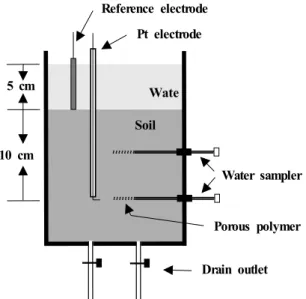
a sealed bottom, 24 cm long with a diameter of 23 cm (Fig.
2). The prepared soil was packed uniformly to a height of 15 cm from bottom of the cylinder. Two soil moisture samplers (Eijkelkamp, Giesbeek, The Netherlands) were placed at each depth of 5 and 10 cm beneath the soil surface for soil solution sample collection. A platinum electrode for redox potential measurement was placed at a depth of 10 cm beneath the soil surface. Two drain outlets were installed on the bottom of the cylinder. In this experiment, three experimental systems were constructed and used for the irrigation treatments of three different NO 3 - concentrations.
Experimental procedure The prepared experimental systems were flooded with 0.02 M CaCl 2 solution supplied from bottom of the soil column through drain outlets and 5 cm flooding depth above the soil surface was maintained with the drain outlets closed until the redox potential measured at 10 cm soil depth lowered below -200 mV. Irrigation waters containing three levels of NO 3 -
(0, 5 and 10 mg N L -1 ) were used in the experiment.
Irrigation waters were prepared by dissolving a reagent grade KNO 3 in distilled water containing 0.02 M CaCl 2 . After the redox potential at 10 cm soil depth was lowered below -200 mV, irrigation water containing NO 3 - was added to maintain 5 cm flooding depth after removing the pre-flooded water (0.02 M CaCl 2 solution) above the soil surface. The drain outlets were opened and the percolation rate was maintained at 1 cm day -1 during the experiment.
Floodwater depth of 5 cm was maintained throughout the
experiment by daily addition of irrigation water. The experiment was conducted at 25 ± 2 . ℃
Daily soil water sampling and monitoring of the effect of NO 3 - on Fe reduction and P solubilization were initiated 5 days after flooding with NO 3 - containing irrigation water. Daily changes of redox potential at 10 cm depth soil were also monitored. Two soil solution samples of 15 mL were collected at each depth of 5 and 10 cm beneath the soil surface using a syringe connected to the soil moisture sampler.
Analytical methods Soil sample was air-dried and passed through a 2-mm sieve. Soil pH was determined using a pH meter in deionized water with a 1:5 soil/solution ratio. Organic matter was determined by using Walkley and Black procedure (Nelson and Sommers, 1982). Total and available P contents were measured using perchloric acid digestion and Bray No. 1 procedures (RDA, 1988). Content of free iron oxides was measured using Na-dithionite-extraction method (Olson and Ellis, 1982). Soil particle size distribution was determined by micro-pipette method (Miller and Miller, 1987).
Soil solution samples were passed through 0.45 m μ membrane filter before analysis. Flow injection autoanalyzer (FIAstar-5000 system, FOSS Tecator, Hӧ gan s, Sweden) was used in the analysis of NO ӓ 3 - and PO 4 3- , and Fe 2+ was determined using 1,10-phenanthroline method (Stucki and Anderson, 1981). Soil redox potential was determined using Eh meter (Fujihara Factory, Tokyo, Japan) and the reference electrode (Ag/AgCl/Sat. KCl) potential 206 mV was adjusted.
Results and Discussion
In the treatment of irrigation water without NO 3 - , NO 3 -
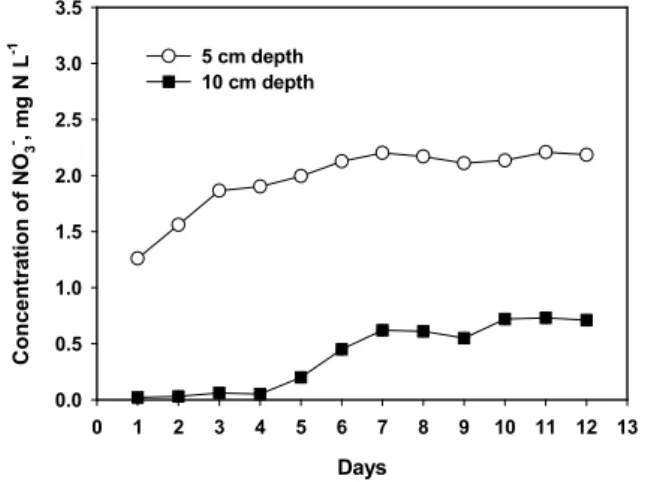
was not detected in soil solutions sampled at 5 and 10 cm depths during the experiment. Any NO 3 - presented in the soil could be completely removed by denitrification during the pre-flooding period. In the treatment of irrigation water containing 5 mg N L -1 of NO 3 - , trace amount of NO 3 - was detected at 5 cm depth but at 10 cm depth NO 3 - was not detected during the experiment. In the treatment of irrigation water containing 10 mg N L -1 of NO 3 - , as shown in Fig. 3, concentration of NO 3 - in the solution was rapidly increased from 1.2 mg N L -1 at the initial measurement and 5 days after the initial 5 cm
10 cm
Porous polymer Water sampler Soil
Wate Pt electrode Reference electrode
Drain outlet
Fig. 2. Schematic diagram of the experimental paddy
soil system.
measurement more than 2.0 mg N L -1 of NO 3 - was found at 5 cm depth. At 10 cm depth, concentration of NO 3 - in the soil solution was below 0.2 mg N L -1 in the early period of measurement and 6 days after the initial measurement 0.4
0.7 mg N L
∼ -1 of NO 3 - was found. In all of the treatments, NO 3 - was not found in the soil solution collected from the drain outlets. Since there was not any loss of NO 3 - via leaching and plant absorption in the experimental systems, the NO 3 - removal from irrigation water during percolation could be due to the denitrification process where NO 3 -
preferentially used as an electron acceptor under anoxic soil condition (Sposito, 1989; Matocha and Coyne, 2007).
Kasuya (1999) also found that most of the NO 3 - in percolating water was removed in the shallow plow layer (0 3 cm) by denitrification in rice paddies where ∼ groundwaters containing 5 27 mg N L ∼ -1 of NO 3 - were irrigated.
Days
0 1 2 3 4 5 6 7 8 9 10 11 12 13
Concentration of NO
3-, m g N L
-10.0 0.5 1.0 1.5 2.0 2.5 3.0 3.5
5 cm depth 10 cm depth
Fig. 3. Changes of soil solution concentrations of NO 3 -
at 5 and 10 cm depth beneath the soil surface in the application of irrigation water containing 10 mg N L -1 NO 3 - . The shown data are average values from duplicate determinations.
Changes of redox potentials at 10 cm depth beneath the soil surface 5 days after applications of irrigation water containing NO 3 - are shown in Fig. 4. During the experiment, the redox potential was continuously lowered from about -225 mV in all treatments. Redox potential changes between the treatments of no NO 3 - application and 5 mg N L -1 NO 3 - application were not different. But, in the soil of 10 mg N L -1 NO 3 - application, redox potential at 10 cm depth was lowered much slowly and remained higher than those found in the other treatments. Nitrate supplied through irrigation water of 5 mg N L -1 at percolating rate of 1 cm day-1 can be completely removed
by denitrification within the surface 5 cm depth soil layer.
Therefore, under this condition irrigation water of 5 mg N L -1 of NO 3 - can affect the redox processes within the top 5 cm depth soil but any effects on the redox processes, including Fe reduction and P solubilization, in the soil layer below 5 cm depth cannot be expected. However, application of irrigation water containing 10 mg N L -1 of NO 3 - at 1 cm day -1 percolation rate is expected to affect the redox processes up to the 10 cm depth of soil, since NO 3 -
in the irrigation water can reach to 10 cm depth soil layer beneath the soil surface. However, the depth of soil layer in which redox processes are influenced by NO 3 -
introduced through irrigation water would be various depending on NO 3 - concentration and percolating rate of irrigation water, and various soil environmental conditions controlling denitrification activities.
Days
0 1 2 3 4 5 6 7 8 9 10 11 12 13
Eh meas ured at 1 0 cm dep th, mV
-300 -275 -250 -225 -200 -175 -150
Control Nitrate 5 mg N L
-1Nitrate 10 mg N L
-1Fig. 4. Changes of redox potentials measured at 10 cm depth beneath the soil surface in the applications of irrigation water containing NO 3 -
.
Effects of NO 3 - introduced through irrigation water on the reduction of Fe in anoxic soil layer are shown in Fig. 5.
In the treatment of irrigation water containing no NO 3 - ,
concentrations of Fe 2+ in soil solution sampled at 5 and 10
cm depths was continuously increased from the initial
concentrations of 2.3-2.7 mg L -1 , and it was higher at 10
cm depth compared to the concentration found at 5 cm
depth. This result indicates that reducing condition in the
soil is continuously developed during the experiment and
the reducing condition is stronger at deeper soil layer. In
the treatment of irrigation water containing 5 mg N L -1 of
NO 3 - , concentration of Fe 2+ in soil solution collected at 5
cm depth beneath the soil surface was relatively lower
than the concentration found in the irrigation treatment
without NO 3 - , and the concentration of Fe 2+ was not
changed during the experiment. In the treatment of irrigation water containing 10 mg N L -1 of NO 3 - , concentration of Fe 2+ in soil solution collected at 5 cm depth beneath the soil surface was much lower than those found in the other treatments, and the concentration of Fe 2+ was slowly decreased during the experiment. These results indicate that Fe reduction can be more strongly suppressed in the soil layer where more NO 3 - is introduced and more denitrification occurs. At 10 cm depth beneath the soil surface, concentration of Fe 2+ in soil solution continuously increased during the experiment from the initial concentrations of 2.7 mg L -1 in all treatments.
Concentrations of Fe 2+ in soil solution between the treatments of no NO 3 - application and 5 mg N L -1 NO 3 -
application were not different, but in the treatment of 10 mg N L -1 of NO 3 - application concentration of Fe 2+ in soil solution at 10 cm depth was considerably lower than those found in the other two treatments. Comparing the concentrations of Fe 2+ in soil solutions between 5 cm and 10 cm depth, the concentrations were higher in the soil
solutions collected at 10 cm depth. This result could be due to the stronger reducing condition developed in the deeper soil layer and the greater suppression of Fe reduction by denitrification in the shallow soil layer.
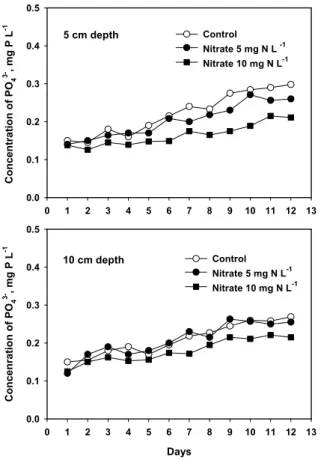
Effects of NO 3 - introduced through irrigation water on the release of PO 4 3- in anoxic soil layer are shown in Fig. 6, and the concentrations of PO 4 3- were slowly and continuously increased during the experiment. At 5 cm depth beneath the soil surface, concentrations of PO 4 3- in the treatment of irrigation water containing 5 mg N L -1 of NO 3 - were relatively lower than the concentrations found in the treatment of no NO 3 - in irrigation water. And in the treatment of irrigation water containing 10 mg N L -1 of NO 3 - , the concentrations of PO 4 3- were further lower, and during the last 1 week period of experiment the concentration difference was about 0.1 mg P L -1 comparing to the treatment of no NO 3 - irrigation water. At 10 cm depth beneath the soil surface, the concentrations of PO 4 3- in soil solution found in the treatments of no NO 3 -
application and 5 mg N L -1 NO 3 - application were not
0 1 2 3 4 5 6 7 8 9 10 11 12 13
Co nce n ra ti on o f F e
2+, m g L
-10 1 2 3 4 5 6
Control Nitrate 5 mg N L
-1Nitrate 10 mg N L
-15 cm depth
Days
0 1 2 3 4 5 6 7 8 9 10 11 12 13
C onc ent rat io n of Fe
2+, m g L
-10 1 2 3 4 5 6
Control Nitrate 5 mg N L
-1Nitrate 10 mg N L
-110 cm depth
Fig. 5. Changes of soil solution concentrations of Fe 2+
at 5 and 10 cm depth beneath the soil surface in the applications of irrigation water containing NO 3 -
. The shown data are average values from duplicate determina- tions.
0 1 2 3 4 5 6 7 8 9 10 11 12 13
Concentrat ion o f PO
43-, m g P L
-10.0 0.1 0.2 0.3 0.4 0.5
Control Nitrate 5 mg N L
-1Nitrate 10 mg N L
-15 cm depth
Days
0 1 2 3 4 5 6 7 8 9 10 11 12 13
C o ncenratio n of PO
43-, m g P L
-10.0 0.1 0.2 0.3 0.4 0.5
Control Nitrate 5 mg N L
-1Nitrate 10 mg N L
-110 cm depth
Fig. 6. Changes of soil solution concentrations of PO 4 3-
at 5 and 10 cm depth beneath the soil surface in the applications of irrigation water containing NO 3 -
. The
shown data are average values from duplicate determina-
tions.
different. But, in the treatment of 10 mg N L -1 of NO 3 - , concentrations of PO 4 3- in soil solution were considerably lower than those found in the other two treatments. These results coincided with the impaired Fe reduction caused by NO 3 - introduced through irrigation water (Fig. 5).
The processes involved in the inhibition of soil Fe reduction and PO 4 3- solubilization by NO 3 - are complicated as presented in Fig. 1, and not completely understood yet. However, a continuous flow of NO 3 - -rich irrigation water through the soil layer can lead to a higher redox potential in the soil than the same water without NO 3 - . And addition of NO 3 - , an energetically more favorable electron acceptor than Fe, to soil under anoxic conditions prevents a release of PO 4 3- by limiting Fe reduction from Fe-PO 4 3- complexes and by anoxic oxidation of Fe 2+ (Straub et al., 2004; Matocha and Coyne, 2007). If NO 3 - concentrations are high, SO 4 2- reduction and Fe immobilization with FeS x formation are also impaired and mobilization of PO 4 3- from iron-phosphate complexes is prevented (Lucassen et al., 2004). Although it cannot be explained in detail, inhibition of Fe reduction by NO 3 - would be one of the main mechanisms which control PO 4 3- mobilization from iron-phosphate com- plexes in flooded anoxic soil conditions including rice paddy. When NO 3 - concentration exceeded about 0.5 mg N L -1 in the water of shallow and very productive lakes, usually no PO 4 3- release from the sediment took place (Anderson, 1982).
Though a considerable reducing condition is developed in flooded anoxic rice paddy soils, if NO 3 - is continuously added through irrigation water and fertilizations during the growth period, the solubilization of PO 4 3- in root zone soil generally found in rice paddy fields after flooding would be limited. This phenomenon could be a mechanism which can reduce PO 4 3- loss through leaching and other ways to the water systems around wet land systems including rice paddies (Smolders and Roelofs, 1993; Lucassen et al., 2004; Surridge et al., 2007).
However, considering the rice roots are distributed within 10 cm depth beneath the soil surface, availability of P for rice plants would be greatly limited by addition of NO 3 - in paddy fields. Irrigation with water containing N more than 5 mg L -1 can cause various damages on rice plants with excess N uptake (Hidaka, 1993). Therefore, introduction of excessive amount of NO 3 - in rice paddy through irrigation in addition to fertilization should be restricted in order to secure the availability of N and P during the
growth period.
References
Anderson, J.M. 1982. Effect of nitrate concentration in lake water on phosphate release from the sediment. Water Res.
16:1119-1126.
Chung, J.B. 2009. Effect of nitrate on iron reduction and phosphorus release in flooded paddy soil. Korean J. Environ.
Agric. 28:165-170.
Chung, J.B., B.J. Kim, and J.K. Kim. 1997. Water pollution in some agricultural areas along Nakdong river. Korean J.
Environ. Agric. 16:187-192.
Chung, J.B., B.J. Kim, J.K. Kim, and M.K. Kim. 1998. Water quality of streams in some agricultural areas of different agricultural practices along Nakdong river basin. Korean J.
Environ. Agric. 17:140-144.
Hidaka, S. 1993. Multi-utilization of water and irrigation water quality. Jpn. J. Soil Sci. Plant Nutr. 64:465-473.
Kasuya, M. 1999. Denitrification of nitrate introduced by groundwater irrigation in rice paddy soil. Jpn. J. Soil Sci.
Plant Nutr. 70:123-131.
Lucassen, E.C.H.E.T., A.J.P. Smolders, A.L. van der Salm, and J. G. M. Roelofs. 2004. High groundwater nitrate concentrations inhibit eutrophication of sulphate-rich freshwater wetlands. Biogeochemistry 67:249-267.
Matocha, C.J., and M.S. Coyne. 2007. Short-term response of soil iron to nitrate addition. Soil Sci. Soc. Am. J. 71:108-117.
McBride, M.B. 1994. Environmental chemistry of soils. Oxford University Press, New York, USA.
Miller, W.P., and D.M. Miller. 1987. A micro-pipette method for soil mechanical analysis. Commun. Soil Sci. Plant Anal.
18:1-15.
Ministry of Environment. 2009. Environmental statistics (http://stat.me.go.kr/nesis/index.jsp). Ministry of Environment, Republic of Korea, Gwacheon, Korea.
Murray, T.E. 1995. The corelation between iron sulfide precipitation and hypolimnetic phosphorus accumulation during one summer in a softwater lake. Can. J. Fish. Aquat.
Sci. 52:1190-1194.
Nelson, D.W., and L.E. Sommers. 1982. Total carbon, organic carbon, and organic matter. p. 539-579. In A. L. Page et al.
(ed.) Methods of soil analysis. Part 2: Chemical and microbiological properties. SSSA, Madison, WI, USA.
Olson, R.V., and R. Ellis, Jr. 1982. Iron. p. 301-312. In A. L.
Page et al. (ed.) Methods of soil analysis. Part 2: Chemical and microbiological properties. SSSA, Madison, WI, USA.
Ponnamperuma, F. N. 1972. The chemistry of submerged soils.
Adv. Agron. 24:29-96.
RDA. 1988. Methods of soil chemical analysis. Rural Development Administration, Suwon, Korea.
Roden, E.E., and J.W. Edmonds. 1997. Phosphate mobilization in iron-rich anaerobic sediments: microbial Fe(III) oxide reduction versus iron-sulfide formation. Arch. Hydrobiol.
139:347-378.
Sallade, Y.E., and J.T. Sims. 1997. Phosphorus transformations in the sediments of Delaware's agricultural drainageways: II.
Effect of reducing conditions on phosphorus release. J.
Environ. Qual. 26:1579-1588.
Sanyal, S.K., and S.K. De Datta. 1991. Chemistry of phosphorus transformations in soil. Adv. Soil Sci. 16:1-120.
Schlesinger, W.H. 1997. Biogeochemistry: An analysis of global change. 2nd ed. Elsevier Academic Press, Amsterdam, Netherlands.
Smolders, A., and J.G.M. Roelofs. 1993. Sulphate-mediated iron limitation and eutrophication in aquatic ecosystems. Aquat.
Bot. 46:247-253.
Sposito, G. 1989. The chemistry of soils. Oxford University Press, New York, USA.
Straub, K.L., W.A. Schonhuber, D.E.E. Buchholz-Cleven, and B. Schink. 2004. Diversity of ferrous iron-oxidizing,
nitrate-reducing bacteria and their involvement in oxygen- independent iron cycling. Geomicrobiol. J. 21:371-378.
Stucki, J.W., and W.L. Anderson. 1981. The quantitative assay of minerals for Fe
2+and Fe
3+using 1,10-phenanthroline : I.
Sources of variability. Soil Sci. Soc. Am. J. 45:633-637.
Surridge, B.W.J., A.L. Heathwaite, and A.J. Baird. 2007. The release of phosphorus to pore water and surface water from river riparian sediments. J. Environ. Qual. 36:1534-1544.
Weber, K.A., J. Pollock, K.A. Cole, S.M. O'Connor, L.A.
Achenbach, and J.D. Coates. 2006. Anaerobic nitrate- ependent iron(II) bio-oxidation by a novel lithoautotrophic betaproteobacterium, strain 2002. Appl. Environ. Microbiol.
72:686-694.
Young, E.O., and D.S. Ross. 2001. Phosphate release from seasonally flooded soils: A laboratory microcosm study. J.
Environ. Qual. 30:91-101.
관개용수 중의 질산 이온이 논토양의 철 환원과 인 용출에 미치는 영향