• 검색 결과가 없습니다.

Financial Literacy, Network Competency, and SMEs Financial Performance: The Moderating Role of Market Orientation

N/A
N/A
Protected

Academic year: 2021

Share "Financial Literacy, Network Competency, and SMEs Financial Performance: The Moderating Role of Market Orientation"

Copied!
12
0
0

로드 중.... (전체 텍스트 보기)

전체 글

(1)

Print ISSN: 2288-4637 / Online ISSN 2288-4645 doi:10.13106/jafeb.2021.vol8.no10.0341

Financial Literacy, Network Competency, and SMEs Financial Performance: The Moderating Role of Market Orientation

Hazem ALI

1

, Yanchao LI

2

Received: June 30, 2021 Revised: September 09, 2021 Accepted: September 17, 2021

Abstract

Research on SMEs highlights their limited resources and the influential role of SMEs’ owners/managers. In this respect, scholars stressed the importance of different capabilities possessed by owners/managers of SMEs in developing a competitive position and enhancing firm performance. This study intended to examine the direct influence of two fundamental capabilities: financial literacy and networking competency possessed by owners/managers of SMEs in China and the United Arab Emirate (UAE) on SMEs’ financial performance.

In addition, this research tested the moderating impact of market orientation. The quantitative research method was employed by administering structured questionnaires. A total of 150 and 120 questionnaires were collected from owners/managers of SMEs in China and UAE. Structural equation modeling was used for data analysis using Smart-Pls. Findings revealed that SMEs’ financial performance was positively related to maintaining financial literacy and networking competency in both samples. Further, market orientation was found to strengthen the positive impact of financial literacy and networking competency on SMEs’ financial performance in China. However, market orientation had a significant moderating impact only on the relationship between networking and the financial performance of SMEs in the UAE. This paper ends with providing a set of concluding remarks, recommendations, and potential areas of further research.

Keywords: Financial Literacy, Network Competency, Financial Performance, Market Orientation, SMEs JEL Classification Code: M10, M16, L25, O30

on SMEs’ performance highlighted a set of managerial capabilities such as managerial skills and their significant impact on the efficient utilization of organizational resources and firm performance (Ahmad & Ahmad, 2021), digital literacy (Sariwulan et al., 2020), and innovation capabilities (Ali et al., 2020).

Owners/managers of SMEs need to possess a set of capabilities to survive and establish a competitive position in today’s uncertain business environment. Financial literacy is advocated as an essential capability with a positive impact on firm performance (Eniola & Entebang, 2017), and essential for undertaking business decisions and achieving a firm’s success (Adomako & Danso, 2014).

In addition, SMEs need to possess networking capabi- lities to create value through generating and accessing a variety of resources, such as new knowledge (Hoang &

Yi, 2015). SMEs need to constantly build and adjust their networks to remain competitive and adapt to continuous market changes (Eberhard & Craig, 2013). Therefore, this research builds on the assumption that managers of SMEs who maintain distinctive financial literacy and networking competencies would maintain a favorable financial performance. Further, this study argues that the presence of market orientation would strengthen the impact of financial

1

First Author. Postdoctoral Researcher, School of Business Administration, Zhejiang Gongshang University, China [Postal Address: No.18, Xuezheng Str., Xiasha University Town, Hangzhou 310018, China] Email: [email protected]

2

Corresponding Author. School of Economics, Zhejiang Gongshang University, China [Postal Address: No.18, Xuezheng Str., Xiasha University Town, Hangzhou 310018, China]

Email: [email protected]

© Copyright: The Author(s)

This is an Open Access article distributed under the terms of the Creative Commons Attribution Non-Commercial License (https://creativecommons.org/licenses/by-nc/4.0/) which permits unrestricted non-commercial use, distribution, and reproduction in any medium, provided the original work is properly cited.
1. Introduction

SMEs are often considered the engine of global growth, job creation, and human development, particularly in developing nations (Ombongi & Long, 2018; Tuffour et al., 2020). Despite their influential role in economic development, research showed that SMEs are underperforming and maintain limited market share (Ye & Kulathunga, 2019;

Omiunu, 2019).

Recognizing the constant change in the business

environment and limited resources of SMEs, research

(2)

literacy and networking competency on SMEs’ financial performance.

Extant literature showed that market orientation is positively linked to SMEs’ performance (Hassen &

Singh, 2020; Ledwith & O’Dwyer, 2009), and the firm’s long-term success and survival (Vieira, 2010). SMEs in developing economies should adopt the market orientation idea to cope with the demands of a dynamic business environment (Sriayudha et al., 2020).

This research builds on the assumption that owners/

managers are the dominant decision-makers and responsible for the survival and growth of SMEs. This indicates that SMEs are dominated and controlled by one individual which is different from larger companies that are controlled and run by a management team. In this regard, the current study intends to examine the impact of possessing networking competencies and financial literacy on influencing SMEs’

financial performance as well as the potential moderating impact of market orientation on this relationship.

The remaining of this paper is divided into three sections.

First, a review of literature and hypotheses development.

Second, explaining research method, data collection procedure, and data analysis techniques. Third, reporting findings and providing a discussion of current findings in relation to existing literature. Finally, the concluding section draws a set of concluding remarks, identifies research limitations, proposes a set of recommendations, and determines areas of further research.

2. Literature Review and Hypotheses Development

2.1. Financial Literacy and SMEs’

Financial Performance

Several studies indicated the positive influence of financial literacy and SMEs’ performance. (Agyapong

& Attram, 2019; Agyei, 2018; Huston, 2010; Lusardi

& Mitchell, 2014; Tuffour et al., 2020). Based on data collected from 319 chief financial officers (CFOs) in Sri Lankan SMEs, Kulathunga et al. (2020) found that financial literacy improves SMEs’ performance and resource management. By expanding organizations’

knowledge base, financial literacy would enable and boost the performance of SMEs in this complex business climate (Lusardi & Mitchell, 2014).

The majority of financial blunders are caused by a lack of financial literacy (Lusardi & Mitchell, 2014; Bunyaminu et al., 2019). Huston (2010) emphasized the importance of increased financial literacy in coping with ongoing economic shifts. Budgeting literacy, debt management literacy, accounting literacy, and saving literacy all have a positive and significant impact on the financial performance of medium-sized businesses (Jemal, 2019).

Financial literacy boosts business performance, particularly when resources are flexible and entrepreneurs have easy access to capital (Adomako & Danso, 2014). Financial literacy represents a key factor in managerial decision- making as well as strategic, long-term financial planning (Allgood & Walstad, 2016).

Financial literacy has a significant favorable influence on financial access and firm performance (Mabula &

Ping, 2018). Financial literacy may assist business owners and managers to be more innovative in their use of credit and debt, budget monitoring, timely raw material acquisition, production, fixed and variable costs, and stock management (Reich & Berman 2015). Tuffour et al. (2020) indicated that the three dimensions of financial literacy:

awareness, attitude, and knowledge have a considerable favorable impact on both financial and non-financial outcomes. Overall, we may argue that SMEs with a strong financial literacy can achieve higher financial performance.

Therefore, the first research hypothesis is set as follows:

H1: Manager’s financial literacy has a positive impact on SMEs’ Financial Performance.

2.2. Networking Competency and SMEs’

Financial Performance

The research emphasized building networks, especially for SMEs. Networking competency is defined as a firm’s ability to build, manage, and deal with interactions with different types of relationships such as suppliers, customers, and other organizations (Ritter et al., 2002). Several studies established the positive relationship between network competency and firms’ financial performance (Chen et al., 2007; Lechner & Gudmundsson, 2016; Sajilan & Tehseen, 2019; Semrau & Sigmund, 2012).

Networking competency allows businesses to stay competitive in the market (Parida et al., 2016), and enhance new market entry (Nuryakin & Ardyan, 2018). Zacca et al.

(2015) found that networking competency had a significant impact on SMEs’ performance through knowledge creation and entrepreneurial orientation in UAE.

Strong networks allow entrepreneurs and their businesses to collect market intelligence and problem-solving ideas, as well as learn new skills and gain moral and technical support (Messersmith & Wales, 2011). However, Kheng and Minai (2015) indicated that networking had an insignificant impact on the performance and success of Malaysian Chinese SMEs. Accordingly, this research predicts a positive relationship between networking competency and SMEs’

financial performance and set the second research hypothesis as follows:

H2: SMEs’ Financial Performance is positively linked

with manager’s networking competency.

(3)

2.3. Moderating Role of Market Orientation

SMEs’ owners/managers need to maintain sufficient awareness of market characteristics and changes. Morgan et al. (2009) argued that market orientation should be used in conjunction with other business competencies to ensure better firm performance. Market orientation can help a company better relate its resources and skills to its consumers’ requirements. SMEs with a high level of market orientation maintain better knowledge and adaptation to emerging market trends (Raju et al., 2011;

Menguc & Auh, 2006). Further, market orientation allows SMEs to promote productivity increases as well as more communication, collaboration, and coordination amongst inter-functional areas with fewer distances between personnel to give superior customer value (Liao et al., 2011).

Various studied employed market orientation as a moderating variable (Hernández-Linares et al., 2018; Zhou

& Li, 2010; Smirnova et al., 2011). For instance, Hernández- Linares et al. (2018) underlined that market orientation moderated the relationship between sensing and learning capabilities and business performance. Similarly, Cacciolatti and Lee (2016) indicated that market orientation has a significant moderating effect on the relationship between marketing dynamic capabilities and company performance.

Strong customer orientation encourages businesses to consistently notice and respond to their customers’

requirements and expectations, as well as to adapt and improve the organization’s performance (Kirca et al., 2005).

Furthermore, market orientation enables businesses to absorb the shocks posed by dynamic and complicated business environments while also taking advantage of new business

prospects (Buli, 2017). Market orientation dimensions (customer, competitor, and inter-functional orientation) are positively related to customers’ satisfaction, responding effectively to competitors’ actions and enhancing long-term profitability (Attia, 2013).

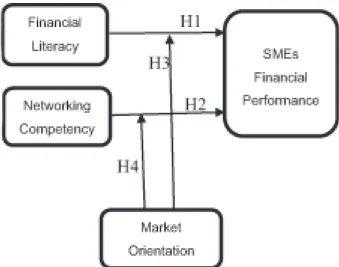
Given that previous research has confirmed the positive moderator effect of market orientation on the marketing capabilities–performance relationship (Cacciolatti & Lee, 2016; Morgan et al., 2009), we expect market orientation to have an enhancing role on the financial literacy and networking competency on– SMEs’ financial performance link. Accordingly, the following two hypotheses were states as follows:

H3: Manager’s market orientation strengthens the relationship between manager’s financial literacy and SMEs’

Financial Performance.

H4: Manager’s market orientation strengthens the relationship between manager’s networking competency and SMEs’ Financial Performance.

Figure 1 explains the proposed conceptual framework.

This study developed and tested two hypotheses to examine the direct effect of financial literacy and networking competency on SMEs’ financial performance in China and the UAE. Further, this research examines the potential moderating impact of market orientation.

3. Data and Methodology 3.1. Method and Data Collection

This research employs a quantitative research method and used a survey questionnaire to collect data from owners/

managers of SMEs in China and UAE. The questionnaire was developed in English and then translated into Chinese.

This research employed a non-probability convenience sampling due to the coronavirus pandemic, and due to time and resources limitations. Convenience samples are very common and indeed are more prominent than samples based on probability sampling.

This study uses a survey questionnaire to collect primary data from managers of SMEs pertaining to their financial literacy and networking competency and their impact on SMEs’ financial performance using a 5 Likert scale to evaluate respondents’ answers from 1 “strongly disagree” to 5 “strongly agree”. The survey questionnaire was assessed by a panel of two organizational behavior professors and two PhD students in business and management fields. They recommended minor changes to some items to improve the clarity and directness of the survey. The final version of the English questionnaire was developed based on the panel’s recommendation and translated into Chinese (Mandarin).

Figure 1: Proposed Conceptual Framework

(4)

A reverse independent translation from Chinese to English was performed to undertake minor wording modification and to ensure consistency.

3.2. Variables Measurement

Financial literacy was measured using Okello et al.

(2017) scale which involved 13 items. Networking competency was assessed using five items based on Parida et al. (2016). The moderating variable, market orientation was measured using Hernández-Linares et al. (2018) which includes five items covering organizational orientation toward understanding customer needs and satisfaction.

Finally, the dependent variable, financial performance of SMEs was assessed using Tuffour et al. (2020) three fundamental financial measures: sales, revenues, and profits.

4. Results and Discussion

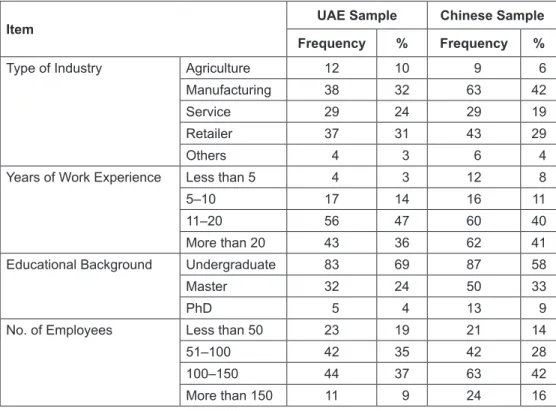
Table 1 lists the details of respondents: SME age group, size, type of industry, and managers’ years of work experience. Most Chinese and UAE SMEs are engaged in manufacturing (42% and 32%) and retailing (29% and 31%). Approximately 40% of Chinese SMEs managers had 11–20 years of work experience and 41% had more

than 20 years of work experience. In the UAE context, 47% of managers had 11–20 years of work experience and 36% had more than 20 years of work experience. For educational qualifications, 58% of Chinese managers had undergraduate degrees, and 33% hold master’s degree while 69% of UAE managers have an undergraduate degree and 27% are holding master’s degree. For firm size, 42% of Chinese SMEs have 100–150 employees and 28% have 51–100 employees, while 37% and 35% of UAE have 100–150 and 51–100 employees respectively.

4.1. Assessment of Measurement Model

This study employs Structural Equation Modeling (SEM) using Smart-Pls software. Reliability was assessed using Cronbach alpha and composite reliability. Validity was assessed based on convergent and discriminant validity measures using factor loading and correlation among study variables, as well as the average variance extraction (AVE). In reporting the results of the proposed model, the researchers used the estimate path coefficient, R square (R

2

), t statistics, and p-value to explain the direction and strength of the relationship among the study variables.

The proposed research model and research hypotheses were tested using Partial Least Squares (PLS) and Table 1: SMEs’ Profile

Item UAE Sample Chinese Sample

Frequency % Frequency %

Type of Industry Agriculture 12 10 9 6

Manufacturing 38 32 63 42

Service 29 24 29 19

Retailer 37 31 43 29

Others 4 3 6 4

Years of Work Experience Less than 5 4 3 12 8

5–10 17 14 16 11

11–20 56 47 60 40

More than 20 43 36 62 41

Educational Background Undergraduate 83 69 87 58

Master 32 24 50 33

PhD 5 4 13 9

No. of Employees Less than 50 23 19 21 14

51–100 42 35 42 28

100–150 44 37 63 42

More than 150 11 9 24 16

(5)

employing Smart-PLS 3.2.3 software. PLS-SEM has gained remarkable attention and is commonly used to test cause- effect relationships due to its simplicity and effectiveness to estimate paths for complex models such as mediating, moderating, and hierarchical models (Hair et al., 2016).

There are four steps used to predict and evaluate the model parameters including identification of construct composite scores, correcting construct attenuation, estimating parameters, and bootstrapping (Henseler et al., 2016).

The evaluation of the measurement model was performed through testing hypotheses based on the significance level of regression analysis.

Table 2 reports the descriptive statistics, composite reliability (CR), and average variance extracted (AVE) for the latent variables. Researchers need to ensure the reliability and validity of constructs before embarking on data analysis.

Guided by the use of the SEM method through Smart-Pls, this research assessed construct reliability based on Cronbach alpha, and composite reliability values of 0.7 or higher are considered reliable as indicated by Hair et al. (2016).

In assessing construct validity, this study used convergent and discriminant validity as recommended.

The convergent validity is recognized when each variable reported average variance extraction (AVE) above 0.5 while discriminant validity is recognized when the correlation of a factor is higher than with any other construct on its scale (Fornell & Larcker, 1981; Hair et al., 2016). Tables 2 and 3 report the reliability and validity of constructs in Chinese and UAE samples.

The reported research findings showed that all constructs had Cronbach’s alpha values above 0.7. With regard to the construct validity, the reported AVE and composite reliability are higher than 0.7 as well.

The internal consistency reliability (CR) showed satisfactory values ranging between 0.70 and 0.90.

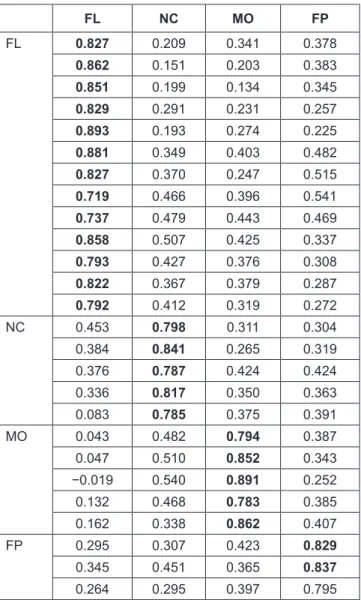
Discriminant validity was tested using Fornell and Larker’s criterion to ensure that one construct does not correlate with other constructs. Discriminant validity is achieved when the reported construct’s square root (average variance extracted (AVE) is greater than its bi-variate correlations with other constructs. The reported square roots of AVE values were higher than their respective inter-construct correlations which indicates that discriminant validity is confirmed. Tables 2 and 3 show the results pertaining to discriminant validity for China and UAE valid samples. It is evident that the correlation of a factor is higher than with any other construct on its scale and all factors had higher loadings than their loaded than corresponding factors on the same scale.

For the further establishment of discriminant validity, this study used the Heterotrait-Monotrait Ratio of Correlations (HTMT). According to Henseler et al. (2016), this criterion assumes that when two constructs’ indicators have an HTMT value less than 1, they are different from each other because their true correlation is different from 1 and HTMT values below 90 are acceptable. It is evident that discriminant validity is established as summarized in Tables 4 and 5.

Table 2: Descriptive Statistics, Reliability and Validity of Constructs (China)

Construct Mean Std. Dev CA CR AVE FL NC MO FP

FL 4.11 1.138 0.839 0.873 0.751* 0.82

NC 3.98 0.098 0.858 0.887 0.736 0. 59 0.81

MO 4.29 1.074 0.821 0.857 0.763 0.39 0.76 0.087

FP 4.38 1.142 0.875 0.901 0.741 0.12 0.03 0.06 0.81

FL: financial literacy; NC: networking competencies; MO: market orientation; and FP: financial performance.

*The diagonal elements are the square root of AVE values for each construct.

Table 3: Descriptive Statistics, Reliability and Validity of Constructs (UAE)

Construct Mean Std. Dev CA CR AVE FL NC MO FP

FL 4.08 1.085 0.857 0.886 0.675 0.73*

NC 4.22 1.132 0.858 0.887 0.736 0.51 0.80

MO 3.87 1.148 0.871 0.903 0.741 0.16 0.07 0.78

FP 4.29 0.097 0.902 0.921 0.761 0.38 0.03 0.17 0.82

FL: financial literacy; NC: networking competencies; MO: market orientation; and FP: financial performance.

* The diagonal elements are the square root of AVE values for each construct.

(6)

Table 4: Measurement Model (China Sample)

FL NC MO FP

FL 0.863 0.211 0.332 0.389

0.888 0.147 0.015 0.381

0.850 0.169 0.036 0.347

0.821 0.291 0.330 0.258

0.892 0.193 0.372 0.224

0.815 0.349 0.400 0.482

0.824 0.370 0.342 0.510

0.708 0.466 0.496 0.540

0.736 0.479 0.542 0.468

0.876 0.507 0.427 0.338

0.784 0.427 0.476 0.307

0.813 0.367 0.379 0.288

0.783 0.284 0.319 0.337

NC 0.455 0.792 0.311 0.308

0.383 0.852 0.265 0.312

0.386 0.735 0.424 0.427

0.306 0.807 0.350 0.367

0.084 0.719 0.378 0.392

MO 0.042 0.482 0.795 0.384

0.042 0.510 0.867 0.344

0.083 0.540 0.897 0.253

0.119 0.468 0.885 0.395

0.161 0.338 0.764 0.406

FP 0.296 0.307 0.427 0.812

0.344 0.450 0.367 0.826

0.263 0.292 0.392 0.804

FL: financial literacy ; NC: networking competencies ; MO: market orientation ; and FP: financial performance.

Table 5: Measurement Model (UAE Sample)

FL NC MO FP

FL 0.827 0.209 0.341 0.378

0.862 0.151 0.203 0.383

0.851 0.199 0.134 0.345

0.829 0.291 0.231 0.257

0.893 0.193 0.274 0.225

0.881 0.349 0.403 0.482

0.827 0.370 0.247 0.515

0.719 0.466 0.396 0.541

0.737 0.479 0.443 0.469

0.858 0.507 0.425 0.337

0.793 0.427 0.376 0.308

0.822 0.367 0.379 0.287

0.792 0.412 0.319 0.272

NC 0.453 0.798 0.311 0.304

0.384 0.841 0.265 0.319

0.376 0.787 0.424 0.424

0.336 0.817 0.350 0.363

0.083 0.785 0.375 0.391

MO 0.043 0.482 0.794 0.387

0.047 0.510 0.852 0.343

−0.019 0.540 0.891 0.252

0.132 0.468 0.783 0.385

0.162 0.338 0.862 0.407

FP 0.295 0.307 0.423 0.829

0.345 0.451 0.365 0.837

0.264 0.295 0.397 0.795

FL: financial literacy ; NC: networking competencies ; MO: market orientation ; and FP: financial performance.

Overall, the assessment of the structural model ensured that constructs meet reliability and validity standards, and the issue of common method bias is not a major concern.

The subsequent section reported the results of the structural model and hypotheses testing based on regression weights using the coefficient of determination (R

2

), path coefficient (estimate), T statistics, and P values.

4.2. Results of the Structural Model

The testing of the research model followed two stages bootstrapping: the independency view model and the dual processing view model. The independence view model reported the direct impact of financial literacy and

networking competency on SMEs’ financial performance without the inclusion of market orientation as a moderator.

On the other hand, the dual processing model reported the regression findings with the presence of the moderator (market orientation). Path coefficient values were obtained using bootstrapping. Based on reported R

2

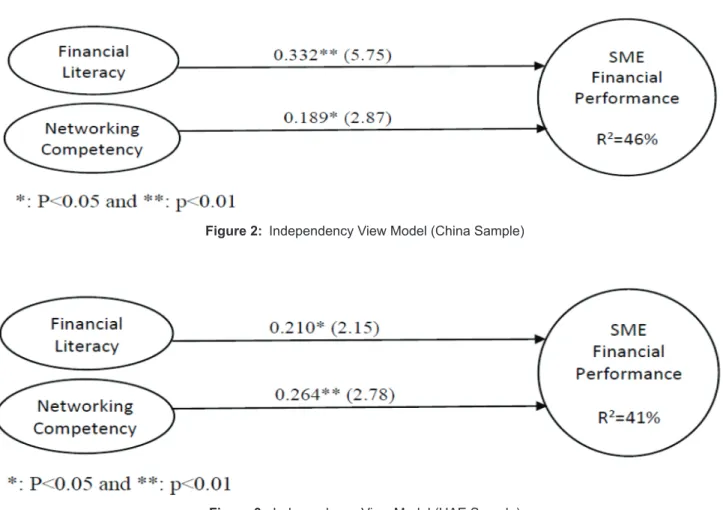
in the Chinese SMEs’ sample, it was revealed that approximately 46%

in the Chinese context and 41% in the UAE context of SME financial performance variation can be explained by financial literacy and networking competencies as shown in Figures 2 and 3.

The first research hypothesis aimed at testing the

association between financial literacy and SMEs’ financial

performance in Chinese and UAE contexts. For the China

(7)

Figure 2: Independency View Model (China Sample)

Figure 3: Independency View Model (UAE Sample)

sample, research findings revealed that path coefficient value (0.332), t-value was (5.753), and p-value (0.01).

For the UAE sample, the results of the study reported a path coefficient value of (0.210), t value (2.152), and p-value (0.05). Accordingly, the first hypothesis is supported in both samples and this research concluded that manager’s financial literacy has a significant impact on SMEs’ financial performance.

The second research hypothesis examined the relationship between networking competencies and SMEs’

financial performance. For the China sample, research findings revealed that path coefficient value of (0.189), t-value (2.871), and p-value (0.01). For the UAE sample, the results of the study reported a path coefficient value of (0.264), t value (2.783), and p-value (0.05). Accordingly, the second hypothesis is accepted in both samples and this research concluded that networking competencies have a significant positive impact on SMEs’ financial performance.

To identify the moderating impact of market orientation, this research applied the case-wide multiplication to measure

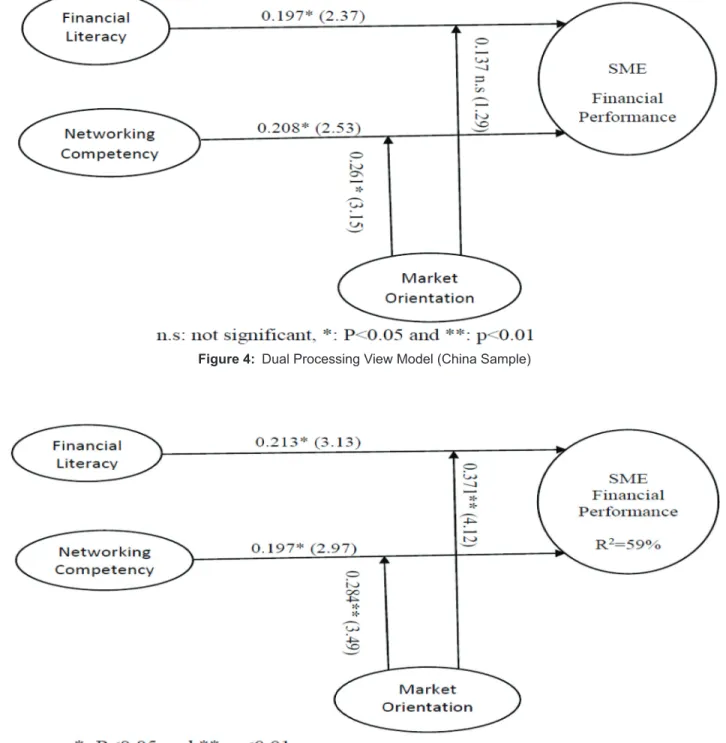
the interaction score values of market orientation and financial literacy; and market orientation and networking competencies and inserted it in Smart-PLS as shown in Figures 4 and 5. The moderating analysis revealed that market orientation has a positive significant impact on the relationship between financial literacy and SMEs’ financial performance (β = 0.371, t = 4.12, p < 0.01).

The inclusion of market orientation as a moderator has resulted in increasing the value of the path coefficient from 0.213 to 0.371 and the relationship between financial literacy and SME financial performance remained significant.

This leads to accepting hypothesis 3 in the Chinese context and concluding that the relationship between financial literacy and SMEs’ financial performance is strengthened by market orientation.

Similarly, the regression findings of market orientation

as a moderator showed that it has a positive significant

impact on the relationship between networking competency

and SMEs’ financial performance (β = 0.284, t = 3.49,

p < 0.01). The presence of market orientation as a moderator

has resulted in increasing the value of path coefficient from

(8)

0.197 to 0.284 and the relationship between networking competency and SME financial performance remained significant. This leads to accepting hypothesis 4 in the Chinese valid sample and concluding that the relationship between networking competency and SMEs’ financial

performance is strengthened by market orientation. In the UAE context, the moderating analysis showed that market orientation has an insignificant moderating impact on the relationship between financial literacy and SMEs’ financial performance (β = 0.137, t = 1.29, p < .05).

Figure 4: Dual Processing View Model (China Sample)

Figure 5: Dual Processing View Model (UAE Sample)

(9)

The inclusion of market orientation as a moderator has led to a sharp decrease in the value of path coefficient from 0.197 to 0.137, however, the relationship between financial literacy and SME financial performance is significant. This indicated that the relationship between financial literacy and SMEs’ financial performance is not influenced by the presence of market orientation and thus hypothesis 3 is rejected in the UAE context. On the other hand, market orientation was found to have a significant positive impact on the relationship between networking competency and SMEs’ financial performance (β = 0.261, t = 3.15, p <

0.05). The existence of market orientation has resulted in increasing the value of path coefficient from 0.208 to 0.261, and the relationship between networking competency and SME financial performance remained significant.

Accordingly, hypothesis 4 is accepted in the UAE context and it is concluded that networking competency and SMEs financial performance are enhanced by the presence of market orientation. It was evident that the presence of market orientation has enhanced the positive impact of financial literacy and networking competencies on SMEs’

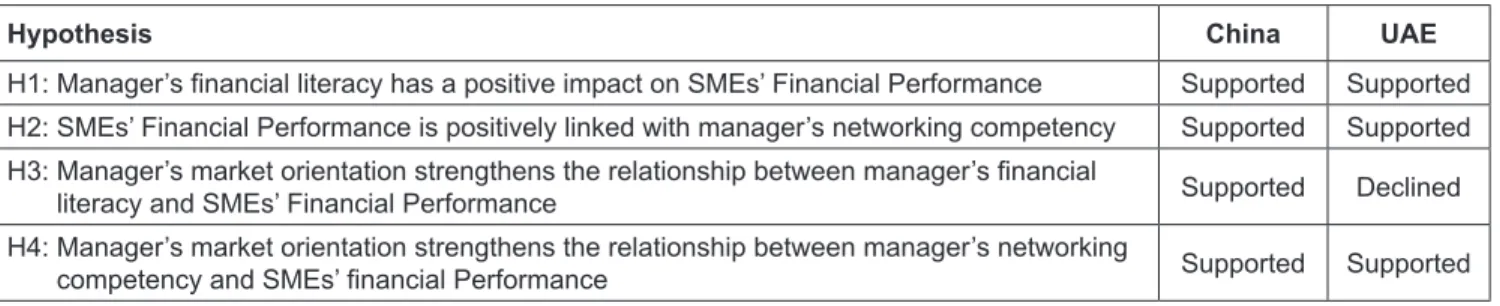
financial performance in Chinese and UAE contexts. Table 6 summarizes the results of the four hypotheses testing for both samples.

Pertaining to examining the relationship between financial literacy and SMEs financial performance of SMEs in China and UAE, a positive significant association was reported.

Such findings are compatible with Agyapong and Attram (2019) who indicated that financial literacy and a firm’s financial performance are closely related and recommended policymakers to create a program and platform aimed at improving the financial literacy of these owner-managers to help their businesses perform better.

Similarly, Kulathunga et al. (2020), Agyei (2018), and Lusardi and Mitchell (2014) showed that financial literacy improves SMEs’ performance and resource management.

Further, Jemal (2019) underlined that financial literacy skills such as debt management, budgeting, saving, and accounting have a favorable and significant impact on the financial performance of medium-sized businesses. Moreover, Tuffour et al. (2020) argued that firm financial performance is positively inked with financial literacy.

Research findings revealed a positive significant relationship between networking competencies and SMEs’ financial performance. This finding is consistent with Tehseen et al. (2018) who reported that networking competencies affect Chinese and Indian SMEs’ performance in the Malaysian context. This triggers businesses to keep developing close networks to diminish risks through enhancing their resources and knowledge (Salamzadeh et al., 2016). Further, various studies revealed a positive association between networking competencies and SMEs’

financial performance (Sajilan & Tehseen, 2019; Kheng &

Minai, 2015; Nuryakin & Ardyan, 2018).

Further, the research findings revealed a positive significant impact of market orientation on the relationship between financial literacy and SMEs’ financial performance in the Chinese sample only, whereas market orientation was found to strengthen the association between networking capabilities and SMEs’ financial performance in both Chinese and UAE samples. These findings are similar to the study undertaken by Morgan et al. (2009) who argued that market orientation should be used in conjunction with other business competencies to achieve greater company performance. In addition, market orientation allows SMEs to acquire better knowledge (Raju et al., 2011), and to exchange different ideas that improve knowledge-related activities (Menguc & Auh, 2006). Prior research advocated the positive moderator effect of market orientation on the marketing capabilities–performance link (Cacciolatti &

Lee, 2016; Morgan et al., 2009). This study argued that market orientation has the potential to enhance the positive impact of financial literacy and networking competencies on SMEs’ financial performance.

The current findings of this research are compatible with Cacciolatti and Lee (2016) who reported a significant moderating effect of market orientation on the relationship between marketing dynamic capabilities and company performance. Further, Nasution et al. (2011) argued that some competencies are also seen to be preceded by market orientation. Managers/owners who are aware of the characteristics and trends of their relevant markets, would make successful financial decisions and build qualified networks to enhance their performance. Overall, the

Table 6: Summary of Hypotheses Testing (both Samples)

Hypothesis China UAE

H1: Manager’s financial literacy has a positive impact on SMEs’ Financial Performance Supported Supported H2: SMEs’ Financial Performance is positively linked with manager’s networking competency Supported Supported H3: Manager’s market orientation strengthens the relationship between manager’s financial

literacy and SMEs’ Financial Performance Supported Declined

H4: Manager’s market orientation strengthens the relationship between manager’s networking

competency and SMEs’ financial Performance Supported Supported

(10)

proposed research model has extended existing literature on SMEs’ financial performance in relation to managers’

financial literacy and networking competencies with emphasis on the moderating impact of market orientation.

5. Conclusion and Recommendations

This research examined the effect of financial literacy and networking competency on SMEs’ financial performance in China and UAE with emphasis on the moderating role of market orientation. Findings showed that SMEs’ financial performance was positively related to maintaining financial literacy and networking competency in both samples. Further, market orientation was found to strengthen the positive impact of financial literacy and networking competency on SMEs’ financial performance in China while market orientation had a significant moderating impact only on the relationship between networking and financial performance of SMEs in the UAE.

It is well-known that conducting research maintains a set of limitations. This study reflects and builds on the perception and viewpoint of respondents at a certain point in time and under specific circumstances. The main limitation is that the study adopted a cross-sectional design which precludes conclusions about causal relationships between the variables. Therefore, the present findings are tentative until replicated in studies with longitudinal designs. Further, the data collection process occurred during the well-known corona-virus pandemic which means that the business and organizational climate might be different from normal conditions and the sample size was only 150 owners/

managers of SMEs from the Chinese context and 120 from the UAE context.

Policymakers may provide assistance programs to help managers/owners of SMEs to develop and enhance their financial literacy. This may involve the introduction of some educational-based training programs related to preparing financial statements, budgeting, fundraising, and evaluation of investment opportunities. Agyapong and Attram (2019) proposed that policymakers create a program and platform aimed at improving the financial literacy of these owner-managers to help their businesses perform better. Similarly, Jemal (2019) suggested that the government invest in training and incorporate financial literacy concerns into formal education to improve the financial literacy of medium-sized business owners. Further, the government may assist SMEs’

owners/managers in simple access to different networks with other parties such as banks and enhance business matching opportunities. Moreover, the government can provide regular reports about customers’ demands, consumption, and preferences changes through regular governmental economic-based reports for each industry.

For managers/owners of SMEs, they need to realize the importance of possessing financial literacy and networking capabilities. Thus, they should pay attention to developing and improving such capabilities to enhance their SMEs’ financial performance. Further, owners/

managers should keep a constant attention to ensure their market orientation to adapt to emerging changes and face severe competitive and uncertain business environments.

Future research may investigate how owners/

managers develop their financial literacy and networking competencies. In addition, empirical research may test the applicability of the proposed model in other countries and use a larger sample size. Further, applying qualitative research methods such as open interviews and case studies can provide a better understanding of the relationships between financial literacy, networking, and SMEs’ financial performance.

References

Adomako, S., & Danso, A., (2014) Financial Literacy and Firm performance: The moderating role of financial capital availability and resource flexibility. International Journal of Management & Organizational Studies, 3(4), 441–459. http://

hdl.handle.net/2086/13895

Agyapong, D., & Attram, A. B. (2019). Effect of owner-manager’s financial literacy on the performance of SMEs in the cape coast metropolis in Ghana. Journal of Global Entrepreneurship Research, 9(1), 11–27. https://doi.org/10.1186/s40497-019- 0191-1

Agyei, S. K. (2018). Culture, financial literacy, and SME performance in Ghana. Cogent Economics & Finance, 6(1), 1463813. https://doi.org/10.1080/23322039.2018.1463813 Ahmad, I., & Ahmad, S. B. (2021). Effect of managerial skills on

the performance of small- and medium-sized enterprises: A case study in Pakistan. The Journal of Asian Finance, Economics, and Business, 8(4), 161–170. https://doi.org/10.13106/jafeb.

2021.vol8.no4.0161

Ali, H., Hao, Y., & Aijuan, C. (2020). Innovation capabilities and small and medium enterprises’ performance: An exploratory study. The Journal of Asian Finance, Economics, and Business, 7(10), 959–968. https://doi.org/10.13106/jafeb.

2020.vol7.no10.959

Allgood, S., & Walstad, W. B. (2015). The effects of perceived and actual financial literacy on financial behaviors. Economic Inquiry, 54(1), 675–697. https://doi.org/10.1111/ecin.12255 Attia, S. T. (2013). Market orientation in an emerging economy –

Egypt. Journal of Strategic Marketing, 21(3), 277–291. https://

doi.org/10.1080/0965254x.2013.768690

Buli, B. M. (2017). Entrepreneurial orientation, market orientation, and performance of SMEs in the manufacturing industry.

Management Research Review, 40(3), 292–309. https://doi.org/

10.1108/mrr-07-2016-0173

(11)

Bunyaminu, A., Tuffour, J. K., & Barnor, C. (2019). Assessing the determinants of business failure of companies listed on the Ghana stock exchange. (2019). Journal of Accounting and Finance, 19(4), 64–78. https://doi.org/10.33423/jaf.

v19i4.2172.

Cacciolatti, L., & Lee, S. H. (2016). Revisiting the relationship between marketing capabilities and firm performance:

The moderating role of market orientation, marketing strategy, and organizational power. Journal of Business Research, 69(12), 5597–5610. https://doi.org/10.1016/j.jbusres.2016.03.067 Chen, C., Tzeng, L., Ou, W., & Chang, K. (2007). The relationship

among social capital, entrepreneurial orientation, organizational resources, and entrepreneurial performance for new ventures.

Contemporary Management Research, 3(3), 90–111. https://

doi.org/10.7903/cmr.90

Eberhard, M., & Craig, J. (2013). The evolving role of organizational and personal networks in international market venturing. Journal of World Business, 48(3), 385–397. https://

doi.org/10.1016/j.jwb.2012.07.022

Eniola, A. A., & Entebang, H. (2017). SME managers and financial literacy. Global Business Review, 18(3), 559–576. https://

doi.org/10.1177/0972150917692063

Hair, J. F., Hult, G. T. M., Ringle, C., & Sarstedt, M. (2016).

A primer on partial least squares structural equation modeling (PLS-SEM). Sage Publications. https://doi.org/

10.15358/9783800653614

Hassen, Y., & Singh, A. (2020). The effect of market orientation on the performance of small and medium enterprises in the case of Amhara region, Ethiopia. Journal of New Business Ventures, 1(1–2), 92–109. https://doi.org/10.1177/2632962x20961051 Henseler, J., Ringle, C. M., & Sarstedt, M. (2016). A new criterion

for assessing discriminant validity in variance-based structural equation modeling. Journal of the Academy of Marketing Science, 43(1), 115–135. https//doi.org/ 10.1007/s11747-014-0403-8 Hernández-Linares, R., Kellermanns, F. W., & López-Fernández,

M. C. (2018). Dynamic capabilities and SME performance:

The moderating effect of market orientation. Journal of Small Business Management, 64, 99–126. https://doi.org/10.1111/

jsbm.12474

Hoang, H., & Yi, A. (2015). Network-based research in entrepreneurship: A decade in review. Foundations and Trends.

Entrepreneurship, 11(1), 1–54. https://doi.org/10.1561/03000 00052

Huston, S. J. (2010). Measuring financial literacy. Journal of Consumer Affairs, 44(2), 296–316. https://doi.org/10.1111/

j.1745-6606.2010.01170.x

Jemal, L. (2019). Effect of financial literacy on the financial performance of medium-scale enterprise: A case study in Hawassa City, Ethiopia. International Journal of Research in Business Studies and Management, 6 (11), 33–39. https://www.

ijrbsm.org/papers/v6-i11/5.pdf

Kheng, L. K., & Minai, M. S. (2015). The network characteristic of Chinese SMEs in Malaysia and their performance. ASEAN

Entrepreneurship Conference Series, 20, 39–47. https://doi.org/

10.1007/978-981-10-0036-2_4

Kirca, A. H., Jayachandran, S., & Bearden, W. O. (2005). Market orientation: A meta-analytic review and assessment of its antecedents and impact on performance. Journal of Marketing, 69(2), 24–41. https://doi.org/10.1509/jmkg.69.2.24.60761 Kulathunga, K., Ye, J., Sharma, S., & Weerathunga, P. (2020).

How does technological and financial literacy influence SME performance: Mediating role of ERM practices. Information, 11(6), 297. https://doi.org/10.3390/info11060297

Lechner, H.T.C.C., & Gudmundsson, S.V. (2016). The interplay of networks and firm performance within high-tech clusters. In C. Boari, T. Elfring, & X.F. Molina-Morales (Eds.), Entrepreneurship and cluster dynamics (pp. 143–161). UK: Routledge.

Ledwith, A., & O’Dwyer, M. (2009). Market orientation, NPD performance, and organizational performance in small firms.

Journal of Product Innovation Management, 26(6), 652–661.

https://doi.org/10.1111/j.1540-5885.2009.00690.x

Liao, S., Chang, W., Wu, C., & Katrichis, J. M. (2011). A survey of market orientation research (1995–2008). Industrial Marketing Management, 40(2), 301–310. https://doi.org/10.1016/

j.indmarman.2010.09.003

Lusardi, A., & Mitchell, O. S. (2014). The economic importance of financial literacy: Theory and evidence. SSRN Electronic Journal, 56, 111–149. https://doi.org/10.2139/ssrn.2260193 Mabula, J. B., & Dong, H. (2018). Financial literacy of SME

managers on access to finance and performance: The mediating role of financial service utilization. International Journal of Advanced Computer Science and Applications, 9(9), 226–241.

https://doi.org/10.14569/ijacsa.2018.090905

Menguc, B., & Auh, M. (2006). Creating a firm-level dynamic capability through capitalizing on market orientation and Innovativeness. Journal of the Academy of Marketing Science, 34(1), 63–73. https://doi.org/10.1177/0092070305281090 Messersmith, J. G., & Wales, W. J. (2011). Entrepreneurial

orientation and performance in young firms: The role of human resource management. International Small Business Journal:

Researching Entrepreneurship, 31(2), 115–136. https://

doi.org/10.1177/0266242611416141

Morgan, N. A., Vorhies, D. W., & Mason, C. H. (2009). Market orientation, marketing capabilities, and firm performance.

Strategic Management Journal, 30(8), 909–920. https://

doi.org/10.1002/smj.764

Nasution, H. N., Mavondo, F. T., Matanda, M. J., &

Ndubisi, N. O. (2011). Entrepreneurship: Its relationship with market orientation and learning orientation and as antecedents to innovation and customer value. Industrial Marketing Management, 40(3), 336–345. https://doi.

org/10.1016/j.indmarman.2010.08.002

Nuryakin, M., & Ardyan, E. (2018). SMEs’ marketing performance:

the mediating role of market entry capability. Journal of Research in Marketing and Entrepreneurship, 11(9), 23–46.

https://doi.org/10.1108/jrme-03-2016-0005

(12)

Okello, C. B. G., Mpeera Ntayi, J., Munene, J. C., & Akol Malinga, C. (2017). The relationship between access to finance and growth of SMEs in developing economies. Review of International Business and Strategy, 27(4), 520–538. https://

doi.org/10.1108/ribs-04-2017-0037

Ombongi, P. N., & Long, W. (2018). Factors affecting the financial performance of small and medium enterprises: A case of manufacturing SMEs in Kenya. International Journal of Research in Business Studies and Management, 5(1), 37–45.

https://www.ijrbsm.org/papers/v5-i1/4.pdf

Omiunu, O. G. (2019). E-literacy-adoption model and performance of women-owned SMEs in southwestern Nigeria. Journal of Global Entrepreneurship Research, 9(1), 46–69. https://

doi.org/10.1186/s40497-019-0149-3

Parida, V., Pesämaa, O., Wincent, J., & Westerberg, M. (2016).

Network capability, innovativeness, and performance:

A multidimensional extension for entrepreneurship. Entre­

preneurship & Regional Development, 29(1–2), 94–115.

https://doi.org/10.1080/08985626.2016.1255434

Raju, P., Lonial, S. C., & Crum, M. D. (2011). Market orientation in the context of SMEs: A conceptual framework.

Journal of Business Research, 64(12), 1320–1326. https://

doi.org/10.1016/j.jbusres.2010.12.002

Reich, C. M., & Berman, J. S. (2014). Do financial literacy classes help? An experimental assessment in a low-income population.

Journal of Social Service Research, 41(2), 193–203. https://

doi.org/10.1080/01488376.2014.977986

Ritter, T., Wilkinson, I. F., & Johnston, W. J. (2002). Measuring network competence: Some international evidence. Journal of Business & Industrial Marketing, 17(2/3), 119–138. https://

doi.org/10.1108/08858620210419763

Sajilan, S., & Tehseen, S. (2019). Network competence and firm performance: The mediating role of entrepreneurial Innovativeness among Malaysian Chinese entrepreneurs of wholesale businesses. Asian Academy of Management Journal, 24(1), 187–201. https://doi.org/10.21315/aamj2019.

24.s1.13

Salamzadeh, Y., Salamzadeh, A., & Radovic-Markovic, M. (2016).

Cultural intelligence and network organizations in society:

Case of Tehran neighborhood councils. International Review, (1–2), 46–58. https://doi.org/10.5937/intrev1602046s

Sariwulan, T., Suparno, S., Disman, D., Ahman, E., & Suwatno, S. (2020). Entrepreneurial performance: The role of literacy and skills. The Journal of Asian Finance, Economics, and Business, 7(11), 269–280. doi.org/10.13106/jafeb.2020.vol7.

no11.269

Semrau, T., & Sigmund, S. (2012). Networking ability and the financial performance of new ventures: A mediation analysis among younger and more mature firms. Strategic Entrepreneurship Journal, 6(4), 335–354. https://doi.

org/10.1002/sej.1146

Smirnova, M., Naudé, P., Henneberg, S. C., Mouzas, S., &

Kouchtch, S. P. (2011). The impact of market orientation on the development of relational capabilities and performance outcomes: The case of Russian industrial firms. Industrial Marketing Management, 40(1), 44–53. https://doi.org/

10.1016/j.indmarman.2010.09.009

Sriayudha, Y., Octavia, A., & Indrawijaya, S. (2020). Entrepreneurial orientation and market orientation in the business performance of SMEs: An exploration of the impact on e-Commerce adoption. Proceedings of the 8th International Conference on Entrepreneurship and Business Management (ICEBM 2019) UNTAR, Kuala Lumpur, Malaysia, 7 November 2019 (pp. 158–163) Amsterdam, The Netherlands: Atlantis Press. https://doi.org/10.2991/aebmr.k.200626.029

Tehseen, S, Qureshi, Z. H., & Ramayah, T. (2018). Impact of network competence on firm’s performances among Chinese and Indian entrepreneurs: A multigroup analysis. International Journal of Entrepreneurship, 22(2), 116–139. https://www.

abacademies.org/articles/impact-of-network-competence-on- firms-performances-among-chinese-and-indian-entrepreneurs- a-multigroup-analysis-7368.html.

Tuffour, J. K., Amoako, A. A., & Amartey, E. O. (2020). Assessing the effect of financial literacy among managers on the performance of small-scale enterprises. Global Business Review, 9(6), 75–95. https://doi.org/10.1177/0972150919899753 Vieira, V. A. (2010). Antecedents and consequences of market

orientation: A Brazilian meta-analysis and an international mega-analysis. BAR ­ Brazilian Administration Review, 7(1), 40–58. https://doi.org/10.1590/s1807-76922010000100004 Ye, J., & Kulathunga, K. (2019). How does financial literacy

promote sustainability in SMEs? A developing country perspective. Sustainability, 11(10), 2990. https://doi.org/

10.3390/su11102990

Zacca, R., Dayan, M., & Ahrens, T. (2015). Impact of network capability on small business performance.

Management Decision, 53(1), 2–23. https://doi.org/10.1108/

md-11-2013-0587

Zhou, K. Z., & Li, C. B. (2010). How strategic orientations influence the building of dynamic capability in emerging economies.

Journal of Business Research, 63(3), 224–231. https://

doi.org/10.1016/j.jbusres.2009.03.003

수치

Figure 1 explains the proposed conceptual framework.
Table 1 lists the details of respondents: SME age  group, size, type of industry, and managers’ years of work  experience
Table 2: Descriptive Statistics, Reliability and Validity of Constructs (China)
Table 4: Measurement Model (China Sample) FL NC MO FP FL 0.863 0.211 0.332 0.389 0.888 0.147 0.015 0.381 0.850 0.169 0.036 0.347 0.821 0.291 0.330 0.258 0.892 0.193 0.372 0.224 0.815 0.349 0.400 0.482 0.824 0.370 0.342 0.510 0.708 0.466 0.496 0.540 0.736 0
+4

참조

관련 문서

The present study is aimed at examining in multilateral ways the structural relationship among technological orientation, market orientation and product

This study examines the roles of firm-level IT competence in the relationship between marketing orientation and marketing performance in the context of Chinese SMEs. To

This study examines the relationship between internal marketing, market orientation, patient satisfaction, and hospital image, and especially focuses on the

Oil price shocks have shown a significant positive impact on real stock returns of most Chinese stock market indices before the financial crisis but negative effects

This study aims to find empirical evidence of causal relationship between strategy type, market orientation, strategic management accounting (SMA) strategic costing

The findings of the study suggest that network competency has the highest impact on degree of internationalization of Omani SMEs, followed by human capital and

The result showed that there is a positive relationship between innovation, market orientation, and organizational learning and the international business

As sub-factor of market orientation intelligence generation and responsiveness to intelligence affected on the relationship specific investment significantly