Earthquake in 2011 had a notable effect on the environ- ment, mainly on coastal topography and ecosystems in coastal wetlands, on the shallow sea floor, and on the shore- line (Ecosystem Sub-Working Group 2011; Hara and Higu- chi 2013). The tsunami that followed the Indian Ocean Sumatran Earthquake in 2004 reportedly affected phyto- plankton populations recorded by IRS P4-Ocean Colour Monito data (Tang et al. 2009) and benthic ecosystems which showed large declines in abundance and diversity (Whanpetch et al. 2010). After the Great East Japan Earth Quake, several studies related with dinoflagellate cyst ecol- ogy were performed by Nishitani et al. (2012), Kamiyama
https://doi.org/10.11626/KJEB.2019.37.3.268
IntroductIon
Coastal ecosystems are affected by changes in environ- mental conditions (both natural and anthropogenic), and their ongoing continuous evolution is well documented.
Unusual natural phenomena, such as typhoons/hurricanes or extreme temperatures, can have severe effects on coastal ecosystems (e.g., UN Atlas of the Oceans 2005: www.ocean satlas.org/results-search/en/?querystring = 2005). In par- ticular, a tsunami caused by an earthquake, submarine land- slide, or other disturbance could cause an unusual set of conditions. The tsunami that followed the Great East Japan
Original article
Vertical and horizontal distributions of ellipsoidal Alexandrium (Dinophyceae) cysts in coastal sediment with special reference to paralytic shellfish poisoning caused by tsunamis - a case study of Osaka Bay (Japan) and the southern coast of the Korean Peninsula
Kazumi Matsuoka*, Keigo Yamamoto
1, Satoshi Akiyama
1, Natsuhiko Kojima
2and Hyeon Ho Shin
3C/O Institute for East China Sea Research, Nagasaki University, Nagasaki City 851-2213, Japan
1
Research Institute of Environment, Agriculture, and Fisheries, Osaka Prefecture 599-0311, Japan
2
Department of Biology, Osaka Institute of Technology, Osaka City 535-8585, Japan
3
Library of Marine Samples, Korea Institute of Ocean Science and Technology, Geoje 53201, Republic of Korea
Korean J. Environ. Biol.
37(3) : 268-277 (2019) ISSN 1226-9999 (print) ISSN 2287-7851 (online)
* Corresponding author Kazumi Matsuoka Tel. +81-75-932-2062
E-mail. [email protected]
Received: 5 July 2019 Revised: 2 August 2019
Revision accepted: 14 August 2019
Abstract: Severe damages will result in human society, when several different critical
natural phenomena coincide. One example relates to the resting cysts of Alexandrium species (dinoflagellates that cause paralytic shellfish poisoning), which are preserved in surface sediments throughout Osaka Bay, Japan. These cysts have been found to accu- mulate particularly densely in shallow areas in the inner parts of Osaka Bay, where a tsunami caused by an earthquake could occur any time. Damage by a tsunami could cause a change of the coastal ecosystems at Osaka Bay including the resuspension of surface sediments containing resting Alexandrium tamarense cysts and the subsequent redistribution of the cysts in newly deposited sediment. Under certain environmental conditions, these cysts could germinate and form dense blooms, leading to paralytic shellfish poisoning. Such a scenario could also affect other coastal areas, including the southern coast of the Korean Peninsula.
Keywords:
Alexandrium cyst, PSP, Osaka Bay, Tsunami, Korean Peninsula
et al. (2014), Natsuike et al. (2014), Ishikawa et al. (2015), and Matsuoka et al. (2018). These studies focused the un- usual big blooms of Alexandrium tamarense (Lebour) Balech accompanied with paralytic shellfish poisoning (PSP) along the Sanriku Coast of East Japan.
Intensive A. tamarense blooms were first observed in Osa- ka Bay in 2002. This dinoflagellate species had not previ- ously formed such dense blooms in Osaka Bay or caused any paralytic shellfish poisoning (PSP) incidents in the area (Yamamoto 2004). Several studies of the horizontal distri- butions of ellipsoidal dinoflagellate cysts identical to A.
tamarense in Osaka Bay have been undertaken recently, and it was found that these ellipsoidal cysts are abundant in sur- face sediments (Yamamoto et al. 2009, 2011; Matsuoka and Ishii 2018). A high cyst density may play an important role in the formation of blooms by acting as a seed population.
A. tamarense blooms now occur almost every year in the inner part of Osaka Bay and off its east coast. However, the accumulation of large numbers of A. tamarense cysts in coastal ecosystems can pose other important risks. For ex- ample, the coastal ecosystem and fishing industry of the Sanriku Coasts were badly affected by strong A. tamarense blooms caused by the germination of large numbers of cysts after the Great East Japan Earthquake (Ishikawa et al. 2015;
Matsuoka et al. 2018). It has been predicted that a huge earthquake (referred to as the Tonankai Earthquake) will affect the Pacific coast of Western Japan in the near future.
This earthquake and the tsunami likely to follow it will cause serious damage to the environment and to society as a whole (Osaka Prefecture 2013).
Here, we investigate the possibility of the occurrence of harmful algal blooms after the Tonankai Earthquake using data on the spatiotemporal distribution of ellipsoidal Alex
andrium cysts in surface sediments in Osaka Bay. We also investigate the possibility of similar effects on the south and east coasts of the Korean Peninsula, where ellipsoidal Alex
andrium cysts are also preserved in surface sediments.
MaterIals and Methods
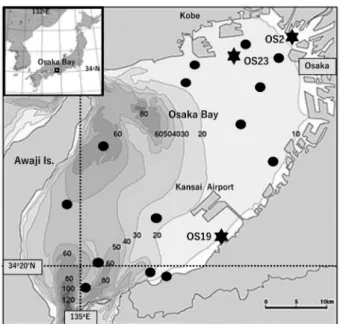
Three 10 cm long core samples, labelled OS 2, OS 19, and OS 23, were collected in 2017. The sampling sites are mark- ed on Figure 1. Core OS 23 was collected from the inner part of Osaka Bay, and core OS 19 was collected from the southeast coast of the bay. The samples were collected using a KK-type gravity corer (Kimata et al. 1960). Core OS 2 was collected from the bed at the mouth of the Yodo-Gawa
River. The sediment in each core was composed of medium to fine silt. The OS 19 and OS 23 cores were cut into 1 cm slices, and each slice was stored in a black plastic bottle to exclude light. Only the top and bottom 1 cm sections of the OS 2 core were analyzed due to the particular location of the sample. The samples were processed using a method described by Matsuoka and Fukuyo (2000). Each sample was treated with HCl and HF at room temperature to re- move calcium carbonate and silicate particles, respectively.
Each sample was then passed through 125 and 20 µm stain- less steel sieves. The material that passed through the 125 µm sieve but retained by the 20 µm sieve was analyzed. Di- noflagellate cysts (including ellipsoidal Alexandrium cysts) in each sample were counted by examination using an opti- cal microscope with a magnification of 400-600. Dinofla- gellate cysts were identified following the procedure describ- ed by Matsuoka and Fukuyo (2000) and Matsuoka and Ishi (2017) (Table 1).
In recent studies, new species names and combinations have been proposed for the species previously known as A.
tamarense, Alexandrium fundyensei Balech, and Alexandrium catenella (Whedon and Kofoid) Balech (John et al. 2014;
Fraga et al. 2015). However, use of the new species name A.
catenella, instead of the old name A. tamarense and use of the new species name Alexandrium pacificum R.W. Litaker instead of the old name A. catenella, causes confusion when
Fig. 1. Sampling locations in Osaka Bay. Closed circles
(
●) indicate
stations used by Matsuoka and Ishii (2018), and stars (
★) indicate
the sites of the three cores in the present study. Numbers on the
contour lines indicate water depths (m).
Table 1. List of dinoflagellate cyst species found in sediment from Osaka Bay
Cyst-based name Plankton-based name Remarks
GONYAULACALES Spiniferites bentori (Rossignol 1964) Wall &
Dale 1970 Gonyaulax digitale (Pouchet 1883) Kofoid 1911
Spiniferites bulloideus sensu Wall (1965) Gonyaulax scrippsae Kofoid 1911 non Deflandre & Cookson 1955 Spinferites delicatus Reid 1974 Gonyaulax sp.
Spiniferites elongatus Reid 1974 Gonyaulax elongate (Reid 1974) Ellegaard et al.
2003 Spiniferites hyperacanthus (Deflandre &
Cookson 1955) Cookson & Eisenack 1974 Gonyaulax cf. spinifera (Claparéde & Lachmann 1859) Diesing 1866
Spiniferites mirabilis (Rossignol 1964) Sarjeant
1970 Gonyaulax cf. spinifera (Claparéde & Lachmann
1859) Diesing 1866 Lingulodinium machaerophorum (Deflandre &
Cookson 1955) Wall 1967 Lingulodinium polyedrum Dodge 1989 Operculodinium centrocarpum sensu Wall &
Dale (1968) Protoceratium reticulatum (Claparéde &
Lachmann 1859) Bütschli 1885 non Deflandre & Cookson 1955 Tuberculodinium vancampoae (Rossignol 1964)
Wall 1965 Pyrophacus steinii (Schiller 1935) Wall & Dale 1971
Alexandrium tamarense/catenella
(Ellipsoidal cyst) Alexandrium tamarense/catenella According to John et al. (2014), Alexandrium catenella is formarly attributed as A. tamarense and A. fundyense, and A. pacificum is formerly called as A. catenella in Japan.
PERIDINIALES
Brigantedinium simplex (Wall 1965) Reid 1977 Protoperidinium conicoides (Paulsen 1905) Balech 1974
Brigantedinium cariacoense (Wall 1965) Reid
1977 Protoperidinium avellana (Meunier 1919)
Balech 1974
Brigantedinium majusclum Reid 1977 Protoperidinium sinuosum Lemmermann 1905
Brigantedinium spp. Protoperidinium spp.
Quinquecuspis concreta (Reid 1977) Harland
1977 Protoperidinium leonis (Pavillard 1916) Balech
1974
Lejeunecysta sp. Protoperidinium sp.
Selenopemphix nephroides (Benedek 1972)
Benedek & Sarjeant 1981 Protoperidinium subinerme (Paulsen 1904) Loeb lich III 1970
Selenopemphix quanta (Bladford 1975)
Matsuoka 1985 Protoperidinium conicum (Gran 1900) Balech
1974
Stelladinium reidii Bradford 1975 Protoperidinium compressum (Abé 1927) Balech 1974
Stelladinium stellatum (Wall 1965) Reid 1977 Protoperidinium compressum (Abé 1927) Balech 1974
Trinovantedinium applanatum (Bradford 1977)
Bujak & Davies 1983 Protoperidinium shanghaiense Gu, Liu &
Mertens 2015
Votatdinium spinosum Reid 1977 Protoperidinium claudicans (Paulsen 1907) Balech 1974
Votatdinium calvum Reid 1977 Protoperidinium latidosale Balech 1974 Votatdinium rhomboideum Gurdebeke, Mertens,
Pospelova, Matsuoka, Li & Louwye 2019 Protoperidinium quadriblongum Sarai, Kawami,
Yamaguchi & Matsuoka 2013 Votatdinium calvum (rhombic type) Cyst of Protoperidinium lattisinum Protoperidinium lattisinum (Kofoid 1907) Balech
1974
Cyst of Protoperidinium americanum Protoperidinium americanum (Gran & Braarud 1935) Balech 1974
Cyst of Protoperidinium acromaticum Protoperidinium acromaticum (Levander 1902)
Balech 1974
attempting to interpret data published before 2014. We therefore use the old species names in this study.
results
Vertical distributions of dinoflagellate cysts in the three cores samples
Dinoflagellate cysts of > 45 species in 21 genera were found in core OS 19. The cysts belonged to five genera and nine species in the Gonyaulacales, three genera and four species in the Gymnodiniales, and 13 genera and 39 species in the Peridiniales. The dinoflagellate cyst densities ranged from 1,109 cysts g
-1at 5-6 cm deep to 2,016 cysts g
-1at 8- 9 cm deep, and the mean cyst density was 1,563 cysts g
-1. (Fig. 2, Table 2). Heterotrophic dinoflagellate cysts predom- inated, and contributed > 70% of the cysts in each sample.
The heterotrophic dinoflagellate cyst contribution increased from the bottom to the top of the sample. As shown in Fig- ures 2 and 3, ellipsoidal Alexandrium cysts were most abun- dant at a depth of 1-2 cm, where the cyst density was 935 cysts g
-1, and least abundant at a depth of 9-10 cm, where the cyst density was 11 cysts g
-1(Fig. 2).
Dinoflagellate cysts from > 40 species in 19 genera were identified in core OS 23. These cysts belonged to five gen- era and nine species in the Gonyaulacales, three genera and four species in the Gymnodiniales, and 13 genera and 39 species in the Peridiniales. The dinoflagellate cyst densities ranged from 1,684 cysts g
-1at 7-8 cm to 3,375 cysts g
-1at
6-7 cm, and the mean cyst density was 2,395 cysts g
-1. Het- erotrophic dinoflagellate cysts were extremely abundant, and contributed > 65% of the cysts throughout the core (Fig. 2, Table 2). Ellipsoidal Alexandrium cysts were most abundant at 0-1 cm, where the cyst density was 616 cysts g
-1, and least abundant at 4-5 cm, where the cyst density was 20 cysts g
-1(Fig. 2).
Dinoflagellate cysts from 12 genera and 20 species were abundant in the top 1 cm of core OS 2, but few ellipsoidal Alexandrium cysts, Brigantedinium simplex (Wall) Reid, and Votadinium calvum Reid were found (Table 2). Ellipsoidal Alexandrium cysts were most abundant at the top of the core, where the cyst density was 1,080 cysts g
-1, and least abundant at the bottom of the core, where the cyst density was 190 cysts g
-1.
horizontal distribution of dinoflagellate cysts in surface sediment in osaka Bay
The results of our study and Matsuoka and Ishii (2018) are combined in Figure 5. The dinoflagellate cyst densities were higher in the northern part of Osaka Bay than else- where. Ellipsoidal Alexandrium cysts were abundant in the northern part of Osaka Bay, at the mouth of the Yodo-Gawa River, and along the east coast of Osaka Bay (Fig. 4). The ellipsoidal Alexandrium cyst density was highest (3,610 cysts g
-1) at Station 7 in Matsuoka and Ishii (2018) and lowest (4 cysts g
-1) at Station 3 in the same work. Ellipsoidal Alex
andrium cysts were abundant in the inner part of Osaka Bay, but were also found in the southern part of the bay. Other
Table 1. List of dinoflagellate cyst species found in sediment from Osaka Bay
Cyst-based name Plankton-based name Remarks
Cyst of Protoperidinium spp. Protoperidinium spp.
Cyst of Peridinium quinquecorne Abé Peridinium quinquecorne Abé 1927 Cyst of Scrippsiella spp. Scrippsiella spp.
Dubridinium cavatum Reid 1977 Diplopsalopsis orbicularis (Paulsen 1907) Meunier 1909
Cyst of Niea acanthocysta Niea acanthocysta (Kawami, Iwataki &
Matsuoka 2006) Liu, Mertens & Gu 2015 Echinidinium aculeatum Zonneverd 1997 Unknown
Echinidinium spp. Unknown
GYMNODINIALES Cyst of Polykrikos kofoidii Polykrikos kofoidii Chatton 1914 Cyst of Polykrikos schwartzii Polykrikos schwartzii Bütschli 1873 Cyst of Levanderina fissa Levanderina fissa (Levander) Moestrup,
Hakanen, Hansen, Daugbjerg & Ellegaard 2014 Formarly called as Cyst of Gyrodinium instriatum
Cyst of Cocholodinium sp. Cocholodinium sp.
Table 1. Continued
dinoflagellate cysts were less abundant in the southern than in the northern part of Osaka Bay.
dIscussIon
concentrations of ellipsoidal alexandrium cysts in sediment
Hamano et al. (2002) stated that the first recorded PSP events caused by bivalves Ruditapes philippinarum (Adams
& Reeve 1850), Mytilus galloprovincialis Lamarck, 1819, and
Crassostrea gigas (Thunberg 1793) occurred in Osaka Bay on 2002. Yamamoto (2004) reported that PSP in Osaka Bay could be caused by the dinoflagellates Gymnodinium catena
tum H.W. Graham, A. tamarense, A. catenella, and Alexan
drium tamiyavanichii Balech. The year 2007 saw the first red tide (discoloration) in Osaka Bay caused by A. tamarense (Yamamoto et al. 2009).
A PSP-causing dinoflagellate species found around Hari- na-Nada in the Seto Inland Sea and in Osaka Bay has been identified as Protogonyaulax catenella (Whedon & Kofoid) Taylor ( = A. catenella) from the results of cyst germination
Table 2. Occurrences of phototrophic, heterotrophic, and ellipsoidal Alexandrium cysts in sediment cores OS 19 and OS 23 from Osaka Bay
OS19
Sample depth (cm) 0-1 1-2 2-3 3-4 4-5 5-6 6-7 7-8 8-9 9-10
Cyst type cysts g
-1cysts g
-1cysts g
-1cysts g
-1cysts g
-1cysts g
-1cysts g
-1cysts g
-1cysts g
-1cysts g
-1Ellipsoidal Alexandrium cyst 168 935 620 516 195 36 33 12 12 11
Cyst of phototrophic species* 150 319 210 408 325 257 273 373 276 445
Cyst of heterotroph species 1,050 1,078 1,070 1,296 1,183 816 946 972 1,728 858
OS 23
Sample depth (cm) 0-1 1-2 2-3 3-4 4-5 5-6 6-7 7-8 8-9 9-10
Cyst type cysts g
-1cysts g
-1cysts g
-1cysts g
-1cysts g
-1cysts g
-1cysts g
-1cysts g
-1cysts g
-1cysts g
-1Ellipsoidal Alexandrium cyst 616 384 242 171 20 69 75 52 120 85
Cyst of phototrophic species* 464 464 330 361 320 460 1,050 552 494 493
Cyst of heterotrophic species 2,156 1,744 1,364 1,976 1,800 1,965 2,250 1,080 1,349 1,445
*: excluding ellipsoidal Alexandrium cysts.
Fig. 2. Vertical distributions of three dinoflagellate cyst groups
(ellipsoidal Alexandrium cysts, autotrophic dinoflagellate cysts, and heterotro- phic dinoflagellate cysts) in cores OS 19 and OS 23.
OS 23 OS 19
experiments and plankton observations (Fukuyo 1983). In- terestingly, no A. tamarense was detected at that time. Yama- guchi et al. (1996) investigated the distributions and abun- dances of A. tamarense and A. catenella cysts in surface sed- iment in the eastern Seto Inland Sea, including Osaka Bay, and found high cyst densities between the inner part and middle of the east coast of Osaka Bay. Yamamoto (2004) and Nagai et al. (2007) suggested that the cyst-producing dinoflagellate species might be A. tamarense because the cyst distribution found by Yamaguchi et al. (1986) was similar to
those found after the A. tamarense blooms in 2002.
Seven PSP events and red tides caused by A. tamarense have been reported since 2002 (Yamamoto 2018). The el- lipsoidal cysts with colourless walls found were identical to the cysts of Alexandrium acathenella (Whedon & Kofoid) Balech, A. tamarense, or A. catenella. However, these cysts could not be differentiated from their external morpholo- gies, so Yamamoto et al. (2011) performed cyst incubation experiments and concluded that most of the ellipsoidal cysts preserved in the surface sediment were identical to A. tama
Fig. 3. Microphotographs of ellipsoidal Alexandrium cysts.
(A) Living cyst filled with protoplasm, (B) and (C) cysts containing protoplasm but probably not alive. The scale bar indicates 10 µm.
A B C
A B
Fig. 4.
(A) Horizontal distribution of total dinoflagellate cysts. (B) Horizontal distribution of ellipsoidal Alexandrium cysts. Data for cores OS 2, OS 19, and OS 23 were added to Figure 7A and 7B from Matsuoka and Ishii (2018).
Cysts g-1
≥10,000 ≥1,000
<4,999 <499
1,000≤ 100≤
<9,999 <999
5,000≤ 500≤
Cysts g-1
rense cysts. A. acathenella was found extremely rarely, and only small amounts of A. catenella have ever been found in Osaka Bay. The ellipsoidal cysts related to PSP events and red tide were therefore concluded to be A. tamarense/catenel
la (mainly A. tamarense) cysts.
Ellipsoidal cysts identical to A. catenella/tamarense cysts were found in all three cores, but the cyst densities varied.
The cyst densities were lowest in the lower parts of the cores, and increased from the middle parts of the cores in an up- ward direction. The highest cyst densities were found at 0- 1 cm in core OS 23 and 1-2 cm in core OS 19. A similar trend was found for core OS 2. This suggests that the pro- duction of A. catenella/tamarense ellipsoidal cysts has in- creased strongly in recent years.
The A. tamarense cyst densities in surface sediments around the world have been investigated, as shown in Table 3 in Matsuoka et al. (2018). The maximum cyst densities (915 cysts g
-1in core OS 19 and 616 cysts g
-1in core OS 23) were not high compared with those found in other areas.
Matsuoka and Ishii (2018) found an ellipsoidal Alexandrium cyst density of 3,610 cysts g
-1at station OS 5 in Osaka Bay, which was ~3 km southwest of core OS 23. Yamamoto et al.
(2009) found a maximum cyst density of 5,683±631 cysts g
-1in wet sediment on the east coast of Osaka Bay (near core OS 19) in 2007 after an A. tamarense bloom. The high- est cyst density recorded after that was 90,672±11,269 cysts g
-1in 2017 (unpublished data). Mizushima and Matsuoka (2004) found that empty A. tamarense and A. catenella cysts representing after germination are not preserved well com- pared with the empty cysts of other dinoflagellates, because A. tamarense and A. catenella cysts are extremely weak and have thin autophragm. More resting cysts than were count- ed were therefore probably produced and deposited in the surface sediment. These data suggest that ellipsoidal Alex
andrium cysts are widely distributed at high densities in the inner to southeastern shallow parts of Osaka Bay (Fig. 4B).
erosion, resuspension, and redeposition of surface sediments containing ellipsoidal alexandrium cysts as caused by a tsunami
case study of osaka Bay
The high densities of ellipsoidal Alexandrium cysts pre- served in surface sediments appear to indicate a high poten- tial risk of PSP incidents in future. A. tamarense blooms have occurred regularly along the Osaka Bay coast ever since the first bloom was recorded (Yamamoto 2004, 2018). This means that cysts preserved in surface sediments may play a role in initiating new blooms. The risks posed by a tsunami after the expected Tonankai Earthquake should also be con- sidered. According to the Osaka Prefecture (2013), a tsu- nami 3.2-5.1 m high will reach the Osaka Bay coast after the expected Tonankai Earthquake off central Japan. The tsunami is expected to be 5.1 m high in the innermost part of Osaka Bay (Fig. 5). The Showa Nankai Earthquake of 1946 caused a tsunami that was ~3 m high when it reached the inner part of Osaka Bay. Unfortunately, no detailed data on sediment disturbance in Osaka Bay were recorded at the time. However, we can predict the effects of a large tsunami on a shallow bay by examining data recorded after the Great East Japan Earthquake. After the tsunami that followed the Great East Japan Earthquake, A. tamarense blooms were observed at Sendai Bay (Kamiyama et al. 2014), Kesennuma Bay (Nishitani et al. 2012; Ishikawa et al. 2015), Ofunato Bay (Kaga et al. 2012; Matsuoka et al. 2018), and Funka Bay (Natsuike et al. 2014). These blooms were initially caused by the germination of living cysts in sediment suspended by the tsunami. In Ofunato Bay, the maximum A. tamarense cell density reached 100,600 cells L
-1on 26 May 2011 and 179,500-676,500 cells L
-1in early June 2011 (Kaga et al.
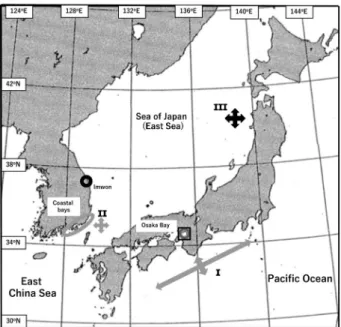
Fig. 5. Sites of possible earthquake epicenters and subsequent