• 검색 결과가 없습니다.

The Impact of Government Regulations on Consumers Behaviour during the COVID-19 Pandemic: A Case Study in Indonesia

N/A
N/A
Protected

Academic year: 2021

Share "The Impact of Government Regulations on Consumers Behaviour during the COVID-19 Pandemic: A Case Study in Indonesia"

Copied!
10
0
0

로드 중.... (전체 텍스트 보기)

전체 글

(1)

Print ISSN: 2288-4637 / Online ISSN 2288-4645 doi:10.13106/jafeb.2021.vol8.no4.0939

The Impact of Government Regulations on Consumers Behaviour during the COVID-19 Pandemic: A Case Study in Indonesia

Sri Setyo IRIANI

1

, Dian Anita NUSWANTARA

2

, Ajeng Dianing KARTIKA

3

, Purwohandoko PURWOHANDOKO

4

Received: December 15, 2020 Revised: March 06, 2021 Accepted: March 15, 2021

Abstract

The purpose of the research is to examine whether government regulation on Covid 19 pandemic has had a significant impact in economic sectors, particularly on consumer behavior. Thus there are three hypotheses, 1) viral marketing has an effect on online trust during the Covid-19 Pandemic Era, 2) viral marketing has an effect on impulse buying during the Covid-19 Pandemic Era, and 3) Viral marketing has an effect on impulse buying in the Covid-19 Pandemic Era through online trust. To test the hypotheses, questionnaires were distributed to 150 respondents, however, only 110 were selected due to incomplete data. There are 3 variables, namely viral marketing, online trust, and impulse buying, where online trust is also a mediating variable. Once the assumption test is completed, the researcher employs path analysis to test the hypotheses. The results are 1) there is an effect of viral marketing on online trust in the Covid-19 Pandemic Era, 2) There is no effect of viral marketing on impulse buying in the Covid-19 Pandemic Era, and 3) Viral marketing has an effect on impulse buying in the Covid-19 Pandemic Era through online trust. This means online trust succeed in mediating viral marketing-impulse buying relationship. The findings emphasized that the credibility of online trust enforce consumers in making buying decisions.

Keywords: Pandemic Situation, Viral Marketing, Impulse Buying, Customer’s Online Trust, Buying Decision JEL Classification Code: O33, M31, M38

competitors and regulations regarding fluctuations in exchange rates and raw material prices are dominant factors that must be considered by business actors (Ibrahim et al., 2019). In 2020, the world situation changed dramatically.

These changes were not because of competitors, exchange rate or price regulations. The government policies related to health protocols to reduce the impact of the Covid-19 pandemic resulted in decreased business performance in various sectors. The health protocol issued by WHO forced governments in many countries to implement physical distancing, social distance, and lockdown, including the Government of Indonesia. This policy forced people to change their lifestyle from being consumptive to being more selective and economical, from traveling on tours to watching videos at home, from shopping at malls to online shopping. These changes directly or indirectly required changes in business strategy.

Research on the dynamics of people’s shopping behavior currently provides empirical evidence that people are starting to change their lifestyle from physical activities to virtual or online activities (Khoa, 2020). This lifestyle change not only

1

First Author. Lecturer, Department of Management, Faculty of Economics, Universitas Negeri Surabaya, Indonesia.

Email: [email protected]

2

Corresponding Author. Lecturer, Department of Accounting, Faculty of Economics, Universitas Negeri Surabaya, Indonesia [Postal Address: Kampus Unesa Ketintang, Surabaya, East Java, 60231, Indonesia] Email: [email protected]

3

Lecturer, Department of Germany Language, Faculty of Arts and Letters, Universitas Negeri Surabaya, Indonesia.

Email: [email protected]

4

Lecturer, Department of Management, Faculty of Economics, Universitas Negeri Surabaya, Indonesia.

Email: [email protected]

© Copyright: The Author(s)

This is an Open Access article distributed under the terms of the Creative Commons Attribution Non-Commercial License (https://creativecommons.org/licenses/by-nc/4.0/) which permits unrestricted non-commercial use, distribution, and reproduction in any medium, provided the original work is properly cited.
1. Introduction

The ability of business people to monitor a dynamic

and extreme environment is the key to the success of a

business. From the perspective of the external environment,

(2)

changes the way of doing activities but also shifts the types of commodities needed by society. Government policies in the field of education, namely studying and working from home, increase the need for smartphones and telecommunications providers that support online learning and working activities. Government policies related to self-protection have dramatically increased the need for health products such as medical masks, hand sanitizers, disinfectants, wipes, and vitamins. It even gave birth to new product innovations such as face shields, hazmat clothes, and non-medical masks or cloth masks. Government policies related to social distancing have increased demand for courier services due to increased online shopping.

The emergence of various new needs is immediately captured by producers. They produce and sell new goods and services according to the needs of the community.

They continuously innovate the products and services to compete. This change forced business people to rearrange their business strategies so that they can quickly seize opportunities and at the same time survive in the era of the Covid-19 pandemic. Like other businesses in a pandemic situation, small businesses called SMEs also experienced these changes. SMEs choose to switch their business fields, such as changing products sold, replacing services provided, and even switching from selling products to providing services needed. SMEs also changed their sales strategy from conventional sales in stores or real markets to online shops or markets. This means that the marketing needs to adjust to being online too, whether on social media or Web- based marketing. In the period before the pandemic, SMEs could still rely on conventional marketing through gallery or outlet visits, face-to-face, and demonstrations, but today all SMEs must be familiar with e-marketing.

In the current situation, there is a tendency to promote their products more intensely to reach wider a community and eventually go viral. Viral marketing refers to a technique in marketing a product or a service where users help in spreading the advertiser’s message to other websites or the users create a scenario that can lead to multi-fold growth (Abbas & Ali, 2020). Dissemination of this kind of information not only delivers messages instantly and on target, but can also influence the recipients to purchase products or services. This kind of spontaneous purchase is called impulse buying (Khokhar et al., 2019). However, viral marketing is an effective marketing instrument as long as it encourages consumers to take action as a result of the message about the brand, product, or service and pass it on to other potential customers. Therefore, the purpose of viral marketing is two-fold. The first one is consumption, and the second is forwarding behavior. Thus, viral marketing has a significant impact on consumer decisions in impulsive purchases (Husnain et al., 2016; Khokhar et al., 2019).

However, empirical evidence presents a unique result - buyers do not always understand the products they buy. The motivation of consumers to buy in the era of the Covid-19 pandemic is largely influenced by the viral activities of marketers with their promotion on social media. The work from home activity causes everyone to depend on their cellphone for news and information, so they tend to use gadgets more often, either for scrolling or surfing information.

It is at this point that marketers enter the world of consumers and influence them to make unplanned purchases. However, a sad situation arises when sellers behave in a deviant manner to trick and deceive consumers.

Meanwhile, one of the factors that influence online shopping decisions is the level of trust. Purchases will not occur if consumers do not have sufficient confidence in the seller or product. Impulsive buying is the tendency of a customer to buy goods and services without planning in advance. When a customer takes such buying decisions at the spur of the moment, it is usually triggered by emotions and feelings (Wu et al., 2016). In this case, consumer trust plays a significant role in making buying decisions. Trust is a factor that encourages customers to buy products without prior planning (Khokhar et al., 2019). This kind of factor psychologically influences the customer’s purchasing decision (Ling et al., 2010; Shiau & Luo, 2012).

Previous research has succeeded in providing empirical evidence that buying decisions by customers are more carried out spontaneously (impulse buying), hence, viral marketing can increase the effectiveness of messages to targeted recipients of the information. Based on the description above, this study conducts further testing to determine the effectiveness of viral marketing in driving spontaneous buying decisions. Meanwhile, this study adds customer trust as a mediating variable with the assumption that during this pandemic the amount of information has increased tremendously, as such, an emulator is needed that can trigger the effectiveness of viral marketing. The findings of this study are important to provide empirical evidence for marketers that building positive relationships with customers is important in building trust.

2. Literature Review 2.1. Viral Marketing

Viral marketing aims at brand building. When people

voluntarily disseminate information they receive through

their social networking that may motivate the receiver to

make a buying decision, it can be called viral marketing

(Abbas & Ali, 2020). Viral marketing is a sales technique

that involves organic or word-of-mouth information about

a product or service to spread at an ever-increasing rate.

(3)

The Internet and the advent of social media have greatly increased the amount of viral messages in the form of memes, shares, likes, and forwards (Ho & Dempsey, 2010).

Four factors for the success of viral marketing are identified as follows (1) attractive content, making it easy to remember (2) social network structure; (3) behavioral characteristics of recipients and incentives to share messages; and (4) seeding strategies at the right initial target (Hinz et al., 2011).

Sherman et al. (2016) recruited adolescents to participate in an “internal social network” that simulated Instagram, a popular photo-sharing tool. Participants submitted their own Instagram photos, and they believed that all photos would be seen and liked by peers. They tested the possibility that the number of likes appearing under each photo would affect participants’ responses. They hypothesized that participants would tend to like photos liked by more peers and refrain from liking less popular photos. This finding showed the influence of virtual peer endorsement and held for both neutral photos and photos of risky behaviors. Viewing photos with many (compared with few) likes was associated with greater activity in neural regions implicated in reward processing, social cognition, imitation, and attention. Furthermore, when adolescents viewed risky photos, activation in the cognitive- control network decreased. These findings highlight possible mechanisms underlying peer influence during adolescence.

There are two types of viral marketing, namely organic and amplified (Kulmala et al., 2013) Organic viral marketing is supported by consumers who on their initiative share information on a brand or product through social media networks (Van der Lans et al., 2010), whereas in an amplified manner, marketers deliberately send information to stimulate and take advantage of word of mouth behavior (WOM) so that other Internet users view the content and continue to their social networks (Hinz et al., 2011). Implementing the FIRO (Fundamental Interpersonal Relations Orientation) conceptual framework developed by Schutz the working process of online content can be investigated (Ho & Dempsey, 2010). This framework confirms that people engage in interpersonal communication because they are motivated to express one or more of three interpersonal needs: inclusion (need to be part of a group/need for attention), affection (show appreciation and concern for others), and control (need to exert power in one’s social environment).

Viral marketing seeks to spread information about a product or service from person to person by word of mouth or sharing via the internet or email. This simple approach can help in creating a lot of positive impact during promotional product launches or campaigns. It helps to get tremendous visibility, exposure, and better traffic which results in increased sales revenue. Consumers who are active on social media often receive abundant product information, because activity on social media has become a habit, so viral marketing can generate impulsive purchase desires. Previous

studies have confirmed that widely spread information on social media networks has a positive impact on impulsive purchases (Khokhar et al., 2019).

2.2. Online Trust

Trust is an essential element in the relationship between two parties. It is a situation where a customer has assurance in exchange for the marketer’s integrity and reliability. It is a belief in the given content of a social commerce organization that enhances e-word-of-mouth and the purchase intentions of customers. Customers are more likely to buy from people they trust or purchase a product or service that performs what it claims. Trust is defined as a willingness to cooperate with the exchange partner who is believed to be reliable and have integrity (Moorman et al., 1993). Lack of trust has been repeatedly identified as one of the most formidable barriers to people engaging in e-commerce, involving transactions in which financial and personal information is submitted to merchants via the Internet. The future of e-commerce is tenuous without a general climate of online trust. Building consumer trust on the Internet presents a challenge for online merchants and is a research topic of increasing interest and importance.

Khoa reformulates the definition of online trust into three dimensions, namely ability, virtue, and integrity (Khoa, 2020). The seller’s ability is the belief that the seller has the expertise and ability to produce goods or services according to their specifications. Virtue is the belief in the seller’s site, the desire for a legal profit, offering the customer a good commodity. Integrity is the belief that the seller keeps his statement or promise. Trust is important for online shopping activities because consumers face high uncertainty over the quality and delivery time of goods, while consumers cannot fully control seller promises. This approach believes that trust can be measured even though the factors cannot be controlled (Usman, 2015).

Ling et al. (2010) defined beliefs as expectations about individual behavior in the society in which they live. Trust can rely on a person, object (product), organization (business), institution (government), or a role (such as professional).

Trust is a feeling that somebody or something can be relied upon, or will turn out to be good. It is the feeling of being sure about something, even if it cannot be proved. Trust is one of the factors that influence online purchasing decisions (Shiau & Luo, 2012). Another finding confirmed that online trust influences impulsive purchases (Ling et al., 2010).

Online customer trust is important for online businesses

(Khoa, 2020). Jun et al. (2019) examined the influence of

key variables that systems integrator (SI) can handle to

improve trust and system quality which finally leads to

user satisfaction toward SI. This study adopted resource

complementarity, user participation and information sharing

as the key variable then builds a research model to explain

(4)

their relationships to user satisfaction. Results showed that both resource complementarity and information sharing have positive relationships with trust. Also, the relationships between trust, system quality, and user satisfaction toward SI are supported. Besides, the mediating roles of trust and system quality are identified.

2.3. Impulse Buying

Decisions on purchases are not always planned, not carefully considered, and without rational reasons. Typically, people impulse buy things that make them feel good; or things that have an emotional value (Husnain et al., 2016).

In impulsive buying, the individual is not actively looking for a particular item and has no plan (has no pre-shopping plan) to purchase that item. Impulsive buying cannot be categorized for one specific product category. Impulsive buying means making an unplanned purchase. It is based on irrational thinking. Marketers try to tap this behavior of customers to boost sales. (Chan et al., 2017). Several things encourage impulsive buying, including economic conditions, personality, time, social visibility, location, and even cultural factors (Wu et al., 2016).

In the past few years, the interest in impulsive buying behavior has been increasing and it has provoked the interests of organizations and researchers to understand the psychological strengths behind this behavior. Impulsive purchases are divided into four types, namely (1) pure impulsive purchases, (2) reminder impulsive purchases, (3) suggestive impulsive purchases, and (4) impulsive purchases planned (Wu et al., 2016). Impulsive buying tendency has been defined as the degree to which an individual is likely to make unintended, immediate, and unreflective purchase (Drossos et al., 2014). Low involvement is associated with routine, habitual, or impulsive behavior without extensive information processing. Unplanned decisions also occur with online purchases. These decisions are called online impulse buying (Chan et al., 2017).

Impulsive buying online includes two main drivers, namely the use of technology and trust (Wu et al., 2016).

2.4. Hypotheses

In the pandemic era, there is a situation where everyone spends a lot of time holding their gadgets from just scrolling pictures to studying. Almost everyone has forwarded messages, including marketing nuanced messages known as viral marketing. Based on the literature review above, a research model can be developed that shows that viral marketing aims to build brand trust, where trust will have implications for impulsive buying. Five factors that influence consumer impulsive buying behavior have been identified as trust, website quality, hedonic motivation, situational

variables, and identified variation searches (Bansal &

Kumar, 2018). Trust is a factor that attracts and encourages consumers to buy products without prior planning (impulsive buying). There is a significant relationship between trust and impulsive customer buying behavior (Khokhar et al., 2019).

If people trust a certain product or service then they can make an impulsive purchase. Thus, it is hypothesized that:

H1: There is an effect of viral marketing on online trust in the Covid-19 Pandemic Era.

H2: There is an effect of viral marketing on impulse buying in the Covid-19 Pandemic Era.

H3: Viral marketing has an effect on impulse buying in the Covid-19 Pandemic Era through online trust.

3. Research Method

The criteria to select informants were (1) own regular income, (2) aged 18 years and over (having a resident card), and (3) have made shopping transactions on social media (Instagram, WhatsApp, during the pandemic). This criterion is needed to ensure that respondents can make shopping decisions on social media and realize their decisions.

Questionnaires were distributed online, either by email or social media through the researchers’ network. The final result shows that 110 out of 150 respondents have filled out the questionnaire completely. Incomplete responses were omitted from the analysis.

There are three research variables, namely viral marketing, online trust, and impulsive buying. Viral marketing is measured by consumer activity in finding and sharing product information on social media networks, which consists of 10 indicators from Ho and Dempsey (2010) translated into Indonesian language. Consumer confidence is measured using the modified online trust indicator to accommodate pandemic conditions (Khoa, 2020). Likewise, the measurement of impulse buying uses 4 modified indicators referring to Bozaci (2020). The measurement scale in this study uses a 5-point Likert scale, namely 5 (strongly agree) to 1 (strongly disagree).

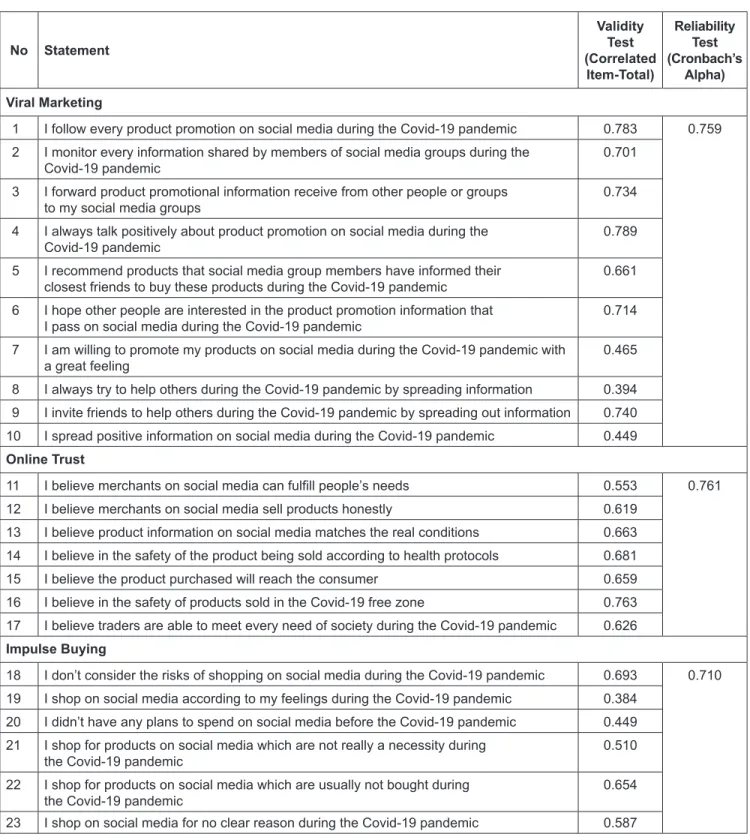
To ensure the quality of the instrument, the researcher conducted a validity test with the item-total correlation method and the reliability test used the Cronbach Alpha coefficient. The results of this process are presented in Table 1 as follows.

Table 1 shows that all statement items that measure

viral marketing variables. Trust and impulse buying

produce r-count values greater than 0.30, so they are

declared valid and can be used as an appropriate measuring

tool. Reliability testing of all variables gives a Cronbach’s

Alpha value greater than 0.70, so it is concluded that all

statements can be said to be reliable and can be used as a

measuring tool.

(5)

Table 1: Validity and Reliability Test Results No Statement

Validity (Correlated Test

Item-Total)

Reliability (Cronbach’s Test

Alpha) Viral Marketing

1 I follow every product promotion on social media during the Covid-19 pandemic 0.783 0.759 2 I monitor every information shared by members of social media groups during the

Covid-19 pandemic 0.701

3 I forward product promotional information receive from other people or groups

to my social media groups 0.734

4 I always talk positively about product promotion on social media during the

Covid-19 pandemic 0.789

5 I recommend products that social media group members have informed their

closest friends to buy these products during the Covid-19 pandemic 0.661 6 I hope other people are interested in the product promotion information that

I pass on social media during the Covid-19 pandemic 0.714

7 I am willing to promote my products on social media during the Covid-19 pandemic with

a great feeling 0.465

8 I always try to help others during the Covid-19 pandemic by spreading information 0.394 9 I invite friends to help others during the Covid-19 pandemic by spreading out information 0.740 10 I spread positive information on social media during the Covid-19 pandemic 0.449 Online Trust

11 I believe merchants on social media can fulfill people’s needs 0.553 0.761

12 I believe merchants on social media sell products honestly 0.619

13 I believe product information on social media matches the real conditions 0.663 14 I believe in the safety of the product being sold according to health protocols 0.681

15 I believe the product purchased will reach the consumer 0.659

16 I believe in the safety of products sold in the Covid-19 free zone 0.763 17 I believe traders are able to meet every need of society during the Covid-19 pandemic 0.626 Impulse Buying

18 I don’t consider the risks of shopping on social media during the Covid-19 pandemic 0.693 0.710 19 I shop on social media according to my feelings during the Covid-19 pandemic 0.384

20 I didn’t have any plans to spend on social media before the Covid-19 pandemic 0.449 21 I shop for products on social media which are not really a necessity during

the Covid-19 pandemic 0.510

22 I shop for products on social media which are usually not bought during

the Covid-19 pandemic 0.654

23 I shop on social media for no clear reason during the Covid-19 pandemic 0.587

(6)

Figure 1: Research Model The independent variables are:

Viral Marketing

Viral marketing or viral advertising is a business strategy that uses existing social networks to promote a product. Its name refers to how consumers spread information about a product with other people, much in the same way that a virus spreads from one person to another. (Abbas & Ali, 2020).

Online Trust

Trust is defined as a willingness to cooperate with the exchange partner who is believed to be reliable and have integrity (Moorman et al., 1993). Online trust is an attitude of confident expectation in an online situation of risk that one’s vulnerabilities will not be exploited.

The dependent variable is impulsive buying

An impulse purchase or impulse buying is an unplanned decision to buy a product or service, made just before a purchase. Buying action as a result of unplanned actions resulting from certain stimuli is called impulsive buying (Ling et al., 2010). Impulsive buying is the tendency of a customer to buy goods and services without planning in advance. When a customer takes such buying decisions on the spur of the moment, it is usually triggered by emotions and feelings (Husnain et al., 2016). In impulsive buying, the individual is not actively looking for a particular item and has no plan (has no pre-shopping plan) to purchase that item.

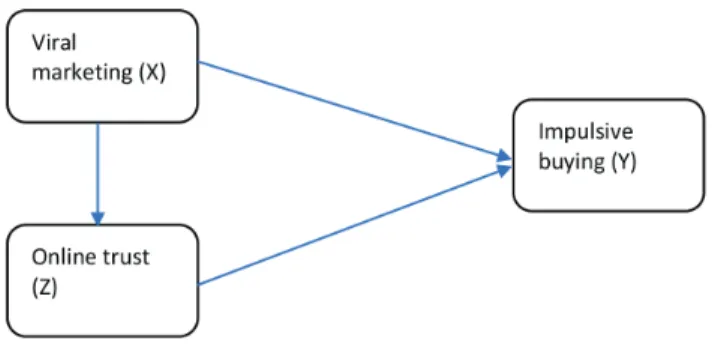
This study uses path analysis as an extension of multiple regression. Path analysis is a statistical technique that allows users to investigate patterns of effect within a system of variables. It is one of several types of the general linear model that examine the impact of a set of predictor variables on multiple dependent variables (here, the causal relationship between variables X to Z and its impact on Y). Of the 4 types of path analysis, this study takes a combination model, which combines regression models, multiple, and mediation models such as the following models:

The figure above shows that variable X affects variable Y directly, and indirectly affects variable Y through variable Z.

Before testing the hypothesis, the data was analyzed using the classical assumption test to ensure that the data was normal.

If the direct effect of viral marketing (X) on impulse buying (Y) is smaller than the indirect effect of viral marketing (X) on impulse buying (Y) through online trust (Z), then H0 is accepted (Ha is rejected). Conversely, if the direct effect of viral marketing (X) on impulse buying (Y) is greater than the indirect effect of viral marketing (X) on impulse buying (Y) through online trust (Z), then H0 is accepted (Ha is rejected).

4. Research Results

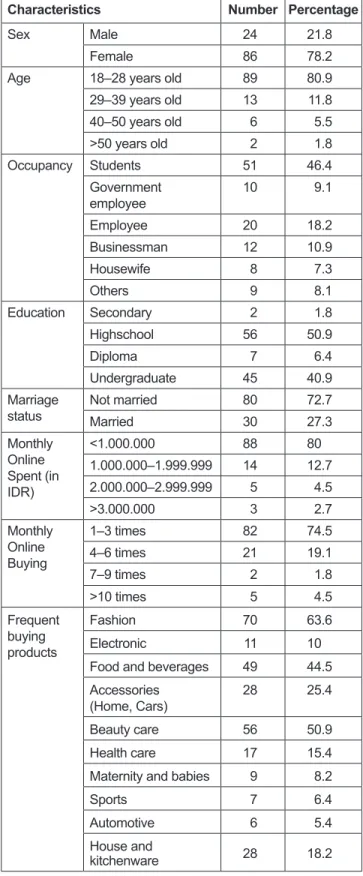
Of the 110 study respondents, 86 were female (78.2%) and 24 were male (21.8%). 80.9% of the respondents were aged between 18–28 years and the rest were 28–38 years old.

56 respondents or 50.9% of the respondents were SMA/SMK/

equivalent, 45 respondents or 40.9% of the respondents were undergraduate, 7 respondents or 6.4% of the respondents were Diploma holders (6.4%), and 2 respondents or 1.8%

of the respondents were SMP/equivalent. Most of the respondents were students, as many as 51 people or 46.4%, 20 respondents were employees, 12 respondents were self- employed, 10 respondents were civil servants, 8 respondents were housewives, and 9 respondents were retirees. As many as 80 people (72.7%) were unmarried and the remaining 30 people (27.3%) were married. The frequency of online shopping for respondents (74.5% or 82 respondents) in a month is between 1–3 times. With the regard to the product category most purchased online was fashion products (63.6%

or 70 respondents), followed by food and beverage (34 or 30.5%), and beauty care products (6 or 5.9%) Table 2 shows the information demographics of the respondents.

The demographic of respondents show that the sample is close to the population. Thus, it can be considered representative of the population.

Path analysis is used to prove the research hypothesis. The first step is to test the requirements for the fulfillment of the assumptions for normality, linearity, and multicollinearity. In the normality test, as seen from the critical ratio skewness and multivariate values, the resulting critical ratio values are in the range –2.58 to 2.58. The linearity test in this study obtained a probability value in each model less than 0.005 and the determinant value of the sample covariance matrix in the multicollinearity test was more than 0. Based on the three analyses, it was concluded that the research data was normal, linear, and did not have multicollinearity problems.

In the feasibility test of the model, the value of the

determinant coefficient (R

2

) in the two-equation models is

24.4%. This value explains that the contribution of the model

to the structural relationship of the viral marketing variable

(7)

Table 2: Informants Demographics

Characteristics Number Percentage

Sex Male 24 21.8

Female 86 78.2

Age 18–28 years old 89 80.9

29–39 years old 13 11.8

40–50 years old 6 5.5

>50 years old 2 1.8

Occupancy Students 51 46.4

Government

employee 10 9.1

Employee 20 18.2

Businessman 12 10.9

Housewife 8 7.3

Others 9 8.1

Education Secondary 2 1.8

Highschool 56 50.9

Diploma 7 6.4

Undergraduate 45 40.9

Marriage

status Not married 80 72.7

Married 30 27.3

Monthly Online Spent (in IDR)

<1.000.000 88 80

1.000.000–1.999.999 14 12.7

2.000.000–2.999.999 5 4.5

>3.000.000 3 2.7

Monthly Online Buying

1–3 times 82 74.5

4–6 times 21 19.1

7–9 times 2 1.8

>10 times 5 4.5

Frequent buying products

Fashion 70 63.6

Electronic 11 10

Food and beverages 49 44.5

Accessories

(Home, Cars) 28 25.4

Beauty care 56 50.9

Health care 17 15.4

Maternity and babies 9 8.2

Sports 7 6.4

Automotive 6 5.4

House and

kitchenware 28 18.2

and trust in impulse buying is 24.4%, while the remaining 75.6% is explained by other variables outside of this study.

Furthermore, Table 3 describes the results of testing the research hypothesis as described below:

In the hypothesis testing stage, the effect of the viral marketing variable on the trust variable obtained a C.R value of 3.781 ≥ 2.00 with a probability value (P) of 0.000 < 0.05, which means the viral marketing variable had a significant positive effect on the trust variable. The effect of the trust variable on the impulse buying variable obtained a C.R value of 3.686 ≥ 2.00 and a probability value (P) of 0.000

< 0.05, which means the trust variable had a significant positive effect on the impulse buying variable. Furthermore, the effect of the viral marketing variable on the impulse buying variable obtained a C.R value of 0.795 ≤ 2.00 with a probability value (P) 0.427 > 0.05, which means the viral marketing variable was not proven to have a direct influence on the impulse buying variable.

Table 4 shows that the direct effect of viral marketing (X) on impulse buying (Y) is greater than the indirect effect of viral marketing (X) on impulse buying (Y) through online trust (Z), hence, H0 is accepted (Ha is rejected).

5. Discussion

The influence of viral marketing on impulse buying Furthermore, the viral marketing variable was not proven to have an influence on the impulse buying variable. These results do not support research conducted by Husnain et al.

(2016) and Khokhar et al. (2019), that the viral marketing variable has a significant effect on impulse buying. Viral marketing is a method or strategy involving digital content that has the potential to create exponential growth in a short time (Khokhar et al., 2019).

Based on the Covid-19 pandemic, many people also consider their limitations in impulse buying, this is due to the many problems that arise due to Covid-19, for example, loss of employment and decreased income. As such before purchasing people will make a “to-do list” before making purchases. Besides, people who experience these limitations will also make plans in making purchases and will make considerations before making purchases. In reality, someone who has limitations will no longer care about his wants; they will tend to fulfill their needs first without being tempted by the promotions that have been offered by business people. Thus, the results of this study are in accordance with the reality that occurred in society during the Covid-19 pandemic.

The influence of viral marketing on online trust

The results showed that the viral marketing variable had

a positive and significant effect on the trust variable. This is

(8)

in accordance with the research conducted by Andini (2014), Hamdani and Mawardi (2018), and Susilowati and Bafadhal (2019) who stated that the Viral Marketing variable has a positive and significant effect on the trust variable. Another research also revealed that viral marketing has a significant effect on consumer trust (Widya & Riptiono, 2019). In the era of the Covid-19 pandemic, people tend to shop online.

Viral broadcast messages that are shared by other users or people closest to them will be more easily accepted and trusted because they are considered a trusted reference. This is in accordance with research conducted by Susilowati and Bafadhal (2019) who stated that in viral marketing, trust becomes an important factor in information development.

The trust variable is identified generally as determining factor in a virtual environment and as an effective factor in engaging consumers to transmit the contents of these viral messages (Fathollah et al., 2011). Besides, the completeness of information available on social media is also able to increase consumer confidence in the products being sold.

When customers trust a website that contains guaranteed information such as the quality, they are concerned about the honesty of the dealer, his claims about the products, and the influx of unwanted messages. Providing useful information can lead to improved awareness and perceptions of the brand. Non-relevant information may reduce consumers’

trust about the products’ ability in value creation.

The results of this study support the previous research conducted by Mohammed Abubakar (2016) who stated that viral marketing has a positive and significant effect on

the trust built by consumers and will affect the consumer’s purchase intention. Viral marketing has had a positive impact on the increase in online shopping carried out by consumers during the Covid-19 pandemic. In this pandemic era, business people use social media to stimulate community stimulation by providing images, videos, audio containing testimonials from the products being sold. Besides, business people also use social media to display their products, make their products look attractive with the help of design applications, and provide information related to their products. Social media marketing is a powerful way for businesses of all sizes to reach prospects and customers. It can help with a number of goals such as building conversions, raising brand awareness, creating a brand identity and positive brand association, improving communication and interaction with a key audience. For example, business features are available in many online applications, such as Instagram, Facebook, TikTok, etc. This is what can be the highest stimulus to increase public confidence in the products offered. Social media platforms allow even the smallest business to interact with the wider world. Social media allows you to create a dynamic online presence and establish a dialogue with a wide audience - including existing customers and new prospects.

The influence of online trust on impulse buying

The influence of the trust variable on the impulse buying variable shows that trust has a significant positive effect on the impulse buying variable. This is in accordance with research conducted by Wu et al. (2016) that online impulse buying includes two main drivers, namely the use of technology and trust. The same thing was also proved in the research of Shiau and Luo (2012) and Ling et al. (2010). Trust is a psychological factor that influences consumer purchasing decisions. If trust is well established, consumers will make purchase decisions (Susilowati & Bafadhal, 2019).

The results of this study support the research conducted by Khokhar et al. (2019) who stated that there is a significant relationship between trust and impulse buying. Social media is a platform for a community of people, and they are more likely to trust those who are helpful than those who are not. The trust that has been built by utilizing social media will increase the stimuli of impulse buying because of the value offered by business people. Social media does have Table 3: Hypotheses Test

Path C.R. P R-square

H1 Viral marketing → Online Trust 0.781 *** 0.075

H2 Viral marketing → Impulse buying 0.795 0.427

H3 Online Trust → Impulse buying 0.686 ***

Table 4: Direct, Indirect, and Total Effect Viral

Marketing Online Trust Direct

effect Online trust 0.34 0

Impulse buying 0.075 0.347

Indirect

effect Online trust 0 0

Impulse buying 0.118 0

Total

effect Online trust 0.34 0

Impulse buying 0.193 0.347

(9)

a positive and significant impact on the impulsive buying behavior of the customers. Therefore, online retailers and marketers should understand the importance of social media for encouraging the online impulsive buying of consumers.

Some businesses use social media for increasing their brand awareness, others use it for driving website traffic and sales.

Social media can also help businesses generate engagement around their brands, create a community, and serve as a customer support channel for the customers. Social media marketing is the use of social media platforms and websites to promote a product or service. The objective of social media marketing is to deliver content that clients will impart to their informal community to enable the organization to build mark attention and widen client reach.

Social media metrics are important because they prove you can measure how successful a campaign is, how well your social strategy is performing, and ultimately if you will have an impact on your overall business. Businesses using such metrics can know many people have seen their products and what steps are taken by those people after seeing pictures/videos that have been posted on businesses’ social media accounts. Usually, food and drink have a higher level of impulsivity compared to fashion and beauty; this happens because people who carry out impulse buying will prefer products that have a lower risk level and are free from the Covid-19 zone. In this pandemic era, people will be more selective in buying products and ensure that the products sold are free from the Covid-19 zone. Thus, the higher the level of public trust in a product, the level of impulse buying will also increase.

6. Conclusion

Unlike normal situations, during the pandemic, information is unstoppable and spread to society in large numbers. This can be an advantage for product marketing.

When a product’s information can be frequently shared with society as the target market, the product will be better known. This state can increase purchasing potential. Yet, due to the pandemic, we need intermediaries before the potential buyers make a decision. This paper successfully identified the effect of viral marketing in this pandemic era. Those are 1) there is an effect of viral marketing on online trust in the Covid-19 Pandemic Era, 2) There is an effect of viral marketing on impulse buying in the Covid-19 Pandemic Era, and 3) Viral marketing has an effect on impulse buying in the Covid-19 Pandemic Era through online trust. These findings emphasized that online trust can push consumers in making buying decisions. In this case, when the product information is not in accordance with the actual condition of the product, it may betray the trust of the customers. There will not be another purchase from them. For the next researcher, we suggest testing this model for a normal situation to recheck whether it results in similar findings.

References

Abbas, A. A., & Ali, R. H. A. (2020). Viral marketing and how to make a viral bomb in the digital space to invest the pandemic COVID-19. International Journal of Multicultural and Multireligions Understanding, 7(4), 323–336. http://dx.doi.

org/10.18415/ijmmu.v7i4.1649

Andini, N. (2014). The influence of viral marketing on customer trust and purchasing decisions: A study on 2013 Brawijaya University Administrative Science Students who make online purchases through Instagram social media. Jurnal Administrasi Bisnis S1 Universitas Brawijaya, 1(11), 1–6.

http://administrasibisnis.studentjournal.ub.ac.id/index.php/jab/

article/view/470

Bansal, M., & Kumar, S. (2018). Impact of social media marketing on online impulse buying behavior. Journal of Advances and Scholarly Researches in Allied Education. 15(5), 760–793.

https://doi.org/10.29070/15/57560

Bozaci, I. (2020). The effect of boredom proneness on smartphone addiction and impulse purchasing: A field study with young consumers in Turkey. Journal of Asian Finance, Economics, and Business, 7(7), 509–517. https://doi.org/10.13106/jafeb.

2020.vol7.no7.509

Chan, T. K. H., Cheung, C. M. K., & Lee, Z. W. Y. (2017). The state of online impulse-buying research: A literature analysis.

Information and Management, 54(2), 221–239. https://doi.

org/10.1016/j.im.2016.06.001

Drossos, D. A., Kokkinaki, F., Giaglis, G. M., & Fouskas, K. G.

(2014). The effects of product involvement and impulse buying on purchase intentions in mobile text advertising. Electronic Commerce Research and Applications, 13(6), 331–357. https://

doi.org/10.1016/j.elerap.2014.08.003

Fathollah, S., Aghdaie, A., Piraman, A., & Fathi, S. (2011). An analysis of factors affecting the consumer’s attitude of trust and their impact on Internet purchasing behavior. International Journal of Business and Social Science, 2(23). 147–158.

https://ijbssnet.com/journals/Vol_2_No_23_Special_Issue_

December_2011/16.pdf

Hamdani, M., & Mawardi, M. (2018). The influence of viral marketing on consumer confidence and its impact on purchasing decisions: Survey on students of the faculty of administrative sciences Universitas Brawiijaya, Class of 2015/2016 who have made online purchases through social media. Administrasi Bisnis, 60(1), 163–171. http://administrasibisnis.studentjournal.

ub.ac.id/index.php/jab/article/view/2493

Hinz, O., Skiera, B., Barrot, C., & Becker, J. U. (2011). Seeding strategies for viral marketing: An empirical comparison. Journal of Marketing, 75(6), 10–18. https://doi.org/10.1509/jm.10.0088 Ho, J. Y. C., & Dempsey, M. (2010). Viral marketing: Motivations

to forward online content. Journal of Business Research, 63(9), 33–49. https://doi.org/10.1016/j.jbusres.2008.08.010

Husnain, M., Qureshi, I., Fatima, T., & Akhtar, W. (2016). The

impact of electronic word-of-mouth on online impulse buying

behavior: The moderating role of big 5 personality traits.

(10)

Journal of Accounting & Marketing, 5(4), 190–209. https://doi.

org/10.4172/2168-9601.1000190

Ibrahim, A., Harrison, M. T., Meinke, H., & Zhou, M. (2019).

Examining the yield potential of barley near-isogenic lines using a genotype by environment by management analysis.

European Journal of Agronomy, 105, 3–9. https://doi.

org/10.1016/j.eja.2019.02.003

Jun, J., Lee, W. J., & Jung, J. (2019). The mediating roles of trust and system quality in achieving system success:

A system integrator perspective. Journal of Asian Finance, Economics, and Business, 6(2), 203–221. https://doi.

org/10.13106/jafeb.2019.vol6.no2.203

Khoa, B. T. (2020). The antecedents of relationship marketing and customer loyalty: A case of the designed fashion product.

Journal of Asian Finance, Economics, and Business, 7(2), 195–213. https://doi.org/10.13106/jafeb.2020.vol7.no2.195 Khokhar, A. A., Qureshi, P. A., Baker, M. F., & Kazi, A. G. (2019). The

impact of social media on impulse buying behavior in Hyderabad Sindh Pakistan. International Journal of Entrepreneurial Research, 2(2), 907–924. https://doi.org/10.31580/ijer.v2i2.907 Kulmala, M., Mesiranta, N., & Tuominen, P. (2013). Organic

and amplified eWOM in consumer fashion blogs. Journal of Fashion Marketing and Management, 17(1), 183–211. https://

doi.org/10.1108/13612021311305119

Ling, K. C., Chai, L. T., & Piew, T. H. (2010). The effects of shopping orientations, online trust, and prior online purchase experience toward customers’ online purchase intention.

International Business Research, 3(3), 63–78. https://doi.

org/10.5539/ibr.v3n3p63

Mohammed Abubakar, A. (2016). Does eWOM influence desti- nation trust and travel intention: A medical tourism perspective.

Economic Research-Ekonomska Istrazivanja, 29(1), 458–479.

https://doi.org/10.1080/1331677X.2016.1189841

Moorman, C., Deshpandé, R., & Zaltman, G. (1993).

Factors affecting trust in market research relationships.

Journal of Marketing, 57(1), 7–16. https://doi.org/

10.1177/002224299305700106

Sherman, L. E., Payton, A. A., Hernandez, L. M., Greenfield, P. M.,

& Dapretto, M. (2016). The power of the like in adolescence:

Effects of peer influence on neural and behavioral responses to social media. Psychological Science, 65, 45–73. https://doi.

org/10.1177/0956797616645673

Shiau, W. L., & Luo, M. M. (2012). Factors affecting online group buying intention and satisfaction: A social exchange theory perspective. Computers in Human Behavior, 28(6), 30–43.

https://doi.org/10.1016/j.chb.2012.07.030

Susilowati, R. P., & Bafadhal, A. . (2019). The effect of viral marketing on consumer trust and its impact on purchase decisions: Online survey on King Mango consumers who are followers of Instagram Account @ Kingmangosurabaya.

Administrasi Bisnis, 66(1), 1–9. http://administrasibisnis.

studentjournal.ub.ac.id/index.php/jab/article/view/2771 Usman, H. (2015). Customers trust Islamic Banks in Indonesia.

The Journal of Asian Finance, Economics, and Business, 2(5), 9–17. https://doi.org/10.13106/jafeb.2015.vol2.no1.5

Van der Lans, R., Van Bruggen, G., Eliashberg, J., & Wierenga, B. (2010). A viral branching model for predicting the spread of electronic word of mouth. Marketing Science, 29, 10–26.

https://doi.org/10.1287/mksc.1090.0520

Widya, C., & Riptiono, S. (2019). The influence of online consumer reviews and viral marketing on purchasing decisions with consumer trust as intervening: Study on Instagram users in 1 Kebumen District. Ilmiah Mahasiswa Manajemen, Bisnis Dan Akuntansi (JIMMBA), 1, 76–84. https://doi.org/10.32639/

jimmba.v1i1.392

Wu, I. L., Chen, K. W., & Chiu, M. L. (2016). Defining key drivers of online impulse purchasing: A perspective of both impulse shoppers and system users. International Journal of Information Management, 36(3), 110–115. https://doi.

org/10.1016/j.ijinfomgt.2015.11.015

수치

Table 1: Validity and Reliability Test Results No Statement Validity   (Correlated Test Item-Total) Reliability  (Cronbach’s TestAlpha) Viral Marketing
Figure 1: Research ModelThe independent variables are:
Table 2: Informants Demographics

참조

관련 문서

First one is to explore the issue of Immunity Passport and Travel Bubble in the context of COVID-19 and the international travel for leisure purpose.. The second one is to

GDP impact of COVID-19 spread, public health response, and economic policies. Virus spread and public

1 John Owen, Justification by Faith Alone, in The Works of John Owen, ed. John Bolt, trans. Scott Clark, &#34;Do This and Live: Christ's Active Obedience as the

In order to verify whether the museum exhibition of intangible cultural heritage has a significant influence on the visitor's behavioral intention, a

The purpose of this study is to examine the situation of online classes due to the COVID-19 situation, and to find out the actual situation and

출처 : IAEA 발표 자료(Comprehensive inspection exercise at bulk handling facilities, “U-235 Enrichment measurements by gamma-ray spectroscopy”) 13.  Uranium

Taken together the results of this study, has brought a change in the Step-Box exercise program, body composition, it had a positive impact on the changes in the strength, if

This paper has significant as a study of case marker reflecting the colloquialism in Yanbian region in China which neglected by the studies on relying on