Print ISSN: 2288-4637 / Online ISSN 2288-4645 doi:10.13106/jafeb.2021.vol8.no3.0319
The Role of Non-Performing Asset, Capital, Adequacy and Insolvency Risk on Bank Performance: A Case Study in Indonesia
Hersugondo HERSUGONDO
1, Nabila ANJANI
2, Imang Dapit PAMUNGKAS
3Received: August 10, 2020 Revised: January 25, 2021 Accepted: February 03, 2021
Abstract
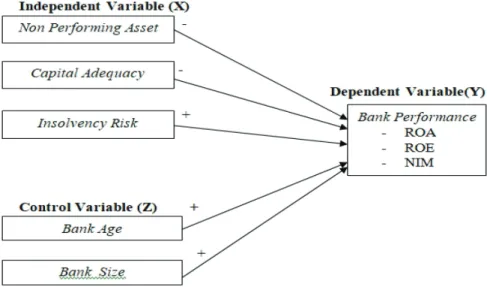
The study examines the impact of bank-level factors like non-performing assets, capital adequacy, and insolvency risk on bank performance.
This study employs a quantitative method with panel data regression. The data was taken from the annual financial statements of state-owned commercial banks and private commercial banks in Indonesia from 2015 to 2019 using a purposive sampling method with a total sample of 470 observations. The result of the study shows that non-performing assets (NPA) have a significant negative impact on bank performance.
Capital adequacy has a significant negative impact on bank performance. Insolvency risk for a bank means it cannot repay its depositors because its liabilities are greater than its assets; therefore, it has a significant impact on bank performance. This study is expected to help banks to understand how to manage the risks they face and to maintain their performance. This study uses ‘size’ and ‘age of bank’ as control variables and for credit risk and insolvency risk, Z-Score is used.
Keywords: Bank Performance, Non-Performing Asset, Capital Adequacy, Insolvency Risk JEL Classification Code: D22, D24, G01, G21, G32
of interest the banks collect on the loans is greater than the amount of interest they pay to customers with savings accounts—and the difference is the banks’ profit (Singh, 2015). The functions of banks include the payment system, financial intermediation, and financial services (Al-Qudah, 2020; Shah et al., 2020).
Banks are a financial intermediary—that is, an institution that operates between a saver who deposits money in a bank and a borrower who receives a loan from that bank.
Digitization is becoming the norm for credit processes.
Credit management is one of the most critical functions of any business. Advances in technology have transformed the credit management process in recent years making it more efficient and easier to manage. Many banks have made credit processes easier through digitization (Chabachib et al., 2020).
However, the ease and speed provided turns out to have its own risk where the loan interest is higher than the average bank credit interest; the higher the interest, the higher the credit risk. With higher interest rates, interest payments on loans are more expensive. Therefore, this discourages people from borrowing and spending. People who already have loans will have less disposable income because they spend more on interest payments (Rahman et al., 2020).
Credit risk refers to the risk of default or non-payment or non-adherence to contractual obligations by a borrower.
1
First Author and Corresponding Author. Department of Management, Faculty of Economics and Business, Diponegoro University, Indonesia [Postal Address: Jl. Prof. Soedharto SH Tembalang, Semarang 50239, Indonesia]
Email: [email protected]
2
Department of Management, Faculty of Economics and Business, Diponegoro University, Indonesia. Email: [email protected]
3
Department of Accounting, Faculty of Economics and Business, Universitas Dian Nuswantoro, Indonesia.
Email: [email protected]
© Copyright: The Author(s)
This is an Open Access article distributed under the terms of the Creative Commons Attribution Non-Commercial License (https://creativecommons.org/licenses/by-nc/4.0/) which permits unrestricted non-commercial use, distribution, and reproduction in any medium, provided the original work is properly cited.