Print ISSN: 2288-4637 / Online ISSN 2288-4645 doi:10.13106/jafeb.2021.vol8.no7.0625
How Social Intelligence, Integrity, and Self-efficacy Affect Job Satisfaction: Empirical Evidence from Indonesia
Moh. ALIFUDDIN
1, Widodo WIDODO
2Received: March 30, 2021 Revised: June 07, 2021 Accepted: June 17, 2021
Abstract
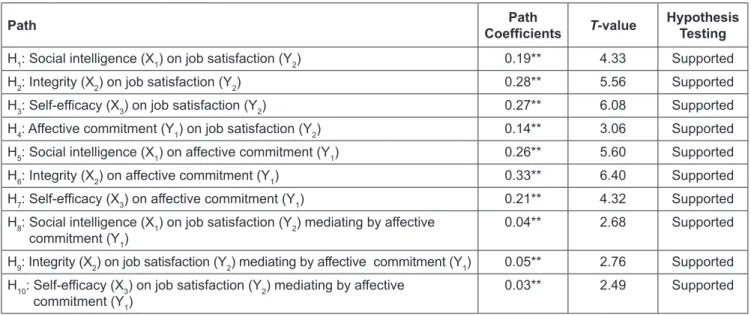
The study aims to explore the empirical effect of social intelligence, integrity, self-efficacy, and affective commitment on job satisfaction, and also to prove the theoretical model regarding affective commitment as a mediator between social intelligence, integrity, self-efficacy, and job satisfaction. This research uses a quantitative approach to the survey method through a Likert scale model questionnaire. The questionnaire for all research variables is reliable with an alpha coefficient > 0.7. The research participants are comprised of 386 teachers in Indonesia selected by accidental sampling. Data analysis uses path analysis supported by descriptive statistics and correlational matrices.
The research results indicate that social intelligence, integrity, self-efficacy, and affective commitment have a significant effect on job satisfaction. Besides, affective commitment also indirectly mediates the effect of social intelligence, integrity, and self-efficacy on job satisfaction. Thus, a new model regarding the effect of social intelligence, integrity, and self-efficacy on job satisfaction mediating by affective commitment was confirmed. The research suggested that the teachers’ job satisfaction can improve through social intelligence, integrity, self-efficacy, and affective commitment. Therefore, researchers and practitioners can adopt a new empirical model to enhance job satisfaction through social intelligence, integrity, self-efficacy, and affective commitment in the future.
Keywords: Social Intelligence, Integrity, Self-Efficacy, Affective Commitment, Job Satisfaction JEL Classification Code: D23, J24, J28, M12, M14
(e.g., Motalebi & Marşap, 2020; Moestain, Hamidah,
& Kadir, 2020; Gustari & Widodo, 2020). Besides, job satisfaction also influences productivity (Embuldeniya, 2017) and performance (e.g., Oravee, Zayum, & Kokona, 2018; Abdulkhaliq, & Mohammadali, 2019; Ngo, 2021), including organizational performance (e.g., Bakotić, 2016;
Miah, 2018). Moreover, job satisfaction is also related to burnout (Khare & Kamalian, 2017) and turnover among employees (e.g., Liu et al., 2019; Romeo, Yepes-Baldó, &
Lins, 2020; Effendi et al., 2021). The studies proved that job satisfaction affects organizational conditions at various levels, both at the individual, group, and organizational levels. Under these conditions, the study of job satisfaction will become increasingly important in the future, especially when employees at various levels of the organization need job satisfaction as capital to build innovative behavior, productivity, and performance needed by organizations to survive and compete.
According to Spector (1997), job satisfaction refers to how people feel about their work and various aspects of their work. The extent to which people like (satisfied) and dislike (dissatisfied) their work or job situation matters (Weiss, 2002).
1
First Author. Senior Lecturer, STMIK Handayani, Makassar, Indonesia. Email: [email protected]
2
Corresponding Author. Senior Lecturer, Department of Social Science Education, Postgraduate Faculty, Universitas Indraprasta PGRI, Jakarta, Indonesia [Postal Address: Jl. Nangka Raya No.
58 C, RT. 5/RW. 5, Tanjung Barat, Kecamatan Jagakarsa, Jakarta Selatan, Daerah Khusus Ibukota Jakarta 12530, Indonesia]
Email: [email protected]
© Copyright: The Author(s)
This is an Open Access article distributed under the terms of the Creative Commons Attribution Non-Commercial License (https://creativecommons.org/licenses/by-nc/4.0/) which permits unrestricted non-commercial use, distribution, and reproduction in any medium, provided the original work is properly cited.