Print ISSN: 2288-4637 / Online ISSN 2288-4645 doi:10.13106/jafeb.2021.vol8.no5.1019
The Impact of Psychological Climate and Self-Resilience on Employee Performance During the COVID-19 Pandemic:
An Empirical Study in Indonesia*
Andriyastuti SURATMAN 1 , Suhartini SUHARTINI 2 , Majang PALUPI 3 , Fereshti Nurdiana DIHAN 4 , Muhammad Bakr MUHLISON 5
Received: February 10, 2021 Revised: April 05, 2021 Accepted: April 15, 2021
Abstract
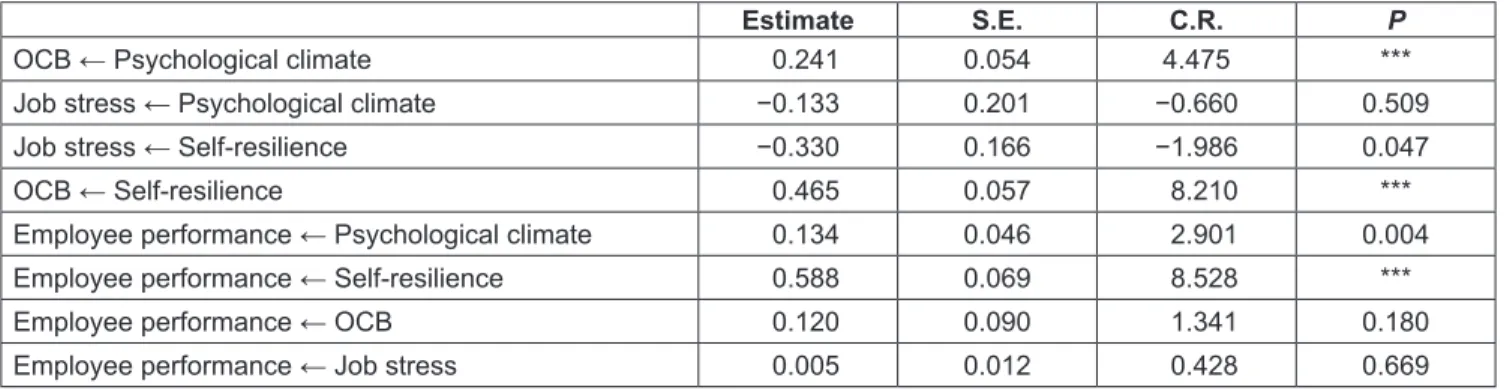
The study aims to investigate the impact of psychological climate, self-resilience, Organizational Citizenship Behaviour (OCB) and job stress on employee performance during Covid-19 pandemic. This paper also attempts to find out the mediating role of OCB and job stress in this context. A confirmatory survey was conducted on 316 employees of several institutions in Indonesia who worked from home during Covid-19 for a minimum period of 2 months. The research revealed that 1) PC has significant and positive influence on OCB and performance; 2) Self resilience have positive and significant influence on performance; 3) PC and self-resilience have a negative influence on job stress; 4) there are insignificant relationship between self-resilience on OCB; OCB and job stress on performance; 5) PC and self-resilience have no indirect influence on performance through OCB and job stress. The findings of this study reveal that organizations expected to have strategic approach in order to handle Covid-19 pandemic in different work patterns that are required to carry out routine office tasks from home, including handling stress as a fast adaptation for both employees and organizations that have a routine task from home.
Keywords: Psychological Climate, Self-Resilience, Organizational Citizenship Behaviour, Job Stress JEL Classification Code: D23, L84, M10, M12, M54
1. Introduction
The dynamic workplaces need to adapt to the fast pace of technology and must have the work culture in order to deal with the challenges at the work place, including facing unpleasant situations (Meymand et al., 2017). Organizations seek stability that comes from a resilient workforce in an often volatile business environment (Varshney & Varshney, 2017). Especially in anticipation of the Covid-19 pandemic, according to the WHO’s report, was the first confirmed case in China on December 8, 2019. This change has been associated with different negative implications and several positive things as some professionals find it more flexible and comfortable to work remotely (Khudhair et al., 2020). The dramatic changes caused by Covid-19 have unprecedented implications for companies worldwide and profoundly impact human resource management (Gigauri, 2020). The situation during the Covid-19 was undoubtedly felt by most organizations at various levels in many countries require decisive and drastic measures to prevent massive transmission throughout life, including by education (Tanveer et al., 2020).
*Acknowledgements:
1
We also acknowledge and thank the Management Development Center (Pusat Pengembangan Manajemen), Faculty of Business and Economics, Universitas Islam Indonesia (PPM FBE UII) for financial support (research grant) for this study.
1
First Author and Corresponding Author. Lecturer, Department of Management, Faculty of Business and Economics, Universitas Islam Indonesia, Indonesia [Postal Address: Ring Road Lor, Condong Catur, Depok, Sleman, DI Yogyakarta, 55283, Indonesia]
Email: [email protected]
2
Associate Professor, Department of Management, Faculty of Business and Economics, Universitas Islam Indonesia, Indonesia.
Email: [email protected]
3
Assistant Professor, Department of Management, Faculty of Business and Economics, Universitas Islam Indonesia, Indonesia.
Email: [email protected]
4
Associate Professor, Department of Management, Faculty of Business and Economics, Universitas Islam Indonesia, Indonesia.
Email: [email protected]
5