J Environ Health Sci, 2011: 37(2): 124-132
식품폐수 처리 공정용 생물막의 겨울철 세균군집 구조와 특성
이동근†·유기환*·박성주**
신라대학교 의생명과학대학 제약공학과, *국립수산과학원 생명공학연구단,
**대전대학교 임상병리학과
Structure and Characteristics of Bacterial Community on Biofilm of Food Wastewater Treatment System in Winter
Dong-Geun Lee†, Ki-Hwan Yoo*, and Seong Joo Park**
Department of Pharmaceutical Engineering, College of Medical Life Science, Silla University, Busan, Korea
*Biotechnology Research Division, National Fisheries Research & Development Institute, Busan, Korea
**Department of Biomedical Laboratory Science, Daejeon University, Daejeon, Korea
ABSTRACT
Biofilm and aeration tank of pilot and full RABC (rotating activated Bacillus contactor) plant were analyzed to characterize and determine bacterial community structure in food wastewater treatment system at winter.
Concentration of heterotrophic bacteria and Bacillus group was 107 and 105 CFU/ml, respectively, at biofilm of pilot-plant while others represented 106 and 104 CFU/ml, respectively. Five and eight phyla were detected at biofilm of pilot- and full-plant, respectively, by 16S rDNA sequencing. Biofilm of pilot-plant was dominated by β- Proteobacteria (38.8%), γ-Proteobacteria (22.4%), and Bacteroidetes (12.2%), and the most dominant genus was Zoogloeae genus (22.4%). Candidate division TM7 (12.5%) was only detected at biofilm of full-plant and it was dominated by Bacteroidetes (33.3%), γ-Proteobacteria (29.2%), and β-Proteobacteria (20.8%). Clostridium genus specific primer set enabled to detect the sequences of Clostridium genus. These suggested that anaerobic and aerobic bacteria were coexisted even from the initial period of biofilm formation and β-Proteobacteria, γ-Proteobacteria and Bacteroidetes were major phyla in biofilm of food wastewater treatment system at winter.
Key words: Bacterial community, Biofilm, Food wastewater, RABC, 16S rDNA I. 서 론
미생물의 활성을 이용한 생물학적 하폐수처리는 폭기조와침전지로구성된활성슬러지공정이널리 사용되어왔다
.
활성슬리지법은처리수의수질이비교적양호하며부산물에의한오염이적다는장점이 있지만 유지관리
,
운전비용,
슬러지 발생량 등에서문제가있다
.
1)또한총질소제거율이10~20%
에지나지않는단점이있는데
,
2)2008
년부터시행된호소등의부영양화방지를위한공공하수처리시설의방
류수수질기준이강화됨에따라3)활성슬러지공정이 아닌고도처리공법의도입이불가피하게되었다
.
고도처리공정으로서
BNR(Biological Nutrient Removal)
4), B3(Bio Best Bacillus),
5)A2O(Anaerobic-Anoxic- Oxic)
6) 등에관한연구보고가있었다.
단위용적당미생물수를높일수있는생물막을활용하는담체공 법은담체표면에부착된미생물응집체
(aggregation)
에 의한 생물학적분해 작용으로 인하여 하폐수에 포함된오염물질의제거가잘되어체류시간을줄일 수있고수처리의안정성확보가가능하다
.
7,8)†Corresponding author: Department of Pharmaceutical Engineering, College of Medical Life Science, Silla University, Busan 617-736, Korea, Tel: +82-51-999-6282, Fax: +82-51-999-5636, E-mail: [email protected]
Received: 25 January 2011, Revised: 21 February 2011, Accepted: 22 March 2011
[ 원 저 ]
담체공법인 회전접촉장치
(Rotating Biological Contactor, RBC)
와 점감폭기법의 결합인Rotating Activated Bacillus Contactors(RABC)
공정은Bacillus속세균을비롯한내생포자형성세균집단을이용하며 난분해성유기물과악취성분제거능이우수한것으
로 보고되고 있다
.
9,10) 점감폭기법은 에너지 소모가적고
,
생물반응조에호기성조건,
혐기적조건,
무산소적조건을구현할 수있어질소
,
인 제거의효율을높일 수있다
.
9,10)인간의 삶과 밀접한 수계의 보건 및 환경유지에 중요한 하폐수처리 공정에서 미생물군집이 중요한
역할을 수행하며11)
RABC
공정에서오염물 제거는주로생물막처리단계에서이루어지므로9)생물막을 구성하는 미생물군집의구조파악은 필요하다
.
동일한
RABC
공정이라도처리대상오수의종류에따라미생물군집의차이가생길수있으며실제로동일한 공정이지만도시하수와 식품폐수처리 공정에서서 로다른군집구조가 보고되었다
.
10,12)일반적으로 기온이떨어지는겨울은미생물의활성도 감소하므로 폐수처리공정에서중요한미생물군집에 대한겨울 철조사도필요할것이다
.
한편Jeong
등13)은pilot-
plant
에서의군집구조만보고하여실제운전에사용된
full-plant
와군집구조에서차이를 보일가능성이있다
.
이에본연구의목적은수질보전을위한식품폐수처리
RABC
공정에서중요한역할을수행하는생물막에 형성된 세균군집구조와 특성을 겨울철에 파악하는것이었고더불어동일한식품폐수를처리 하는
pilot-plant
와full-plant
의생물막에형성된세균군집을도시하수처리용
RABC
생물막의세균군집과10)비교하였다
.
II. 연구방법 1. 처리시스템및 시료채취
연구에사용된
plant
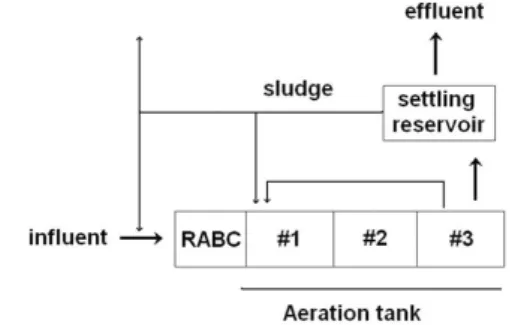
의 구조를Fig. 1
에나타내었다
. Pilot-plant
공정과 공장폐수실처리용full-plant
공정의기본구조는유사하였다
.
폐수는생물막,
폭기조
1-2-3
순서로 처리되며용존산소농도는생물막에서
0.5~1.0 ppm
사이이며폭기조(aeration tank)
에서는점감식폭기방식으로운영하여폭기조
1
에서1.0~1.5 ppm,
폭기조2
에서0.4~0.5 ppm,
폭기조3
에서
0.1~0.2 ppm
범위였다. Pilot-plant
공정의폐수처리용량은
0.5 m
3/day
규모였고, full-plant
공정의폐수처리용량은
1300 m
3/day
규모였다. Pilot-plant
와full-plant
공정의생물막모두동일분뇨처리장의슬러지케이크를식종원으로사용하였고 동일한돼지 도축폐수를유입수로사용하였다
. 2007
년2
월초에시료를 채취하였는데
pilot-plant
공정은 접종 후3
일째였고full-plant
공정은접종 후45
일 정도소요된상태였다
.
냉장상태로6
시간 이내에 실험실로운송한생물막 시료의일부를 초저온냉동
(
−65
oC)
하여미생물군집의변화를최소화하였고생물막시료 일부와폭기조
1
의시료는세균계수용으로사용하였다.
2. 세균탈착과 배양계수
시료를손으로
3
분이상아주세게흔들면서교반하여잘섞은후시료
5.0 m
l씩을멸균된45.0 m
l의0.85% NaCl
희석수가 담긴falcon tube
에 넣었다.
세균탈착과정은교반
(vortexing) 1
분,
얼음에꽂아두기
1
분,
초음파세척(Branson sonicator 7150, USA) 1
분,
얼음에 꽂아두기1
분의 총4
단계로 거쳤다.
14)세균탈착과정을 연속적으로
3
회 실시한 후에 시료침전물과세포가함유된상층액을분리하기위해원 심분리하였다
(1000
×g, 2
분).
세균탈착액을희석수로연속희석한후에 Bacillus그룹세균과호기성종속 영양세균의 농도를 측정하였다
.
연속희석된 시료를Bacillus 선택배지
(Fluka #11703)
와TSA
한천배지(Tryptic Soy agar media, Difco)
에도말하였고37
oC
에서
48
시간배양한 후에생성된 세균집락(colony)
을계수하였다
.
3. 세균군집구조 분석
생물막 시료의 세포벽파괴와
DNA
추출 그리고Fig. 1.Schematic diagram of wastewater treatment system.
PCR
은각 시료에 대해duplicate
로 실시하였다.
냉동 보관한 시료
1.0 m
l을 취하여eppendorf tube
에넣고
14000
×g에서5
분간 원심분리한 후에 상층액을버리고
pellet
을취하였다.
세포벽파괴를위하여eppendorf tube
를parafilm
으로 밀봉하고,
−75
oC
에보관된
99%
에탄올용액에담궈10
분간냉동하고,
80
oC
에서3
분간처리하는 과정을 총3
회 반복하였다
. Genomic DNA
추출을 위하여Mo-Bio
회사(USA)
의PowerMax Soil DNA Isolation Kit
를이용하였다
. PCR primer
는bacterial universal primer,
호기성포자생성세균인 Bacillus 속특이
primer,
혐기성 포자생성세균인 Clostridium속 특이
primer set
등총
3
종을이용하였다(Table 1). PCR
반응액의조성은
10X Pyrobest buffer 2.5
µl, 2.5 mM each deoxynucleoside triphosphate(dNTPs) 2
µl, 10 pM each oligonucleotide primer 1
µl, genomic DNA 2
µl, 2U of Pyrobest(Takara)
였으며 멸균된 무이온증류수
(deionized distilled water)
를 첨가하여 최종25
µl로하였다. PCR
반응조건은94
oC
에서5
분간전처리한 후
denaturation(94
oC), annealing(Table 1), extension(72
oC)
과정을35
회반복하였고 각과정을1
분간처리하였다.
마지막으로72
oC
에서10
분간final extension
을 하였다. PCR
반응에는Perkin Elmer Geneamp 2400 PCR System
을이용하였고PCR
반응물은
4
oC
에서보관하였다.
형질전환 및 형질전환체의 확인은 전반적으로
Sambrook
등15)을 따랐다.
배양한 재조합 군체를14000
×g, 3
분의 원심분리로 회수한 후, Quiagen plasmid purification kit
를이용하여재조합플라스미드를 추출
,
정제하였다.
정제가완료된재조합플라스미드를서열결정 전문회사인솔젠트
(
주)
에의뢰하여재조합된
16S rDNA
염기서열을결정하였다.
4. 염기서열 분석
솔젠트
(
주)
으로부터얻은16S rDNA
의염기서열을BLAST(http://www.ncbi.nlm.nih.gov/BLAST)
를이용하여
GenBank
에있는염기서열정보와비교하였다.
III. 결과 및 고찰 1. 배양 계수 및 처리효율
Table 2
는 배양법으로 파악한 종속영양세균과Bacillus 속의농도그리고 Bacillus 속세균의비율 을 나타내는 표이다
.
종속영양세균은pilot-plant
만10
7CFU/m
l수준이었고나머지는10
6CFU/m
l수준 이었다.
Bacillus속은10
4내지10
5CFU/m
l수준으 로파악되었다.
종속영양세균과 비교한 Bacillus속의비율은모든시료가
1.0%
이하로낮게나타났다.
Pilot-plant
생물막이 Bacillus속세균과종속영양세 균의농도가다른시료들에비해m
l 당1 order
정도높은값을보였고다른시료들은유사하였다
.
종속영양세균에대한 Bacillus속세균의농도는처리
대상 폐수의 수질과 계절에 따라
0.1%
이하에서34.0%
까지다양하였고 본 연구결과와 같이겨울에가장낮았다
.
12) Bacillus속과같은포자생성균은영 양분의 결핍이나DO
농도가 낮으면 내생포자(endospore)
를형성하고성장에필요한조건이다시형성되면 포자가 발아하여 영양세포로 성장하며
RABC
공정에서중요한역할을수행한다.
9)Table 2
의 Bacillus 속세균의농도는 Bacillus배지위에서 도말
(loading)
법을적용한후성장한세균집락(colony)
을종류별로분류하고계수한후에
,
각콜로니종류별로 순수분리한 세균을 대상으로
27F-1492R
의bacterial universal primer set
을적용하여16S rDNA
를증폭시킨후에염기서열을분석한결과를바탕으 Table 1.Sequence, position to E. coli 16S rRNA, size of PCR product (base pairs, b.p.) and annealing temperature (oC)
of used primer set for polymerase chain reaction
Primer set Primer Sequence Primer Positionvs
E. coli 16S rRNA† PCR Product
(b.p.) Annealing Temperature (oC) Bacterial universal 5'-AGAGTTTGATCMTGGCTCAG5'-GGYTACCTTGTTACGACTT 27F 1492R ~1480 50.0
Bacillus specific 5'-TCACCAAGGCRACGATGCG5'-CGTATTCACCGCGGCATG 255F 1350R ~1095 63.0 Clostridium specific 5'-CTCAACTTGGGTGCTGCATTT5'-ATTGTAGTACGTGTGTAGCCC 586F 1205R ~619 60.0
로계수한것으로
,
크기2 mm
이상의흰색혹은노란색세균집락이 Bacillus속으로파악되었다
.
12)처리대상식품폐수는시료채취월인
2007
년2
월에는
BOD 2000 mg/
l, TN 250 mg/
l, TP 50 mg/
l 수 준이었고2005
년1
월부터2007
년2
월까지의 평균BOD
는1899 mg/
l, TN
은309 mg/
l, TP
는83 mg/
l이 었다.
12)Full-plant
는평균적으로유입수의BOD 99.6%, TN
96.9%, TP 98.2 %
를제거하였고시료채취월에도유사하였다
. Pilot-plant
에서도오염물제거능이우수하여 전체 공정을 거친 후
SCOD 91.4%, NH
3-N
97.9%, PO
4-P 96.8%
가 제거되었고TN
의97.6%
와TP
의96.4%
가 제거되었는데12) 이러한 처리효율은DNR(Daewoo Nutrient Removal)
공정의TN 67.8%, TP 80.6%
에비해15.8%
이상높은것이었다.
2)Shin
등도미생물의생물막형성에도움을주는메디아의 첨가가하수의 질소제거효율은 많이증진시킨다고 보고하였다
.
1)일반RBC
반응조의생물막두께가1- 2 mm
인데 비하여RABC full-plant
공정의 생물막두께가
30-40 mm
로미생물이고농도이며다양한생물상에의해
COD
및인산염의제거와질산화가활발하게일어나는것이라고판단되었으며
pilot-plant
와
full-plant
모두우수한악취제거능을보고하였다.
12)2. 세균군집구조
RABC
공정의오염물처리에서중요한역할을수행하는생물막에형성된 세균군집구조를
Table 1
의bacterial universal primer set
를적용한후16S rDNA
염기서열결정으로파악한결과를
Table 3
에나타내었다
. Chimera
등을제외하고 분석에 사용된 염기서열의수는
pilot-plant
와full-plant
생물막각각49
개와
48
개였다.
본연구수행당시와달리최근에는NGS(next generation sequencing)
기술의발달로예전보다저렴하게훨씬많은수의
16S rDNA
유전자분석이가능하므로즉많은수의염기서열을이용할 수있으므로향후 미생물군집연구에유용할것으 로사료된다
.
검출된문(phylum)
의수를보면pilot- plant
가8
개, full-plant
가5
개로full-plant
의군집구조가단순화된것으로파악되었다
. Full-plant
에서는특별히많이관찰된 속
(genus)
이 없었지만pilot-plant
에서가장많이관찰된속은 β
-
Proteobacteria에속 하는Zoogloea속으로전체군집의22.4%
를차지하였다
.
Zoogloea속은생물막 형성에서중요한역할을수행하고16) 도시하수처리17)에서풍부하게존재하 며 윤활유를 분해하는 능력 등을 가지는 것18)으로 보고되고있어오염물질분해에도관여하는것을알 수있었다
.
Table 3
을보면pilot-plant
생물막에서가장우점한그룹은β
-
Proteobacteria(38.8%)
였고 γ-
Proteobacteria(22.4%),
Bacteroidetes(12.2%)
순서였고Full-plant
생물막은 Bacteroidetes
(33.3%)
가 가장 우점하였고γ
-
Proteobacteria(29.2%),
β-
Proteobacteria(20.8%), candidate division TM7(12.5%)
순서였다.
생물학적폐수처리공정에서세균군집은대부분유기물농도 가 높은 환경에서 유리한 β
-
Proteobacteria와 γ-
Proteobacteria가최대군집이란보고와함께19,20)식 품 폐수처리에서는 Firmicutes도 주요군집으로보 고되었다.
21)Park
등은도시하수를처리하는RABC
공정에서 Firmicutes가
43.9%
로 가장 우점하였고 Bacteroidetes(17.6%)
와 β-
Proteobacteria(14.3%)
가우점하고 있다고 보고하였다
.
10) 동일한 식품폐수를처리했던
pilot-plant
와full-plant
의 생물막을구성하는세균군집구조가차이를 보인원인은첫째가동 시간의차이로판단되었다
.
동일한생물막도시간에따라 파악되는 세균의 종류가 달라지는데13)
pilot- plant
는가동3
일째였고full-plant
는가동45
일정도Table 2.Numbers of Bacillus and heterotrophic bacteria (CFU/ml) and ratio of Bacillus (%) in biofilm and wastewater of aeration tank 1 of pilot- and full-plant
Sample No. of Bacillus
(A) No. of heterotrophic
bacteria (B) % of Bacillus (A/B×100)
Pilot-plant Biofilm 1.0×10⁵ 1.3×10⁷ 0.76
Aeration tank 1 3.0×10⁴ 9.3×10⁶ 0.32
Full-plant Biofilm 6.0×10⁴ 9.8×10⁶ 0.61
Aeration tank 1 5.0×10⁴ 6.4×10⁶ 0.78
가지난후에시료를채취하였다
.
그리고생물막처리단계에서의체류시간은
pilot-plant
가4.5
시간full-
plant
가0.23
시간이었는데 이러한 운전조건의 차이등도영향을줄수있었을것으로판단되었다
.
원활한운전이 되는
full-plant
생물막에서만관찰된
candidate division TM7
은현재까지배양된균주가 없는세균군집으로
,
다양한환경에서발견되는그람양성세균으로분류가불완전하며간균
,
구균,
사상균등 다양한 형태가있고
,
일부는하수처리에서는슬러지 팽화현상을일으킨다고보고되었다
.
22,23)또한
Jeong
등도pilot-plant
의 운전 안정화 단계에서
candidate division TM7
이우점한다고보고하여13)실제 원활한 운전이 되는
full-plant
에서 검출된 본연구와일치하였다
.
Jeong
등13)은 돼지도축 폐수를 유입수로 사용한RABC
공정에서27F
와785R primer set
를 이용하여생물막의세균군집을 공정가동
1, 13, 27, 125
일째등총
4
번분석하였는데Bacteroidetes가공정 가동1
일째30%
이상에서27
일째까지감소하다가125
일째최대군집으로50%
를차지한다고보고하였는데
,
본 연구에서는pilot-plant
생물막에서12.2%
검출되었고
full-plant
생물막에서33.3%
검출되었다(Table 3). Jeong
등은 호기와 혐기환경의 반복이Bacteroidetes의우점과 연관이 있는것으로보고하 였다
.
13)RABC
공정의생물막을대상으로본연구와동일Table 3.Comparison of bacterial communities in biofilms of the RABC process for the treatment of food wastewater and municipal wastewater
Phylum Class Order
(Family)
Municipal wastewater (Park et al. 2007)12)
This study Pilot-plant Full-plant
% % %
Firmicutes
Clostridia Clostridiales 40.6 2.0
Bacilli Bacillales 2.2
Lactobacillales 1.1 2.0
sum 3.3 2.0
Sum 43.9 4.0
Bacteroidetes 17.6 12.2 33.3
Proteobacteria
Gammaproteobacteria 8.8 22.4 29.2
Betaproteobacteria 14.3 38.8 20.8
Alphaproteobacteria 4.4 2.0
Deltaproteobacteria 1.1
Sum 28.6
Actinobacteria Actinobacteria 1.1
Nitrospirae Nitrospira Nitrospirales 1.1
Planctomycetes 4.4
Verrucmicrobia 1.1
Chloroflexi Dehalococcoidetes 2.0 2.1
Acidobacteria Acidobacteria Acidobacteriales 4.0
Chlorobi Chlorobia Chlorobiales 2.2 4.0
Fusobacteria Fusobacteriales
Cyanobacteria 2.0
Candidate division TM7 4.0 12.5
Environmental samples 4.0 2.1
Total 100.0 100 100
한
PCR
조건과primer set
을사용한연구는Park
등과
Sung
의 보고가 있었다.
10,26)Park
등은도시하수처리공정의생물막을봄에분석하여내생포자를형 성하는 Firmicutes 문의 비율이
43.9%
였는데10) 본연구에서는 낮았다
(Table 3). Sung
은 본 연구와 동일한
full-plant
생물막을 여름에 분석하여 β-
Proteobacteria
(32%)
가가장우점하였고내생포자형성세균의 비율이
17.3%
였으며 Actinobacteria 문의비율이
18.3%
라고 밝혔는데26) 본 연구에서는 전혀검출되지않았다
.
따라서겨울에도full-plant RABC
의식품폐수처리효율이높았지만12)내생포자형성세 균의비율이낮은원인에계절적 요인도있음을암 시하는 것으로판단되었다
.
본 연구에서사용된 시료의수가적어일반화시키기는어렵지만
,
이러한결과는향후연구를위한 토대로는충분할것으로판 단되었다
.
도시하수처리용
RABC
공정의생물막을구성하는세균군집의
40%
이상이혐기성이며 내생포자를형성하는 Clostridia 강
(class)
이고 호기성이며 내생포자를형성하는 Bacillus속을포함하는 Bacilli 강은
3.3%
였다.
10)본연구도full-plant
생물막시료에27F- 1492R primer set
를 적용하였지만 Clostridia 강과Bacilli 강에속하는 염기서열이 전혀발견되지 않
았으며
pilot-plant
생물막에서 Clostridia 강과 Lactobacilli강에속하는염기서열이각각2%
발견되었다
(Table 3).
하지만 배양법에서1%
미만의 Bacillus 속 세균이 검출되었고(Table 2)
Clostridia 강에 속하는 염기서열도 일부만 검출되었다(Table
3).
이러한결과가이들세균이존재하지않아서나타나는것인지확인하기위하여 Firmicutes문에속
하는Bacillus속24)과Clostridium속25)만특이적으로 증폭시킨다고보고된
primer set(Table 1)
을 사용한결과를
Table 4
와5
에나타내었다. PCR
산물은pilot- plant
와full-plant
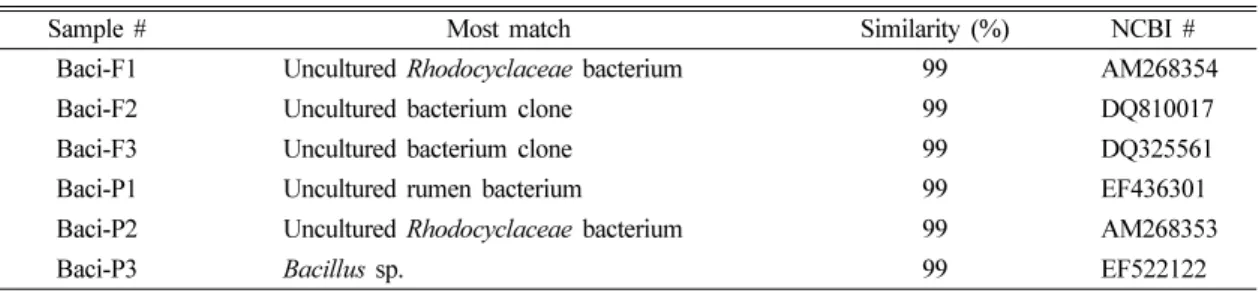
생물막에서모두검출되었으며형질변환후각각동일한수만큼염기서열을결정하 였다
. Wu
등24)이 호기성 포자생성균인 Bacillus속 에 특이적이라고보고했던primer set
은 본 연구에서는특이성이높지않아분석대상
6
개의염기서열중
1
개의 염기서열만 Bacillus 속의16S rDNA
염기서열과 가장 유사하였다
(Table 4).
한편Rekha
등25)이혐기성포자생성균인 Clostridium속에 특이
적이라고보고했던
primer set
은 본 연구에서 분석대상
14
개의 염기서열 모두가 Clostridium 속이나 Clostridiales과의염기서열과유사도가가장높았다(Table 5). Full-plant
생물막 시료의27F-1492R primer set
에서전혀검출되지않았던 Clostridium 속 이pilot-plant
와full-plant
에서공통적으로검출되었다
(Table 3, 5).
이는 Clostridium속등포자생성균 이연구대상시료에존재할가능성이높음을나타내 는것이며생물막형성초기에호기성인Zoogloea속 세균 등과 혐기성인 Bacteroidetes,
Clostridium 속 등이공존함을나타내는것으로판단된다.
실제로개선된
full-plant RABC
공정의 생물막을 대상으로2008
년1
월, 4
월, 5
월3
회의배양을통한생물막분석에서
m
l당 Clostridium 속이10
7~10
9CFU/m
l이 고 Bacillus속이10
6~10
8CFU/m
l이었다.
12)Lim
등27)은 절삭유로 오염된 지하수를 처리하는생물활성탄상에생성된미생물군집분석에
quinone
법을 시도하여 오염물질의 분해가 원활한 위치는 파악하였지만 정확한 세균을 동정할 수는 없었다
. Seo
등28)은시흥천의미생물군집을PCR-DGGE
로조사하여공단지역상류와하류가미생물 군집구조 가 완전히 다르며 비교적 적은수인
10
개의DNA
band
에대해염기서열분석만을수행하여정확한군Table 4.Identified Bacillus genus sequences derived from the PCR product of Bacillus-specific primer set (Table 1).
F1~F7 and P1-P7 sequences were originated from biofilm of full- and pilot-plant, respectively
Sample # Most match Similarity (%) NCBI #
Baci-F1 Uncultured Rhodocyclaceae bacterium 99 AM268354
Baci-F2 Uncultured bacterium clone 99 DQ810017
Baci-F3 Uncultured bacterium clone 99 DQ325561
Baci-P1 Uncultured rumen bacterium 99 EF436301
Baci-P2 Uncultured Rhodocyclaceae bacterium 99 AM268353
Baci-P3 Bacillus sp. 99 EF522122
집구조를 분석할 수 없었다
. FISH(fluorescent
in situhybridization)
법을 이용하여retrofitting BNR (Biological Nutrient Removal)
공정의하수처리장에β
-
Proteobacteria가 우점이며 Bacillus 속의 비율은1%
미만이라는 보고도 있었지만29)FISH
법은잡종화
(hybridization)
에서생기는가짜양성(false-positive)
등의한계가있다
. Jeong
등은T-RFLP
분석으로폐수처리장치의 가동초기와 안정화 단계의 세균군집 구조가 다르다고 보고하면서 염기서열분석을 추가 하여동정하였다
.
13) 본연구와 같이16S rDNA
염기서열을 분석하는 것은시간과 비용이 많이든다 는 한계를 상쇄하여 정확한 분석과 동정이 가능하 다는장점이있지만사용된
primer
의종류, PCR
반응 온도와
cycle
수,
주형속에포함된 부식질 등에의한효과등 여러변수가
PCR-cloning
결과에 영향을미쳐군집구조의오차가발생한다고알려져있 다
.
30)RABC
공정을 대상으로 한 본 연구와Park
등10) 및
Jeong
등13)의 보고를 비교하면 본 연구와Park
등10)의 연구에서 사용한primer set
은Jeong
등13)의 연구와 차이가있었고
DNA
추출,
정제 과정은모두달랐다
.
IV. 결 론
돈도축식품폐수실처리용
full-plant
공정과pilot-
plant
공정의시료에대한배양과군집구조분석으로다음과같은결론을 얻었다
.
1.
생물막과폭기조시료속에포함된Bacillus속은10
4~10
5CFU/m
l 수준이고종속영양세균은10
6~10
7CFU/ml
수준으로 Bacillus속의비율은1%
미만이었는데이는겨울철낮은온도에의한기존결과와 상응하는것이었다
.
2.
배양없이추출한DNA
에대해27F-1492R primer set
를 이용한16S rDNA
분석법을적용한 결과가동시간이짧은
pilot-plant
생물막에서8
개문(phylum)
이
,
가동시간이비교적긴full-plant
생물막에서5
개문이검출되어
full-plant
의 생물막세균군집이단순한것으로판단되었다
.
3. Pilot-plant
에서가장우점한속(genus)
은Zoogloeae 속으로전체군집의22.4%
를차지하였고,
가장우점한종류는 β
-
Proteobacteria(38.8%)
였고 γ-
Proteobacteria(22.4%),
Bacteroidetes(12.2%)
의 순서였으며full- plant
에서는Bacteroidetes(33.3%)
가가장우점하였고γ
-
Proteobacteria(29.2%),
β-
Proteobacteria(20.8%), candidate division TM7(12.5%)
로순서로차이를보였으며
candidate division TM7
은full-plant
에서만우점하였다
.
4.
호기성 포자생성균인 Bacillus 속 세균 검출용primer set
는 특이성이낮았으며혐기성포자생성균인 Clostridium속세균검출용
primer set
는특이성Table 5.Identified Clostridium genus sequences derived from the PCR product of Clostridium-specific primer set (Table 1). F1~F7 and P1-P7 sequences were originated from biofilm of full- and pilot-plant, respectively
Sequence Most match Similarity (%) NCBI #
Clo-F1 Uncultured Clostridiales bacterium 93 DQ144105
Clo-F2 Clostridium sp. 99 AM117584
Clo-F3, F7 Clostridium sp. 99 DQ144101
Clo-F4 Clostridium sp. 98 DQ144101
Clo-F5 Clostridium sp. 99 AM042697
Clo-F6 Clostridium sp. 98 AM117583
Clo-P1 Clostridium sp. 99 AM042697
Clo-P2 Uncultured Clostridiales bacterium 98 DQ144105
Clo-P3 Uncultured Clostridiales bacterium 100 DQ144105
Clo-P4 Clostridium butyricum 99 DQ831126
Clo-P5 Clostridium butyricum 100 DQ831127
Clo-P6 Clostridium sp. 99 DQ144101
Clo-P7 Clostridium sp. 99 AM117584
이 매우 높았다.
5. Pilot-plant에서 호기성이며 생물막 형성에 관여 하는 Zoogloeae 속 세균과 혐기성인 Bacteroidetes 문과 Clostridium 속 세균의 염기서열이 함께 검출 된 것은 생물막의 형성 초기에 혐기성 조건의 형성 이 병행되는 것으로 판단되었다.
참고문헌
1. Shin MC, Lee YS. The effects of changing of hydraulic retention time and charging media on the removal of nitrogen and phosphorus in the up-flow anaerobic/anoxic reactor and water-mill for sewage treatment. J Environ Heallth Sci. 2009; 35(1): 64- 2. Choi JT, Nam SY. Sewage treatment using a mod-70.
ified DNR process. J Environ Heallth Sci. 2008;
34(6): 446-451.
3. Ministry of Enviornment Republic of Korea. 2008 White paper on environment. 2009.
4. Kim DS, Park YS. Nutrient removal characteriza- tion by the addition ratio of BNR sludge in SBR. J Environ Heallth Sci. 2008; 34(1): 76-85.
5. Ahn TS, Hong SH, Kim OS, Yoo JJ, Jeon SO, Choi SI. The changes of Bacillus spp. in municipal wastewater treatment plant with B3 process. Korean J Microbiol. 2001; 37(3): 209-213.
6. Park TJ, Lee CM, Song KS, Cho IH, Kim YK, Chung MH. A study on the removal of nitrogen and phosphorus depending on existence of cilia media in sewage in anaerobic-anoxic-oxic process. J Envi-
ron Heallth Sci. 2000; 26(3): 69-75.
7. Imai A, Onuma K, Inamori Y, Sudo R. Biodegra- dation and adsorption in refractory leachate treat- ment by the biological activated carbon fluidized bed process. Wat Res. 1995; 29(2): 687-694.
8. Kutics K, Suzuki M. Attachment and growth of biomass on surface-modified activated carbon fibers. Wat Sci Tech. 1992; 26(10): 665-671.
9. Kim EH, Jo YJ, Park SJ, Sin GS, Im SB, Jeong JG.
Advanced wastewater treatment process using rotat- ing activated Bacillus contactor (RABC). J KSWQ.
2004; 20(2): 190-195.
10. Park SJ, Yoon JC, Shin KS, Kim EH, Yim S, Cho YJ, Sung GM, Lee DG, Kim SB, Lee DU, Woo SH, Koopman B. Dominance of endospore-form- ing bacteria on a rotating activated bacillus contac- tor biofilm for advanced wastewater treatment. The
J Microbiol. 2007; 45(2): 113-121.
11. Forster S, Lappin-Scott HM, Snape JR, Porter J.
Rains, drains and active strains: towards online assessment of wastewater bacterial communities. J Microbiol Meth. 2003; 55(3): 859-864.
12. Ministry of Environment, Mechanistic Modeling for Bacillus System, 2008.
13. Jeong S, Nam JH, Bae W, Lee DH. Bacterial com- munity structure of food wastewater treatment sys- tem combined with rotating biological contactor and tapered aeration reactor. Korean J Microbiol. 2010;
46(2): 169-176.
14. Lee DG, Lee JH, Kim SJ. Diversity and dynamics of bacterial species in a biofilm at the end of the Seoul water distribution system. World J Microbiol Biotech. 2005; 21(2): 155-162.
15. Sambrook J, Fritsch EF, Maniatis T. Molecular cloning: A laboratory manual, 2nd Ed., Cold Spring Harbor Laboratory, New York; 1989.
16. Lu F, Lukasik J, Farrah SR. Immunological meth- ods for the study of Zoogloea strains in natural environments. Wat Res. 2001; 35(17): 4011-4018.
17. Rossell-Mora RA, Wagner M, Amann R, Schleifer KH. The abundance of Zoogloea ramigera in sew- age treatment plants. Appl Environ Microbiol. 1995;
61(2): 702-707.
18. Jin L, Wang XJ, Gu ZL, Zhou DZ, Xie SQ. Bio- degradation of lubricating oil in wastewater with
Zoogloea sp. Pedosphere. 2006; 16(4): 540-544.
19. Lee H, Choi E, Yun Z, Park YK. Microbial struc- ture and community of RBC biofilm removing nitrate and phosphorus from domestic wastewater. J
Microbiol Biotech. 2008; 18(8): 1459-1469.
20. Silva CC, Jesus EC, Torres AP, Sousa MP, Santi- ago VM, Oliveira, VM. Investigation of bacterial diversity in membrane bioreactor and conventional activated sludge processes from petroleum refiner- ies using phylogenetic and statistical approaches. J
Microbiol Biotech. 2010; 20(3): 447-459.
21. Ren N, Xing D, Rittmann BE, Zhao L, Xie T, Zhao X. Microbial community structure of ethanol type fermentation in bio-hydrogen production. Environ Microbiol. 2007; 9(5): 1112-1125.
22. Hugenholtz P, Tryson GW, Webb RI, Wagner AM, Blackall L.L. Investigation of candidate division TM7, a recently recognized major lineage of the domain Bacteria with no known pure-culture repre- sentatives. Appl Environ Microbiol. 2001; 67(1):
411-419.
23. Thomsen TR, Kjellerup BV, Nielsen JL. In situ studies of the phylogeny and physiology of filamen- tous bacteria with attached growth. Environ Micro-