Korean J. Breed. Sci. 50(4):522-528(2018. 12) https://doi.org/10.9787/KJBS.2018.50.4.522
쌀면전용 고아밀로스 중생 통일형 벼 ‘새미면’
조준현1⋅이종희1⋅박노봉1⋅손영보2⋅오성환3⋅한상익1⋅송유천1⋅서우덕1⋅박동수1⋅남민희1⋅이지윤1*
1국립식량과학원, 2경북농업기술원, 3농촌진흥청
‘Saemimyeon’, a Tongil-Type Medium-Late Maturing Rice Variety with High Amylose ContentUsed for Rice Noodle Preparation
Jun-Hyeon Cho1, Jong-Hee Lee1, No-Bong Park1, Young-Bo Son2, Sung-Hwan Oh3, Sang-Ik Han1, You-Chun Song1, Woo-Duck Seo1, Dong-Soo Park1, Min-Hee Nam1, and Ji-Yoon Lee1*
1
National Institute of Crop Science (NICS), RDA, Republic of Korea
2
Agricultural Research & Extension Services, Kyeongsangbuk-do, Daegu, Republic of Korea
3
Rural Development Administration, RDA, Jeonju, Republic of Korea
Abstract Saemimyeon, a Tongil type, medium-late maturing rice variety, is especially used for preparing rice noodles. Its high amylose content was developed to fit market demands and to be affordable for rice processing industries. One of the high yielding lines, Milyang181 (Hanareum), was used in the final three-way cross of IR50*2/YR18241-B-B-115-1-1 for yield improvement and cultivation stabilization, including disease resistance. YR24235-10-1-3, a high yielding and compact plant type, was selected and named Milyang278 after yield test at NICS (RDA, Miryang) in 2010. It was subjected to regional yield test at six sites in the middle and southern plain areas of South Korea. Saemimyeon heading occurs on August 12 and is a mid-late maturing cultivar, with resistance to leaf blast, rice stripe virus, and bacterial blight (K1-K3a), but it is susceptible to major diseases and insect pest infestation. Saemimyeon showed a high amylose content of 26.7%, with a relatively low KOH digestion value of 3.5, which are key factors in rice noodles and pasta processing. In the local adaptability tests, the yield of Saemimyeon was 7.08 MT/ha —an increase of approximately 106% compared to that of Dasan. Thus, Saemimyeon is suitable for cultivation in the southern and middle plain areas of South Korea.
Keywords Rice, Tongil type, Saemimyeon, High amylose, Rice noodles
Received on October 17, 2018. Revised on November 10, 2018. Accepted on November 12, 2018.
* Corresponding Author (E-mail: [email protected], Tel: +82-55-350-1164, Fax: +82-55-352-3059)
ⓒ 2018 by the Korean Society of Breeding Science
서 언
벼를 포함한 주요 재배 작물의 육종에서 수량성, 병해충 저항성 등 재배 안정성 및 유색미와 같은 목표형질 등이 품종의 기본요건 으로 대별될 수 있는데, 최근 들어 식문화 및 경제적 여건 변화에 따라 성인병 환자가 늘면서 다이어트에 효과적이며 다양한 생리 활성을 나타내는 식이섬유 및 인체에 필수영양소인 무기 성분 등 다양한 목표형질들에 대한 요구가 크게 증가되고 있다(Heo et al. 2017, Lee & Shin 2002). 특히, 해외 음식문화의 다양성과 함께 쌀국수 등 쌀 가공품에 대한 소비자 및 가공 전용 품종에 대한 산업체의 관심이 높아지고 있다(Kuk & Han 2010).
쌀에 대한 인식변화에도 불구하고 쌀을 이용한 가공 제품이 시장에서 크게 활성화 되지못한 것은 밀가루와 달리 가공 적성이
제한적이고 다양하지 못한 가공기술 등에 있다(Kim 2011, Lee
& Eun 2008). 쌀 가공에 중요한 전분의 이화학적 특성은 알카리 붕괴도, 아밀로스 함량, 아밀로그램 특성, 단백질 함량 등이 주요 한 인자로 작용한다(Choi et al. 2012, Kim et al. 2006, RDA 2017). 최근 국내에서도 전통식품에 주로 사용되는 찰벼 이외에 양조 등 일부 쌀 가공전용 품종들이 육성되어 보급되고 있으며 (Hong et al. 2011), 특히 밥쌀용 품종에 비해 상대적으로 아밀로 스함량이 높아 쌀국수 제조특성이 양호한 ‘새고아미’, ‘미면’
및 ‘팔방미’ 등 쌀면 전용품종들이 일부 육성되어 농가에 보급되 고 있다(RDA, http://www.nongsaro.go.kr). 그러나 현재까지의 쌀가공 전용품종들은 상대적으로 수량성이 낮아 원료곡의 가격 경쟁력이 취약하였다. 또한 병해충 저항성 등 재배 안정성이 부족하여 재배 농가에서 관리가 어려운 점이 많았다. 특히 다양한
Year '02 '03 '04 '05 '06 '07 '08 '09 '10 '11 '12 '13 '14
Gen. Cross F
1F
2F
3F
4F
5F
6F
7F
8F
9F
10F
11F
12Milyang181
× YR23766
YR24235 1
→
13 1
→
1350
1
→
39
①→
3
1
→
15
YR24235-10-1-3 → Saemimyeon
No. of pedigree (plants)
51 (13) 1350 39 3 15
Note Bulk Pedigree OYT
z← RYT
y→ ←LAT
xYR23766: IR50/YR22889 (YR18241-B-B-115-1-1/IR50)
z
OYT: Observational yield trial,
yRYT: Replicated yield trial,
xLAT: Local adaptability test Fig. 1. Pedigree diagram of ‘Saemimyeon’.
쌀 가공식품에 적합한 품종별 특성에 관한 연구가 미비하고 쌀 가공제품의 품질, 다양화 및 원가 등을 개선하기 위한 건식제 분 특성 및 초다수성 품종들에 대한 평가는 매우 제한적인 상황이 다(Choi et al 2012).
따라서 쌀 가공 산업에서 원료곡의 가격 경쟁력 향상을 위해 중요한 선결 요건은 수량성이 높고 내병성 등 재배 안정성이 높은 품종이다. 본 연구에서는 쌀파스타 등 다양한 쌀면 제조에 적합한 가공 특성을 충족시키면서 수량성이 높고 재배안정성이 우수한 고아밀로스 제면전용 품종을 개발하여 이를 보고하고자 한다.
재료 및 방법
본 연구는 2012~2014년 3개년간 실시한 영호남 및 중부 평야 지 6개 지역의 벼 지역적응시험 포장에서 보통기 다비 재배로
‘다산’을 대비품종으로 공시하여 수행하였다(RDA 2012a, 2013, 2014). 각 시험지별 재배 방법은 4월 20~25일에 파종하여 5월 25~30일에 30×12㎝ 재식거리로 주당 5본씩 이앙하고, 시비량은 N-P2O5-K2O=18-9-11㎏/10a로 하였다. 기타 재배관리와 품종육 성을 위한 주요 농업적 특성, 수량특성, 생리장해, 병충해 저항성 및 품질분석 조사는 농촌진흥청 신품종개발 공동연구사업 과제 수행계획서 조사기준에 준하였다(RDA 2012b). 쌀국수 요리 후 특성은 TestXpet II (Zwic, Germany)를 이용하였다. 쌀파스타 요리 후 특성에서는 펜네 및 스파게티 각 20 g에 물 500 ml를 첨가 후 세몰리나 펜네 12분, 쌀 펜네의 경우 냉동제품은 2분, 건조제품은 6분, 그리고 스파게티의 경우 세몰리나 9분, 쌀 파스
타 냉동제품은 4분, 건조제품은 8분간 각각 요리 후 Rheometer (Compac-100, Sun Scientific Co., Japan)을 이용 분석하였다.
결과 및 고찰
육성경위
‘새미면’은 산업체의 가격경쟁력 및 제면 가공 적성에 대한 요구에 부흥하기 위해 아밀로스함량이 높은 ‘IR50’이 여교배된 YR23766계통을 수량성과 재배안정성이 높은 ‘밀양181호(한아 름)’과 교배한 다음 계통육종법으로 육성한 품종이다.
생산력검정 예비시험을 포함한 2년간의 생산력검정시험에서 내병성 등 재배적 특성이 양호하고, 특히 제면 적성에 중요한 아밀로스 함량이 높은 YR24235-10-1-3 계통을 선발하여 ‘밀양 278호’의 계통명을 부여하였다. 2012~2014년 3개년의 지역적 응시험 결과 재배 안전성 및 제면 가공적성이 인정되어 농작물 직무육성 신품종선정위원회에서 국가목록등재 품종으로 선정 되었다(Figs. 1, 2). ‘새미면’은 영·호남 남부 및 중부 평야지 1모작지에 적응성이 높은 중생 통일형 품종으로서 밀식 재배가 가능한 밀집형 초형이다.
출수기 및 주요 농업적 특성
‘새미면’의 출수기는 영·호남 남부 및 중부 평야지 보통기 다비 재배에서 3개년 평균이 8월 12일로 ‘다산’보다 5일 늦은 중생종이다(Table 1). 잎은 진한 녹색이며 분얼간 각도가 적은 직립성인 밀집형 초형이다. 줄기의 굵기와 강도는 보통이고 간장 은 81 cm로 ‘다산’보다 다소 큰 편이다(Table 2). 이삭의 길이는
Fig. 2. Crosses diagram of ‘Saemimyeon’.
Cultivar No. of panicles/hill No. of spikelets/panicle Ratio of rippened grain (%) 1000 grain-wt of brown rice (g)
Saemimyeon 12 111 80.9 22.6
Dasan 12 110 80.1 22.6
Table 4. Yield components of ‘Saemimyeon’.
Cultivar Panicle length (cm) Spikelet density Shattering Panicle exertion Awn Spikelet color
Saemimyeon 26 High Easy Normal Few Yellowish white
Dasan 25 High Easy Normal Few Yellowish white
Table 3. Panicle and grain characteristics of ‘Saemimyeon’.
Cultivar Flag leaf Culm
Color Length Width Erectness Length (cm) Thickness Stiffness
Saemimyeon Green Medium Medium Erect 81 Thick Strong
Dasan Green Medium Medium Erect 75 Thick Strong
Table 2. Leaf and culm characteristics of ‘Saemimyeon’.
Locationz (No. of site) Heading date
Transplanting date
Saemimyeon Dasan
Middle plain area (3) Aug. 13 Aug. 7 May 25
Yeongnam plain area (2) Aug. 12 Aug. 7 May 30
Honam plain area (1) Aug. 12 Aug. 7 May 30
Mean Aug. 12 Aug. 7 -
z
Middle plain area: Suwon, Hwaseon, Cheongwon. Yeongnam plain area: Miryang, Daegu. Honam plain area: Iksan Table 1. Heading date of ‘Saemimyeon’.
26 cm로 ‘다산’보다 약간 길고 이삭 추출은 양호한 편이다.
벼알은 까락이 없거나 적으며 탈립은 ‘다산’과 같이 잘 되는 편이고 부선과 영은 황백색으로 숙색이 밝고 양호하다(Table 3). ‘새미 면’은 주당 수수가 12개, 수당 립수는 111개로 ‘다산’과 비슷하였 고 기타 현미 천립중 또한 ‘다산’과 비슷한 경향을 보였으나, 등숙률은 ‘다산’보다 조금 높은 경향이었다(Table 4).
생리장해 및 도복 저항성
‘새미면’의 성숙기 하위엽 노화는 ‘다산’과 비슷하고, 냉수처 리 검정포에서 유묘기 적고는 약한 편이며 출수 지연일수 및 임실률은 ‘다산’ 대비 비슷하거나 약간 낮은 수준으로 내냉성은 약한편이다. 50일간의 못자리에서 불시출수는 없었으며, 출수 후 40일의 수발아율은 0.7%로 거의 발생하지 않았다(Table 5).
Cultivar
Percentage of diseased leaf area
Based on the sequential seeding (%) Durable resistance index No. of virulence isolate
1st 2nd 3rd 4th 5th
Saemimyeon 2.0 0.0 0.0 0.0 0.0 0 1
Dasan 8.0 2.0 1.0 2.0 1.0 0 7
Table 8. Reaction of durable resistance to leaf blast disease of ‘Saemimyeon’.
Cultivar
Leaf blast nursery (N : 24kg/10a) Neck blast field nursery (N : 22kg/10a)
No. of tested site (14) Diseased panical (%)
yR
z(0~3)
M (4~6)
S
(7~9) Avg. Icheon Iksan Yaesan Miryang
Saemimyeon 14 0 0 1.6 0.0 0.0 0.0 0.0
Dasan 13 1 0 1.6 0.0 0.0 0.0 0.0
z
R: Resistant, M: Moderate, S: Susceptible.
yMaximum infection ratio Table 7. Reaction to leaf blast of ‘Saemimyeon’.
Cultivar Height of Culm length
z(cm)
Length of 3rd internode (cm)
Breaking weight of 3rd
internode (g) Lodging index Field lodging (1-9)
Saemimyeon 99 10.1 2,027 119 1
Dasan 97 10.6 2,251 88 1
z
Culm length + Panicle length
Table 6. Lodging tolerance and its related characteristics of ‘Saemimyeon’.
Cultivar
Low tem.
germinability (13℃ 15DAS, %)
Appear- ance of wilting
Adult leaf senes-cence
Viviparous germinationz
(%)
Cold tolerancey Seedling stage
(0-9)
Heading delay (days)
Grain fertility (%)
Saemimyeon 86.0 Resistant Normal 0.7 7 12 45.1
Dasan 47.7 Resistant Normal 1.4 6 11 54.9
z
Germination rate at 7
thday after incubation (25 ℃)
y
Cold tolerance was evaluated at Chuncheon, a cold-water irrigated nursery
Table 5. Reaction to the environmental and physiological stress of ‘Saemimyeon’.
도복관련 특성에서 3절간장 및 좌절중은 ‘다산’과 비슷하였으나
‘다산’에 비해 도복지수는 높았으나 포장도복은 발생하지 않았 다(Table 6).
병충해 저항성
‘새미면’의 잎도열병 밭못자리 검정에서는 전국 14개 시험지 평균 저항성 정도가 1.6으로 강한 저항성 반응을 나타냈고, 목도열병 포장 검정에서는 ‘다산’과 같이 발병은 없었다(Tables 7, 8). 흰잎마 름병(K1~K3a) 및 줄무늬잎마름병에는 저항성이나 오갈병 및 검은줄오갈병에는 감수성이었다(Table 9). 애멸구에 저항성이었 으나, 벼멸구에는 중도 저항성을 보였다(Table 10).
품질 및 제면 특성
‘새미면’의 현미 장폭비는 2.20으로 ‘다산’과 비슷한 중단립형 이며, 제현율 등 도정특성 또한 ‘다산’과 비슷한 경향을 보였다.
특히 ‘새미면’의 분상질률은 65.7%로 ‘다산’보다 심백이 매우 심한 편이다(Table 11). ‘새미면’의 단백질 함량은 7.0%로 ‘다산’
과 비슷하나 알카리붕괴도는 3.5로 ‘다산’보다 낮았으며, 아밀로 스 함량은 26.7%로 ‘다산’보다 높았으며 쌀국수 요리 특성은 기존의 쌀국수 전용품종인 새고아미벼 보다 우수한 것으로 나타 났다(Table 12).
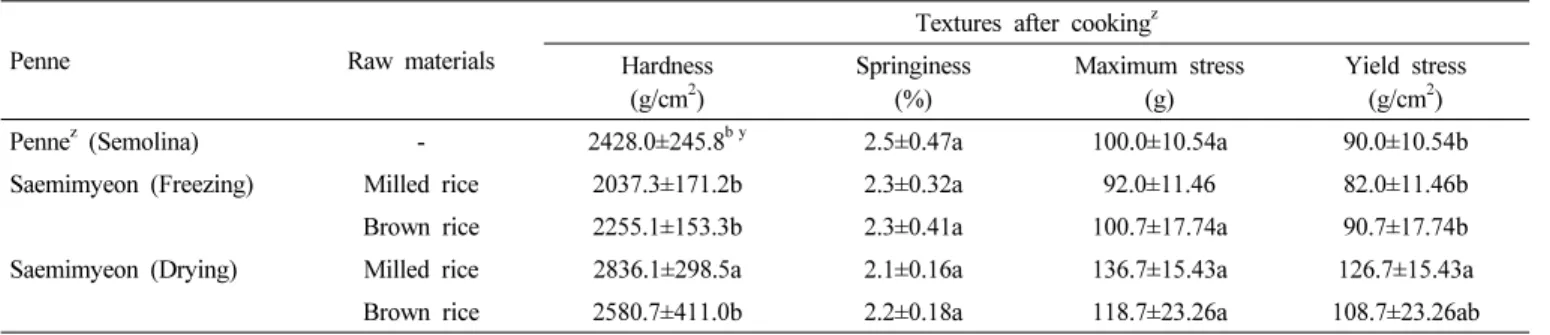
‘새미면’을 이용한 스타게티 및 펜네 쌀파스타 제조 특성 검정결 과 탄력성 및 씹힘성 등 요리 후 물리성이 기존의 세몰리나 제품과
Cultivar Brown planthopper Small brown planthopper
Saemimyeon MR
zR
Dasan S R
z
R: Resistant, MR: Moderate resistant, S: Susceptible
Table 10. Resistance to major insects of ‘Saemimyeon’.
Cultivar
Milling properties
(%) Brown rice Trans-
parency (1-9)
WC/
WB (0-9)
BRz MB MR CR Length
(mm)
Width (mm)
Thic-kness (mm)
L/W Ratio
Saemimyeon 81.2 91.0 73.8 65.7 5.82 2.64 1.67 2.20 7 8/2
Dasan 80.6 91.6 73.8 29.9 5.85 2.66 1.67 2.20 1 2/2
z
BR ratio: Brown/rough rice ratio, MB ratio: Milled/brown rice ratio, MR: Milling ratio, CR: chalkiness ratio Table 11. Milling properties and grain quality of ‘Saemimyeon’.
Cultivar Amylose
(%)
Protein (%)
Alkali digestion value (1-7)
Rice noodles texture
zThickness
(mm)
Strength (g)
Adhesiveness (mm)
Saemimyeon 26.7 7.0 3.5 1.33 12.8 38.9
Dasan 18.2 7.4 6.4 (1.22) (10.9) (8.4)
z
Textures after cooking, ( ): Goami (CK), Rice noodles: rice flour 90% + potato flour 10%, Rice flour: wet milling, Rice noodles processing: extrusion Table 12. Grain and rice noodles quality of ‘Saemimyeon’.
Cultivar Bacterial blight Virus disease
K1 K2 K3 K3a Stripe Dwarf Black streaked dwarf
Saemimyeon R
zR R R R S S
Dasan R S S S R M S
z
R: Resistant, M: Moderate, S: Susceptible
Table 9. Reaction to bacterial blight and virus diseases of ‘Saemimyeon’.
Spagetti Raw
materials
Textures after cooking Hardness
(g/cm
2)
Springiness (%)
Maximum stress (g)
Yield stress (g/cm
2)
Spaghetti
z(Semolina) - 9167.0±1748.0
b y5.9±0.16
a172.0±13.73
a61.3±12.46
aSaemimyeon (Freezing) Milled rice 29340.0±3395.9
a6.8±0.79
a48.0±0.07
b42.0±4.47
bBrown rice 32384.0±1263.1
a5.1±0.98
b74.0±13.42
a64.0±13.42
aSaemimyeon (Drying) Milled rice 35516.0±2091.4
a5.3±1.43
a64.0±11.40
b54.0±11.40
bBrown rice 37220.0±2049.9
a4.8±0.31
b84.0±8.94
a74.0±8.94
az
Spaghetti (100% Semolina, Ponte, Italy)
y
Different superscripts within a column (a-b) indicate significant differences (p<0.05)
Table 13. Textures of rice pasta (spaghetti) made from ‘Saemimyeon’.
Fig. 3. Rice pasta (spaghetti and penne) made from ‘Saemimyeon’.
Penne Raw materials
Textures after cooking
zHardness
(g/cm
2)
Springiness (%)
Maximum stress (g)
Yield stress (g/cm
2)
Penne
z(Semolina) - 2428.0±245.8
b y2.5±0.47a 100.0±10.54a 90.0±10.54b
Saemimyeon (Freezing) Milled rice 2037.3±171.2b 2.3±0.32a 92.0±11.46 82.0±11.46b
Brown rice 2255.1±153.3b 2.3±0.41a 100.7±17.74a 90.7±17.74b
Saemimyeon (Drying) Milled rice 2836.1±298.5a 2.1±0.16a 136.7±15.43a 126.7±15.43a
Brown rice 2580.7±411.0b 2.2±0.18a 118.7±23.26a 108.7±23.26ab
z
Penne (100% Semolina, TESCO, Italy)
y
Different superscripts within a column (a-b) indicate significant differences (p<0.05) Table 14. Textures of rice pasta (penne) made from ‘Saemimyeon’.
Regionz No. of tested sites
Dasan (MT/ha)
Milled rice of Saemimyeon (MT/ha)
'12 '13 '14 Mean Index (A/B) Range
Middle plain 3 6.84 6.32 7.31 7.15 6.93 102 5.62~7.90
Yeongam plain 2 6.81 7.38 7.48 7.50 7.45 110 6.29~8.46
Honam plain 1 6.11 6.14 6.88 7.32 6.78 111 6.14~7.32
Average 6 6.71 6.64 7.29 7.30 7.08 106
z
Middle plain area: Suwon, Hwaseon, Cheongwon. Yeongnam plain area: Miryang, Daegu. Honam plain area: Iksan Table 15. Summarized results of local adaptability test of ‘Saemimyeon’.
비슷한 우수한 특성을 보였다(Tables 13, 14, Fig. 3).
수량성
‘새미면’은 2012~2014년 3개년간 실시한 지역적응시험 보통 기 다비재배에서 쌀수량이 7.08 MT/ha로 ‘다산’보다 6% 증수되 었다(Table 15).
적응지역 및 재배상 유의점
‘새미면’은 중생 통일형 품종으로 중부 및 영·호남 평야 1모작 지가 적응지역이다. 질소질 비료 과용 시 도복 및 병해충의 피해 가 우려되므로 적정 균형 시비하여야 하며, 메소트리온 및 벤조비 사이클론 성분 등을 함유하는 제초제 사용을 금하여야 한다.
5월 말까지 적기에 모내기를 실시하여야 하며, 냉수 용출답 등 출수 지연이 우려되는 지역은 재배를 피해야 한다. 벼멸구에는 약하므로 적기 기본 방제를 하여야 한다.
적 요
통일형 중생종 ‘새미면’은 가공업체의 가격경쟁력 및 가공 적성에 대한 요구에 부흥하기 위하여 개발된 아밀로스 함량이 높은 쌀국수 전용품종이다. 내병성 등 재배 안정성 및 수량성을 개량하기 위하여 IR50*2/YR18241-B-B-115-1-1 계통에 초다수 성인 ‘밀양181호(한아름)’을 삼원 교잡한 후 잡종집단 육성 및 선발 등 계통관리를 하였다. 2010년 국립식량과학원에서 생산력 검정시험 결과 초다수성이며 직립형인 YR24235-10-1-3 계통을 선발하여 ‘밀양278호’로 명명한 후 중부 및 남부 평야지 6개소에 서 지역적응성시험을 수행하였다. ‘새미면’의 출수기는 8월 12일 로 중생종이며 도열병, 줄무늬잎마름병, 및 흰잎마름병(K1-K3a)
에 저항성이고 벼멸구 등 주요 해충에는 감수성이다.
‘새미면’은 쌀국수 및 쌀파스타 제조에 중요한 요소인 아밀로 스함량이 26.7%이며 알카리붕괴도가 3.5로 낮은 특성을 보였다.
‘새미면’은 쌀수량이 7.08 MT/ha로서 대비품종인 ‘다산’에 비해 6% 높았으며, 남부 및 중부 평야지에 적합한 품종이다.
사 사
본 ‘새미면’ 제면 전용품종은 농촌진흥청 연구사업(세부과제명:
통일형 초다수성 벼 품종개발, 과제번호: PJ010267012018, 세부 과제명: 고품질 가공용 벼 품종개발, 과제번호: PJ010268022018) 의 지원에 의해 이루어진 것임. 본 ‘새미면’을 육성함에 있어 협력하여 주신 국립식량과학원 벼 육종연구진, 농촌진흥청 연구 관리국, 기술지원국 및 각도 농업기술원 관계관께 깊은 감사를 드리는 바이다.
REFERENCES