MOST 인터페이스를 갖는 차량용 미디어 서버 플랫폼에 대한 임베디드 시스템 설계
Embedded System Design of Automotive Media Server Platform with the MOST Interface
곽재민*, 박부식*
Jae-Min Kwak
*and Pu-Sik Park
*요 약
이동 차량에서도 멀티미디어 응용 서비스에 대한 요구가 급증함에 따라, MOST(Media Oriented Systems Transport) 프로토콜이 주목을 받게 되었다. MOST 프로토콜은 짧은 제어 메시지, 비동기 패킷, 그리고 예약형 동기 스트림 데이터와 같은 세가지 형태의 통신 모드를 지원한다. MOST는 다양한 전송모드를 지원하여 차량 내부의 네트워크에 응용하는 프로토콜로서 적합하다. 본 논문에서는 MOST 프로토콜을 장착한 AMS(Automotive Media Server) 플랫폼 기반의 임베디드 시스템을 구현하고 제어 포트와 소스포트의 동기 채널을 통한 네트워크 통신테스트를 동해 시스템을 검증한다. MOST POF(Plastic Optical Fiber) 네트워크 상에서 서로 멀티미디어 통 신을 할 수 있는 프로토타입 임베디드 플랫폼을 구현하여 시스템의 동작 테스트를 위해 DivX 디코더를 연결하 고 비디오 스트림과 제어 메시지를 MOST 네트워크를 통해 전송하여 동작을 확인하였다.
Abstract
For growing need for the multimedia application in the vehicles, the MOST protocol has been focused on.
The MOST protocol supports three kinds of communication modes; short control message, asynchronous packets, and reserved synchronous stream data. Because of a variety of transportation, the MOST is suitable for various applications in vehicle environment. In this paper, we implemented embedded system which is MOST-enabled AMS platform and tested the network communication operation through the control port and the synchronous channel of the source port. We implemented the prototype platforms which communicate each other on the MOST's POF network. Moreover we implemented the DivX decoder attached AMS platform and verified the operation by transferring the video stream and the control messages through the MOST network.
Key words : Automotive, MOST, ring network, in-vehicle network
* 전자부품연구원(Korea Electronics Technology Institute) ‧ 제1저자 (First Author) : 곽재민
‧ 접수일자 : 2006년 7월 11일
I. Introduction
The current vehicle consists of electronic devices as well as mechanical devices. Nowadays, the electronic devices connect each other by the standardized network
protocol such as CAN(Controller Area Network) which
is the predominant global standard for medium speed
(ISO1519 class B: 10kpcs; 125kbps) and high-speed
(ISO11898 class C: 125kpcs; 1Mbps) event-driven
automotive communications networking, LIN(Local
Interconnect Network) standardized in 1999 as a low-speed (class A: 20kbps) network, MOST(Media Oriented Systems Transport) which is intended for interconnecting multimedia components on an optical fiber bearer and whose bandwidth is approximately 23M baud, and so on[1],[2].
According to the increasing need for the multimedia service on a seat, amount of electronic devices such as a DVD player, a MP3 player, and a DMB receiver, which are installed in the vehicle, has been growing fast[3]. There are two legacy interconnecting network protocols described above, CAN and LIN. Both CAN and LIN are the protocols to control the body of a vehicle. They can support just low-bandwidth; maximum 1Mbps. The channel with 1Mbps bandwidth can not transfer the multimedia stream for example the DMB video stream, which requires 2Mbps bandwidth over[4].
Thus, for the multimedia service the need for the protocol offering the higher bandwidth emerged and the MOST could do it.
MOST is an communication network protocol for multimedia application with POF(Plastic Optical Fiber) media. It is developed by Audi, BMW, Daimler Chrysler, Becker Automotive, Oasis Silicon Systems, etc. Now the protocol supports 24.8Mbps frame rate, and later will be improved to support 150Mbps[5]-[7].
The AMS platform supports the fundamental functions such as GUI, networking, storage, and so on.
Especially, the interface with the MOST transceiver and the common bus interface for sub-functional platforms were focused on in this paper. These design methods of the AMS was described and demonstrated. Finally, summary and future work were described.
Ⅱ. Media Oriented Systems Transport(MOST)
The MOST technology was designed from the beginning to offer full inter-connectivity for audio, video, and data services over a plastic fiber optic network. The goal has been to make it easy for
car-makers and manufacturers of multimedia systems to design components that can easily communicate with each other, so that intelligent vehicle systems can be deployed into the consumer marketplace.
Figure 1 shows the superframe structure. A superframe has 64 octets. The last 4-octet area is reserved for the control port and the remaining 60-octet area is for source port[7],[8].
Admin Synchronous Data Asynchronous Data Control Admin
1 60 2 1
Boundary is defined by the Timing Master node(bSBC)
1 MOST Frame (64 Bytes)
1 Control Block (= 16 MOST Frames)
16 x 2 Bytes per MOST Frame
Admin FBlockID.InstID.FktID.OpType...
Type of Message Message Data Source Data Target Data
1 Control Message Frame (32 Bytes)
Admin
CRC Checksum Message Data format is defined by the MOST Specification
Figure 1. The MOST superframe structure.
Ⅲ. Design of AMS Plaftorm
The AMS platform includes several functions, which include high performance MCU(micro-processor unit), in-vehicle NIC(network interface controller), graphic output device, touch-screen input device, audio output device, and hub system for external devices such as USB, etc. Although we prepared the multi-purposed platform for the in-vehicle devices, additional functions such as graphic output device or touch-screen input device are optional according to each application's specification. However, the MCU, the in-vehicle NIC for the in-vehicle backbone, and the relative software are mandatory for the in-vehicle devices.
3-1 Fundamental Components
SAMSUNG 32-bit RISC micro-processor, 2MB
NOR flash memory, 256MB SDRAM, 128MB NAND
flash memory, OASIS MOST transceiver, and its
interface logic are fundamental components for our
in-vehicle system. Moreover, the common bus controller
logic is ready for an additional function, for example DivX decoder, Bluetooth communication, or DMB.
In addition to the above described components, 6.4 inch TFT LCD which has 640 x 480 resolution, 10Mbps Ethernet controller, USB 1.1 master and slave, touch screen, stereo audio, and so on. Figure 2 shows the block diagram of the AMS platform and the DivX sub-system.
Touch screen
SAMSUNG S3C2410 ARM920T 266MHz
MOST Transceiver
OS8104A Fiber Optical Transceiver
Plastic Optical Fiber Common bus
Master
SDRAM 64MB
NOR Flash 2MB NAND Flash 32MB
MOST Interface
Parallel Combine mode
640 x 480 6.4 inch TFT LCD
CODEC USB 2.0
4 port Hub
Ethernet 10 Mbps MUX Common bus
Slave Com
mon bus
SIGMA DESIGNS EM8621L ARM920T Multimedia Decoder
Figure 2. The hardware block diagram of the AMS.
3-2 The Common Bus Interface
The AMS platform introduced in this paper is for the template platform for various functions offering the fundamental components basically. For example, the AMS platform attaching a DMB receiver acts as the MOST-enabled DMB modem and the AMS platform attaching a DivX decoder is the MOST-enabled DivX player. We propose the common bus interface to link diverse sub-functional systems.
The common bus consists of a parallel interface, serial interface, and differential analog interface. The final system combing the AMS platform and sub-functional system have to include one or more interfaces according to the need of the own system.
For demonstration we interconnected the AMS platform and the DivX decoder sub-system with the parallel common bus interface. As soon as receiving the MPEG video stream and the control messages on the MOST network, the AMS platform transports the stream and control messages to the DivX decoder
through the common bus. Figure 3 shows the common bus interface logic block diagram for the DivX sub-system.
REG_MASK_DIVX REG_INTR_DIVX
Sub-system(SIGMA DESIGNS)
nRESET nCS nWR nRD ADDR[23:16]
DATA[15:8]
nIRQ
AMS platform
nCS nWR nRD ADDR[7:0]
EX_DI[7:0]
nIRQ
fifo_controller IDT 72V06 L15J
nRST nRE nWE
nXI D[8:0] Q[8:0]
33MHz
fifo_controller Interrupt_controller
regDataW_divx Etc.
regDataW_ams Etc.
REG_MASK_AMS REG_INTR_AMS
nINT_divx nINT_ams
regDataW_divx
Etc. REG_FIFO _CMD
REG_RESP_U REG_COMMAND REG_RESP
REG_COMMAND_U
regDataW_ams, Etc.
REG_LOADDEF EX_DO[7:0]
Figure 3. The common interface block diagram.
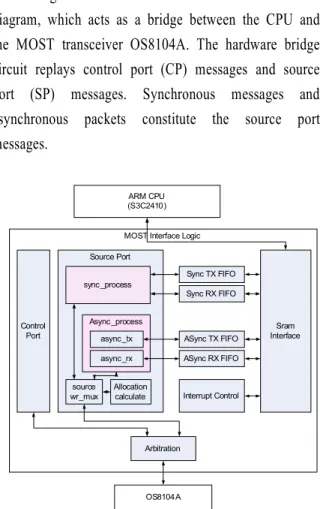
The figure 4 shows the MOST interface block diagram, which acts as a bridge between the CPU and the MOST transceiver OS8104A. The hardware bridge circuit replays control port (CP) messages and source port (SP) messages. Synchronous messages and asynchronous packets constitute the source port messages.
MOST Interface Logic
Source Port
OS8104A Arbitration Control
Port
Sync TX FIFO Sync RX FIFO
ASync TX FIFO ASync RX FIFO
Interrupt Control
Sram Interface ARM CPU
(S3C2410)
source wr_mux
Allocation calculate sync_process
Async_process async_tx async_rx
Figure 4. The MOST interface block diagram.
OS8104A provides three kind of interfacing method
such as serial SP/serial CP, parallel SP/serial CP, and
parallel SP/parallel CP. The parallel SP/parallel CP also
consists of three kind of configurations such as parallel synchronous mode, parallel asynchronous mode, and combined mode.
We designed the hardware bridge circuit for parallel SP/parallel CP with combined mode. Therefore, the MOST application on the AMS can access all kind of the MOST data for example TCP/IP packets by asynchronous packets, video stream by synchronous data.
3-3 The software design
We determined that the software platform of the AMS should be the QNX. The micro-kernel architecture of the QNX is so reliable and fault-tolerable that the QNX-based system is suitable for the in-vehicle devices which request high reliability.
Thus we should build device-drivers and applications on the QNX platform.
Software bus micro
kernel 32KB
Process manager
QNX file manager
NFS file manager
Photon GUI manager
TCP/IP manager
Character manager
MOST device driver
MOST application
Figure 5. The software diagram.
The figure 5 shows the software architecture. The software modules including the MOST device driver except the MOST application, is the common software package for the AMS platform. Every MOST-enabled AMS platform has the MOST device driver, which exchanges data with the MOST transceiver; OS8104A.
The MOST application just communicates with the MOST device driver by the IPC. The MOST device driver is similar in function to the NetService.
The MOST application of the DivX sub-system delivers video data from the video source or control messages from the remote controller to the DivX
decoder by the MOST device driver. The MOST application uses the control port channel for the control messages such as play, stop, pause, etc. and makes use of the synchronous channel of the source port for the video stream for example MPEG2 stream.
Ⅳ. Results
For demonstration, we built three systems. One was the MOST master, another was the AMS platform with the GUI, and the other system was the AMS platform attaching the DivX decoder sub-system. Three systems linked each other such as figure 6 and established the MOST network.
GUI AMS platform MOST
DivX sub-system AMS platform MOST
Legacy MPEG2 Decoder
MOST
DMB Decoder sub-system AMS platform MOST
Koinonia sub-system AMS platform MOST
Bluetooth Gateway sub-system AMS platform MOST
Legacy DVD Player
MOST
DMB Receiver sub-system AMS platform MOST Plastic Optical Fiber
Figure 6. The test environment.
We implemented the parallel-combined mode MOST interface logic using the XILINX XC2V1000 FPGA device and the logic occupied 309,742 equivalent gates for the design. The common bus logic required 110 equivalent gates of the ALTERA EPM7512 and small relatively.
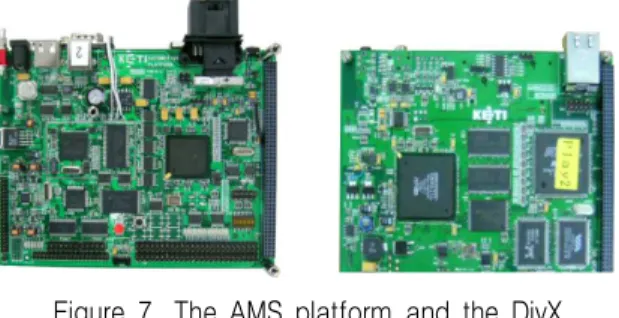
Figure 7. The AMS platform and the DivX sub-system prototype
The figure 7 shows the AMS platform prototype(left
figure) and the DivX sub-system prototype(right figure).
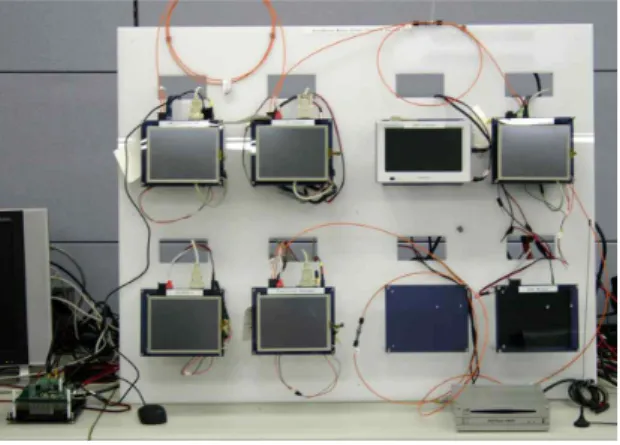
The MOST timing master, the AMS platform prototype board, and the AMS platform prototype board with the DivX sub-system prototype linked each other by the plastic optic fiber (POF) and constituted the MOST ring like the figure 8. For the compatibility test, we added the legacy DVD player which enabled the MOST.
Figure 8. The actual testbed.
First of all, we demonstrated the control message communication with the control port. Touching a DivX button on the GUI with the touch screen, the AMS platform attaching the DivX decoder sub-system received the control message and then communicated with the attached DivX sub-system. Receiving the control message, the DivX sub-system operated correspondingly.
The MOST synchronous channel can contain minimum 24-octet and maximum 60-octet out of 64-octet; bandwidth from 9.3Mbps to 23.25Mbps. Each device can allocate the channel in terms of quadlets.
Thus the AMS platform configured a quadlet for the synchronous channel and transmitted the video stream to the another AMS platform. We confirmed the reception of the data on the synchronous channel
Ⅴ. Summary
The MOST protocol is appropriate to transport
various kinds of data such as control data, internet packets, and multimedia data in the in-vehicle environment due to its superframe structure with three types of frame.
We proposed the automotive media server (AMS) platform with the MOST network interface controller and showed our MOST interface logic implemented in the FPGA. Moreover, we implemented the DivX decoder for demonstration of multimedia stream data transmission and the common interface logic for interconnecting the AMS with the DivX decoder sub-system.
The function of the control port and the source port was verified by exchanging the DivX control data and transporting the video stream on the plastic optical fiber (POF) ring network. Additionally the compatibility with the legacy MOST DVD device made by OASIS was verified
Ⅵ. Future Work
We implemented the MOST-enabled AMS platform and tested the control port and the synchronous channel of the source port. Our future works are the verification of the asynchronous channel, the high bandwidth synchronous channel and the NetService implementation
Reference
[1] Simonds, C., "Software for the next-generation auto mobile", Digital Object Identifier, Volume 5, Issue 6, pp. 7-11, Nov-Dec 2003.
[2] C. Thiel and R. Konig, "Media oriented systems trans port (MOST) standard for multi-media networking in vehicle environment, " VDI Berichte, vol. 1415, pp.
819-834, 1998.
[3] Ming Li, RuiMin Hu, Rong Zhu, and Wei Li, "Video
streaming on moving vehicles over seamless internet
works of WLANs and cellular networks", IEEE Inter
national Conf. on Vehicular Electronics and Safety,
pp. 369-372, 14-16 Oct. 2005.
[4] Chwan-Hwa Wu, Irwin, J.D., "Multimedia and multi media communication: a tutorial", IEEE Transaction on Industrial Electronics, vol. 45, Issue 1, pp. 4-14, Feb 1998.
[5] N. Navet, Y. Song, F. Simonot-Lion, and C. Wilwert,
"Trends in automotive communication systems," Pro ceedings of the IEEE, vol. 93, Issue 6, pp. 1204-1223, June 2005.
[6] T. Gaul, W. Lowe, M.L. Noga, "Specification in a large industry consortium-the MOST approach," Indu strial Electronics Society(IECON'01), vol. 3, pp. 182 8-1833, nov. 2001.
[7] MOST Cooperation Official. [Online]. Available: htt p://www.mostcooperation.com.
[8] MOST Specification of Physical Layer, Rev. 1.1, MO ST Cooperation Standard, 2003.
곽 재 민 (洪吉憧)
1998년 2월 : 한국항공대학교 통신 정보공학과(공학사)
1999년 8월 : 한국항공대학교 대학 원 통신정보공학과(공학석사) 2002년 8월 : 한국항공대학교 대학
원 통신정보공학과(공학박사) 2002년 7월 ~ 2003년 7월 : 한국
전자통신연구원 Post-doc.
2003년 7월 ~ 현재 : 전자부품연구원 SoC연구센터 선임 연구원
관심분야 : 통신신호처리, 임베디드시스템, In-vehicle Network
박 부 식 (洪吉憧)
1999년 2월 : 한국항공대학교 통신 정보공학과(공학사)
2001년 8월 : 한국항공대학교 대 학원 통신정보공학과(공학석사) 2001년 1월 ~ 현재 : 전자부품연
구원 SoC연구센터(전임연구원) 관심분야 : In-vehicle network, Media Access Control, Embedded
![Figure 1 shows the superframe structure. A superframe has 64 octets. The last 4-octet area is reserved for the control port and the remaining 60-octet area is for source port[7],[8].](https://thumb-ap.123doks.com/thumbv2/123dokinfo/5203701.353548/2.892.483.791.353.535/figure-superframe-structure-superframe-octets-reserved-control-remaining.webp)