Effect of Bacillus subtilis C4 and B. cereus D8 on Plant Growth of Canola and Controlling Activity Against Soft Rot and Stem Rot
Jae Eun Lee, Seo Hyeun Lee, Kyung Soo Park, Jin Woo Park and Kyungseok Park*
Microbial Resources Lab, Department of Agricultural Microbiology, National Academy of Agricultural Science, RDA, Suwon 441-707, Korea
(Received October 5, 2009; accepted October 13, 2009)
The effect of two plant growth-promoting rhizobacteria (PGPR) on plant growth and systemic protection against soft rot disease and stem rot disease of canola (Brassica napus), caused by Erwinia carotovora and Sclerotinia sclerotiorum was investigated in a laboratory and a greenhouse. Selected PGPR strains C4 and D8 were treated to canola seeds by soaking. Strains C4 and D8 significantly not only increased plant height and root length about 74% and 40.3% and also reduced disease severity of soft rot disease by 80% by C4 and D8 respectively, compared to the control. Especially strain C4 showed antifungal activity against 6 fungal pathogens, S. sclerotiorum, Rhizoctonia solani, Botrytis cinerea, Fusarium oxysporum, Phytophthora capsici and Colletotrichum acutatum. In greenhouse experiment, the seed treatment of both of them increased plant height, leaf width and leaf length of canola plant to 19.5% and 24.9%, 11.3% and 15.3%, and 14.1% and 20.7%
by C4 and D8, respectively, and reduced disease severity of S. sclerotiorium. These results indicate that these two PGPR strains can decrease disease severity and increased plant growth under greenhouse condition.
Therefore, these two bacteria have a potential in controlling Sclerotinia stem rot of canola. These strains have to investigate under field condition to determine their role of antibiosis, induced systemic resistance and plant growth promotion on canola.
Key words PGPR, ISR, canola, plant pathogen, antibiosis Abstract
*연락저자 : Tel. +82-31-290-0424, Fax. +82-31-290-0426 E-mail: [email protected]
Introduction
The canola plant is one of oil crops and is the second only to soybean as the most important source of vegetable oil in the world (Raymer, 2002). Sclerotinia stem rot, caused by Sclerotinia sclerotiorum, is one of the most economically important disease on canola. Control of sclerotinia stem rot by traditional methods has not been very effective (Fuller et al., 1984). Although bacteria have proved to be excellent sources of antagonists and biocontrol of plant diseases focused on the root-colonizing rhizobacteria (Fernando et al., 2007), bacterial biocontrol
agents against S. sclerotiorum are rarely studied (Boyetchko, 1999). Some bacterial strains were presented to show antifungal activity to S. sclerotiorum (Godoy et al., 1990;
Tu, 1997).
Rhizosphere is a highly favorable habitat for the proli- feration of microorganisms and rhizobacteria are present in large numbers on the root surface by the reason that plant exudates and lysates provide nutrients rhizoc-bacteria (Sorensen, 1997). Among them, certain strains of rhizosphere bacteria stimulate plant growth and are therefore often referred to as plant growth-promoting rhizobacteria (PGPR) (Kloepper and Schroth, 1978). Plant growth promoting rhizobacteria enhance plant growth either by direct or indirect mechanisms (Glick, 1995). The growth promotion 275
ORIGINAL ARTICLE/CONTROL
has been confirmed in plants elicited by direct mechanisms such as nitrogen fixation, solubilization of phosphorus, sequestering of iron by production of siderophores, pro- duction of phytohormones such as auxins, gibberellins, cytokinins and lowering of ethylene concentration (Kloepper et al., 1989; Glick et al., 1999; Idriss et al., 2002). PGPR also promote plant growth indirectly by suppressing growth of plant pathogens. Colonization of PGPR onto plant roots can lead systemic resistance in parts of the plant that are spatially separated from the inducing microorganism (Kloepper, 1992). This effect of rhizobacteria is referred to as induced systemic resistance (ISR) and has been demonstrated in different plant species, e.g., bean, carnation, cucumber, radish, tobacco, tomato, and in the model plant Arabidopsis thaliana (van Loon et al. 1998). ISR is activated by jasmonate- and ethylene-dependent but salicylate-indepenent signaling pathways (Pieterse et al., 1996). Several studies have shown that individual strains of plant growth-promoting rhizobacteria could elicit ISR against multiple diseases in a plant(Hoffland et al., 1996; Liu et al., 1995; Raupach et al., 1996; Wei et al., 1996; Park et al., 2007). Among many isolates of the Bacillus genus, and Bacillus subtilis was reported to be effective for the biocontrol of several plant diseases caused by soilborne pathogens (Asaka and Shoda, 1996; Chen and Wu, 1999; Raupach and Kloepper, 1998).
In this study, we tested two selected plant growth- promoting bacterial strain C4 and D8 for investigation their ability to enhance plant growth promotion and induce systemic resistance on canola.
Materials and Methods
Identification of selected strains
Selected strain C4 and D8 were isolated from the rhizosphere of canola plant in Cheju island in Korea.
Isolates tested in this study were stored in tryptic soy broth (TSB, Difco) amended with 20% glycerol at -80℃
prior to use. PGPR isolates from ultra-cold storage were streaked onto tryptic soy agar (TSA, Difco) plates and incubated at 28℃ for 24 hours to check for purity.
Bacterial isolate C4 and D8 were identified by a phy-
logenetic analysis of nucleotide sequence of 16S rRNA.
Total DNA was extracted from one week-old cultures as described by Park et al. (2005). The size and amount of extracted DNA were determined by agarose gel (1%) electrophoresis. Extracted DNAs were stored at -20°C until needed. PCR amplification of 16S rDNA was carried out using two universal primers, 27f; 5'-AGA GTT TGA TCM TGG CTC AG-3' and 1492r; 5'-GGY TAC CTT GTT ACG ACT T-3', which were also used for sequencing.
The PCR consisted of an initial denaturation step at 95°C for 3 min, which was followed by 30 cycles of 95°C for 1 min, 60°C for 1 min and 72°C for 8 min. Sequencing was performed using the service of Solgent Co. (Korea).
The sequences were proofread, edited and merged into full length sequences using the PHYDIT program version 3.2 (Chun, 1995). The sequences were aligned with those of reference taxa retrieved from public databases. Distance- based phylogenetic trees were generated using the model of Kimura's 2-parameter and neighbor-joining algorithm (Kimura, 1980). The topology of phylogenetic trees was evaluated using bootstrap analysis with 1,000 resampled dataset. PHYLIP program ver. 3.5c (Felsenstein, 1993) was used for the analyses.
Preparation of bacterial and fungal pathogens For preparing bacterial suspension E. carotovora SCC1, casual agent of soft rot disease on plants, was incubated onto a TSA plate then incubating at 30℃ for 24 hours and harvested from the plate with sterile distilled water.
The concentration of bacterial suspension was adjusted to 108 CFU ml-1 with sterile distilled water and then diluted to appropriate concentrations for experimental use. S.
sclerotiorum, casual agent of stem rot disease on plants, was cultured on potato dextrose agar (PDA, Difco) and maintained in incubator at 20℃. All challenging pathogens came from the culture collection of belonging to the Department of Agricultural Microbiology of the National Academy of Agricultural Science in Korea.
Seed-treatment and soil-drenching of PGPR The canola (Brassica napus, L) seeds were received
from Mokpo agricultural experimental station. They were surface sterilized by soaking in a solution of 1% NaOCl for 5 min and 70% ethanol for 1 min and washed 4~5 times in sterilized distilled water. PGPR strain C4 and D8 were cultured on TSA plate at 28℃ for 24 hours and harvested from the plate into sterile distilled water. Sterilized canola seeds were soaked in each bacterial suspension for 3 hours before planting seeds. Seed treated with or without strain C4 and C8 were planted into a test tube which contained Murashige and Skoog(MSA, Sigma) medium for in vitro experiment. In greenhouse experiment, sterilized soil was put into pots (W × L × H; 10 × 10 × 5 cm). One of non-treated seed was put into each pot with a forceps.
The pots where seeds were planted were then arranged into one tray for every treatment, twelve pots on each tray, and kept in a greenhouse. After one week, 30 ml of each bacterial suspension (108 CFU ml-1) was poured into each pot. Water was applied in the same way as a non- treated control.
Test for canola plant growth promotion and systemic disease protection in vitro and in greenhouse
Canola plants treated with PGPR were used for investi- gating the effect of PGPR on plant growth and ISR activity. Plant height and root length were measured after two weeks of planting for the effect of PGPR on plant growth in vitro assay. The suspension of E. carotovora SCC1 prepared as mentioned above was dropped on a leaf of canola plants in test tube and incubated for 24 hours at 30℃. The number of diseased plant was measured and disease incidence was counted. In green house experiment, canola plants of 5th leaf stage were used for investigating plant growth promoting effect and ISR activity. Such as plant height, leaf width and leaf length of the first leaf of 6 replicates for each treatment several factors were measured to assess the effect of PGPR on plant growth.
The first leaf and the stem (upper part, 10 cm from the ground) were taken out from the plant and placed into a plastic box with moisturizing filter papers. Mycelial plug (6 mm in diameter), taken from the leading edge of 5- day-old S. sclerotiorum culture, was placed on each leaf.
In a treatment there were 6 leaves. Plastic boxes were kept at 20℃ for 3 days. To investigate controlling activity of strain C4 and D8 the lesion diameter was measured.
The stem was cut into 5 cm long then put on a plastic box. As the same mentioned above, one mycelial plug (6 mm in diameter) was inoculated on the bottom of each stem. After 3 days, the vertical length (cm) of each lesion was measured and scored as uninfected, 0; 1~10% infected, 1; 11~25% infected, 2; 26~45% infected, 3; 46~70%
infected, 4; 71~90% infected, 5; fully infected, 6.
Antifungal activity
To test antibiotic activity of two PGPR strains, potato dextrose-1/10 tryptic soy agar (PD-1/10TSA) plates was used to test for antifungal activity against fungal pathogens, as mentioned above. One mycelia plug of each pathogen was inoculated on the center of PDA plates. Three paper disks were placed around a pathogen inoculated on the center of PDA and then bacterial suspensions of C4 and D8 (107 cfu/ml) were applied onto each disk by 30 μl- dropping. Plates were incubated at 20℃ and 28℃ for 7 days, for each fungal pathogen respectively. The inhibition zone was observed and was recorded. There were three replications per treatment.
Statistical Analysis
Each experiment had four replications and each repli- cation consisted of 6 plants. Data were analyzed with ANOVA in SAS JMP software (SAS Institute, Cary, NC) (SAS, 1995). Significant differences in treatment means on each sample data were determined using LSD at P = 0.05.
Results
Identification of selected strains
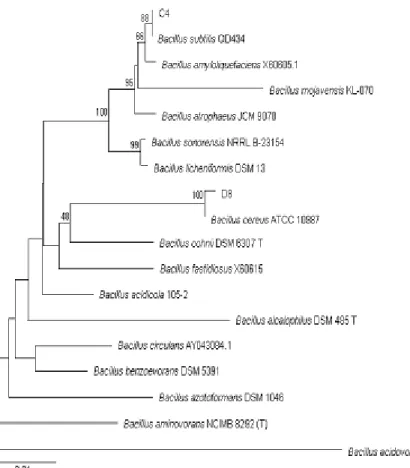
C4 and D8 strains were identified by sequence analysis of its 16S rRNA gene. C4 strain showed 99% similarity to Bacillus subtilis and D8 strain showed 99% similarity to Bacillus cereus (Fig. 1).
Fig. 1. Phylogenetic position of C4 and D8 in the phylogenetic trees generated by the analysis of 16S rRNA gene sequences. The percentage of number below each branch indicate levels of bootstrap support for the branch point based on 1,000 resampling.
Table 1. Promoting effect of plant growth in canola seedling plant by seed soaking of selected rhizobateria in test tube condition
Treatmenta Plant height (mm)
Root length (mm)
Water treated control 41.1b 44.1
0.1 mM BTH 41.5 44.8
Bacillus subtilis C4 71.5* 61.9*
Bacillus cereus D8 71.5* 61.8*
LSD (p=0.05) 7.5 9.3
aTreatment included Bacillus subtilis C4 and Baciluus cereus D8, and two controls: SAR control (that was treated with 0.1 mM benzo (1,2,3) thiadiazole-7-carbothioic acid S-methyl ester (BTH) and a water treated control.
bMean of four experiments.
*indicates significant different according to Student’s least significant difference (P = 0.05) test.
*
* *
0 10 20 30 40 50 60 70 80 90
CON BTH C4 D8
Treatment
Disease incidence(%)
Fig. 2. Induced systemic resistance of Bacillus subtilis C4 and B. cereus D8 against Erwinia carotovora SCC1 on canola plant in a test tube. * indicates significant differences from control.
LSD = least significant difference (p = 0.05).
Canola plant growth promotion and systemic disease protection in a laboratory
The ability of strain C4 and D8 to promote the growth of canola was studied. Strain C4 and D8 significantly
increased plant height and root length about 74% and 40.3% compared to the control (Table 1, Fig. 3). Erwinia carotovora SCC1 was on a leaf of canola plants in test tube to investigate ISR activity by C4 and D8. Soft rot disease was reduced 60% by chemical inducer, as BTH, whereas 80% by C4 and D8 respectively, compare to the control (Fig. 2).
Table 2. Plant growth promotion of canola plant by soil drench of selected rhizobateria in green house condition
Treatmenta Plant height (cm) Leaf width (mm) Leaf length (mm)
Water treated control 16.9b 71.7 72.3
0.1 mM BTH 17.2 72.0 73.9
Bacillus subtilis C4 20.2* 79.8* 82.5*
Bacillus cereus D8 21.1* 82.7* 87.3*
LSD (p=0.05) 1.3 4.6 4.6
aTreatment included Bacillus subtilis C4 and Baciluus cereus D8, and two controls: SAR control (that was treated with 0.1 mM benzo (1,2,3) thiadiazole-7-carbothioic acid S-methyl ester (BTH) and a water treated control.
bMean of four experiments.
*indicates significant different according to Student’s least significant difference (P = 0.05) test.
* *
*
*
0.0 1.0 2.0 3.0 4.0 5.0 6.0
CON BTH C4 D8
Treatment
Disease severity (0-6)
s tem leaf
Fig. 3. Effect of Bacillus subtilis C4 and B. cereus D8 on the stem rot caused by S. sclerotiorum in greenhouse experiment.
The stem and leaf of canola were cut and treated in a laboratory condition.
Table 3. Antifungal compound activity of selected PGPR strains against different fungal pathogens
Fungal pathogens Inhihition activity
C4 D8
Botrytis cinerea +++a -
Phytophthora capsici ++ -
Fusarium oxysforum +++ -
Sclerotinia sclerotiorum +++ -
Rhizoctonia solani ++ -
Colletotricum acutatum ++ -
aInhibition zone size -: 0 mm, +: 0.1~2.0 mm, ++: 2.1~3.0 mm, +++: 3.1~4.0 mm
Canola plant growth promotion and systemic disease protection in green house condition
In green house condition, the growth of canola was significantly increased by C4 and D8 (Fig. 3). Plant height was increased 19.5% and 24.9% by C4 and D8, respectively, compared to the control. Also leaf width and leaf length increased by more than 10% (Table 2).
Disease reduction of canola plants to Sclerotinia by C4 and D8 was tested in a laboratory condition. Results showed that disease severity of both C4 and D8 treat- ments were much lower than control and BTH treatment (Fig. 3).
Antifungal activity
To assess the antifungal activity of Bacillus subtilis C4 and B. cereus D8, 6 plant fungal pathogens, such as Sclerotinia sclerotiorum, Rhizoctonia solani, Botrytis cinerea, Fusarium oxysporum, Phytophthora capsici and Colletrotrichum acutatum were selected in this study.
Only C4 showed antifungal activity against all pathogens (Table 3).
Discussion
It was investigated the effect of plant growth promotion and induced systemic resistance by Bacillus subtilis C4 and Bacillus cereus D8 on canola in this experiment.
Plant growth - promoting rhizobacteria (PGPR) are free- living bacteria that colonize plant roots and result in plant growth promotion and induction of plant defense system against pathogens (Kloepper, 1994; Ryu et al., 2003).
Several studies have reported the utility of Bacillus species for growth promotion and biological control activity (Garcia et al., 2004; Joo et al., 2004; Podile and Prakash, 1996).
In this study, seeds treatment and soil-drench with two bacterial strain showed significant growth promoting effect in vitro assay and in vivo. Both C4 and D8 strains increased the root length of canola plant in vitro and also
increased the plant height, leaf width and leaf length of canola compared to non-treatment control in a green house condition. Although the growth condition of canola in vitro and in green house is different, the growth of canola was promoted in both conditions. The effect of growth promotion of canola plant by treatment C4 and D8 was very similar in vitro and in green house experiment.
Several methods have been suggested to explain the plant growth-promotion when plants are inoculated with rhizo- bacteria. These include increases in the nitrogen fixation, the production of auxin, gibberellins, cytokinin, ethylene, the solublization of phosphorus, the extra-cellular production of antibiotics, and strict competition for the available nutrients (Chanway, 1997; Kloepper, 1993). Such compounds (e.g., auxins, gibberellins, and cytokines) mediate processes that include plant cell enlargement, division, and enlarge- ment in symbiotic roots and nonsymbiotic roots as well (Choudhary and Johri, 2009). Several Bacillus species can produce these hormones including B. subtilis (Priest, 1993).
The induced systemic reistance (ISR) is the mode of action of disease suppression by non-pathogenic rhizosphere bacteria (Kloepper et al., 1992). Induction of systemic resistance by rhizobacteria was first demonstrated inde- pendently by van Peer et al. (1991) against fusarium wilt in carnation, and by Wei et al. (1991) against anthracnose in cucumber. Since then, it has been established in different plant species against various pathogens by using different rhizobacterial strains (van Loon et al., 1998). Specific strains of spore-forming Bacillus spp. can elicit ISR that results in reduction on disease severity by a broad range of pathogens (Kloepper et al., 2004). Bacterial determinants of ISR include salicylic acid (SA), siderophores, antibiotics, and lipopolysaccharides (LPS) (van Loon et al., 1998).
Very few studies have been done on induced systemic resistance in canola. We investigated ISR by C4 and D8 against Erwinia carotovora SCC1 in vitro and the results show that C4 and D8 strains induced systemic resistance on canola plant. In green house study, both C4 and D8 strains showed significantly disease reduction against S.
sclerotiorum. Several species of Bacillus are known to produce toxins that are inhibitory to the growth and/or
activities of fungal pathogens of plants (Pinchuk et al., 2002). B. subtilis strains that produce the lipopeptide antibiotics iturin A and surfactin could suppress damping- off in tomato whereas zwittermicin A from B. cereus have been correlated to suppression of damping-off in alfalfa (Yu et al., 2002). The role of C4 and D8 strains in disease suppression has proved to be related to ISR from results of in vitro assay. For antibiosis in which D8 strain did not produce any antibiotic compounds against tested fungal pathogens. Even though C4 strain showed antibiotic activity to tested fungal pathogen, it was not found inside the stem and leaves of canola plants. Similarly, Jetiyanon and Kloepper (2002) have reported from their in vitro antibiosis study that the mechanism of disease control is not a direct antagonism. The protective effect of B. scubtilis C4 can be explained by production of antibiotic substances, but other mechanisms must also be involved. B. subtilis C4 may reduce the various plant diseases by more than one mechanism and may different with D8. The best evidence for PGPR-mediated ISR is obtained when the rhizobacterium does not antagonize the pathogen in culture.
In this study, we estimated plant growth promotion on canola along with biocontrol activity by treatment with C4 and D8 strains in vitro and in vivo conditions. The effects induced by inoculation with PGPR strains, could be consequence of hormones production. Phytohormones produced by PGPR, are believed to be changing assimilate partitioning patterns in plants altering growth in roots, the fructification process and development of the fruit under production conditions (Lucas-Garcia et al., 2004). The results of this study indicated that the mechanism of disease protection of C4 and D8 may different. Although the mechanism of plant growth promotion and disease suppression was not studied in this study, the results suggest that these PGPR strains (C4 and D8) can control disease severity by mechanism of antibiosis, induce systemic resistance as well as plant growth promotion under green- house condition. These strains have to investigate under field condition to determine their role of antibiosis, ISR and plant growth promotion on canola.
Literature Cited
Asaka O. and Shoda M. (1996) Biocontrol of Rhizoctonia solani damping-off of tomato with Bacillus subtilis RB14.
Appl. Environ. Microbiol. 62:4081~4085.
Boyetchko S.M. (1999) Biological control agents of canola and rapeseed diseases-status and practical approaches. In Mukerji K., Chamola B. and Upadhyay R., eds. Biotechmological approaches in biocontrol of plant pathogens. New York:
Kluwer Acadimic / Plemum Publishers. pp. 51~71.
Chanway C.P. (1997) Inoculation of tree roots with plant growth-promoting soil bacteria: An emerging technology for reforestation. For. Sci. 43:99~112.
Chen T.W. and Wu W.S. (1999) Biological control of carrot black rot. J. Phytopathol. 147:99~104.
Choudhary D.K., Johri B.N. (2009) Interactions of Bacillus spp.
and plants – With special reference to induced systemic resistance (ISR). Microbiol. Res. 164:493~513.
Chun J. (1995) Computer assisted classification and identification of actinomycetes. Ph. D. Thesis, University of Newcatle, Newcatle upon Tyne, UK.
Felsenstein J. (1993) PHYLIP (phylogenetic inference package).
Version 3.5c. Department of Genetics, University of Washington, Seattle, USA.
Fernando W.G.D., Nakkeeran S., Zhang Y. and Savchuk S.
(2007) Biological control of Sclerotinia sclerotiorum (Lib.) de Bary by Pseudomonas and Bacillus species on canola petals. Crop. Protect. 26:100~107.
Fuller P., Coyne D. and Steadman J. (1984) Inheritance of resistance to white mold disease in a diallel cross of dry beans. Crop. Sci. 24:929~933.
Garcia, J.A.L., Probanza A., Ramos B., Palomino M.R. and Manero F.J.G., (2004) Effect of inoculation of Bacillus licheniformis on tomato and pepper. Agronomie. 24:169~
176.
Glick B.R. (1995) The enhancement of plant growth by free- living bacteria. Can. J. Microbiol. 41:109~117.
Glick B.R., Patten C.L., Holguin G. and Penrose D.M. (1999).
Biochemical and genetic mechanisms used by plant growth promoting bacteria. Imperial College Press, London, United Kingdom, pp. 267.
Godoy G., Steadman J.R., and Yuen G. (1990) Bean blossom bacteria have potential for biological control of white mold disease caused by Sclerotinia sclerotiorum. Annu. Rep.
Bean. Improv. Coop. 33:45~46.
Hoffland E., Hakulinen J. and van Pelt J.A. (1996) Comparison of systemic resistance induced by avirulent and nonpathogenic Pseudomonas species. Phytopathology. 86:757~762.
Idriss E.E, Makarewicz O., Farouk A., Rosner K., Greiner R., Bochow H., Richter T. and Borriss R. (2002) Extracellular phytase activity of Bacillus amyloliquefaciens FZB45 con-
tributes to its plant-growth-promoting effect. Microbiology.
148:2097~2109.
Jetiyanon K. and Kloepper J.W. (2002) Mixtures of plant growth-promoting rhizobacteria for induction of systemic resistance against multiple plant disease. Biol. Control.
24:285~291.
Joo G.J., Kim Y.M., Lee I.J., Song K.S., and Rhee I.K.. (2004) Growth promotion of red pepper plug seedlings and the production of gibberellins by Bacillus cereus, Bacillus macroides and Bacillus pumilus. Biotechnol. Lett. 26:487~
491.
Kimura M. (1980) A simple method for estimating evolutionary rate of base substitution through comparative studies of nucleotide sequence. J. Mol. Evol. 16:111~120.
Kloepper J.W. and Schroth M.N. (1978) Plant growth-promoting rhizobacteria on radishes. In: Proceedings of 4th Inter- national Conference on Plant Pathogenic Bacteria 2:879~
882.
Kloepper J.W., Tuzun S., Kuc J.A. (1992) Proposed definitions related to induced disease resistance. Biocontrol. Sci. Technol.
2:349~51.
Kloepper J.W., Ryu C.M. and Zhang S. (2004) Induced systemic resistance and promotion of plant growth by Bacillus spp.
Phytopathology. 94:1259~1266.
Kloepper J.W. (1993) Plant growth-promoting rhizobacteria as biological control agents. P. 255~274 in Soil microbial ecology-applications in agricultural and environmental manage- ment. Metting, F.B., Jr. (ed.). Marcel Dekker, New York.
Kloepper J.W. (1994) Plant growth-promoting rhizobacteria. In:
Okon, Y. (Ed.), Azospirillum/Plant Associations. CRC Press, Boca Raton, FL, pp. 137~166.
Kloepper J.W., Lifshitz R. and Zablotowicz R.M. (1989) Free living bacterial inocula for enhancing crop productivity. Trends.
Biotechnol. 7:39~44.
Liu L., Kloepper J.W. and Tuzum S. (1995) Induction of systemic resistance in cucumber by plant growth-promoting rhizo- bacteria: Duration of protection and effect of host resistance on protection and root colonization. Phytopathology. 85:
1064~1068.
Lucas-Garcia J.A., Probanza A., Ramos B., Colon-Flores J.J.
and Gutierez-Manero F.J. (2004) Effects of plant growth promoting rhizobacteria (PGPRs) on the biological nitrogen fixation, nodulation and growth of Lupinus albus I.cv.
Multolupa, Eng. Life Sci. 4:71~77.
Pieterse C.M.J., van Wees S.C.M., Hoffland E., van Pelt J.A.
and van Loon L.C. (1996) Systemic resistance in Arabidopsis induced by biocontrol bacteria is independent of salicylic acid and pathogenesis-related gene expression. Plant Cell 8:1225~1237.
Pinchuk I.V., Bressollier P., Sorokulova I., Verneuil B. and Urdaci M.C. (2002) Amicoumacin antibiotic production and genetic diversity of Bacillus subtilis strains isolated from different habitats. Res. Microbiol. 153:269~276.
Bacillus subtilis C4와 B. cereus D8에 의한 유채의 생육증대 및 무름병과 균핵병 방제효과
이재은 ・ 이서현 ・ 박경수 ・ 박진우 ・ 박경석*
농촌진흥청 국립농업과학원 농업미생물과
요 약 선발된 PGPR 균주인 Bacillus subtilis C4와 Bacillus cereus D8 균주의 유채에 대한 생육촉진 및 무름병균인 Erwinia carotovora와 균핵병균인 Sclerotinia sclerotiorum에 대한 방제효과를 검정하기 위하여 실내검정과 온실검정을 실시하였다. 실내검정 결과, C4와 D8균주처리에 의하여 유채의 생육이 40.3%~74% 증가하였으며 무름병이 대조구에 비하 여 80% 감소하였다. 실내검정에서 C4와 D8균주를 종자에 처리하였을 때 뿌리가 크게 신장되었다. 주요 식물병원균 Sclerotinia sclerotiorum, Rhizoctonia solani, Botrytis cinerea, Fusarium oxysporum, Phytophthora capsici, Colletotrichum acutatum에 대하여 항균활성시험을 수행한 결과 두 균주 중 C4균주는 모든 병원성 곰팡이에 대하여 항균활성을 나타내었다.
온실검정에서 C4와D8균주처리는 대조구에 비하여 유채의 초장, 엽폭 및 엽장을 19.5%~24.9%, 11.3%~15.3%, 14.1%~
20.7% 각각 증가시켰으며 균핵병균인 Sclerotinia sclerotiorum에 대한 억제효과가 우수하였다. 이와 같은 결과를 볼 때 C4, D8 균주 처리는 유채의 생육을 촉진시키며 유채에 저항성을 유도하므로 친환경생물방제에 적용할 수 있을 것으로 생각 된다.
색인어 근권세균, 유채, 생육촉진, 균핵병
Park M.S., Jung S.K., Lee M.S., Kim K.O., Do J.O., Lee K.H., Kim S.B. and Bae K.S. (2005) Isolation and characterization of bacteria associated with two sand dune plant species Calystegia soldanella and Elymus mollis. J. Microbiol.
43:219~227.
Park K.S., Paul D., Kim Y.K., Nam K.W., Lee Y.K., Choi H.W.
and Lee S.Y. (2007) Induce systemic resistance by Bacillus vallismortis EXTN-1 supressed bacterial wilt in tomato caused by Ralstonia solanacearum. P.P.J. 23:22~25.
Podile A.R. and Prakash A.P. (1996) Lysis and biological control of Aspergillus niger by Bacillus subtilis AF1. Can.
J. Microbiol. 42:533~538.
Priest F. (1993) Systematics and ecology of Bacillus. In: Bacillus subtilis and other gram-positive bacteria, biochemistry, physiology, and molecular genetics. Washington:ASM Press;
pp. 3~16.
Raupach G.S., Liu L., Murphy J.F., Tuzun S. and Kloepper J.W. (1996) Induced systemic resistance in cucumber and tomato against cucumber mosaic cucumo virus using plant growth-promoting rhizobacteria (PGPR). Plant Dis. 80:891~
894.
Raupach G.S. and Kloepper J.W. (1998) Mixtures of plant growth-promoting rhizobacteria enhance biological control of multiple cucumber pathogens. Phytopathology. 88:1158~
1164.
Raymer P.L. (2002) Canola: An emerging oilseed crop. Trends in new crops and new uses. ASHS Press, Alexandria, VA.
Ryu C.-M., Farag M.A., Hu C-H., Reddy M.S., Wei H-X., Par P.W. and Kloepper J.W. (2003) Bacterial volatiles promote growth in Arabidopsis. Proc. Natl. Acad. Sci. 100:4927~
4932.
Sorensen J. (1997) The rhizosphere as a habitat for soil micro- organisms. In van Elsas J. D., Trevors J. T. and Welington E. M. H. (Eds.). Modern Soil Ecology (pp. 21~46). New York: Marcel Dekker, Inc.
Tu J.C. (1997) Biological control of white mould in white bean using Trichoderma viride, Gliocladium roseum and Bacillus subtillis as protective foliar spray. In proceedings of 49th International Symposium on Crop Protection. 6. May 1997, Genr. Part IV. Meded. Fac. Landbouwkd. Toegep. Biol.
Wet. Univ. Gent, 62:979~986.
van Loon L.C., Bakker P.A.H.M and Pieterse C.M.J. (1998) Systemic resistance induced by rhizosphere bacteria. Annu.
Rev. Phytopathol. 36:453~483.
van Peer R., Niemann G.J. and Schippers B. (1991) Induced resistance and phytoalexin accumulation in biological control of fusarium wilt of carnation by Pseudomonas sp. strain WCS417r. Phytopathology. 81:728~734.
Wei G., Kloepper J.W. and Tuzun S. (1991) Induction of systemic resistance of cucumber to Colletotrichum orbiculare by select strains of plant growth-promoting rhizobacteria.
Phytopathology. 81:1508~1512.
Wei G., Kloepper J.W. and Tuzun S. (1996) Induced systemic reisistance to cucumber disease and increased plant growth by plant growth-promoting rhizobacteria under field conditions.
Phytopathology. 86:221~224.
Yu G.Y., Sinclair J.B., Hartman G.L. and Bertagnolli B.L.
(2002) Production of iturin A by Bacillus amyloliquefaciens suppressing Rhizoctonia solani. Soil. Biol. Biochem. 34:955~
963.