Bacillus subtilis BS 62의 γ-Glutamyltranspeptidase 유전자
이태은1· 윤민호1· 최우영1*
γ-Glutamyltranspeptidase Gene from Bacillus subtilis BS 62
Tae-Eun Lee1 · Min-Ho Yoon1· Woo-Young Choi1*
ABSTRACT
To characterize γ-glutamyltranspeptidase (γ-GTP or ggt; EC 2. 3. 2. 2.) gene of Bacillus subtilis BS 62, the γ-GTP gene of BS 62 was prepared from PCR products amplified with the chromosomal DNA. The γ-GTP gene of about 2.5 kb was sequenced, and its homology was compared with the other ggt genes which were reported previously. The base sequence of the gene appeared to have an open reading frame of 1,758 bp encoding a protein of 62,175 Da. The coding region was flanked by putative ribosome binding site - AGGAGG of 7th to 12th upstream
▔ and the stem-loof sequence was followed by transcription terminator codon. Homology of the amino acid residues sequence consisting of 587 amino acid residues was found as 98% with Bacillus subtilis gene (BSU49358), 97.4% with that of Bacillus subtilis KX 102, 37% with Pseudomonas sp. A14 (S63255) and 38% with Streptomyces avermitils (AP005028).
Key words : γ-Glutamyltranspeptidase gene, PCR product, Bacillus subtilis BS 62.
1
1 충남대학교 농업생명과학대학 응용생물환경화학식품학부 생물환경화학전공(Division of Applied Biology, Chemistry
& Food Science, College of Agriculture and Life Sciences, Chungnam National University, Daejeon 305-764, Korea)
* 교신저자 : 최우영(E-mail: [email protected], Tel: 042-821-6733)
이태은 · 윤민호 · 최우영
- 162 -
Ⅰ. 서 론
미생물에 의해 생산 가능한 생분해성 고분자 중, polyglutamic acid는 D-형과 L-형의 단량체 로 구성된 수용성 고분자로서, 주로 Bacillus속 균주인 B. anthracis, B. licheniformis, B.
megaterium, 및 B. subtilis 등에 의해 생산된다.
미생물에 의해 polyglutamic acid가 합성될 경우, γ위치의 carboxylic acid가 amide 결합을 한 poly(γ-glutamic acid) (γ-PGA 또는 PGA)를 생산하는 것으로 밝혀졌다.
PGA의 생성에 관련이 있는 것으로 알려진 효 소 γ-glutamyltranspeptidase(γ-GTP or ggt; EC 2.3.2.2.)의 유전자는 이미 여러 균주에서 보고된 바 있다. 미생물에 의해 생산되는 PGA의 glutamic acid의 형태는 γ-결합의 형태로서 이들 γ결합에 γ-GTP 효소가 관여하는 것으로 알려져 있다 (Chung과 Ko, 1997). γ-GTP는 2가지 종류로 존 재하는데 첫 번째는 glutamine에서 각종 amine으 로 γ-glutamyl기를 전이해주는 효소이고 두 번째 는 glutathione의 γ-glutamyl기를 아미노산이나 peptide로 전이해주는 효소이다(Housewright, 1962).
그러나, PGA의 γ-glutamyl기의 전이는 γ-D- glutamyl-D,L-glutamic acid의 생합성에 관여하는 trans-peptidase가 촉매하는 것으로 알려져 있다.
이 효소는 D-, L-glutamine의 가수분해, glutamine 과 glutamic acid사이의 transamidation 또는 γ-D -glutamyl-D, L-glutamic acid의 transpeptidation 에 관여하는 효소로 알려져 있다(Ulbrich와 Duncan, 1993).
B. subtilis BS 62에 의한 PGA의 생산에 관하 여는 γ-GTP의 부분정제 및 성질(Park과 Choi, 1993), 생분해성 PGA의 생산과 물성에 이어 hydrogel화 및 특성에 관한 연구 등(Park과 Yoon,
2005)의 지속적인 연구가 진행되어 왔다. 본 연 구는 BS 62균주가 생산하는 PGA 관련 효소 γ- GTP 유전자를 해석하기 위하여 염색체 DNA로 부터 얻어진 PCR 생성물을 해독하여, 기왕에 보 고된 기타의 γ-GTP 생산균주들의 유전자군과 비교, 분석하는 유전자의 해석을 주목적으로 하 고 있다.
Ⅱ. 재료 및 방법
1. 사용균주 및 배지
사용균주는 점질물을 생성하고 16S rDNA에 의하여 분류 동정된(Choi 등, 2001) 청국장균 Bacillus subtilis BS 62를 사용하였다. 균주 전배 양이나 본배양을 위한 배지로는 nutrient broth (NB) (8 g ℓ-1)를 사용하였다.
2. DNA 분리 및 DNA 전기영동
B. subtilis BS 62의 chromosomal DNA는 Saito 와 Miura의 방법에 의해 추출하였다. 분리된 DNA 의 전기영동은 0.02%의 EtBr(ethidium bromide)이 첨가된 0.8% agarose gel에 0.5% TBE 완충액을 사용하였으며, 시료와 loading buffer를 5:1로 혼 합하여 그 6 ㎕를 loading하였다. 100 V에서 30 분간 전기영동하여 bromophenol blue가 gel의 70%정도 끝부분에 오면 전기영동을 멈추고 증류 수에 세척하고 UV하에서 관찰하였다.
3. γ-GTP PCR 유전자 제작 1) Primer 제작
주형으로 사용되는 DNA를 분리한 후 γ-GTP 유전자의 PCR(Polymerase Chain Reaction)증폭 을 위하여 두 종류의 primer와 분석량을 고려하
여 추가로 4가지의 primer를 선정하였다. 즉 DNA 합성의 진행방향 primer인 5' -TCG ATG CGA CAG CGA GAA TG- 3'와 역방향 primer 인 5' -CAC CGC TGC ATT ACG TGA GT- 3'와 그 외 Forward Ff-1: 5' -ACA GCC GTG AGC GTG CTC CA- 3', Ff-2: 5' -GGA GAT TAT CAA GGC TAT CA- 3', Ff-3: 5' -ATT TTA AAC AAT GAA TTA AC- 3', Ff-4: 5'
▔GTA CAG TTT TTT CAT GCA GA- 3'을 Bioneer사에 주문 제작하였다.
2) γ-GTP Gene Production by PCR
제작된 PCR primer를 DNA의 농도에 따라 1~0.1 배로 희석하여 중합효소 연쇄반응에 이용 하였다. 중합효소 연쇄반응은 자동온도 조절장치 (GeneAmp PCR System 2400, Perkin Elmer)를 이용하여 수행하였으며 primer(1.25 μM)를 각각 1 ㎕, template DNA 1㎕, 250 μM의 dATP, dCTP, dGTP, 그리고 dTTP, 2.5 unit의 Taq polymerase를 첨가하여 전체부피 20 ㎕가 되게 혼합 하여 사용하였다. PCR반응조건은 predenaturation 94℃에서 5분간 시행 후 denaturation 72℃에서 30초, annealing 45℃에서 90초, extension 72℃에 서 1분으로 하여 30 cycle을 중합하였으며, Final extension은 72℃에서 3분으로 하였다. 반응이 끝 난 PCR 생성물은 1.2% agarose gel에서 전기영 동한 후 EtBr로 염색하여 U.V. Transilluminator 로 생성분획을 확인하였다.
3) PCR 산물의 정제
증폭된 DNA band가 단일인 경우에는 High PureTM PCR Product Purification Kit (Boehringer Mannheim, USA)를 사용하여 염기서열 분석이 가능한 DNA로 정제하였다. 그러나 증폭된 DNA
band가 단일이 아닌 경우에는 1.2% agarose gels (1×TBE)을 이용한 Promega Wizard PCR Product Clean-up System을 사용하여 더욱 정제하였다.
각 과정에서 얻어진 DNA는 EtBr이 첨가된 0.8%
agarose gel에서 확인하여 염기서열 분석에 적당 한 template DNA를 정량하였다.
4) DNA의 염기서열 분석
정제한 PCR 산물은 자동염기서열 분석에 직접 사용하였고 자동 염기서열 분석은 ABI PRISMTM 377 DNA Sequencer (Perkin-Elmer, USA)를 이 용하여, BigDyeTM Terminator Cycle Sequencing Kit (Perkin-Elmer, USA)의 공급사에서 제공한 사용법에 다라 수행하였다. 기존에 알려진 유사 염기서열 탐색을 위해 웹사이트인 NCBI BLAST homepage (http://www.ncbi.nlm.nih.gov/ BLAST) 의 standard nucleotide-nucleotide BLAST를 이 용하였다.
Ⅲ. 결과 및 고찰
1. γ-GTP 유전자의 PCR 산물
PGA 합성관련효소인 γ-GTP는 glutathione이 나 γ-glutamyl 화합물을 기질로 하여 가수분해반 응을 촉매하거나 또는 다른 peptide로의 γ- glutamyl기의 전이반응을 촉매하는 활성을 가지 며, Bacillus속의 균주 이외에도 Proteus mirabilis (Nakayama 등, 1984), Citrobacter intermedium (Hasegawa와 Matsubara, 1978) 등의 세균 및 Saccharomyces cerevisiae(Yoon 등, 1996) 등의 효모에도 분포되어 있다. 식물계에서는 대두, 버 섯, 양파 등, 동물계에서는 곤충, 포유동물의 신 장, 췌장, 뇌, 태아의 간장에서 발견되었으며 화
이태은 · 윤민호 · 최우영
- 164 - 학적으로 유도된 hepatoma에 대한 주요한 표지 효소 (maker enzyme)로서도 그 임상적 의미를 가진다.
γ-GTP에 대한 유전자연구는 B. subtilis(natto) (Hara 등, 1982) 등을 비롯한 여러 세균을 대상 으로 진행되어 그 유전자가 플라스미드에도 존재 하고 있음이 구명되었으며 염기서열 및 특성도 부분적으로 밝혀지고 있다. 그러나 levan이나 PGA와 같은 복합화합물을 구성하고 있는 biopolymer를 생산하는 Bacillus속 균주에 대한 유전학적 연구는 충분하다고 볼 수 없으며, 최근 국내에서는 김 등(김관필 등, 2001) 세포융합기 술을 이용하여 γ-GTP의 활성이 높은 융합균주 를 선발하고 그 특성을 보고한 바 있다.
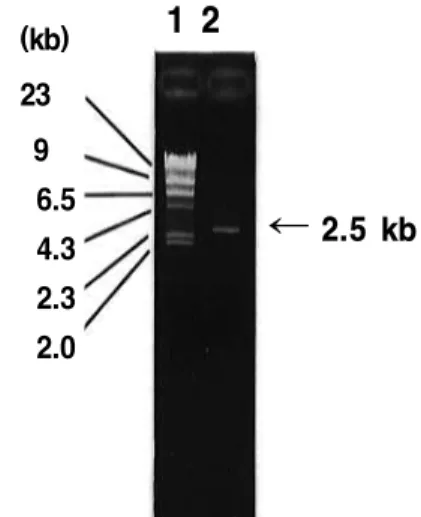
B. subtilis BS 62의 γ-GTP 유전자를 확인하 기 위하여 사용한 4개의 primer중 F-1, F-3 및 F-4 primer의 경우 0.8% agarose gel에서 확인 결과 1.5 kb이하의 생성분획물이 얻어진 반면에 ggt(Ff-2)와 ggt(R-2)를 primer로 사용한 분획 에서는 Fig. 1에서처럼 약 2.5 kb 크기의 γ-GTP 유전자로 추정되는 생성물이 확인 되었다.
2. γ-GTP 유전자의 염기서열 분석
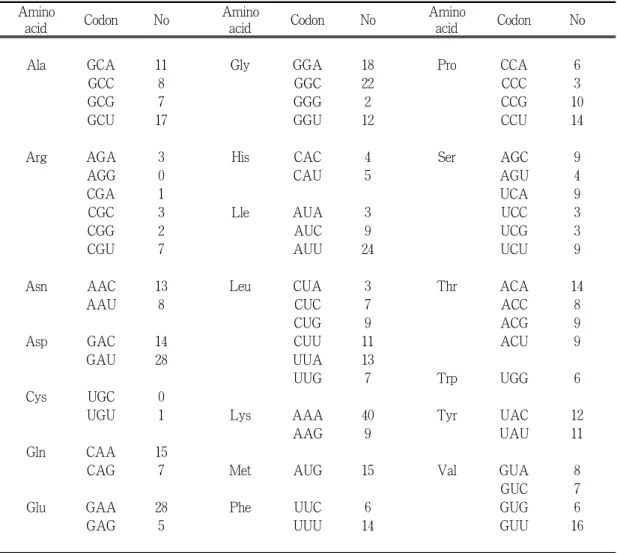
중합연쇄반응 결과 생성된 2.5 kb의 B. subtilis BS 62의 γ-GTP (ggt) 유전자의 염기서열을 분 석한 결과, γ-GTP의 open reading frame (ORF) 은 Fig. 2와 같이 587개의 amino acid로 구성된 polypeptide의 것으로 해석되었으며 이들 아미노 산의 조성은 표 1과 같다. 또한 BS 62의 γ-GTP (ggt) 유전자를 기장에 보고된 다른 B. subtilis γ- GTP (ggt) 유전자들과 비교하여 본 결과 Fig. 3 에서 보는 바와 같이 거의 98% 이상의 상동성을 나타내었으며, 587개의 amino acid 서열을 ORF 상에서 확인할 수 있었다. N-말단의 28개 아미노
산은 B. subtilis 펩타이드의 전형적인 형태를 보 이며(Nagarajan, 1993), 한 γ-GTP의 효소활성은 세포외로 분비되는 특징을 나타내었다. 전형적인 리보솜 부착 부위는 ATG 시작코돈의 위쪽 7번 에서 12번 bp (AGGAGG)에서 발견되었고, 종 지코돈 다음에는 stem-loop 구조가 확인되었다.
γ-GTP의 ORF의 윗쪽 약 50 bp 지점에는 catabolite-responsive element로 볼 수 있는 서열 (TGAAAACGCTGTAAT)이 발견되었다(Huech 와 Hillen, 1995).
(kb) 23 9 6.5 4.3 2.3 2.0
← 2.5 kb 1 2
Fig. 1. PCR analysis of γ-GTP gene generated by PCR with the specific primers (F-2), (R-2) and DNA extracted from Bacillus subtilis BS 62.
Lanes 1 : DNA marker (λ/Hind Ⅲ digest), 2 : γ-GTP gene (2,517 bp).
BS 62의 γ-GTP 유전자를 구성하는 아미노산 의 서열은 B. subtilis(GenBank No. BSU 49358) 와 98%, Pseudomonas sp. A14 (S 63255)와는 37%, 방선균인 Streptomyces avermitils (AP 005028)의 게놈 DNA와는 38%의 상동성을 나타
이태은 · 윤민호 · 최우영
- 168 -
Table 1. Relative synonymous codon usage of B. subtilis BS 62 ggt gene Amino
acid Codon No Amino
acid Codon No Amino
acid Codon No
Ala GCA 11 Gly GGA 18 Pro CCA 6
GCC 8 GGC 22 CCC 3
GCG 7 GGG 2 CCG 10
GCU 17 GGU 12 CCU 14
Arg AGA 3 His CAC 4 Ser AGC 9
AGG 0 CAU 5 AGU 4
CGA 1 UCA 9
CGC 3 Lle AUA 3 UCC 3
CGG 2 AUC 9 UCG 3
CGU 7 AUU 24 UCU 9
Asn AAC 13 Leu CUA 3 Thr ACA 14
AAU 8 CUC 7 ACC 8
CUG 9 ACG 9
Asp GAC 14 CUU 11 ACU 9
GAU 28 UUA 13
UUG 7 Trp UGG 6
Cys UGC 0
UGU 1 Lys AAA 40 Tyr UAC 12
AAG 9 UAU 11
Gln CAA 15
CAG 7 Met AUG 15 Val GUA 8
GUC 7
Glu GAA 28 Phe UUC 6 GUG 6
GAG 5 UUU 14 GUU 16
내었다. B. subtilis 효소와 다른 종류의 γ-GTP의 구성 아미노산 중 현저한 차이를 보이는 것은 467번 잔기로서, 이 부분은 active site로 추측되 며 γ-glutanyl 기의 부착 부위로 추측되는 threonine인 반면, 다른 박테리아에서는 serine으 로 치환된 형태이었고, 포유동물 종류에서는 cysteine으로 밝혀졌다(Xu와 Strauch, 1996).
이상의 결과를 통해서 생성된 B. subtilis B62 의 PCR 산물은 기왕에 보고된 B. subtilis 균주와
높은 상동성을 보이는 전형적인 γ-GTP 생성 유 전자임을 확인하였다.
Ⅳ. 적 요
Poly(γ-glutamic acid) 및 levan의 생성균주로 알려진 Bacillus subtilis BS 62의 γ-GTP(ggt) 유전자를 해석하기 위하여 PCR 반응에 의해 BS
62의 염색체 DNA로부터 약 2.5 kb의 γ-GTP (ggt) 유전자 분획을 얻어 그 PCR 산물의 염기 서열을 분석하여 기왕에 보고된 기타의 ggt 유전 자와 비교 분석한 결과, B. subtilis γ-GTP 유전 자(BSU49358)와 98%의 높은 상동성을 보였으 며, Pseudomonas sp. A14(S63255)와는 37%, 방 선균인 Streptomyces avermitils(AP005028)의 게 놈 DNA와는 38%의 상동성을 나타냈다. BS 62 의 γ-GTP 유전자의 open reading frame은 587 개의 amino acid로 구성된 polypeptide의 것으로 해석되었으며, N-terminal의 28개 아미노산은 B.
subtilis 펩타이드의 전형적인 형태를 보였고, 전 형적인 리보솜의 부착부위는 개시코돈 ATG의 위쪽 7번에서 12번 염기(AGGAGG)에 위치하였 고, 그리고 종지코돈 다음에서는 stem-loop 구조, ORF의 위쪽 약 50 bp 지점에서는 catabolite- responsive element가 발견되었다. 또한 B.
subtilis 효소의 촉매자리로 추정되는 467번 잔기 는 threonine으로서, 다른 박테리아의 serine, 포 유동물의 cysteine과는 구별되는 것이었다.
참고문헌
1. Choi, S. H., C. G. Sung, and W. Y. Choi. 2001.
Levan producing Bacillus subtilis BS 62 and its phylogeny based on its 16S rDNA sequence. J.
Microbiol. Biotechnol. 11(3) : 428-434.
2. Chung, W. S. and Y. H. Ko. 1997. Transformation and mutation of Bacillus licheniformis 9945a producing γ-poly(glutamic acid). Agric. Chem.
Biotech. 40(3) : 173-177.
3. Dempsey, L. and D. A. Dubnau. 1989. Identification of plasmid and Bacillus subtilis chromosomal recombination sites used for PE194 integration.
J. Bacteriol. 171 : 2856-2865.
4. Hara, T., A. Aumayr, Y. Fujio, and S. Ueda.
1982. Elimination of plasmid-linked polyglutamate production by Bacillus subtilis (natto) with acridine orange. Appl. Environ. Microbiol. 44 : 1456-1458.
5. Hasegawa, M. and I. Matsubara. 1978. γ -glutamylpeptide formative activity of Corynebacterium glutamicum by the reverse reaction of the γ-glutamylpeptide hydrolytic enzyme. Agric. Biol. Chem. 42 : 371-381.
6. Hueck, C. J. and W. Hillen. 1995. Catabolite repression in Bacillus subtilis: a global regulatory mechanism for the Gram-positive bacteria. Mol.
Microbiol. 15 : 395-401.
7. Housewright, R. D. 1962. The biosynthesis of homopolymeric peptides. In The bacteria Ⅲ, Gunsalus, I. C. and Stainer, R. Y.(eds), p.389- 412. Academic Press, New York.
8. Nagarajan, V. 1993. Protein secretion, In A. L.
Sonenshein, J. A. Hoch, and R. Losick(ed), Bacillus subtilis and other gram-positive bacteria:
biochemistry, physiology, and molecular genetics.
p.713-726. American Society for Microbiology, Washington, D. C.
9. Nakayama, R., H. Kumagai, and T. Tochikra.
1984. Purification and property of γ-GTP from Proteus mirabilis. J. Bacteriol. 160 : 341-346.
10. Prak, J. S., S. H. Choi, W. Y. Choi, and M. H.
Yoon. 2005. Characteristics of hydrogel prepared from microbial poly(γ-glutamic acid) by chemical crosslinker. Agric. Chem. Biotechnol. 48(4) : 213-217.
11. Park, M. O. and W. Y. Choi. 1993. Characterization of extracellular γ-GTP from the Chungkookjang strain Bacillus subtilis BS 62. RCNBMA. 93 : 22(B-18).
12. Ulbrich, K. and R. Duncan. 1993. Novel biodegradable hydrogels prepared using the divinylic crosslinking
이태은 · 윤민호 · 최우영
- 170 - agent N, O-dimethacryloyl hydoxyl-amine:
Synthesis and characterization of rates of gel degradation, and rate of release of model drugs, in vitro and in vivo. Journal of Controlled Release. 24 : 181-190.
13. Xu, K. and M. A. Strauch. 1996. Identification, sequence, and expression of the gene encoding γ-glutamytranspeptidase in Bacillus subtilis. J.
Bacteriol. 178 : 4319-4322.
14. Yoon, J. H., H. Kim, S. B. Kim, H. J. Kim, W.
Y. Kim, S. T. Lee, M. Goodfellow, and Y. H.
Park. 1996. Identification of Saccharomonospora strains by the use of genomic DNA fragments and rRNA gene probes. Int. J. Syst. Bacteriol.
46 : 502-505.
15. 김관필, 김성호, 정낙현. 2001. 배양조건이 Bacillus subtilis 융합주의 γ-GTP 활성에 미치는 영향. J.
Korean Soc. Nutr. 30(3) : 395-402.