This is an Open Access article distributed under the terms of the Creative Commons Attribution Non-Commercial License (http: //creativecommons.org/licenses/by- nc/4.0/) which permits unrestricted non-commercial use, distribution, and reproduction in any medium, provided the original work is properly cited.
Copyright: © 2018 Korean Journal of Agrcultural Science
https://doi.org/10.7744/kjoas.20180086
PLANT & FOREST
Analysis of intraspecific genetic diversity in Acidovorax citrulli causing bacterial fruit blotch on cucurbits in Korea
Jeong Young Song1, May Moe Oo1, Su Yeon Park1, Mun Won Seo1, Seong-Chan Lee2, Nak Beom Jeon3, Myeong Hyeon Nam3, Youn Su Lee4, Hong Gi Kim1,*, Sang-Keun Oh1,*
1Department of Applied Biology, Chungnam National University, Daejeon 34134, Korea
2Protected Horticulture Research Institute, National Institute of Horticultural and Herbal Science, Haman 52054, Korea
3Fruit and Vegetable Research Center, Chungnam ARES, Nonsan 32914, Korea
4Division of Bio-resource Sciences, Kangwon National University, Chuncheon 24341, Korea
*Corresponding authors: [email protected], [email protected]
Abstract
Bacterial fruit blotch (BFB) caused by Acidovorax citrulli is a devastating disease found in many cucurbits cultivation fields. The genetic diversity for 29 strains of A. citrulli collected from various cucurbits in South Korea was determined by DNA fingerprinting with a pathogenicity test, multi locus analysis, Rep-PCR (repetitive sequence polymerase chain reaction), and URP (universal rice primers) PCR bands. Two distinct groups (Korean Clonal Complex, KCC1 and KCC2) in the population were identified based on group specific genetic variation in the multi locus phylogeny using six conserved loci and showed a very high similarity with DNA sequences for representative foreign groups [the group I (CC1-1 type) and the group II (CC2-5 type)] widely distributed worldwide, respectively. Additionally, in the case of phaC, a new genotype was found within each Korean group. The KCC1 was more heterogeneous compared to the KCC2. The KCC1 recovered mainly from melons and watermelons (ratio of 6 : 3) and 15 of the 20 KCC2 strains recovered from watermelons were dominant in the pathogen population. Accordingly, this study found that two distinct groups of differentiated A. citrulli exist in South Korea, genetically very similar to representative foreign groups, with a new genotype in each group resulting in their genetic diversity.
Keywords: Acidovorax citrulli, bacterial fruit blotch, genetic diversity, multi-locus, Rep-PCR
Introduction
Bacterialfruitblotch (BFB) causedbyAcidovoraxcitrulli (Schaadetal., 1978), isadevastating diseaseofmanycucurbitaceaehosts (BurdmanandWalcott, 2012). Sinceahighlyaggressivestrain wasfirstreportedfromcommercialwatermelonsatUSAin1989 (Somodietal., 1991), BFBoutbreaks OPEN ACCESS
Accepted: November 13, 2018 Revised: November 12, 2018 Received: November 8, 2018 DOI:
Citation: Song JY, Oo MM, Park SY, Seo MW, Lee SC, Jeon NB, Nam MH, Lee YS, Kim HG, Oh SK. 2018. Analysis of intraspecific genetic diversity in Acidovorax citrulli causing bacterial fruit blotch on cucurbits in Korea. Korean Journal of Agricultural Science. https://
doi.org/10.7744/kjoas.20180086
haveoccurredthroughouttheworld. InKorea, thepathogenwasfirstrecoveredfromcommercialwatermelonsatCheonbuk provincein1991 (Songetal., 1991) andhassincebeenreportedfromothercucurbitplants (Songetal., 2015). Likeother bacterialdiseases, useofchemicalcontrolagainstBFBisalittleeffective. Themosteffectivestrategywasknowntouse resistancecultivars (Wechteretal., 2011), thegreatgeneticdiversityofA. citrullicausesresistantcultivarstoactrestrictedly. Thus, theanalysisinformationonthegeneticdiversityofA. citrullicontainingtherelationshipwithinpopulationandhost’s geographicalorigincanprovideaveryusefuldatabasefordevelopingresistantcultivarsandforeffectivecontrolstrategyof the disease. Recently, manyresearchers havestudied the genetic diversityofA. citrullipopulationby physiological, phenotypiccharacteristics, serology, biochemicalreactionandpathogenicitytests (Walcottetal., 2004; Meloetal., 2014).
Additionally, Songetal. (2015) alsoreportedtheexistenceoftwogroupsinKoreanA. citrullipopulation. However, these studiescouldn’tgiveenoughinformationtounderstandgeneticcharacteristicsofKoreanpopulation. Therefore, thecurrent study was tried toclarify the intraspecificgenetic diversitywithin Korean A. citrullipopulation throughmulti-locus, repetitive-sequence-polymerasechainreaction (Rep-PCR) anduniversalriceprimers (URP)-PCRanalysisinordertoobtain reliabledatafordevelopingresistancecultivarsandtheintegratedcontrolofbacterialfruitblotchinKorea.
Materials and Methods
Bacteria strains and DNA extraction
Atotalof29A. citrullistrainswerecollectedfromseeds, fruits, leavesandstemsofmelon, pumpkin, cucumberand watermelonplantsinthecultivationfieldsofKoreafrom2011to2014 (Table1). Allofthesebacteriawerestoredin15% sterileglycerolat - 80 . Theidentificationofallstrains wereperformed throughpathogenicitytest byinoculation on watermelonseedlingsand16srDNAsequencing (Songetal., 2015). BacterialDNAwasextractedusingtheDNeasyTissue Kit (QiagenInc., USA).
Multi-locus analysis
Forthemulti-locusanalysis, DNAsequencesofsixhousekeepinggenes; adk (437bp), glyA (563bp), gltA (487bp), pilT (405bp) obtainedfromourpreviouswork (Songetal., 2015) andugpB (452bp) andphaC (479bp) wereselectedandPCR productswereperformedusingPrimersofugpB (ugpB1 & ugpB2) andphaC (phaCF & phaCR). EachPCRreactionwas performedbymixture (SolgentCo., Ltd., Korea) underthePCRconditionsdescribedbyKangetal. (2002). AllofthePCR ampliconsweresequenced (MacrogenLtd., Korea). ThesequenceswerevisualizedandalignedwithMEGA5 (Tamuraetal., 2011) andalsocomparedwithforeignA. citrullistrains (ATCC29625; groupIand30002; groupII). Amaximumlikelihood treewasconstructedwiththeconcatenateddatasetofthefourloci (gltA, pilT, ugpB, andphaC) astheDNAsequencesfor fiveloci (adk, gltA, glyA, pilT, ugpB) ofallKoreanclonalcomplex (KCC)1andKCC2strainsofA. citrulliwereidentical accordingtothegroup. A. avenaesubsp. cattleyaewereservedasoutgroups.
Rep-PCR and URP-PCR
DNAfingerprintingwasconductedusingRep-PCRprimers; ERIC1R/ERIC2andBOXA1R (Louwsetal., 1994) and URP-PCRprimers; URP2, URP5, URP6, andURP8fromKangetal. (2002). ConditionsforPCRamplificationreactions
wereperformedasdescribedbyKangetal. (2002). RAPDbandswerescoredfromtheagarosegelandrecordedaspresent (1) orabsent (0) andassembledintoadatamatrix. ThecombinedsixresultswereanalyzedwithNTSYS (ExterBiological Software), anddendrogramsweregeneratedusingtheunweightedpairgroupmethodwithaverage (UPGMA).
Table 1. Host, geographic origin and multi-locus genotypes of Acidovorax citrulli strains isolated from cucurbit cultivation fields in Korea.
Strain No. Year Hosts Geographic origin Multi-locus genotypeGroup phaC Path ogenicityw References 11246
11247 11248 14194 14201 14202 12091 12158 14222 11171 12170 13217 13255 14236 17913 11147 11162 11163 11164 11165 11201 11251 11259 12089 12090 13034 13211 17000 17912 29625 x 19822 y 33619 z
20122012 2012 20142014 20142012 2012 20142011 20122013 2013 20142012 20112011 2011 20112011 20122012 2012 20122012 20132013 2012 20121978 1997nd
melon melon melon melon melon melon watermelon watermelon watermelon cucumber cucumber cucumber cucumber melon pumpkin seed
watermelon watermelon watermelon watermelon watermelon watermelon watermelon watermelon watermelon watermelon watermelon watermelon watermelon watermelon watermelon
Orchidrice
Goksung, Jeonnam Goksung, Jeonnam Goksung, Jeonnam Anseong, Gyeonggi
Gwangju City Anseong, Gyeonggi
Buyeo, Chungnam Nonsan , Chungnam
Yicheon, Gyeonggi Nonsan , Chungnam Nonsan , Chungnam Buyeo, Chungnam Youngam, Jeonnam
Goksung, Jeonnam Busan City Gochang, Jeonbuk Buyeo, Chungnam Buyeo, Chungnam Nonsan , Chungnam Nonsan , Chungnam Jinju, Gyeongnam
Suwon, Gyeonggi Hamyang, Gyeongnam
Buyeo, Chungnam Buyeo, Chungnam Anseong, Gyeonggi Youngam, Jeonnam Buyeo, Chungnam Andong , Gyeongbuk
USA, Georgia Japan
USA
KCC1KCC1 KCC1 KCC1KCC1 KCC1KCC1 KCC1 KCC1KCC2 KCC2KCC2 KCC2 KCC2KCC2 KCC2KCC2 KCC2 KCC2KCC2 KCC2KCC2 KCC2 KCC2KCC2 KCC2KCC2 KCC2 KCC2KCC1 OGOG
GA G GA GA G AG GG G GG AG G GG AA G GG AG G ndA ndnd
++ + ++ ++ + ++ ++ + ++ ++ + ++ ++ + ++ ++ + nd+ ndnd
Song et al., 2015 ʺ ʺ ʺ ʺ ʺ ʺ ʺ ʺ ʺ ʺ ʺ ʺ ʺ ʺ ʺ ʺ ʺ ʺ ʺ ʺ ʺ ʺ ʺ ʺ ʺ ʺ ʺ
Willems et al., 1992 Feng et al., 2009 Schaada et al., 2008 KCC, Korean clonal complex; OG, Outgroup; A, adenine; G, guanine; nd, not determined.
w All strains were shown virulence activities.
x ATCC29625 Multilocus sequence typing (MLST) clonal complex (CC) and sequence type assignments.
yATCC19822 A. avenae subsp. avenae.
z
Results and Discussion
Multi-locus relationship analysis
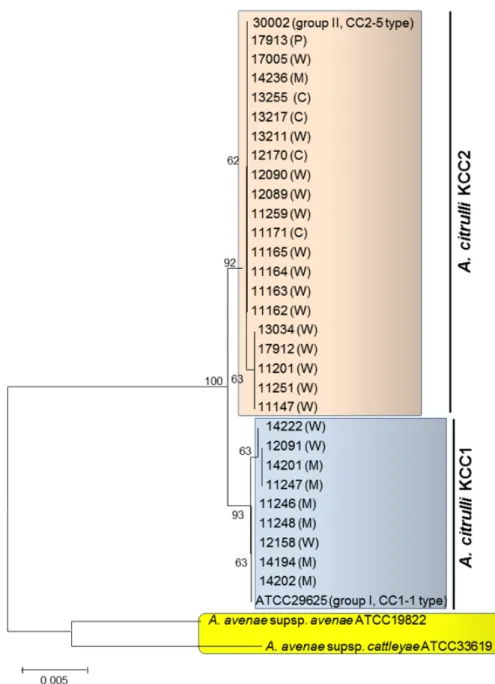
Uponmulti-locusrelationshipanalysisusing1,823bpofthetotalbasesequenceofthegeneswhichincludedgltA, pilT, ugpB, andphaC, A. citrulliwereclassifiedintotwogroups; KCC1andKCC2withinthesamecladeapartfromA. avenae subsp. avenaeandA. subsp. cattaleyae (Fig. 1).
Inthisstudy, theallelicprofileanalysisusingthebasesequenceofthegenesincludingadk, gltA, glyA, pilT, ugpBexcept
Fig. 1. Maximum likelihood phylogeny of 29 Korean strains of Acidovorax citrulli with two foreign strains;
A. citrulli CC1 and CC2 types (Feng et al., 2009) and two Acidovorax spp. as the outgroup. The tree was constructed from 1,823 bp using four genes: pilT, gltA, ugpB and phaC. Bootstrap values with 1,000 replicates for the major divisions of A. citrulli from the outgroups. C, cucumber; M, melon; W, watermelon; P, pumpkin.
phaCpresentedtheexistenceofspecies-specificandgroup-specificbasemutationin7sitesofKCC1andKCC2groupsin 29KoreanA. citrullistrainswithforeignisolates (Table2). The30thbaseswerecytosine (C), thymine (T) inadk; 439th, 442th, and451thbaseswereC, guanine (G), adenine (A) andG, A, CingltA; 452thwereAandGinglyA; 94thwereCand TinpilT; and280thwereGandCinugpBinthestrainsofKCC1andKCC2groups, respectively (Table2). DNAsequences ofgltA, pilT, andugpBgenesforCC1–1typeshared86% ofCC1group (groupI) andCC2-5typeshared82% oftheCC2 group (groupII); foreignA. citrullistrainsusedinstudiesofFengetal. (2009) thatshowedtheconsistencywithKorean strainsofKCC1andKCC2group, respectively. Ontheotherhand, nogroup-specificmutationoccurredinthebasesequence ofphaCgene, whilethe84thbaseappearedrandomlywith20 : 9ratiointheindividualstrainsofGtoA, demonstrating anothermutationwithineachgroupinKoreanA. citrullipopulation (Table1). DNAsequencesforCC1-1type (ATCC29625) andCC2-5type (30002), foreignA. citrullistrainsthatshowedtheconsistencywithGtypesofKCC1andKCC2group havingonlyGatthe84thbase.
DNA fingerprinting Rep-PCR and URP-PCR
AccordingtotheclusteranalysisusingDNAfingerprintingdatawiththeseresults, wehaveconfirmedtwoclustersforming 29uniquehaplotypesfrom29strains (Fig. 2). 65% ofsimilaritywasshownbetweentheclusters. Cluster1included11 recoveredstrains from watermelonand melon, and cluster 2 included18 recoveredstrains from watermelon, melon, cucumber, andpumpkin, whichwereconsistentwiththeclassificationresultsofKCC1andKCC2groupsbymulti-locus analysis. Whendividingbytwocladesofisolatedstrainsfromwatermelonandmelon, 72% ofsimilaritywasshownwithin thegroupofKCC1cluster. KCC2groupshowed81% similarity, whichwashigherthanKCC1group; isolatedhostsdid developtheclusterbutnotclade.
Consequently, KCC1groupshowedhigherisolationrateinthemelonthaninthewatermelonunlikethestrainsinKCC2 group. 103bandsderivedfromcomprehensiveresultsofbothRep-PCRandURP-PCR, 6weremonomorphicand97were polymorphic (SupplementaryFig. 1). Therefore, wecouldsecurethefingerprintingdatawithmorereliablegeneticdiversity fromtheresultsofRep-PCRandURP-PCRthanthosefrommulti-locusphylogeneticanalysis. Meanwhile, thestrainsin KCC2groupwhichwerepredominantinthewatermelonshowedhigheroccurrenceratewithinthegroupofA. citrulli speciesthantheKCC1group. TheywerewidelyrecoveredfromvariouscultivationregionsofthecucurbitsinGyeongbook,
Table 2. Comparison of DNA variation sites for six genes of Korean KCC1 and KCC2 groups with two foreign groups of Acidovorax citrulli.
Group Gene (bp)y
gltA (439, 442, 451) ugpB (280) pilT (94) adk (30) glyA (452) phaC (84)
Group I z C, G, A G C nd nd G
KCC1 C, G, A G C C A A or G
Group II z G, A, C C T nd nd G
KCC2 G, A, C C T T G A or G
KCC, Korean clonal complex; A, adenine; C, cytocine; G, guanine; T, thymine; nd, not determined.
y DNA variation sites within each gene. DNA sequences of adk, glyA, gltA, pilT were obtained from results of Song et al. (2015).
z group I (CC1-1 type); ATCC29625 and group II (CC2-5 type); 30002 (Feng et al., 2009, Walcott et al., 2004). DNA sequences for gltA, pilT, ugpB and phaC of A. citrulli strains are 30081; EU928015, EU928415, EU928623, and EU928313, and 30001; EU928015, EU928426, EU928634, and EU928322.
Gyeonggi, Gyeongnam, Jeonnam, Jeonbuk, andChungnam, etc.
Accordingly, usingbothmulti-locusanalysisandRep-PCRandURP-PCRanalysis, wehaverevealedthattwogroupsof geneticallydifferentiatedA. citrulliexistedinKorea, verysimilartotwoforeigngroupswidelydistributedworldwide, with avarietyofgenotypesineachgroupresultinginthegeneticdiversityandthisisverymeaningful. Uponfurthercomparison analysisonthepathogenicitydifferencesusingvarioushostsofthesestrainsandonthefeaturesoftheresponsesagainst variouscontrolagents, itisconsideredtobetheveryusefuldatainthedevelopmentofeffectiveresistancecultivarsandfor theestablishmentofthediseasecontrolsystemagainstBFBduetoA. citrulli.
Fig. 2. Cluster analysis of Acidovorax citrulli strains and A. valerianella 12066 based on DNA fingerprint profiles generated by polymerase chain reaction (PCR) amplification of repetitive elements and universal rice primers (URP) primers. Distance matrix data was generated using Dice’s (1945) coefficient of similarity and the dendrogram was constructed using the unweighted pairwise group method with arithmetic mean (UPGMA) algorithm. C, cucumber; M, melon; W, watermelon; P, pumpkin.
Acknowledgement
ThisworkwassupportedbyresearchfundofChungnamNationalUniversity.
References
Burdman S, Walcott RR. 2012. Acidovorax citrulli: Generating basic and applied knowledge to tackle a global threat to the cucurbit industry. Molecular Plant Pathology 13:805-815.
Dice LR. 1945. Measures of the amount of ecologic association. Ecology 26:297-302.
Feng JJ, Schuenzel EL, Li J, Schaad NW. 2009. Multilocus sequence typing reveals two evolutionary lineages of Acidovorax avenae subsp. citrulli. Phytopathology 99:913-920.
Kang HW, Park DS, Park YJ, You CH, Lee BM, Eun MY, Go SJ. 2002. Fingerprinting of diverse genomes using PCR with universal rice primers generated from repetitive sequence of Korean weedy rice. Molecules Supplementary Fig 1. Representative DNA fingerprinting by four universal rice primers-polymerase chain reaction (URP-PCR) and two repetitive elements amplification of Acidovorax citrulli strains. M; 100 bp plus DNA ladder, Lane 1; 11246, 2; 11247, 3; 11248, 4; 14194, 5; 14201, 6; 14202, 7; 12091, 8; 12158, 9; 14222, 10;
11147, 11; 11162, 12; 11163, 13; 11164, 14; 11165, 15; 11201, 16; 11251, 17; 11259, 18; 12089, 19; 12090, 20;
13034, 21; 13211, 22; 17005, 23; 17912, 24; 13255, 25; 11171, 26; 12170, 27; 13217, 28; 14236, 29; 17913 of A.
citrulli and 30; A. valerianella 12066.
and Cells 3:281-287.
Louws F, Fullbright DW, Stephens CT, Bruijn FJ. 1994. Specific genomic fingerprints of phytopatogenic Xanthomonas and Pseudomonas pathovars and strains generated with repetitive sequences and PCR.
Applied and Environmental Microbiology 60:2286-2295.
Melo LA, Tebaldi ND, Mehta A, Marques AS. 2014. Comparing Acidovorax citrulli strains from melon and watermelon: Phenotypic characteristics, pathogenicity and genetic diversity. Tropical Plant Pathology 9:154-162.
Schaad NW, Sowell G, Goth RW, Colwell RR, Webb RE. 1978. Pseudomonas pseudoalcaligenes subsp.
citrulli subsp. nov. International Journal of Systematic and Evolutionary Microbiology 28:117-125.
Somodi GC, Jones JB, Hopkins DL, Stall RE, Kucharek TA, Hodge NC, Watterson JC. 1991. Occurrence of a bacterial watermelon fruit blotch in Florida. Plant Disease 75:1053-1056.
Song JY, Seo MW, Lim HS, Lee YS. 2015. Genetic characteristics of Acidovorax citrulli population causing bacterial fruit blotch against cucurbits in Korea. Research in Plant Disease 21:82-88.
Song WY, Kim HM, So IY, Kang YK. 1991. Pseudomonas pseudoalcaligenes subsp. citrulli: The causal agent of bacterial fruit blotch rot on watermelon. Korean Journal of Plant Pathology 7:177-182.
Schaada NW, Postnikovaa E, Sechlera A, Claflinb LE, Vidaverc AK, Jonesd JB, Agarkovac I, Ignatove A, Dicksteind E, Ramundob BA. 2008. Reclassification of subspecies of Acidovorax avenae as A. Avenae (Manns 1905) emend., A. cattleyae (Pavarino, 1911) comb. nov., A. citrulli Schaad et al., 1978) comb.
nov., and proposal of A. oryzae sp. nov. Systematic and Applied Microbiology 31:434-446.
Tamura K, Peterson D, Peterson N, Stecher G, Nei M, Kumar S. 2011. MEGA5: Molecular evolutionary genetics analysis using maximum likelihood, evolutionary distance, and maximum parsimony methods. Molecular Biology and Evolution 28:2731-2739.
Walcott RR, Fessehaie A, Castro AC. 2004. Differences in pathogenicity between two genetically distinct groups of Acidovorax avenae subsp. citrulli on cucurbit hosts. Journal of Phytopathology 52:277-285.
Wechter WP, Levi A, Ling K-S, Kousik C, Block CC. 2011. Identification of resistance to Acidovorax avenae subsp. citrulli among melon (Cucumis spp.) plant introductions. HortScience 46:207-212.
Willems A, Goor M, Thielemans S, Gillis M, Kersters K, De Ley J. 1992. Transfer of several phytopathogenic Pseudomonas species to Acidovorax as Acidovorax avenae subsp. avenae subsp. nov., comb. nov., Acidovorax avenae subsp. citrulli, Acidovorax avenae subsp. cattleyae, and Acidovorax konjaci.
International Journal of Systematic and Evolutionary Microbiology 42:107-119.