사과 과수원에서의 토양 CO
2발생량 평가
이재만1·김승희2*·박희승1·서형호3·윤석규2
1중앙대학교 식물응용과학과, 2국립원예특작과학원 과수과,
3국립원예특작과학원 온난화농업대응연구센터
(2009년 4월 2일 접수; 2009년 6월 3일 수정; 2009년 6월 22일 수락)
Estimation of Soil CO
2Efflux from an Apple Orchard
Jae-Man Lee
1, Seung-Heui Kim
2*, Hee-Seung Park
1, Hyeong-Ho Seo
3and Seok-Kyu Yun
21Department of Applied Plant Science, Chung Ang University, Anseong 456-756, Korea
2Fruit Research Division, National Institute of Horticultural & Herbal Science, RDA, Suwon 441-706, Korea
3Agricultural Research Center for Climate Change, National Institute of Horticultural & Herbal Science, RDA, Suwon 441-706, Korea
(Received April 2, 2009; Revised June 3, 2009; Accepted June 22, 2009)
ABSTRACT
This study was conducted to quantify the soil respiratory CO2 emission (SR) in an apple orchard and to determine its relationship with key environmental factors such as air temperature, soil temperature and soil moisture content. Experiment was made over the period from 23 April 2007 to 31 March 2008 in ‘Fuji’ apple orchard of National Institute of Horticultural and Herbal Science in Suwon, Gyeonggi-do, Korea. The SR was measured by using the automatic opening/closing chamber system based on a closed method. Diurnal variations in SR showed an increase around 0700 hours with increasing soil temperature, its peak between 1400 and 1500 hours, and then a gradual decrease thereafter. Daily variations in SR depended largely on soil and air temperatures over the year, ranging from 0.8 to 13.7 g CO2 m−2 d−1. During the rainy spell in summer (July~Autumn) with higher temperature and more precipitation, the SR was lower than that in the spring (May~June) with moderate temperature. The SR showed a significant exponential relationship with soil temperature (r2=0.800) and air temperature (r2=0.805), but not with soil moisture content (r2=0.160). The Q10
values of SR with annual soil temperature and air temperature were 2.0 and 1.9, respectively. The annually integrated SR was 19.6 ton CO2 ha−1.
Key words: Soil CO2 emission, Soil temperature, Apple orchard, AOCC(Automatic Opening Closing Chamber)
I. 서 언
최근지구온난화에따른기상이변의원인으로알려 진온실가스방출에대한우려와감축 의무가산업분 야뿐만아니라농업분야에서도확산되고있다. 온실가 스 중 CO2는 지구 온난화 또는 총 온실효과의 약
60%를차지하여지구온난화와기후변화의중요한요
인으로 인식되고 있으며(Rastogi et al., 2002), 대기
CO2의약 10%에해당하는 막대한양의 CO2가매년 토양으로부터 방출된다(Raich and Schlesinger, 1992).
이는 현재 화석연료의 소비에의해 발생되는 CO2의 약 10배가 넘는 양이다. 토양에서 발생되는 CO2는 토양 호흡의형태로방출되며, 토양호흡은뿌리호흡 (root respiration)과 미생물호흡(microbial respiration)
* Corresponding Author : Seung-Heui Kim ([email protected])
적요소에의한 CO2발생조절이가장중요한요소로 알려져 있다(Raich and Schlesinger, 1992; Davidson
et al., 1998). 토양온도의상승은 유기물 분해, 산화,
미생물과뿌리의활성그리고탄소분해과정을촉진시 켜토양으로부터의 CO2방출을증가시키며(Boone et
al., 1998; Davidson et al., 1998), 높은 토양수분은 미생물활성에더좋은조건을제공하여미생물의산 소소비와 CO2 발생을 증가시키기도 한다(Buyano- wsky and Wagner, 1983). 그러나 토양호흡에 대한 이러한생물적및비생물적영향은식생의형태에따 라크게다를 수있다. 따라서다양한식생을대상으 로토양호흡에대한토양온도및습도와같은토양환 경의 영향을파악하는 것은 미래의 기후변화에따른 온도증가나 강수량변화 등의 환경 변화에대한 토 양의 CO2방출량을예측하는데있어서매우중요하다.
그러나현재우리나라에서의토양호흡에대한연구는
대부분 산림 생태계에 국한되어 있으며(Lee and
Moon, 2001; Yi, 2003; Moon, 2004; Min, 2006) 논,
밭경작지, 초지, 과수원등에서의 토양 호흡 연구는
부족한실정이다.
본연구는우리나라의과수생태계에서큰비중을차 지하는사과원을대상으로토양호흡을연속적으로계 측하여, 토양으로부터 방출되는 CO2의일변화및 계 절변화를정량화함으로써사과원토양호흡에대한토 양온도와수분의영향을정량적으로파악하기위하여 수행하였다.
II. 재료 및 방법
2.1.실험 site
경기도수원소재국립원예특작과학원내의사과원
(N 37o 18', E 126o 49', 해발 56m) 토양을 대상으
Inc. USA)와 109-L(Campbell Scientific Inc. USA),
열전대(Copper-constantan)를이용하여측정하였다. 토 양수분 함량은 2007년 5월 20일부터실험종료시까
지 TDR sensor(CS 616, Campbell Scientific Inc.
USA)를이용하여 0-0.15m 토양층에서측정하였다. 실
험기간중의강수량은수원기상청자료를활용하였다.
2.3.토양호흡측정
토양호흡의측정에는자체제작한자동개폐식챔버
(Automatic Opening/Closing Chamber, AOCC)를 이
용하였으며(Fig. 1), 주간의수관 하부에챔버를설치 한후 약한달 정도의안정화단계를거친 다음측 정을 개시하였다. AOCC밀폐법(closed method)을채 택하여여러개의동일한챔버를대상으로순차적이고 연속적인계측이가능한다채널(Multi-channel)방식자 료 수집장치(CR1000, Campbell Scientific Inc. USA)
의 프로그램에 의해 SDM AC/DC 16 controller (Campbell Scientific Inc. USA)를이용하여토양호흡
Fig. 1. Conceptual diagram of automatic opening/closing chamber system for soil respiration measurement.
을측정하였다. 측정개시와동시에챔버의덮개가밀
폐되고측정종료시덮개가열린상태로유지되어강 우나낙엽등이그대로유입되도록하여챔버내부의 환경이주변환경과가능한한유사한상태를유지하도 록하였다. 챔버형태 및재질은내부의원활한공기 순환과온도, 광도, 습도등의환경적제약이적은투 명한원통 아크릴(Volume: 35,837cm3, Inside diameter
×Height: 0.39m×0.30m)을 사용하였으며 야외에서의
원통아크릴의안정적고정과내구성을위해 고정대를 외부에설치하였다(Fig. 1). 토양 호흡 측정 시 챔버
내부의 공기는 공기순환펌프(Techno Takatsuki CO.
LTD)를작동시켜 2l min−1로순환시켰으며, 토양에서
발생된CO2 분석은 유량계를 이용하여 0.8l min−1로
CO2적외선 분석기(Li-820, Campbell Scientific Inc.
USA)를통과시켜측정하였다. 데이터는 1초마다측정 하여 10초 평균값으로 자료수집장치(CR-1000, Cam- pbell sci.)에저장하였다.
토양호흡을 측정하기전에 공기 순환 펌프와챔버 내부 순환 팬이 먼저 작동하여 챔버 내부의 공기를 대기와최대한동일하게유지시켰으며챔버가닫혀있 는시간은 160초로 설정하였다. 토양 호흡 측정기간 동안챔버내부에자라는초본류의광합성작용에의 해토양호흡이과소평가되지않도록챔버내부에서 자라는 초본류는 뿌리까지 모두 제거하였으며, 챔버 배치 및측정은 완점임의배치법으로 세 번 반복하여 실시하였다.
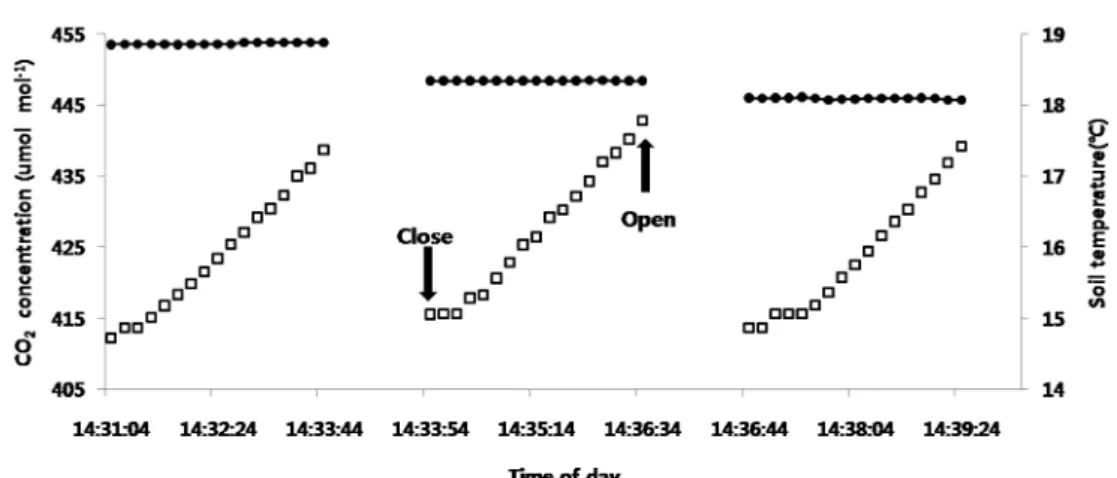
측정시간(160초)동안 챔버내의 CO2변화를확인한 결과, 챔버가닫히고약 40~50초경과후 CO2농도가
안정적으로지속적인증가경향을나타냈으며가장안 정적인 구간인챔버가열리기 전 80초간의데이터를 자료분석에 이용하였다(Fig. 2). Hongxing et al.
(2007)은밀폐법을기초로한자동챔버측정방식에서
챔버당180초동안토양호흡을측정하였으며, 또한 밀 폐법을기초로하여챔버내에 식물체를포함한 CO2
플럭스 측정 시 챔버가 닫힌 후 1~3분 동안 농도의 변화가 CO2플럭스를계산하는데적당하다(Nishimura
et al., 2005)는 연구결과와 본 실험에서의 토양호흡 측정시간(160초)은유사한범위였다. 본실험에서밀폐
된챔버에의해 토양호흡에영향을미칠수있는토 양온도의변화는무시할수있는수준이었으며, 각챔
버별 공간적 위치 차이로인한 CO2농도 변화에약 간의차이가발생하였다(Fig. 2).
2.4.토양호흡속도(Soil respiration rate; SR)의추정 토양호흡속도(mg CO2 m−2 s−1)는 단위면적에서 단
위시간당방출되는CO2로나타낼수있는데, 본실험
에서는 다음의 계산식(Nakayama, 1990)을 이용하여
추정하였다.
여기에서 Δt는측정시간(초), Δc는 측정 시간 동안의
CO2농도 변화(μmol/mol), V는 챔버 부피(m3), A는 챔버에의해 덮인토양 표면적(m2), h는챔버의높이 (m)이다.
토양호흡속도와온도사이의관계는지수함수식모 SR Δc
---Δt
⎝ ⎠⎛ ⎞V A--- Δc
---Δt
⎝ ⎠⎛ ⎞h
= =
Fig. 2. Temporal changes of CO2 concentration and soil temperature (at 0.05m) inside automatic opening/closing chamber for a 160-second measurement period.
한편, 토양호흡속도와 토양 수분 함량과의 관계는 이차함수적관계를 이용하였다(Bunnell et al., 1977;
Linn and Doran, 1984).
2.5. 자료분석
실험기간을통하여연속적으로계측한데이터는일 평균 토양 호흡속도로 산출하였다. 또한, 토양호흡에 대한토양온도와수분의영향은회귀분석을이용하여 검정하였고, 모든자료는 SPSS 12.0을이용하여분석 하였다.
III. 결과 및 고찰
3.1. 기상및토양특성
측정기간동안사과원의일평균기온은 -7.5~29.5oC
범위에 분포하여 평균 12.5oC이었다. 일 평균지온은
-2.0~26.3oC 범위에서일변화및계절변화를나타내면
서평균 12.0oC로기온보다약간낮은 수준으로추이
하였다. 연강수량은평년수준(1267.9mm)이었으나, 7~9
월에 200mm이상의 많은 강우가 있었다. 특히 9월
강수량(268.8mm)이평년(133.5mm)에 비해 2배정도 많았으며, 평균토양수분함량은 18.1%이고 7.6~26.9%
수준에서일변화와계절변화를나타내었다.
3.2. 토양호흡속도의일변화
측정 기간중 맑은날(2007년 5월20일~21일)을선
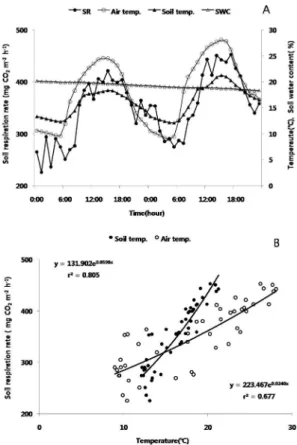
정하여토양호흡속도의일변화와기온, 지온및토양 수분함량의일변화를측정하였다. 그결과, 온도가상 승하는 7시경부터토양호흡이점차증가하기시작하여 온도가가장높은 14~15시경에최대값(399.4~450.9mg CO2 m−2h−1)을 나타내었으며이후 온도의하강과함 께토양호흡속도는감소하였다(Fig. 3A).
토양호흡속도의일변화는토양수분함량의변화보 다 기온과 지온의일변화와 유사한 경향을나타내며 온도증가에따라지수함수적으로증가하였다. 토양호 흡속도는 기온(r2=0.677)보다도 지온(r2=0.805)과 더 밀접한 상관관계에있었으며(Fig. 3B), 이는 토양 내
CO2 발생의주요 원인은주로 표토 안에 위치하므로 지표면으로부터 0.05~0.10m의깊이의토양온도와밀
접하게 관련되어 있기 때문으로 사료된다(Buyanovsky
et al., 1986; Rochette et al., 1992; Lessard et al., 1994).
3.3. 토양호흡속도와환경인자와의상관관계 실험기간전체를통하여일평균토양호흡속도와환 경인자와의상관관계를검토한결과, 토양수분함량과 는 낮은 상관관계(r2=0.160)를 나타냈으나(Fig. 4B),
지온(r2=0.800) 및 기온(r2=0.805)과는 높은 상관관계 를 나타냈다(Fig. 4A). 그러나 장마기가 있는 7~9월
Fig. 3. (A) Daily variations (on 20-21 May 2007) in soil respiration rate (SR), air and soil temperature and soil water content (SWC) and (B) the relationship between soil respiration rate and air temperature or soil temperature.
에는 지온과의 뚜렷한 상관관계(r2=0.429)가 보이지
않았으며(Fig. 4C), 토양수분함량과는 부의 상관관계
(r2=0.379)를나타내는경향이있었다(Fig. 4D).
일반적으로 토양호흡은 지온에 의해서 일차적으로 주도되고이들 간에는상당히 높은 상관관계가있는 것으로알려졌다(Son and Kim 1996; Knapp et al., 1998; Mc Hale et al., 1998; Lee and Moon, 2001).
또한 토양 수분 조건의 영향에 관해서는 연구자 및 조사지역에따라서다양한연구결과가보고되어있다.
즉, 온대지역에서는토양수분함량이낮은조건하에서 토양호흡속도를감소시킨다는보고(Dong et al., 1998;
Londo et al., 1999; Kosugi et al., 2005; Mitani et al., 2007)가 있는 반면, 건조조건과다습조건은모두 토양 호흡속도를 감소시킨다는 결과(Martin and
Bolstad, 2005)와토양수분은토양호흡에유의적인효
과가 없다는 결과도 보고되었다(Fang et al., 1998;
Ohashi et al., 1999). 이와 같은 선행연구결과를 종 합해 볼 때, 사과원 토양으로부터 연간 방출되는
CO2(토양호흡)는토양수분함량보다는온도와밀접하게
관련되어있으나, 장마기간동안에는토양온도와토양 수분함량의영향을모두받는것으로생각된다.
사과원의토양호흡과온도와의관계에있어서지수 함수식에 따라 토양 호흡의 온도 민감성 지표로서
Q10을검토한결과, 지온과기온대한 Q10은각각 2.0과 1.9이었다(Fig. 4A). Raich and Schlesinger(1992)가 보고한 지구 평균 Q10수치인 2.4보다는 낮은 수치를
나타냈다. 국내의 경기도광릉지역의낙엽활엽수림에 서의 지온에 대한 Q10은 3.3(Min, 2006), 경기도 수 원지역의 고추경작지에서는 1.9(Lee, 2008)로 보고되 어 있다. 따라서, 본 실험에서 측정한 사과원의 Q10
수치는산림보다는낮고고추경작지와는유사한경향 을나타냈다.
토양호흡에서 Q10이높다는것은온도변화에대해 토양미생물과식물뿌리의호흡속도가높아진다는것 을의미한다. 식생에따라 Q10에차이를나타내는이 유는 토양호흡에관여하는요소(뿌리호흡, 근권호흡,
균근, 타가영양체호흡등)들의온도에대한민감성이 서로 다르기 때문이다(Bowden et al., 1998). 또한 년간토양호흡과온도와의관계로부터평가된 Q10은 온도반응뿐만아니라토양수분함량, 뿌리생체량,
낙엽 및 낙지(가지) 유입, 토양 미생물 집단 등의계 절적 차이가 종합된 것이기 때문에(Davidson et al.,
Fig. 4. Relationships of soil respiration rate with (A) air/soil temperature and (B) soil water content over the whole season, and with those (C and D, respectivelyc) over rainy season (July-September 2007).
1998) 식생에따라서로다른 Q10을나타내는것으로 생각된다.
3.4.연중토양호흡량평가
측정 기간 동안 일별 토양 호흡속도 범위는
0.82~13.65g CO2 m−2d−1 이었다(Fig. 5). 사과원 토 양으로부터의 CO2방출량은지온이상승하기시작하는
3월부터 증가하여 5월~6월에 가장 높았으며, 장마가 있는 7월~9월사이에는토양온도가높음에도불구하
고 강우의영향으로 낮은 수준에 머물렀다(Fig. 4D).
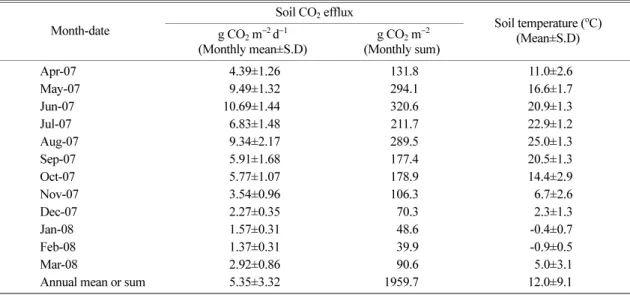
이후기온이하강하는가을에는토양호흡이지속적으 로 감소하기시작하여 월평균지온이 가장 낮은 2월 에 가장낮은 토양 호흡을나타냈다(Fig. 5, Table 1).
한편, 선행연구결과에의하면고추경작지에서의토양 호흡은지온이가장높은 9월에가장높은토양호흡 을나타냈으며(Lee, 2008), 소나무, 굴피나무및굴참 나무림에서도 토양 온도가 가장 높은 7~8월에 가장 많은토양호흡을나타낸다고하였다(Moon, 2004).
Fig. 5. Seasonal changes in soil respiration rate (SR), precipitation, soil water content (SWC) and temperature.
Table 1. Seasonal changes in soil respiratory CO2 emission and soil temperature
Month-date Soil CO2 efflux Soil temperature (oC)
(Mean±S.D) g CO2 m−2 d−1
(Monthly mean±S.D) g CO2 m−2 (Monthly sum)
Apr-07 4.39±1.26 131.8 11.0±2.6
May-07 9.49±1.32 294.1 16.6±1.7
Jun-07 10.69±1.44 320.6 20.9±1.3
Jul-07 6.83±1.48 211.7 22.9±1.2
Aug-07 9.34±2.17 289.5 25.0±1.3
Sep-07 5.91±1.68 177.4 20.5±1.3
Oct-07 5.77±1.07 178.9 14.4±2.9
Nov-07 3.54±0.96 106.3 6.7±2.6
Dec-07 2.27±0.35 70.3 2.3±1.3
Jan-08 1.57±0.31 48.6 -0.4±0.7
Feb-08 1.37±0.31 39.9 -0.9±0.5
Mar-08 2.92±0.86 90.6 5.0±3.1
Annual mean or sum 5.35±3.32 1959.7 12.0±9.1
그러나 본실험에서는 장마기의 많은 강우로인한 높은토양 수분 함량이토양과 대기 사이의가스 교 환을제한함으로서토양 내의산소농도가낮게유지 되었기때문에토양생물군락의호기성호흡이억제된 것으로 판단된다(Davidson et al., 1998). 또한 높은 토양수분은식물뿌리의호흡활성을억제하여뿌리 생체량과토양의가스확산에영향을미친다는연구결 과(Adachi et al., 2006)로부터, 장마 기간의 많은 강 우는토양내수분함량을증가시켜사과원의토양호흡 을억제시킨것으로생각된다.
Shi et al.(2006)는티벳평원 밀경작지에서의토양
CO2방출량은 온도가가장 높을 때보다엽면적지수
가최대이고살아있는뿌리생체량이가장많은 5~6월
의개화기간에최고였으며엽면적지수보다는뿌리생 체량과토양호흡속도간에더높은상관관계가있음을 보고하였다. 따라서 온도가 낮은 5~6월의 높은 토양 호흡과온도가높은 7~9월의 낮은 토양호흡의차이 는단순히온도와토양수분 함량과의영향뿐만아니 라사과나무의생물기후학의영향까지모두고려한종 합적인이해가필요할것으로판단된다.
사과원토양으로부터토양호흡에의해연간방출된
CO2는 19.6t CO2 ha−1yr−1 이었다(Table 1). 국내의
강원지역 굴참나무림과 신갈나무림의 헥타르당 년간 토양 호흡량이 각각 33.7t과, 34.2t 이었으며(Yi,
2003), 경기도광릉 지역의 온대 낙엽활엽수림에서는
27.1t(Min, 2006), 경기도수원지역의고추경작지에서 는 17.2t(Lee, 2008)이었다. 본실험에서의사과원토 양으로부터토양호흡에의해연간 방출되는 CO2량은
산림보다약 27~42% 정도적고, 일년생작물인고추
경작지보다는약 12% 정도높은수준이었다.
식생마다 년간 발생되는 토양 호흡량 차이는토양 호흡에영향을미치는온도와토양수분등의영향력 이서로다르고토양호흡에관여하는요소들의온도 에반응하는민감성이서로다르기때문으로생각된다.
또한 Raich and Nadelhoffer(1989)는 토양 호흡량과 지상부식생으로부터유입되는낙엽량간에정의상관
관계가있다고하였으며, Kim(1996)은지상부에서공
급되는유기물량의차이가토양호흡량의차이를가져 올수있다고하였다. 즉, 고추와같은 일년생작물들 은수확후, 잔사물은대부분소각되기때문에토양에
유입되는유기물량이상당히적으며사과원역시산림 에비해 상대적으로그양이 적기 때문에 토양호흡
량이적은것으로생각된다.
또한토양호흡은기상환경조건의영향을받기쉽기 때문에(Kurganova et al., 2003) 측정기간 동안의집 중강우와같은 기상환경이토양호흡에영향을미친 것으로생각된다.
IV. 적 요
본실험은사과원토양으로부터의 CO2방출량을정 량적으로 파악하고, 토양호흡과환경인자와의 관계를 알아보기 위해수행되었다, 실험은경기도수원 국립
원예특작과학원 내의사과 ‘후지’ 과수원에서 2007년
4월 23일~2008년 3월 31일까지 실시하였다. 자체제
작한자동토양호흡측정장치(밀폐법)를이용하여밀폐 법에근거하여사과원의토양호흡을지속적으로측정 하였다. 토양호흡속도의일변화는일출 이후의온도 상승과 함께 아침 7시경부터 증가하여, 온도가 가장 높은 14~15시경에 최대값(399.4~450.9mg CO2 m−2 h−1)을나타내었으며이후온도의하강과함께감소하 였다. 토양 호흡속도는 0.82~13.65g CO2 m−2d−1 범
위의 계절변화를보였고, 온도가높고 강우가많았던
7~9월에는비교적온도가낮았던 5~6월보다토양호흡
속도가낮았다. 토양호흡속도는 지온(r2=0.800) 및기 온(r2=0.805)과 유의한지수함수적관계를보였다. 지 온과기온에대한 토양호흡속도의 Q10값은 각각 2.0
과 1.9이었으며, 연간총토양 호흡량은 19.6ton CO2
ha−1이었다.
REFERENCES
Adachi, M., Y. S. Bekku, W. Rashidah, T. Okuda, and H.
Koizumi, 2006: Differences in soil respiration between different tropical ecosystems. Applied Soil Ecology 34, 258-265.
Boone, R. D., K. J. Nadelhoffer, J. D. Canary, and J. P. Kaye, 1998: Root exerts a strong influence on the temperature sensitivity of soil respiration. Nature396, 570-572.
Bowden, R. D., K. M. Newkirk, and G. Rullo, 1998: Carbon dioxide and methane fluxes by a forest soil under laboratory- controlled moisture and temperature conditions. Soil biology and Biochemistry30, 1591-1597.
Buchmann, N., 2000: Biotic and abiotic factors controling soil respiration rates in Picea abiesstands. Soil Biology and Biochemistry 32, 1625-1635.
Bunnell, F. L., D. E. N. Tait, and K. Van Cleve, 1977:
Dong, Y., D. Scharffe, J. M. Lobert, P. J. Crutzen, and E.227.
Sanhueza, 1998: Fluxes of CO2, Ch4 and N2O from a temperate forest soil: the effects of leaves and humus layers. Tellus50B, 243-252.
Fang, C., J. B. Moncrieff, H. L. Gholz, and K. L. Clark, 1998: Soil CO2 efflux and its spatial variation in a Florida slash pine plantation. Plant Soil205,135-146.
Gough, C. M., and J. R. Siler, 2004: The influence of environmental, soil carbon, root, and stand characteri- stics on soil CO2 efflux in loblolly pine (Pinus taeda L.) plantations located on the South Carolina Coastal Plain.
Forest Ecology and Management191(5), 353-363.
Hongxing, Z., W. Xiaoke, F. Zongwei, S. Wenzhi, L. Wenzhao, and O. Zhiyun, 2007: Multichannel automated chamber system for continuous monitoring of CO2 exchange between the agro-ecosystem or soil and the atmosphere.
Acta Ecologica Sinica27(4), 1273-1282.
Jassal, R. S., and T. A. Black, 2006: Estimating heterotrophic and autotrophic soil respiration using small-area trenched plot technique: Theory and practice. Agricultural and forest meteorology140, 193-202.
Kim, J. S., 1996: Biomass and distribution of nitrogen and phosphorus for Pinus rigida , Larix leptolepis, and Quercus serrata stands in Yangpyeong Area. Ph.D. Thesis Korea University.
Knapp, A. K., S.L. Conard, and J. M. Blair, 1998: Deter- mination of soil CO2 flux from a subhumid grassland:
Effects of fire and fire history. Ecological application4, 760-770.
Kosugi, Y., H. Tanaka, S. Takanashi, N. Matsuo, N. Ohte, S. Shibata, and M. Tani, 2005: Three years of carbon and energy fluxes from Japanese evergreen broad-leaved forest. Agricultural and Forest Meteorology 132, 329- Kurganova, I., V. Lopes de gerenyu, L. Rozanova, D.343.
Sapronov, T. Myakshina, and V. Kudeyarov, 2003: Annual and seasonal CO2 fluxes from Russian southern taiga soils. Tellus55B, 338-344.
Lee, J. H., 2008: Effect of carbonization of agricultural product on increasing of carbon sequestration in red
dependence of soil respiration. Functional Ecology 8, 315-323.
Londo, A. J., M. G. Messina, and S. H. Schoenholtz, 1999:
Forest harvesting effects on soil temperate, moisture and respiration in a bottomland hardwood forest. Soil science society of America Journal63, 637-644.
Martin, J. G., and P. V. Bolstad, 2005: Annual soil respiration in broadleaf forests of northern Wiscons influence of moisture site biological chemical physical characteristics.
Biogeochemistry73, 149-182.
Mc Hale, P. J., M. J. Mitchell, and F. P. Bowles, 1998: Soil warming in a northern hardwood forest; trace gas fluxes and leaf litter decomposition. Canadian Journal of Forest Research28, 1365-1372.
Min, Y. K., 2006: Characteristics on the soil carbon flux in the cool-temperate deciduous forest at Gwangneung.
Master Thesis. Konkuk University.
Mitani, T., Y. Kosugi, K. Osaka, S. Ohkubo, S. Takanashi, and M. Tani, 2007: Spatial and temporal variability of soil respiration rate at a small watershed revegetated with Japanese cypress. Journal of the Japanese Forest Society88,496-507.
Moon, H. S., 2004: Soil respiration in Pinus densiflora, Quercus variabilis and Platycarya strobilacea stands in Jinju, Gyeongnam province. Journal of Ecology and Field Biology 7(1), 57-65.
Nakayama, F. S., 1990: Soil respiration. Remote Sensing Reviews5(1), 311-321.
Nishimura, S., S. Sudo, H. Akiyama, S. Yonemura, K.
Yagi, and H. Tsuruta, 2005: Development of a system for simultaneous and continuous measurement of carbon dioxide, methane and nitrous oxide fluxes from croplands based on the automated closed chamber method. Soil Science and Plant Nutrition51(4), 557-564.
Ohashi, M., K. Gykusen, and A. Daito, 1999: Measurement of carbon dioxide evolution from a Japanse cedar (Cryp- tomeria japonica D. Don) forest floor using an open- flow chamber method. Forest Ecology and Management 123, 105-114.
Raich, J. W., and K. J. Nadelhoffer, 1989: Belowground carbon allocation in forest ecosystem : Global trends. Ecology
70, 1346-1354
Raich, J. W., and W. H. Schlesinger, 1992: The global carbon dioxide efflux in soil respiration and its relationship to vegetation and climate. Tellus44B, 81-99.
Rastogi, M., S. Singh, and H. Pathak, 2002: Emission of carbon dioxide from soil. Current science 82, 510-517.
Rochette, P., R. L. Deshardins, E. G. Gregorhch, E. Patty, and R. Lessard, 1992: Soil respiration in barely (Hordeum vulgare L.) and fallow fields. Canadian Journal of Soil Science 72, 591-603.
Shi, P. L., X. Z. Zhang, Z. M. Zhong, and H. Ouyang, 2006: Diurnal and seasonal variability of soil CO2 efflux
in a cropland ecosystem on the Tibetan Plateau.
Agricultural and Forest Meteorology137, 220-233.
Son, Y. H., and H. W. Kim, 1996: Soil respiration in Pinus rigida and Larix leptolepis plantation. Journal of Korean Forestry Society85, 496-505.
Tufekcioglu, A., J. W. Raich, T. M. Isenhart, and R. C.
Schultz, 2001: Soil respiration within riparian buffer and adjacent crop fields. Plant and Soil229,117-124.
Yi, M. J. 2003: Soil CO2 evolution in Quercus variabilis and Q. mongolica forests in Chunchon, Kangwon provice.
Journal of Korean Forestry Society92(3), 236-269.