Print ISSN: 1738-3110 / Online ISSN 2093-7717 JDS website: http://www.jds.or.kr/
http://dx.doi.org/10.15722/jds.19.10.202110.43
Impact Assessment of First Wave of Covid-19 Pandemic on Goods and Services Tax (GST) Revenue Collection & Distribution in India*
Dr. Maithili NAIK 1 , Gajanan B. HALDANKAR 2
Received: July 28, 2021. Revised: August 30, 2021. Accepted: October 05, 2021 .
Abstract
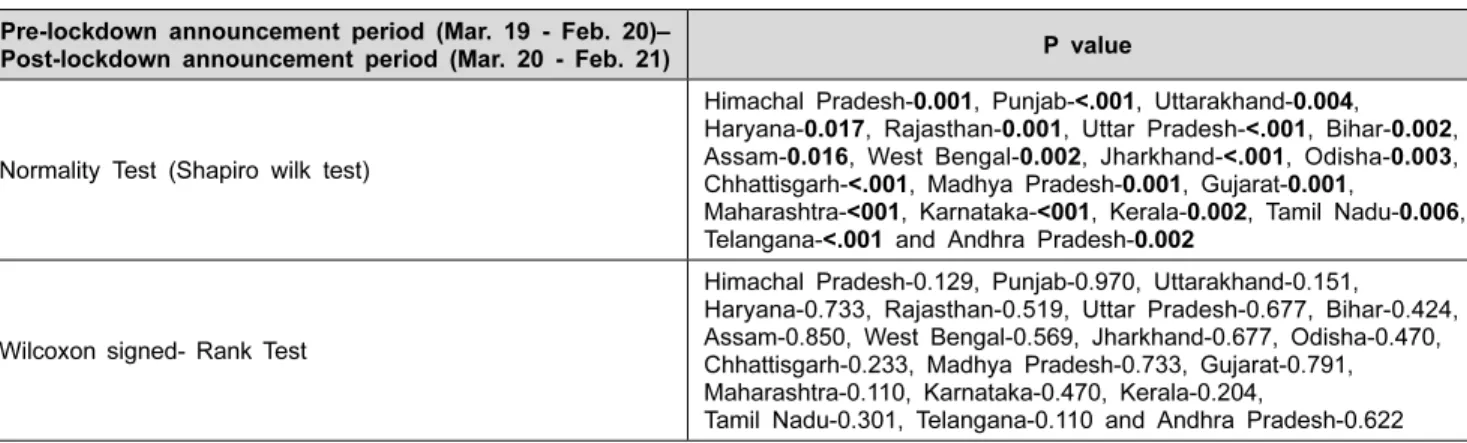
Purpose: The restrictions posed by the COVID-19 pandemic have affected the normal functioning of the economy. A country like India is facing a lot of concerns in all its sectors especially, in its fiscal system. This paper makes an attempt to examine the impact of COVID- 19 first wave on Goods and Service Tax revenue collection and distribution in India and also studies the impact of COVID-19 first wave on the state wise GST revenue of the country. Research Design, Data and Methodology: Our study is based on published GST revenue data. Tools such as Paired Sample t-test, Wilcoxon signed rank test are employed to analyze the data. Results: Our results provide evidence that there is a sharp decline in the GST revenue in the months after the lockdown announcement. The large states show no significance impact of COVID-19 pandemic on GST collection. Whereas, small states like Manipur and Goa show significant difference in GST revenue collection & distribution between the pre and post lockdown period. Conclusion: The outcome of this study will help the policymakers to analyze the extent of the GST revenue loss to the government treasury and will allow them to take appropriate measures in the future.
Keywords : COVID-19, Distribution, First Wave, Lockdown, GST Revenue collection ,GST Revenue distribution , Fiscal Impact JEL Classification Code : H25, H70, I15, I18
1. Introduction
12The global economy came to a sudden halt with the COVID-19 pandemic causing blows to demand and supply situation worldwide. With its origin in Chinese City of Wuhan in December 2019, the new virus has affected country after country with deadly economic and financial consequences. According to the WHO till June 2021, the virus has so far infected more than 186 million people across different countries and has distributed globally. The pandemic poses two kinds of major risks to a country. Being a health catastrophe, it causes a health threat which in turn inflicts an economic risk on a country. The highly contagious nature of the virus makes it absolutely essential to resort to measures like self-isolation, social distancing,
* Acknowledgements: The authors are thankful to the editor &
reviewer team for their valuable suggestions and comments.
1 First Author, Assistant professor, Department of Commerce, VVM’s Shree Damodar college of Commerce & Economics, Margao Goa, India. Email: [email protected]
2 Corresponding Author and Second Author, Ph.D. Scholar at Goa Business School, Goa University, Assistant professor, Department of Commerce, VVM’s Shree Damodar college of
restrictions on national and international travel, closure of public facilities and initial nationwide lockdown. These restrictions affect the normal functioning of an economy and have led to terrible consequences on the monetary situation in countries around the world. So much so, that the year 2020 is considered as the worst year in the global economic history after the great depression in 1930s. Forecasts of IMF and World Bank indicate that the GDP per capita will be lower than Dec 2019 in most countries. The pandemic has also sent the process of globalization in reverse laying greater emphasis on domestic economy of a country with the collapse of international supply chains.
The pandemic has had very deep setting and highly disruptive impact on the Indian economy as well. In India the first covid 19 case was reported in the month of March
Commerce & Economics, Margao Goa, India. Email:
[email protected]
ⓒ Copyright: The Author(s)
This is an Open Access article distributed under the terms of the Creative Commons
Attribution Non-Commercial License (http://Creativecommons.org/licenses/by-nc/4.0/)
which permits unrestricted noncommercial use, distribution, and reproduction in any
medium, provided the original work is properly cited.
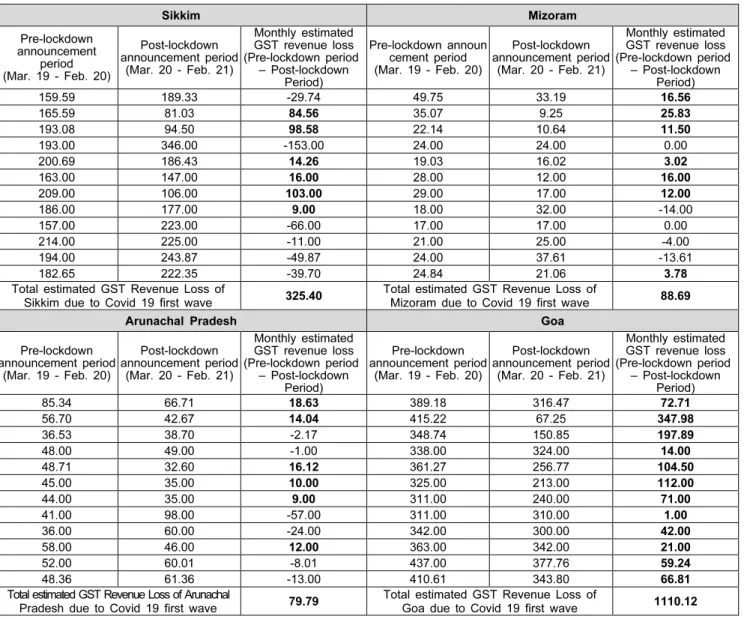
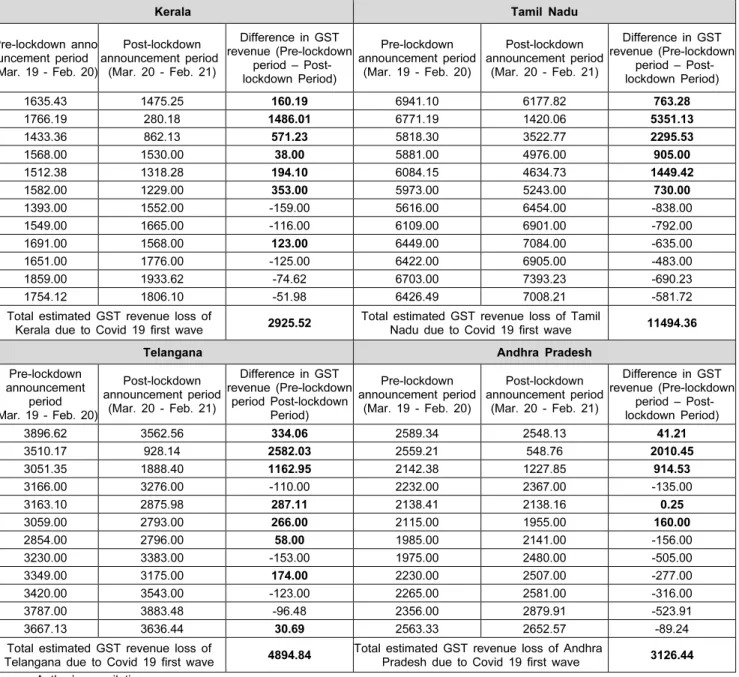
2020 since than lockdown was announced in March 2020, even though lockdown was imposed there was surge in the daily covid cases in India and it marked the beginning of first wave of Covid 19 pandemic in the country which lasted till February 2021. During economic downturns, the budgets of state and local governments come under stress due to contractions in revenues and increases in expenditure needs (Clemens & Veuger, 2020). In India, GST is the tax levied on all goods and services sold internally within its boundaries. It is a major source of revenue to the Central and State government through its CGST, SGCT and IGST components. In this paper, we have made an attempt to study the impact of the Covid-19 first wave on the fiscal state of affairs of the India by exploring the impact of the pandemic on the Goods and Service Tax revenue collection and distribution in India. Further, the pre-lockdown and post- lockdown GST revenue collection distribution & pattern for individually all the states are also examined.
2. Literature Review
Numerous studies have been undertaken to analyze the impact of this novel corona virus on the economic growth of countries and economies worldwide. Scholars globally, attempt to understand the size and nature of destruction caused by the deadly virus. They have suggested measures to limit the damage caused by the pandemic and speed up the post-pandemic recovery process. (Baldwin & Mauro, 2020) discuss the magnitude and the speed with which the virus is going to cause damage to global economy. They uncover the economic contagion mechanism and suggest that G7 and China are the most hit nations with the manufacturing sector being the most affected globally.
(Canuto, 2020) believes that the emerging and developing economies will face maximum threat. He confirms that post coronavirus era is going to be one with less globalization, acceleration in digitalization and higher levels of public and private debt. These results are further confirmed by (Siddiqui, 2020) in his study. He studied the policy response of major global economies to curb the pandemic. He places importance on domestic markets, national economy and sovereignty. He suggests adoption of Keynesian policies, with services and utilities managed by the state, which helps in meeting the basic needs of the society. (Choi & Jun, 2020) tried to explore the impact of covid 19 on new down development paradigm. The results of the research revealed that covid 19 had a strong impact on urban development and regional economies. (Mishra, 2020) suggests adoption of bold policy measures for sustained economic growth and stability. He foresees a drop in FDI flow, Investments and far-reaching repercussions on local business and MNCs.
(AÇIKGÖZ & GÜNAY, 2020) reveal that the pandemic has
had adverse effects on employees, customers, supply chain, financial markets and others. They believe that the pandemic will lead to a permanent shift in the world of policies, health, trade and security. Scholars also study the impact of pandemic on the global financial markets. (Senol & Zeren, 2020) Confirm the existence of a long-term relationship between global markets and COVID-19 outbreak by running the Fourier Co-integration Test. They establish that the ongoing crises have severe implications on human health as well as on the operations and risk perception of financial markets. According to (Morales & Callaghan, 2020) the global markets awoke to the global threat posed by the novel virus after the European Sub-continent registered its first case in Italy. The reaction of international market indices to volatility levels exhibited by the Shanghai Stock Exchange is fairly mild. (Zhang, Hu, & Ji, 2020) Imply that global disintegration has been a bigger threat to financial stability than the pandemic. The country specific stock market risk depends on the severity of the outbreak in the country and policy intervention by authorities has heightened the risk perception in the market. (Yousef, 2020) suggest that there exist systematic risks in the global markets. His GARCH, TGARCH and GJR GARCH results offers evidence of increased volatility in the returns of S&P500, Dow Jones and NASDAQ index post detection of the virus. Further (Aljawaheri, Ojah, Machi, & Almagtome, 2021) studied the impact of covid 19 lockdown on stock market in Iraq concluded that lockdown had negative impact on the value of firms stocks in Iraq stock market. In Indonesia (Utomo &
Hanggraeni, 2021) also evaluated the impact of covid 19 performance of stock market. The authors tried to study the impact of different sectors. As per the finding, sectors like trade, service, property and investment had significant negative performance whereas basic industry sectors had a better performance. Authors concluded that Covid 19 pandemic and lockdown policies had a mix impact on stock market returns in Indonesia. (Khan, Zhao, Zhang, Yang, Shah, & Jahanger, 2020) tried to study the impact of covid 19 pandemic on major stock market indices across the globe.
They revealed that during the early stages of covid 19 pandemic the investors did not react much but once the human-to-human transmission took place all the stock market started to negatively react to the pandemic news. In India, several studies have been conducted to evaluate the impact of the pandemic on the economy. (Dev & Sengupta, 2020) assess the potential impact of the Covid-19 shock on the sectoral front. They evaluate the central government and the RBI response to the pandemic. They emphasize on the importance of balanced response from state government and local bodies to the situation. The preparedness of the policy makers to scale up their response with minimum impact on the formal and informal sector is crucial. (Alam, Alam, &
Chavali, 2020) studied the response of stock market during
covid 19 lockdown period in India. The authors tried to examine the impact of lockdown on Indian stock market by understanding the pre and post lockdown implication.
Similarly, (Chaudhary, Sodani, & Das, 2020) examine the sectoral impact of the pandemic in India. They review the opportunity available to India to participate in global supply chain and replace China. They also evaluate the reforms and policy changes essential to engulf this opportunity. (Singh, 2020) highlights the plight of migrant workers amidst the pandemic and the impact it has had on rural economy of India. His work suggests that 400 million workers will face a risk of falling deeper into poverty during these crises. The migration will also lead to a pressure on the rural economy and agriculture. He suggests provision of cash incentive and wage subsidy to these workers to reverse their condition.
(Bhat, Khan, Manzoor, Niyaz, Tak, & Anees, 2020) through a primary survey, examine the impact of the pandemic on psychological health, economy and social life of the people in Kashmir Valley. The survey reveals the emotional damage caused by the pandemic with rise in cases of depression and anxiety together with the economic damage caused.
Many researchers have also examined the fiscal situation in their country. At the time of a pandemic, studying a nation’s financial position allows us to assess the ability of the government to provide essential services, programs and restart the process of economic recovery. (Heald & Hodges, 2020) reveal that the pandemic has had far reaching impact on the government finances of UK. The receipts see a sharp drop by 12% whereas, the expenditure increased by 36% in the initial three months of the crises. They claim that the government debt is the highest since March 2016. They expect the pressure on UK government finances to extend beyond 2020-21. (Clemens & Veuger, 2020; Bruce D.
McDonald & Larson, 2020) study the impact of the pandemic on the tax revenues. They observe that the pandemic will lead to a shortfall of roughly 106 billion dollars in the sales and Income tax revenue of state governments in the United States for the fiscal year 2020-21.
(Bruce D. McDonald & Larson, 2020) conclude that the reduction in sales tax revenues threatens the state governments to remain solvent and respond to the virus. A similar study was conducted by (Rephann, 2020) by employing standard commercial regional economic model to forecast the tax revenue impact of covid-19 on the common wealth of Virginia and its localities. In the India Context, (Patnaik & Sengupta, 2020) assume that the government fiscal deficit will be 6.2% of GDP assuming a 5% decline in real GDP and 14.4% in net tax revenue.
(Balajee, Tomar, & Udupa, 2020) in their work, estimate the fiscal deficit of India to range between 3.7% to 8.4% amidst this pandemic. They further estimate a spending of 2.2% - 4.8% of the GDP towards the pandemic. (Roy, Patnaika, &
Satpathy, 2020) review the economic health of MSME’s in
meeting the GST compliance. The authors see a need to exempt penalties, re-structuring of GST filing patterns from monthly to quarterly, computing ITC and GST charges through an automated system and resetting the rate of interest to reduce the burden of MSME’s amidst this volatile situation.
2.1. Objectives of the study
The overall objective of this paper is examining the impact of Covid-19 first wave on GST revenue collection and distribution in India and also to examine impact of Covid-19 first wave on GST revenue collection of each state of India.
2.2. Hypotheses of the study
Based on the Review of literature and objectives, the present study attempts to study the impact of first wave of covid 19 on GST revenue and distribution in India and of its states by formulating the following hypotheses
Ho1: There is no significant impact on GST revenue collection of India before and after covid 19 lockdown announcement in India.
Ho2: There is no significant impact on GST revenue collection of small states of India before and after Covid 19 lockdown announcement in India.
Ho3: There is no significant impact on GST revenue collection of large states of India before and after Covid 19 lockdown announcement in India.
3. Research Methods and Materials
3.1. Study design
The research design is based on already published GST
revenue data. Paired sample t-test, Wilcoxon signed rank
test and descriptive analysis has been employed using
Jamovi statistical software. This paper tries to study impact
of covid-19 first wave on GST revenue on all 28 states
(excluding the union territories) of India along with the
impact on overall GST revenue collection and distribution
of the country before announcement of lockdown and after
announcement of the lockdown due to Covid-19 pandemic
in India. Goods and services tax (GST) in India is
consumption-based tax which basically means that the state
which are having high population distribution will have
higher GST collection as compared to small states, therefore
all the 28 states of India are divided into small states and
large states on the basis of Population in order to get in in
dept detail picture of impact of 1st wave of covid 19
pandemic. The small states comprise of Sikkim, Mizoram, Arunachal Pradesh, Goa, Nagaland, Manipur, Meghalaya and Tripura and the large states comprise of Himachal Pradesh, Punjab, Uttarakhand, Haryana, Rajasthan, Uttar Pradesh, Bihar, Assam, West Bengal, Jharkhand, Odisha, Chhattisgarh, Madhya Pradesh, Gujarat, Maharashtra, Karnataka, Kerala, Tamil Nadu, Telangana and Andhra Pradesh.
3.4. Sources of Data collection
The study is based on secondary data compiled by authors which is obtained from www.gstcouncil.gov.in/gst- revenue, www.gst.gov.in/download/gststatistics, Press information bureau Government of India and Ministry of health & family welfare. Firstly, the raw data of GST revenue collection of India and each 28 states of each month starting from March 2019 to February 2021(i.e., two years) was collected and subsequently bifurcated using Microsoft excel to finetune the data for analyzing it into Jamovi statistical software. The start of first wave of Covid-19 in India is considered from the month of March 2020 when first case was reported and subsequently lockdown was announced in India and the end of first wave was considered in February 2021 when cases in India were the minimum and subsequent reversal started in the month of March 2021 i.e., start of second Covid-19 wave in India. To study the impact of covid 19 first wave on GST revenue collection and distribution in India, the period covered in this study is from March 2019 to February 2021 which is divided into Pre- lockdown announcement period starting from March 2019 to February 2020 (one year) and post-lockdown announcement period starting from March 2020 to February 2021 (one Year).
4. Results and Discussion
4.1. Following Analysis Have Been Undertaken to Study the Impact of Covid-19 First Wave on Total GST Revenue of India
Figure 1: Total GST revenue of India pre-lockdown announcement period (series 1) vs post-lockdown
announcement period (series 2)
Table 1: Total GST Revenue of India Before and After Announcement of Lockdown Due to Covid-19 in India and Monthly Covid Cases in India During First Wave of Pandemic.
(Rs.in Crore) Total GST Revenue collection of India
Pre-lockd own anno uncement period (Mar. 19 -
Feb. 20)
Post-lockd own anno- uncement period (Mar. 20 -
Feb. 21)
Monthly estimated GST revenue loss (Pre-lockd own period – Post-lockd
own period)
Monthly covid 19 cases in
India from March 20 to February 2021
i.e., 1
stCovid wave in India 1,06,577 97,597 8,999 (Estimated loss) 1,397 1,13,865 32,294 81,571 (Estimated loss) 32,213 1,00,289 62,009 38,280 (Estimated loss) 1,48,533
99,938 90,917 9,635 (Estimated loss) 3,84,697 1,02,083 87,422 14,661 (Estimated loss) 10,72,030
98,203 86,449 11,754 (Estimated loss) 19,82,375 91,917 95,480 496 (Estimated loss) 26,04,518
95,380 1,05,155 -9,775 19,11,356
1,03,491 1,04,963 2,007 (Estimated loss) 12,94,572
1,03,184 1,15,174 -11,990 8,35,555
1,10,818 1,19,847 15 (Estimated loss) 4,79,509 1,05,366 1,13,143 75 (Estimated loss) 3,50,548 Total estimated GST
revenue loss for India due to Covid 19 first
wave.
Rs. 1,67,493 Source: Author’s compilation
In figure 1, series 1 represents pre-lockdown announcement period and series 2 represents post-lockdown announcement period which clearly indicates that starting when lockdown was announced in March 2020 there was a sharp fall and uneven distribution in Monthly GST revenue of India as compared to pre-lockdown period, this was mainly because there was no movement of people taking place which affected the economic activities but after the month of September 2020 when majority of lockdown restrictions were uplifted and economic activities started to fall back in place as a result GST revenue started to rise.
Table 1 shows that due to covid 19 lockdown majority of the month there was shortfall of collection of GST revenue as compared to pre lockdown period, by adding all month’s shortfall of GST revenue, the total estimated GST revenue loss which India has suffered due to the covid 19 first wave is estimated to be around Rs. 1,67,493crores as compared to pre-lockdown announcement period. Further table 1 also put light on the number of Covid-19 infected cases during the first wave in India, it is clear from data that there is no established relation between Covid-19 cases and GST revenue collection and distribution, for example when lockdown was going on cases in India were less because people were not moving out which has resulted into low GST revenue but in subsequent months when lockdown restriction were relaxed the number of cases started rising and also GST revenue collection started going up which
0.00 50000.00 100000.00 150000.00
1 2 3 4 5 6 7 8 9 10 11 12
G ST R e v e nue
계열1 계열2