- 659 -
Phytochemical compounds and quality characteristics of spray-dried powders with the blanching condition and selected forming agents
from pressed extracts of Ligularia fischeri leaves
Jae-Won Kim
1, In-Kyung Park
2. Kwang-Sup Youn
1*
1
Department of Food Science and Technology, Catholic University of Daegu, Gyeongsan 712-702, Korea
2Dessertkitchen Ltd, Catholic University of Daegu, BI Center, Gyeongsan 712-702, Korea
블랜칭 처리 및 부형제 종류에 따른 곰취 착즙액 분무건조 분말의 phytochemical 성분 및 품질특성
김재원
1․박인경
2․윤광섭
1*
1
대구가톨릭대학교 식품공학전공,
2(주)디저트키친
Abstract
This study was performed to determine the effects of the blanching condition (immersion ratio 1:15 (w/v) for 3 min at 95
oC, and solution containing 1% sodium chloride) and selected forming agents (dextrin DE=10, dextrin DE=20, β-cyclodextrin; each forming agents added 5%) on the phytochemical compounds and quality characteristics of Ligularia fischeri leaves. The moisture was not affected by the forming agent. The color of a, b and chroma values were low in the blanching treatment groups and were significantly lowest with β-cyclodextrin (CD). The polyphenol and flavonoid contents in the blanching treatment groups were higher than those in the non-blanching-treatment group. The ascorbic acid content was higher in the non-blanching-treatment group and was significantly highest in the group treated with dextrin (DE=10) whereas the blanching treatment groups showed lower dehydroascorbic acid content than the non-blanching-treatment group. The water absorption was higher in the non-blanching-treatment group and was significantly highest in the group treated with CD. The water solubility in the blanching treatment groups treated with dextrin (DE=20) and CD was higher than that in the blanching treatment group treated with DE=10. The total chlorophyll and chlorophyll a and b contents were high in the blanching treatment group treated with CD, and for the total carotenoid contents, the same tendency as that seen with the chlorophyll content was observed. With regard to the particle diameter, those in the blanching treatment groups were lower than that in the non-blanching-treatment group and was significantly lowest in the blanching treatment groups treated with DE=20 and CD. The result of SEM observation showed that the spray-dried powders in blanching treatment groups treated with the DE=20 and CD forming agents had uniform particle distribution.
Key words :spray drying, Ligularia fischeri leaves, quality characteristics, forming agents
서 론
1)
최근 건강에 대한 관심이 높아짐에 따라 약용생물자원에 대한 관심이 높아지고 있으며, 고부가가치의 기능성 소재 로 사용될 수 있는 천연신소재 발굴이 주목을 받고 있다.
우리나라에 서식하고 있는 자생식물 4,500여 종 중 480여 종이 식용이 가능한 식물로 분류되고 있다(1). 대부분 독특
*Corresponding author. E-mail:[email protected] Phone:82-53-850-3209, Fax:82-53-850-3209
한 맛과 풍미를 가지고 있어 그동안 식용으로만 활용되었지 만 최근에는 기능적 특성이 밝혀짐에 따라 농가의 새로운 소득 작목으로 부상되고 있으며, 다양한 가공기술 및 제품개 발을 통하여 고부가가치화 하려는 노력이 경주되고 있다.
곰취( Ligularia fischeri )는 넓은 잎을 특징으로 하는 취의 일종으로 전국의 심산 수림이나 비옥 습윤한 초생지에서 자생하는 국화과( Compositae )의 다년생 초본 식물이다(2).
근경은 굵고 줄기 위쪽에 잔털이 있으며, 근생엽은 가장자
리에 규칙적인 톱니를 갖는 신장상 심장형 모양을, 경생엽
은 아랫부분 잎은 근생엽에 유사하나 엽병이 짧고 밑 부분 이 넓어져서 엽초처럼 되는 형태학적 특성을 지닌다. 민간 에서는 봄에 어린잎을 채취하여 쌈을 싸먹거나 그대로 무쳐 서 나물로 먹기도 하였으며, 최근에는 인공재배가 이루어 지면서 녹즙의 형태 또는 가공제품으로 광범위하게 섭취 되고 있다. 곰취는 비타민 A, B, B
1, B
2, C, β-carotene과 niacin 등이 고루 함유되어 있으며, chamomile, jacobine, ameleme 등의 약리성분을 함유하고 있어 항돌연변이, 항 산화 효과가 있다고 알려지고 있다(3). 현재까지 곰취에서 는 terpene 계열의 화합물들이 주로 분리되었는데 잎으로 부터는 eremophilanolide, intermedeol 등의 sesquiterpene (4)과 spiciformisins a, b, monocyclosqualene의 terpenoid(5) 가 분리되었고, 뿌리에서는 norsesquiterpene(6)이 분리되 었다. 또 페놀 성분의 화합물로는 3,4-di-O-caffeoylquinic acid(3,4-DCQA)가 곰취 잎으로부터 분리되었고 간 지질과 산화를 억제하여 간 보호효과를 나타낸다고 보고되었다(7).
그 이외에도 곰취에 관한 생리활성 연구로는 활성산소 생성 억제 및 항암효과(8), 항돌연변이성 및 유전독성 억제효과 (9), 통증완화효과(10), 항관절염효과(11) 등이 보고되면서 고부가가치의 기능성식품과 의약품 개발을 위한 자원으로 우수성이 밝혀진 바 있다. 이처럼 함유성분과 생리적인 기 능이 알려지면서 식품학적 및 약리학적 가치는 인정받아오 고 있지만 아직까지는 전통적 음식제조방법에 편중되어 있어 향후 활용 가치를 확장하고 소비를 증대시킬 수 있는 공정 개선과 품질 향상에 관한 연구가 필요한 실정이다.
열처리 기술 중 블랜칭 처리는 짧은 시간 고온 가열하여 품질 저하에 관련되는 효소를 불활성화 시켜 저장기간 동안 색상의 변화를 방지하고 조직의 연화를 최소화하기 위한 식 품가공 공정으로 노화를 억제하여 기호성과 기능성을 보존할 수 있는 장점이 있다(12). 또, 분무건조법은 미세캡슐화를 만 드는 상업화된 방법 중 가장 보편화 된 것으로 그 생산량도 가장 많아서 여러 분야에서 다양한 목적으로 이용되고 있다.
미세캡슐에 이용되는 피복물질은 기본적으로 피막형성능력 이 우수하고 용해성이 뛰어나며, 경제적이고 식용 가능한 특성을 가져야 한다고 알려져 있으며(13), 주로 starch, dextrin, lactose, glucose, maltose, gelatin, arabic gum, methyl cellulose 등을 이용한다. 이들 중 dextrin은 glucose와 maltose를 제외한 전분의 가수분해 생성물을 말하며 분해정도를 나타내는 dextrose equivalent(DE)에 따라 각기 다른 성질을 가지나 일반 적으로 흡습성이 낮고 용해분산성이 우수하고 조직감 개선효 과가 있어 널리 사용되고 있다(14). 또한 cyclodextrin(CD)은 전분에 효소(cycloldextrin glucanotransferase; CGTase)를 작용 시켜 얻어진 환상구조의 물질로 강한 포접능을 가져 향기를 보호할 뿐만 아니라 산소, 열, 빛에 대한 안정성을 강화시키는 등의 기능이 있어 다방면에서 사용되고 있다(15).
따라서 본 연구에서는 다양한 생리활성을 가지고 있는 곰취의 이용가치를 향상시키고자 블랜칭 처리 유무와 부형 제로 당량이 다른 dextrin(DE=10~20) 및 β-cyclodextrin의
첨가에 따른 곰취 착즙액 분무건조 분말의 품질특성을 검토 하여 적합한 피복물질 및 소재로서의 활용을 위한 기초자료 를 제공하고자 하였다.
재료 및 방법
재 료
본 실험에 사용된 곰취( Ligularia fischeri )는 2012년 5월 에 경북 영양군 수비면에서 재배된 것을 구입하여 사용하였 으며, 구입한 즉시 이물질을 제거하고 시료로 사용하였다.
전처리 및 착즙
시료의 블랜칭 조건은 예비실험을 통하여 결정하였으며, 품질에 영향을 미치지 않는 적정구간을 선정하여 전처리 유무에 따른 품질평가를 비교하였다. 시료는 줄기를 제거 한 잎만을 사용하였으며, 곰취 잎은 1% 식염이 함유된 15배 (w/v)의 블랜칭 액에 95℃의 조건에서 3분간 데친 후 즉시 흐르는 냉수에 1분간 냉각하였다. 다음 salad spinner(EMSA Werke, Germany)를 이용하여 30초 동안 탈수하여 물기를 제거한 다음 착즙기(MS-2080, Oscarelectronic Co., Gimhae, Korea)를 이용하여 착즙하였으며, 착즙액은 여과지 (Whatman No. 3)로 여과하여 분무건조에 사용하였다.
착즙액의 미세캡슐화
부형제는 콘프로덕츠 코리아(Corn Products Korea Inc., Seoul, Korea)에서 구입하여 사용하였으며, dextrin(DE=10), dextrin(DE=20) 및 β-cyclodextrin(CD)을 곰취 착즙액에 각 각 5%(w/v) 첨가하고 homogenizer(SSC811EA, Matsushita electric industrial, Osaka, Japan)로 9,000 rpm에서 20분간 균질화 하였다. 균질된 액은 spray dryer(B-191, Büchi Labortechnik AG, Switzerland)를 이용하여 미세캡슐화 하 였으며 -50℃에 보관하면서 실험에 사용하였다. 분무건조 조건은 inlet temperature 180~190℃, outlet temperature 100~120℃로 설정하였고, flow control 400~600, pump speed 3~5 mL/min로 조절하였다.
착즙 균질액의 pH, 가용성고형분 및 점도
착즙 균질액의 pH는 pH meter(MP230, Mettler-Toledo, Greifensee, Switzerland)를 이용하였으며, 가용성고형분 함 량은 굴절 당도계(N-1E, Atago, Tokyo, Japan)를 이용하여 측정하였다. 점도는 viscometer(LVDV II+, Brookfield Engineering Laboratories Inc., Middleboro, MA USA)를 사 용하였으며 spindle No.18을 사용하여 20 rpm, 30
oC에서 측정하였다.
수분함량 및 색도 측정
수분함량은 적외선 수분 측정기(HG53 Halogen Moisture
Analyzer, Mettler-Toledo, Zurich, Switzerland)를 이용하여 측정하였다. 색도는 표준 백색판으로 보정된 chromameter (CR-300, Minolta Co., Osaka, Japan)를 이용하여 측정하였 고 분무건조 분말의 색차를 Hunter scale에 의한 L 값 (lightness), a 값(redness-greenness) 및 b 값(yellowness- blueness)을 측정하였으며, chroma value는 다음의 계산식 에 의하여 산출하였다.
폴리페놀, 플라보노이드 및 프로안토시아니딘 함량 측정
폴리페놀 함량은 Dewanto 등(16)의 방법에 따라 추출 물 100 μL에 2% sodium carbonate 2 mL와 50%
Folin-Ciocalteu reagent 100 μL를 가한 후 720 nm에서 흡광도를 측정하였으며 gallic acid(Sigma-Aldrich Co., Louis, MO, USA)의 검량선에 의하여 함량을 산출하였다.
플라보노이드 함량은 Saleh와 Hameed(17)의 방법에 따라 추출물 100 mL에 5% sodium nitrite 0.15 mL를 가한 후 25℃에서 6분간 방치한 다음 10% aluminium chloride 0.3 mL를 가하여 25℃에서 5분간 방치하였다. 다음 1 N NaOH 1 mL를 가하고 교반한 다음 510 nm에서 흡광도를 측정하였으며 rutin hydrate(Sigma-Aldrich Co.)의 검량선 에 의하여 함량을 산출하였다. Vanillin-sulfuric acid법(18) 에 따라 시료 200 μL에 1.2% vanillin 용액 500 μL와 20%
sulfuric acid 500 μL를 혼합하여 20 분간 방치한 후 500 nm에서 흡광도를 측적하였으며 (+)-catechin(Sigma- Aldrich Co.)의 검량선에 의하여 함량을 산출하였다.
비타민 C 함량 측정
비타민 C(ascorbic acid)는 식품공전방법에 의해 2,4- dinitrophenyl hydrazine법을 이용하여 측정하였으며, 일정 시료에 5%(w/v) metaphosphoric acid를 가하여 homogenizer (Nissei AM-12, Nohon seiki Co., Tokyo, Japan)로 10,000 rpm에서 1분간 마쇄 후, 원심분리(4℃, 5,000 rpm, 10 min)한 다음 상등액을 Whatman No. 1여과지로 여과하여 비타민 C 추출물을 사용하였다. 비타민 C 함량 측정을 위하여 시료 2 mL에 0.2% 2,4-dichloropenol indophenol(DCP) 용액을 가 하고 1분간 방치 후, thiourea-metaphosphoric acid 용액 2 mL와 2,4-dinitrophenyl hydrazine(DNP) 용액 1 mL를 가한 다음 50℃에서 1시간 반응시킨 후 얼음물로 냉각시켰다.
다음 85% sulfuric acid 5 mL를 천천히 첨가한 후 실온에서 30분간 방치하고, 540 nm에서 흡광도를 측정하였으며, L(+)-ascorbic acid(Junsei Chemical Co., Japan)의 검량선에 의하여 ascorbic acid의 함량을 산출하였다.
총 Chlorophyll 및 Chlorophyll a, b 함량 측정
AOAC법(20)에 따라 시료 무게 10배의 85% acetone으로 추출하여 660.0 nm, 642.5 nm에서 흡광도를 측정한 후 농도
는 다음의 정량 식으로 계산하였다.
Chlorophyll (μL/mL) = 7.12 O.D. (660.0 nm) + 16.80 O.D. (642.5 nm) Chlorophyll a (μL/mL) = 9.930 O.D. (660.0 nm) - 0.777 O.D. (642.5 nm) Chlorophyll b (μL/mL) = 17.60 O.D. (642.5 nm) - 2.81 O.D. (660.0 nm)
총 carotenoid 함량 측정총 carotenoid 함량은 일정량의 곰취 분무건조 분말에 acetone 20 mL에 넣고 균질화 한 후 Whatman No. 1여과지 로 여과한 다음 450 nm에서 흡광도를 측정하였으며, β -carotene(Sigma-Aldrich Co.)의 검량선에 의하여 함량을 산 출하였다(19).
수분흡수지수(WAI) 및 수분용해지수(WSI)
수분흡수지수(water absorption index, WAI)와 수분용해 지수(water solubility index, WSI)는 Phillips(21)의 방법으 로 측정하였다. 곰취 분무건조 분말 0.5 g에 증류수 30 mL를 잘 혼합하여 25℃에서 1분간 진탕 교반한 한 후 3,000 rpm에서 20분간 원심분리 하였다. 상등액은 미리 무게를 구한 수분정량 수기에서 건조하여 고형분량을 WSI로 측정하였으며, 침전물의 무게를 측정하여 다음과 같이 계산하였다.
수분흡수지수
시료량 침전물의 양
수분용해지수 상등액 고형분량 시료량 ×
입도분석 및 주사현미경 관찰
입자 크기는 particle size analyzer(LS 13 320, Beckman Coulter, Fullerton, CA, USA)를 이용하였고, 각 시료를 isopropyl alcohol에 분산시켜 입도를 측정하였다. 형태의 관찰 은 시료 일정부위를 Gold-polladium으로 Ion sputter(C1010, Hitachi, Tokyo, Japan)를 이용하여 coating 한 다음 field emission scanning electron microscopy(FE-SEM, JSM-6335F, JEOL, Tokyo Japan)를 이용하여 1,500배 배율에서 관찰하였다.
통계처리
모든 실험은 3회 반복으로 행하여 평균치와 표준편차로 나타내었고, 유의성 검증은 SPSS(Ver. 12, SPSS Inc., Chicago, IL, USA) software를 이용하여 Duncan's multiple range test를 행하였다.
결과 및 고찰
곰취 착즙 균질액의 pH, 가용성 고형분 및 점도
블랜칭 유무(NT: non-treatment, BT: blanching treatment;
immersion ratio 1:15(w/v) for 3 min at 95℃, and solution
containing 1% NaCl) 및 부형제 종류(dextrin DE=10, dextrin DE=20, β-cyclodextrin; each forming agents added 5%)에 따른 곰취 착즙 균질액의 pH, 가용성 고형분 및 점도를 측정한 결과는 Table 1과 같다. 일반적으로 pH 및 가용성 고형분 함량은 가공 공정과 제품 품질 관리에서 지표로 사용된다. 각각의 처리 조건에 따른 곰취 착즙액의 pH 범위는 6.36~6.38로 유사하였으며 블랜칭 처리 및 부형제 첨가가 pH에 영향을 미치지 않는 것으로 나타났다. 한편 가용성 고형분 함량 및 점도는 BT군에서 증가하였는데 이는 적정 열처리에 의한 식물체 세포내 원형질막의 손상, 세포간의 결합력 감소, 불용성 세포벽의 수용화 등으로 착즙 시 효율의 증대하는 것과 더불어 polysaccharides 분 해 등의 부대 효과(22)에 따라 고형물 함량 증가와 물성에 영향을 미치는 것으로 사료된다(23). 한편 부형제 종류에 따라서는 무처리 및 블랜칭 처리구 모두 β-cyclodextrin
> DE=10 > DE=20의 순으로 높은 점도를 나타내었는데, 일반적으로 부형제의 DE 값이 낮을수록 점도는 상승하며 분자량 크기에 따라 성질이 달라지는 현상과 부합되는 결과를 나타내었다(24).
Table 1. pH, soluble solid content and viscosity of pressed extracts in
Ligularia fischeri
with the blanching condition and selected forming agentsGroups1) Forming agents pH Soluble solids content (°Bx) Viscosity (cP)
NT
Dextrin (DE=10) 6.37±0.012),NS3) 5.43±0.06NS 3.03±0.03e
Dextrin (DE=20) 6.37±0.02 5.53±0.06 2.88±0.01f
β-Cyclodextrin 6.37±0.01 5.47±0.06 3.10±0.02d
BT
Dextrin (DE=10) 6.38±0.01 7.07±0.15b4) 3.98±0.08b
Dextrin (DE=20) 6.37±0.02 7.30±0.10a 3.86±0.01c
β-Cyclodextrin 6.36±0.02 7.23±0.15ab 4.07±0.02a
1)
Abbreviations: NT; non-treatment, BT; blanching treatment.
2)
Values are means±standard deviation of triplicate determinations.
3)
NS: not significant.
4)
Different superscripts within a column (a-f) indicate significant differences (p<0.05).
Table 2. Moisture contents and colour parameters of spray-dried powders with the blanching condition and selected forming agents from pressed extracts of
Ligularia fischeri
leavesGroups1) Forming agents Moisture content (%) L Hunter's color valuea b Chroma value NT Dextrin (DE=10) 5.45±0.132),b3) 62.92±0.36c 1.51±0.14b 23.85±0.41c 23.90±0.40c
Dextrin (DE=20) 5.56±0.24b 63.21±0.65c 3.27±0.16a 25.41±1.08b 25.62±1.09b β-Cyclodextrin 5.34±0.08b 63.22±0.18c -0.79±0.37c 21.10±0.42d 21.12±0.43d BT Dextrin (DE=10) 5.69±0.04a 86.64±0.19a -4.12±0.11d 17.32±0.14e 17.80±0.16e Dextrin (DE=20) 5.99±0.21a 79.16±0.44b -5.33±0.05e 26.61±0.06a 27.14±0.07a β-Cyclodextrin 5.45±0.32b 78.62±0.26b -6.38±0.14f 20.70±0.27d 21.66±0.25d
1)
Abbreviations: NT; non-treatment, BT; blanching treatment.
2)
Values are means±standard deviation of triplicate determinations.
3)
Different superscripts within a column (a-f) indicate significant differences (p<0.05).
수분함량 및 색도
블랜칭 유무 및 부형제 종류에 따른 곰취 착즙액 분무건 조 분말의 수율, 수분함량 및 색도를 측정한 결과는 Table
2와 같다. 수분함량은 다소 차이는 있으나 유사한 수준의 함량을 나타내었으며, 전반적으로 블랜칭 유무에 따른 L 값 및 a 값에서는 BT군에서 밝기가 증가하고 녹색도가 강해져 효소 불활성화(12)에 따라 색도가 유지되는 것으로 나타났 다. 식물체의 chlorophyll은 pheophytin, chlorophyllides, pyrochlorophyll 등 epimerization 과정에 의해 여러 형태의 유도체를 형성하며 온도, pH, 압력 등 외부적인 요인에 의한 치환반응으로 유도체는 증가하게 되며 갈색화(25)가 진행되는데, 곰취 착즙액의 분무건조 시 β-cyclodextrin을 부형제로 사용할 경우 녹색도가 높은 것으로 나타나 산화 되기 쉬운 물질의 화학적 변화로부터 안정화가 높은 것으 로 관찰되었다.
폴리페놀, 플라보노이드 및 프로안토시아니딘 함량
블랜칭 유무 및 부형제 종류에 따른 곰취 착즙액 분무건 조 분말의 폴리페놀(polyphenol), 플라보노이드(flavonoid) 및 프로안토시아니딘(proanthocyanidin)의 함량을 측정한 결과는 Table 3과 같다. NT군의 DE=10, DE=20 및 β
-cyclodextrin의 폴리페놀 함량은 g당 각각 27.15 mg, 30.26
mg 및 30.59 mg인 반면 BT군의 경우는 g당 각각 66.16
mg, 61.95 mg 및 70.38 mg으로 블랜칭 처리 시 함량이 증대
Table 3. Total polyphenol, flavonoid and proanthocyanidin contents of spray-dried powders with the blanching condition and selected forming agents from pressed extracts of
Ligularia fischeri
leavesGroups1) Forming agents Polyphenols (mg GAE2)/g) Flavonoids (mg RHE3)/g) Proanthocyanidins (mg CE4)/g) NT
Dextrin (DE=10) 27.16±0.095),e6) 8.62±0.21c 4.11±0.02a
Dextrin (DE=20) 30.26±0.44d 8.88±0.25c 3.84±0.04b
β-Cyclodextrin 30.59±0.07d 8.86±0.77c 3.62±0.04c
BT
Dextrin (DE=10) 66.16±0.40b 24.59±0.28a 2.15±0.03e
Dextrin (DE=20) 61.95±0.70c 22.27±0.53b 2.11±0.03e
β-Cyclodextrin 70.38±0.55a 24.84±0.41a 2.24±0.05d
1)
Abbreviations: NT; non-treatment, BT; blanching treatment.
2-4)
GAE, gallic acid equivalents; RHE, rutin hydrate equivalents; CE, catechin hydrate equivalents.
5)
Values are means±standard deviation of triplicate determinations.
6)
Different superscripts within a column (a-e) indicate significant differences (p<0.05).
Table 4. Total ascorbic acid and dehydroascorbic acid contents of spray-dried powders with the blanching condition and selected forming agents from pressed extracts of
Ligularia fischeri
leaves(mg/g, dry basis)
Groups1) Forming agents TAC2) DHAA3) AA4)
NT
Dextrin (DE=10) 11.64±0.235),a6) 6.31±0.07a 5.33±0.17c
Dextrin (DE=20) 11.11±0.63a 4.40±0.50b 6.71±0.78ab
β-Cyclodextrin 11.75±0.28a 4.06±0.74b 7.70±0.88a
BT
Dextrin (DE=10) 6.29±0.30c 1.66±0.50c 5.63±0.21c
Dextrin (DE=20) 7.83±0.53b 1.45±0.32c 6.39±0.37bc
β-Cyclodextrin 6.96±0.64c 1.00±0.12c 5.95±0.53bc
1-4)
Abbreviations: NT; non-treatment, BT; blanching treatment. TAC, total ascorbic acid; DHAA, dehydroascorbic acid; AA, ascorbic acid. AA = TAC - DHAA
5)
Values are means±standard deviation of triplicate determinations.
6)
Different superscripts within a column (a-c) indicate significant differences (p<0.05).
Table 5. Chlorophylls and total carotenoid contents (TCC) of spray-dried powders with the blanching condition and selected forming agents from pressed extracts of
Ligularia fischeri
leavesGroups1) Forming agents Chlorophylls (mg/100 g, dry basis)
Ca/Cb TCC
(mg/g)
Total a b
NT
Dextrin (DE10) 27.79±0.232),d3) 20.43±0.13de 7.40±0.11e 2.76±0.02ab 1.80±0.00c Dextrin (DE20) 27.56±0.26d 18.84±0.54d 8.74±0.29d 2.16±0.13ab 1.47±0.00d β-Cyclodextrin 74.45±0.59b 54.88±0.63b 19.61±0.05b 2.80±0.04a 2.15±0.00a BT
Dextrin (DE10) 46.40±0.13c 31.77±0.12c 14.66±0.02c 2.17±0.01ab 1.07±0.05f Dextrin (DE20) 15.21±0.32d 8.48±0.14e 6.85±0.14de 1.24±0.01b 1.36±0.00e β-Cyclodextrin 94.37±0.23a 71.37±0.19a 23.05±0.05a 3.10±0.02a 2.07±0.01b
1)
Abbreviations: NT; non-treatment, BT; blanching treatment.
2)
Values are means±standard deviation of triplicate determinations.
3)
Different superscripts within a column (a-f) indicate significant differences (p<0.05).
되는 결과를 나타내었다. 플라보노이드 함량에서도 BT군 에서 그 함량이 유의적으로 증가되는 양상을 나타내었으나 프로안토시아니딘 함량에서는 블랜칭 처리 시 고온에 의한 성분의 손실이 있는 것으로 관찰되었다. 한편 부형제 종류
에 따라서는 전반적으로 β-cyclodextrin을 첨가하였을 때
높은 함량을 나타내었다. Lee와 Lee(26)의 보고에 따르면
식용식물의 블랜칭 처리 시 식염을 첨가할 경우 불미성분을
제거하는데 효과가 있으며, 또한 생리활성성분 보호 효과
가 있는 것으로 보고한 바 있다. 또 Choi 등(27)은 고온의 열처리가 free형, bound형의 폴리페놀 화합물의 증가와 항 산화활성 등이 증가한다고 보고하였으며 이와 같은 현상은 불용성 polymer와 함께 공유결합을 형성하여 존재하는 bound형 폴리페놀 화합물이 열처리에 의해 free형 폴리페놀 로 유리되어 용출이 용이해지거나, 일부 고분자의 페놀성 화합물이 저분자의 폴리페놀로 전환되었기 때문이라 보고 하였다. 따라서 블랜칭 처리구에서 폴리페놀 및 플라보노 이드 함량이 증대된 결과는 이에 기인된 현상이라 사료되 며, 식물체 배당체로 존재하는 페놀성 물질이 불용성 성분 으로부터 유리됨에 따른 결과로 해석된다.
비타민 C 함량
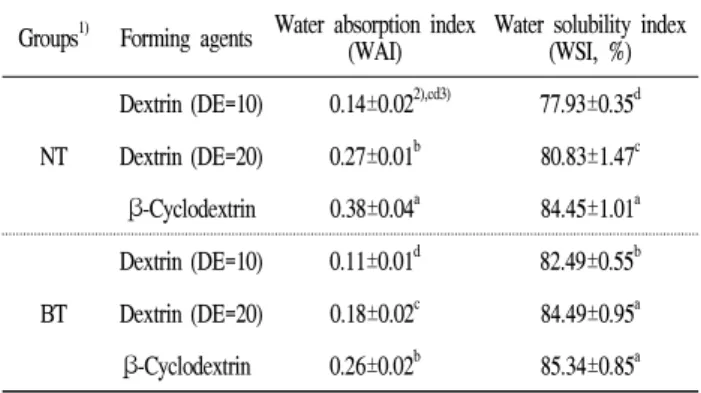
블랜칭 유무 및 부형제 종류에 따른 곰취 착즙액 분무건 조 분말의 비타민 C 함량을 측정한 결과는 Table 4와 같다.
NT군의 DE=10, DE=20 및 β-cyclodextrin의 총 비타민 C 함량은 g당 각각 11.64 mg, 11.11 mg 및 11.75 mg으로 유의 적인 차이는 나타나지 않았으나 BT군의 경우는 g당 각각 6.29 mg, 7.83 mg 및 6.96 mg으로 낮은 함량을 나타내었다.
수용성 성분인 비타민 C의 경우 열에 의한 영향을 직접적으 로 받음에 따라 블랜칭 처리 시의 용출현상, 열에 의한 파괴, 산화과정 등으로 인한 열적 손실이 있는 것으로 관찰되었 다. 이에 반해 환원형 비타민 C의 함량은 모든 시료가 유사 한 수준의 함량을 나타내는 반면 산화형 비타민 C 함량의 경우 NT군에 비해 BT군에서 상당히 감소되었는데 이러한 결과는 블랜칭 처리에 의하여 열적 손실은 발생하나 산화효 소의 불활성화(28)에 따라 산화되는 정도가 억제되는 것으 로 사료되며, 또한 각각의 고분자 형태 부형제의 미세 코팅 으로 인한 보호효과가 영향을 미치는 것으로 판단된다.
Table 6. Water absorption index and water solubility index of spray-dried powders with the blanching condition and selected forming agents from pressed extracts of
Ligularia fischeri
leaves Groups1) Forming agents Water absorption index(WAI) Water solubility index(WSI, %) NT
Dextrin (DE=10) 0.14±0.022),cd3) 77.93±0.35d Dextrin (DE=20) 0.27±0.01b 80.83±1.47c β-Cyclodextrin 0.38±0.04a 84.45±1.01a BT
Dextrin (DE=10) 0.11±0.01d 82.49±0.55b Dextrin (DE=20) 0.18±0.02c 84.49±0.95a β-Cyclodextrin 0.26±0.02b 85.34±0.85a
1)
Abbreviations: NT; non-treatment, BT; blanching treatment.
2)
Values are means±standard deviation of triplicate determinations.
3)
Different superscripts within a column (a-d) indicate significant differences (p<0.05).
총 chlorophylls 및 carotenoids 함량 측정
블랜칭 유무 및 부형제 종류에 따른 곰취 착즙액 분무건
조 분말의 chlorophyll 및 carotenoid 함량을 측정한 결과는 Table 5와 같다. 각각의 조건별에 따른 chlorophyll 함량은 유의적인 차이를 나타내었으며, 각각의 함량 비 또한 차이 를 보였다. 블랜칭 처리구에서 전반적으로 높은 함량을 나타내었으며, 부형제 종류에 따라서는 β-cyclodextrin에서 chlorophyll a의 함량의 보존효과가 높은 것으로 관찰되었 다. Ca/Cb의 비율 역시 NT군 및 BT군 모두에서 β -cyclodextrin이 높은 값을 나타내어 유용성분을 안정화 시 킬 수 있는 부형제로서 활용 가능한 것으로 나타났으며 이에 따라 청록색이 짙어지고 녹색도가 유지되는 양상 (Table 2)과 일치하는 결과를 보였다. BT군에서 다소 높은 chlorophyll 함량을 나타내는 것은 Na 첨가가 chlorophyll의 용출을 저해시키고 적정 블랜칭 처리가 chlorophyll a의 함 량을 증가(29) 시킨다는 보고와 관련지어 볼 때 이에 기인 된 결과로 판단된다. 식물체의 chlorophyll의 경우 단백질과 약한 결합상태로 존재 하다가 가열 시 분리되며 이러한 현상은 단백질의 양과 질에 따라 차이를 나타낸다는 보고 (30)가 있어 본 연구에서 chlorophyll의 함량이 증대되는 현상은 블랜칭 처리 과정 중 단백질과 결합 상태로 있는 chlorophyll이 separation을 일으켰기 때문일 것으로 추측된 다. 총 carotenoid 함량에서는 NT군의 NT군의 DE=10, DE=20 및 β-cyclodextrin의 총 carotenoid 함량은 g당 1.80 mg, 1.36 mg 및 2.07 mg이 검출된 반면 BT군에서는 1.07 mg, 1.36 mg 및 2.07 mg의 함량을 나타내어 블랜칭 처리에 따른 함량의 손실이 동반되는 것으로 나타났다. 한편 부형 제 종류에 따라서는 β-cyclodextrin에서 carotenoid 함량의 보존효과가 높은 것으로 관찰되었는데 이는 분무건조 시 피막형성능이 우수한 특성에 따라 곰취 착즙액에 균일하게 포접되면서 안정성이 높아진 것으로 사료된다(15). 따라서 블랜칭 처리와 더불어 β-cyclodextrin을 부형제로 분무건조 한 분말은 천연 색소로의 역할을 할 수 있는 소재로 사용가 능성이 높을 것으로 기대된다.
수분흡수지수(WAI) 및 수분용해지수(WSI)
블랜칭 유무 및 부형제 종류에 따른 곰취 착즙액 분무건
조 분말의 수분흡수지수와 수분용해지수를 측정한 결과는
Table 6과 같다. 건조 분말의 경우 수분흡수지수와 용해지
수는 중요한 가공적성 요인으로 알려져 있다. 수분흡수지
수는 NT군 및 BT군 모두 β-cyclodextrin > DE=20 > DE=10
의 순으로 DE=10에서 낮은 수치를 나타내었으며 블랜칭
처리 시 감소되는 양상을 보였다. 이는 DE에 따른 흡습성
등 부형제의 물리화학적 특성의 차이로 DE 값이 낮을수록
흡습성도 함께 낮아지는 특성에 기인된 결과로 사료되며
(24), 흡습특성의 경우 조직구조와 밀접한 관계(31)가 있는
점을 고려해 볼 때 블랜칭 처리군에서 낮은 수분흡수지수를
나타내는 것은 분무효율의 증가와 아울러 미세캡슐화 시
균일한 입자분포(Fig. 2)를 나타냄에 따른 결과로 판단된다.
전분 polymer는 여러 형태로 존재하며 온도 및 조건에 따라 분해정도나 그 형태의 분포에 차이를 나타내어 수분용해도 에 영향을 미치게 된다(32). Lim 등(33)은 블랜칭 처리 시 molecule의 손상에 따라 수용액과 쉽게 hydrogen bond를 형성함에 따라 용해도(solubility)는 증가하고 시료의 수분 용해도에도 영향을 미칠 수 있다고 보고한 바 있으며 이는 가공처리 과정 중 soluble matrix가 증가됨에 따른 현상으로 보고하였는데 본 연구 또한 수분용해지수는 열적 처리가 가해진 블랜칭 처리구에서 증가하는 양상을 보여 일치하는
10.35a 161.27a
159.23a
13.44a 12.63b
26.46b
0 50 100 150 200 250 300
DE=10 DE=20 β-cyclode xtrin
P ar ti cl e di am et er ( μ m ) .
Non-blanching Blanching
Fig. 1. Particle diameter of spray-dried powders with the blanching condition and selected forming agents from pressed extracts of
Ligularia fischeri
leaves.Values are means±standard deviation of triplicate determinations. Bars/mean values with different letters are significant differences (p<0.05).
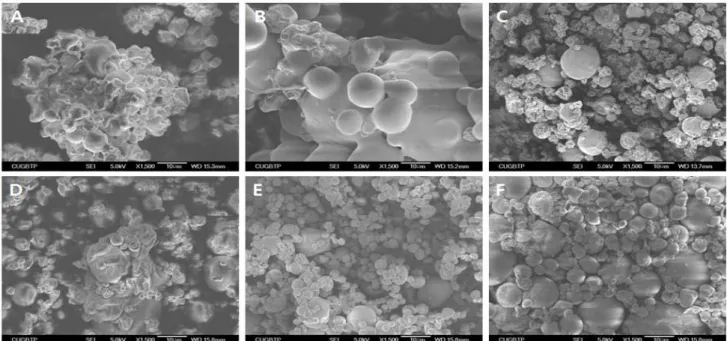
Fig. 2. Scanning electron microscopic photographs of spray-dried powders (x1500) with the blanching condition and selected forming agents from pressed extracts of
Ligularia fischeri
leaves.A: Non-blanched and added 5% dextrin(DE=10), B: Non-blanched and added 5% dextrin(DE=20), C: Non-blanched and added 5% β-cyclodextrin, D: Blanched and added 5%
dextrin(DE=10), E: Blanched and added 5% dextrin(DE=20), F: Blanched and added 5% β-cyclodextrin
결과를 나타내었다. 한편 부형제 종류에 따라서는 NT군의 DE=10, DE=20 및 β-cyclodextrin의 수분용해지수가 각각 77.93%, 80.83% 및 84.45%이었고 BT군의 경우는 82.49%, 84.49% 및 85.34%로 블랜칭 처리에 따라 수분용해지수가 각각 5.85%, 4.53% 및 1.05% 증가하는 경향을 나타내었다.
입자크기가 작을수록 수분용해지수는 증가한다는 보고 (34)와 관련지어 볼 때 본 연구의 블랜칭 처리군에서 상대적 으로 작은 입자크기(Fig. 1)를 나타내는 것 이외에도 부형제 의 결합력 차이에 따른 결과로 사료된다. 또한 용해도의 경우 분말에서 중용한 품질특성으로 간주됨에 따라 적정 열처리와 DE=20의 dextrin 및 β-cyclodextrin을 부형제로 활용할 경우 용해도 증가에 유효할 것으로 판단된다.
입도 분석 및 주사전자 현미경 관찰
블랜칭 유무 및 부형제 종류에 따른 곰취 착즙액 분무건 조 분말의 입자크기 및 분말의 형태를 관찰한 결과는 Fig.
1과 Fig. 2와 같다. NT군의 DE=10, DE=20, β-cyclodextin
의 평균 입자크기는 각각 159.23 μm, 161.27 μm, 10.35
μm 로 DE=10~20의 경우 β-cyclodextin에 비해 상대적으로
큰 입자크기를 나타내었다. 반면 BT군의 DE=10, DE=20
및 β-cyclodextin의 평균 입자크기는 각각 24.46 μm, 12.63
μm, 13.4 μm 로 다소 차이는 있으나 균일한 크기의 입자를
내타내었다. 분말의 크기가 작을수록 내부물질의 포집에
유리하다는 연구결과가 있으나, 일반적으로 크기보다는
피막물질의 종류나 분무시의 조건 등이 더 중요한 것으로
보고(35)된 바 있다. 분말의 형태에서는 NT군에서의 D=10
과 DE=20의 경우 분자들이 엉키는 현상이 관찰되어 입도분 석 결과 입자의 크기가 크게 측정된 것과 일치하는 결과를 나타내었다. 또한 입자 표면은 부드러운 구형이 아닌 움푹 들어간 자국을 관찰할 수 있었는데 이 자국들은 건조 과정 중에 입자들이 수축함에 따른 현상으로 판단된다. 한편 블랜 칭 처리를 하였을 경우에는 응집하는 현상이 완화되는 것으 로 나타났으며 특히 DE=20과 β-cyclodextrin을 부형제로 사 용할 경우 보다 균일한 구형을 형성하는 것으로 나타났다.
요 약
본 연구에서는 다양한 생리활성을 가지고 있는 곰취의 이용가치를 향상시키고자 블랜칭 처리 유무와 부형제로 당 량이 다른 dextrin(DE=10~20) 및 β-cyclodextrin의 첨가에 따 른 곰취 착즙액 분무건조 분말의 품질특성을 비교 분석하였 다. 곰취 착즙액의 pH 범위는 6.36~6.38로 유사하였으며 가 용성 고형분 함량 및 점도는 BT군에서 높았고 β-cyclodextrin
> DE=10 > DE=20의 순으로 높은 점도를 나타내었다. 분무 건조 분말의 수율은 BT군에서 높았고, 부형제에 따라서는 β -cyclodextrin > DE=20 > DE=10 순이었다. 수분함량은 유 사한 수준을 나타내었고 색도는 BT군에서 밝기가 증가하고 녹색도는 강해지는 것으로 나타났으며, β-cyclodextrin에서 녹색도의 안정화가 높았다. 폴리페놀 및 플라보노이드 함량 은 블랜칭 처리 시 증가하는 반면 프로안토시아니딘 함량은 감소하였다. 비타민 C 함량에서는 블랜칭 처리에 의하여 열적 손실은 발생하나 미세 코팅으로 인하여 외부적 요인으 로부터 산화되는 정도가 억제되는 것으로 관찰되었다.
Chlorophyll 함량은 BT군에서 전반적으로 높은 함량을 나타 내었으며, Ca/Cb의 비율에서는 NT군 및 BT군 모두 β -cyclodextrin에서 높은 값을 나타내었다. 총 carotenoid 함량 은 블랜칭 처리구에서 감소하였으나 β-cyclodextrin 첨가구 의 경우 carotenoid 함량이 보존되었다. 수분흡수지수는 DE=10에서 낮았으며 블랜칭 처리 시 감소하는 반면 수분용 해지수는 블랜칭 처리구에서 증가하는 양상을 보였으며 부 형제 종류에 따라서는 DE=20 및 β-cyclodextrin에서 높은 수치를 나타내었다. 입자의 크기 및 분말의 형태를 검경한 결과 BT군에서 균일하고 작은 입자를 나타내었고 DE=20 과 β-cyclodextrin의 경우 보다 균일한 구형을 형성하였다.
감사의 글
본 연구는 지식경제부에서 시행한 지역산업기술개발사 업(과제번호 : R0000780)의 지원을 받아 수행된 연구의 일 부이며 이에 감사드립니다.
References
1. Kim WB (2009) Industrial use of wild edible plants.
Wild edible plants for the development of medicare industry at Yanggu-gun. Seminar of Yanggu-gun.
Yanggu, Korea, p 39-66
2. Cha JY, Cho YS (2001) Biofunctional activities of citrus flavonoids. J Korean Soc Agric Chem Biotechnol, 44, 122-128
3. Choi MS, Yang JK (2008) Industrial potentiality of wild edible greens. J Food Research Technol, 21, 1-7 4. Hwang BY, Lee JH, Koo TH, Kim HS, Hong YS, Ro
JS, Lee KS, Lee JJ (2002) Furanoligularenone, an eremophilane from Ligularia fischeri , inhibits the LPS-induced production of nitric oxide and prostaglandin E
2in macrophage RAW264.7 cells. Planta Med, 68, 101-105
5. Lee KT, Koo SJ, Jung SH, Choi JW, Jung HJ, Park HJ (2002) Structure of three new terpenoids, spiciformisins a and b, and monocyclosqualene, isolated from the herbs of Ligularia fischeri var. spiciformis and cytotoxicity. Arch Pharm Res, 25, 820-823
6. Zhang WJ, Qi HY, Shi YP (2010) Norsesquiterpene derivatives from the roots of Ligulaira fischeri . Planta Med, 76, 159-164
7. Choi JW, Park JK, Lee KT, Park KK, Kim WB, Lee JH, Jung HJ, Park HJ (2005) In vivo antihepatotoxic effects of Ligularia fischeri var. spiciformis and the identification of the active component, 3,4-dicaffeoylquinic acid. J Med Food, 8, 348-352 8. Bae JH, Yu SO, Kim YM, Chon SU, Kim BW, Heo
BG (2009) Physiological activity of methanol extracts from Ligularia fischeri and their hyperplasia inhibition activity of cancer cell. J Bio-Environ Control, 18, 67-63 9. Ham SS, Lee SY, Oh DH, Jung SW, Kim SH, Chung CK, Kang IJ (1998) Antimutagenic and antigenotoxic effects of Ligularia fischeri extracts. J Korean Soc Food Sci Nutr, 27, 745-750
10. Lee KH, Choi EM (2008) Analgesic and anti-inflammatory effects of Ligularia fischeri leaves in experimental animals. J Ethnopharmacol, 120, 103–107 11. Choi EM, Kim YH (2008) A preliminary study of the effects of an extract of Ligularia fischeri leaves on type II collagen-induced arthritis in DBA/1J mice. Food Chem Toxicol, 46, 375-379
12. Lee YJ, Lee HO, Kim JY, Kwon KH, Cha HS, Kim
BS (2011) Quality characteristics of frozen Doraji
( Platycodon grandiflorum ) according to various blanching treatment conditions. Korean J Food Preserv, 18, 661-668
13. Reinccius GA (1991) Carbohydrates for flavor encapsulation. Food Technol, 45, 144-150
14. Kim WJ, Ku KH (1994) Optimization of heating and addition of water, oil and dextrin for uncompressed SPI tofu preparation. Korean J Food Sci Technol, 26, 37-43 15. Shahidi F, Han XQ (1993) Encapsulation of food
ingredients. Crit Rev Food Sci Nutr, 33, 501-547 16. Dewanto V, Wu X, Adom KK, Liu RH (2002) Thermal
processing enhances the nutritional value of tomatoes by increasing total antioxidant activity. J Agric Food Chem, 50, 3010-3014
17. Saleh ES, Hameed A (2008) Total phenolic contents and free radical scavenging activity of certain Egyptian Ficus species leaf samples. Food Chem, 114, 1271-1277 18. Baoshan S, Jorge MR, Isabel S (1998) Critical factors of vanillin assay for catechins and proanthocyanidins.
J Agric Food Chem, 46, 4267-4274
19. Kwon YJ, Kim KH, Kim HK (2008) Changes of total polyphenol content and antioxidant activity of Ligularia fischeri extracts with different microwave-assisted extraction conditions. Korean J Food Preserv, 9, 332-337 20. AOAC (2003) Offical Methods of Analysis of AOAC Intl. 17th ed. Association of Official Analytical Chemists. Washington, DC, USA
21. Phillips RD, Chinnan MS, Granch AI, Miller J, Mcwatters KH (1998) Effects of pre-treatment on functional and nutritional properties of cowpea meal.
J Food Sci, 53, 805-809
22. Choi JH, Kim KY, Lee JC (1998) Effects of pre-pressing condition on quality of pear juice. Korean J Food Sci Technol, 30, 827-831
23. Hwang JK, Kim CT, Hong SI, Kim CJ (1994) Solubilization of plant cell walls by extrusion. J Korean Soc Food Nutr, 23, 358-370
24. Biliaderis CG, Swan RS, Arvanitoyannis I (1999) Physicochemical properties of commercial starch hydrolyzates in the frozen state. Food Chem, 64, 537-546
25. Chen BH, Chen YY (1993) Stability of chlorophylls and carotenoids in sweet potato leaves during microwave cooking. J Agric Food Chem, 41, 1315-1320 26. Lee JH, Lee SR (1994) Analysis of phenolic substances content in korean plant foods. Korean J Food Sci Technol, 26, 310-316
27. Choi Y, Lee SM, Chun J, Lee HB, Lee J (2006) Influence of heat treatment on the antioxidant activities and polyphenolic compounds of Shiitake ( Lentinus edodes ) mushroom. Food Chem, 99, 381-387 28. Kim DH, Kim SM, Kim HB, Moon KD (2012) Effects
of optimized co-treatment conditions with ultrasound and low-temperature blanching using the response surface methodology on the browning and quality of fresh-cut lettuce. Korean J Food Preserv, 19, 470-476 29. Choi NS, Oh SS, Lee JM (2001) Changes of biologically functional compounds and quality properties of Aster scaber ( Chamchwi ) by blanching conditions. Korean J Food Sci Technol, 33, 745-752
30. Peleg M, Bagley B (1983) Physical Properties of Foods.
Avi Publishing Co, Westport, Conneticut
31. Wolf W, Walker JE, Kapsalis JG (1972) Water vapor sorption hysteresis in dehydrated food. J Agric Food Chem, 20, 1073-1077
32. Jackson DS, Gomez MH, Waniska RD, Rooney LW (1990) Effects of single-screw extrusion cooking on starch as measured by aqueous high-performance size-exclusion chromatography. Cereal Chem, 67, 529-532
33. Lim JH, Kim JH, Seo YH, Moon KD (1999) Effects of low-temperature blanching on physical properties of chestnut powder. Korean J Food Sci Technol, 31, 1216-1220
34. Choi BK, Kum JS, Lee HY, Park JD (2006) Physicochemical properties of black rice flours (BRFs) affected by milling conditions. Korean J Food Sci Technol, 38, 751-755
35. Rosenberg M, Kopelman IJ, Talmon Y (1990) Factors affecting in spray-drying microencapsulation of volatile materials. J Agric Food Chem, 50, 139-144
(접수 2013년 8월 29일 수정 2013년 9월 17일 채택 2013년 9월 23일)