http://dx.doi.org/10.4489/KJM.2012.40.4.282
282
Paraconiothyrium minitans S134의 마늘흑색썩음균핵병에 대한 생물적 방제
이상엽*1·홍성기2·최인후3·전용달4·김정준1·한지희1·김완규1
1농촌진흥청 국립농업과학원 농업미생물과, 2농촌진흥청 국립농업과학원 작물보호과,
3농촌진흥청 국립식량과학원 바이오에너지작물연구센터, 4농촌진흥청 충남 태안군농업기술센터
Biological Control of Paraconiothyrium minitans S134 on Garlic White Rot Caused by Sclerotium cepivorum
Sang Yeob Lee
1*, Sung Kee Hong
2, In Hu Choi
3, Yong Dal Chon
4, Jeong Jun Kim
1, Ji Hee Han
1and Wan Gyu Kim
11Agricultural Microbiology Division, National Academy of Agricultural Science (NAAS), RDA, Suwon 441-707, Korea
2Crop Protection Division, NASS, RDA, Suwon 441-707, Korea
3Bioenergy Crop Research Center, National Institute of Crop Science, Jeonnam, Muan 534-804, Korea
4Taean-gun Agricultural Development & Technology Center, Chungnam, Taean-Gun 357-903, Korea (Received 8, November 2012., Revised 10, December 2012., Accepted 11, December 2012)
ABSTRACT :Sclerotium cepivorum is a causal agent of white rot disease on different plants including Allium spe- cies such as garlic. A mycoparasite, Paraconiothyrium minitans S134 was selected for biological control of sclerotinia rot of garlic caused by S. cepivorum. The experiment was carried out in a garlic field in Taean from October in 2011 to June in 2012. Spore suspension of the mycoparasite was treated twice onto soil surface around garlic plants in sowing in 2011 and late Feb. in 2012, and disease rating was made June in 2012. Incidence of white rot in the twice-application plot of the mycoparasite (5 × 10⁶ spores/mL) and in the fluquinconazole (WP)-treated plot was 6.8% and 0.4%, respectively, whereas that of control was 19.5%. As the results, P. minitans S134 could be a pro- spective biofungicide for biological control of white rot of garlic.
KEYWORDS : Biological control, Garlic, Paraconiothyrium minitans, Sclerotium cepivorum, White rot
서 론
마늘 등 Allium속 작물에서 흑색썩음균핵병(Sclerotium cepivorum)은 토양전염성병해로 가장 피해가 큰 병으로 반드시 방제가 필요한 병해 이다. 이 병은 우리나라에서 1988년에 전남 고흥에서 마늘에서 처음 발생하였으며, 1995년에 무안지방에서 양파에 발생하여 파, 쪽파와 달래 에서도 발생되어 피해가 급속히 확산되고 있다(Kim, 2005). 이집트에서 1965년부터 1982년에 겨울 양파 생산 량이 65% 감소되어 수출이 90% 줄었다고 하며(Entwistle, 1992), 영국에서는 양파 생산량이 10% 감소되어 약 450 만 파운드에 이른다고 한다(Clarkson et al., 2002).
흑색썩음균핵병균은 S. cepivorum으로 토양전염성이 병 원균이며, 생육적온은 15~20oC이며, 1oC에서도 균사생장 이 가능하며(McLean, and Stewart, 2000; McLean et al., 2001b), 병원균의 전염은 토양에서 균핵으로 15~20년간 생존하면서 관개수나 토양에 의해 감염과 마늘, 파 등의
식물체 잔재물이나 영양번식체에 감염되어 병이 폭발적으 로 발생하였다(Entwistle, 1992).
흑색썩음균핵병의 방제는 거의 40년간 파종 또는 정식 전에 주로 화학농약을 사용해왔다. 토양속의 균핵을 제거 하기위하여 토양소독제, 이랑과 종자와 재배기간 중에 식 물체의 지제부에 보호용 살균제의 처리나 이프로디온의 종자와 지제부의 체계처리가 효과적 방법으로 현재 화학 적 방제의 기틀이 되었다. 이러한 방법은 병원균의 균핵 감소로 병 발생을 줄일 수 있으나 화학농약의 오남용으로 토양내에 생존하는 유용 미생물에도 해를 미치며, 식물과 및 토양내에 잔류농약에 대한 위해 우려가 되고 있다. 이 를 방지하는 국내에서 분리한 유용미생물을 이용한 생물 학적 방제가 친환경 안전 농산물 생산에 필수적이며, 우 리나라 환경조건에 알맞은 미생물농약 개발이 요구되고 있다.
외국에서 흑색썩음균핵병에 대한 곰팡이를 이용한 생물 적 방제는 1969년 Ghaffar가 Penicillium nigricans에 의 한 시험을 하였으며, 그 후로 병원균에 기생하는 곰팡이 Coniothyrium minitans, Cheatonium globosum, Trichoderma
*Corresponding author <E-mail : [email protected]>
harzianum Trichoderma viride, Trichoderma koninggii를 이용하는 방법 등이 시도된바 있다(McLean and Stewart, 2000; Clarkson et al., 2002). 또한 최근에는 유용미생물 을 이용한 작물병의 환경친화적인 생물학적 방제법 연구 가 활발히 이루어지고 있 세계적으로 병해충과 잡초방제 에 사용되는 미생물농약은 149종이 등록되어 사용되고 있다(Copping, 2009).
본 시험은 기생진균 Paraconiothyrium minitans S134 와 P. minitans CM2 균주를 마늘 흑색썩음균핵병의 생물 적 방제에 활용하기 위하여 태안의 마늘재배포장에서 흑 색썩음균핵병에 대한 발생 억제 효과를 조사하였다.
재료 및 방법
P. minitans S134 균주의 형태적 특성 조사
국내에서 Sclerotinia sclerotiorum(Lib.) de Bary와 S.
minor Jagger에 기생하는 토양분리 곰팡이 중에서 분리한 균주(S134)에 대한 형태적 특성을 조사하기 위하여 분리 균주를 오트밀배지(Oat meal agar)에 이식한 다음 22oC의 항온기에서 22일간 배양하였다. 배지에 형성된 균총을 관 찰하고, 자실체를 분리하여 현미경으로 형태적 특성을 관 찰하였다.
P. minitans S134의 분자적 특성 조사
공시균주의 ribosomal DNA-internal transcribed spacer (ITS) 부위의 염기서열 분석을 실시하였다. P. minitans S134를 potato dextrose broth에 7일간 배양하여 동결건조 하고 마쇄한 후, DNeasy kit(QIAGEN, Germany)를 사용 하여 Genomic DNA를 추출하였다. ITS 부위의 증폭을 위해 ITS1(5'TCC GTA GGT GAA CCT. TGC GG 3') 과 ITS4(5'TCC TCC GCT TAT TGA TAT GC 3') 프라 이머가 사용되었고, PCR 반응조건은 94oC에서 5분간 predenaturation, 94oC에서 50초 denaturation, 52oC에서 90초 annealing, 72oC에서 1분간 extension을 30회 반복 하였고, 최종적으로 72oC에서 7분간 post extension하 였다. 증폭된 PCR 산물은 Gel extraction kit(Bioneer)를 사용하여 순화 후 염기서열을 분석하였다. 계통수를 작성 하기 위해 P. minitans CM2의 염기서열 뿐만 아니라, 형 태적으로 동정하여 유사한 균으로 추정되는 GenBank에 등록된 Coniothyrium spp.와 Paraconiothyrium spp. 등 다른 종들의 ITS 염기서열을 사용하여 분석하였다. 염기 서열은 DNASTAR 프로그램의 sequman을 사용하여 편 집하고, CLUSTAL W 분석법(Thompson et al., 1994)을 사 용하여 정렬하였다. 정렬된 염기서열은 Mega 5.0(Tamura et al., 2011) 프로그램을 사용하여 Neighbor-Joining(NJ)법 으로 분석하였고, 분류군간 sequence distance는 Kimura- 2 parameter법으로 계산되었고, Bootstrap 분석이 수행되 었다.
또한 외국균주 KACC46876(CBS641.80), KACC 41241 (CBS859.71)와 KACC 46877(IMI134523)과의 동일균주 가 아님을 증명하기 위하여 genomic DNA를 추출하기 위 해 potato dextrose broth(PDB)배지에 접종하고, 25oC에 서 3일간 배양하였다. 균사체는 miracloth로 수거하고 동 결건조하여 마쇄한 후 DNeasy kit(QIAGEN, Germany) 를 사용하여 genomic DNA를 추출하였다. Glutamine synthetase(GS) 유전자의 intron 2 염기서열을 분석하기 위해 GSF1(5'-ATGGCCGAGTACATCTGG-3')과 GSR1 (5'-GAACCGTCGAAGTTCCAC-3') 프라이머(Guerber et al., 2009)가 사용되었고, PCR 반응조건은 94oC에서 5분간 predenaturation, 94oC에서 50초 denaturation, 52oC에서 90초 annealing, 72oC에서 1분간 extension을 30회 반복 하였고, 최종적으로 72oC에서 7분간 post extension하 였다. 증폭된 PCR 산물은 Gel extraction kit(Bioneer)를 사용하여 순화 후 염기서열을 분석하였다.
P. minitans S134와 CM2의 배양
P. minitans S134와 CM2 균주를 감자포도당한천배지 (PDA)에 이식 후 22℃의 항온기에서 10일간 배양한 다음, 형성된 균총을 떼어 내어서 oat meal agar(Difco) 배지를 분주하여 사각플레이트(24*24 cm)에 이식한 다음 22oC의 항온기에서 20일간 배양하여 포자현탁액을 제조하여 사 용하였다.
포장에서 P. minitans S134 균주의 마늘 흑색썩음균 핵병 발생 억제효과 조사
충남 태안군 태안군농업기술센터의 흑색썩음균핵병이 발생하였던 실증포장에서 마늘(품종 남도마늘)을 2011년 10월 4일에 관행방법에 따라서 처리구당 면적은 2.4 m2 이며, 모든 처리는 3반복으로 파종하였다. 마늘을 파종한 직후에 P. minitans S134와 CM2 균주의 포자현탁액을 5× 10⁶m
l
로 제조하여 주당 100 mL씩 관주처리하였다.대조구로 화학약제 플로퀀코나졸수화제를 2 g/kg(마늘종 구)으로 분의처리하여 파종하였다. 그리고 P. minitans S134와 CM2 균주의 2차 처리는 2012년 2월 22일에 1차 처리와 동일하게 관주처리하였다.
발병주율 및 수량 조사
2012년에 6월 5일에 마늘 흑색썩음균핵병 발생조사는 마늘을 캐어내어 병 발생을 조사하였으며, 상품성이 없는 병든 마늘을 제외하고 전처리구의 수량을 조사하였다.
토양내 P. minitans의 균밀도 조사
토양내의 균밀도 조사는 포장에 처리한 P. minitans S134와 CM2 균주의 포자현탁액(5 × 10⁶m
l
)를 처리하고 마늘 재배기간중에 매월 1회씩 토양내에서 처리한 미생물 의 변동을 알기 위하여 식물체 주변의 토양을 채취하여토양 10 g과 0.01% agar를 90 mL 멸균수에 넣고 10분간 150 rpm으로 진탕한 다음 20분간 방치 후 상등액을 1 mL 분취하여 멸균수로 102~104희석하여 Czapeck Dox agar(Difco.)배지에 Triton X-100 2 mL/L를 넣고 멸균하 여 식힌 후 aureomycine(2 µg/mL)를 넣어 분주한 배지에 분취한 액을 페트리디쉬당 200 µg씩 3반복으로 도말한 다음 20oC에서 7~10일 배양다음에 균수를 조사하였다.
결과 및 고찰
선발균주(S134)의 동정
경기도 양평에서 상추 시설재배단지에서 토양에서 분리
한 진균 중에서 선발된 균주(S134)에 대한 형태적 특성을 조사한 결과, Coniothyrium minitans Campbell로 동정되 었다(Table 1, Fig. 1). 본 연구에서 분리하여 동정한 C.
minitans의 형태적 특성은 Punithalingam(1982)이 기술한 특성과 유사하였다.
형태적 특성에 의해 C. minitans로 동정된 S134균주를 분자적으로 확인하기 위해 CM2의 ITS 염기서열뿐만 아니라 GenBank에서 얻어진 Coniothyrium spp., Paraphaeosphaeria spp. 및 Paraconiothyrium spp.을 포함하여 13개의 ITS 염기서열을 비교, 분석하고, Neighbour-joining tree를 작 성하였다(Fig. 2). S134 균주는 GenBank에 등록된 3개의 균 기생성 C. minitans 균주(KACC46876, KACC 41241 Table 1. Identification of Paraconiothyrium minitans S134, a mycoparasitic fungus selected for biological control of garlic white rot
Structure examined Morphological characteristics
Present isolate Punithalingam (1982)
Pycnidium Brown to black, globose to subglobose, 200-600 µm in diameter
Brown to black, globose to subglobose, 150-600 µm in diameter
Conidium Dark brown, globose to ellipsoid, 3.5-7.5× 3.0-5.0 µm
Dark brown, globose to ellipsoid, 4.0-7.0× 2.5-3.5 µm
Fig. 1. Morphological characteristics of P. minitans S134 cultured on oat meal agar media. A, colony; B, pycnidia; C, pycnidiospores.
Fig. 2. Neighbor-joining tree based on sequences of rDNA-ITS regions of Paraconiothyrium minitans S134 and related species.
The numbers above the nodes represent bootstrap values of > 60% out of 1,000 bootstrap replication. Bar represents the number of nucleotide substitutions per site.
와 KACC 46877들과 100%의 상동성을 나타냈으며, 계 통수에서도 같은 Clade에 속하였고, 100%의 bootstrap값 으로 지지되었다. 그러나 Verkley 등(2004)은 분자적 연구로 균 기생성 C. minitans를 새로운 속인 Paraconiothyrium에 소속시킨바 있다. 따라서 C. minitans는 Paraconiothyrium.
minitans(W. A. Campb.) Verkley의 이명이며, 저자들의 선발균주인 S134는 ITS 염기서열을 기초로 P. minitans로 동정되었다(Fig. 2). S134균주는 CM2균주와 2개의 염기 가 달랐으나, GenBank에 등록된 C. minitans균주들과는 염기서열이 차이가 없어 GSF1과 GSR1 프라이머를 이용 하여 분석한 결과, S134균주는 KACC46876(CBS641.80) 및 KACC46877(IMI134523)와 분석된 염기서열의 크기 가 536bp로 동일하였고, 99.8%의 상동성을 나타내었지만, 1개의 염기에서 차이를 나타냈다(Fig. 3). S134균주는 508 번째 염기가 A였으나 KACC46876(CBS641.80)과 KACC 46877(IMI134523)은 G로 나타났다. 또한, KACC41241
(CBS859.71)의 염기서열 크기는 507 bp였고, 염기서열에 서도 S134균주와 47.8%의 낮은 상동성을 나타내었다. 그 러므로 S134균주는 기존에 보고된 균주와 동일한 균주가 아니라 국내에서 분리된 새로운 계통의 균주라는 것이 확 인되었다.
포장에서 P.minitans S134의 마늘 흑색썩음균핵병 방 제효과
태안포장에서 마늘 흑색썩음균핵병의 발생은 5월 초순 에 발생이 시작되었고 소균핵을 형성하는 병원균이었다 (Fig. 5C). 마늘 수확시기인 6월 5일에 포장에서 흑색썩음 균핵병은 미생물처리구와 무처리구간의 뚜렷하지 않았지 만(Fig. 4A-B), 마늘을 수확하면 병든 마늘에서는 구근 표피와 줄기에 흰색의 병원균 균사 또는 균핵이 형성되어 확실히 구별이 가능하였다.(Fig. 5A-B). 태안포장에서 발 생한 흑색썩음균핵병균은 소균핵을 형성하는 병원균이었 다(Fig. 5C).
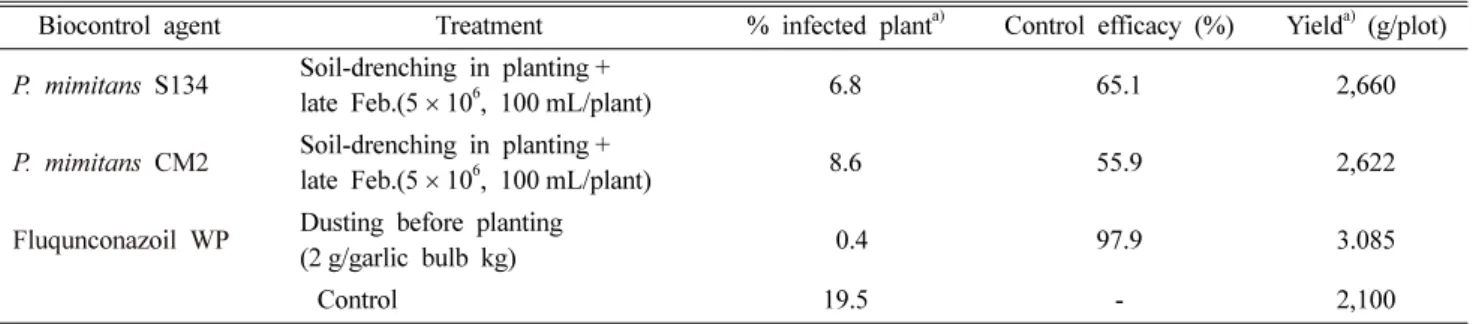
기생성진균을 처리한 구에서 흑색썩음균핵병은 P. minitans S134균주는 6.8%, CM2균주는 8.6% 발생하였으며, 무처 리구는 19.5% 발생하였다(Table 2). 병든 마늘을 제외하 고 상품성이 있는 마늘의 수량을 조사한 결과, 무처리에 비하여 P. minitans S134균주는 127%, CM2균주는 125%
수량이 증가되었다(Fig. 4C-D). 대조약제인 플로퀸코나졸 수화제 분의처리구는 0.4% 흑색썩음균핵병이 발생하여 수량은 무처리에 비하여 147% 증수되었다.
기생진균 P. minitans S134와 CM2 균주를 마늘 파종한 직후와 2월 하순에 각각 포자현탁액을 5 × 10⁶m
l
로 제조Fig. 3. Neighbor-joining tree based on glutamine synthetase intron 2 sequences of Paraconiothyrium minitans strains. The numbers above the nodes represent bootstrap values of > 50% out of 1,000 bootstrap replication. Bar represents the number of nucleotide substitutions per site.
Fig. 4. Suppressive effect of P. minitans S134 against garlic white rot in the field in Taean. A, S134 plot; B, control; C, yield of control; D, yield of twice soil-drenching of P. minitans S134.
Fig. 5. Damage and symptoms of garlic white rot caused by Sclerotium sepivorm in the field. A, symptoms of white rot in the garlic bulbs; B, sclerotia of S. cepivorum formed on garlic stem; C, sclerotia of S. cepivorum isolated from infected garlic bulb on PDA media.
하여 주당 100 mL씩 관주처리하여 마늘 재배기간 동안에 토양내의 Paraconiothyrium spp.의 균밀도를 조사한 결과 , S134균주가 CM2균주보다 균밀도가 높이 유지되는 경 향을 나타내어서 S134균주가 CM2균주보다 마늘 흑색썩 음균핵병에 방제효과가 높았다고 사료된다(Fig. 6).
외국에서 양파 흑색썩음균핵병에 대한 생물적 방제는 길항곰팡이균으로 Cheatonium globosum, Trichoderma harzianum, T. viride, T. koningi와 Coniothyrium minitans 등을 이용하여 종자코팅, 펫éð 또는 모래와 밀기울을 혼 합 처리시에 모래와 밀기울의 혼합처리가 가장 효과적이 었으며, C. globosum은 67%, Trichoderma harzianum은 51%, Coniothyrium minitans은 51.8%, T. viride는 41%, T. koningii는 73%의 방제효과를 나타내었다(McLean and Stewart, 2000; Mclean et al., 2001b).
C. minitans(P. minitans의 이명)는 1947년에 미국에서 발견된 후 유럽, 뉴질랜드, 중국, 러시아, 캐나다, 인도, 남 아프리카 등 18개국에서도 발견되어, 균핵을 형성하는 병 원균 Sclerotinia minor, S. sclerotiorum, S. trifoliorum, Botrytis cinerea, B. fabae. Sclerotium cepivorum의 균핵 에 기생하여 방제균으로서의 활용 가능성이 제시한 바 있 으며(Whipps et al. 1992), 우리나라에서는 S. sclerotiorum 와 S. minor의 균핵 발아를 억제하여 생물적방제의 가능
성을 보고하였다(Lee et al., 2011).
또한 양파에 사용하는 캡탄수화제와 베노밀수화제를 종 자처리한 후에 기생진균 Trichoderma harzianum C52 균 주를 포장에서 이랑에 처리하여 양파흑색썩음균핵병 방제 에 효과적이었다(Mclean et al., 2001a). 흑색썩음균핵병 을 발생을 억제하가 위하여 균핵의 생존율의 감소시키는 투명한 폴리에틸렌필름으로 4주간 피복하여 생존율을 40.2
~53.3%롤 감소시켰으며(Mclean et al., 2001b), 태양열소 독이 병원균의 전염원을 75%, 균핵의 활력을 84% 각각 감소시켰다(Ulacio-Osorio et al., 2006; Edizioni, 2006).
생물적 방제의 단점으로 유용미생물과 처리방법에 따라 서 방제효과의 차이가 있는 것은 전염원 밀도, 포장조건 및 재배자의 포장관리, 토양조건 등에 의하여 방제효과가 달라질 수 있지만 효과적인 방제를 위하여 토양내의 전염 원을 감소시키는 태양열 소독을 한 후에 마늘을 파종한 직후에 선발한 기생진균 P. minitans S134 균주를 처리하 는 체계처리는 흑색썩음균핵병을 보다 효과적인 방제 방 법이라고 생각된다. 그러므로 선발한 기생진균 P. minitans S134 균주는 마늘 흑색썩음균핵병에 대한 생물적방제 미 생물로 환경친화적인 마늘 생산이 기대된다.
적 요
Sclerotium cepivrum은 마늘과 같은 파속작물에 발생하는 흑색썩음균핵병의 병원균이다. 기생진균 Paraconiothyrium minitans S134 균주는 마늘 흑색썩음균핵병의 생물적 방 제를 위하여 선발되었다. 포장실험은 태안에서 2011년 10 월부터 2012년 6월까지 실시하였다. P. minitans S134 균 주의 포자현탁액(5 × 10⁶m
l
)을 마늘 종구를 파종직후와 다음해 2월 하순에 주당 100 ml
씩 각각 관주처리하여 6 월 5일에 흑색썩음균핵병 발생 억제효과를 조사하였다.P. minitans S134 균주를 2회 관주처리구가 6.8%, 플루퀀 코나졸수화제 분의처리구가 0.4%, 무처리구가 19.5%의 흑 색썩음균핵병이 발생하였다. 그러므로 P. minitans S134 균주는 마늘 흑색썩음균핵병에 대한 유망한 미생물농약으 로서 가능성을 나타내었다.
Table 2. Effect of biological control on garlic white rot by treatment with P. minitans S134 in field in Taean in 2012b)
Biocontrol agent Treatment % infected planta) Control efficacy (%) Yielda) (g/plot) P. mimitans S134 Soil-drenching in planting +
late Feb.(5× 10⁶, 100 mL/plant) 6.8 65.1 2,660
P. mimitans CM2 Soil-drenching in planting +
late Feb.(5× 10⁶, 100 mL/plant) 8.6 55.9 2,622
Fluqunconazoil WP Dusting before planting
(2 g/garlic bulb kg) 0.4 97.9 3.085
Control 19.5 - 2,100
a)Infected plants and yields of garlic were investigated at Taean on June 5th 2012.
b)In a column, means followed by a common letter are not significantly different at the 5% level by DMRT.
Fig. 6. Population change of Paraconiothyrium spp. in soil of garlic cultivation after treatment of P. minitans S134 and CM2 in the field.
감사의 글
본 연구는 농촌진흥청 국립농업과학원 농업과학기술 연 구개발사업(과제번호: PJ0067412012)의 지원에 의해 이 루어진 것이며, 이에 감사드립니다.
참고문헌
Clarkson, J. P., Payne, T,. Mead, A. and Whipps, J. M. 2002.
Selection of fungal biological control agents for control of white rot by sclerotial degradation in a UK soil. Plant Pathol- ogy 51:735-745.
Copping, L. G. 2009. The manual of biocontrol agents. Four edi- tion, BCPC. UK. 851 pp.
Edizioni ETS Pisa. 2006. Stratgies for managemant of Sclerotium cepivorum in garlic. Journal of Plant Pathology 88(3):253-261.
Entwistle, A. R. 1992. Controlling Allium white rot (Sclerotium cepivorum) without chemicals. Phytoparasitica 20:121S-125S.
Ghaffar, A. 1969. Biological control of white rot of onion. Myco- pathologia et mycologia applicata 38:113-127.
Guerber, J. C., Liu, B., Correll, J. C. and Johnston, P. R. 2009.
Characterization of diversity in Colletotrichum acutatum sensu lato by sequence analysis of two gene introns, mtDNA and intron RFLPs, and mating compatibility. Mycologia 95:872- 895.
Kim, Y. K. 2005. Ecology and control strategy of white rot of garlic and onion. Rural Development Administration Coopera- tive Research Report 6-12. (in Korea).
McLean, K. L., Hunt J. and Stewart, A. 2001a. Compatibility of the biocontrol agent Trichoderma harzianum C52 with selected fungicides. N. Z. Plant Prot. 54:84-88.
McLean, K. L., Swaminathan, J. and Stewart, A. 2001b. Increas- ing soil temperature to reduce sclerotial viability of Sclerotium
cepivorum in New Zealand soils. Soil Biology & Biochemistry 33:137-143.
McLean, K. L. and Stewart, A. 2000. Application stratgies for control of onion white rot by fungal antagonists. N. Z. J. Crop Hort. Sci. 28:115-122.
Punithalingam, E. 1982. Coniothyrium minitans. CMI Descrip- tions of Pathogenic and Bacteria No. 732.
Lee, S. Y., Kim, W. G., Hong, S. K., Weon, H. Y. and Park, K. S.
2011. Inhibitory effect of Paraconiothyrium minitans CM2 on sclerotial germination of Sclerotinia sclerotiorum and S. minor causing sclerotinia rot of lettuce. Kor. J. Mycol. 39:131-135. (in Korea).
Tamura K., Peterson D., Peterson N., Stecher G., Nei M. and Kumar, S. 2011. MEGA5: Molecular evolutionary genetics analysis using maximum likelihood, evolutionary distance, and maximum parsimony methods. Molecular Biology and Evolu- tion. doi: 10.1093/molbev/msr121.
Thompson, J. D., Higgins, D. G. and Gibson, T. J. 1994.
CLUSTAL W: Improving the sensitivity of progressive multi- ple sequence alignment through sequence weighting, position specific gap penalties and weight matrix choice. Nucl. Acids Res. 22:4673-4680.
Ulacio-Osorio, D., Zavaleta-Meja1, E., Martnez-Garza1, A. and Pedroza-Sandoval, A. 2006. Strategies for management of Scle- rotium cepivorum in garlic. Journal of Plant Pathology 88(3):
253-261.
Verkley, G. J. M., Silva, M. da, Wicklow, D. T. and Crous, P.
W. 2004. Paraconiothyrium, a new genus to accommodate the mycoparasite Coniothyrium minitans, anamorphs of Paraphaeosphaeria, and four new species. Studies in Mycol- ogy 50:323-335.
Whipps J. M. and Gerlagh, M. 1992. Biology of Coniothyrium minitans and its potential for use in disease biocontrol. Myco.
Res. 96(11):897-907.