Article https://doi.org/10.14478/ace.2019.1059
1. Introduction
1)Phosphorus is an essential nutrient of all biological organisms.
Phosphorous in the form of phosphates is mainly used in the pro- duction of fertilizers, detergents, animal feed, dentistry, metal cleaning and coating[1]. Other than its main use, phosphate rock is the main source of phosphate on earth. It is a non-renewable source and will be depleted before the end of this century due to increasing civilization[2].
Apart from its use and advantages, the main disadvantage of phos- phorous is eutrophication which is a wide spreading global pollution problem in the freshwater ecosystems. Nowadays, phosphate-bearing wastes contained in industrial and municipal effluent streams are gen- erally discharged into the water bodies. When the phosphate was high- ly accumulated in surface waters it triggers algal and plant growth in surface waters. It reduces the dissolved oxygen levels which causes death of fish and other aquatic life. This affects the aquatic balance and diminishes the water quality[3]. Taking into consideration of lim- ited availability of phosphate sources as well as its disadvantages, it is essential to focus on phosphate recovery from wastewater.
Several techniques such as biological, chemical, physical, and phys- icochemical methods have been studied in order to reduce the phos- phate contents in an aqueous environment[4,5]. Low phosphorous con- centrations were achieved by enhanced biological phosphorous removal
† Corresponding Author: Pyeongtaek University,
Department of Integrated Environmental Systems, Pyeongtaek 17869, Korea Tel: +82-31-659-8309 e-mail: [email protected]
pISSN: 1225-0112eISSN: 2288-4505 @ 2019 The Korean Society of Industrial and Engineering Chemistry. All rights reserved.
(EBPR) and it was a widely used due to its minimal sludge production and moderate operational cost. However, reliability and stability are key issues in the operation of EBPR plants[6]. Chemical precipitation is a conventional process for phosphorous removal and Ca2+, Al3+ and Fe3+ salts are normally used in this process. The phosphorous was eliminated as a non-recyclable metal-phosphate precipitates or pre- cipitated together with numerous other waste materials as sludge.
However, the phosphate sludge formed by Al3+ and Fe3+ salts except Ca2+ can not be used as fertilizer which resulted in loss of huge amount of phosphorus. In addition, usage of corrosive chemicals, generation of huge amounts of waste sludge and high cost for waste disposal are the limitations of this method[7,8]. Compared to previous techniques, the adsorption process is more promising due to its ease of operation, sim- plicity of design and economics, provided that low-cost sorbents are used[9].
Several adsorbents such as metal oxides and hydroxides[10,11], met- al carbonates[12], layered double hydroxide (LDH)[13], clay materi- als[14], metal loaded carbon[15,16], anion exchange resins[17], metal loaded silica[18] have been studied for phosphate adsorption. Recently calcium silicate hydrate (CSH) which is a major constituent phase of Portland cement[19], has been explored as chemisorbent for phosphate removal[8,20,21]. However, in many reports the CSH was used in the powder form. Powder cannot be used in column operations due to loss of CSH particles in the effluent stream and formation of pressure drop[22]. Therefore, it is necessary to develop a suitable method for converting the CSH powder into shaped bodies.
Immobilization of small solid particles, liquid droplets, or gas bub- bles within a porous membrane of shell material is called micro-
Preparation of Calcium Silicate Hydrate Extrudates and Their Phosphate Adsorption Studies
Phani Brahma Somayajulu Rallapalli and Jeong Hyub Ha†
Department of Integrated Environmental Systems, Pyeongtaek University, Pyeongtaek 17869, Korea (Received July 30, 2019; Revised August 7, 2019; Accepted August 11, 2019)
Abstract
Cylindrical shape extrudates of calcium silicate hydrate (CSH) were prepared using different percentages of polyvinyl alcohol (PVA) / sodium alginate (SA) mixtures as binders and an aqueous solution containing 6% H3BO3 and 3% CaCl2 was used as a cross linking agent. As the quantity of alginate increases, the phosphate removal efficiency and capacity were decreased.
Among four different extrudate samples, the sample prepared by 8% PVA + 2% SA showed the highest phosphate removal efficiency (59.59%) and capacity (29.97 mg/g) at an initial phosphate concentration of 100 ppm and 2.0 g/L adsorbent dosage.
Effects of the adsorbent dosage, contact time and initial phosphate concentration on the sample were further studied. The removal efficiency and capacity obtained by a 4.0 g/L adsorbent dose at an initial phosphate concentration of 100 ppm in 3 h were 79.38% and 19.96 mg/g, respectively. The experimental data of kinetic and isotherm measurements followed the pseudo-second-order kinetic equation and Langmuir isotherm model, respectively. These results suggested that the phosphate removal was processed via a chemisorption and a monolayer coverage of phosphate anions was on the CSH surface. The maximum adsorption capacity () was calculated as 23.87 mg/g from Langmuir isotherm model.
Keywords: Calcium silicate hydrate, Phosphate removal, Extrusion, Chemical cross linking, Chemisorption
encapsulation, which is successfully applied in pharmaceutical, agricul- tural, food and environmental engineering industries[23]. Shilin et al.
(2018) prepared CSH flakes using poly vinyl alcohol (PVA) polymer by chemical cross linking with NaNO3 solution[24]. Extrusion of core materials into spherical/cylindrical shapes using a dry/wet blend of core material and a binder is also another method for producing shaped bodies which is commonly used in the field of gas separation and cat- alysis[25]. So far, few reports have been available on preparation of CSH extrudates.
In the present work, the CSH powder was transformed into ex- trudates using various percentages of PVA and sodium alginate (SA).
Then their removal efficiency and removal capacity of phosphate were investigated. The parameters affecting the phosphate removal efficiency such as adsorbent dosage, contact time and initial phosphate concen- tration were evaluated.
2. Materials and Methods
2.1. Materials
Calcium silicate hydrate (CaSiO3⋅nH2O, extra pure), polyvinyl al- cohol (PVA, MW 2000), sodium alginate (SA), boric acid (H3BO3, 99.5%), calcium chloride, anhydrous (CaCl2, 96.0%) and potassium phosphate, monobasic (KH2PO4, 99.0%) were purchased from Samchun Chemical., Ltd., South Korea.
2.2. Preparation of extrudates
PVA and SA were taken in different (w/w) percentages i.e. 8% PVA + 2% SA, 6% PVA + 4% SA, 4% PVA + 6% SA, 2% PVA + 8%
SA along with 90% CSH powder. Then they were mixed by using mortar and piston to get a homogeneous physical mixture. Water was sprinkled on these mixtures until a wet blend was prepared. The result- ing paste was extruded in the form of wire using a syringe. The ex- trudates were soaked in 6% H3BO3 + 3% CaCl2 solution at 25 ℃ for 24 h at static condition to achieve complete crosslinking of PVA and SA. The extrudate wires were taken out and washed several times with hot water to remove the unreacted H3BO3 and CaCl2. They were dried at room temperature (25 ℃) and broken into small pieces which re- sulted in cylindrical extrudates. Then they were dried at 100 ℃ for 24 h in air oven. In the present study, the extrudates prepared by 8% PVA + 2% SA, 6% PVA + 4% SA, 4% PVA + 6% SA, 2% PVA + 8%
SA were named as sample A, sample B, sample C and sample D. The preparation of sample A (8% PVA + 2 % SA extrudates) was shown in Figure 1.
2.3 Adsorption measurements
Phosphate removal experiments were conducted by a series of batch experiments at room temperature (25 ± 0.5 ℃). In all experiments, 100 ppm phosphate working solution was prepared by using KH2PO4 and distilled water. All these batch experiments were conducted in open air shaker (Jeio Tech, South Korea) at a speed of 200 rpm. After the com- pletion of experiments, the suspension was filtered through a 0.45 µm membrane syringe filter.
Figure 1. Preparation of 8% PVA + 2% SA + 90% CSH extrudates (Sample A).
2.4. Screening of adsorbents and adsorbent dosage experiments For screening of extrudates, 0.2 g of extrudates (sample A~D) and 0.2 g of CSH powder were taken in to 100 mL of 100 ppm phosphate solution and in the adsorbent dosage experiments, the sample A was taken at various doses i.e 0.1~0.45 g and then was added to 100 mL of 100 ppm phosphate solution. The suspensions were placed on shak- er and stirred for 3 h. After completion of experiments the suspensions were filtered and the residual phosphate concentration was measured.
2.5. Effect of contact time and initial phosphate concentration on phosphate removal
To determine the effect of contact time on phosphate removal, 0.4 g of sample A was taken in to 100 mL of 100 ppm phosphate solution and the suspension was placed on shaker and stirred for 180 min. 1 mL of solution was taken out from the suspension at specified time intervals and was diluted to 10 times. The diluted solutions were fil- tered and the residual phosphate concentration was measured.
To determine the effect of initial phosphate concentration on phos- phate removal, 0.2 g of sample A was taken in to 100 mL phosphate solution. The initial concentrations of phosphate solutions were ad- justed in the range of 5~125 ppm. The suspensions were placed on shaker and stirred for 3 h. The suspensions were filtered and the re- sidual phosphate concentration was measured.
2.6. Determination of phosphate concentration
The concentration of phosphate in this study was measured by ion chromatography system (Dionex ICS-1100, Thermo Scientific Inc., USA) equipped with automatic sampler. These ions are separated on an anion separator column (Dionex, Ionpac, AS22) by using 1.4 mM NaHCO3/ 4.5 mM Na2CO3 eluent solution.
The phosphate removal efficiency (% removal) was calculated by the following equation.
% removal =
× (1)
The Phosphate removal capacity (removal capacity) at equilibrium was calculated by the following equation.
Removal capacity (mg/g) =
× (2)
Where and are the initial and equilibrium concentrations in mg/L of Phosphate, is the volume of solution in a liter and is the dosage of CSH in grams.
3. Results and Discussion
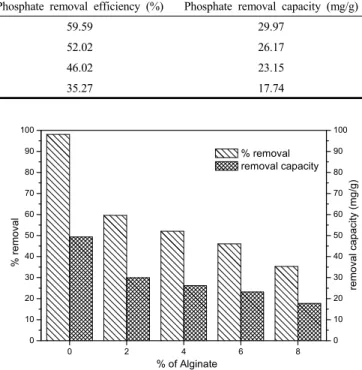
3.1. Effect of the amount of SA on phosphate removal Initially, 10% PVA + 90% CSH powder wet blende was tried for extrusion. But the mixture was so sticky and it was not coming out of the syringe nozzle. The hydrogel beads prepared with PVA have strong tendency to agglomerate and resulted in a sticky mass. To avoid this problem SA was used along with PVA[22]. According to Jinxing et al. (2019), the PVA and SA forms an interpenetrating polymer net- works which restricts the agglomeration problem[26]. Later we in- cluded SA in the extrusion process which made it very easy. We pre- pared four different samples by varying the percentages of PVA and SA. The % removal and removal capacity of phosphate ions versus % of SA were shown in Figure 2 and the values were tabulated in Table 1. The CSH powder was taken as reference sample in which SA per- centage was zero and its % removal and removal capacity were meas- ured and compared with other extrudates. The % removal and removal capacity follows a similar trend and they decreased with increasing the SA percentage. Jinxing et al. (2019) reported that SA forms a dense layer around the adsorbent surface in PVA-SA interpenetrating polymer networks which could hinders the diffusion of adsorbate and reduces the adsorbent performance[26]. Yang et al. (2017) studied the inter- facial connection mechanisms in CSH/poly acrylic acid (PAA) and CSH/PVA nanocomposites. A strong coordination bond was formed between calcium ions and double-bonded oxygen atoms in the -COOH group. These Ca-O connections makes CSH to strongly bind the PAA.
Whereas the PVA only contains the -OH groups and the interfacial in teractions between the CSH and PVA are weak hydrogen bonds[27].
In the extrusion process, CaCl2 was used as crosslinking agent for SA and it may be possible that some portion of SA may strongly binds to calcium counter ions which present on the surface of CSH. Based
0 2 4 6 8
0 10 20 30 40 50 60 70 80 90 100
0 10 20 30 40 50 60 70 80 90 100 % removal
removal capacity
removal capacity (mg/g)
% removal
% of Alginate
Figure 2. Phosphate removal percentage (%) and capacity (mg/g) of CSH powder, sample A, sample B, sample C and sample D at 25 ℃.
Initial phosphate concentration: 100 ppm, volume: 100 mL, adsorbent dosage: 2 g/L, adsorption time: 3 h.
on these assumptions it was concluded that high percentages of SA may react with CSH and form a dense layer around the CSH surface which further decreases the availability as well as accessibility of the calcium sites to the phosphate ions. The % removal and removal ca- pacity obtained by CSH powder were measured for comparison and they were 98.08% and 49.33 mg/g respectively. Whereas the % re- moval and removal capacity obtained by Sample A were 59.59% and 29.97 mg/g respectively. CSH powder shows superior performance than sample A. The powder can spread all over in the phosphate sol- ution and more adsorption sites are available for phosphate adsorption.
However, the powder particles are closely packed in sample A and they were shielded by the PVA-SA dense layer. Hence, the adsorption sites are not exposed as much as in the case of CSH powder. 10% less amount of CSH in sample A compared to CSH powder also decreases its performance. Among four extrudate samples, sample A showed most efficient phosphate removal. Hence, here onwards this sample was tak- en for further adsorption studies.
3.2. Effect of adsorbent dosage on phosphate removal
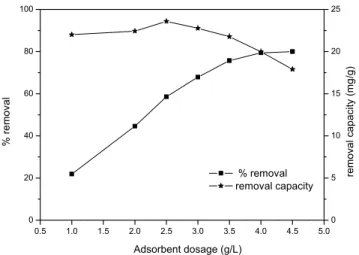
Figure 3 illustrates the effect of adsorbent dosage on % removal and removal capacity. A constant increase in the % removal up to 3.5 g/L dose was observed and after it slowly reaches the equilibrium state.
Whereas a reverse phenomenon was observed in the case of removal capacity. Up to 2.5 g/L dose it was almost in steady state and from 3.0~4.5 g/L dose the removal capacity was gradually decreased. It indicates that the CSH was not completely utilized under high dosage Sample code Sample Phosphate removal efficiency (%) Phosphate removal capacity (mg/g)
Sample A 90% CSH + 8% PVA + 2% SA 59.59 29.97
Sample B 90% CSH + 6% PVA + 4% SA 52.02 26.17
Sample C 90% CSH + 4% PVA + 6% SA 46.02 23.15
Sample D 90% CSH + 2% PVA + 8% SA 35.27 17.74
Table 1. The Phosphate Removal Percentage (%) and Capacity (mg/g) of Various Extrudates
0.5 1.0 1.5 2.0 2.5 3.0 3.5 4.0 4.5 5.0 0
20 40 60 80 100
% removal removal capacity
Adsorbent dosage (g/L)
% removal
0 5 10 15 20 25
removal capacity (mg/g)
Figure 3. Effect of 8% PVA + 2% SA extrudate (Sample A) dosage on phosphate removal percentage (%) and capacity (mg/g). Initial phosphate concentration: 100 ppm, volume: 100 mL, adsorption time:
3 h, adsorption temperature: 25 ℃.
conditions. Southam et al. (2008) reported that the mechanism behind the phosphate removal by CSH was ligand exchange. The OH group bound to CSH surface (Ca-OH) and also CSH releases spontaneously some Ca2+ and OH- ions into the solution[28]. Initially some phosphate anions were reacted with free Ca2+ ions but major phosphate removal occurred by displacement of OH- ions by phosphate anions in Ca-OH groups. Subsequently the OH- ions were discharged from the CSH and accumulated near the environs of CSH surface which might repel the phosphate anions and decreases the phosphate removal capacity[9].
Similar results were reported by Dexin et al.[29]. The % removal and removal capacity obtained by 4.0 g/L adsorbent dose were 79.38% and 19.96 mg/g respectively. Considering both % removal and removal ca- pacity, 4.0 g/L adsorbent dose seems to be the appropriate dosage for 100 mL of 100 ppm phosphate solution.
3.3. Effect of contact time on phosphate removal
The effects of contact time on % removal and removal capacity were studied up to 180 min and the results were illustrated in Figure 4. Both parameters were increased with increasing the contact time and attained equilibrium after 120 min. Furthermore, no change in the rate of adsorption was observed until 180 min. The % removal and removal capacity at 180 min were calculated as 59.93% and 16.51 mg/g. The adsorption occurs when the phosphate ions diffuses from bulk solution through the PVA/SA layer and contacted with the Ca2+ adsorption sites in the CSH. In the initial stage of adsorption, the concentration gra- dient near the PVA/SA layer was higher and the diffusion of phosphate ions was faster, hence the % removal as well as the removal capacity was higher until 120 min[30]. Later negligible change in rate of ad- sorption was observed. Estimation of adsorption kinetics provides in- formation about the sorption rates and sorption mechanism. The ex- perimental adsorption kinetics data was fitted using the nonlinear pseu- do-first-order and pseudo-second-order kinetic models according to equations (3) and (4), respectively[31] and the results were shown in Figure 5.
0 60 120 180
0 10 20 30 40 50 60 70 80 90 100
% removal removal capacity
% removal
time (min)
0 2 4 6 8 10 12 14 16 18 20
removal capacity (mg/g)
Figure 4. Effect of contact time on phosphate removal percentage (%) and capacity (mg/g) of 8% PVA + 2% SA extrudate (Sample A). Initial phosphate concentration: 100 ppm, volume: 100 mL, adsorbent dosage: 4 g/L, adsorption temperature: 25 ℃.
0 60 120 180
0 3 6 9 12 15 18
experimental
pseudo-first-order model pseudo-second-order model qt (mg/g)
t (min)
Figure 5. Experimental and nonlinear curve fittings of pseudo-first-order and pseudo-second-order kinetic models.
= (3)
=
(4)
Where (mg/g) and (mg/g) are the amount of phosphate ions ad- sorbed per mass of adsorbent at equilibrium and at any time (min), respectively. While, (1/min) is the rate constant of the pseu- do-first-order kinetic model and (g/mg min) is the rate constant of the pseudo-second-order kinetic model.
The experimental data was fitted well in the pseudo-second-order model (r2 = 0.9941) compared to pseudo-first-order model (r2 = 0.9216).
The calculated removal capacity at 180 min was 16.95 mg/g and it was quite near to the experimental removal capacity (16.51 mg/g). In this model, the rate-limiting step is the surface adsorption that involves chemisorption process[32]. Similar results were reported on PVA im-
0 25 50 75 100 125 150 0
20 40 60 80 100
% removal removal capacity
initial phosphate concentration (ppm)
% removal
0 2 4 6 8 10 12 14 16 18 20
removal capacity (mg/g)
Figure 6. Effect of initial concentration on phosphate removal percen- tage (%) and capacity (mg/g) of 8% PVA + 2% SA extrudate (Sample A). Adsorbent dosage: 4 g/L, volume: 100 mL, adsorption time: 3 h, adsorption temperature: 25 ℃.
mobilized CSH[24] and nanostructured CSH[28]. As discussed above, these results further confirmed that the phosphate removal on sample A follows chemisorption via ligand exchange mechanism.
3.4. Effect of initial phosphate concentration on phosphate removal The effects of changing the initial phosphate concentration (i.e. 5, 10, 25, 50, 75, 100 and 125 ppm) on % removal and removal capacity were studied while keeping the sample A amount constant. The results were shown in Figure 6. The % removal increased from 23.51 to 68.48% in the range 5~25 ppm. After that % removal gradually de- creased to 29.51%. In contrast, an increase in the removal capacity from 0.59~18.09 (mg/g) was observed with increasing the initial phos- phate concentration from 5~100 ppm and further increase in the initial concentration (125 ppm) seem to have slight change in the removal ca- pacity (18.44 mg/g). The initial concentration provides a necessary driving force to overcome the mass transfer resistance of adsorbent ions from bulk to the active adsorption sites of the adsorbent[30]. The
% removal in the case of low initial phosphate concentrations (i.e. 5 and 10 ppm) was lower due to less concentration gradient near the PVA/Alginate layer and the phosphate ions does not seem to diffuse well. Similar results at low initial concentrations were reported by Saffa et al. and Salman et al.[30,33]. Further decrease in the % re- moval with increasing the initial phosphate concentration can be ex- plained as, at constant adsorbent dosage, the total number of available adsorption sites present in the sample A are fixed thereby adsorbing almost the same amount of phosphate ions, thus resulting in a decrease in the % removal of the phosphate ions corresponding to an increase in initial concentration[34]. However, the adsorption capacity at equili- brium increased with increase in initial phosphate ions concentration.
The increase in the initial concentration also enhances the interaction between the phosphate ions in the aqueous phase and the CSH surface.
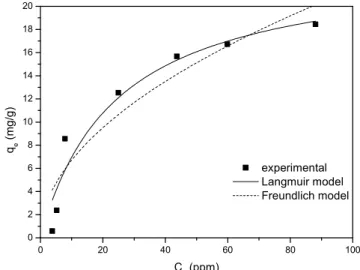
Therefore, a higher initial concentration of phosphate ions enhances the rate of adsorption. Similar results were reported by das et al.[34]. The experimental data was fitted in nonlinear Langmuir and Freundlich iso-
0 20 40 60 80 100
0 2 4 6 8 10 12 14 16 18 20
experimental Langmuir model Freundlich model qe (mg/g)
Ce (ppm)
Figure 7. Experimental and nonlinear curve fittings of Langmuir and Freundlich isotherm models.
therm models given by the equations (5) and (6) respectively[24] and the results were shown in Figure 7.
=
(5)
= (6)
Where represents the equilibrium concentration of phosphate ions;
(mg/g) represents the amount of phosphate adsorbed per unit mass of adsorbent at equilibrium; (mg/g) is the Langmuir constant that represents maximum adsorption capacity assuming a monolayer cover- age of adsorbate over a homogenous adsorbent surface; is a kinetic parameter representing the adsorption energy of the adsorbent for the adsorbate phosphate; (mg/g) is the Freundlich constant related to ad- sorption capacity; and is an empirical parameter related to adsorp- tion intensity or surface heterogeneity.
The Langmuir model (r2 = 0.9268) is displayed a considerably better fit than Freundlich model (r2 = 0. 8632). Langmuir model can be as- cribed to the monolayer coverage of phosphate anions on the CSH surface. Once monolayer formation was completed the CSH gets satu- rated and further increase of phosphate concentration resulted in reduc- tion of % removal of phosphate ions. The maximum adsorption ca- pacity () was calculated as 23.87 mg/g from the Langmuir isotherm model. The Langmuir maximum phosphate adsorption capacity () of various adsorbents was compared with sample A and they were giv- en in Table 2. The sample A shows higher capacity than Al-bentonite and DWTR-CA beads and 15.27% less capacity than CSH/PVA flakes.
4. Conclusions
In the present study, the CSH extrudates were prepared from wet blend of CSH, PVA & SA and tested for phosphate removal. High ra- tio of SA in CSH extrudates decreases the phosphate removal effi-
ciency as well as removal capacity. The experimental data of adsorp- tion kinetics on 8% PVA + 2% SA extrudates followed pseudo-sec- ond-order kinetic model. The isotherm measurements fitted well in the Langmuir isotherm model and the maximum adsorption capacity () was calculated as 23.87 mg/g from the Langmuir isotherm model. This process of making CSH extrudates could be used as alternative for hy- drogel beads. However, the phosphate removal percentage as well as capacity of extrudates were lower than the powder which indicates the investigation of more suitable binders and cross-linking agents is necessary.
Acknowledgements
This research was supported by Basic Science Research Program through the National Research Foundation of Korea (NRF) funded by the Ministry of Education (2017R1D1A1B03033256).
References
1. Z. T. Hijran, World phosphate industry, Iraqi Bull. Geol. Min., 7, 5-23 (2017).
2. I. Steen, Phosphorus availability in the 21st century: Management of a non-renewable resource, Phosphorus Potassium, 217, 25-31 (1998).
3. K. B. Biplob, I. Katsutoshi, N. G. Kedar, H. Hiroyuki, O. Keisuke, and K. Hidetaka, Removal and recovery of phosphorus from water by means of adsorption onto orange waste gel loaded with zirco- nium, Bioresour. Technol., 99, 8685-8690 (2008).
4. K. G. Ravindra, B. Sushmita, K. G. Pavan, and M. C. Chattopad- hyaya, Remediation technologies for phosphate removal from waste- water: An overview. advances in environmental research, Nova Science Publishers, Inc., 36, 177-200 (2014).
5. T. B. Joshua, N. Edmond, D. O. Irina, M. Andrew, and W. G.
David, A review of phosphorus removal technologies and their ap- plicability to small-scale domestic wastewater treatment systems, Front. Environ. Sci., 6, 1-15 (2018).
6. A. Oehmen, P. C. Lemos, G. Carvalho, Z. Yuan, J. Keller, L. L.
Blackall, and M. A. M. Reis, Advances in enhanced biological phosphorus removal: From micro to macro scale, Water Res., 41, 2271-2300 (2007).
7. L. E. De-Bashan and Y. Bashan, Recent advances in removing pho- sphorus from wastewater and its future use as fertilizer (1997-2003), Water Res., 38, 4222-4246 (2004).
8. K. Okano, M. Uemoto, J. Kagami, K. Miura, T. Aketo, and M.
Toda, Novel technique for phosphorus recovery from aqueous sol- utions using amorphous calcium silicate bhydrates (A-CSHs), Water Res., 47, 2251-2259 (2013).
9. P. Loganathan, V. Saravanamuthu, J. Kandasamy, and S. B. Nanthi, Removal and recovery of phosphate from water using sorption, Crit.
Rev. Environ. Sci. Technol., 44, 847-907 (2014).
10. R. Chitrakar, S. Tezuka, A. Sonoda, K. Sakane, K. Ooi, and T.
Hirotsu, Selective adsorption of phosphate from sea water and wastewater by amorphous zirconium hydroxide, J. Colloid Inter- face Sci., 297, 426-433 (2006).
11. G. Zhang, H. Liu, R. Liu, and J. Qu, Removal of phosphate from water by a Fe-Mn binary oxide adsorbent, J. Colloid Interface Sci., 335, 168-174 (2009).
12. S. Karaca, A. Gurses, M. Ejder, and M. Acikyildiz, Adsorptive re- moval of phosphate from aqueous solutions using raw and calcined dolomite, J. Hazard. Mater., B128, 273-279 (2006).
13. S. M. Ashekuzzaman and J. Jia-Qian, Study on the sorption-de- sorption-regeneration performance of Ca-, Mg- and CaMg-based layered double hydroxides for removing phosphate from water, Chem. Eng. J., 246, 97-105 (2014).
14. J. K. Edzwald, D. C. Toensing, and M. C. Y. Leung, Phosphate adsorption reactions with clay minerals, Environ. Sci. Technol., 10, 485-490 (1976).
15. X. Cui, X. Dai, K. Y. Khan, T. Li, X. Yang, and Z. He, Removal of phosphate from aqueous solution using magnesium-alginate/chi- tosan modified biochar microspheres derived from Thalia dealbata, Bioresour. Technol., 218, 1123-1132 (2016).
16. Q. Yin, R. Wang, and Z. Zhao, Application of Mg-Al-modified bi- ochar for simultaneous removal of ammonium, nitrate, and phos- phate from eutrophic water, J. Clean. Prod., 176, 230-240 (2018).
17. R. Awual, A. Jyo, S. A. El-Safty, M. Tamada, and N. Seka, A weak-fibrous anion exchanger effective for rapid phosphate removal from water, J. Hazard. Mater., 188, 164-171 (2011).
18. E. Ou, J. Zhou, S. Mao, J. Wang, F. Xia, and L. Min, Higly effi- cient removal of phosphate by lanthanum-doped mesoporous SiO2, Colloids Surf. A, 308, 47-53 (2007).
19. X. Chen, H. Kong, D. Wu, X. Wang, and Y. Lin, Phosphate re- moval and recovery through crystallization of hydroxyapatite using xonotlite as seed crystal, J. Environ. Sci., 21, 575-580 (2009).
20. D. C. Southam, T.W. Lewis, A. J. McFarlane, and J. H. Johnston, Amorphous calcium silicate as a chemisorbent for phosphate, Curr.
Appl. Phys., 4, 355-358 (2004).
21. K. Okano, M. Shimpei, K. Ayaka, T. Hiroyuki, A. Tsuyoshi, T.
Masaya, H. Kohsuke, and O. Hisao, Amorphous calcium silicate hydrates and their possible mechanism for recovering phosphate from wastewater, Sep. Purif. Technol., 144, 63-69 (2015).
22. M. M. Abd El-Latif, M. F. El-Kady, M. I. Amal, and E. O. Mona, Alginate/ polyvinyl alcohol-kaolin composite for removal of meth- ylene blue from aqueous solution in a batch stirred tank reactor, J. Am. Sci., 6(5), 280-292 (2010).
23. S. Cheng, Z. Yaqian, L. Ranbin, M. Yi, and M. David, Adsorption of phosphorus with calcium alginate beads containing drinking wa- S. No. Adsorbent Polymer / cross linking agent Langmuir sorp. capacity (mg/g) Reference
1 Aluminium-pillared acid activated bentonite beads SA / CaCl2 11.11 35
2 Drinking water treatment residual (DWTR)-CA beads SA / CaCl2 19.42 23
3 CSH flakes PVA / NaNO3 28.15 24
4 CSH PVA + SA / H3BO3 + CaCl2 23.87 Present study
Table 2. Comparison of Langmuir Maximum Adsorption Capacity () of Various Adsorbents
ter treatment residual, Water Sci. Technol., 78(9), 1980-1989 (2018).
24. D. Shilin, F. Dexin, P. Zishan, L. Bin, K. Li, W. Han, Z. Qian, S. Qiushi, and J. Fangying, Immobilization of powdery calcium silicate hydrate via PVA covalent cross-linking process for phos- phorus removal, Sci. Total Environ., 645, 937-945 (2018).
25. A. Farid, A. Linnéa, O. Steven, H. Niklas, and B. Lennart, Struc- turing adsorbents and catalysts by processing of porous powders, J. Eur. Ceram. Soc., 34, 1643-1666 (2014).
26. W. Jinxing, L. Jidong, S. Li, and G. Sha, PVA/CS and PVA/CS/Fe gel beads’ synthesis mechanism and their performance in cultivat- ing anaerobic granular sludge, Chemosphere, 219, 130-139 (2019).
27. Z. Yang, H. Dongshuai, M. Hegoi, O. Carlos, G. Guoqing, J. M.
M. Paulo, and L. Jiaping, Interfacial connection mechanisms in calcium-silicate-hydrates/polymer nanocomposites: A molecular dy- namics study, ACS Appl. Mater. Interfaces, 46, 41014-41025 (2017).
28. D. C. Southam, W. L. Trevor, J. M. Andrew, T. Borrmann, and H. J. Jim. Calcium-phosphorus interactions at a nano-structured sil- icate surface, J. Colloid Interface Sci., 319, 489-497 (2008).
29. F. Dexin, H. Liping, F. Zhuoyao, Z. Qian, S. Qiushi, L. Yimeng, X. Xiaoyi, and I. J. Fangy, Evaluation of porous calcium silicate hydrate derived from carbide slag for removing phosphate from wastewater, Chem. Eng. J., 354, 1-11 (2018).
30. S. M. Ragheb, Phosphate removal from aqueous solution using slag and fly ash, Housing and Building National Research Center Journal (HBRC J.), 9, 270-275 (2013).
31. H. Moussout, H. Ahlafi, M. Aazza, and H. Maghat, Critical of lin- ear and nonlinear equations of pseudo-first order and pseudo-sec- ond order kinetic models, Karbala Int. J. Mod. Sci., 4(2), 244-254 (2018).
32. R. Dariush, Pseudo-second-order kinetic equations for modeling adsorption systems for removal of lead ions using multi-walled carbon nanotube, J. Nanostruct. Chem., 3, 55-60 (2013).
33. N. Salman, B. Vijay, M. Jiri, W. Jakub, B. Promoda, and A. Azeem, Sorption properties of iron impregnated activated carbon web for removal of methylene blue from aqueous media, Fibers Polym., 17, 1245-1255 (2016).
34. J. Das, B. S. Patra, N. Baliarsingh, and K. M. Parida, Adsorption of phosphate by layered double hydroxides in aqueous solutions, Appl. Clay Sci., 32, 252-260 (2006).
35. R. P. Radheshyam, G. Prabuddha, B. Lalhmunsiama, C. B. Hari, and S. M. Lee, Al-intercalated acid activated bentonite beads for the removal of aqueous phosphate, Sci. Total Environ., 572, 1222-1230 (2016).