
응은α-amino phosphonates의 합성에 매우 효과적 인 반응이다. 이들 three component 반응을 [bmim]
PF6 용매하에서 phosphorous nucleophile로서 tri- ethylphosphite를 사용하고 Sc(OTf)3를 촉매로 이용 한 경우, 반응속도 현격하게 증가되어 2시간 만에 반 응이 종결되었다. 뿐만 아니라 이들 lanthanide triflate 촉매들은 이온성 액체 용매에 효과적으로 immobilize되어 재회수 및 재사용이 가능하였다.
결론
본고의 앞부분에서 언급된 몇 가지 예에서 볼 수 있 듯이 이온성 액체는 촉매반응에서 새로운 종류의 반 응 매질로서 분명 놀라운 특성을 갖고 있다. 특히
ionic liquids는 촉매와 용매의 반복적 사용을 가능하 게 함에 따라 결국 촉매와 용매의 소비를 최소화시킬 수 있는 가능성을 제시하고 있다. 더욱이 이온성 액체 내에서 촉매반응이 가속화될 수도 있고, 선택성 및 촉 매의 안정성 향상 역시 기대할 수 있다. 또한 많은 중 요한 유기반응에서 자신이 recyclable한 촉매로도 작 용할 수 있음도 알았다. 이러한 관점에서 이온성 액체 는 clean process를 위한 새로운 개념의 green solvent-green catalyst라 할 수 있을 것이다. 이온성 액체 연구는 이제 막 시작단계이며 이온성 액체가 갖 고 있는 이 거대한 potential을 충분히 이해하고 활용 하기 위해서는 앞으로 보다 더 광범위하고도 체계적 인 연구가 필요할 것이다.
Introduction
Many transition metal complexes dissolve readily in ionic liquids which enables their use as solvents for transition metal catalysis. Sufficient solubilityfor a wide range of catalyst complexes is an obvious, but not trivial, prerequisite for a versatile solvent for homogenous catalysis.
The first example of homogeneous transition metalcatalysis in an ionic liquid dates back to 1972 when Parshall described the platinum catalysed hydroformylation of ethene in tetraethylammonium trichlorostannate(mp. 78°C). This work was followed
by the pioneering studies of Knifton who reported the ruthenium- and cobalt-catalysed hydroformylation of internal and terminal alkenes in molten [Bu4P]Br in 1987. The first biphasic, liquid-liquid catalysis with room temperature liquid ionic liquids was carried out by Chauvin and Olivier-Bourbigiou in the early nineties. However, only the development and broader availability of non-chloroaluminate ionic liquids led to the much larger number of publications in thisresearch field starting from the late nineties.
Today, a significant part of the balooning number of publications on ionic liquid chemistry(more than
Engineering of Transition Metal Catalysis in Ionic Liquids: Liquid-liquid-biphasic Reactions and the
“Supported Ionic Liquid Phase(SILP)” Concept
Peter Wasserscheid*, Marco Haumann
Lehrstuhl für Chemische Reaktionstechnik, Universität Erlangen,Germany [email protected]*
2000 in 2006 according to SciFinder) deals with transition metal catalysis in these unusual liquid materials. This has also generated an extensive reviewing practice. Latest examples originate from Welton, MacFarlane, and Pozzi and compile the development of the research field in a more or less comprehensive way, though with slightly different emphasis and from specific, different viewpoints.
These three up-date earlier published reviews by Dupont, Zhao, Haag, Dobbs, Olivier-Bourbigou, Sheldon, Gordon, Wasserscheid, Welton and Seddon on the same topic.
Important general facts concerning transition metal catalysis in ionic liquids
Obviously, there are many good reasons to apply ionic liquids as alternative solvents in transition metal catalysed reactions. Besides their very low vapour pressure and their good thermal stability and acidity/coordination properties by varying the nature of the anions and cations systematically.
The possibility of adjusting solubility properties is of particular use for liquid-liquid-biphasic catalysis.
Liquid-liquid catalysis can be realized when the ionic liquid is able to dissolve the catalyst, displays a partial solubility with the substrates and a poor solubility with the reaction products. Under these conditions, the product phase, containing also the unconverted reactants, is removed by simple phase decantation, and the ionic liquid containing the catalyst can be recycled. A crucial aspect of this concept is the immobilization of the transition metal catalyst in the ionic liquid. While most transition metal catalysts easily dissolve in an ionic liquid without a special ligand design, ionic ligand systems have been applied with great success to prevent catalyst leaching under
the conditions of intense mixing in a continuous liquid-liquid-biphasic operation.
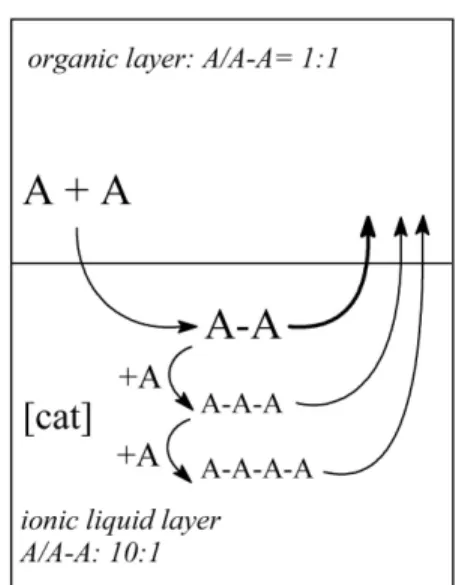
Apart from these recycling aspects, liquid-liquid- biphasic catalysis can also help to improve the selectivity of a given reaction. Attractive options arisefrom the preferential solubility of only one reactant in the catalyst solvent or from the in-situ extraction of desired reaction products out of the catalyst layer in order to avoid unfavourable consecutive reactions[Figure 1].
The possibility of adjusting acidity/coordination properties opens up a wide range of possible interaction between the ionic liquid solvent and the dissolved transition metal complex. Depending on the acidity/coordination properties of the anion and on the degree of the cation’s reactivity(the possibility for carbene ligand formation from 1,3-dialky- limidazolium salts is of here of particular importance), the ionic liquid can be either regarded as “innocent”
solvent, as ligand precursor, as co-catalyst or as
Figure 1. Enhanced dimer selectivity in the oligomerization of compound A due to thebiphasic reaction mode with an ionic liquid of high preferential solubility for A.
catalyst itself.
Ionic liquids with weakly coordinating, inert anions(e.[(CF3SO2)2N]-, [BF4]- or [PF6]- under anhydrous conditions) and inert cations (cations that do not coordinate to the catalyst themselves and that do not form species under the reaction conditions that coordinate to the catalyst) can be considered as
“innocent” solvents in transition metal catalysis. In these cases, the role of the ionic liquid is solely to provide a more or less polar, more or less weakly coordinating medium for the transition metal catalyst that additionally offers special solubility for feedstock and products.
However, many ionic liquid combine in an unique manner high solvation power for polar catalyst complexes (polarity) with weak coordination (nucleophilicity). It is thiscombination that enables a biphasic reaction mode with these ionic liquids even with catalyst systems which are deactivated by water or polar organic solvents.
In many other reactions where ionic or polar transition metal catalysts are used it could be demonstrated that the use of polar and weekly coordinating ionic liquids can result in a clear enhancement of catalytic activity.
A truly co-catalytic effect of ionic liquids is observed with those ionic liquids displaying a certain latent or real Lewis-acid character. These ionic liquids are usually formed by the reaction of a halide salt with a Lewis acid (e.chloroaluminate or
chlorostannate melts). In many examples, the Lewis acidity of an ionic liquid has been used to convert the neutral catalyst precursor into the active form of the catalyst by halide abstraction[Scheme 1] .
In those cases where the ionic liquid is not directly involved in creating the active catalytic species, a co- catalytic interaction between the ionic liquid solvent and the dissolved transition metal complex still often takes place and can result in significant catalyst activation. When a catalyst complex is, for example, dissolved in a slightly acidic ionic liquid some electron-rich parts of the complex (e.g., lone pairs of electrons in the ligand) may interact with the solvent in a beneficial way regarding the activity of the resulting catalytic centre. The acidic ionic liquid can be considered as a liquid acidic support for the transition metal catalysts dissolved therein.
Liquid-liquid-biphasic catalysis using ionic liquids
Liquid-liquid multiphasic catalysis with the catalyst present in the ionic liquid phase relies on the transfer of organic substrates into the ionic liquid or at the phase boundary. One important parameter for the development of kinetic models (which is crucial for up-scaling and proper economic evaluations) is to know the exact location of the reaction. Does the reaction take place in the bulk of the liquid, in the diffusion layer or immediately at the surface of the ionic liquid droplets?
Scheme 1. Activation of a neutral catalyst precursor by different Lewis acidic ionic liquids.
Cp2TiCl2+ [cation][Al2Cl7] [Cp2TiCl][Al2Cl4] + [cation][AlCl4] (ligand)2NiCl2+ [cation][Al2Cl7] + [cation][Al2EtCl6]
[(ligand)Ni-CH2-CH3][AlCl4] + 2[cation][AlCl4] + AlCl3-ligand
The answer to this question depends mainly on the relative speed of the chemical reaction vs. mass transfer of the substrate into the ionic liquid layer. In case the chemical reaction is fast vs. the mass transfer, a significant part of the reaction will already take place at the surface or in the diffusion layer. In case the chemical reaction is slow, the feedstock’s concentration will be still high in the bulk ionic liquid phase and the major part of the reaction will take place there.
In the case of biphasic catalysis in ionic liquids the influence of mass transfer on the observed kinetics is of particular importance. While chemical kinetics is often enhanced in ionic liquids (see above) mass transfer into/from the ionic liquid layer is generally slower compared to organic or aqueous media. This is mainly due to the ionic liquid’s usually much higher viscosity. The lowest viscous ionic liquids comparesomehow to ethylene glycol as demonstrated in [Table 1]. However many ionic liquids used in liquid-liquid-biphasic catalysis are significantly more viscous.
Why does high viscosity harm the mass transfer into an ionic liquid? The diffusional mass transfer into an ionic liquid can be expressed by the following equation:
dn/dt = D1,2LA dc1/dz with
D1,2L: diffusion coefficient A: liquid-liquid interfacial area
As can be seen easily from this equation, relatively high viscosity of the ionic liquid reduces the mass transfer into the catalytically active layer in two ways:
a) the higher the viscosity, the lower is the diffusion coefficient D1,2L b) the higher the viscosity the bigger
are the droplets formed with a given stirring effort in a given device and - consequently - the smaller is the liquid-liquid interfacial area A.
The here mentioned aspects are also relevant for the transfer of reactive gases into the ionic liquids. If the chemical kinetics are relatively fast a special stirrer design [Figure 2] has provenhelpful to reduce mass transfer problems of the reactive gas into the ionic
[CH3CO2] 293 162
[CH3SO3] 298 160
[C3F7CO2] 293 105
[CF3SO3] 293 45
[CF3CO2] 293 35
[BF4] 298 34
[(CF3SO2)2N] 293 34
Br/AlBr3(34.0/66.0mol%) 298 32
298 25
[N(CN)2] 298 21
Cl/AlCl3(50.0/50.0mol%) 298 18 Cl/AlCl3(34.0/66.0mol%) 298 14 for comparison:
ethylene glycol 298 16
Table 1. Viscosities of selected ionic liquids with 1-ethyl-3-methylimidazolium([EMIM]) being the cation.
Anion T/K viscosity/cP
Figure 2. A 150ml autoclave with a special stirrer design to maximize the intake of gaseous reactants into an ionic liquid.
liquid.
It should be also noted that in some cases the existence of mass transfer limitations can be advantageously used to control the exothermicity of reactions. For example, a decrease of stirring can be a simple and efficient way to decrease the reaction rate (e.g. for better control of the reaction’s exothermicity).
Supported ionic liquid phase(SILP) catalysis
The term “Supported ionic liquid phase(SILP) catalysis” has been recently introduced into the literature describing the heterogenization of a homogeneous catalyticsystem by confining an ionic liquid solution of catalytically active complexes on a solid support. In comparison to the conventional liquid-liquid-biphasic catalysis in organic/ionic liquid mixtures, the concept of SILP-catalysis offers very efficient use of the ionic liquid and short diffusion distances. [Figure 3] exemplifies the concept for the Rh-catalyzed hydroformylation of propene.The principle of the supported ionic liquid phase (SILP) technology involves surface modification of a solid material by an ionic liquid coating. The ionic liquid coating constitutes a thin film, which is confined on the surface of the solid by various methods such as, e.g. physisorption, tethering, or covalent anchoring of ionic liquid fragments. By an appropriate choice of the ions contained in the ionic liquid material, it is possible to transfer specific properties of the fluid to the surface of a solid material. In the case of catalytic SILP materials, the SILP concept allows tailor making of a catalyst by confining a catalytically active, ionic liquid- transition metal complex solution onto the surface.
Apart from the fact that SILP catalysts help to overcome problems of mass transport limitation (very short diffusion distances!) this technology allows the application of fixed-bed reactors for simple continuous processing (e.g. when applied in combination with gaseous reaction mixtures) while still offering a homogeneously dissolved, molecular
Figure 3. Supported ionic liquid phase(SILP) catalysis exemplified for the Rh-catalyzed hydroformylation of propene.
defined catalytic centre.
The use of catalytic SILP materials has been recently reviewed covering Friedel-Crafts reactions, hydroformylations (Rh-catalysed), hydrogenation (Rh-catalysed), Heck reactions (Pd-catalysed), and hydroaminations (Rh-, Pd-, and Zn-catalysed).
Conclusions
In many respects transition metal catalysis in ionic liquids is better regarded as heterogeneous catalysis on a liquid support than as conventional homogeneous catalysis in an organic solvent. As mentioned above, support-catalyst interactions are known in ionic liquids and can lead to catalyst activation. Product separation from an ionic catalyst layer is often easy (at least if the products are not too polar and have low boiling points) as in classical heterogeneous catalysis.
However, mass transfer limitation problems (when the chemical kinetics are fast) and some uncertainty concerning the exact micro-environment around the catalytically active centre represent common limitations for transition metal catalysis in ionic liquids and in heterogeneous catalysis.
Of course, the use of a liquid catalyst immobilization
phase still makes some very important differences in comparison to classical heterogeneous supports.
Obviously, by using a liquid, ionic catalyst support it is possible to integrate some classical features of traditional homogenous catalysis into this type of
“heterogeneous”catalysis. For example, a defined transition metal complex can be introduced and immobilized in an ionic liquid giving access to the chance to optimise the selectivity of a reaction by ligand variation, which is a typical approach in homogeneous catalysis. Reaction conditions in ionic liquid catalysis are still mild as typically used in homogenous catalysis. Analysis of the active catalyst in an ionic liquid immobilization phase is, in principle, possible using the same methods developed for homogeneous catalysis, which should enable a more rational catalyst design in the future.
In comparison to traditional biphasic catalysis using water, fluorous phases or polar organic solvents, transition metal catalysis in ionic liquids represents a new and advanced way to combine the specific advantages of homogeneous and heterogeneous catalysis.
![Table 1. Viscosities of selected ionic liquids with 1-ethyl-3-methylimidazolium([EMIM]) being the cation.](https://thumb-ap.123doks.com/thumbv2/123dokinfo/4993032.303800/4.798.396.703.212.547/table-viscosities-selected-ionic-liquids-ethyl-methylimidazolium-cation.webp)

