6
-트 리 아 졸 엑 소 메 칠 렌 펜 남 유 도 체 의 베 타 락 타 마 제 효 소 억 제 력 과베 타 락 탐 항 생 제 병 용 시 활 성 비 교
임 채 욱# •오 정 석•이 선 혜•김 경 원 • 임 철 부 중앙대학교 약학대학 의약품화학 교실
(Received December 4,2004; Revised January 15,2005)
|3-Lactamase Inhibitory Activity and Comparative Activity of 6-Triazole Exomethylenepenam Derivatives Combined with P-Lactam Antibiotics
Chaeuk Im#, Jung Suk Oh, Sun Hye Lee, Kyoung Won Kim and Chul Bu Yim Division of Medicinal Chemistry, College of Pharmacy, Chung-ang University, Seoul 156-756,Korea
Abstract — In vitro p-lactamase inhibitory activity of 6-triazole exomethylenepenam compounds ( 1,2, 3,4,5 and 6) was compared with clavulanic acid, sulbactam and tazobactam. The inhibitory activity of 3, 4 and 5 was stronger than those of sulbactam, clavulanic acid and tazobactam against Type IV enzymes. And, inhibitory activity of 3 and 4 was stronger than those of sulbactam, clavulanic acid and tazobactam against Type III enzymes. The in vitro antimicrobial activity of 3,4 and 5 combined with ampicillin was better than those with sulbactam and with cefoperazone was compared with the sulbactam against (3-lactamase producing 27 strains. The synergistic activity of (Z)-form compounds (3 and 5) was better than that of
©-form compound (4) and sulfone compound (5) was better than sulfide compound (3).
Keywords □ antimicrobial activity, p-lactamase inhibitors, 6-exomethylenepenam
p-Lactam계 항생제에 대한 세균의 일반적인 내성기전은 (3- lactam 항생제를 불활성화시키는 (3-lactamase 효소를 내성균이 분비하여 항생제의 약효를 제거하는 것이다. 이런 내성균을 치 료할수있는방법으로 (3-lactamase 효소를억제하는 (3-lactamase 억제제를 개발하고, (3-lactam 항생제와병용 투여하여 p-lactam 항생제를 P-lactamase 효소로부터 보호하는것이 활발히 연구되 고 있다.1ᅵ3)
Streptomyces clavuligeru^A]분리한 clavulanic acid를시작으 로 sulbactam, tazobactam이 (3-lactamase 억제제로 개발되었고,
이들을 amoxicillin, ampicillin, piperacillin등• 기존항생제와병용 투여하여 P-lactamase를분비하는내성균의 치료에사용하고있 다. p-Lactamase 억제제들은항균력이 약하지만,(3-lactamase 효 소에는 강한 친화력이 있는 suicide inhibitor로 작용한다. Clavulanic acid의경우, p-lactamase효소활성부위의 serine OH
#본 논문에 관한 문의는 저자에게로 (전화) 02-820-5603 (팩스) 02-815-2199 (E-mail) [email protected]
기와 억제제의 P-lactam carbonyl bond 사이에 acyl 결합이 발생 하고, 효소의 활성부위에결힘하여 (3-lactamase의기능을 억제한 다. 특히, tazobactam은 다양한 물라스미드 매개형 p-lactamase
를 강력히 억제하고, 기존의 (3-lactam 항생제와병용하여우수한 효소 억제력을보여주었다.4ᅵ8)
본 실험에서는기존의 (3-lactamase 억제제보다우수한 억제효 과가 있는신규화합물을 개발하기9'u) 위하여 합성된 triazole-6- exomethylene penamsulfone 유도체 6종에 대한 약효검색을 목 적으로 in vitro (3-lactamase 효소 억제력을 즉정한후, 효소 억 제력이 우수한 3종의 화합물을 선택하여 (3-lactamase를 생산하
는 내성균주를 대상으로 현재 임상에서 사용되고 있는 (3-
lactamase 억제제와 in vitro항균력을 비교 실험하였다.
실험 방법
시약 및 균주
P-Lactamase Type I(from Bacillus cereus), Type II(from Bacillus cereus), Type III(from Enterobacter cloacae), Type IV
51
52 임채욱 • 오정석 • 이선혜 • 김경원 • 임철부
(from Enterobacter cloacae) 및 TEM(from Escherichia coli 205) 효소는 Sigma 회사에서 구입하여 사용하였다. 대조약물 로 clavulanic acid(Smithkline Beecham), sulbactam(Pfizer),
tazobactam(한미약품)을 이용하였고, 그밖에 cuvette(quartz),
Mueller Hinton broth(Difco) 및 membrane filter paper(0.2 ^im,
22 mm : Gilman) 등을 사용하였다. Penam 유도체는본실험실 에서 합성한것이었고,p-lactamase를생산하는균주 27종은한 미약품에서 제공한것이었다.
In vitro
P-Lactamase 효소 억제활성 측정12그3》UV/Vis Spectrophotometer를이용하여 합성한 화합물 5종의
(3-lactamase효소의 억제활성을즉정하였다(Table I). 효소활성을
50% 억제하는데 필요한 화합물의 농도즉, p-lactamase에의한 기질의 가수분해를 50% 억제하는 억제제의 농도를 ICso 수치로 계산하였다. 합성된 화합물들은 5가지의 농도(0.01, 0.1, 1, 10,
100 |iM)로조제하여 사용하였다.
p-Lactamase Type I에대한억제제의 IC50
Cuvett에 phosphate 완충용액 (pH 7.0, 2.875 m l), (3-lactamase 효소 Type 1(15 [xlf 0.2 unit/assay) 및합성 화합물 용액 50 (i/를 넣고 잘섞은 후,30oC에서 10분간 방치한다. 여기에 효소에 대 한 기질로 6 0 나/의 penicillin G(10m M )를 가하고 233nm에서 2 분간흡광도를측정히여 각화합물농도에 대한 억제율(%)을구 하고 IC50값을 계산하였다.
P-Lactamase Type II에대한억제제의 IC50
(3-Lactamase Type II를 이용하여 p-lactamase Type I와동일 한방법으로 ICso값을 계산하였다.
p-Lactamase Type III에 대한억제제의 IC50
Cuvett에 phosphate 완충용액 (pH 7.0, 2.875 m/), p-lactamase
Type 111(15 |a/, 0.2 unit/assay) 및 합성 화합물 용액 50 ji/ 넣고 잘섞은 후,30oC에서 10분간방치한다. 여기에 효소에 대한기
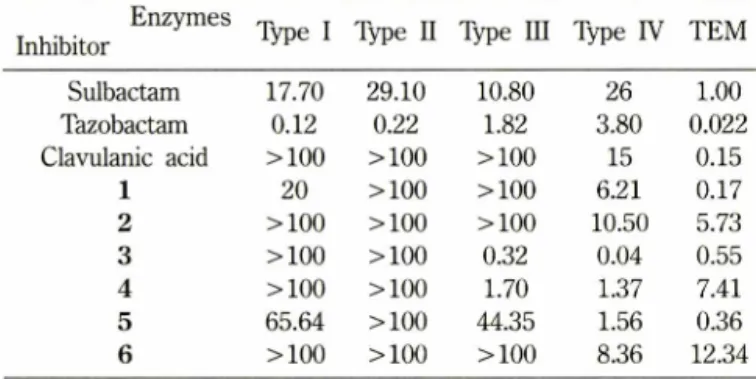
Table 1- In vitro (3-lactamase inhibitory activity of synthesized compounds (IC50, |iM)
Inhibitor EnZym6S 加 6 I Type II Type III Type IV TEM Sulbactam 17.70 29.10 10.80 26 1.00 Tazobactam 0.12 0.22 1.82 3.80 0.022 Clavulanic acid >100 >100 >100 15 0.15
1 20 >100 >100 6.21 0.17 2 >100 >100 >100 10.50 5.73 3 >100 >100 0.32 0.04 0.55 4 >100 >100 1.70 1.37 7.41 5 65.64 >100 44.35 1.56 0.36 6 >100 >100 >100 8.36 12.34
질로 60 (o/의 cephaloridine(5 mM)을 가하고 260 nm에서 2분간 흡광도를측정하여 각화합물 농도에 대한억제율(%>을구하고
IC50값을 계산하였다.
P-Lactamase Type IV에 대한 억제제의 IC50
P-Lactamase Type IV를 이용하여 (3-lactamase Type III와동 일한방법으로 ICso값을계산하였다.
TEM 효소에 대한 억제제의 IC50
(3-Lactamase TEM 효소를 이용하여 p-lactamase Type III와 동일한방법으로 ICso값을 계산하였다.
항균력실험 (MIC)14)
시판하는 (3-lactamase 억제제와유사하거나우수한 효소억제 력을보여주는새로운 penam유도체 3종(3, 4,5)의 합성물에대 하여 P-lactamase를생산하는 27종의 내성균주를 대상으로현재 임상에서 사용되고 있는 p-lactamase 억제제인 sulbactam과in 에서 상대적인힝균력 활성을비교실험하였다. 본실험에서 는 억제제와항생제의 혼합비율을 고정하고 2배희석법으로 희 석하여 결과를 나타냈다. 항균시험은 National Committee for Clinical Laboratory Standard(NCCLS) 의 "Dilution Antimicrobial Susceptibility Tests for Bacteria”의규정에따라 액체배지 희석 법으로 실시하였다. (3-Lactamase 억제제와 P-lactam 항생제의 혼합용량비를최종농도가 l.OOmg/m/가되게 하였고, 합성된 화 합물도 p-lactam 항생제를혼합하여 1.00 mg/m/ 정도로 맞추었 다. 균주는 108 CFU가 되도록 제조한 후, 105까지 회석하여
100 jo/씩접종하였다. 세균의 접종은 Mueller Hinton broth로표 준 2배희석법으로실시하였다. 완성된 well plate는 35~37°C에 서 16〜24시간배양하였다. 배양후육안으로탁도를 살펴서 생 존여부를 조사하였고, 균의 성장이 억제된 최소한의 농도를
MIC(Minimal Inhibitory Concentration)로 하였다.
실험결고ᅡ 및 고찰
효소억제효과 (IC50)
p-Lactamase Type I에대하여 화합물 1의 IC50가 20 나서으로
clavulanic acid보다 효소억제력이 우수하였으나,sulbactam과
tazobactam보다는약하였다. Type II 효소에 대해서 IC5(가 모두
100 jiM 이상으로 합성 화합물의 억제력이 clavulanic acid와유 사하였으나, sulbactam과 tazobactam보다는 약하였다. 그러나,
Type m 효소에 대해서 화합물 3과 4의 IC50가각각 0.32 jiM과
1.70|iM으로 sulbactam과 clavulanic acid 뿐만아니라 가장 강 력한 억제제인 tazobactam보다 우수한 효소억제력을 보였다.
화합물 3은 tazobactam보다 5배강력한효소억제력을 나타내었
J. Pharm, Soc. Korea
C. freundu NIH 10018-68 E. cloacae 11
E. aerogenes 37 K pneumoniae F I 1035 S. marcescens 1 S. marcescens 2 P. vulgaris 20 P aeruginosa F0013 P aeruginosa 5164 P aeruginosa 6390 A calcoaceticus S21 E. coli ML4901/Rms213 E. coli ML1401/RNG 14 E. coli ML1401/RNG823 B vulgaris GN 76 P aeruginosa GN 918 S. aureus MS15009/1258 E. coli 1193E
E. coli 3455E E. coli 3739E E. coli 3457E E. coli 2639E C. diversus 2046E E. cloacae 1194E K aerogenes 1976E K aerogenes 1082E E. cloacae P99
AMP= Ampicillin, SUL= Sulbactam.
C 0 2Na
c o2p m b
c o2p m b
C 0 2Na
C 0 2Na
CH2C 0 2Na
Fig. 1 - Structure of synthesized compounds
다. Type IV 효소에 대해서 화합물 1 의 IC50는 6.21 jiM으로
sulbactam과 clavulanic acid보다 우수하고,tazobactam과 유사 한 효소억제력을 보였다. 특히, 화합물 3, 4, 5의 IC50는 각각
0.04 jiM, 1.37 |aM,1.56 (iM으로 tazobactam보다도 각각 95배,
3배,2배강력한 효소억제력을나타내었다. TEM S소에 대해서 화합물 1과 5의 효소 억제력이 sulbactam보다 우수하였으나, tazobactam과 clavulanic acid보다낮은 활성을 보였다.
화합물 1, 2,6은모든 p-lactamase 효소에 대하여 거의 활성 을 보여주지 못하였고,화합물 5의경우 Type IV와 TEM 효소 에대해서만 효소억제력을보여주었다. 그러나, 화합물 3과 4는
Type III과 Type IV 효소에 대하여 시판하는 P-lactamase 억제 제보다더욱 강력한효소억제력을 보여주었다(Table I).
In vitro
항균력실험p-LactamaseS 생산하는 27종의 내성균주를 대상으로 합성화 합물가운데 (3-lactamase 효소억제력이 우수한 3종(3,4 및 5)의 화합물이 항생제 (ampicillin과 cefoperazone)와 병용시 보여주는 항균력을 sulbactam과비교하여 Table II와 III에나타내었다.
Ampicillin의경우, 합성화합물 3과 병용시,27종의 내성균주 가운데 7종의 균주에서 sulbactam과유사•한병용효과를 보여주 었고,10종의 균주에서는 sulbactam보다 우수한 병용효과를보
Table II - Antimicrobial activity of ampicillin alone and in combination with sulbactam or synthesized compounds (3, 4 and 5) Antibiotics
(3-Lactamase Producing strains
Minimal inhibitory concentration (MIC (ig/m/)
AMP AMP+SUL AMP+3 AMP+4 AMP+5
2668668668866688848842882443152552552255522262263366
2 1 2 2 1 2 2 1 1 2 2 2 1 1 1
1 1
25(
25(
25(
25(
5L 25(
25(
51i 51:
25(
5K 25(
25(
25(
25(
25(
25(
25(
25(
25(
25(
25(
25(
25(
25(
25(
25(
46662666668862626866668866865551555552251515255552255222252222211252521222211221
6288222226268662644482466225122111115152551566623655112511555552521225212255
2222222222262222222222222221XXIXIX11AIX1IXIX5IXIXIXIXIX1IX1IXIX11IX11555555555552555555555555555
Vol. 49,No. 1’ 2005
54 임채욱 • 오정석 • 이선혜 • 김경원 • 임철부
C. freundn NIH 10018-68 E. cloacae 11
E. aerogenes 37 K pneumoniae F I 1035 S. marcescens 1 S. marcescens 2 P vulgaris 20 P aeruginosa F0013 P. aeruginosa 5164 P. aeruginosa 6390 A. calcoaceticus S21 E. coli ML4901/Rms213 E. coli ML1401/RNG 14 E. coli ML1401/RNG823 P vulgaris GN 76 P. aeruginosa GN 918 S. aureus MS15009/1258 E. coli 1193E
E. coli 3455E E. coli 3739E E. coli 3457E E. coli 2639E C. diversus 2046E E. cloacae 1194E K aerogenes 1976E K aerogenes 1082E E. cloacae P99
Table III - Antimicrobial activity of cefoperazone alone and in combination with sulbactam or synthesized compounds (3,4 and 5) Antibiotics
P-Lactamase Producing strains
Minimal inhibitory concentration (MIC (a.g/m/)
CEF CEF+SUL CEF+3 CEF+4 CEF+5
CEF= Cefoperazone, SUL= Sulbactam.
여주었다. 화합물 4와 병용시,27종의 내성균주 가운데 11종의 균주에서 sulbactam과유사한병용효과를보여주었고, 6종의 균 주에서는 sulbactam보다우수한병용효과를 보여주었다. 화합물
5와병용시,27종의 내성균주가운데 5종의 균주에서 sulbactam
과유사한병용효과를보여주었고, 18종의균주에서는 sulbactam
보다 우수한 병용효과를보여주었으며 특히, 9종의 균주에서는
sulbactam보다월등한병용효과를보여주었다. 그리고, ampicillin
을 단독으로사용한경우보다 합성화합물과 병용한 경우, 대부 분의 내성균주에서 MIC가낮게 나타나서 sulbactam보다우수한 합성화합물의 병용효과를 확인하였다 (Table II).
Cefoperazone의경우, 합성화합물 3과 병용할때,27종의 내성 균주 가운데 4종의 균주에서 sulbactam과유사한병용효과를보 여주었고,8종의 균주에서는 sulbactam보다 우수한 병용효과를 보여주었다. 화합물 4와병용할때, 27종의 내성균주 가운데 7종 의균주에서 sulbactam과유사한병용효과를보여주었고, 4종의 균주에서는 sulbactam보다우수한 병용효과를보여주었다. 화합 물 5와 병용할때, 27종의 내성균주 가운데 4종의 균주에서
sulbactam과유사한 병용효과를보여주었고,16종의 균주에서는
sulbactam보다우수한병용효과를보여주었다. 특히, 8종의 균주 에서는 sulbactam보다 월등한 병용효과를보여주었다. 그리고,
cefoperazone을단독으로사용한경우보다 합성화합물과병용한
경우, 많은 내성균주에서 MIC가우수하게 나타나서 sulbactam
과유사한합성화합물의 병용효과를확인하였다(Table III).
결 론
합성화합물 6종에 대한 |3-lactamase 효소억제 활성실험에서 6- exomethylene의구조(3, 4, 5 및 6)가 (3-lactamase 효소억제력 에중요하고,6-exomethylene에서도 (Z)-form의구조(3과 5)가
(£)-form의구조 (4와 6)보다효소 활성억제 효과에 중요하다는 결과를 얻었다. 그러나, sulfone 구조의 화합물(5와 6)이 sulfide
구조의 화합물(3과 4)보다 효소 억제력이 낮게 나타났다. 특히,
화합물 3과 4는 Type III과 Type IV 효소에 대하여현재 임상에 서시용하는 clavulanic acid, sulbactam 및 tazobactam보다우수 한효소억제력을 보여주었고,화합물 5는 Type IV와 TEM 효소 에대해서 우수한효소억제력을보여주어서,P-lactamasei:생산 하는내성균주를 대상으로 항생제와 병용시 보여주는 항균력을
sulbactam과비교하였다.
합성화합물(3, 4 및 5)과 cefoperazone의 병용효과는
sulbactam과유사하였으나, ampicillin의병용효과는 sulbactam보 다우수한 병용효과를보여주었다. (Z)-form의화합물(3과 5)이
(£)-form의화합물(4)보다우수한병용효과를보여주었으며특히,
6886686868444844426666864-11525252^6626663111116
6452555555222222222616626222 68666666888888888464484888 2 1 2 2 2 2 2 2 1 1 1 1 1 1 1 1 1
1
1 1 1
28866666684448668626844448832255555526662112131666622
1 1 2 2 2 2 2 2 1
1
1
1 1
-4226686288826884622442442863355251222
끼几
5226536612
? l r o l r o 5 1 1
1c
2
1 1
2
5 1
46462286282886888646448462865651125121225222561662651222551251511211121251
J. Pharm. Soc. Korea
(Z)-form의 sulfone 화합물(5)이 (Z)-form의 sulfide 화합물(3)보 다 강력한병용효과를 보여주었다.
참고문헌
1) Sandanayaka, V P and Prashad, A. S. : Resistance to P-lactam antibiotics: Structure and mechanism based design of (3- lactamase inhibitors. Current Med. Chem. 9, 12, 1145,(2002).
2) Jacoby, G. A. and Archer, G. L. : New mechanisms of bacterial resistance to antimicrobial agents. New Eng. ]. Med. 324,60, 1, (1991).
3) Moland, E. S., Black, J. A., Ourada, J., Reisbig, M. D.,Hanson, N. D. and Thomson, K. S .: Occurrence of newer (3-lactamases in Klebsiella pneumoniae isolates from 24 U.S. Hospitals.
Antimicrob. Agents Chemother. 46,12,3837,(2002).
4) Maddux, S. M. : Effects of (3-lactamases mediated antimicrobial resistance: The role of p-lactamases inhibitors. Pharmacother.
11,Parts 2, 40 (1991).
5) Smith, J. T, Hamilton-Miller, J. M. T. and Knox, R. : Bacterial resistance to penicillins and cephalosporins. J. Pharm.
Pharmac. 21,337 (1969).
6) Quinn, J. R : Clinical significance of extended spectrum beta- lactamases. Eur. J. Clin. Microbiol. Infect Dis. 13, (Suppl. 1),
S39 (1994).
7) Aronoff, S. C., Jacobs, M. R.,Johenning, S. and Yamabe. S. : Comparative activities of the p-lactamase inhibitors YTR830,
sodium clavulanate, and sulbactam combined with amoxicillin or ampicillin. J. Antimicrob. Chemother. 26. 580 (1984).
8) Fassand, J. R. and Prior, B. R. : Comparative in vitro activities of piperacillin-tazobactam and ticarcillin-clavulanate. Antimicrob.
Agents Chemother. 33,1268 (1989).
9) Bennet, I., Broom, N. J. R, Bruton, G. S., Alvert, C.,Clarke, B.
R, Coleman, K.,Edmondson, R.,Edwards, R, Jones, D.’
Osbone, N. E and Walker, G .: 6-(Substituted methylene)penems, potent broad spectrum inhibitors of bacterial p-lactamase. J.
Antibiotics 44,331 (1990).
10) Lin, Y. I., Bitha, P, Li, Z. and Francisco, G. D. : Preparation of 3,6-disubstituted penam sulfone derivatives with p-lactamase inhibiting activity for use as antibacterial agents, US Patent 6395726 B I 20020528 (2002).
11) Sandanayaka, V R and Prashad, A. S. : Preparation of 6- (spirocyclopropyl) penicillanic acid 4,4-dioxides as p-lactamase inhibitors. U.S. P^t. Appl. 2002147178 A l 20021010 (2002).
12) Waley, S. G .: A spectrophotometric assay of (3-lactamase action on penicillins. Biochem. J. 139, 789 (1974).
13) Ross, G. W., Chanter, K. V,Harris, A. M .,Kirby, S. M .,
Marshall, M. J. and O'Callaghan, C. H. : Comparison of assay techniques for p-lactamase activity. Anal. Biochem. 54, 9 (1973).
14) American national standards institute : Methods for Dilution Antimicrobial Susceptibility Tests for Bacteria that grow Aerobically. 2nd. NCCLS Document M7-A2. 10. 1 (1990).
Vol. 49, No. 1, 2005