Kim SJ, et al. • Clinical features and prognostic factors of early-onset sepsis
Clinical features and prognostic factors of early-onset sepsis: a 7.5-year experience in one neo natal intensive care unit
Se Jin Kim, MD, Ga Eun Kim, MD, Jae Hyun Park, MD, PhD, Sang Lak Lee, MD, PhD, Chun Soo Kim, MD, PhD
Department of Pediatrics, Keimyung University School of Medicine, Daegu, Korea
Copyright © 2018 by The Korean Pediatric Society This is an open-access article distributed under the terms of the Creative Commons Attribution Non- Commercial License (http://creativecommons.org/
licenses/by-nc/4.0/) which permits unrestricted non- commercial use, distribution, and reproduction in any medium, provided the original work is properly cited.
Korean J Pediatr 2019;62(1):36-41 https://doi.org/10.3345/kjp.2018.06807 pISSN 1738-1061
•eISSN 2092-7258
Purpose: In this study, we investigated the clinical features and prognostic factors of early-onset sepsis (EOS) in neonatal intensive care unit (NICU) patients.
Methods: A retrospective analysis was conducted on medical records from January 2010 to June 2017 (7.5 years) of a university hospital NICU.
Results: There were 45 cases of EOS (1.2%) in 3,862 infants. The most common pathogen responsible for EOS was group B Streptococcus (GBS), implicated in 10 cases (22.2%), followed by Escherichia coli, implicated in 9 cases (20%). The frequency of gram-positive sepsis was higher in term than in preterm infants, whereas the rate of gram-negative infection was higher in preterm than in term infants (P<0.05).
The overall mortality was 37.8% (17 of 45), and 47% of deaths occurred within the first 3 days of infection.
There were significant differences in terms of gestational age (26.8 weeks vs. 35.1 weeks) and birth weight (957 g vs. 2,520 g) between the death and survival groups. After adjustments based on the difference in gestational age and birth weight between the 2 groups, gram-negative pathogens (odds ratio [OR], 42;
95% confidence interval [CI], 1.4–1,281.8) and some clinical findings, such as neutropenia (OR, 46; 95%
CI, 1.3–1,628.7) and decreased activity (OR, 34; 95% CI, 1.8–633.4), were found to be associated with fatality.
Conclusion: The common pathogens found to be responsible for EOS in NICU patients are GBS and E. coli.
Gram-negative bacterial infections, decreased activity in the early phase of infection, and neutropenia were associated with poor outcomes.
Key words: Early-onset sepsis, Clinical features, Prognosis, Neonatal intensive care unit
Introduction
Although the survival rate of newborn infants has been improved by advance in neonatal intensive therapy, the incidence of infections in high-risk infants is not decreasing. The overall incidence of early-onset sepsis (EOS), defined as sepsis occurring within 72 hours of birth, is 1–4.6 per 1,000 live births worldwide,
1,2)but increases to 11–36 per 1,000 live births in very low birth weight infants (VLBWIs).
1,3,4)VLBWIs with EOS have a higher rate of mortality and complications, including bronchopulmonary dysplasia, severe ventricular hemorrhage, sever retinopathy of prematurity and neurodevelopmental defects, than those without infection.
3-5)EOS is usually caused by microorganisms, including bacteria, that are present in the birth canal of the mother, and the infection occurs before or during labor. Various obstetric factors, including chorioamnionitis, premature rupture of membranes (PROM), maternal fever, and preterm labor, are associated with EOS.
6-8)The incidence of EOS and the distribution of causative organisms vary by geographic region and race,
9,10)and also depends on the medical
Corresponding author: Chun Soo Kim, MD, PhD Department of Pediatrics, Keimyung University School of Medicine, 56 Dalseong-ro, Jung-gu, Daegu 41931, Korea
Tel: +82-53-250-7526 Fax: +82-53-250-7783 E-mail: [email protected]
https://orcid.org/0000-0003-3888-334X Received: 26 July, 2018
Revised: 17 September, 2018 Accepted: 27 September, 2018
Korean J Pediatr
clinical findings of infections, including causative organisms, symp- toms and signs, laboratory findings, mortality, and risk factors asso- ciated with fatality, were investigated.
2. Definitions of variables
Clinical symptoms associated with sepsis were limited to the following: decreased activity, fever, tachycardia, bradycardia, apnea, abdominal distension, and hypotension. Clinical symptoms and laboratory tests in the early phase of infection were limited to findings within the first 48 hours from the time of blood culture. Cho- rioamnionitis included both a clinical and histological diagnosis.
8)Maternal hypertension included all four types of hypertension in pregnancy classified as gestational hypertension, preeclampsia, eclampsia, and chronic hypertension of any etiology.
17)The use of antenatal steroids was limited to 2 or more doses of dexamethasone.
The use of antenatal antibiotics was limited to the administration of drugs for more than 3 days. Apnea was defined as temporary cessa- tion of breathing for a duration of >20 seconds or when ac companied by bradycardia and desaturation, even though the duration was <20 seconds.
18)Hypotension was defined as a mean blood pressure of <30 mmHg.
19)Neutropenia was defined as a neutrophil count of <1,000/
μL.
20)Respiratory distress syndrome (RDS) was limited to the cases undergoing surfactant replacement treatments. Pneumothorax was limited to cases with chest tube insertion. Pulmonary hemorrhage was limited to cases that required interventional therapies, including tracheal instillation of epinephrine. Patent ductus arteriosus (PDA) was limited to cases with hemodynamic significance confirmed by echocardiography and associated symptoms. Acute kidney injury was defined as both oliguria (<1 mL/kg/hr) and elevated serum creatinine (>1.5 mg/dL).
21)Empirical antimicrobial therapy for EOS was based on the use of ampicillin and gentamicin. Also, the results of culture test for maternal specimens were considered.
The empirical antimicrobial regimen was considered appropriate if at least one antibiotic is susceptible to the causative organism;
otherwise, it was assessed to be inappropriate. Fulminant infection was defined as deaths within 48 hours after the onset of sepsis.
22)Fatality in patients with sepsis was limited to death within 14 days after infection.
3. Statistical analysis
Data were analyzed using IBM SPSS Statistics ver. 20.0 (IBM Co., Armonk, NY, USA). The chi-square test and Fisher exact test were used for categorical variables, and the Man-Whitney U test and t test were used for continuous variables. Multiple logistic regression analysis was performed to detect the risk factors associated with the prognosis of EOS. P values less than 0.05 were considered sta- tistically significant.
environment at individual hospitals, such as the application of maternal chemoprophylaxis and the proportion of VLBWI among neonatal intensive care unit (NICU) patients.
9,11)Intrapartum anti- biotic prophylaxis (IAP) using ampicillin has been administered to pregnant women with group B Streptococcus (GBS) rectovaginal colonization and other obstetric risk factors for EOS in the United States (US) since 1996, and the incidence of EOS due to GBS has decreased.
12)However, infection by E. coli has not been reduced,
13)and infection by resistant strains has been increasing.
14)Therefore, serial investigations of the causative organisms of EOS in individual NICUs are important for infection control.
Infants suffering from EOS show a high mortality rate of approxi- mately 11%–37%,
1,3,13)despite advance in intensive care, including early antibiotic therapy. The time of death due to sepsis is usually within 2 weeks after the onset of the infection.
1,5)The incidence of fatality is affected by the gestational age and birth weight of babies with infections.
1)Additionally, the outcomes of sepsis may differ depending on the causative pathogens and clinical findings for the infected patients.
13,15,16)However, clinical studies on the prognostic factors associated with the mortality of EOS are still lacking. This study was undertaken to investigate the clinical features and pro- gnostic factors related to fatality of EOS in NICU patients.
Materials and methods
This study was conducted on patients with EOS at the NICU of a university hospital in Korea over a 7.5-year period (Jan 2010–
Jun 2017). The medical records and radiographic findings of the subjects were retrospectively reviewed. This study was approved by the Institutional Review Board of Keimyung University Dongsan Hospital (approval number: 2018-06-027). Informed consent was waived by the board.
1. Study design
The subjects were those who had clinical signs of infection and/
or elevated C-reactive protein (CRP) among the patients who were
identified with causative organisms in blood cultures within 72
hours of life.
1,3)In patients with skin flora, including coagulase-
negative staphylococci, the diagnosis of sepsis was based on both
the presence of clinical signs of infection and elevated CRP, or the
same bacteria were continuously detected in the blood culture per-
formed within 48 hours. Among patients who were positive for
microorganisms in their blood specimens within 3 days of life, those
with contaminants were excluded from the study. The following
were assessed as contamination: if contaminants (Corynebacterium,
Diphtheroids, Micrococci, and Propionibacterium) or more than
one organism were detected in the blood culture and antibiotics
were discontinued within 5 days in the surviving patient.
1,5)Using
the medical data of patients with EOS, the incidence of sepsis and
Results
1. Study population
Of the total 3,862 patients, microorganisms were identified in the blood samples of 167 babies (4.3%). Among the infants with identified microbes in their blood specimens, 45 were diagnosed as infected, and the remaining 122 were classified as cases with contaminants. Among the babies with contaminants, mixed bacteria were detected in 2 cases, and 2 different contaminants were detected in blood culture tests at intervals of 48 hours in another. The EOS group was classified into 17 deaths and 28 survivors (Fig. 1).
2. Distribution of microorganisms
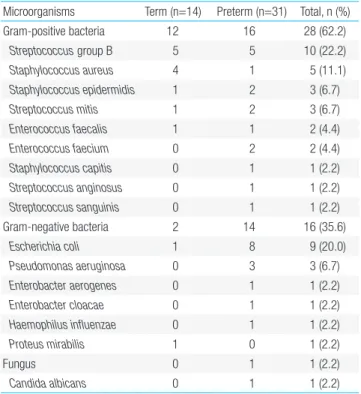
In a total of 45 subjects, the most common pathogen responsible for EOS was GBS in 10 cases (22.2%), followed by E. coli in 9 cases (20%). The rate of gram-positive sepsis was higher in term than in preterm infants (85.7% vs. 51.6%) (P<0.05). In contrast, the rate of gram-negative infection was higher in preterm than in term infants (45.2% vs. 14.3%) (P<0.05) (Table 1).
3. Mortality and time of death
The overall mortality within 14 days after the infection was 37.8
% (17 of 45). The number of deaths was the highest at 8 (47.1%) during the first 3 days after infection, 4 (23.5%) after 4–7 days, and 5 (29.4%) after 8–14 days (Table 2). Fulminant infections occurred in 7 cases (15.6%), and all were preterm infants. In detail, 3 cases oc- curred in patients with Pseudomonas aeruginosa and E. coli sep sis, respectively; the remaining 1 developed in infants with Staphyloco
ccus aureus sepsis.
4. Incidence of fatal infections by causative organisms
The rate of fatality in patients with P. aeruginosa, E. coli and GBS sepsis was 100%, 77.8%, and 10%, respectively. The overall rate of fatal infections in infants with gram-negative sepsis was 68.8%,
3,862 Newborn infants with blood culture tests
167 Infants with microbes detected in blood specimens
122 Infants with contaminants 45 Infants with true infections
17 Death 28 Survival