Journal of the Korean Institute of Industrial Engineers Vol. 31, No. 2, pp. 152-163, June 2005.
공급사슬 협업을 위한 참조모델 기반의 프레임워크
최영환†ㆍ채희권ㆍ김광수
포항공과대학교 산업공학과
A Reference Model Based Framework for Supply Chain Collaboration
Younghwan ChoiㆍHeekwon ChaeㆍKwangsoo Kim
Department of Industrial Engineering, Pohang University of Science and Technology, Pohang, 790-784 The focus of enterprise collaboration of supply chain management, has changed from integrating and exchanging business information to integrating and managing business processes between business partners. However, the collaboration is difficult due to the inherent complexity such as diverse business processes and dynamic business environments. To settle these problems, a reference model based enterprise architecture framework for the collaboration of supply chains is proposed in this paper. The supply chain collaboration framework is composed of three reference models capturing the different views of supply chain collaboration: supply process reference model, service component reference model, and technology and standard reference model. As the framework adapts the OMG’s metadata architecture, the processes in the supply chain can be extended and integrated with other value chains, such as design chains, when it is necessary. Using the proposed framework, business managers can rapidly integrate and manage their business processes with their suppliers and customers.
Keywords: supply chain management, collaboration, reference model, enterprise architecture framework, business process
본 연구는 한국과학재단 특정기초연구(R01-2003-000-10171-0) 지원으로 수행되었음.
†연락저자 : 최영환, 790-784, 경북 포항시 남구 효자동 포항공과대학교 산업공학과, Fax : 054-279-5998, E-mail : [email protected] 2004년 9월 접수; 2005년 1월 수정본 접수; 2005년 4월 게재 확정.
1. 서 론
비즈니스 환경이 끊임없이 변하고 다양한 고객의 요구를 만족 시키기 위하여 치열한 경쟁이 벌어지고 있는 시장에서 기업은 생존과 번영에 필요한 모든 활동을 직접 수행할 수 없다. 기업 들은 차별화되어 경쟁력이 있는 몇 가지 활동만을 선택하여 자사의 핵심역량으로서 모든 노력을 집중하고, 나머지 활동은 핵심역량을 보유한 다른 기업을 아웃소싱함으로써 시장에서 의 경쟁력을 강화시켜 왔다(Jagdev and Thoben, 2001). 그 결과 시장 경쟁력의 주체가 단일 기업으로부터 가치사슬(value chain)로 전이되었으며(Cadence, 2003; MESA, 2004), 이 가치 사슬은 확장기업과 가상기업이라는 네트워크 기반의 유연한 조직구조를 가진 기업형태를 발생시켰다(COSME, 2001).
대부분의 기업들은 주요 상품군에 대한 3~15개의 가치사슬
을 운영하고 있는데(Wolf, 2003), 그 중에서 물류업무를 지원 하는 공급사슬관리(supply chain management; SCM)는 일반 기 업의 경영활동 중에서 가장 핵심적으로 운영되는 가치사슬이 다(Kacandes, 2004; Harmon, 2003a). SCM은 기존의 물류관리 에 정보통신기술이 접목된 전자물류(e-Logistics)가 등장하여 물류생산성의 급격한 상승효과를 이미 경험하였으며, 현재 무 선통신기술의 발달에 따라 모바일 물류(m-Logistics)로 변화하 고 있고, 향후에는 유비쿼터스 네트워크와 접목되어 유비쿼터 스 물류(u-Logistics)로 발전할 전망이다(Kim, 2003).
이와 같이 물류업무의 일대 혁신을 이루고 새로운 비즈니스 모델을 통한 신개념의 서비스와 사용자 인터페이스를 제공하 기 위해서는, SCM을 비즈니스 파트너 사이에서 수행되는 하 나의 큰 활동-협업적 비즈니스 프로세스-으로 인식하고, SCM의 유통정보 인프라에 대한 변경, 기업의 기간 시스템의
공급사슬 협업을 위한 참조모델 기반의 프레임워크 153
변경, 프로세스의 수정, 개인 및 사회 각 집단의 패러다임 변화 등이 수반되어야 한다. 즉, SCM의 대상이 되는 조달물류 (upstream supply chain), 생산물류(internal supply chain), 판매물 류(downstream supply chain) 사이에서 물자, 정보, 자금의 흐름 을 효과적으로 관리하고 지원하는 다양한 시스템을 하나의 체 계적인 틀 안에서 효과적이고 신속하게 개발하고 관리해야만 한다.
최근 들어 비즈니스와 정보기술(Information Technology; IT) 의 밀접한 연관을 통하여 시장상황의 변화에 즉시 대응하기 위하여 효율적인 IT 아키텍처의 구현과 효과적인 투자를 목적 으로 하는 전사적 아키텍처(Enterprise Architecture; EA)가 기 업의 새로운 정보기술 패러다임으로 부상하고 있다. EA는 기 업의 정보전략을 위한 기본적인 기술 및 프로세스 구조를 제 공하며, EA 프레임워크는 특정 EA를 신속하게 개발할 수 있도 록 지원하는 도구의 역할을 한다. 기업의 다양한 비즈니스 프 로세스와 이를 지원하는 애플리케이션들의 개발 및 관리에 EA 프레임워크를 이용하게 되면 개발단계의 신속성과 실행 단계의 안정성을 보장할 수 있다(Bass and Mabry, 2004).
따라서 본 논문에서는 공급사슬에 참여하는 기업들 사이의 협업을 가능하게 하는 전사적 아키텍처의 수립을 위하여 공급 사슬 관리에 요구되는 비즈니스 프로세스를 중심으로 이를 구 현하는 애플리케이션과 지원기술에 대한 컴포넌트로 구성되 는 참조모델 기반의 EA 프레임워크를 제시한다.
본 논문은 다음과 같이 구성되어 있다. 2장에서는 공급사슬 관리를 위한 기존의 모델과 EA 프레임워크에 대한 연구들을 소개하고, 3장에서는 공급사슬 협업을 위한 프레임워크의 계 층구조 및 각 계층의 모델에 대하여 설명한다. 4장에서는 본 논문에서 제시된 프레임워크를 이용하여 공급사슬의 비즈니 스 프로세스를 모델링하고 공급사슬이 다른 가치사슬과 통합 되어 상호 운용되는 예를 소개한다.
2. 관련 연구
2.1 확장기업과 가상기업
급변하는 시장환경에 신속하게 대응하고 새로운 시장기회 를 선점하기 위하여 인터넷과 같은 네트워크를 가치사슬 내에 서의 정보교환을 위한 매개수단으로 이용하는 새로운 형태의 기업들이 나타나게 되었다. 이와 같은 추세는 두 가지 특수한 형태의 조직구조, 즉 확장기업과 가상기업이라는 유연한 조직 구조를 가진 기업으로 설명된다. 확장기업(extended enterprise) 은 고도로 계층화된 거대기업의 하부조직들이 top-down 방식 에 따라 가치사슬에서 요구하는 특정 활동을 수행하는 전담조 직으로 분리되어 가치사슬을 구성하는 형태의 조직구조를 가 진다. 이에 반하여 가상기업(virtual enterprise)은 특정 활동에 경쟁력을 보유한 단일기업들이 bottom-up 방식에 따라 하나의
가치사슬로 통합되는 형태의 조직구조를 가진다(COSME, 2001).
가치사슬의 특정한 목적을 달성하기 위해서는 이에 참여하 는 확장기업의 전담조직이나 가상기업의 단일기업들이 서로 협력하여 비즈니스 정보를 신속히 교환하고 비즈니스 활동을 원활히 수행할 수 있어야 한다. 이를 위해서는 가치사슬의 참 여자들이 가상의 기반 위에서 기업 내x외부에서 요구되는 비 즈니스 프로세스와 이를 지원하는 애플리케이션 및 기술들을 모델링하고 관리할 수 있는 단일화된 체계가 필요하다. Jagdev and Thoben(2001)은 기업들의 협업에 대한 연구에서 확장기업 이나 가상기업이란 기업들의 정보 시스템이 통합되어 비즈니 스 정보를 서로 통신하여 협력함으로써 하나의 기업망(enter- prise network)을 구성하는 새로운 패러다임이라고 정의하였다.
따라서 기업망의 모든 노드들은 동기화된 방식으로 운영되어 야 하며, 이의 실현을 위해서 정보통신기술(Information and Communication Technology; ICT)의 역할이 중요함을 강조하였 다. Gou et al.(2003)은 가상기업의 비즈니스 프로세스 통합을 위한 프레임워크를 소개하면서 가상기업의 통합을 위해서는 비즈니스 프로세스의 통합에 더불어 애플리케이션과 피지컬 시스템의 통합이 필요함을 언급하였으나 이에 대한 구체적인 내용은 제시하지 않았다.
2.2 공급사슬 참조모델
공급사슬 참조모델(Supply Chain Management Reference Model; SCOR)은 공급사슬 참여자들 사이에서 수행되는 비즈 니스 프로세스들에 대한 정의를 개념적인 틀(template)의 형태 로 표현한 참조모델이다. SCOR는 산업 전반에 공통적으로 적 용되는 SCM을 분석하고 공급사슬 참여자들 사이의 의사소통 을 향상시키기 위하여, SCM의 비즈니스 프로세스에 대한 정 의와 용어, 성과측정지표, best practice 등에 대한 표준을 제공 하고 있다(SCC, 2003).
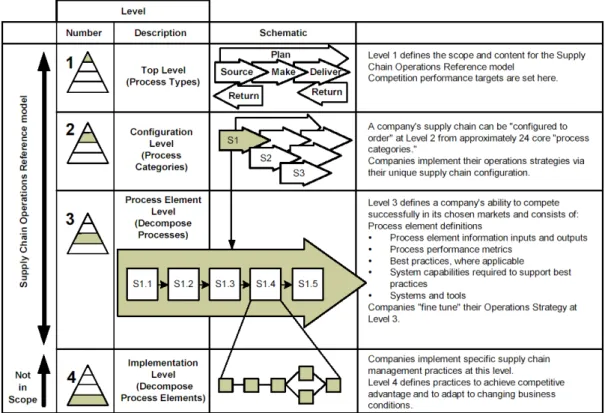
SCOR의 프로세스는 <Figure 1>과 같이 3개의 레벨로 구성 되어 있는데, 1레벨의 프로세스는 Plan, Source, Make, Deliver, Return 등 5개의 기본적인 프로세스 타입이며, 2레벨은 비즈니 스 시나리오에 따른 프로세스 타입의 변형, 그리고 3레벨은 각 각의 변형된 프로세스 타입에 대한 하위 프로세스로 표현된다.
4레벨 이후의 하위 프로세스들은 SCOR에서 규정하는 범위를 벗어난다.
SCM이라는 특정 도메인 내에서, 비즈니스 프로세스를 직접 수행하는 관리자에 의하여, 급변하는 비즈니스 환경에 요구되 는 새로운 비즈니스 프로세스를 신속하게 개발하는 것을 지원 한다는 점에 SCOR의 큰 장점이 있지만(Harmon, 2003b), 기업 조직 전반에 걸친 모델 개발의 어려움, 분석도구의 부족, 도출 된 문제점의 해결을 위한 프로젝트 연계도구의 미비 등은 SCOR 적용의 한계를 보여준다(Recker and Bolstorff, 2003).
Swartwood(2003)는 SCOR의 비즈니스 프로세스 참조모델을
154 Younghwan ChoiㆍHeekwon ChaeㆍKwangsoo Kim
Figure 1. The structure of the SCOR.
이용하여 공급사슬의 문제점과 개선점을 도출한 후 이를 다른 비즈니스 프로세스의 개선활동, 즉 Lean manufacturing과 Six- Sigma로 연계시키는 방안에 대하여 제안하였다.
2.3 EA 프레임워크
전사적 아키텍처(EA)는 기업의 업무 및 관리 프로세스와 IT 사이의 현재 및 목표 관계에 대한 명확한 설명과 문서(OMB, 2000)로서 정보전략을 위한 기본적인 기술 및 프로세스 구조 를 제공한다(The Open Group, 2002). 일반적으로 EA는 비즈니 스, 애플리케이션, 기술 및 표준, 데이터가 서로 독립적으로 분 리되어 있는 아키텍처들의 집합이며, 특히 비즈니스 주도형 EA는 비즈니스 관점에서 기업의 정보기술 아키텍처를 구성함 으로써 서비스 주도형 구조(Service Oriented Architecture; SOA) 를 구현할 수 있는 기본 환경을 제공한다(Bass and Mabry, 2004).
EA 프레임워크는 특정 도메인의 특수한 목적을 위한 EA들 을 신속하게 개발하는 것을 지원하는 도구로서, 정보를 조직 화하고 공유하여 고객의 요구에 빠르고 정확하게 대응하는 것 을 목적으로 한다(The CIO Council, 1999). EA 프레임워크 중 가장 대표적인 것은 Zachman Framework(Sowa and Zachman, 1992; Zachman, 1996; Zachman, 2003)이며, 산출물 위주의 DoD AF (Department of Defense Architecture Framework) (DoDAFWG, 2003), 참조모델 중심의 FEAF(Federal Enterprise Archi- tecture Framework)(The CIO Council,1999), 소프트웨어 개발을 지원하는 TOGAF(The Open Group Architecture
Framework)(The Open Group, 2002) 등이 있다.
EA 프레임워크는 기업의 구성요소를 모델링하는 목적에 따 라 다양한 기준(dimension)에 의거하여 개발된다. Zachman Framework에서는 기업의 구성요소를 바라보는 사람의 시각 (perspective)과 모델링의 대상이 되는 관점(view)을 기준으로 각 셀에 해당되는 모델을 제시하고 있다. 또한 각 기준에서 필 요한 일부 항목만을 선택하여 기업모델을 표현하거나, 이를 확장시켜 범위(scope) 또는 추상화(abstraction)와 같은 새로운 기준을 추가하여 기업의 구성요소를 모델링할 수 있다. 다른 EA 프레임워크들도 각각 고유한 모델링 기준들에 의거한 프 레임워크를 제시하고 있다.
본 논문에서는 공급사슬이라는 도메인을 대상으로 가치사 슬에 참여하는 확장기업과 가상기업이 자신들의 고유한 비즈 니스 프로세스를 통합시키고 이를 실행하는 애플리케이션을 신속히 개발하기 위한 참조모델 기반의 새로운 프레임워크를 제시한다.
3. 공급사슬 협업 프레임워크
3.1 프레임워크의 개요
공급사슬에 참여하는 기업들은 거래업체의 비즈니스 프로 세스가 자사의 비즈니스 프로세스와 일치해 주기를 바란다.
비즈니스 프로세스를 일련의 업무들을 순차적으로 수행하는
A Reference Model Based Framework for Supply Chain Collaboration 155
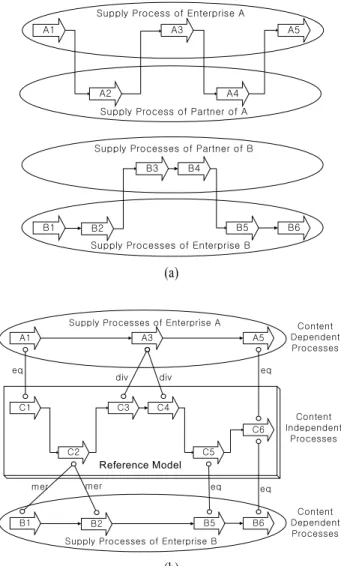
것으로 정의할 경우, 기업들은 자사의 업무가 거래업체의 업 무와 일치해 주기를 원한다. 그러나 각 기업은 여러 가지 상황 에 따라 기업 고유의 다양한 비즈니스 프로세스를 운영하고 있으므로, 이의 구현은 현실적으로 매우 어려운 문제이다. 예 를 들어, <Figure 2>의 (a)와 같이 A업체는 공급 프로세스를 수 행하는 과정에서 업무(activity) A1, A3, A5에 대하여 거래업체 가 A2, A4의 업무를 수행해 주기를 기대한다. 이에 반하여 B업 체는 업무 B1, B2, B5, B6에 대하여 거래업체가 B3, B4의 업무 를 수행해 주기를 기대한다.
이와 같이 서로의 업무수행에 대한 기대가 다른 상황에서 두 기업이 상응하는 비즈니스 프로세스를 통합해 비즈니스 수 행에 필요한 정보를 공유하기 위해서는 별도의 복잡한 데이터 매핑 과정을 거쳐야만 한다. 또한 공급사슬에는 불특정 다수 의 기업이 참여할 수 있으므로, 이와 같은 문제는 공급사슬에 참여하는 기업의 수가 증가함에 따라 비즈니스 프로세스의 통 합에 심각한 문제를 발생시킨다.
이 문제를 해결하기 위하여 본 논문에서는 공급사슬 협업에 요구되는 비즈니스 프로세스들을 구성하는 요소들 중에서 공 통적으로 활용할 수 있는 단위 프로세스들을 참조모델의 형태 로 미리 정의해 줌으로써, 각 기업의 개별 프로세스들을 매핑 할 수 있는 공급사슬 협업을 위한 프레임워크(Supply Chain Collaboration Framework; SCCF)를 제안한다. 공급사슬에 참여 하는 기업들은 자사의 비즈니스 프로세스를 SCCF의 프로세 스 참조모델에 매핑시켜 거래업체의 비즈니스 프로세스와 통 합시킬 수 있다.
예를 들어, <Figure 2>의 (b)와 같이 A업체는 업무 A3를 C3 와 C4라는 두 가지 업무로 나눌 수 있고, B업체는 업무 B1과 B2를 C2라는 하나의 업무로 병합할 수 있다. 이 과정은 업무 담당자들의 단순한 프로세스 매핑으로 가능하므로 급변하는 비즈니스 환경의 변화에 따라 비즈니스 프로세스를 신속히 개 발 및 변경시킬 수 있다는 장점이 있다.
본 논문에서 제시하는 프레임워크인 SCCF는 두 가지 기준 에 의한 기업 모델링 방식을 채택하였다. 우선 Zachman Frame- work의 관점(view)에 해당되는 기업모델의 대상으로서 비즈 니스, 애플리케이션, 기술항목에 대하여 각각 공급 프로세스 참조모델(Supply Process Reference Model; SPRM), 서비스 컴 포넌트 참조모델(Service Component Reference Model; SCRM), 기술 및 표준 참조모델(Technology and Standard Reference Model; TSRM)의 3가지 참조모델을 제시하고 있다.
일반적인 EA 프레임워크와 비교하여 볼 때 데이터 항목은 비즈니스와 애플리케이션에 포함되어 있다. 이와 같은 관점은 DoD AF(DoDAFWG,2003)의 3가지 관점들과 유사한 관계를 가지고 있으나, SCCF는 산출물(product) 그 자체보다는 산출 물을 작성하기 위하여 기업의 구성요소를 모델링하는 과정에 서 비교 및 참고하는 참조모델의 구성에 중점을 두고 있다.
SCCF에서 제시하는 3가지 참조모델 사이의 상호관계는
<Figure 3>에 나타나 있다.
A2 A4
B1 B2 B5 B6
A1 A5
B3 B4
A3
Supply Process of Enterprise A
Supply Process of Partner of A
Supply Processes of Enterprise B Supply Processes of Partner of B
(a)
Reference Model
C1 C3 C4
C2 C5
B1 B2 B5 B6
A1 A3 A5
C6
Supply Processes of Enterprise B
Supply Processes of Enterprise A Content
Dependent Processes
Content Independent
Processes
Content Dependent
Processes
eq eq
eq
div div
mer mer eq
(b)
Figure 2. The supply process collaboration between enterprise.
다른 하나의 SCCF 모델링 기준은 모델 주도형 구조(Model Driven Architecture; MDA)(OMG, 2002)를 따른 추상화이다.
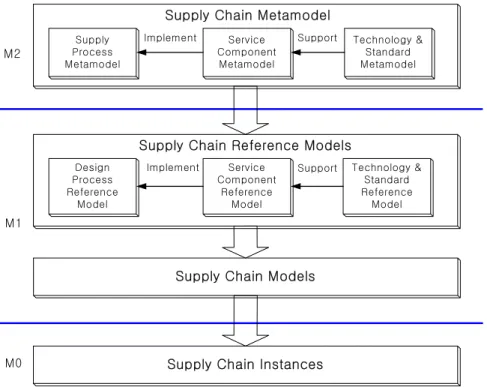
즉, OMG의 메타데이터 아키텍처에 맞추어 공급사슬에 대한 기업모델을 다수의 계층별 구조로 구성하였으며, 하위계층의 모델은 상위계층의 모델을 기반으로 생성되는 방식을 취하고 있다. 상위계층(M2)은 공급사슬 모델의 메타모델을 포함하고 있는데, 이는 공급사슬 모델을 표현하는 클래스(class), 속성 (attribute), 클래스 사이의 관계에 대한 정보를 명시함으로써 모델의 확장방법을 규정하고, 적합성(well-formedness)을 검증 하거나, 다른 가치사슬에 있는 모델들과 의미적 매핑(semantic mapping)을 하는 데 사용된다. 중간계층(M1)은 공급사슬 모델 의 참조모델과 이를 사용하여 기업의 공급 프로세스를 표현한 모델을 포함하고 있다. 하위계층(M0)은 기업에서 실제 수행되 는 공급 프로세스의 인스턴스를 포함한다.
공급사슬 협업을 위한 참조모델 기반의 프레임워크는
<Figure 4>와 같이 공급 프로세스를 중심으로 하고, 이를 구현
156 최영환ㆍ채희권ㆍ김광수
Figure 3. The relationships between reference models.
SPRM
Captures supply processes of enterprises for the collaboration of supply chain management
SCRM TSRM
Describes service components implementing the supply processes
Specifies technologies and standards supporting the service components
• Service package/node that implements required process
• Functionality
• Role of participant
• Required information exchange
• Enabling technology
• Technical standards for interoperable implementation or procurement
• Technical basis that supports service package
• Operational requirements and capabilities
Figure 4. The supply chain collaboration framework.
M1 M2
Supply Chain Metamodel
Supply Process Metamodel
Service Component
Metamodel
Supply Chain Reference Models
Design Process Reference
Model
Service Component
Reference Model Implement
Implement
Technology &
Standard Metamodel Support
Technology &
Standard Reference
Model Support
M0
Supply Chain Models
Supply Chain Instances 하는 데 사용되는 서비스 컴포넌트, 그리고 서비스 컴포넌트
를 지원하는 기술 및 표준에 대한 모델링 요소들이 추상화 정 도에 따른 3가지 계층구조로 구성되어 있다.
3.2 SCCF 메타모델
메타모델(metamodel)은 ‘모델의 모델’로 볼 수 있으며, 시스 템을 구성하는 객체들의 핵심적인 요소, 표현방법(syntax), 모 델의 구조 등을 정의한 모델이다(Poole, 2001). 메타모델은 메 타데이터의 교환을 위한 기술과 미들웨어에 대하여 독립적이 므로, 분산처리환경에서 모델링 언어를 구성하는 요소들에 대 한 매핑을 통함으로써 도구, 데이터 저장소, 애플리케이션의
상호운영성을 지원해 준다. 메타모델의 예로서 각종 프로그래 밍 언어들과 UML 프로파일들이 있으며, 특히 비즈니스 프로 세스의 모델링에는 OMG EDOC(Enterprise Distributed Object Computing)이 대표적인 메타모델이다.
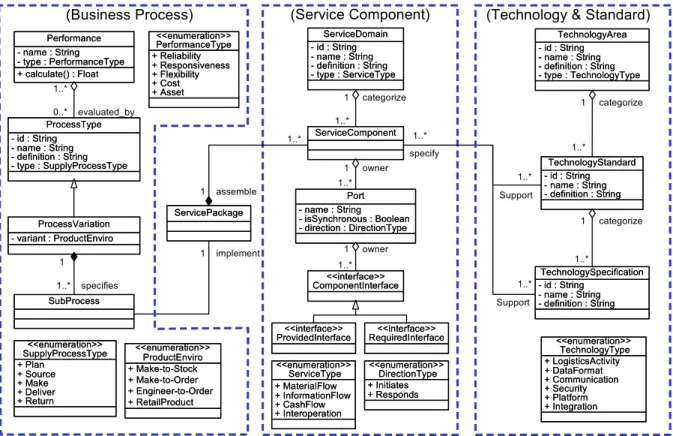
SCCF의 상위계층(M2)에 포함된 메타모델은 공급사슬 참조 모델의 표현에 사용되는 개념과 개념 사이의 관계에 대하여 명시하고 있으며, <Figure 5>와 같이 공급사슬의 3가지 관점 각각에 대한 서브모델 및 서브모델 사이의 관계를 표현하는 요소로 구성되어 있다. 예를 들어, 클래스 ProcessType은 id, name, definition, type 속성이 문자열로 표현되어야 하며, type 속성은 SupplyProcessType에 나열되어 있는 문자열 중에서 하 나를 선택해야 함을 명시한다. 클래스 ServiceComponent는 다
공급사슬 협업을 위한 참조모델 기반의 프레임워크 157
Figure 5. The supply chain metamodel.
+ calculate() : Float - name : String - type : PerformanceType
Performance
+ calculate() : Float - name : String - type : PerformanceType
Performance
- id : String - name : String - definition : String - type : SupplyProcessType
ProcessType - id : String - name : String - definition : String - type : SupplyProcessType
ProcessType
- variant : ProductEnviro ProcessVariation - variant : ProductEnviro
ProcessVariation
SubProcess SubProcess
ServicePackage ServicePackage
- id : String - name : String - definition : String - type : ServiceType
ServiceDomain - id : String - name : String - definition : String - type : ServiceType
ServiceDomain
ServiceComponent ServiceComponent
- name : String - isSynchronous : Boolean - direction : DirectionType
Port - name : String - isSynchronous : Boolean - direction : DirectionType
Port
<<interface>>
ComponentInterface<<interface>>
ComponentInterface
<<interface>>
ProvidedInterface<<interface>>
ProvidedInterface <<interface>>
RequiredInterface<<interface>>
RequiredInterface
- id : String - name : String - definition : String - type : TechnologyType
TechnologyArea - id : String - name : String - definition : String - type : TechnologyType
TechnologyArea
- id : String - name : String - definition : String
TechnologyStandard - id : String - name : String - definition : String
TechnologyStandard
- id : String - name : String - definition : String
TechnologySpecification - id : String
- name : String - definition : String
TechnologySpecification 1 categorize
1..*
1 categorize
1..*
+ Reliability + Responsiveness + Flexibility + Cost + Asset
<<enumeration>>
PerformanceType + Reliability + Responsiveness + Flexibility + Cost + Asset
<<enumeration>>
PerformanceType
+ Plan + Source + Make + Deliver + Return
<<enumeration>>
SupplyProcessType + Plan
+ Source + Make + Deliver + Return
<<enumeration>>
SupplyProcessType
+ Make-to-Stock + Make-to-Order + Engineer-to-Order + RetailProduct
<<enumeration>>
ProductEnviro + Make-to-Stock + Make-to-Order + Engineer-to-Order + RetailProduct
<<enumeration>>
ProductEnviro
+ MaterialFlow + InformationFlow + CashFlow + Interoperation
<<enumeration>>
ServiceType + MaterialFlow + InformationFlow + CashFlow + Interoperation
<<enumeration>>
ServiceType
+ Initiates + Responds
<<enumeration>>
DirectionType + Initiates + Responds
<<enumeration>>
DirectionType
+ LogisticsActivity + DataFormat + Communication + Security + Platform + Integration
<<enumeration>>
TechnologyType + LogisticsActivity + DataFormat + Communication + Security + Platform + Integration
<<enumeration>>
TechnologyType 0..* evaluated_by
1..*
1
1..* specifies
1 implement 1 assemble
1..*
1 categorize 1..*
1 owner 1..*
1 owner 1..*
Support specify
1..*
1..*
(Business Process) (Service Component) (Technology & Standard)
Support 1..*
른 서비스 컴포넌트와 메시지를 교환하기 위하여 Port라는 클 래스를 소유하고, 클래스 Port는 교환되는 메시지의 형식을 지 정하기 위하여 ComponentInterfac라는 클래스를 소유함을 명 시한다.
이와 같이 메타모델에 명시된 모델 요소들에 대한 정보를 이용하여 공급사슬의 모델 요소들과 다른 가치사슬의 모델 요 소들을 매핑시키면 기업 내․외부에서 운영되는 여러 가치사 슬의 모델들이 하나의 프레임워크를 기반으로 통합될 수 있다.
따라서 메타모델은 새로운 시장기회가 주어졌을 경우에 기업 의 비즈니스 프로세스의 개발 또는 변경을 신속히 수행할 수 있는 기본정보를 제공함으로써 급변하는 시장환경에 대응할 수 있는 기업의 경쟁력 향상에 중요한 역할을 한다.
3.3 SCCF 참조모델
기존의 비즈니스 프로세스 모델링은 모든 도메인에 적용하 기 위하여 일반적인 모델링 기법을 이용하고 프로세스 전문가 에 의하여 밑그림부터 새로이 시작하는 방법론으로서 ‘1세대 방법론’으로 볼 수 있다. 이에 반하여 프레임워크 기반의 비즈 니스 프로세스 모델링은 특정 도메인에 대하여 프로세스 관리 자가 미리 정의되어 있는 프로세스 요소와 평가측정기준, best practice를 명시한 참조모델을 이용하여 비즈니스 프로세스 모 델링에 이용하는 방법론으로서 ‘2세대 방법론’으로 볼 수 있 다. 참조모델을 이용한 방법론은 IT 전문지식이 부족한 비즈니
스 관리자들도 간단히 자신의 비즈니스 프로세스를 모델링하 고, 평가하여 개선함으로써 급변하는 비즈니스 환경에 신속하 게 대처할 수 있는 혁신적이면서도 새로운 비즈니스 프로세스 모델링 방법론이다(Harmon, 2003b). 본 논문에서는 2세대 방 법론을 적용하여 공급사슬 협업을 위한 프레임워크를 구성하 는 참조모델들을 제시하고 있다. SCCF의 중간계층(M1)에는 공급사슬의 3가지 관점에 대한 참조모델로서 공급 프로세스 참조모델(SPRM), 서비스 컴포넌트 참조모델(SCRM), 기술 및 표준 참조모델(TSRM)이 포함되어 있다.
SPRM은 공급사슬에 참여하는 기업들이 협력하여 수행하고 자 하는 공급 프로세스에 대한 템플릿을 제시하는데, 본 논문 에서 제시하는 프레임워크에서는 공급사슬 운영에 대한 국제 표준인 SCOR에서 제시한 3단계의 프로세스 계층구조를 적용 하였다(<Figure 1>).
서비스 컴포넌트는 단위활동을 수행하는 소프트웨어 컴포 넌트의 클래스이며, 다른 서비스 컴포넌트와 조합함으로써 SPRM 레벨 3의 프로세스에 명시된 활동을 구현하는 서비스 패키지를 구성한다. 서비스 컴포넌트는 재사용성을 위하여 SPRM에 대하여 독립적이며, 입력 메시지와 출력 메시지에 의 하여 서로 다른 인스턴스들을 가진다.
단위활동(atomic activity)은 활동(activity)에 대한 개념이 명 사(noun)와 동사(verb)로 구성되었을 때 동사에 해당되는 부분 이다. 예를 들어, SCOR에 나타나 있는 aggregate_demand, aggregate_product_requirements, aggregate_production_resources,
158 Younghwan ChoiㆍHeekwon ChaeㆍKwangsoo Kim
Figure 6. A relationship between SPRM and SCRM.
Quality & Delivery Performance :Evaluate
S3.2 : SelectFinalSuppliers&Negotiate Service Package
Service Components (SCRM Level 2)
:Decide
:Negotiate :Receive
Agreed Cost Quality & Delivery Data of Suppliers
Procurement Signal (Supplier)
Supplier Agreement ETO
Proposal (Supplier) Sourcing Review
Capability Data of Supplier
:Explore
:Decompose
Estimated Cost :Select
:Request
Identification of Source of Supplier
Selected Suppliers S3.2
Select Final Supplier(s) and Negotiate
- Procurement signal - Supplier agreement - Sourcing review - ETO proposal
implements
aggregate_delivery_requirements와 같이 다양한 활동들은 aggregate라는 단위활동에 대한 동사를 포함한다. 즉, 단위활동 은 입․출력 메시지가 다른 다양한 활동들을 표현하는 데 재 사용될 수 있도록 일반화된 활동을 의미한다.
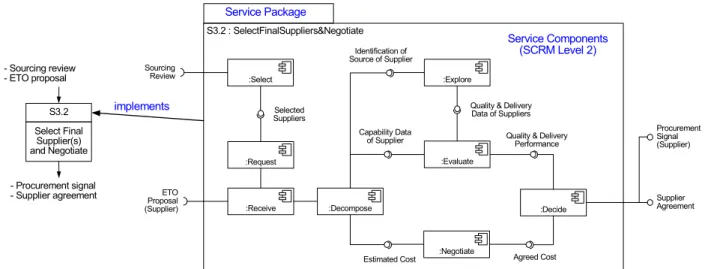
SCRM은 SCOR 명세서에 나타난 제반 활동들을 분석한 후 단위활동들을 추출하고 그룹핑하여 다음의 <Table 1>과 같은 두 개의 단계로 구성되었다. SCRM 레벨 1은 서비스 도메인을 나타내는데, 공급사슬의 물자흐름, 정보흐름, 자금흐름과 세 가 지 흐름 사이의 상호작용에 대한 4가지 서비스 도메인으로 구 분되어 있다. SCRM 레벨 2는 단위활동들을 명시하고 있으며, 이 단위활동에 대한 서비스 컴포넌트의 인스턴스들이 조합되 어 하나의 서비스 패키지를 구성하게 된다. <Table 1>에서 단 위활동에 대한 “>” 표시는 특수화(specialization)을 의미한다.
Table 1. A portion of service component reference model
Level 1 Level 2
Material Flow
Assort, Calibrate, Consume, Dispose, Install, Isolate, Launch, Load, Maintain, Monitor, Package, Pick, Procure, Produce>Manufacture, Recall, Recover, Remove, Repair, Rework, Replenish, Reserve, Route, Scrap, Stage, Stock
Information Flow
Approve, Assess, Claim, Collect>Aggregate, Configure, Control>Adjust>Balance, Document, Establish, Estimate>Calculate, Forecast, Identify, Invoice, Issue, Measure, Prioritize, Project, Rate, Schedule, Verify>Validate, Update, Warrant Cash Flow Credit, Merchandise, Pay, Promote
Inter- operation
Align, Commit, Contract, Exchange, Negotiate, Order, Quote, Purchase>Import, Release, Respond, Sell>Export, Transfer>Transport
서비스 패키지(service package)는 SPRM 레벨 3의 서브프로
세스를 구현하는 소프트웨어의 추상화된 표현으로서 MDA (OMG, 2002)의 플랫폼 독립적 모델(Platform Independent Model;
PIM) 또는 플랫폼 명시적 모델(Platform Specific Model; PSM) 에 해당된다. 만약 비즈니스 프로세스의 구현 플랫폼으로서 웹 서비스를 고려한다면, WSDL(W3C, 2001)은 서비스 컴포넌 트에 해당되고 BPEL4WS(Andrews et al., 2003)은 서비스 패키 지에 해당되는 것으로 볼 수 있다. SCOR의 레벨 3 서브프로세 스를 구성하는 S3.2(select final suppliers and negotiate)에 대한 서비스 패키지의 예가 <Figure 6>에 나타나 있다.
레지스트리에 저장되어 있는 서비스 컴포넌트들을 검색 및 조합함으로써 새로운 서비스 패키지를 생성하는 방식은 소프 트웨어 개발능력이 부족한 일반 관리자들도 비즈니스 프로세 스를 수행하기 위한 실용적이고 완성도 높은 애플리케이션을 구현할 수 있도록 지원함으로써 시장환경의 변화에 신속한 대 응을 가능하게 한다.
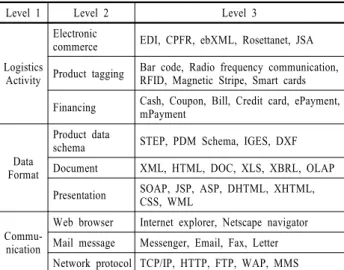
TSRM은 SCOR의 best practice에 제시된 내용들을 분석하여 SCRM에 명시된 서비스 컴포넌트의 구현이 가능하도록 지원 하는 기술 및 표준에 대한 항목들을 애플리케이션에 독립적인 컴포넌트 형태로 분류한 taxonomy이다. TSRM은 <Table 2>에 나타난 바와 같이 3개의 층으로 구성되어 있는데, TSRM 레벨 1에는 물류활동, 데이터 형식, 통신, 보안, 플랫폼, 통합과 같은 6가지 기술영역(technology area)이 구분되어 있다. TSRM 레벨 2에는 널리 알려져 있는 기술표준(technology standard)에 대한 항목들이 포함되어 있으며, TSRM 레벨 3에는 서비스 컴포넌 트를 개발하는 데 요구되는 기술명세(technology specification) 에 대한 항목들이 포함되어 있다.
제안된 프레임워크에서는 TSRM의 기술항목이 지원하는 SCRM의 서비스 컴포넌트에 대한 명시적인 관계정보를 관리 함으로써 SCRM과 TSRM 사이의 관계를 표현하고 있다.
<Figure 6>에 나타나 있는 SCOR S3.2의 서비스 패키지를 구성 하는 서비스 컴포넌트들과 이들을 지원하는 TSRM 기술항목 사이의 관계에 대한 예가 <Figure 7>에 나타나 있다.
A Reference Model Based Framework for Supply Chain Collaboration 159
Figure 7. A relationship between SCRM and TSRM.
Financing Product
schema
Electronic commerce
Quality management
Database
Optimization Knowledge/Rule
managem ent SCRM Level 2
Evaluate Select
Decompose
Request
Receive
Negotiate Explore
Decide
TSRM Level 2
Network type
Table 2. A portion of technology and standard reference model
Level 1 Level 2 Level 3
Logistics Activity
Electronic
commerce EDI, CPFR, ebXML, Rosettanet, JSA Product tagging Bar code, Radio frequency communication,
RFID, Magnetic Stripe, Smart cards Financing Cash, Coupon, Bill, Credit card, ePayment,
mPayment
Data Format
Product data
schema STEP, PDM Schema, IGES, DXF Document XML, HTML, DOC, XLS, XBRL, OLAP Presentation SOAP, JSP, ASP, DHTML, XHTML,
CSS, WML
Commu- nication
Web browser Internet explorer, Netscape navigator Mail message Messenger, Email, Fax, Letter Network protocol TCP/IP, HTTP, FTP, WAP, MMS
4. 공급사슬 모델 및 확장
4.1 공급사슬 모델
앞에서 설명된 3가지 참조모델과 더불어 SCCF의 중간계층 (M1)에는 공급사슬의 운영을 위한 공급사슬 모델이 포함되는 데, 공급사슬 모델은 참여하는 모든 기업들의 공급 프로세스 와 이를 구현한 애플리케이션, 그리고 이의 구현을 지원하는 기술을 표현한다. 프레임워크에서 미리 정의된 참조모델을 재 사용 가능한 프로세스 템플릿으로 활용함으로써 비즈니스 프 로세스 관리자들은 간단한 선택작업만으로 공급사슬 모델을 신속히 구성할 수 있다.
공급사슬의 운영을 위한 비즈니스 프로세스, 서비스 컴포넌 트, 기술 및 표준항목들이 결정되어 공급사슬 모델이 완성된 후에 실질적인 공급사슬의 운영은 공급사슬 모델에 대한 인스 턴스에 의하여 수행된다. 즉, 비즈니스 프로세스를 구성하는
서비스 패키지들은 BPEL4WS와 같은 실행 가능한 모델로 변 환되어 웹 애플리케이션 서버(WAS)에서 인스턴스화되어 실 행될 수 있다. 특히 공급사슬에 특화된 관리 시스템은 공급사 슬 모델의 실행기능에 더불어 실행결과에 대한 평가측정 기준 별 성능 측정치들을 수집 및 분석하여 프로세스의 개선을 위 한 다양한 정보를 제공해 줄 수 있다. 공급사슬의 운영을 위한 시스템 개발에는 모델의 구성 이외에도 트랜잭션 처리, 모니 터링/측정/분석, 보안관리 등과 같은 다양한 기능이 요구되지 만 이들은 본 논문의 범위를 벗어난다.
4.2 공급사슬 모델의 확장
기업이 운영하는 중요한 가치사슬로는 공급사슬(supply chain), 설계사슬(design chain), 고객사슬(customer chain) 등이 있으며, 이들은 독립적으로 운영되지 않고 다른 가치사슬과 서로 영향을 주고받기 때문에 궁극적으로는 하나의 틀 안에서 통합되어야 한다(Harmon, 2003b). 따라서 본 논문에서는 공급 사슬 모델과 설계사슬 모델의 통합을 시도함으로써 다른 가치 사슬로의 확장 및 통합의 가능성을 제시한다.
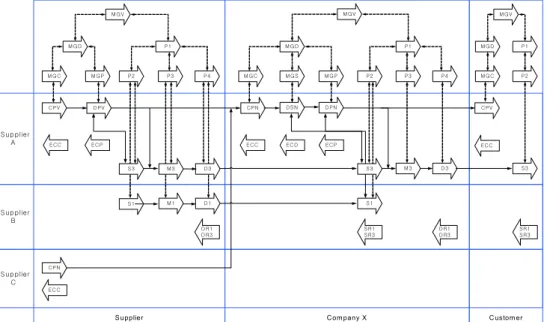
<Figure 8>은 X기업의 공급사슬 일부를 SCOR의 레벨 2 프 로세스에 대한 스레드 다이어그램으로 표현한 것이며, <Figure 9>는 SCCF와 동일한 방법으로 설계사슬을 위한 프레임워크 (Choi, 2005)를 만든 후에, 이에 의거하여 X기업의 설계사슬 일 부를 레벨 2 프로세스에 대한 쓰레드 다이어그램으로 표현한 것이다. 각각의 쓰레드 다이어그램은 비교적 간단한 구조로 표현되지만 두 쓰레드 다이어그램이 하나로 통합될 경우는
<Figure 10>과 같이 매우 복잡한 구조로 표현된다.
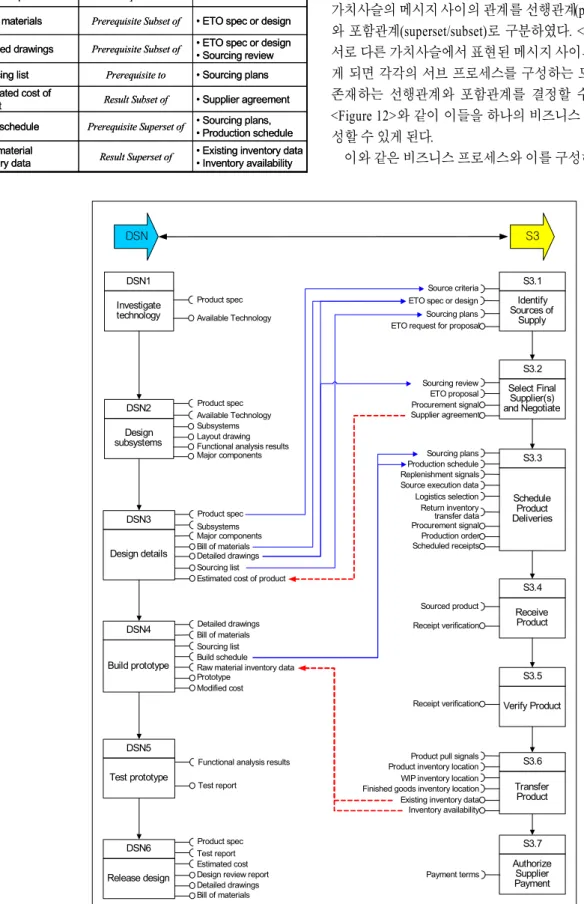
<Figure 10>의 DSN(design new product)과 S3(source engineer- to-order product)에 대하여 프로세스 참조모델의 레벨 3에서 통 합되어야 할 공급사슬과 설계사슬의 예를 <Figure 11>에 나타 내었다.
160 최영환ㆍ채희권ㆍ김광수
Figure 8. A thread diagram for supply chain.
Supplier Supplier
B Supplier A
Company X Customer
SR1 SR3 DR1 DR3 SR1
SR3 DR1 DR3
P2 P1
P3 P4
P1
P2 P3 P4
P1
P2
M3 D3 S3
S1 D1
S3 M3 D3
S1 M1
S3
Figure 10. A thread diagram for supply and design chain.
Supplier S up plier
B S up plier A
Com pany X D PN
C ustom er
C P V D P V D S N
M 3 D 3 M 3 S 3
M 1 D 1
EC P EC D EC C EC C
SR 1 SR 3 D R1
D R3 S R1
S R3 D R 1
D R 3
M G C M G S M G P
M G D
M G C M G P
M G D
P 2 P 1
P 3 P 4
P 1
C PV
EC C M G C M G D
S 1 C P N
EC P
S 1
P 2 P 3 P 4
P 1
S 3
P 2
S 3 D 3
M G V M G V
M G V
S up plier C
C P N
EC C
Figure 11. The level 3 subprocesses of supply and design chain.
DSN1 Investigate technology
DSN2 Design subsystems
DSN3 Design details
DSN4 Build prototype
DSN5 Test prototype
DSN6 Release
design
- Subsystems - Layout drawing - Functional analysis results - Major components - Product spec - Available technology
- Available technology - Product spec
- Detailed drawings - Bill of materials - Sourcing list - Estimated cost of product - Product spec - Subsystems - Major components
- Prototype - Modified cost - Detailed drawings - Bill of materials - Sourcing list - Build schedule - Raw material inventory data
- Test report - Functional analysis results
- Design review report - Detailed drawings - Bill of materials
- Product spec - Test report - Estimated cost
DSN : Design New Product
DSN1 Investigate technology
DSN2 Design subsystems
DSN3 Design details
DSN4 Build prototype
DSN5 Test prototype
DSN6 Release
design
- Subsystems - Layout drawing - Functional analysis results - Major components - Product spec - Available technology
- Available technology - Product spec
- Detailed drawings - Bill of materials - Sourcing list - Estimated cost of product - Product spec - Subsystems - Major components
- Prototype - Modified cost - Detailed drawings - Bill of materials - Sourcing list - Build schedule - Raw material inventory data
- Test report - Functional analysis results
- Design review report - Detailed drawings - Bill of materials
- Product spec - Test report - Estimated cost
DSN : Design New Product
S3.1 Identify Sources of
Supply
S3.2 Select Final Supplier(s) and Negotiate
S3.3 Schedule
Product Deliveries
S3.4 Receive Product
S3.5 Verify Product
S3.6 Transfer Product
- Procurement signal - Supplier agreement - Sourcing review - ETO proposal
- ETO request for proposal - Sourcing plans - ETO spec or design - Source criteria
- Procurement signal - Production order - Scheduled receipts - Sourcing plans - Production schedule - Replenishment signals - Source execution data - Logistics selection - Return inventory transfer data
- Receipt verification - Sourced product
- Receipt verification - Existing inventory data - Inventory availability
- Product pull signals - Product inventory location - W IP inventory location - Finished goods inventory location
S3.7 Authorize
Supplier Payment
S3 : Source Engineer-to-Order Product
S3.1 Identify Sources of
Supply
S3.2 Select Final Supplier(s) and Negotiate
S3.3 Schedule
Product Deliveries
S3.4 Receive Product
S3.5 Verify Product
S3.6 Transfer Product
- Procurement signal - Supplier agreement - Sourcing review - ETO proposal
- ETO request for proposal - Sourcing plans - ETO spec or design - Source criteria
- Procurement signal - Production order - Scheduled receipts - Sourcing plans - Production schedule - Replenishment signals - Source execution data - Logistics selection - Return inventory transfer data
- Receipt verification - Sourced product
- Receipt verification - Existing inventory data - Inventory availability
- Product pull signals - Product inventory location - W IP inventory location - Finished goods inventory location
S3.7 Authorize
Supplier Payment
S3 : Source Engineer-to-Order Product S3
DSN
Figure 9. A thread diagram for design chain.
Supplier Supplier
A
Company X DPN
Customer
CPV DPV DSN
ECP ECD ECC ECC
MGC MGS MGP
MGD
MGC MGP
MGD
CPV
ECC MGC MGD
CPN
ECP
Supplier C
CPN
ECC
공급사슬 협업을 위한 참조모델 기반의 프레임워크 161
Figure 12. An integrated subprocess.
S3.1 Identify Sources of
Supply
S3.2 Select Final
Supplier(s) and Negotiate
S3.3
Schedule Product Deliveries
S3.4 Receive Product
S3.5 Verify Product
S3.6 Transfer
Product
S3.7 Authorize
Supplier Payment DSN
DSN1 Investigate technology
DSN2 Design subsystems
DSN3 Design details
DSN4 Build prototype
DSN5 Test prototype
DSN6 Release design
Product spec
Available Technology Product spec Available Technology
Subsystems Layout drawing Functional analysis results Major components
Subsystems Product spec
Major components Detailed drawings Bill of materials
Sourcing list Estimated cost of product
Bill of materials Detailed drawings
Sourcing list Build schedule Prototype Modified cost
Raw material inventory data
Functional analysis results
Test report
Test report Product spec
Estimated cost Design review report Detailed drawings Bill of materials
Sourcing plans ETO spec or design Source criteria
ETO request for proposal
Sourcing review ETO proposal Procurement signal Supplier agreement
Logistics selection Return inventory transfer data Procurement signal Production order Replenishment signals Source execution data Sourcing plans Production schedule
Scheduled receipts
Sourced product Receipt verification
Receipt verification
WIP inventory location Finished goods inventory location Existing inventory data Inventory availability Product pull signals Product inventory location
Payment terms
S3
Table 3. Terminology mapping between processes
• Sourcing plans Prerequisite to
• Sourcing list
• Supplier agreement Result Subset of
• Estimated cost of product
• Sourcing plans,
• Production schedule Prerequisite Superset of
• Build schedule
• Existing inventory data
• Inventory availability Result Superset of
• Raw material inventory data
• ETO spec or design
• Sourcing review Prerequisite Subset of
• Detailed drawings
• ETO spec or design Prerequisite Subset of
• Bill of materials
• Source criteria Prerequisite to
• Product Spec
Supply Chain Relationship
Design Chain
• Sourcing plans Prerequisite to
• Sourcing list
• Supplier agreement Result Subset of
• Estimated cost of product
• Sourcing plans,
• Production schedule Prerequisite Superset of
• Build schedule
• Existing inventory data
• Inventory availability Result Superset of
• Raw material inventory data
• ETO spec or design
• Sourcing review Prerequisite Subset of
• Detailed drawings
• ETO spec or design Prerequisite Subset of
• Bill of materials
• Source criteria Prerequisite to
• Product Spec
Supply Chain Relationship
Design Chain
설계사슬의 서브프로세스와 공급사슬의 서브프로세스는 서브프로세스를 구성하는 일련의 활동에 대한 입․출력 메시 지를 비교하여 통합과정에 반영시켜야 한다. 본 논문에서는 가치사슬의 메시지 사이의 관계를 선행관계(prerequisite/result) 와 포함관계(superset/subset)로 구분하였다. <Table 3>과 같이 서로 다른 가치사슬에서 표현된 메시지 사이의 관계를 설정하 게 되면 각각의 서브 프로세스를 구성하는 모든 활동 사이에 존재하는 선행관계와 포함관계를 결정할 수 있게 됨으로써
<Figure 12>와 같이 이들을 하나의 비즈니스 프로세스로 재구 성할 수 있게 된다.
이와 같은 비즈니스 프로세스와 이를 구성하는 활동들의 통
162 Younghwan ChoiㆍHeekwon ChaeㆍKwangsoo Kim
Figure 13. An interaction between service packages.
S3.2 Select Final Supplier(s) and Negotiate DSN3
Design details Subsystems Product spec Major components Detailed drawings Bill of materials Sourcing list Estimated cost of Product
Sourcing review ETO proposal Procurement signal Supplier agreement
Subprocess (DPRM Level 3) Subprocess (SPRM Level 3)
Quality & Delivery Performance :Evaluate
S3.2 : SelectFinalSuppliers&Negotiate Service Package
Service Components (SCRM Level 2)
:Decide
:Negotiate :Receive
Agreed Cost Quality & Delivery Data of Suppliers
Procurement Signal (Supplier)
Supplier Agreement ProposalETO
(Supplier) Sourcing Review
implements
Capability Data of Supplier
:Explore
:Decompose
Estimated Cost :Select
:Request
Identification of Source of Supplier
Selected Suppliers DSN3 : DesignDetails
implements
Manufacturing Cost :Estimate Service Package
Service Components (SCRM Level 2)
:Draw :Decompose
:Analyze
:Gather
:Generate :Negotiate
:Search
Estimated Cost :Decide
Manufacturing Item
Purchasing Item Supplier
List
:Compose :Decide
:Define
:Evaluate
:Synthesis Piece Parts
Analysis Results
Defined Parts
Subsystem Details Iteration Signal
Evaluation Results
Defined Details
Product Structure
Bill of Materials
Detailed Drawings
Estimated Cost of Product
Sourcing List Major
Components Product Spec Subsystems
Detailed Drawings Bill of
Materials
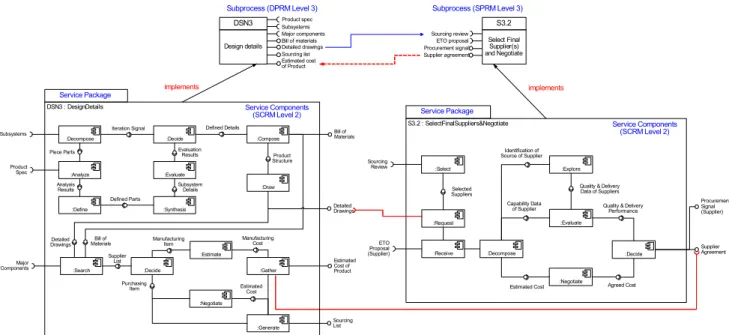
합을 넘어서, 서로 다른 가치사슬의 통합은 애플리케이션의 구현 측면에서도 고려되어야 한다. 즉, 각각의 가치사슬에서 이미 구현되어 사용중인 서비스 패키지들은 서로 통합되기 위 하여 구성품인 서비스 컴포넌트 중의 일부를 교체하여야 한 다. <Figure 13>에 예시한 것처럼 DSN3(Design details)의 gather 와 S3.2(Select final suppliers and negotiate)의 request라는 두 개 의 서비스 컴포넌트들을 입력 메시지가 추가된 새로운 서비스 컴포넌트들로 교체해 주면, 두 서비스 패키지가 서로 메시지 를 주고받는 하나의 서비스 패키지로 조합되어 통합된 비즈니 스 프로세스를 구현하는 애플리케이션의 역할을 할 수 있다.
5. 결 론
공급사슬을 효과적으로 운영하기 위해서는 공급사슬에 관련 된 기업모델을 효과적으로 표현할 수 있는 모델링 방법론이 필요하다. 기존의 일반적인 모델링 방법론은 비즈니스 프로세 스의 관리자들이 사용하기에 어려움이 있어 급변하는 시장환 경에 신속히 대응하기에는 한계가 있다.
본 논문에서는 공급사슬에 참여하는 기업들이 합의하여 협 력할 수 있는 가상의 틀, 즉 참조모델에 기반한 새로운 프레임 워크를 제시함으로써 공급사슬의 협력적 운영을 위한 기업모 델링 방법론을 제안하였다.
본 논문의 프레임워크는 공급사슬 협업을 비즈니스, 애플리 케이션, 기술이라는 3가지 관점에서 바라보고 각 관점에 대한 참조모델을 제시함으로써 공급사슬의 신속한 모델링을 지원 하고 있다. 비즈니스 참조모델은 공급사슬의 프로세스에 대한 국제표준인 SCOR를 이용하였으므로 제안된 프레임워크는 기
업에서의 적응성이 높으며, SCOR를 위한 도구 개발 시 구현을 위한 가이드로서 활용할 수 있다. 또한 제안된 프레임워크는 MDA의 메타데이터 아키텍처의 계층별 구조로 구성되었으므 로 다른 가치사슬의 모델과 통합되어 확장될 수 있음을 공급 사슬과 설계사슬의 예제로 설명하였다. 다양한 가치사슬의 통 합에 따른 기업모델의 확장성은 시장환경의 변동에 대하여 새 로운 사업기회의 창출을 위한 비즈니스 프로세스의 개발 및 개선에 크게 기여할 수 있다.
참고문헌
Andrews,T., Curbera,F., Dholakia,H., Goland,Y. and Klein, J. et al.
(2003), Business Process Execution Language for Web Services (BPEL4WS) v1.1, http://www.ibm.com/developerworks/library/
ws-bpel.
Bass, Tim and Mabry, Roy (2004), Enterprise Architecture Reference Models: A Shared Vision for Service-Oriented Architectures, IEEE MILCOM 2004.
COSME(Cooperation Of Small and Medium Enterprises) (2001), The Virtual Enterprise X The Extended Enterprise, http://www.cosme.rwth-aachen.de/Cosme/public_html/Extend edXvirtual/ ExtendedXvirtual.htm.
Cadence Design Systems (2003), Design Chain Optimization:
Competing in the disaggregated electronics industry, White Paper.
Choi, Y., Kim, K. and Kim, C. (2005), A Design Chain Colla- boration Framework Using Reference Models, Int. J. of Applied Manufacturing and Technology, published online.
DoD Architecture Framework Working Group (2003), DoD Architecture Framework: Volume I: Definitions and guidelines.
Gou, H., Huang, B., Liu, W. and Li, X. (2003), A framework for