한국정보통신학회논문지 Vol. 22, No. 9: 1208~1213, Sep. 2018
간호대학생의 시뮬레이션기반 교육 시 구조화된 디브리핑 유형이 학습성과에 미치는 효과
최소은1·김현주2*
Effect of Structured Debriefing on the Learning Outcomes of Nursing Students in Simulation-based Education
So-Eun Choi
1· Hyun-Ju Kim
2*1Department of Nursing, The Research Institute of Women, Mokpo National University, Jeollanam-do, 58554, Korea
2*Department of Nursing, Catholic University of Pusan, 46265, Korea
요 약
시뮬레이션 교육 시 구조화된 디브리핑 유형이 간호대학생의 학습몰입, 비판적사고성향과 임상수행능력에 미치 는 효과를 검증하고자 시도된 비동등성 대조군 사후 시차설계의 유사실험 연구이다. 연구대상자는 P 대학교 간호학 과 4학년 학생으로, 실험군 22명, 비교군 24명, 대조군 20명으로 총 66명이었다. 실험군에게는 LCJR 질문을 이용한 구조화된 비디오 디브리핑, 비교군은 구조화된 구두 디브리핑, 대조군은 구조화된 그룹 토론 디브리핑을 실시하였 다. 연구결과 학습몰입과 비판적사고성향 및 임상수행능력은 세 군간 유의한 차이가 없었으나 사전-사후 차이 검정 시 모두 향상되었다. 또한 임상수행능력의 세부영역 중 계획과 중재는 실험군이 다른 두 군에 비해 유의하게 향상되 었다. 이를 통해 LCJR의 임상판단 루브릭을 활용한 디브리핑은 시뮬레이션교육에 효과적이며 특히 비디오를 활용 한 구조화된 디브리핑 유형은 임상수행능력을 높이는데 영향을 끼치는 것으로 나타났다.
ABSTRACT
The study investigates how the structured debriefing method affects the learning flow, critical thinking disposition, and clinical performance of nursing students, using the Lasater Clinical Judgment Rubric (LCJR). Nursing students in the 4th grade of P University were divided into three groups, each trying out a different structured debriefing method: the experimental group - structured video debriefing using the LCJR question, the comparative group - structured oral debriefing, and the control group - structured group discussion debriefing. There was no significant difference between the three groups in learning flow (p=.640), critical thinking disposition (p=.420) and clinical performance ability (p=.360).
Planning and intervention among the areas of clinical performance were significantly improved in the experimental group compared to the other two groups (p=.005). Structured debriefing when used with LCJR improves the learning flow and critical thinking disposition of students, while structured video debriefing improves clinical performance.
키워드 : 간호대학생, 시뮬레이션, 비판적사고성향, 임상수행능력
Key word : Nursing students, Simulation, Critical thinking disposition, Clinical performance
Received 29 April 2018, Revised 16 May 2018, Accepted 2 June 2018
* Corresponding Author Hyun-Ju Kim(E-mail:[email protected], Tel:+82-51-510-0772) Department of Nursing, Catholic University of Pusan, 46265, Korea
This paper was supported by RESEARCH FUND offered from Catholic University of Pusan in 2017
Open Access http://doi.org/10.6109/jkiice.2018.22.9.1208 print ISSN: 2234-4772 online ISSN: 2288-4165
Ⅰ. 서 론
Nursing education aims to nurture professionals who are knowledge able in the theory and practice of nursing while developing their skills in critical thinking and decision-making [1-2]. To facilitate wholesome learning, various educational methods are being tried.
Because nursing students are mostly employed as nurses after graduation, critical thinking skills are needed to cultivate problem solving abilities and to cope with various health-care needs, to effectively solve subjects' problems [3-4].
In particular, the recent medical environment emphasizes the nurse's ability to judge the situation and determine interventions accordingly due to the increasing complexity of the clinical situation, increasing the number of diseases requiring professional and complex management, and increasing the patient's severity [5].
In addition, the curriculum of the nursing is very complicated according to the academic characteristics in which various major theories and clinical practice should be combined, and it is necessary to alternate theoretical and practical classes within the same semester due to the difficulty of obtaining an institution capable of clinical practice. As a result, nursing students are experiencing physical and mental illness due to maladjustment of different teaching environments, frequent mistakes caused by concentration loss, and abandonment of study. Therefore, learning motivation is required to drive the curiosity and aspiration to learn and challenge new and difficult level tasks and motivate motivation to achieve [6]. There is also a growing interest in learning commitment, which helps learners to actively participate in the curriculum and to lead and collaborate on learning activities.
However, nursing students are exposed to poor clinical practice environment such as lack of practical training institutions and clinical practice of observation.
Therefore, nursing students are not able to acquire practical skills. Furthermore, it makes me relinquish my studies or avoid hospital employment [7]. In order to
solve these limitations of clinical practice education, simulation education is emerging as a teaching and learning strategy to actively learn clinical performance ability [8-10].
Ⅱ. 본 론
Simulation training consists of three stages:
preliminary briefing, simulation phase, and debriefing.
Debriefing is the core of simulation training. Debriefing provides a time for structuring meaningful experiences of learners through reflection, discussion, and feedback after scenario implementation [11]. Therefore, debriefing is the stage in which the effect of structured debriefing on learning is seen the most. The learning effects are observed in the following areas: nursing knowledge, clinical performance ability, critical thinking, and improvement in confidence. However, according to the debriefing, there were many differences in learning results [12]. The debriefing method can be divided into video, oral, and group discussion debriefing according to the type of media used. It can also be divided into instructors and self-briefing according to the subject of the class. The debriefing method may further be divided into structured or unstructured debriefing according to the structuring of the debriefing guidelines [7][13-14]. Video debriefing allows learners to compare the performance of a recorded video with the actual situation and evaluate the behavior to generalize the experience. It also allows learners to share their conversations and exercises [4]. Oral debriefing is a process in which a learner engages in reconsideration and reflection of practical experience, which provides a starting point for the learner to reflect on the simulation experience and help to find alternative interventions [14]. Group discussion debriefing involves a group of learners who recreate the simulation by sharing their experiences and important contents with colleagues, and reconstructing the knowledge and experience by examining how they can be applied in the clinical field.
Structured debriefing is a learner-centered strategy which provides an opportunity for reflection, presenting high-level feedback, linking abstract concepts, and giving consistent feedback. Structured debriefing, done using structured questions facilitate the learner’s thinking and learning, helping them understand the difference between simulation experience and knowledge, and helps them connect knowledge and practice. To this end, the instructor is required to take on the role of a facilitator to guide the students to voluntarily engage in discussion and draw upon experiences for reflection.
If the debriefing is systematic and structured, the level of reflective learning will improve, and the simulation experience will be organized, which will result in the development of clinical judgment and the ability to analyze performance and correct oneself.
Through reflection activities, professional competence develops, which can then be as similated into new experiences [15]. Teachers, therefore, need training to apply structured questions to enhance students' critical thinking and learning. However, the results for the difference according to the debriefing method are inconsistent with empirical studies on effective debriefing structure and factors.
The purpose of this study was to investigate the effect of debriefing using the structured debriefing method of lasater on the clinical judgment rubrics and to compare the effectiveness of simulation education to improve the critical thinking disposition of nursing college students, and to provide a basis for empirical.
Ⅲ. 연구 방법
3.1. 연구설계
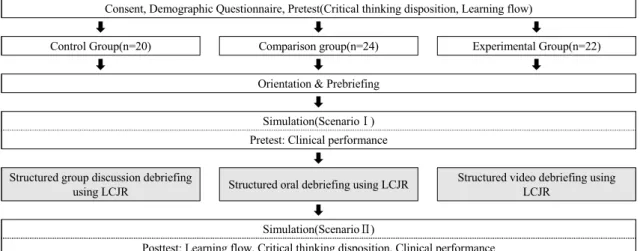
Sixty-six nursing students from P University, in the fourth year of the program, understood and agreed on the purpose of the study. The first period was assigned to the control group (consisting of 20 students), the second period to the comparative group (consisting of 24 students), and the third period to the experimental
group (consisting of 22 students). The researchers developed a gastric resection surgery (scenario I) and spinal surgery patient care (scenario II) and clinical performance checklist. Before the simulation was run, the purpose of the simulation, the learning objectives, the related core nursing skills, demonstrations, and autonomous exercises were carried out in the pre-briefing session.
The research design as shown in Fig.1.
3.2. 연구도구 3.2.1. 학습몰입
Learning immersion is a tool developed by Klein et al. [8]. It is a 5-point scale consisting of 5 items. The range is from 5 to 25, which means that the higher the score, the stronger the immersion. The reliability of the instrument at the time of development was .83, and Cronbach's α in this study was .80.
3.2.2. 비판적사고성향
This is a score measured using the Yoon’s critical thinking disposition measurement tool developed by Yoon [3], comprising 27 items. It ranges from a minimum of 27 to a maximum of 135; the higher the score, the stronger is the critical thinking disposition. In Yoon's study, the reliability of the instrument at the time of development was .84, and Cronbach's α in this study was .81.
3.2.3. 임상수행능력
Based on the clinical performance evaluation tool of the spinal surgery patient simulation presented by the Korea Nursing Evaluation Institute, the checklist developed by the present researcher was used to assess the clinical skills suitable for the situations of scenario I and scenario II. Cronbach's alpha in this study is. 70.
3.3. 자료분석
The collected data were analyzed using SAS (ver.
9.2) statistical program. The general characteristics of the participants were presented as frequency, percentage, mean and standard deviation. The chi-square test and Fisher's exact test were used for the general
characteristics and the homogeneity test of the preliminary data. Differences in pre- and post-training effects were analyzed by one way ANOVA.
Ⅳ. 연구 결과
4.1. 세 군의 학습몰입, 비판적사고성향과 임상수행능력의 비교
Analysis of the learning flow score showed that the experimental group increased from 3.11 points before the experiment to 3.28 points after the experiment, and the comparison group increased from 2.99 points to 3.12 points. In the control group, 3.11 Point to 3.18 points after the experiment. However, there was no significant difference between the three groups (p=.640).
Analysis of the critical thinking disposition score showed that the experimental group increased from 3.46 points before the experiment to 3.54 points after the experiment and from 3.50 points to 3.57 points in the comparison group. There was no significant difference between the three groups (p=.420), while the control group decreased from 3.51 to 3.50.
Clinical performance score showed that the experimental group increased from 25.90 before the
experiment to 34.09 after the experiment. In the comparison group, it increased from 25.83 to 30.50 and the control group from 34.70 to 30.80. However, there was no significant difference between the three groups (p=.360). In detail, in the planning and intervention aspect, the experimental group increased from 9.54 points before the experiment to 10.39 points after the experiment, and from 9.08 to 8.41 in the control group and from 8.00 to 9.00 in the control group. When the difference between the three groups was examined, the experimental group showed significant increase compared to the other two groups (p=.005).
Ⅴ. 결 론
As a result of applying the structured debriefing method using the LCJR, the scores of learning flow and critical thinking disposition were improved in all three groups. Particularly, when examining the pre-post score difference of learning flow, the highest in the experimental group using the video which was led by the instructor and debriefed. These results suggest that it is necessary to reinforce self-learning of students by encouraging students to participate in reinterpretation and sharing of recorded image viewer and to act as a Consent, Demographic Questionnaire, Pretest(Critical thinking disposition, Learning flow)
Control Group(n=20) Comparison group(n=24) Experimental Group(n=22)
Orientation & Prebriefing
Simulation(ScenarioⅠ) Pretest: Clinical performance
Structured group discussion debriefing
using LCJR Structured oral debriefing using LCJR Structured video debriefing using LCJR
Simulation(ScenarioⅡ)
Posttest: Learning flow, Critical thinking disposition, Clinical performance
Fig. 1 Research Design
facilitator for the self-reflection of the instructor.
The structured debriefing using the clinical judgment rubric was carried out in four stages of cognition, interpretation, reaction and reflection. In the cognitive domain 'What you found', in the interpretation domain,
‘What kind of link is there?’ and ‘Does the response area provide the required nursing intervention?, in the reaction domain ,'Do you provide the required nursing intervention?', in the reflection domain, 'What do you think about the outcome of judgment?' etc, use the debriefing progress question and self- assessment. As a result, all three groups facilitated the critical thinking process of nursing college students.
However, the difference of the pre-post scores in the area of critical thinking disposition, pertaining to the experimental group with the structured video debriefing, was the most improved. The critical thinking disposition score of the control group, which performed the group discussion debriefing, was the lowest. In the course of the debriefing, the instructor guides the learners with the use of structured questions through the processes of cognition, interpretation, reaction, and reflection based on the simulation situation. It aids the learning experience by promoting logical thinking involved in the process.
As a result of applying structured debriefing using the clinical judgment rubrics, the clinical performance score improved in all three groups. These results suggest that structured debriefing using LCJR questions can stimulate learners' thinking and stimulate learning, allowing learners to interpret their actions an remedy them where necessary which results in improved clinical performance. In addition, the clinical performance of the experimental group was significantly improved in the planning and intervention areas. This can be attributed to the more objectively evaluated structured video debriefing as opposed to a case being evaluated from the memory of an individual. There is an enhanced understanding of the error operation during execution, helping us obtain the effect of the behavior correction. Further, the nursing process can be seen
directly. Therefore, it is considered to have a significant effect on improvement of clinical performance ability;
by helping to maintain the acquired technique for a long time. On the other hand, the comparative group with structured oral debriefing was debriefed after associating the performance based on memories only. In addition, the control group that performed the structured group discussion debriefing reviewed the contents of the exercise only using the feedback between the peers.
This provided them with a relatively narrow limit to correct the performance behavior by deriving the exact problem and related factors. Therefore, it is suggested that teachers will be needed to help guide and encourage debriefing at least when peer to peer feedback is conducted through group discussion. In conclusion, it is necessary to develop and apply various types of structured debriefing to improve the critical thinking skills and clinical judgment, through the process of sufficient reflection of the learners in the future simulation education.
References
[ 1 ] E. H. Kim, “The relationship between clinical stress, fatigue, satisfaction and self-efficacy in clinical practice of nursing students,” Journal of The Korea Socity of Health Informatics and Statistics, vol. 40, no. 1, pp. 24-36, Feb.
2015.
[ 2 ] Y. Y. Hwang, S. H. Kim, and M. S. Chu, “Developing course outcome to achieve exit outcome : applying hauenstein’s theory,” Journal of Korean Academic Society of Nursing Education, vol. 21, no. 2, pp. 155-167, May.
2015.
[ 3 ] J. Yoon, “Development of an instrument for the measurement of critical thinking disposition: in nursing,”
Unpublished master’s thesis, Catholic university, Seoul, Korea, 2004.
[ 4 ] K. Lasater, “Clinical judgement: the last frontier for evaluation,” Nurse Education in Practice, vol. 11, no. 2, pp. 86-92, Mar. 2011.
[ 5 ] Y. Eun, and S. Y. Bang, “Effects of the lasater’s clinical rubric of debriefing in advanced cardiovascular life
support training,” The Journal of the Korea Contents Association, vol. 16, no. 4, pp. 516-527, Apr. 2016.
[ 6 ] M. O. Kim, A. K. Lee, and H. A. Nam, “Effects on nursing students’ learning flow, critical judgement, and problem solving ability in simulation training: focused on obstetrical nursing case,” Learner-Centered Curriculum Education Research, vol. 17, no. 24, pp. 521-534, Dec.
2017.
[ 7 ] H. J. Kim, “Effects of a simulation-based debriefing using video in nursing education,” Information, vol. 20, no. 8a, pp. 5509-5514, Aug. 2017.
[ 8 ] H. J. Klein, M. J. Wesson, J. R. Hollenbeck, P. M. Wright, and R. P. Deshon, “The assessment of goal commitment : a measurement model meta-analysis,” Organization Behavior and Human Decision Process, vol. 85, no. 1, pp. 32-55, May. 2001.
[ 9 ] E. H. Choi, and Y. K. Kwang, “Nursing students’ problem solving, and clinical competence between standard patient and high fidelity simulator simulation,” Asia-pacific Journal of Multimedia Services Convergent with Art, Humanities, and Sociology, vol. 5, no. 2, pp. 29-36, Feb.
2015.
[10] K. H. Choi, G. Y. Kim, Y. T. Shin, and J. B. Kim, “A study on the performance simulation model for estimating hardware scale,” International Journal of Control and Automation, vol. 7, no. 10, pp. 405-410, Oct. 2014.
[11] Y. G. Ha, “The effects of debriefing utilizing the clinical judgment rubric on nursing students’ clinical judgment, knowledge and self-confidence,” Unpublished doctoral dissertation, Seoul national university, Seoul, 2014.
[12] A. L. Sabei, D. Sulaiman, and K. Lasater, “Simulation debriefing for clinical judgment development: a concept analysis,” Nurse Education Today, vol. 45, pp. Oct. 42-47, 2016.
[13] H. K. Oh, “Effects on nursing students’ clinical judgment, communication, and skill performance following debriefing using a clinical judgment rubric,” International Journal of Bio-Science and Bio-Technology, vol. 8, no. 1, pp.
303-312, Feb. 2016.
[14] K. Lasater, “High-fidelity simulation and the development of clinical judgment: students’ experiences,” Journal of Nursing Education, vol. 46, no. 6, pp. 269-276, Jun. 2007.
[15] K. Lasater, “Clinical judgment development; using simulation to create an assessment rubric,” Journal of Nursing Education, vol. 46, no. 11, pp. 496-503, Nov. 2007.
최소은(So-Eun Choi)
가톨릭대학교 간호학 박사 국립목포대학교 간호학과 교수
※관심분야 : 혈액종양, 간호교육
김현주(Hyun-Ju Kim)
가톨릭대학교 간호학 박사 부산가톨릭대학교 간호학과 교수
※관심분야 : 시뮬레이션, 뇌졸중, 간호교육