INTRODUCTION
During human movement, the impact force is transmitted to the musculoskeletal system of the lower extremities within 50 ms, which is the initial stage of the support phase during running. The magnitude of the impact peak force depends on the speed of the movement or body weight (Andriacchi, Ogle, & Galante, 1977; Hamill, Bates, Knutzen,
& Sawhill, 1983; Frederick, 1986) or foot strike pattern during running (Cavanagh & Lafortune, 1980); however, it is 1.5~3 times the body weight for typical running (Cavanagh & Lafortune, 1980; Munro, Miller, &
Fuglevand, 1987; Miller, 1990; Mario & Ewald, 1991). A typical impact peak force at landing during barefoot running is associated with a load factor 400~600 times the body weight per second (i.e. loading rate), which can be reduced with sufficient cushioning of the running shoes (Shorten, 1993; Pohl, Hamill, & Davis, 2009). If the magnitude of the impact peak force is increased, the impact load factor is also in- creased, which may cause damage to the joints of the lower extremities (McMahon, Valiant, & Frederick, 1987).
Upon reviewing previous studies on the magnitude of the impact peak force and the association with injury to the musculoskeletal system
of the lower extremities, Whittle (1999) reported that the impact at the moment of heel landing during running causes internal load of the lower extremities and that the temporary stress is transmitted up through the skeletal structure of the body. In addition, runners with injuries due to overuse in the past had a greater impact peak force than those without injuries (Hreljac, Marshall, & Hume, 2000; Milner, Ferber, & Pollard, 2006; Pohl et al., 2009). Meanwhile, Syed and Davis (2000) asserted that arthritis is induced by the impact force, and Daoud, Geissler, Wang, Saretsky, and Daoud (2012) hypothesized that the impact peak force causes potentially high stress and changes to the skeletal tissues and that it has an effect on the injury as high tensile stress for repeated cycles is caused. In addition, an increased impact load may affect plantar fasciitis (Pohl, Mullineaux, Milner, Hamill, & Davis, 2008), lower extremity stress fracture (Milner et al., 2006), patellofemoral pain syndrome, medial tibial stress syndrome, lower back pain, hip pain, and knee pain (Pohl et al., 2008; Hamill, Miller, Noehren, & Davis, 2008), and tibial stress fracture directly and indirectly (Ferber, McClay-Davis, Hamill, Pollard, & McKeown, 2002; Davis, Milner, & Hamill, 2004; Zifchock, Davis,
& Hamill, 2006; Pohl et al., 2008). The impact peak force may cause damage more easily in situations, such as anatomical abnormalities,
KJSB http://e-kjsb.org eISSN 2093-9752 ORIGINAL
Relationship between the Impact Peak Force and Lower Extremity Kinematics during Treadmill Running
Ji-Seon Ryu1,2, Sang-Kyoon Park1,3
1Motion Innovation Center, Korea National Sport University, Seoul, South Korea
2Department of Health and Exercise Science, College of Lifetime Sport, Korea National Sport University, Seoul, South Korea
3College of Physical Education, Korea National Sport University, Seoul, South Korea
Received : 18 August 2018 Revised : 06 September 2018 Accepted : 12 September 2018
Corresponding Author Sang-Kyoon Park
College of Physical Education, Korea National Sport University, Seoul, 05541, South Korea
Tel : +82-2-410-6952 Fax : +82-2-410-6952 Email : [email protected]
Objective:The aims of this study were to determine the impact peak force and kinematic variables in running speed and investigate the relationship between them.
Method:Thirty-nine male heel strike runners (mean age=21.7±1.6 y, mean mass=72.5±8.7 kg, mean height=
176.6±6.1 cm) were recruited in this investigation. The impact peak forces during treadmill running were assessed, and the kinematic variables were computed using three-dimensional data collected using eight infrared cameras (Oqus 300, Qualisys, Sweden). One-way analysis of variance ANOVA was used to investigate the influence of the running speed on the parameters, and Pearson's partial correlation was used to investigate the relationship between the impact peak force and kinematic variables.
Results:The running speed affected the impact peak force, stride length, stride frequency, and kinematic variables during the stride phase and the foot angle at heel contact; however, it did not affect the ankle and knee joint angles in the sagittal plane at heel contact. No significant correlation was noted between the impact peak force and kinematic variables in constant running speed.
Conclusion: Increasing ankle and knee joint angles at heel contact may not be related to the mechanism behind reducing the impact peak force during treadmill running at constant speed.
Keywords:Impact peak force, Stride length, Stride frequency, Joint angle, Heel striker
long runs, short recovery time, downhill runs, running on hard ground, and fatigue (Dickinson, Cook, & Leinhardt, 1984; Christina, White, &
Mccrory, 1998). Bus (2003) asserted that a high impact peak force was more likely to increase the potential for overuse injury among elderly runners than among younger runners and observed the impact peak force from the aging perspective. Therefore, while some investigators reported no relationship between the impact peak force and damage to the musculoskeletal system of the body during movement (Nigg, Cole, & Bruggemann, 1995; Darren, Stergiou, Nigg, Lun, & Meeuwisse, 2000; Darren, Stergiou, Lun, & Meeuwisse, 2001; Nigg, 2004), most in- vestigators still attribute the impact peak force as a typical factor that causes damage along with impact loading during running.
Although many studies have analyzed the relationship between the impact peak force and damage during running, only a few studies have identified the factors that affect the impact peak force. Investigators reported that the impact peak force is affected by the running speed (Denoth, 1986; Nigg, Bahlsen, Luethi, & Stokes, 1987) and stride length (Derrick, Hamill, & Caldwell, 1998). Gerritsen, Van den Bogert, & Nigg (1995) reported that the impact peak force is influenced by the plantar flexion of the foot segment, vertical velocity of the heel, and initial knee flexion angle in their dynamic simulation model. Whittle (1999) asserted that the transfer of the impact force to the body depends on the initial contact location of the foot during running through a review analysis of previous studies. Therefore, studies that identify the factor that affects the magnitude of the impact force during running are classified as studies that focus on the relationship between the running speed and stride length, and studies that investigate the kinematics of the foot and knee at the initial stage where the foot comes in contact with the ground. However, there are only a few experimental studies as most studies are conducted through simulation or review. Running is a move- ment achieved by the reaction force obtained from the foot acting on the ground transmitting to the entire body. Therefore, analyzing the kinematic characteristics of the leg and foot segment that play a leading role in running is important.
This study aimed to determine the change in the impact peak force and the kinematic variables depending on the running speed and iden- tify the relationship between them.
METHODS 1. Participants
39 men (age=21.7±1.6 y, weight=72.5±8.7 kg, height=176.6±6.1 cm), who are heel strike runners, were recruited. All participants did not have any history of injury to the lower extremities within the past 12 months, and healthy participants who can run naturally at the speed of 4.44 m/s were selected. Consent forms were collected before parti- cipation in the study according to the university’s institutional review board policy.
2. Measurements
Prior to the experiment, all participants had a sufficient warm-up time
of more than 5 minutes and then were put on a treadmill (instru- mented dual belt treadmills; Bertec, USA) equipped with two ground reaction force measure devices at two fixed speeds of slow running at 2.22 m/s and fast running at 4.44 m/s for 2 minutes. Prior to the data collection, a nonlinear transformation motion space was constructed using an L-shaped frame with four markers and a T-shaped frame with two markers spaced 75 cm apart to obtain true coordinates. The labora- tory coordinate system was set to the rear right of the treadmill on which the L-shaped frame was placed. The axial direction crossing the upper vertical side was set as +Z; the running direction was set as +Y;
and the right direction of crossing from +Y to +Z was set as +X. The local coordinate axes of x, y, and z for the lower extremities were set with the identical directions as the global coordinate axis. Data were col- lected without the participants knowing, at a sampling rate of 1,000 Hz and 100 Hz for vertical ground reaction and kinematic data, respectively, for at least 30 steps per participant. For kinematic data, eight infrared cameras (Oqus 300, Qualisys, Sweden) were used to collect three- dimensional coordinates of reflective markers on the following anato- mical locations of the right lower limb; greater trochanter, lateral knee, lateral ankle, toe, heel, navicular, and fifth metatarsal head medial ankle.
3. Data processing and statistical analysis
The collected vertical ground reaction force signals and kinematic coordinates underwent fourth-order Butterworth filtering, and the selected variables were then computed. To process the vertical ground reaction force, the power spectrum density method was used to select the fre- quency that includes the accumulated frequency value of 99.9% (Ryu, 2013). For the kinematic coordinates, the cutoff frequency was selected differently depending on the speed; 9 Hz for 2.22-m/s running and 12 Hz for 4.44-m/s running were selected according to the horizontal component of the heel's spatial coordinates. In addition, the time of ground contact was defined as that when the vertical ground reaction force increases to greater than 5 N. After the impact peak force of the vertical ground reaction force was synchronized with the kinematic variable, the 5th and 10th strides of each participant's right leg were analyzed to obtain the mean value.
Based on the stride length and the y coordinate of the collected three-dimensional heel coordinates, the displacement from the moment the right foot comes in contact with the ground to the next right foot contact was assessed. In addition, the stride rate was computed by dividing the running stride by the stride length. For the kinematic varia- bles to represent the legs, the center of the leg was assessed using the markers attached to the knee and ankle, and the horizontal and vertical displacement ranges and the maximum horizontal and vertical velo- cities were then obtained. Here, the angular displacement range and the maximum angular velocity of the leg segment were assessed. In addition, the angle and ankle angles projected on the sagittal plane and the angle between the ground and foot segment at the moment of contact were computed (Hamill & Ryu, 2003). The velocity and angular velocity were obtained using the finite difference method, and the y (before and after) coordinate value errors during treadmill running were adjusted as follows.
Actual before and after coordinate value = latter coordinate value + (running speed * first coordinate/data collection sampling rate)
Based on the findings of previous studies that showed a weak cor- relation between the stride length and height (Cavanagh, Pollock, &
Landa, 1977; Cavanagh & Williams, 1982; Cavanagh & Kram, 1989), the height of participants was not normalized. To minimize the difference by the shoes among participants, all participants wore identical shoes (Prospecs Flash101-103, Korea) (Clarke, Frederick, & Hamill, 1983).
To investigate the statistical difference in the impact peak force and kinematic variables between the selected running speeds, one-way ANOVA was used. Further, to investigate the relationship between the impact peak force and kinematic variables occurring during running, Pearson's partial correlations were used; however, it was assumed that among the kinematic variables, the stride length and frequency, vertical displacement range of the center of the leg and maximum speed, hori- zontal displacement range of the center of the leg and maximum speed,
and ankle angle at the moment of contact with the ground and foot segment were related. Thus, for assessing the correlation between these factors and the impact peak force, partial correlation coefficients that exclude one variable to minimize the influence of each other were used.
For all statistical analysis, the SPSS program (IBM SPSS, USA) was used, and the statistical significance level was set at 5%.
RESULTS
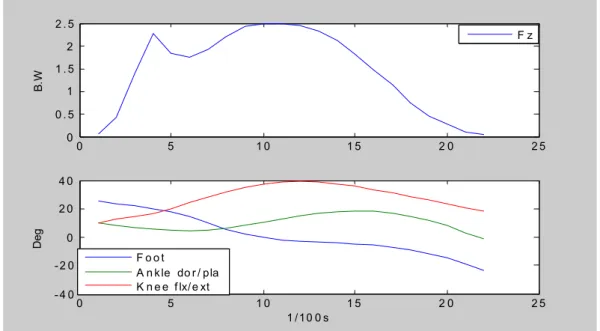
The means and standard deviations of the impact peak force magni- tude and kinematic variables at the two running conditions, as well as the statistical validities are shown in (Table 1), and the correlations be- tween the impact peak force magnitude and kinematic variables are shown in (Table 2). (Figure 1) shows the vertical ground reaction force (top figure) in the support phase at the running velocity of 4.4 m/s, corresponding flexion-extension angles of the knee and ankle, and angle change between the ground and foot segment (bottom figure).
Table 1.Mean (SD) impact peak force and kinematic variables between the two running speed conditions and ANOVA 1 results (F(p)) (m)Sl Sf
(1/s) Shd
(m) Svd
(m) Smhv
(m/s) Smvv
(m/s) Sa
(rad) Smav
(rad/s) Aa
(°) Ka
(°) Fa
(°) Ip
(BW) 2.22 m/s 1.70
(.09) 1.29
(.07) 1.34
(.10) .05
(.01) 3.77
(.21) .20
(.12) 1.2
(.1) 7.8
(.7) 5.3
(3.8) 11.2
(5.2) 13.2
(3.8) 1.4
(.1) 4.44 m/s 3.02
(.17) 1.46
(.08) 2.55
(.17) .15
(.03) 7.07
(.24) 1.17
(.15) 1.8
(.1) 11.3
(.9) 6.1
(4.3) 13.5
(5.7) 19.3
(4.0) 2.0
(.2) F (p) 1687
(.000)† 88
(.000)† 252
(.000)† 1368
(.000)† 3934
(.000)† 886
(.000)† 424
(.000)† 325
(.000)† .63
(.4284) 3.25
(.0755) 46
(.000)† 180 (.000)†
†Significant differences detected. SD: standard deviation, Sl: stride length, Sf: stride frequency, Shd: shank horizontal displacement, Svd: shank vertical displacement, Smhv: shank max horizontal velocity, Smvv: shank max vertical velocity, Sa: shank angle, Smav: shank max angular velocity, Aa: ankle angle: dorsi-flexion, Ka: knee angle: flexion, Fa: foot angle: attack angle (foot angle with respect to the ground), Ip: impact peak
0 5 1 0 1 5 2 0 2 5
0 0 . 5 1 1 . 5 2 2 . 5
B.W
0 5 1 0 1 5 2 0 2 5
- 4 0 - 2 0 0 2 0 4 0
1 /10 0 s
Deg
F o o t
A n kle do r / pla K n e e f lx/e xt
F z
Figure 1.Example of vertical reaction force, the foot, knee flexion/extension, and ankle dorsi/plantar angles in the support phase in an individual at 4.4-m/s running speed. Fz has a decimal reduction in the time scale to match the kinematic time.
As shown in (Table 1), the stride length, which is a space-time vari- able, was 77% greater, and the stride frequency was 13% greater at fast running (4.4 m/s) than at slow running (2.2 m/s) (p<.05). Upon reviewing the linear motion of the legs at the two speeds, the horizontal and vertical displacements were 90% and 200%, respectively, which were greater at the fast running speed (p<.05); further, the maximum speeds were 87% and 485%, respectively, which were also greater at the fast running speed (p<.05). For the angular motion, the angular displacement and maximum angular speed were 53% and 44%, respec- tively, which were greater at the fast running speed (p<.05). At the moment of the heel coming into contact with the ground, the dorsi- flexion of the foot and the absolute flexion angle of the knee did not differ between the running speeds; however, the angle between the foot segments and the ground was 46% greater at the fast running speed (p<.05). The impact peak force was 42% greater at the fast running speed than at the slow running speed (p<.05).
As shown in (Table 2), there was no significant difference in the cor- relation between the impact peak force and space-time variables such as the stride frequency and stride length. In addition, the correlation between the impact peak force and linear/angular kinematic variables during stride was weak. Furthermore, there were no significant cor- relations among the impact peak force and joint angles at the ankle and knee as well as foot segment angle at the moment of contact with the ground for each running speed.
DISCUSSION
This study analyzed the impact peak force and kinematic variables of the lower extremities between two running speeds and investigated the relationship between them within each speed. The results of the study showed that the running speed affected the stride length and frequency, except for the flexion angle of the knee joint and the dorsi- flexion angle of the ankle at the moment when the foot came in contact with the ground and increased the impact peak force and the foot segment angle. The results aligned with the results observed in previous studies (Clarke, Cooper, Hamill, & Clark, 1985; Derrick et al., 1998; Whittle, 1999; Mercer, Vance, Hreljac, & Hamill, 2002). However, the running speed did not affect the dorsiflexion angle of the ankle and the flexion angle of the knee joint at the moment of the foot coming into contact with the ground. Because the impact peak force increases proportionally with the increase in the running speed, the
flexion angles of the knee and ankle joints were expected to be in- creased to absorb the force; however, there were no changes in these angles, while the angle between the foot segment and the ground in- creased. In particular, the knee joint was expected to bend more at the faster running speed with a larger impact peak force, since the knee joint acts as the major joint for absorbing the impact while running (Michael et al., 2003); however, the knee joint angle was not affected by the running speed. The large angle of the foot segment with the ground at a fast speed seems to be a part of obtaining a larger driving force by increasing the range of motion. The impact peak force during running is known to be absorbed through the bones and ligaments, which are passive structures of the lower extremities (Milner et al., 2006). Therefore, based on the results of this study, it can be concluded that as the running speed increases, the incidence of potential running injury, such as tibial stress fracture, also increases. However, treadmill running at a fixed speed may have a slight difference in terms of the characteristics of the kinematic variables and impacts related to braking and propulsion as compared with natural running on the ground. Nonetheless, this study is more focused on the relationship between the kinematic varia- bles of the lower extremities during running and the characteristics of the impact associated with lower musculoskeletal injuries. Furthermore, previous studies that examined the difference between conventional treadmill running and normal ground running have reported the diffe- rences in most kinematic variables to be negligible (Riley et al., 2008;
Kluitenberg et al., 2012).
As a result of observing the relationship between the impact peak force determined by the running speed and the kinematics of the lower extremities, a statistically weak correlation was found at both the fast and slow running speeds. As mentioned previously, the stride length and frequency, which are space-time variables of running, increased with the increase in the running speed; however, the correlation between these variables and the impact peak force within the fixed running speed was very weak. This contradicts the results of a previous study that reported that the modification of stride length and stride frequency tended to decrease the impact peak force (Hobara, Sato, & Sakaguchi, 2012). Although not statistically significant, the knee flexion angle was small with a greater impact force (p=.06) at slow running, while the plantarflexion angle of the ankle increased with a greater impact force (p=.13) at fast running.
In addition, the kinematic variable of the leg during the stride and impact peak force did not show a close relationship. Such a pheno- Table 2.Correlation coefficients and p-values between the impact peak force and kinematic variables for the two running speeds
Sl Sf Shd Svd Smhv Smvv Sa Smav Aa Ka Fa
2.22 m/s .1521
(.3618) .1580
(.3435) .2175
(.1895) -.2226
(.1791) -.0264
(.8748) -.1820
(.2742) -.2111
(.2032) -.1501
(.3684) .0690
(.6804) -.3057
(.0620) .0872 (.5974) 4.44 m/s -.0434
(.7957) -.0261
(.8765) -.1390
(.4053) .0741
(.6585) -.1365
(.4138) -.2026
(.2225) -.1896
(.2543) -.2147
(.1956) -.2500
(.1300) .1657
(.3201) -.0870 (.5984) Sl: stride length, Sf: stride frequency, Shd: shank horizontal displacement, Svd: shank vertical displacement, Smhv: shank max horizontal velocity, Smvv: shank max vertical velocity, Sa: shank angle, Smav: shank max angular velocity, Aa: ankle angle: dorsi-flexion, Ka: knee angle: flexion, Fa: foot angle: attack angle (foot angle with respect to the ground)
menon is considered that controlling the center of entire body would be more related to the levels of impact peak force rather than the motion of the lower extremities in during running; however, to verify such a conclusion, it is necessary to analyze the motion of the entire body, including the upper and center parts of the body (Mero, Komi,
& Gregor, 1992). Although the segments compared are different, the results of this study showing no significant correlation between the vertical velocity of the leg center and the impact peak force contradict those of the study by Gerritsen et al. (1995), who claimed that the vertical velocity of the heel through a simulation model influenced the impact peak force. It is necessary to observe the motion of the lower extremity segment in detail in the future.
The knee flexion angle, dorsiflexion angle of the foot, angle between the foot segment and ground, and magnitude of the impact peak force at the moment of the foot coming into contact with the ground, as a result of deceleration of the lower limbs (Whittle, 1999), showed a weak correlation. The results of this study aligned with the results of Park et al. (2018), who reported that the correlation between the impact peak force and the angle between the foot and ground during running was weak. However, the results were different from the findings that the characteristics of the vertical ground reaction force at the moment of contact with the ground during running depend on the initial landing condition (Bobbert, Yeadon, & Nigg, 1992) and adaptation based on landing geometry (Gerritsen et al., 1995). In addition, this result contra- dicts those of previous studies reporting that greater angles between the foot segment and the ground and extension angles greater than the knee angle at the moment of contact with the ground during running accompany a greater impact peak force (Valiant, 1990); it also contradicts the assertion that the difference in the ankle dorsiflexion angle during striking may affect the ground reaction force variables (Kline & Williams, 2015). The results are also different from the findings by Bus (2003), showing a positive correlation between the impact peak force and flexion-extension angle of the knee and ankle joints at the moment of landing in an elderly population. The difference between the results of this study and the theories and results of some previous studies is assumed to be due to the influence of various complex factors, such as experimental design, participants' experience in running, and difference between ground and treadmill running. Therefore, to clarify the difference, it is necessary to conduct further studies with a larger number of participants.
CONCLUSION
Based on the results of this study, the running speed affected the impact peak force, stride length, stride frequency, kinematic variables during the stride phase, and foot angle at heel contact, but not the ankle and knee joint angles at heel contact. In addition, there was no significant correlation between the impact peak force at the fixed running speed and kinematic variables. Based on such findings, improved cush- ioning of the shoes should be considered to prevent potential injury as it may reduce high impact peak force during relatively high-speed running. However, additional structure, such as sneaker padding, to control the contact angles of the knee and ankle joints with the foot
segments that was intended to reduce the maximum impact peak force during running, are considered to be unnecessary. In future studies, further analysis using the kinematic mechanism of the lower extremities and sneaker to reduce the high impact peak force that occurs during running is required. Finally, we suggest that follow-up studies should consider the expansion of participants, kinematics of a whole body, impact loading rate, and various running speed.
REFERENCES
Andriacchi, T. P., Ogle, J. A. & Galante, J. O. (1977). Walking speed as a basis for normal and abnormal gait measurements. Journal of Bio- mechanics, 10(4), 261-268.
Bobbert, M. F., Yeadon, M. R. & Nigg, B. M. (1992). Mechanical analysis of landing phase in heel-toe running. Journal of Biomechanics, 25(3), 223-234.
Bus, S. A. (2003). Ground reaction forces and kinematics in distance running in older-aged men. Medicine And Science In Sports And Exercise, 35(7), 1167-1175.
Cavanagh, P. R. & Kram, R. (1989). Stride length in distance running:
velocity, body dimensions, and added mass effects. Medicine and Science in Sports and Exercise, 21(4), 467-479.
Cavanagh, P. R. & Lafortune, M. A. (1980). Ground reaction forces in distance running. Journal of Biomechanics, 13(5), 397-406.
Cavanagh, P. R., Pollock, M. L. & Landa, J. (1977). A biomechanical com- parison of elite and good distance runners. Annals of the New York Academy of Sciences, 301, 328-345,
Cavanagh, P. R. & Williams, K. R. (1982). The effect of stride length vari- ation on oxygen uptake during distance running. Medicine and Science in Sports and Exercise, 14(1), 30-35.
Christina, K., White, S. & Mccrory, J. (1998). The effects of dorsiflexor fatigue on kinetic measures during running. Proceedings of the Third North American Congress on Biomechanics, 311-312.
Clarke, T. E., Cooper, L. B., Hamill, C. L. & Clark, D. E. (1985). The effect of varied stride rate upon shank deceleration in running. Journal of Sports Sciences, 3(1), 41-49.
Clarke, T. E., Frederick, E. C. & Hamill. C. L. (1983). The effects of shoe design parameters on rearfoot control in running. Medicine and Science in Sports and Exercise, 15(5), 376-381.
Daoud, A., Geissler, G. J., Wang, F., Saretsky, J. & Daoud, Y. A. (2012).
Foot strike and injury rates in endurance runners: A retrospective study. Medicine and Science in Sports and Exercise, 44(7), 1325 -1334.
Darren S., Stergiou, P., Lun, V. M. Y. & Meeuwisse, W. H. (2001). Dynamic variables and injuries in running, 2001 ISB Footwear Symposium, 74.
Darren S., Stergiou P., Nigg B. M., Lun V. M. Y. & Meeuwisse W. H.
(2000). The relationship between impact forces and running injuries, Canadian Society for Biomechanics Abstract, 43.
Davis, I., Milner, C. E. & Hamill, J. (2004). Does increased loading during running lead to tibial stress fractures? A prospective study.Medicine and Science in Sports and Exercise, 36, s58.
Denoth, J. (1986). Load on the locomotor system and modeling. In:
Biomechanics of Running Shoes, B. M. Nigg (Ed.). Champaign, IL:
Human Kinetics, 63-116.
Derrick T. R., Hamill, J. & Caldwell G. E. (1998). Energy absorption of impacts during running at various stride lengths.Medicine Science Sports Exercise, 30(1), 128-135.
Dickinson, J. A., Cook, S. D. & Leinhardt, T. M. (1984). The measurement of shock waves following heel strike while running. Journal of Bio- mechanics, 18(6), 415-422.
Ferber, R., McClay-Davis, I., Hamill, J., Pollard, C. D. & McKeown, K. A.
(2002). Kinetic variables in subjects with previous lower extremity stress fracture. Medicine and Science in Sports and Exercise, 34, s5.
Frederick, E. C. (1986). Kinematically mediated effects of sport shoe design: A review. Journal of Sports Sciences, 4(3), 169-184.
Gerritsen, K. G. M., Van den Bogert, A. J. & Nigg, B. M. (1995). Direct dynamics simulation of the impact phase in heel-toe running.
Journal of Biomechanics, 28(6), 661-668.
Hamill, J., Bates, B. T., Knutzen, K. M. & Sawhill, J. A. (1983). Variations in ground reaction force parameters at different running speeds.
Human Movement Science, 2(1-2), 47-56.
Hamill J., Miller R., Noehren B. & Davis I. (2008). A prospective study of iliotibial band strain in runners. Clinical Biomechanics (Bristol, Avon), 23, 1018-1025.
Hamill, J. & Ryu, J. (2003). Experiment in Sport Biomechanics. Daehan media
Hobara, H., Sato, T. & Sakaguchi, M. (2012). Step frequency and lower extremity loading during running.International Journal of Sports Medicine, 33(4), 310-313.
Hreljac, A., Marshall, R. N. & Hume, P. A. (2000). Evaluation of lower ex- tremity overuse injury potential in runners. Medicine and Science in Sport and Exercise, 32(9), 1635-1641.
Kline, P. W. & Williams, D. S. III (2015). Effects of normal aging on lower extremity loading and coordination during running in males and females.International Journal of Sports Physical Therapy, 10(6), 901 -909.
Kluitenberg, B., Bredeweg, S.W., Zijlstra, S., Zijlstra, W. & Buist, I. (2012).
Comparison of vertical ground reaction forces during overground and treadmill running. A validation study. BMC Musculoskeletal Disorders,13, 235.
Mario, A. L. & Ewald, M. H. (1991). Contribution of angular motion and gravity to tibial acceleration. Medicine and Science in Sport and Exercise, 23(3), 360-363.
McMahon, T. A., Valiant, G. & Frederick, E. (1987). Groucho running.
Journal of Applied Physiology, 62, 2326-2337.
Mercer J. A., Vance J., Hreljac A. & Hamill, J. (2002). Relationship between shock attenuation and stride length during running at different velocities. European Journal of Applied Physiology, 87(4-5), 403-408.
Mero, A., Komi, P. V. & Gregor, R. J. (1992). Biomechanics of sprint running. Sports Medicine, 13(6), 376-392.
Miller, D. I (1990). Ground reaction forces in distance running. In: Bio-
mechanics of distance Running, P.R. Cavanagh (Ed.). Champaign, IL:
Human Kinetics, 203-224.
Milner, C. E., Ferber, R. & Pollard, C. D. (2006). Biomechanical factors associated with tibial stress fracture in female runners. Medicine and Science in Sports and Exercise, 38(2), 323-328.
Michael, J. D., Michael, R. T., Douglas J. W., William, I. S. J. & Richard, S.
(2003). Gender differences in lower extremity kinematics, kinetics and energy absorption during landing. Clinical Biomechanics, 18(7), 662-669.
Munro, C. F., Miller, D. I. & Fuglevand, A. J. (1987). Ground reaction forces in running: A reexamination. Journal of Biomechanics, 20(2), 147-155.
Nigg, B. M. (2004). Impact forces and movement control-Two new para- digms. ISBS 2004. Ottawa Canada, 3-8.
Nigg, B. M., Bahlsen, H. A., Luethi, S. M. & Stokes, S. (1987). The influence of running velocity and midsole hardness on external impact forces in heel-toe running. Journal of Biomechanics, 20(10), 951-959.
Nigg, B. M., Cole, G. K. & Bruggemann, G. P. (1995). Impact forces during heel toe running. Journal of Applied Biomechanics, 11(4), 407-432.
Park, S. H., Yoon, S. H., Park, S. K. & Ryu, J. S. (2018). Initial contact angle of the foot segment and GRF components by the Gender.
The Korean Journal of Physical Education, 57(2), 625-633.
Pohl, M. B., Hamil, l. J. & Davis, I. S. (2009). Biomechanical and anatomic factors associated with a history of plantar fasciitis in female runners.
Clinical Journal of Sport Medicine, 19(5), 372-376.
Pohl, M. B., Mullineaux, D. R., Milner, C. E., Hamill, J. & Davis, I. S. (2008).
Biomechanical predictors of retrospective tibial stress fracutures in runners. Journal of Biomechanics, 41(6), 1160-1165.
Riley, P. O., Dicharry, J., Franz, J., Della Croce, U., Wilder, R. P. & Kerrigan, D. C. A. (2008). Kinematics and kinetic comparison of overground and treadmill running. Medicine and Science in Sports and Exercise, 40, 1093-1100.
Ryu, J. S. (2013). Effects of a prolonged-run-induced fatigue on the ground reaction force components. Korean Journal of Sport Bio- mechanics, 23(3), 225-233.
Shorten, M. (1993). The energetics of running and running shoes.Journal of Biomechanics, 26(supplement 1), 41-51.
Syed, I. Y. & Davis, B. L. (2000). Obesity and osteoarthritis of the knee:
hypotheses concerning the relationship between ground reaction forces and quadriceps fatigue in long-duration walking. Medical Hypotheses, 54(2), 182-185.
Valiant, G. A. (1990). Transmission and attenuation of heel strike accel- erations. In: Biomechanics of Distance Running. Cavanagh, P.R. (Ed.).
Champaign, IL.:Human Kinetics Book, 225-247.
Whittle, M. W. (1999). Generation and attenuation of transient impulsive forces beneath the foot: a review. Gait & Posture, 10(3), 264-275.
Zifchock, R. A., Davis, I. & Hamill, J. (2006). Kinetic asymmetry in female runners with and without retrospective tibial stress fractures. Journal of Biomechanics, 39(15), 2792-2797.