INTRODUCTION
Running is an effective form of exercise for improving cardiopul- monary endurance, strengthening muscles, and reducing fat; and as such, it is a form of exercise enjoyed by many people regardless of age.
However, it is also accompanied by risks of musculoskeletal injuries.
The annual rate of injuries from running has been reported to be 30~75% (van Gent et al., 2007). During running, the musculoskeletal system is subjected to impact force every time the foot touches the ground. Consequently, the actions of such impact force cause the lower extremity segments to experience high pressure and acceleration shock.
Among the various forms of impact, impact shockwaves can be said to represent the vertical impact peak force (Bobbert, Schamhardt, & Nigg, 1991; Shorten & Winslow, 1992). Shockwaves generated by impact force
can cause high stress and deformation in the skeletal tissues. These shockwaves have been reported to place burden on the body, as they maintain a high degree of elastic interaction for repeated cycles during running (Daoud, Geissler, Wang, Saretsky, & Daoud, 2012). As indicated, the muscles and bones in the lower extremities experience shock during running, which is the outcome of ground reaction force generated when the foot contacts the ground. This shock is transmitted up to the head. Therefore, all muscles and bones throughout the body are exposed to impact shock during running, which is suspected to pose a significant potential for injuries of the musculoskeletal system (James
& Jones, 1990; Milgrom et al., 1992).
The slope conditions of the running surface affect the level of shock generated in the lower extremities, with vertical impact peak force being higher during downhill running than during level running (Dick &
KJSB
http://e-kjsb.org eISSN 2093-9752ORIGINAL
Relationship between Attenuation of Impact Shock at High Frequency and Flexion-Extension of the Lower Extremity Joints during Downhill Running
Ji-Seon Ryu1, Suk-Hoon Yoon2, Sang-Kyoon Park3
1Department of Health and Exercise Science, College of Lifetime Sport of Korea National Sport University, Seoul, South Korea
2Department of Community Sports, College of Lifetime Sport of Korea National Sport University, Seoul, South Korea
3Department of Physical Education, College of Sport Science of Korea National Sport University, Seoul, South Korea
Received : 20 April 2016 Revised : 10 June 2016 Accepted : 10 June 2016
Corresponding Author Sang-Kyoon Park
Department of Physical Education, College of Sport Science of Korea National Sport University, 1239 Yangjaedaero Songpa-gu Seoul, 05541, South Korea
Tel : +82-10-5378-9617 Fax : +82-2-410-6952 Email : [email protected]
Objective: The purpose of this study was to determine the interrelationship between ranges of motion of the knee and ankle joints on the sagittal plane and the attenuation magnitude of impact shock at high frequency (9~20 Hz) in the support phase during downhill running.
Method: Fifteen male heel-toe runners with no history of lower extremity injuries were recruited for this study (age, 25.07 ± 5.35 years; height, 175.4 ± 4.6 cm; mass, 75.8 ± .70 kg). Two uniaxial accelerometers were mounted to the tuberosity of tibia and sacrum, respectively, to measure acceleration signals. The participants were asked to run at their preferred running speed on a treadmill set at 0°, 7°, and 15° downhill. Six optical cameras were placed around the treadmill to capture the coordinates of the joints of the lower extremities. The power spectrum densities of the two acceleration signals were analyzed and used in the transfer function describing the gain and attenuation of impact shock between the tibia and the sacrum.
Angles of the knee and ankle joints on the sagittal plane and their angle ranges were calculated. The Pearson correlation coefficient was used to test the relationship between two variables, the magnitude of impact shock, and the range of joint angle under three downhill conditions. The alpha level was set at .05.
Results: Close correlations were observed between the knee joint range of motion and the attenuation magnitude of impact shock regardless of running slopes (p<.05), and positive correlations were found between the ranges of motion of the knee and ankle joints and the attenuation magnitude of impact shock in 15° downhill running (p<.05).
Conclusion: In conclusion, increased knee flexion might be required to attenuate impact shock during downhill and level running through change in stride or cadence while maintaining stability, and strong and flexible ankle joints are also needed in steeper downhill running.
Keywords: Downhill running, Accelerometer, Impact shock, High frequency, PSD, Correlation coefficient, Shock attenuation, Joint angle
Cavanagh, 1987; Hamill, Clarke, Frederick, Goodyear, & Goodyear, 1984;
Hamill, Derrick, & Holt, 1995). Voloshin, Mizrahi, Vebitsky, and Isakov (1998) claimed that when running at a speed slightly higher than that of the aerobic threshold until reaching a fatigued state, the magnitude of tibial and sacral shock acceleration increases more during downhill running than during level running. Numerous experiments have well proven that damages to muscle fibers and cytoskeletal components caused by eccentric muscle activities are greater during downhill running than during level running (Jann & Richard, 1992). Milgrom (1989) claimed that during downhill running, which represents a condition with high eccentric muscle activity, the risk of stress fracture is increased because of instability in the muscle fibers generated to effectively absorb and distribute the increased shock load on the body. Meanwhile, Lieber, Thornell, and Friden (1996) indicated that the phenomenon of skeletal cell damage found in experimental animal models was an outcome of stretch-shortening cycle. Therefore, when eccentric muscle contraction is active, such as during downhill running, muscle function for atten uating and distributing the impact shock induced by heel strike is ex- pected to be diminished. During steep downhill running, shockwaves transmitted from the tibial tuberosity to the sacrum or head can cause major muscle injuries, while it is believed that instability of muscle fibers in the lower extremities for attenuating and distributing increased shock- wave would be larger than that during level running. During running, impact shockwaves are generated from rapid reduction in foot and leg speed at the moment of heel strike when the foot contacts the ground (Bobbert, Schamhardt, & Nigg, 1991; Derrick, Hamill, & Caldwell, 1998;
Edwards, Derrick, & Hamill, 2012). During running, the muscles and bones in the lower extremities experience and transmit impact shock, which is the outcome of the ground reaction force from the foot con- tacting the ground. In particular, as compared with level running, down- hill running not only increases impact shock (Hamill et al., 1984), but also adds negative workload by increasing eccentric contraction in the ankle and knee joints (Buczek & Cavanagh, 1990). Impact shock gene- rated during running contains both low- and high-frequency com- ponents. Low-frequency peaks (3~8 Hz) are related to typical up and down movements of the lower extremities that occur during a running cycle (Gruber, Boyer, Derrick, & Hamill, 2014). The frequency of impact shockwave during running is known to consist of high frequencies ranging from 9 to 20 Hz (Gruber et al., 2014). Low-frequency com- ponents that are transmitted to and attenuated in the body during running appear mostly as increases in gain or signal, while almost all of the high-frequency signals are attenuated in the body. Therefore, the signals that affect the body are high-frequency signals (Shorten &
Winslow, 1992; Hamill, Derrick, & Holt, 1995; Gruber et al., 2014).
Approximately 70% of the impact shockwaves generated in this manner are attenuated by the time they reach the head (Hamill et al., 1995; Shorten et al., 1992; Lafortune, Lake, & Hennig, 1995). Attenuation of impact shockwaves during running occurs from the passive mech- anism involving the heel pad of shoe insole, bones, and cartilage (Chu, Yazdani-Ardakani, Gradisar, & Askew, 1986; Hamill, Clarke, & Frederick, 1984) and, otherwise, by the active mechanism of kinematic character- istics of the runner (Frederick, 1986; Mahar, Derrick, Hamill, & Caldwell, 1997). Although the kinematic role of reducing impact shock during
running can be found in various parts of the body, the patterns of knee movement and foot contact during contact with the ground are re- ported to be important (Frederick, 1986). Finding the characteristics of impact shock by investigating the active mechanism involved in impact shock attenuation can be a meaningful study for reducing potential exposure to injuries by alleviating the burden on the passive shock attenuation mechanism involving the muscles or bones in the body (Gruber et al., 2014). Despite this fact, studies on the impact shock attenuation capacity of the lower extremity joints through quantification of the degree of association between lower extremity joint activities during running and shock attenuation are still lacking. Therefore, atten- uation of impact shock that is transmitted up to the head during running should be observed in relation to the angular movement of the lower extremity joints during contact phase (McMahon, Valiant, &
Frederick, 1987). In particular, as the extensors in the lower extremities are relatively more active than during level running, downhill running poses greater potential for muscle injury (Jann & Richard, 1992; Lieber et al., 1996; Milgrom, 1989). Therefore, studies to understand the kine- matic characteristics of downhill running, and to determine and predict their relationships to injuries are warranted.
Although several studies on shock attenuation during running have been conducted under various conditions (Gruber et al., 2014; Hamill et al., 1995; Ryu, 2005a; Ryu & Yoon, 2005; Ryu & Lim, 2015), precedent studies that examined the degree of relationship between biomechanics and impact shock attenuation are limited. Ryu (2005b) analyzed the degree of correlation between mean angles of the knee and ankle joints at the time of heel strike according to degree of downhill slope and the magnitude of tibial acceleration in time domain. However, actual attenuation of the impact shockwave in the body through frequency analysis was not considered. Moreover, Edwards, Derrick, and Hamill (2012) observed the relationship between shock attenuation and power spectrum density (PSD) of the tibia and head according to knee flexion during inline skating. However, they did not clearly identify the degree of relationship with frequency magnitude, which represents the actual impact shockwave.
As shown, studies to identify the relationship between impact shock during movement exercise and kinematic variables of the lower ex- tremity joints are still ongoing despite the limitations of their analyses.
However, as mentioned earlier, few studies have examined the degree of relationship between shock attenuation and kinematic functions of the joints through frequency analysis of impact shock during downhill running, which has greater injury potential due to greater eccentric muscle activities of the lower extremities. Therefore, the present study was conducted to identify the degree of relationship between high- frequency attenuation of impact shock and flexion-extension motion of the lower extremity joints during level and downhill running.
METHODS
1. ParticipantsThe participants in the present study consisted of 15 men, aged 20~
30 years (mean, 25.07 ± 5.35 years), who were rear-foot strikers during
running. Their mean height, body mass, and lower extremity length were 175.4 ± 4.6 cm, 75.8 ± .70 kg, and 0.85 ± 0.05 m, respectively.
All the participants were in good health and did not have any history of lower extremity injury at the time of data collection.
2. Procedures
The running speed applied in the present study was the speed pre- ferred by each participant. Preferred running speed was established by arbitrarily increasing and decreasing the treadmill speed and repeating this process to determine the running speed that was most comfort- able for the participant (Ryu, 2005b). This process was repeated three times for each participant, and an average of all the participants' pre- ferred running speed (10.1 km/h) was used as the running speed in the test. Data were collected relative to the right foot; and before running, each participant attached two lightweight (4.5 g) miniature accelero- meters (Kistler PiezoBeam, type 8634B50, Kistler, Winterthur, Switzerland) on the protruding areas of the sacrum and tibial tuberosity by using an elastic belt. These accelerometers were fixed toward the long axes of the tibia and spine to acquire the vertical axis component in order to obtain the impact shock transmitted from the long axes of the tibia and spine (Ryu, 2005b; Verbitsky et al., 1998; Voloshin et al., 1998).
Non-coplanar triangular reflective markers for calculating the flexion- extension angles of the knee and ankle joints were attached between the femur and the lower leg segment, cap of the shoes, and the dorsal and distal parts of 5 foot joints (Ryu, 2005b). To acquire the coordinates for these markers, 6 high-speed digital cameras (Qualisys ProReflex system) were set up near the treadmill. To establish a global coordinate system, an L-shaped frame with 4 markers of known lengths was placed at the back of the treadmill. A right-handed coordinate system was used, with coordinate directions represented by +Z for upward vertical axis, +Y for the axis in the direction of motion, and +X for left-right direction across from the +Y to the +Z axis. Meanwhile, a segment or local coordinate system was established in the same direction as the global coordinate axes of the femur, lower leg, and foot on one side (Ryu, 2005b). Accelerometer and kinematic data were collected while the participants were running on the treadmill at their preferred speed under level (no slope), 7° downhillslope, and 15° downhillslope con- ditions, in random order. Then, the signal sampling rate of the two accelerometers was set at 1,000 Hz, while voltage was amplified to produce a double-digit value. Moreover, the sampling rate of all the high-speed digital cameras that collected kinematic data was set at 100 Hz. Data were collected for approximately 20 sec with the cameras and accelerometers synchronized; and when possible, data were col- lected without the participant being aware to minimize any stride deviations (Ryu, 2005b). For standing calibration to establish the refer- ence directions for the lower extremity segments prior to actual running, the long axis of the participant's foot was aligned with the antero- posterior axis of the global coordinated system, and the coordinates of the markers attached to the body were acquired while the participant stayed in a standing position for 3 sec. Before actual data collection, all the participants were given sufficient time for warm-up to get accli- mated with treadmill running and the experimental conditions (Ryu,
2005b). In order to establish the same test conditions for all the partic- pants, the same type of running shoes was provided to the participants.
3. Data processing and analysis
As shown in (Figure 1) (top), acceleration signals (mean tibial accel- eration: level = 5.1 g, 7° slope = 6.3 g, 15° slope = 7.1 g; mean sacral acceleration: level = 1.2 g, 7° slope = 1.6 g, 15° slope = 1.7 g) corres- ponding to gravitational force (9.81 m/s2 = 1 g) were obtained from the accelerometers attached to the tibia and sacrum. After which, the time-based signals of the supporting surface were transformed into frequency domains by using fast Fourier transfofrmation (FFT). Based on this, the rectangular window function was used to determine the power spectrum density (PSD) of the applied signal data (Derrick et al., 1998, Figure 1, middle). Before using the FFT algorithm, direct current components were eliminated from the acceleration signals and the slope between the first and last data points were adjusted (Ryu & Lim, 2015).
For elimination of noise for the signal of time function, second-order Butterworth low-pass filtering was performed. Here, the cutoff frequency used was based on the cumulative frequency value of up to 99.9% of the signal power (Stergiou, Giakas, Byrne, & Pomeroy, 2002). For iden- tification of high-frequency attenuation magnitude of impact shock transmitted to the body during running, the impact transformation function (Figure 1, bottom) between the accelerometers attached to the tibia and sacrum was calculated by using the following equation (Gruber et al., 2014; Ryu & Lim, 2015):
TF = 10log (PSD /PSD )
PSDsacrum and PSDtibia represent the PSD functions for the sacrum and tibia, respectively.
Based on the PSD analysis results, high frequency within the range of 9~20 Hz was used for impact shock (Gruber et al., 2014; Ryu, 2015).
To examine the impact attenuation magnitude of these components, transformation function results within these frequencies were integrated.
Knee and ankle joint flexion-extension angles were calculated by using the joint coordinate system method suggested by Areblad et al. (1990) to derive at three-dimensional angles (Ryu, 2005b). After which, only the flexion-extension angles were used. Prior to calculating the flexion- extension angles, three-dimensional orthogonal coordinate values for the segment markers were calculated in relation to each time recording by using a nonlinear transformation (NLT) method. These coordinate values were filtered by using the same method as used on the accel- eration signals (Stergiou et al., 2002). In the present study, the phase of analysis was defined as the time from the heel touching down on the ground (heel strike) to the forefoot landing on the ground. These incidences were determined based on peak vertical jerk of markers attached to the shoe caps (Heiderscheit et al., 2002). In the present study, accelerometer-related variable and kinematic data analyses were performed by using Matlab (Mathworks, Inc., Natick, MA, USA).
4. Statistical analyses
The magnitude of high-frequency attenuation of impact shock be- ween the tibia and sacrum was derived as the mean integral value of high-frequency range of transfer function (9~20 Hz) in relation to 3 heel strike moments selected for analysis of each participant. Ankle and knee ranges of motion (ROM) were also derived as the mean value of 3 heel strike moments. Pearson product-moment correlation analysis was performed to investigate the degree of relationship between the attenuation magnitude of these high frequencies and lower extremities' ROM at strike moment. For this, the significance level was set at 5%.
RESULTS
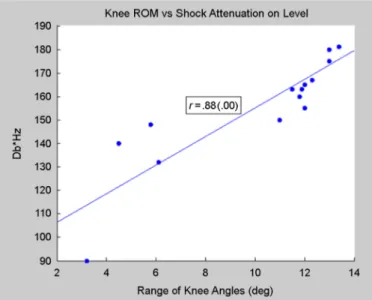
The degree of relationship between the high-frequency attenuation magnitude of impact shock and knee and ankle flexion-extension according to downhill running slope was analyzed by using the afore- mentioned procedure and data analysis, the results of which are shown in (Figures 2~7). According to the results, in level running, the increase in knee flexion-extension ROM was correlated with a greater magni- tude of impact shock attenuation. The correlation between these two variables appeared high at r=.88 (p<.05). On the other hand, in level running, ankle flexion-extension ROM and high-frequency attenuation of impact shock showed a low negative relationship with r=-.22 (p>.05).
In 7° downhill slope running, knee joint flexion-extension ROM and high-frequency attenuation of impact shock showed a high positive correlation of r=.65 (p<.05), which was lower than the correlation during level running, but still statistically significant. Under this slope condition, ankle joint flexion-extension ROM and high-frequency atten- uation of impact shock showed a low negative correlation of r=-.03
(p>.05), which was not statistically significant.
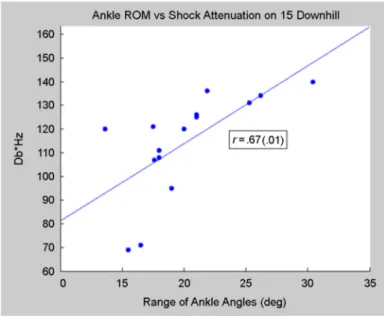
In 15° downhill running, with a steeper downhill slope, knee joint flexion-extension ROM and high-frequency attenuation of impact shock showed a high correlation of r=.58 (p<.05). Under this condition, ankle joint flexion-extension ROM and high-frequency attenuation of impact shock showed a high correlation of r=.67 (p<.05). In summary, we found that during running, the magnitude of impact shock attenuation and knee flexion-extension ROM were closely associated. The degree of their relationship was highest in level running and showed a decreasing trend with decreasing downhill slope. However, the magnitude of impact shock attenuation and ankle flexion-extension ROM were not highly Figure 1. Top: Accelerometer signals (upper) collected from the tibia
(larger) and sacrum (smaller). Middle: Power spectrum densities. Bottom:
Transfer function.
Figure 2. Correlation between ranges of motion of the knee flexion and the high-frequency attenuation of the impact shock during level running.
Figure 3. Correlation between the range of ankle plantar flexion angles and the high-frequency attenuation of the impact shock during level running.
correlated at level and 7° downhill slope running, but their correlation was high at 15° downhill slope running. The findings in the present study showed that with the smaller downhill slope during running, greater ankle flexion-extension ROM resulted in greater high-frequency attenuation of impact shock. By contrast, the downhill slope being less steep had the characteristics of showing a lower degree of relationship between knee flexion-extension ROM and the magnitude of high- frequency attenuation of impact shock.
DISCUSSION
The present study was conducted with the objective of examining the relationship between lower extremity joint ROM and magnitude of high-frequency attenuation of impact shock components that are generated during running according to downhill slope. The magnitude of high-frequency attenuation of impact shock under 3 different slope conditions for running was observed by using the transformation func- tion that showed the transmission of shock from the tibia to the sacrum. Lower extremity joint flexion-extension ROM was observed Figure 4. Correlation between the range of knee flexion angles and
the high-frequency attenuation of the impact shock during 7° downhill running.
Figure 5. Correlation between the range of ankle plantar flexion angle and the high-frequency attenuation of the impact shock during 7°
downhill running.
Figure 6. Correlation between the range of knee flexion angle and the high-frequency attenuation of the impact shock during 15° downhill running.
Figure 7. Correlation between the range of ankle plantar flexion angles and the high-frequency attenuation of the impact shock during 15°
downhill running.
from the moment of heel strike to forefoot contact with the ground.
In the present study, greater knee flexion-extension ROM resulted in greater attenuation of the high-frequency components of impact shock in level running. This was in agreement with the claims of McMahon et al. (1987) that during running, when the knee joints are flexed, the vertical stiffness and impact shockwave transmitted from the foot to the head are decreased. This is also consistent with the findings of Lafortune, Lake, and Hennig (1996) that increased knee flexion angle resulted in greater impact shock attenuation. Moreover, the findings in the present study can also be viewed as being consistent with the results from a precedent study by Edwards, Derrick, and Hamill (2012), who claimed that having greater knee flexion angle during inline skat- ing resulted in greater impact shockwave attenuation. A review of the findings in the present study showed that regardless of surface slope condition, high-frequency attenuation of impact shock and knee ROM during running showed high correlations. Only downhill running at 15°
slope showed high correlation between ankle ROM and the magnitude of impact shockwave attenuation. Such phenomenon can be viewed as being in the same context as the results from a study by Ryu (2005b) that suggested that ankle flexion-extension ROM was correlated with magnitude of acceleration in time domain. Moreover, although it can be viewed that except for level running, running under 7° and 15°
slope conditions showed knee flexion-extension ROM that is consistent with the magnitude of shock attenuation, an absolute comparison is limited in that it is a comparison of impact shock between time and frequency functions. In going from level running to downhill running with a steeper slope, a decreasing trend was observed in the degree of relationship between the magnitude of high-frequency attenuation of impact shock and knee ROM, whereas an increasing trend was observed in the degree of relationship with ankle ROM. In 15° down- hillslope running, a steep slope condition, appearance of such pheno- menon can be attributed to an effort to reduce impact by reducing the magnitude of ground reaction force, which is relatively smaller than that in level running, through kinematic changes in ankle flexion when touching the ground (Gerritsen, van den Bogert, & Nigg, 1995). The results of the present study suggest that to facilitate impact shock atten- uation during running, level running and running under steep slope conditions, the knee flexion ROM should be increased while maintaining stability. For downhill running under steep slope conditions, a strategy for effective impact shock attenuation would need to involve smooth movement of not only the knees but the ankles as well. Increased knee and ankle flexion-extension ROM during running is believed to alleviate the burden of shock attenuation in biologically passive tissues such as bones and cartilage while promoting activities of active muscles.
In other words, when impact shock during running is attenuated by the muscles that pass the knees and ankles, other tissues in the body can be relatively freer from risk of injury. If impact shock during running is not attenuated by kinematic movements of the joints, the bones and cartilages can be easily exposed to risk of injury from chronic overuse (James & Jones, 1990; Milgrom et al., 1992). High load frequency of impact shock affects the viscoelasticity of cartilages, causing cartilage- specific injuries. In other words, high-frequency vertical contact force with the joints interferes with fluid movement within cartilages and
induces radial displacement and high tension in collagen fibers (Quinn et al., 2001). Therefore, potential differences in dependence on the mechanism of impact shock attenuation can affect not only the risk of injury but also the tissues and joints that are susceptible to injury (Gruber et al., 2014; Smeathers, 1989).
Injuries that occur during running are not limited to impact shock- waves only and are caused by complex interactions between numerous variables (Gruber et al., 2014). In other words, an injury from running is an outcome of complex interactions between many variables such as excessive joint movement and moment, larger active peak of vertical ground reaction force, and muscle atrophy (Gruber et al., 2014; Messier, Davis, Curl, Lowery, & Pack, 1991). In consideration of such theoretical claim, knee and ankle joint flexion-extension ROM in 15° downhill running appeared to be involved more in impact shock attenuation through more-excessive movements than under two other running conditions. However, this can be viewed as the flexion angle being relatively larger than during level running, which caused the internal force of the joints to act more significantly (Gerritsen et al., 1995), there- by presenting greater exposure to injury. In other words, in order to predict injuries from running, excessive joint movement for impact shock attenuation and consequent internal force of the joints must be considered. In downhill running with a relatively steep slope, because the knee and ankle flexion ROM were relatively larger, the internal force acting on the joints was just as large. In particular, as the internal force per ankle flexion angle during running is larger than the internal force of the knee (Gerritsen et al.,1995), strong yet flexible joint movement can be viewed as an important aspect in protecting the ankles from injury due to impact shock attenuation during downhill running at a steep slope.
CONCLUSION
The present study showed that downhill running at a steeper slope resulted in a slightly weaker correlation between the knee flexion- extension ROM and the magnitude of high-frequency attenuation of impact shock, but the magnitude of high-frequency attenuation of impact shock was larger when knee flexion-extension was greater. On the other hand, ankle flexion-extension ROM and magnitude of impact attenuation did not show correlations at level and 7° downhill slope running, but showed a high correlation in running at a steeper slope of 15°. Based on these findings, we believe that in order to prevent injuries caused by high frequency of impact shock transmitted to the body during not only downhill running but also level running, knee flexion angle must be increased through changes in cadence and stride length within the range of maintaining a stable posture during running so that the high frequency of impact shock can be attenuated. In parti- cular, we conclude that in order to withstand the internal force of exces- sive ankle flexion-extension for impact shock attenuation under steep downhill slope conditions, strong yet flexible ankle flexion-extension must be present.
For future studies expounding on this topic, we recommend that the relationship between knee and ankle flexion-extension, varus and valgus movement of the ankles, and impact shock attenuation should
be examined. In addition, the degree of relationship between activation of the lower extremity muscles and impact attenuation should be investigated.
REFERENCES
Azevedo, L. B., Lambert, M. I., Vaughan, C. L., O'Connor, C. M. &
Schwellnus, M. P. (2009). Biomechanical variables associated with Achilles tendinopathy in runners. British Journal of Sports Medicine, 43(4), 288-292.
Bennell, K., Crossley, K., Jayarajan, J., Walton, E., Warden, S. & Kiss, Z. S.
(2004). Ground reaction forces and bone parameters in females with tibial stress fracture. Medicine and Science in Sports and Exercise, 36(3), 397-404.
Bobbert, M. F., Schamhardt, H. C. & Nigg, B. M. (1991). Calculation of vertical ground reaction force estimates during from positional data.
Journal of Biomechanics, 24(12), 1095-1105.
Bredeweg, S. (2011). No relationship between running related injuries and kinetic variables. British Journal of Sports Medicine, 45(4), 328.
Buczek, F. L. & Cavanagh, P. R. (1990). Stance phase and ankle kine- matics and kinetics during level and downhill running. Medicine and Science in Sports and Exercise, 22(5), 669-677.
Chu, M. L., Yazdani_Ardakani, S., Gradisar, I. A. & Askew, M. J. (1986). An in vivo simulation study of impulsive force transmission along the lower skeletal extremity. Journal of Biomechanics, 19(12), 979-987.
Daoud, A., Geissler, G. J., Wang, F., Saretsky, J. & Daoud, Y. A. (2012).
Foot strike and injury rates in endurance runners: A retrospective study. Medicine and Science in Sports and Exercise, 44(7), 1325- 1334.
Denoth, J. (1983). Load on the locomotor system and modeling. In:
Biomechanics of Running Shoes, B.M. Nigg (Ed.). Champaign, IL:
Human Kinetics: 63-116.
Derrick, T. R., Hamill, J. & Caldwell, G. E. (1998). Energy absorption of impacts during running at various stride lengths. Medicine and Science in Sports and Exercise, 30(1), 128-135.
Dick, R. W. & Cavanagh, P. R. (1987). A comparison of ground reaction forces (GRF) during level and downhill running at similar speeds (Abstract). Medicine and Science in Sports and Exercise, 19, S12.
Edwards, W. B., Derrick, T. R. & Hamill, J. (2012). Musculoskeletal atten- uation of impact shock in response to knee angle manipulation.
Journal of Applied Biomechanics, 28(5), 502-510.
Frederick, E. C. (1986). Kinematically mediated effects of sport shoe design: A review. Journal of Sports Sciences, 4(3), 169-184.
Frederick, E. C., Clarke, T. E. & Hamill, C. L. (1984). The effect of running shoe design on shock attenuation. In E. C. Frederick (Ed.), Sport shoes and playing surfaces: Their biomechanical properties (pp.
190-198). Champaign, IL: Human Kinetics.
Gerritsen, K. G. M., van den Bogert, A. J. & Nigg, B. M. (1995). Direct dynamics simulation of the impact phase in heel-toe running.
Journal of Biomechanics, 28(6), 661-668.
Gruber, A. H., Boyer, K. A., Derrick, T. R. & Hamill, J. (2014). Impact shock frequency components and attenuation in rearfoot and forefoot running. Journal of Sport and Health Science, 3(2), 113-121.
Hamill, C. L., Clarke, T. E., Frederick, E. C., Goodyear, L. J. & Goodyear, E. T.
(1984). Effect of grade running on the kinematics and impact force (Abstract). Medicine and Science in Sports and Exercise, 16(2), 184.
Hamill, J., Derrick, T. R. & Holt, K. G. (1995). Shock attenuation and stride frequency during running. Human Movement Science, 14(1), 45-60.
Heiderscheit, B. C., Hamill, J. & Van Emmerik, R. E. A. (2002). Variability of stride characteristics and joint coordination among individuals with unilateral patellofemoral pain. Journal of Applied Biomechanics, 18(2), 110-121.
Hennig, E. M. & Lafortune, M. A. (1991). Relationships between ground reaction force and tibial bone acceleration parameters. International Journal of Sports Biomechanics, 7(3), 303-309.
Hreljac, A., Marshall, R. N. & Hume, P. A. (2000). Evaluation of lower extremity overuse injury potential in runners. Medicine and Science in Sports and Exercise, 32(9), 1635-1641.
James, S. L. & Jones, D. C. (1990). Biomechanical aspects of distance running injuries. In Biomechanics of distance Running (Edited by Cavanagh, P. R.), 249-269. Human Kinetics Publishers, Champaign.
Jan, F. & Richard, L. L. (1992). Structural and mechanical basis of exercise- induced muscle injury. Medicine and Science in Sportsand Exercise, 24(5), 521-530.
Lafortune, M. A., Lake, M. J. & Hennig, E. (1995). Transfer function be- tween tibial acceleration and ground reaction force. Journal of Biomechanics, 28(1), 113-117.
Lafortune, M. A., Lake, M. J. & Hennig, E. M. (1996). Differential shock transmission response of the human body to impact severity and lower limb posture. Journal of Biomechanics, 29(12), 1531-1537.
Lieber, R. L., Thornell, L. A. & Friden, J. (1996). Muscle cytoskeletal dis- ruption occurs within the first 15 min of cyclic eccentric contraction.
Journal of Applied Physiology, 80(1), 278-284.
Mahar, A. T., Derrick, T. R., Hamill, J. & Caldwell, G. E. (1997). Impact shock and attenuation during in-line skating. Medicine and Science in Sports and Exercise, 29(8), 1069-1075.
McMahon, T. A., Valiant, G. A. & Frederick, E. C. (1987). Groucho running.
Journal of Physiology, 62(6), 2326-2337.
Messier, S. P., Davis, S. E., Curl, W. W., Lowery, R. B. & Pack, R. J. (1991).
Etiologic factors associated with patellofemoral pain in runners.
Medicine Science Sports Exercise, 23(9), 1008-1015.
Milgrom, C. (1989) The israeli elite infantry recruit: a model for under- standing the biomechanics of stress fractures. Journal of the Royal College of Surgeons of Edinburgh, 34 Suppl. 6: S18-S21.
Milgrom, C., Finestone, A., Shlamkovitz, N., Wosk J., Laor, A., Voloshine, A. & Eldad, A. (1992). Prevention of overuse injuries of the foot by improved shoe shock attenuation. Clinical Orthopaedics and Related Research, 281, 189-192.
Milner, C. E., Ferber, R., Pollard, C. D., Hamill, J. & Davis, I. S. (2006). Bio- mechanical factors associated with tibial stress fracture in female runners. Medicine and Science in Sports and Exercise, 38(2), 323- 328.
Queen, R. M., Mall, N. A., Nunley, J. A. & Chuckpaiwong, B. (2001).
Difference in plantar loading between flat and normal feet during different athletic tasks, Gait & Posture, 29(4), 582-586.
Radin, E. L., Parker, H. G., Pugh, G. V., Steinberg, R. S., Paul, I. L. & Rose, R.
M. (1973). Response of joints to impact loading. Journal of Bio- mechanics, 6(1), 51-57.
Ryu, J. S. & Yoon, H. J. (2005). A study on the magnitudes of impact force, impact shock, and shock attenuation of the elderly during the running. Korean Journal of Physical Education, 44(2), 327-340.
Ryu, J. S. (2005a). Gender differences in the impact magnitude and its attenuation during running. Korean Journal of Sport Biomechanics, 15(1), 91-109.
Ryu, J. S. (2005b). Impact shock and kinematic characteristics of the lower extremity’s joint during downhill running. Korean Journal of Sport Biomechanics, 15(4), 117-129.
Ryu, J. S. & Lim, G. Y. (2015). Impact shock components and atten- uation in flat foot running. Korean Journal of Sport Biomechanics, 25(3), 283-291.
Shorten, M. R. & Winslow, D. S. (1992). Spectral analysis of impact shock during running. International Journal of Sports Biomechanics, 8(4), 288-304.
Smeathers, J. E. (1989). Transient vibrations caused by heel strike. Pro- ceedings Institute Mechanical Engineering, H203(4), 181-186.
Stergiou, N., Giakas, G., Byrne, J. E. & Pomeroy, V. (2002). Frequency domain characteristics of ground reaction forces during walking of young and elderly females. Clinical Biomechanics, 17(8), 615-617.
van Gent, R. M., Siem, D., van Middlekoop, M., van Os, A. G., Bierma- Zeinstra, A. M. A. & Koes, B. W. (2007). Incidence and determinants of lower extremity running injuries in long distance runners: a systematic review. British Journal of Sports Medicine, 41(8), 469- 480.
Voloshin, A., Mizrahi, J., Verbitsky, O. & Isakov, E. (1998). Dynamic loading on the human musculoskeletal system-effect of fatigue. Clinical Biomechanics, 13(7), 515-20.
Zifchock, R. A., Davis, I. S. & Hamill, J. (2006). Kinetic asymmetry in female runners with and without retrospective tibial stress fractures.
Journal of Biomechanics, 39(15), 2792-2797.