• 검색 결과가 없습니다.

Landslide Susceptibility Analysis in Baekdu Mountain Area Using ANN and AHP Method

N/A
N/A
Protected

Academic year: 2021

Share "Landslide Susceptibility Analysis in Baekdu Mountain Area Using ANN and AHP Method"

Copied!
7
0
0

로드 중.... (전체 텍스트 보기)

전체 글

(1)

1) Department of Civil Engineering, Yanbian University

Landslide Susceptibility Analysis in Baekdu Mountain Area Using ANN and AHP Method

Hechun Quan

1)

・ Hongduk Moon

2)

・ Guangri Jin

・ Sungsik Park

3)

Received: September 1

st

, 2014; Revised: September 18

th

, 2014; Accepted: November 10

th

, 2014

ABSTRACT : To analyze the landslide susceptibility in Baekdu mountain area in china, we get two susceptibility maps using AcrView software through weighted overlay GIS (Geographic Information System) method in this paper. To assess the landslide susceptibility, five factors which affect the landslide occurrence were selected as: slope, aspect, soil type, geological type, and land use. The weight value and rating value of each factor were calculated by the two different methods of AHP (Analytic Hierarchy Process) and ANN (Artificial Neural Network). Then, the weight and rating value was used to obtain the susceptibility maps. Finally, the susceptibility map shows that the very dangerous areas (0.9 or higher) were mainly distributed in the mountainous areas around JiAnShi, LinJiangShi, and HeLongShi near the china-north Korea border and in the mountainous area between the WangQingXian and AnTuXian. From the contrast two susceptibility map, we also Knew that The accuracy of landslide susceptibility map drew by ANN method was better than AHP method.

Keywords : Landslide, Susceptibility, GIS, ANN, AHP Journal of the Korean Geo-Environmental Society 15(12): 79~85. (December, 2014) http://www.kges.or.kr

ISSN 1598-0820 DOI http://dx.doi.org/10.14481/jkges.2014.15.12.79

1. Introduction

Landslides are significant natural hazards in many areas around the world. Globally, they cause hundreds of billions of dollars in damage, and hundreds of thousands of death and injuries each year (Aleotti & Chowdhury, 1999). Over the past 25 years, many governments and international research institutions have invested considerable resources in assessing landslide hazards and in attempting to produce maps of portraying their spatial distribution (Guzzetti et al., 1999).

The core techniques for studying landslides are a landslide survey, estimation and prediction of a landslide occurrence and real time monitoring.

Several researches about the landslide susceptibility analysis have been performed in the recent past. In china, Sun et al.

(2002) made the study about the debris flows around the tourist are of Baekdu Mountain and find that spatial distribution of debris flow is interrelated with the developing condition of talus. Wang & Cao (2004) presented the regularity of collapse-slide disaster and suggested dredging, hitching and blocking out cranny as control methods around the Baekdu Mountain tourist area.

In oversea, it has been tried to portray an objective and quantitative landslide risk map based on a conditional probability model, certainty factor model, and fuzzy set model (Chuang et al., 1995). There was also some research that analyzed the models through a logistic regression analysis using factors, such as aspect, height, land cover, soil drainage and so on (Dai & Lee, 2002). Yesilnacar & Topal (2005) performed a study about landslides in Turkey. In their study, two different approaches, logistic regression and neural networks, were applied in order to prepare a susceptibility map. Finally, they found that the susceptibility map prepared by a neural network was more realistic. Yalcina et al. (2011) did a study about the landslide susceptibility mapping using frequency ratio, analytical hierarchy process, bivariate statistics and logistics regression methods.

Baekdu mountain area has deep grooves and steep slopes

and whole landscape is very rugged and very ups and downs

of diverse. The activity of the structural earthquake is very

frequent, geological environment quality is poorer and the

rainy season is more in this area. Thus, these disadvantage

factors will eventually cause the occurrence of various geological

disasters such as landslide, debris flow and collapse. In recent

(2)

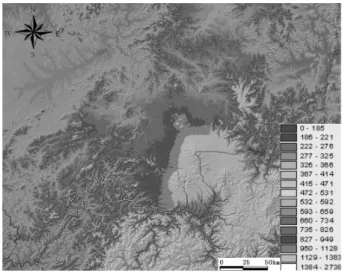
Fig. 1. The study area in Baekdu mountain Fig. 2. The DEM in Baekdu mountain year, some researchers made studies about the landslide,

debris flow and collapse-slide in Baekdu Mountain area. But these studies just confined to the local area or a certain landslide events. The information about the disaster is scattered and not formed a system effectively. Thus, it is necessary to analyze the landslide susceptibility using GIS and RS in all area of Baekdu mountain.

2. The Study Area

The Baekdu mountain area is located in the border of three countries of the china, russia and north korea in the eastern JiLin province, and face the east sea (approximately 125°20'E to 131°20'E, 40°40'N to 44°30'N). In the area, the whole west region is higher than east region and the HunChun region is the lowest area. The mountains, hilly and basin are mainly distributed in the study area. Mountains are mostly distributed in the surrounding areas, the hill are mostly distributed in the edge of the mountains and the basin are mainly distributed in the between the mountains or on the both sides of the rivers as shown in Fig. 1.

3. Materials and Methods

To analysis the landslide susceptibility, many studies that used natural and artificial, or causal and triggering factors together have been done before. From the different kind of factors, causative factors are the basis of an LSA (Landslide

Susceptibility Analysis); as many as 40 factors have been used in the building of discriminant LSA models (Guzzetti et al., 1999). However, to make the LSA model more compact and effective, we must consider the availability, effectiveness, and independence of each factor. In this study, for the reason that some data of the factors are very hard to get and some factors are not very important to analyze the susceptibility, so just five factors were selected to analyze the landslide susceptibility. The slope, aspect, soil type, geological type, and land cover were selected as casual factors.

For the landslide susceptibility analysis, several qualitative or quantitative approaches were used. Early attempts defined susceptibility classes by qualitative overlaying of geological and morphological slope-attributes to landslide inventories (Nielsen et al., 1979). More sophisticated assessments involve AHP, bivariate, multivariate, logistics regression, fuzzy logic, artificial neural network etc. (Carrara, 1983; van Westen, 1997; Dai et al., 2001; Lee & Min, 2001; Ercanoglu &

Gokceoglu, 2004; Lee et al., 2004; Komac, 2006).

Considering the condition of Baekdu mountain area and characteristic of each analysis method, AHP and ANN methods were used for the landslide susceptibility analysis and compared the suitability between these two methods.

3.1 Landslide Occurrence Related Factors

3.1.1 Slope

The slope is directly related to the landslides. It is frequently used in preparing landslide susceptibility maps (Yalcin, 2008).

Slope was calculated from the DEM (Digital Elevation

(3)

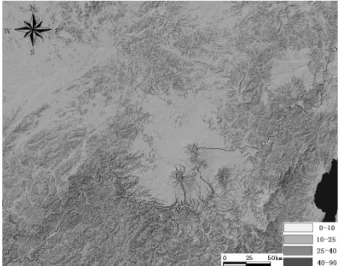
Fig. 3. The slope map

Fig. 4. The aspect map Fig. 5. The geological classification map

Model). The DEM is one of the most important factors in the GIS. The DEM expresses the land surface by a regular grid or arbitrary point connected by a triangle. The 90 m

× 90 m DEM used in this study was developed from the SRTM (Shuttle Radar Topography Mission) as shown in Fig.

2. The slope map generated from the DEM was divided into nine slope categories and it was reclassified to four levels for the LSA as shown in Fig. 3. The resolution and scale of the slope map is same with the DEM.

3.1.2 Aspect

Like slope, aspect is one of the important factors in preparing landslide susceptibility maps. Aspect related parameters such as exposure to sunlight, winds, rainfall (degree of saturation), and discontinuities may control the occurrence of landslides (Yalcin, 2008).

The aspect map displays the distribution of each direction in the topography by using different colors to each cell of the study area. The aspect map generated from the DEM was divided into nine slope categories as shown in Fig. 4.

The resolution and scale of the aspect map is also same with the DEM.

3.1.3 Geological Type

It is widely recognized that geology greatly influences the occurrence of landslides, because lithological and structural variations often lead to a difference in strength and permeability of rocks and soils (Pradhan & Lee, 2010).

Fig. 5 shows a geological map used in this study and it is generally classified into four types as Loose rock porosity aquifer, Clastic rock void fracture aquifer, Carbonate solution fissure aquifer and Metamorphic rock fissure aquifer. Each kind of types also classified in to four levels as A (very high), B (high), C (normal), D (very low) according to the water storage capacity as shown in Fig. 5.

3.1.4 Soil Type

Soil type is also one of the important factors to preparing

landslide susceptibility map. Especially, the drainage conditions

of the soil directly influence the weight of the soil when

typhoon or heavy rain came. The soil map used in this study

was finally reclassified to 4 levels as A (very high), B (high),

C (normal), D (very low) according to their drainage and

intensity conditions as shown in Fig. 6.

(4)

Fig. 6. The soil classification map

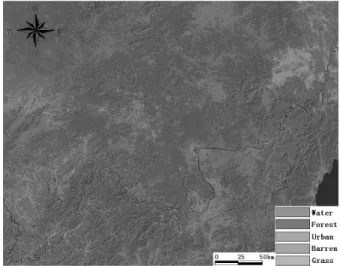
Fig. 7. The land cover classification map

Table 1. The setting values for neural network training

Setting factors Values

Input layer 5

Hidden layer 10

Output layer 2

The number of weights

between input and hidden layer 50 The number of weights

between hidden and output layer 10

Learning cycles 50,000

Table 2. The learning rates and momentum No

Factor 1 2 3 4 5 6 7 8

Learning rate 0.01 0.01 0.01 0.01 0.1 0.1 0.1 0.1

Momentum 0.1 0.3 0.5 0.7 0.1 0.3 0.5 0.7

No

Factor 9 10 11 12 13 14 15 16

Learning rate 0.3 0.3 0.3 0.3 0.5 0.5 0.5 0.5

Momentum 0.1 0.3 0.5 0.7 0.1 0.3 0.5 0.7

Fig. 8. The weight value of each input factor

3.1.5 Land Cover

Land cover is also frequently used in preparing landslide susceptibility maps. A land cover classification is one of the most representative and typical methods of remote sensing and it can classify physical circumstances of the earth surface like forest, grassland, and concrete pavement. In this study, the whole area of Baekdu mountain was classified into five classes as forest, grass, urban, barren and water as shown in Fig. 7 using supervised classification. This classified image was applied to an analysis of a landslide.

3.2 The Application of ANN Method

An ANN (Artificial Neural Network) is defined by neurons, topological structure, and learning rules. The neuron is the fundamental processing unit of an ANN for computation (Jensen et al., 1999). Analogous to the human brain's biological neuron,

an artificial neuron is composed of inputs (dendrites), weights (synapses), processing units (cell bodies), and outputs (axons) (Hagan et al., 1996).

Kavzoglu (2001) suggested that an appropriate sample size needed for neural network analysis be between ・ 

・ 

 

and  ・ 

・ 

  (

: number of input layers), so the sample size used in this study was decided according to the suggestion. The neuron number of the hidden layer was 10, the numbers of the input layer, output layer and weights between the input and hidden layer were shown in Table 1.

Generally, 50,000 times of circulation were proceeded to achieve a designed error value as 0.01.

In the ANN method, learning rates and momentum values

are the important parameters influencing the convergence of

the model. To calculate a relative importance of each input

(5)

Table 3. Fundamental scale for pair-wise comparisons

1 Equal importance

3 Moderate importance

5 Essential or strong importance 7 Very strong or demonstrated importance

9 Extremely high importance

2, 4, 6, 8 intermediate values

Table 4. The weight values between each factor

Factors Slope Aspect Geology Soil Landuse

Slope 1 5 3 2 4

Aspect 1/5 1 1/3 1/4 1/2

Geology 1/3 3 1 1/2 2

Soil 1/2 4 2 1 3

Landuse 1/4 2 1/2 1/3 1

Weight 0.44 0.07 0.15 0.24 0.1

Table 5. The rating values of each factor

Factors (Weight / %) Classification Rating value / %

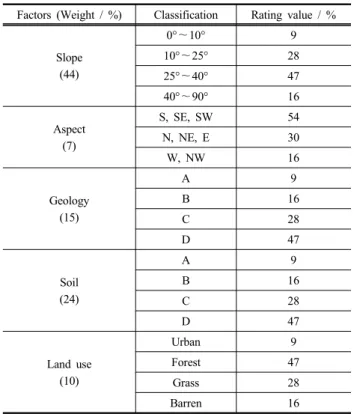
Slope (44)

0°~10° 9

10°~25° 28

25°~40° 47

40°~90° 16

Aspect (7)

S, SE, SW 54

N, NE, E 30

W, NW 16

Geology (15)

A 9

B 16

C 28

D 47

Soil (24)

A 9

B 16

C 28

D 47

Land use (10)

Urban 9

Forest 47

Grass 28

Barren 16

factor, we used 16 pairs of the learning rates and momentum values as shown in Table 2. Finally, the relative importance of each input factor calculated by an ANN method was shown in Fig. 8.

3.3 The Application of AHP Method

AHP was firstly introduced by the Saaty (1980) and it was the abbreviation of the words, “Analytic Hierarchy Process”, and could be explained as a hierarchical analysis process.

AHP gained wide application in site selection, suitability analysis, regional planning, and landslide susceptibility analysis (Ayalew et al., 2005). For the landslide susceptibility analysis, the weight value and rating value of factors are to be known.

The weight value was relatively important in factors such as slope, Aspect, and land cover. The rating value was relatively important in classes of each factors.

To get weight and rating value in AHP, one has to build a pair wise comparison matrix with scores given in Table 3. When the factor on the vertical axis is more important than the factor on the horizontal axis, this value varies between 1 and 9. Conversely, the value varies between the reciprocals 1/2 and 1/9 as shown in Table 4. The diagonal boxes of a pair wise comparison matrix always take a value of 1. Finally, the rating and weight values were shown in Table 5.

3.4 The Landslide Susceptibility Analysis using GIS Overlay Method

To generate the susceptibility map, we used the GIS overlay method. The new attribute value generated by an overlay is converted and generated by a function so that attribute values corresponded to many layers used in the overlay are able to defined as a function, which can be written as follows:

        ⋯

U : Attribute value generated by an overlay f : Conversion function applied to an overlay

A, B, C, … : Attribute value of layers used in an overlay

At this time, an applicable function is possible to apply from a simple operation like addition or subtraction to a more complicated operation or numerical formula through a pattern.

In this study, a slope map, aspect map, geology map, soil

map, and land cover map were used as the attribute values

(A, B, C, …) of the layer. In the process of a calculation,

a weighted overlay operation was used for a transformation

function (f) applied to an overlay and layers were piled up

one another after a generated model considered all the

weights of the factors which had an influence on a landslide

(6)

Fig. 9. The weighted overlay model

Fig. 10. The landslide susceptibility map generated by ANN method

Fig. 11. The landslide susceptibility map generated by AHP method susceptibility as shown in Fig. 9. An attribute value (U) generated by an overlay was made out of a landslide sus- ceptibility map of the study area using the weight and rating value calculated by ANN method. The susceptibility map as shown in Fig. 10 and Fig. 11 were respectively generated by the ANN method and AHP method.

4. Results and Discussions

The susceptibility map was classified to four levels. Level 1 (0~0.7) is the very low susceptibility area, level 2 (0.7~

0.8) and level 3 (0.8~0.9) are the low and high susceptibility areas and the level 4 (0.9 or higher) corresponds to very high susceptibility area, respectively. The area of the each level was showed in Fig. 9 and Fig. 10. The susceptibility area of a landslide were expressed by a red and yellow color in the susceptibility map and the result show that the very dangerous areas (0.9 or higher) were mainly distributed in the mountainous areas around JiAnShi, LinJiangShi, and HeLongShi near the china-north Korea border and in the mountainous area between the WangQingXian and AnTuXian.

To analyze the accuracy of the susceptibility maps generated by ANN and AHP methods, we made a contrast between the susceptibility map and geological disaster map in Baekdu mountain area. The geological disaster map was made by remote sensing technique and has carried on the detailed interpretation of 128 landslides in Jilin province. We selected 11 landslides for analyzing the accuracy of susceptibility map. The result of the contrast showed that really happened landslide areas were mostly included in the very dangerous areas (0.9 or higher) in susceptibility map made by ANN method than AHP method and 9 landslides were correctly recognized by ANN method but AHP method just recognized 5 landslides. The main reason of ANN method better than AHP was that AHP method include some subjective analysis during the landslide susceptibility analysis process.

5. Results and Discussions

In this study, we analyzed landslide susceptibility in Baekdu mountain area by portraying the susceptibility maps using ANN and AHP method, and the following conclusions are drawn.

First, according to the weight values calculated by the ANN method, the weight values of slope, soil and geology were 36 %, 25 % and 18 %, respectively, and these accounted for 79 % of entire value. Then, we assumed that the slope, soil and geology were the most important factors to analyze landslide susceptibilities.

Second, according to the susceptibility maps, the very

(7)

dangerous areas (0.9 or higher) were mainly distributed in the mountainous areas around JiAnShi, LinJiangShi, and HeLongShi near the china-north Korea border and in the mountainous area between the WangQingXian and AnTuXian.

Third, to analyze the accuracy of the susceptibility maps generated by ANN and AHP method, we made a contrast between the susceptibility maps and geological disaster map in Baekdu mountain area. After the comparison between two maps, we found that ANN and AHP method can be used to analyze the landslide susceptibility and ANN method was better than AHP to portray the susceptibility map in Baekdu mountain area.

Acknowledgments

This research was supported by the Public Welfare & Safety Research Program through the National Research Foundation of Korea (NRF) funded by the Ministry of Science, ICT &

Future Planning (2012M3A2A1050982).

References

1. Aleotti, P. and Chowdhury, R. (1999), Landslide hazard assessment:

summary review and new perspectives, Bulletin of Engineering Geology and the Environment, Vol. 58, No. 1, pp. 21~44.

2. Ayalew, L., Yamagishi, H., Marui, H. and Kanno, T. (2005), Landslides in sado island of Japan: Part II. GIS-based suscepti- bility mapping with comparisons of results from two methods and verifications, Engineering Geology, Vol. 81, No. 4, pp.

432~445.

3. Carrara, A. (1983), A multivariate model for landslide hazard evaluation, Mathematical Geology, Vol. 15, No. 3, pp. 403~426.

4. Chung, C. F., Fabbri, A. G. and van Westen, C. J. (1995), Multivariate regression analysis for landslide hazard zonation, Geographical Information Systems in Assessing Natural Hazards, Vol. 5, No. 1, pp. 135~175.

5. Dai, F. C. and Lee, C. F. (2002), Landslide characteristics and slope instability modeling using GIS, Lantau island, Hong kong, Geomorphology, Vol. 42, No. 3-4, pp. 213~228.

6. Dai, F. C., Lee, C. F., Li, J. and Xu, Z. W. (2001), Assessment of landslide susceptibility on the natural terrain of Lantau Island, Hong Kong, Environmental Geology, Vol. 43, No. 3, pp. 381~391.

7. Ercanoglu, M. and Gokceoglu, C. (2004), Use of fuzzy relations to produce landslide susceptibility map of a landslide prone area (West Black Sea Region, Turkey), Engineering Geology, Vol. 75, No. 3~4, pp. 229~250.

8. Guzzetti, F., Carrara, A., Cardinalli, M. and Reichenbach, P.

(1999), Landslide hazard evaluation: a review of current techniques and their application in a multi-scale study, Central Italy, Geomorphology, Vol. 31, No.1~4, pp. 181~216.

9. Hagan, M. T., Demuth, H. B. and Beale, M. (1996), Neural network design, Boston: PWS Publishing. pp. 4~26.

10. Jensen, J. R., Qiu, F. and Ji, M. (1999), Predictive modeling of coniferous forest age using statistical and artificial neural network approaches applied to remote sensing data, International Journal of Remote Sensing, Vol. 20, No. 14, pp. 2805~2822.

11. Kavzoglu, T. (2001), An investigation of the design and use of feedforward artificial neural networks in the classification of remotely sensed images, PhD thesis, University of Nottingham, School of Geography, pp. 306.

12. Komac, M. (2006), A landslide susceptibility model using the analytical hierarchy process method and multivariate statistics in perialpine Slovenia, Geomorphology, Vol. 74, No. 1~4, pp.

17~28.

13. Lee, S. R., Choi, J. W. and Min, K. D. (2004), Probabilistic landslide hazard mapping using GIS and remote sensing data at Boun, Korea, International Journal of Remote Sensing, Vol.

25, No. 11, pp. 2037~2052 (in Korean).

14. Lee, S. R. and Min, K. D. (2001), Statistical analysis of landslide susceptibility at Yongin, Korea, Environmental Geology, Vol. 40, No. 9, pp. 1095~1113 (in Korean).

15. Nielsen, T. H., Wrigth, R. H., Vlasic, T. C. and Spangle, W.

E. (1979), Relative slope stability and land-use planning in the San Francisco Bay region, California, US, Geological Survey Professional Paper, Vol. 200, No. 944, pp. 3~23.

16. Pradhan, B. and Lee, S. (2010), Landslide susceptibility assessment and factor effect analysis: backpropagation artificial neural networks and their comparison with frequency ratio and bivariate logistic regression modelling, Environmental Modelling & Software, Vol. 25, No. 6, pp. 747~759.

17. Saaty, T. L. (1980), The analytic hierarchy process, McGraw-Hill, pp. 11~76.

18. Sun, P., Wang, G. C. and Cao, B. L. (2002), Research on the debris flows hazard in the tourist area of Changbai mountain, World geology, Vol. 21, No. 2, pp. 64~67.

19. van Westen, C. J. (1997), Statistical landslide hazard analysis.

ILWIS 2.1 for Windows application guide, ITC Publication, Enschede, pp. 73~84.

20. Wang, H. and Cao, B. L. (2004), Research on influence factors of collapse-slide in tourist area of Changbai mountain, World geology, Vol. 23, No. 1, pp. 58~61.

21. Yalcin, A. (2008), GIS-based landslide susceptibility mapping using analytical hierarchy process and bivariate statistics in Ardesen (Turkey); Comparisons of results and confirmations, Catena, Vol. 72, No. 1, pp. 1~12.

22. Yalcina, A., Reisb, S., Aydinogluc, A. C. and Yomralioglu, T.

(2011), A GIS-based comparative study of frequency ratio, analytical hierarchy process, bivariate statistics and logistics regression methods for landslide susceptibility mapping in Trabzon, NE Turkey, CATENA, Vol. 85, No. 3, pp. 274~287.

23. Yesilnacar, E. and Topal, T. (2005), Landslide susceptibility

mapping: A comparison of logistic regression and neural networks

methods in a medium scale study, Hendek region (Turkey),

Engineering Geology, Vol. 79, No. 3~4, pp. 251~266.

수치

Fig. 1. The study area in Baekdu mountain Fig. 2. The DEM in Baekdu mountainyear, some researchers made studies about the landslide,
Fig. 3. The slope map
Table 2. The learning rates and momentum No  Factor 1 2 3 4 5 6 7 8 Learning rate 0.01 0.01 0.01 0.01 0.1 0.1 0.1 0.1 Momentum 0.1 0.3 0.5 0.7 0.1 0.3 0.5 0.7 No Factor 9 10 11 12 13 14 15 16 Learning rate 0.3 0.3 0.3 0.3 0.5 0.5 0.5 0.5 Momentum 0.1 0.3 0
Table 5. The rating values of each factor
+2

참조

관련 문서