*정회원, 울산대학교 전기전자정보시스템공학부 접수일자 : 2013년 5월 1일, 수정완료 : 2013년 9월 7일 게재확정일자 : 2013년 10월 11일
Received: 1 May, 2013 / Revised: 7 September, 2013 / Accepted: 11 October, 2013
*Corresponding Author: [email protected]
School of Electrical Engineering, University of Ulsan, Korea http://dx.doi.org/10.7236/JIIBC.2013.13.5.65
JIIBC 2013-5-8
레일리 페이딩 채널을 통해 결합된 등가 이득 협력 라우팅의 에너지 효율
Energy Efficiency of Cooperative Routing with EGC Over Rayleigh Fading Channel
공형윤*, Truc Thanh Tran Hyung-Yun Kong, Truc Thanh Tran
요 약 본 논문에선, 정적 무선 네크워크에서 에너지 절약을 얻기 위한 멀티 홉 협력 전송 프로토콜을 제안한다. 네 트워크의 각 터미널에서는 수신된 신호를 각 수신단에서 등 이득 결합 기법을 사용하고 단일 안테나를 설치한다. 또 한, 각 구간에서 최적의 전체 전송 전력의 할당 방법을 제안한다. 몬테-카를로 시뮬레이션으로 평균 전체 전송 전력 과 구간의 평균 수의 부분에서 멀티 홉 직접 전송(MDT)와 Khadani에 의해 제안된 협력 라우팅 프로토콜을 제안된 프로토콜로 성능을 비교 분석한다.
Abstract In this paper, we propose a multi-hop cooperative transmission protocol to obtain energy savings in static wireless networks. Each terminal in the network is equipped with a single antenna and each receiver uses equal gain combining technique (EGC) to combine received signals. We also propose a power allocation strategy which optimizes the total transmit power at each stage. Monte-Carlo simulations are presented to evaluate and compare performance of the proposed protocol with the multi-hop direct transmission (MDT) and the cooperative routing protocol proposed by Khadani [8], in terms of the average total transmit power and the average number of required stages.
Key Words : Cooperative routing, equal gain combining, Rayleigh fading channel, multi-hop transmission.
Ⅰ. Introduction
Nowadays, the problem of energy efficiency communication in multi-hop wireless networks has received a lot of attention. To obtain energy savings for multi-hop approaches, cooperative communication [1-3]
can be used efficiently. Cooperative diversity exploits the broadcast nature of the wireless channel and allows
single-antenna radios to share their antennas to form a virtual antenna array. Cooperative protocols can obtain higher performance as compared to direct transmission in terms of diversity order and error rate. Hence, for the same performance such as throughput, transmission rate, outage probability, bit error rate, symbol error rate and packet error rate, the use of cooperative relaying techniques can reduce the average
total transmit power which is an important issue in wireless systems such as wireless sensor networks (WSNs).
In multi-hop cooperative transmission strategies [4-8], each relay node exploits cooperative diversity transmission to enhance the reliability of the data transmission. In [8], Khandani et al proposed an efficient protocol in which a terminal cooperates previous ones to reduce the power consumption. However, the authors in [8] assumed that all channels between two nodes are same and capture slow Rayleigh fading channels. In practice, the channels between two arbitrary nodes can be different with each other and vary with time. Furthermore, because the protocol in [8]
cannot reduce the number of stages for each data transmission, the transmission times used in this protocol cannot be reduced.
To enhance the system performance, one of the combining techniques [9], i.e., Selection Combining (SC), Equal Gain Combining (EGC) or Maximal Ratio Combining (MRC) can be employed at the receivers to combine the received signals. In SC technique, the signal from the diversity path with the largest instantaneous signal-to-noise ratio (SNR) is selected for the decoding. In EGC technique, the combiner coherently combines all available paths weighting each with equal gain while MRC technique coherently combines all available paths but weighs each with the respective ones. Among these techniques, MRC gives the best and the optimum performance, SC gives the most inferior performance, and EGC has a performance quality in between the others [10].
In this paper, we propose a cooperative routing protocol in order to reduce the power consumption and the number of transmission times in multi-hop networks. In the proposed scheme, each relay on the route uses EGC technique to combine received signals from the source and relays. We provide Monte-Carlo simulation results to evaluate and compare the performance of the proposed protocol (named CR2) with that of the multi-hop direct transmission protocol
(MDT) and the protocol presented in [8] (named CR1).
Results present that the proposed protocol reduces the average total transmit power and the average number of stages used for the transmissions.
The rest of the paper is organized as follows. The system model is described in Section II. The simulation results are presented in Section III. Finally, the paper is concluded in Section IV.
Ⅱ. System Model
1. Power Allocation Problems
At first, we consider the direct transmission between two nodes, e.g., node i and node j. The signal received at node j due to the transmission of node i is given by
(1) where is AWGN noise with variance at terminal j, is fading coefficient between nodes i and j, s is the signal transmitted by node i and is transmit power of node i. It is noted that although is assumed to follow Rayleigh distribution, our algorithm can be applied for all of the fading environments.
To take path loss in account, we can model the variance of channel coefficient as [5]:
(2) where is called path loss exponent and is the distance between nodes i and j.
From (1), the received SNR at node j is given by
(3) If ≥ , where is predetermined threshold, node j is assumed to decode successfully the received signal. Therefore, the minimum transmit power of node i is given as
(4) Next, we consider the cooperative transmission scheme in which a set of N sources, i.e.,
, which attempt to transmit the same signal s to the destination j. Node j uses EGC technique to combine all the received signals. In this case, the instantaneous SNR at the output of the combiner is given as [11]:
(5)
where is transmit power of the transmitter , and is channel coefficient between nodes and j.
Also, the received SNR at the destination j must satisfy the condition ≥ so that it can successfully decode the signal s. Therefore, our objective here is to find the minimum value of total
transmit power
. Now, utilizing
Cauchy–Schwarz inequality for (5), we obtain (6) as
≤
(6) For (6), the condition of equality can be given as
(7)
Hence, an optimal transmit power solution is given as
(8)
where
.
2. Minimum-Energy Evaluation
We consider an M-hop route between the source
and the destination . On the route, there are (M-1) relays, i.e., , , ..., , which are ready to forward the source signal to the destination. The
relays are numbered follows their distance to the destination, i.e., the is furthest and the relay
is nearest.
In the MDT protocol, the source signal is relayed hop-by-hop from the source to the destination.
Therefore, the MDT protocol must use M stages to relay the source signal. At each stage, by using (4), we obtain the minimum transmit power of node . So, the minimum total transmit power of the MDT protocol is calculated by
(9)
Now, we remind the operation of the cooperative routing protocol (CR1) proposed by Khadani in [8]. It is noted that for a fair comparison with our scheme, we assume that all of the receivers in the CR1 protocol use EGC technique to combine the received signals. At the first phase, the source transmits its signal to relay
. By using (4), the minimum transmit power of the source in the first stage is given as
(10)
At the second phase, the nodes and cooperate to transmit the source signal to the node . Then, the node uses EGC to combine the received signals and do decoding. Generally, at the stage, nodes , , ..., cooperate to transmit the signal to the node . By using the results in (8), the optimal transmit power in this stage can be given as
(11)
Therefore, the optimal transmit power of the CR1 protocol can be obtained as
(12)
Next, we present the operation of the proposed scheme. In our scheme, at each stage, we find a optimal receiver so that this receiver can decode the signal
successfully and the total transmit power of the transmitting nodes is minimum. At the first phase, the source transmits its signal to the destination and relays. By using (4), we can obtain the minimum transmit power of the source so that node can decode the source signal successfully, where
∈. Then, the receiver in this stage is chosen follows the strategy as
(13) If ≡, we stop the search algorithm at this stage and in this case the total transmit power of the CR2 protocol is
. If
≠, the search algorithm goes to step 2 in which the source and the relay
cooperate to forward the source signal to remaining nodes.
Generally, at the stage, we assume the set of the transmitting nodes is
.
Also, at this stage, we also calculate the optimal transmit power by using (8), where
∈. Then, the node at this stage is chosen by using the following strategy as
(14) Next, if ≡, the proposed algorithm ends at this stage and the total transmit power is given as
(15)
Otherwise, the algorithm goes to step m+1 with the transmitting set
. We can observe that the CR2 uses one stage at least and M stages at most. Hence, the proposed scheme can reduce the number of the required stages in average, as compared with the MDT protocol and the CR1 protocol.
III. Simulation Results
Now, we provide some Monte-Carlo simulations to
evaluate and compare the performance of the considered protocols. We consider line network, in which all nodes are placed on straight line and the distance between two adjacent nodes is normalized to 1. In all simulations, we make 10000 trials and the total transmit power is averagely calculated.
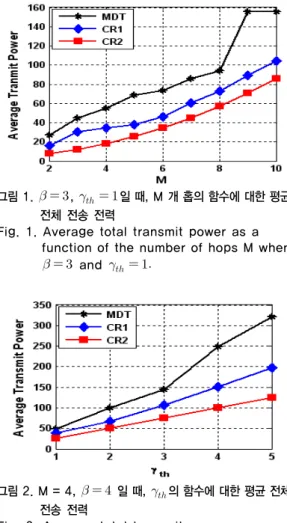
Fig. 1 presents the average total transmit power as a function of the number of hops M when the path-loss exponent and the threshold value are 3 and 1, respectively. As we can see, the transmit power of the CR2 protocol is lower than that of the MDT protocol and the CR1 protocol for all values M. It is apparent from this figure that the total transmit power of the protocols increase with the increase of M.
그림 1. , 일 때, M 개 홉의 함수에 대한 평균 전체 전송 전력
Fig. 1. Average total transmit power as a function of the number of hops M when
and
그림 2. M = 4, 일 때, 의 함수에 대한 평균 전체 전송 전력
Fig. 2. Average total transmit power as a function of when M=4 and .
In Fig. 2, we investigate impact of the threshold value on the average total transmit power when M=4 and . The simulation results present that the CR2 protocol consumes least power, among three considered protocols. In addition, it can be seen that the average total power consumption increases with increasing .
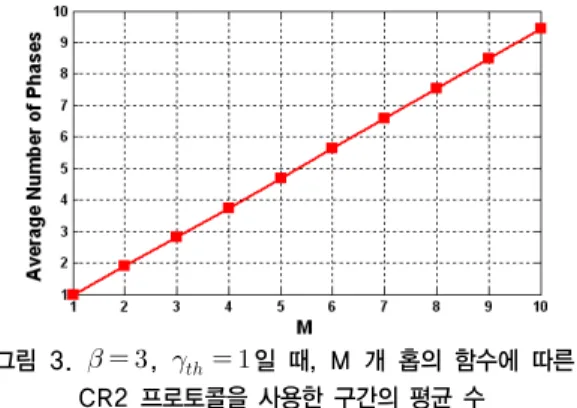
그림 3. , 일 때, M 개 홉의 함수에 따른 CR2 프로토콜을 사용한 구간의 평균 수 Fig. 3. Average number of stages used in the
CR2 protocol as a function of M when
and
In Fig. 3, we draw the average number of stages used in the CR2 protocol as a function of the number of hops M with and . It can be seen that the average number of stages increases as we increase the number of hops. In addition, the number of stages of the MDT protocol and the CR1 protocol always equal to M. Therefore, the CR2 protocol can reduce the number of stage in of the data transmission.
Furthermore, when the time division multiple access is used to relay the signal, the decreasing of the number of stages can reduce the delay time, which is an important criterion in multi-hop transmission schemes.
Ⅳ. Conclusion
In this paper, we proposed a multi-hop cooperative routing protocol in which each node on the route exploits cooperative communication to reduce the
average total transmit power and the average number of stages. We proposed a power allocation strategy when the EGC technique is employed at the receivers.
Monte-Carlo simulations were presented to compare the performance of the proposed protocol with the multi-hop direct transmission protocol (MDT) and the multi-hop cooperative transmission protocol (CR1) proposed in[8]. Results presented that the proposed scheme outperforms the MDT protocol and the CR1 protocol in terms of the average total transmit power and the average transmission stages.
References
[1] J.N Laneman, D.N.C Tse, G.W. Wornell,
“Cooperative diversity in wireless networks:
Efficient protocols and outage behavior,” IEEE Transactions on Information Theory, vol. 50, issue 12, pp. 3062 – 3080, Dec. 2004.
[2] T. E. Hunter and A. Nosratinia, “Diversity through Coded Cooperation,” IEEE Transactions on Wireless Communications, vol. 5, no.2, pp. 283-289, Feb. 2006.
[3] T. E. Hunter and A. Nosratinia, “Diversity through Coded Cooperation,” IEEE Transactions on Wireless Communications, vol. 5, no.2, pp. 283-289, Feb. 2006.
[4] A. Bletsas, A Khisti, D. P. Reed, A Lippman, “A simple Cooperative Diversity Method Based on Network Path Selection,” IEEE Journal on Selected Areas in Commun., vol.24, no. 3, pp. 659-672, March 2006.
[5] T. T. Duy, B. An and H.Y. Kong, "A Novel Cooperative-Aided Transmission in Multi-Hop Wireless Networks", IEICE Transactions on Communications, vol. E93-B, no. 3, pp. 716-720, March 2010.
[6] T. T. Duy and H.Y. Kong, "Cooperative Multi-relay Scheme for Secondary Spectrum Access", KSII Transactions on Internet and Information Systems
저자 소개
공 형 윤(정회원)
∙1989년 2월 : New York Institute of Technology(미국) 전자공학과 학사
∙1991년 2월 : Polytechnic University (미국) 전자 공학과 석사
∙1996년 2월 : Polytechnic University (미국) 전자 공학과 박사
∙1996년~1996년 : LG전자 PCS팀장
∙1996년~1998년 : LG 전자 회장실 전략 사업단
∙1998년~현재 : 울산대학교 전기전자정보시스템공학부 교수
<주관심분야 : 모듈레이션, 채널 부호화, 검파 및 추정 기술, 협력통신, 센서네트워크>
Truc Thanh Tran(학생회원)
∙2005년 2월 : Poly-technique University of Danang B.S degree in Telecommunication Engineering
∙2009년 2월 : degree of Master from Hochiminh University of Technology
∙2010년~현 : PhD program at Univerisity of Ulsan
<주관심분야 : 인지통신, 협력통신>
(TIIS), vol. 4, no. 3, pp. 273-288, June 2010.
[7] T. T. Duy, A. Anpalagan and H.Y. Kong,
"Multi-hop Cooperative Transmission Using Fountain Codes over Rayleigh Fading Channels", Journal of Communications and Networks (JCN), vol. 14, no. 3, pp. 267-272, June 2012.
[8] A. E. Khandani, J. Abounadi, E. Modiano and L.
Zheng, “Cooperative routing in static wireless networks,” IEEE Trans. Commun., vol. 55, no. 11,.
Nov. 2007.
[9] D.G. Brennan, “Linear diversity combining techniques”,
in Proc. of the IRE, vol. 47, no. 6, pp. 1075–1102, 1959.
[10] V. N. Q. Bao and H. Y. Kong, "Symbol Error Rate Expression for Decode-And-Forward Relaying Using Generalized Selection Combining over Rayleigh Fading Channels," IEICE Trans Commun., vol. E92-B, no. 4, pp. 1369-1372, Apr. 2009.
[11] M.K. Simon and M.-S. Alouini, “Digital communications over fading channels,”
Wiley-Interscience publication, New York, 2000.