• 검색 결과가 없습니다.

Study on Learning Model for Improving Computational Thinking of Early Childhood Education in Domestic Setting

N/A
N/A
Protected

Academic year: 2021

Share "Study on Learning Model for Improving Computational Thinking of Early Childhood Education in Domestic Setting"

Copied!
7
0
0

로드 중.... (전체 텍스트 보기)

전체 글

(1)

Study on Learning Model for Improving Computational Thinking of Early Childhood Education in Domestic Setting

1)

Yan Ha*

Abstract

This paper draws attention on the importance of computational thinking, which is being utilized more and more in recent educational environment. Also, it suggests a teaching and learning model for improving computational thinking within early childhood education. With the advent of the Fourth Industrial Revolution, this era demands people to possess integrative thinking and problem-solving skills. As a result, education on computational thinking is done beginning from the early childhood, enabling children to take the leading part in the future digital generation. However, despite the appearance of many education services and products regarding computational thinking, the field lacks evaluation and academic verification. Thus, this study will complement the methodological aspect of computational thinking.

▸Keyword: Early Childhood, Coding, Computational Thinking

I. Introduction

Recently, S/W education is becoming compulsory at schools in Korea. In other countries, such as the United Kingdom, education on coding is implemented from the kindergarten.

Such education is an alternative to enhance of computational thinking and will take a pivotal role as a part of future education.

Yet, specific measures such as verification of experts, educational tools and contents have not been made. Therefore, this article acknowledges the importance of computational thinking, well defines the concept of computational thinking and related terms. Additionally, it provides environmental and content suggestions in order to establish an educational system for improving computational thinking. The objective is to make effective the education for computational thinking and enhance computational thinking of children from the early age, thus improving logical thinking abilities andproblem-solving skills.

Especially, this article suggests a system model well suited for the domestic educational setting. In Korea, coding education is implemented privately, rather than through the public

education. In this sense, education without teaching materials and tools will be more appropriate to enhance computational thinking in the country. In particular, the education should correspond to the life topics related to the Nuri Curriculum.

On top of that, many commercial products on improving computational thinking has been launched recently, but academic evaluation tools on these products are yet to be develop. This signals the urgency of fostering specialists and forming an evaluation model. Hence, this study aims to provide an academic and practical research on computational thinking in domestic educational backgrounds and develop a system to evaluate the educational methods.

II. Preliminaries

Computational thinking refers to logical and procedural

∙First Author: Yan Ha, Corresponding Author: Yan Ha

*Yan Ha ([email protected]), Dept. of Early Children education, KyungIn Women’s University

∙Received: 2018. 06. 28, Revised: 2018. 08. 30, Accepted: 2018. 09. 12.

∙This work was extended by the paper(“Study about Kids Coding Education in Domestic Setting”) published in the

proceedings in Jan., 2018.

(2)

problem-solving skills based on principles of computer science.

It is distinguishable from simple problem-solving processes or programming[1]. Coding education aims to teach computational thinking by coordinating computer instructions and thus forming a software[2]. It connects to the structure of Nuri Curriculum for well-rounded growth of children aged 3 to 5. Coding tools utilized popularly in domestic setting can be divided in to two formats: plugged and unplugged. The ‘Hello Ruby’ series launched worldwide is a typical example of an unplugged tool[3]. It is composed of a story book and an activity book, designed to improve general problem-solving skills and computational thinking. And currently, many smart products related to coding has been being launched and utilized in educational setting. Coding educations are implemented through smart blocks and robots such as Albert, Beebot, Ozobot.

However, this raises concerns on reckless spread of private education on S/W [4]. This is because not a lot of studies on computational thinking and coding, especially for young children, have been conducted yet. Such studies associating Nuri Curriculum are still at an early stage, and related textbooks and tools are difficult to find[5].

III. The Proposed Scheme

This study suggests a development model for computational thinking in domestic educational backgrounds. The most accessible method to enhance computational thinking is coding education. The goal of coding education is to enhance computational thinking and problem-solving skills. In determining the activity theme, this paper leads teachers to make use of life themes of Nuri Curriculum. In the process, concepts need to be defined by professional technicians trained for the particular job and contents. Teachers willing to apply this method into class activities will be able to do so just by education and training.

1. Educational Model for Improving Computational Thinking

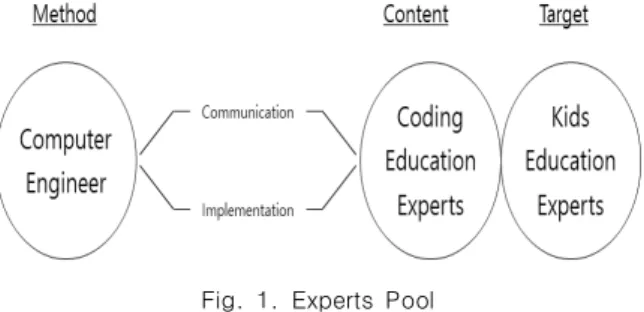
Important substances of computational thinking development model can be organized into following. First of all, an expert pool to develop and review contents, targets and related technical skills is required, teachers as experts of target children and engineers as coding and technical experts.

The role of IT experts who are in charge of technical aspects is crucial. Therefore, it is ideal for educational experts and

computer engineers to cooperate from the developing stage.

Content and technology wise, development of plugged or unplugged contents is possible through the understandings of the experts.

Fig. 1. Experts Pool

Secondly, examples and activities based on computational thinking should be included in 5 fields and 11 activity themes of Nuri Curriculum. More than 2 fields of Nuri Curriculum should be integrated and turned into an activity theme. For example, under mathematics and science, the activity theme could be understanding regularity. This promotes growth of children with integrative thoughts. Not only that, it prevents the overlap of coding, math and science classes when Nuri Curriculum takes place. According to [6], math and science education already having been combined, computer education should be further integrated into math and science education, Third, an evaluation tool for textbooks and tools should be developed. Currently, many IT companies are creating tools for children's education. Also, many publishers are making efforts to develop textbooks related to coding. In this manner, disruptive use of plugged and unplugged teaching materials can lead to difficulties or resistance in stead of interests in coding education. Thus, qualitative evaluation on tools, considering the core and upper concepts of target age is required.

2. Computational Thinking and Nuri Curriculum

Fig. 2. Integration of Math, Science and Computer

Education

(3)

As the concept of computational thinking is not limited to computer itself, but rather expands to problem-solving skills and logical thinking, Fields of Nuri Curriculum and life themes need to expand, integrate and diversify as well.

1) Components of Computational Thinking

9 components of computational thinking are as follows[7].

① Data Collection

Gathering of data related to the problem

② Data Analysis

Understanding of data and finding a pattern

③ Data Representation

Systemizing data into graphs, charts, text, picture, etc.

④ Problem Decomposition

Splitting a complex problem into relatively smaller, easier tasks

⑤ Abstraction

Simplifying a complicated problem by comprehending core components of the problem

⑥ Algorithms & Procedures

Going through a series of stages to solve a problem or achieve a goal

⑦ Automation

Displaying solutions in a way that computers can process in order to complete repetitive tasks

⑧ Simulation

Expressing a single procedure or modeling it, Implementing a model and finding out the results of automation

⑨ Parallelization

Structuring resources in order to complete tasks simultaneously

2) Computational Thinking System of Children There are 9 types of thinking systems in computational thinking of children[8]. They should be considered when developing teaching instruments and implementing activities.

① Reformulative Thinking

Reformulative thinking helps children realize that a difficult problem they face is in fact the same as one that they already know of, enabling them to solve the problem in an easier way. Downsizing, inlaying, modifying and imitating fall under this category.

② Recursive Thinking

When solving a problem, repeating a thinking process increases the ability to solve problems.

③ Data as code, code as data

Coding thoughts into letters, numbers, symbols and gestures enhances children's ability to interact.

④ Abstraction

Abstraction refers to expressing problems with their salient characteristics and thus, simplifying.

⑤ Decomposition

Decomposition improves thinking abilities through disassembling and recombination of thoughts.

⑥ Prefetch and Cache

Children's ability to categorize and allocate objects will increase.

⑦ Deadlock, Gridlock

It enables efficient allocation of common resources.

⑧ Heuristic Reasoning

Heuristic reasoning improves deductive thinking by inferring to experiences and solving problems.

⑨ Algorithmic Thinking

Algorithmic thinking strengthens ability to progressively solve problems by considering the sequence of given work.

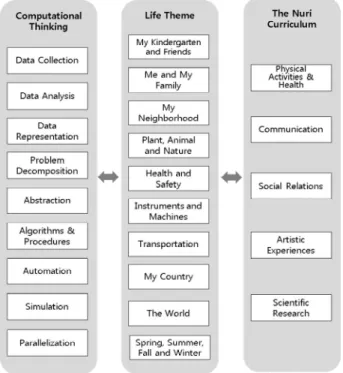
Fig. 3. Computational Thinking & Life Theme & The Nuri curriculum

3) Nuri Curriculum and Life Theme

Nuri Curriculum aims the formation of basis for

democratic citizens by supporting healthy and harmonious

growth of 3 to 5-year-old children. Nuri Curriculum is

composed of 5 fields: physical activities and health,

communication, social relations, artistic experiences and

scientific research. All fields suggest a single goal

although each of them was formed by considering the

development levels of ages. In addition, life themes were

(4)

devised to reflect Nuri Curriculum. There are 10 manuals to apply 10 themes for 3-year-olds, 11 manuals to apply 11 themes for 4-year-olds, a revised form of a manual including a general introduction for 5-year-olds and 1 operation manual for guiding multi-age classes. 11 life themes are ‘My Kindergarten and Friends’, ‘Me and My Family’, ‘My Neighborhood’, ‘Plant, Animal and Nature’,

‘Health and Safety’, ' Instruments and Machines‘,

’Transportation‘, ’My Country‘, ’The World‘, ’Environment and Life‘, ’Four Seasons: Spring, Summer, Fall and Winter‘. Among these, computer-related field of Nuri Curriculum is "Scientific Research", making use of

"Instruments and Machines". From ages 3 to 4, children get interested in simple tools and machines in life. In specific, this theme helps even young children of those ages to develop proper experiences and understanding of the Internet and media[9]. Especially, Nuri Curriculum for age 5 emphasizes altering life tools and the media, and instruments of the future. Also, it teaches children of age 5 to have interest in new instruments and machines and understand the advantages and side effects of each tools.

A life theme most directly related to reinforcement of computational thinking is "Instruments and Machines".

Activities are to be run corresponding to Nuri Curriculum by setting a subject reflecting computational thinking in other life themes as well. For example, computational thinking fit into the following contents in the Scientific research[10].

① Research attitude - Expanding curiosity

- Enjoying the research process - Utilizing research techniques

② Mathematical research - Understanding patterns

- Collecting data and showing results

③ Scientific research

- Using simple tools and machines

4) Examples of activities

Examples of many activities are as follows.

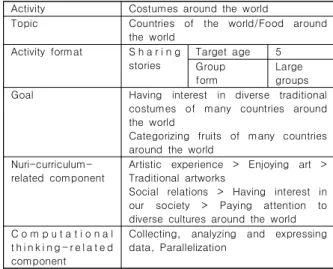
Components of Nuri-curriculum and computational thinking to be included through diverse forms of activities such as ‘costumes around the world’, ‘making fruit sticks’,

‘finding directions’ according to the age of target children.

Activity Costumes around the world

Topic Countries of the world/Food around the world

Activity format S h a r i n g stories

Target age 5 Group

form

Large groups Goal Having interest in diverse traditional

costumes of many countries around the world

Categorizing fruits of many countries around the world

Nuri-curriculum- related component

Artistic experience > Enjoying art >

Traditional artworks

Social relations > Having interest in our society > Paying attention to diverse cultures around the world C o m p u t a t i o n a l

t h i n k i n g - r e l a t e d component

Collecting, analyzing and expressing data, Parallelization

Table 1. Activity of Sharing Story

Activity Finding directions

Topic My neighborhood

Activity format Game Target age 5

Group form

Large groups Goal Understanding directions and finding

ways with directions

Abiding by rules and cooperating with friends

Nuri-curriculum- related component

Communication > Speaking > Speaking with words and sentences

Communication > Listening

>Understanding words and sentences Physical Activities&Health > Recognizing body > Recognizing and moving body parts

C o m p u t a t i o n a l t h i n k i n g - r e l a t e d component

Expressing data, Algorithm and process

Table 2. Game Activity

Activity Making fruit sticks

Topic Being healthy in summer/ Food and nutrition in Summer

Activity format Cooking Target age 4 Group

form

Small groups Goal Playing with patterns of fruits that I like

Finding repeating patterns of diverse fruits

Nuri-curriculum- related component

Scientific Research > Mathematics >

Understanding patterns

Scientific Research > Learning research attitudes > Enjoying research process C o m p u t a t i o n a l

t hi nk i n g - r el a t ed component

Expressing data, Algorithm and process, Parallelization

Table 3. Cooking Activity

3. Class Development Model to Enhance Computa tional Thinking

This paper shapes a class development process

enabling classes based on computational thinking. The

process is comprised of 5 steps.

(5)

[Step 1] Set a goal, theme and group size of the activity.

- Set a target age.

Set a life theme.

Set an activity format.

Set a group size.

Consider Nuri Curriculum-related components.

[Step 2] Form components of computational thinking and make examples.

- Find life-centered/probable/meaning-centered /problem-based/empirically possible subject matter.

- Organize an activity.

- Consider computational thinking-related elements.

[Step 3] Write an activity plan.

Divide into introduction, body and conclusion.

Consider related activities and expand to other activities.

[Step 4] Proceed a class activity.

- Do different unplugged activities according to ages.

Do computer-based activities on demand.

[Step 5] Evaluate.

- Wrap up the activity.

- Review contents.

4. Standards of Selecting Educational Tools A representative class to enhance computational thinking is coding education. However, in domestic setting, such education has not taken place yet in regular kindergarten curriculum. Thus, coding education seeks reflection of computational thinking through original curriculum and class materials, not relying on coding classes and materials. Current educational curriculum should increase computational thinking abilities of children. Besides, if coding education were to be implemented in elementary education or extracurricular activities of kindergarten, education kit is explained in the picture below. As children get older, transfer from unplugged to plugged form of education is available.

Generally, both forms are to be utilized.

Fig. 4. Ways of Kids Coding Education

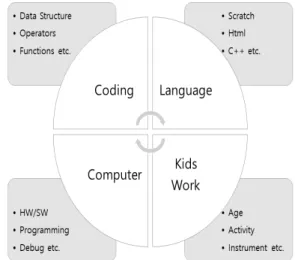
Generally, coding education teaches basic knowledge on computer technology, concepts of coding and coding education. Based on this, coding education for young students and children is implemented. The substances are as follows.

Fig. 5. Contents of Configuration of Coding Education

5. Kids' Kit and Activity Evaluation 1) Kids' Kit Evaluation

Computational thinking and coding education for kids are done in unplugged or plugged forms. The teaching instruments can be evaluated with following standards.

Robotic media evaluation standards of [11] are appliable.

① Usefulness

How much does it contribute to learning? How frequent is it utilized? Can it be transformed to meet certain learning goals?

② Convenience

Can a child handle it easily by himself/herself? Is the

explanation easy to understand?

(6)

③ Reliability

Do the functions of the instrument perform well? Does it overheat when used for long hours?

④ Appearance

Can it be disassembled and assembled again to be used together with other instruments? Is it attractive?

⑤ Strength and safety

Is the tool safe? Is it balanced in terms of weight? Is it confirmed by the country? Are there any corners or sharp parts? Is it transported and stored in a safe box? Is it made of firm materials?

⑥ Repairing availability and services

Are the parts cost-efficient? Are workshops for simple repairing methods provided? Does it provide diverse services?

⑦ Versatility

Can it be used for diverse purposes? Is it appropriate for children's physical, perceptual, emotional, social and creative development? Is it cost-effective? Can it be used by multiple users?

2) Activity Evaluation

Activities and instruments can be assessed through following measures. The assessments involve criteria on computational thinking components and class materials.

① Selecting an activity

- Is the activity and the subject creative?

- Is the activity appropriate for certain age?

② Activity plan

- Is the activity goal set properly?

- Are the components of Nuri Curriculum appropriate?

- Are the components of computational thinking appropriate?

③ Teaching and learning

- Is the environment for teaching and learning established well?

- Are the class materials used effectively?

- Does it enable communication?

IV. Conclusions

This paper introduces the increasing trend of recent education on computational thinking and coding in institutions for children education. Thus, it suggests

means to apply such education well into the domestic educational setting.

First, cooperation between experts is crucial. Technical experts and educational experts, including teachers and coding experts, need to work together.

Second, contents of each age need to be connected to those of other ages. Not only that, association with subjects of elementary school is required as well.

Activities to improve computational thinking abilities and their categories have to be selected according to age.

Plugged education are not recommended at early ages, but both unplugged and plugged formats can be used as children get older.

Third, development of life themes related to Nuri Curriculum is urgent. Currently, coding education is not a regular curriculum of kindergartens. So activities should be designed to enhance computational thinking through math and science, not coding. Without separate education, a regular course should cover all topics. Research needs to be done to prevent serious overlap of contents. In turn, children education experts and coding education experts are required to select appropriate materials and develop corresponding activities.

Last, experts to evaluate computational thinking education and an evaluation tool for them is required. The tool should involve standards for content, technical skills and teaching materials.

In other words, in order to achieve holistic development of children, this research encourages improvement in environment and contents of education for computational thinking. Lots of research to raise experts and formulate an evaluation system is demanded. In this regard, this study is significant in that it paves the way for coding education which is increasing recently to reinforce computational thinking of children. It is also crucial in that it realizes such proved educational format from the early ages of children and relates such to education at elementary level.

REFERENCES

[1] Jan Cuny, Larry Snyder and Jeannette M. Wing(2010), Demystifying Computational Thinking for Non-Computer Scientists. Work in progress,2010.

[2] Min Young Lee, A Study of Early Childhood Teacher’s

(7)

Stage of Concern and Perception on Coding Education for Young Children, Dept. of Early Childhood Education, Graduate School of Kyungsung University, 2017.

[3] Linda Liukas, Hello Ruby: Adventures in Coding, Gilbut Children Publishing, 2016.

[4] Ji-Hyun Jung, “Analysis on Pre-service Early Childhood Teachers’ Stage of Concerns about SW Education According to the Concerns-Based Adoption Model”, Journal of the Korea Academia-Industrial cooperation Society, Vol. 18, No. 7 pp.431-440, 2017.

[5] JeongWon Choi, YoungJun Lee, “The Design of Puzzle-Based Leaning for Computational Thinking”, Korea Society of Computer Information Summer Proceedings, Volume.22, No.2, July 2014.

[6] Yoon-hee Ko, Children’s Math and Science Education Based on Standard Childcare Curriculum and Nuri Curriculum, Knowledge Community, 2017.

[7] Kyungsun Oh, Seongjin Ahn “A study on development of educational contents about computational thinking”, The Journal of Korean Association of Computer Education Volume. 19, No.2, p.11~20, 2016, 3.

[8] JungMin Han, Ungyeoi Jung, YoungJun Lee, “Analysis on Research Trends related Computational Thinking in Korea”, Korean Association of Computer Education Summer Proceedings, Volume.21, No.2, 2017.

[9] Soo Bum Shin, Chul Kim, Namje Park, KapSu Kim, YoungHoon Sung, YoungSik Jeong, “Convergence Organization Strategies of the Computational Thinking in Informatics Curriculums“, Journal of The Korean Association of Information Education, Vol.20, No.6, 2016.

pp. 607-616.

[10] Okjung Gee, Heejun Seo, Bokyung Gye, Youngmi Go, YiJung Gwun, Miae Kim, Hyjung Kim, Sujin lim, “Early child education and Media application”, Changjisa, 2018 [11] Sang Un Kim, Effectiveness Education Program using

Robot for Young Children’s Computational Thinking, Graduate School of Kongju National University, 2018.

[12] YongJu Jeon, “A Study on the Cognitive, Psychomotor and Affective Aspects of Software Education by Exploring Computational Thinking”, The Journal of Korean Association of Computer Education, 2017.

[13] Dae-soo Kim, Software and Computational Thinking, Life and Power Press, 2017.

Authors

Yan Ha received the B.S, Ph.D. degrees in

Computer Science and Engineering from

Duksung Woman’s University and ChonBuk

National University, Korea, in 1992 and

2000, respectively. Especially, she received

th M.S. degreed in Computer Education

from Ewha Woman’s University. Dr. Ha joined the Visit

professor of the SEITI at Central Michigan University, MI,

USA, in 2005. She is currently a Professor in the

Department of early childhood education, KyungIn

Women’s University. She is interested in Computer

Education and Computing thinking for early childhood and

preliminary teacher.

수치

Fig.  1.  Experts  Pool
Fig.  3.  Computational  Thinking  &  Life  Theme  &  The  Nuri  curriculum
Table  1.  Activity  of  Sharing  Story
Fig.  5.  Contents  of  Configuration  of  Coding  Education

참조

관련 문서

In this study, it expect that the student's school achievement skills and the mathematical problem solving skills increase according to textbook of an

So, if sixth graders of elementary school was provided the class unit art therapy program applying the creative problem solving model developed in this

Therefore, in this study, we investigate how workplace innovation affects workers' workplace learning and corporate performance for workers engaged in

Therefore, the purpose of this study is to study on the special education teachers’ state of first aid education completion, knowledge level and abilities

Therefore, this study investigated the interest, satisfaction and participation in STEAM of middle school students centering on programs where music education

This study aims for investigating the relationship between the satisfaction based on one’s participation in physical education class and a physical self-concept

To identify the legal education in the department of social studies, this study analyses the contents of legal education according to different

activities in music education in an actual school setting, a systematic and specific music appreciation teaching method that is in accordance with the