Energy Efficient Routing Protocol for Mobile Wireless Sensor Networks
Jinho Yoo*, Sung-Gi Choi
모바일 WSN을 위한 에너지 효율적인 경로배정 프로토콜
유진호*, 최성기
Abstract In this paper, we propose routing protocol for mobile wireless sensor networks with a mobile sink in cluster configuration. The proposed protocol extends LEACH-ME by introducing a mobile sink. The mobile sink moves to the cluster head with the highest number of member nodes to collect sensed data from cluster heads within its vicinity, which results in reducing energy consumption in forwarding packets to the sink. The simulation results show that the proposed protocol outperform LEACH-ME in terms of energy efficiency.
요 약 본 논문에서 우리는 모바일 싱크노드를 가지는 모바일 센서 네트워크를 위한 경로배정 프로토콜을 제안합니다.
제안된 논문은 모바일 싱크를 도입하는 것에 의해 확장됩니다. 모바일 싱크는 그 주변의 클러스터 헤드로부터 센싱 데 이터를 수집하는 가장 많은 멤버수를 가진 클러스터 헤드로 이동합니다. 이러한 이동은 싱크에 패킷을 보내는데 필요 한 에너지소모를 감소시킵니다. 모의실험 결과는 제안된 프로토콜이 에너지 효율면에서 LEACH-ME를 능가하는 것 을 보여줍니다.
Key Words : clustering, mobility, routing, sensor networks, cluster heads
*Corresponding Author : Division of Information and Communication, Baekseok University([email protected] ) Received October 7, 2015 Revised October 10, 2015 Accepted October 15, 2015
1. Introduction
Wireless sensor network (WSN) is a highly distributed network of small, lightweight wireless sensor nodes which monitor environment or system by measuring physical parameters such as temperature, pressure and humidity. The sensed data are routed to a sink either directly or through other sensor nodes. Mobile wireless sensor network (MWSN) is a WSN in which sensor nodes are mobile either by external force or their own mobility capability. Designing energy efficient routing protocols for WSN in constrained resources is very important. Many
research projects and papers have shown that the cluster based routing protocols are energy efficient[1]. Most of cluster based routing protocols of WSNs assume that sensor nodes are stationary, which is not realistic with some applications such as animal tracking.
Inclusion of node mobility as a new criterion for the cluster creation and maintenance adds new challenges for cluster based routing protocols. Nowadays, contrary to static sink, mobile sink approach has attracted much research interest because of its potential to improve network performance such as energy efficiency and throughput[2]. A mobile sink
that moves closer to sensor nodes can help conserve energy since data is transmitted over fewer hops thus reducing the quantity of transmitted packets. It can also handle sparse and disconnected networks better[2].
In this paper, we propose a routing protocol for MWSN with a mobile sink for achieving energy efficiency in cluster configuration. A mobile sink moves to the cluster head with the highest number of member nodes to collect data from cluster heads within its vicinity, which results in reducing energy consumption.
The remainder of the paper is organized as follows. Related works are discussed in section 2. We describe the system model in section 3 and the new protocol is proposed in section 4. In section 5, we evaluate the performance of our protocol via simulations and compare the results with LEACH-ME[3].
Finally, Section 6 concludes this paper.
2. Related Works
Many research projects and papers have shown that clustering in WSN makes significant improvement in energy efficiency and scalability. Most of cluster based routing protocols, such as the Low-Energy Adaptive Clustering Hierarchy (LEACH) protocol[4], assume that nodes are stationary. This assumption is not realistic with some applications having moving nodes such as animal tracking etc. Inclusion of node mobility as a new criterion for the cluster creation and maintenance adds new challenges for the cluster based routing protocols. In this section, we briefly outline the related work in LEACH protocol improvements in terms of mobility.
Low-Energy Adaptive Clustering Hierarchy (LEACH) is one of the popular energy efficient cluster based routing protocol for WSNs, and its thoughts of clustering run through most of the subsequent cluster based routing protocols. LEACH utilizes randomized rotation of cluster heads to evenly distribute the energy load among the sensors in the network. Its operation is divided into rounds and each round consists of two phases. In the setup phase, cluster heads are elected and each non-cluster head node chooses the proper cluster to join according to the signal strength value from the cluster heads. Once the clusters are formed, the cluster head create TDMA schedule and assigns each node a timeslot when it can transmit. In the steady state phase, the sensor nodes transmit sensed data to the cluster heads and the cluster heads collect them for sending them to the sink. After a certain time the network goes back into the setup phase again and enters another round of electing new cluster heads.
LEACH does not consider the mobility of nodes during the steady state phase, which may lead to data loss seriously in mobile environments. LEACH-M (LEACH-Mobile)[5]
increases successful data transmission rate from mobile nodes to the sink by confirming whether a mobile sensor node is able to communicate with its cluster head within a time slot assigned in TDMA. For this purpose, at the beginning of each TDMA slot the cluster head transmits a message requesting data transmission from a member node. If the member node does not receive the request message from its cluster head for two successive TDMA frames it searches for a new cluster head and joins it. LEACH-ME
(LEACH-Mobile Enhanced) extends LEACH-M by proposing remoteness concept for cluster head election to cope with the situation of a cluster head’s going out of reach due to mobility. The basic idea of LEACH-ME is that the nodes that are less mobile relative to its neighbors should be elected as cluster heads. For this purpose, each node estimates the distance to all its neighbors and calculates the mobility factor based on the “remoteness” of a node from its neighbors during the setup phase. Node with least mobility factor is elected as a cluster head, provided the energy level of that node is not below a certain threshold. All these LEACH protocol improvements do not consider the mobility of the sink. In this paper, we propose an improvement to LEACH-ME by introducing a mobile sink for achieving energy efficiency.
3. SYSTEM MODEL
The model of MWSN we have considered is as follows: The network consists of hundreds of sensor nodes and a mobile sink.
The sensor nodes are attached to mobile objects such as some animals which are moving within a certain geographic area.
They have limited memory size, limited processing capability and limited battery power. On the other hand, the mobile sink is a resourceful and reliable computing device carried by a person or a vehicle. The battery of the mobile sink may be recharged if necessary. It may be equipped with a cellular interface and can be connected to Internet via a cellular network.
3.1 Topology Model
We consider a cluster-based wireless sensor network topology as shown in Fig. 1.
The sensor nodes form clusters and cluster heads are elected for each cluster. Each sensor node chooses the most suitable cluster head. And then sensor nodes send sensed data to the cluster heads respectively. The cluster heads collect the sensed data and then wait for the mobile sink to come in its vicinity to send data. The mobile sink moves in the network and collects the collected data from the cluster heads in its vicinity. When a cellular network is available, the mobile sink will upload the collected data to the server.
When a cellular network is not available, the mobile sink will store the collected data and then upload them to the server as soon as a cellular network becomes available.
3.2 Mobility Model
In our work, the Random Waypoint Mobility Model[6] is used for the mobility of sensor nodes. A mobile node picks its direction at random from (0, 2] and moves in that direction from its current position to a new position for a distance d with a speed v between [Vmin, Vmax], where d is exponentially distributed. If the node hits the boundary, it is reflected at the boundary.
Fig. 1. The topology model of MWSN[7]
Upon reaching the destination, the node pauses for a period of time, Tpause, based on random variables and the process repeats itself. We assume that the mobility of the mobile sink is controllable and the mobile sink movements can be designed so as to achieve specific goals and optimize given performance parameters.
4. THE PROPOSED PROTOCOL
We propose a cluster based routing protocol for MWSNs with a mobile sink. It extends LEACH-ME by introducing a mobile sink.
The proposed protocol is divided into three main phases: setup, steady state and mobile data collection phase.
4.1. Setup Phase
In the setup phase, cluster formation takes place. To cope with the situation of cluster heads’ going out of reach due to mobility, cluster heads are elected from the group of mobile nodes to meet minimum node mobility.
1) Initial setup: Sensor nodes elect themselves to be initial cluster heads with a certain probability. After initial cluster heads are elected they broadcasts an advertisement messages to the rest of the sensor nodes in their network. After receiving advertisement messages from one or more cluster heads, each sensor node selects the cluster head which needs the minimum amount of transmitted energy for communicating and sends registration message to the cluster head and joins the cluster.
2) Cluster formation: Each cluster head broadcasts a cluster head election message to all its member nodes. Upon receiving the
cluster head election message, all member nodes calculate mobility factor and the node with minimal mobility factor is elected as a cluster head, provided its energy level is not below the threshold. The mobility factor is calculated using (1), where MFi(t) is the mobility factor based on the “remoteness” of node i from member nodes in the cluster which node i belongs to, M is the number of member nodes of the cluster, dij(t) is the distance of node i from member node j at time t. dij(t) is calculated based on the locational information acquired from a localization technique.
(1)
After a cluster head has been elected, it broadcasts a cluster head advertisement message to the rest of the sensor nodes in a cluster. Each non-cluster head node send a registration request message to inform the cluster head. And then, the cluster head creates a TDMA schedule based on the number of member nodes and assigns each node a time slot when it can transmit. This schedule is broadcasted to all the sensor nodes in the cluster.
4.2 Steady state phase
In the steady state phase, the sensed data from sensor nodes are transferred to their cluster heads according to a TDMA schedule.
To cope with node mobility during this phase, membership declaration of mobile nodes is used.
1) Sensor node side: A sensor node wakes up at the beginning of its timeslot and waits for data request message sent from the
cluster head. If the sensor nodes receives data request message, it will send the data back to the cluster head. Otherwise it will go back to sleep mode until the next allocated time slot in the next frame. If no data request message is received once again, the sensor node assumes that it is not a member of the cluster. And then it sends the join request message to the nearby cluster heads.
2) Cluster head side: If the cluster head does not receive data from a sensor node during two consecutive frames, the cluster head removes the sensor node from its scheduling and it may also assign this slot to the newly joined node in TDMA schedule.
The cluster head assumes that the sensor node had moved out of the cluster. The cluster head listening the join request message allots a time slot in its TDMA schedule and broadcasts it to all the member nodes including the new member. After receiving the sensed data from all the member nodes, the cluster head collects the data and waits for the mobile sink to come in its vicinity to send the collected data to it.
4.3 Mobile data collection phase In the mobile data collection phase, a mobile sink moves in the network and collects the sensed data from the cluster heads in its vicinity. In each round, the mobile sink decides the location where it stays based on the number of member nodes received from each cluster head.
1) Mobile sink advertisement: When the mobile sink reaches any new place during its movement, it needs to inform the nearest cluster heads about its presence for cluster heads in its vicinity to be able to send the
collected data to it. For that purpose, the mobile sink broadcasts a beacon messages to the cluster heads in its vicinity during the mobile data collection phase.
2) Cluster head registration: When the mobile sink enters the valid dissemination range of some cluster heads, a cluster head intercepts the beacon message of the mobile sink and responds to it by sending a registration request message with the information of its location and the number of member nodes. If the mobile sink receives a registration request message from a cluster head the mobile sink sends an acknowledgement message to that cluster head and includes the cluster head in the registered cluster head list. Once all cluster heads have been registered, the mobile sink assigns the time slots to all the registered cluster heads and broadcast the TDMA schedule to them.
3) Data gathering: The mobile sink moves to the cluster head having the highest number of member nodes and stay there during a round. Each cluster head sends the aggregated data to the mobile sink using single hop communication in an agreed TDMA time slot.
5. SIMULATION STUDY AND PERFOMANCE EVALUATION
We maded the simulation codes using C language to evaluate the performance of the proposed protocol and compared it with LEACH-ME in terms of energy consumption.
For that purpose, we use three metrics:
average energy per packet, the time when the first node exhausts its energy, and the number of sensors still alive.
5.1 Simulation Setup
The sensing area is 500m x 500m and sensor nodes are deployed randomly. The number of sensor nodes is varied from 100 to 500. The percentage of cluster heads is 10%
and each sensor node has a 2000-bit data packet to send to the sink. Sensor nodes move by the Random Waypoint Mobility model with a speed v between [0.5m/s, 1.5m/s] and pause for a period of time, Tpause between [0, 60s]. The sink is located at (500, 500) in the simulation of LEACH-ME.
5.2 Simulation Results
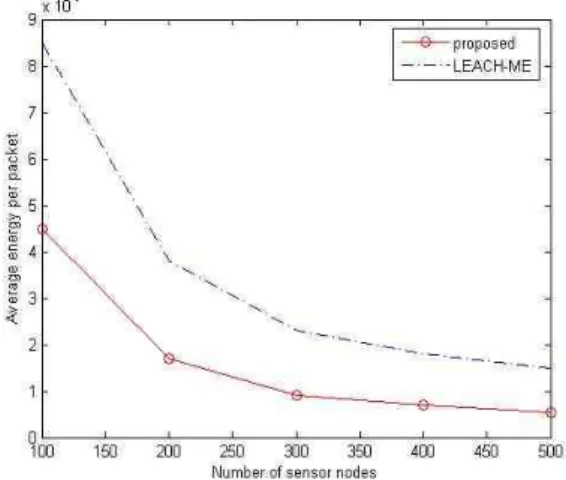
Fig. 2 shows the average energy per packet using our protocol versus using LEACH-ME as the number of sensor nodes is increased.
Fig. 2. Average energy per packet
This metric is the measure of energy spent in forwarding a packet to the sink. In our protocol, the cluster head with the highest number of member nodes is nearest to the sink as the sink moves to the cluster head with the highest number of member nodes.
This results in reducing average energy consumption in forwarding packets to the sink.
Fig. 3. Average energy per packet
Fig. 3 shows the time when the first node exhausts its energy in our protocol versus in LEACH-ME as the number of sensor nodes is increased. The time when the first node exhausts its energy in our protocol increases as the number of sensor nodes is increased, whereas in LEACH-ME the time decreases as the number of sensor nodes is increased. This means that our protocol not only prolongs the network lifetime more but also is more scalable in terms of the number of sensor nodes compared to LEACH-ME.
6. CONCLUSION
In this paper, we proposed a cluster based routing protocol for MWSNs with a mobile sink. The mobile sink moves to the cluster head with the highest number of members to collect the sensed data from cluster heads within its vicinity, which results in reducing energy consumption in forwarding packets to the sink. The simulation results show the proposed protocol outperforms LEACH-ME in terms of energy efficiency. And the proposed protocol is more scalable in terms of the number of sensor nodes and more suitable for MWSNs with a large number of sensor nodes
compared to LEACH-ME.
REFERENCES
[1] Kyriakos Karenos, Vana Kalogeraki, Srikanth V. Krishnamurthy, “Cluster-based Congestion Control for Sensor Networks”, ACM Transactions on Sensor Networks, vol. 4, issue 1, pp. 1-39, 2008.
[2] Ioannis Chatzigiannakis, Athanasios Kinalis, Sotiris Nikoletseas, “Sink Mobility Protocols for Data Collection in Wireless Sensor Networks”, in Proceedings of the 4th ACM International Workshop on Mobility Management and Wireless Access, pp. 52-59, 2006.
[3] G. Santhosh Kumar, Vinu Paul M V, K.
Poulose Jacob, “Mobility Metric based LEACH-Mobile Protocol”, in Proceedings of the 16th International Conference on Advanced Computing and Communications, pp. 248-253, 2008.
[4] Wendi Rabiner Heinzelman, Anantha Chandrakasan, Hari Balakrishnan,
“Energy-Efficient Communication Protocol for Wireless Microsensor Networks”, in Proceedings of the 33rd Hawaii International Conference on System Sciences, vol. 8, pp. 110, 2000.
[5] Do-Seong Kim, Yeong-Jee Chung,
“Self-Organization Routing Protocol Supporting Mobile Nodes for Wireless Sensor Network”, in Proceedings of the 1st International Multi-Symposium on Computer and Computational Sciences, pp.622-626, 2006.
[6] Josh Broch, David A. Maltz, David B.
Johnson, Yih-Chun Hu, Jorjeta Jetcheva,
“A Performance Comparison of Multi-Hop
Wireless Ad Hoc Network Routing Protocols”, in Proceedings of the 4th Annual ACM/IEEE International Conference on Mobile Computing and Networking, pp.
85-97, 1998.
[7] Quazi Mamun, "A Qualitative Comparison of Different Logical Topologies for Wireless Sensor Networks", Sensors, pp.14887-14913. Dec. 2012.
Author Biography
Jinho Yoo [Regular Member]
•Feb. 1996 : Sogang Univ.
computer Engineering, M.S.
•Aug. 2006 : Chungbuk Nat'l Univ. computer science, Ph.D.
•Feb. 1996 ~ Dec. 1998 : LG Information and Communication Research Center
•Jan. 1999 ~ Feb. 2008 : Electronics Telecommunications Research Institute
•Mar. 2008 ~ current : Baekseok Univ. Division of Information and Communication, Professor
<Research Interests> Embedded System, Virtualization
Sung-Gi Choi
•Feb. 1996, 2002 : Korea Advanced Institute of Science and Technology, B.S. M.S.
•Jan. 1996 ~ June. 2000 : SsangYong Information and Communication
•Feb. 2002 ~ Feb. 2007 : Electronics Telecommunications Research Institute
•Jan. 2009 ~ June. 2011 : Huree University of Information and Communication, Professor
•Jul. 2014 ~ current: National Research Foundation of Korea, WFK-TPC member
<Research Interests> IoT convergence, WSN