Energy-efficient Positioning of Cluster Heads in Wireless Sensor Networks
Surgwon Sohn* , Kwang-Rok Han**★
Abstract
As one of the most important requirements for wireless sensor networks, prolonging network lifetime can be realized by minimizing energy consumption in cluster heads as well as sensor nodes. While most of the previous researches have focused on the energy of sensor nodes, we devote our attention to cluster heads because they are most dominant source of power consumption in the cluster-based sensor networks. Therefore, we seek to minimize energy consumption by minimizing the maximum(MINMAX) energy dissipation at each cluster heads.
This work requires energy-efficient clustering of the sensor nodes while satisfying given energy constraints. In this paper, we present a constraint satisfaction modeling of cluster-based routing in a heterogeneous sensor networks because mixed integer programming cannot provide solutions to this MINMAX problem. Computational experiments show that substantial energy savings can be obtained with the MINMAX algorithm in comparison with a minimum total energy(MTE) strategy.
Key words: Energy-efficient Positioning, MINMAX, Constraint Satisfaction, Mixed Integer Programming
* Dept. of New Media, Hoseo University
** Division of Computer Eng., Hoseo University
★ Corresponding author
Manuscript received Mar. 3, 2009 ; revised Mar. 11, 2009
I. Introduction
Wireless sensor networks (WSNs) are composed of hundreds of battery-powered sensor nodes those may be deployed in hostile environment, where it is impractical to replace or recharge the battery of sensor nodes. Typically, they are all alike and able to transmit some environmental data over a limited distance range. Therefore, a lifetime of each sensor node is very important in the networks. Network lifetime can be thought of the time spanning from the instant when the network starts functioning to the instant when the first sensor node runs out of energy. If each sensor node transmits its sensed data directly to the base station, then it will deplete its power quickly. To bypass this problem, clustering approaches have been proposed in many recent work[1-4].
In cluster-based network architecture, cluster heads have to transmit all the traffic generated by sensors to the base station. Communication is also known to be a dominant source of power consumption in WSNs[5], and it is a primary role of cluster heads.
Thus, the network lifetime is strongly related to the failure of cluster heads, and energy spent in the cluster heads must be minimized. In general, multi-hop wireless links are utilized to relay sensed data to the base station. Inevitably, the sensor nodes those are closer to the base station will experience higher data traffic and energy consumption rate. These nodes will be the first ones which run out of energy. This unbalanced energy consumption is an inherent problem in wireless sensor networks.
To solve this energy-unbalancing problem, we propose a 2-tiered heterogeneous sensor network which is composed of sensor nodes(SNs) and cluster heads(CHs). Cluster heads are mainly used to forward all traffic generated by sensors to the base station, so initial energy and communication
capability of CHs are much greater than those of SNs. Then, we need to assign every sensor node to appropriate cluster head so as to minimize the energy consumption in cluster heads under the assumption that the locations of both SNs and CHs are randomly chosen in a given service area.
Specifically, solving a problem of minimum total energy(MTE) of cluster heads and sensor nodes assigned to them is to find a solution of clustering problem. Even the simplest clustering problems are known to be NP-hard[6]. However, it is unclear whether MTE strategy[7] can provide the longest network lifetime. In this paper, we investigate energy-efficient routing from the viewpoint of minimizing the maximum(MINMAX) energy consumption at each cluster head. Our research objective is to find good suboptimal solutions of cluster-based energy-efficient routing by using constraint satisfaction modeling.
The rest of the paper is organized as follows.
Section 2 describes related work on clustering in WSNs. The radio system model of the problem is described in section 3. The constraint satisfaction model and its algorithms are presented in section 4.
Section 5 discusses computational experiments and section 6 concludes the paper.
II. Related Work
Theoretical aspects of the clustering problem in sensor networks with application to energy optimization was studied[8]. They proposed an algorithm of balanced k-clustering problem, where k signifies the specific master nodes in the system.
Low-energy adaptive clustering hierarchy(LEACH) protocol[1] was proposed for a distributed cluster formation, which offers no guarantee about the placement and/or number of cluster heads. This problem is solved by LEACH-centralized, a protocol that uses a centralized clustering algorithm. Hybrid energy-efficient distributed clustering(HEED) protocol[2] selects cluster heads according to a hybrid of their residual energy and a secondary parameter such as node proximity to its neighbors or node degree.
An optimal assignment of nodes to cluster heads
in cluster-based ad-hoc networks has been developed[9], where maximizing lifetime of cluster heads is focused on because they are most critical network elements from the energy viewpoint.
Inevitably, the nodes closer to the cluster heads experience higher traffic and energy consumption rate. To avoid this energy-unbalancing problem, a cluster-based energy balancing scheme has been introduced in heterogeneous WSNs, where a strong node acts as a cluster head[10]. Younis et al.[11]
have also paid an attention to the efficiency of energy usage at the cluster heads and problem of task allocation is implemented by using simulated annealing optimization method.
On the one hand, MTE proposed shortest cost path routing whose link cost is a combination of transmission and reception energy consumption and the residual energy levels at the two end nodes, but on the other Kang et al.[12] formulated a min-max optimization problem and solved by using graph-theoretic approaches. They have also provided an optimal polynomial-time heuristic algorithm based on the minimum spanning tree(MST) for a static network.
III. Radio System Model of Energy-efficient Clustering
Cluster formation is one of the important problems because it affects the cluster heads to dissipate the energy very fast. Each sensor node wants to communicate with the closest cluster head to conserve the energy, but the cluster heads can handle only a limited number of sensor nodes.
Therefore, this does not allow each sensor node to communicate to their closest cluster head. This is called k-optimal clustering problem[1,6] and it is an NP-hard problem.
We use the same radio model as discussed in LEACH for the radio hardware energy dissipation where the transmitter spends energy to run the radio electronics and the power amplifier, and the receiver consumes energy to run the radio electronics. To accurately model the attenuation of radio waves between the sensor nodes and cluster heads, radio engineers[13] typically use a free-space
model that attenuates the power of a signal as 1/r2 at short distances in which r is the distance between the sensor node and the cluster head. At longer distances, multi-path model is used, where the signal power is attenuated as 1/r4. If the distance is less than a crossover point that is called the reference distance r0, the free space model is used. Otherwise, the multi-path model is used. This reference distance is typically around 90 meters for outdoors low gain antennas 1.5m above the ground plane operating in the 1-2 GHz band. Thus, to send k-bit message to a distance r, the radio energy needed in free space channel is shown below.
(1)
where Eelec is the power consumed by the transmitter circuit and a distance-independent term, whereas Pfsr2 is transmitter amplifier energy and a distance-dependent term. In the multi-path fading channel, the total transmission energy is
(2)
where Pmpd4 is energy for the transmission amplifier in the multi-path fading channel. In both free-space and multi-space fading channels, the radio consumes energy to receive the message.
(3)
Let us assume that a set of possible cluster heads CH = {1,...,m } is already given a priori and is fixed in a static sensor network. In a dynamic network, this cluster head selection is performed every round. Cluster head j can be installed and j∈
CH. A set of sensor nodes SN = {1,...,n } is also given. Each sensor node i∈SN is assigned to cluster head j.
Perfect power control is assumed both in the sensor nodes and the cluster heads, and traffic load is uniformly distributed throughout the networks.
Now suppose that X is the consumed energy vector of cluster heads. Xj is the total amount of energy
consumed at cluster head j to send to the base station a 1-bit data message which comes from the sensor nodes, and we observe that
Xj = nj(2Eelec + Eda + Pmpdj4) (4)
where nj is the number of sensor nodes assigned to cluster head j. dj is the distance between cluster head j to the base station, and Eda is the consumed energy for data aggregation from the sensor nodes within cluster j.
According to many papers cited in [14], this problem is NP-hard and we need a good heuristic search method to get approximate solutions within a reasonable length of time. As mentioned in section 1, MTE does not guarantee the maximization of the network lifetime. Thus, we provide MINMAX criteria as an objective to minimize the energy dissipation for each cluster head, and we have focused on only cluster heads.
IV. Constraint Satisfaction Model and Algorithms
Many combinatorial problems can be expressed as constraint satisfaction problems(CSPs)[15,16]. As are the case with facility location problem[17] and base station location problem[14], the clustering problem in the wireless sensor networks described in the above section can also be modeled as a constraint satisfaction problem because clustering problem is very similar to facility location problem. A CSP consists of a set of variables, where each variable has associated with a finite set of possible values.
There is also a set of constraints that restrict the values that can be simultaneously assigned to the variables.
Let us define xij as a decision variable, and it is a binary variable. It is equal to 1 if a sensor node i is assigned to a cluster head j, otherwise it is equal to 0. Consequently, our objective function for q-bit transmission can be represented for the constraint programming using equation (4) as follows.
min
max∈∈
(5)
subject to
∀∈ (6)
≤ ∀∈ ∀∈ (7)
(8)
≤ ∀∈ (9)
∈ ∀∈ ∀∈ (10)
Constraint (6) makes sure that each sensor node i is assigned to a single cluster head. A solution to a CSP is an assignment of every sensor node to its nearest cluster head in such a way that all the constraints are satisfied. The CSP can be solved by using the generate-and-test paradigm, but more efficient method uses the backtracking in which variables are instantiated sequentially.
The backtracking method essentially performs a depth-first search of the search space. The backtracking algorithm is defined by a variable ordering and a value ordering rule. Experiments show that good variable and value ordering move a solution of CSP to the left of the search tree, so the solution can be found quickly by heuristic backtracking algorithms.
At level i of the backtracking algorithm, variables have been assigned a value from their domain, i=1,...n. The variable ordering is usually based on some heuristic measure of the difficulty of a variable decision. The idea is that if it is difficult to find a value for a given variable, then it is better to assign a value to this variable as early as possible.
Every sensor node has been grouped according to its distance to the cluster head. Therefore we can make a temporary clustering according to its closeness to the cluster head. The clustering is ordered by increasing number of sensor nodes per cluster head. Therefore, the sensor node that is farthest away from the cluster head is selected first.
This is farthest-sensor variable ordering heuristic.
Once a cluster head has been selected, the algorithm generates a sensor node for it in a
nondeterministic manner. Once again, the model specifies a heuristic for the value ordering where the cluster head must be tried. To minimize the total amount of energy in the network, the model says to try first those values that were closest to the sensor nodes. This is called a closest-cluster head value ordering rule. As a local search of CSP, depth first search is used.
V. Computational Experiments and Discussion
MINMAX solutions are NP-hard and approximate solutions can be obtained by using constraint programming which has an advantage of expressing a heuristic search procedure in an elegant way. For our proposed MINMAX algorithm, equation (5) to (10) are used. Other parameters are the same as LEACH protocol. In the same manner, we consider a 100m x 100m square service area for each instance. 4 to 12 cluster heads are chosen for installation of cluster heads, and 100 sensor nodes are provided with uniform distribution. Let us assume (0,0) as the lower-left corner and (100,100) as the upper-right corner in the service area. We also assume that the location of the base station is (50,175), and the locations of cluster heads and sensor nodes are randomly chosen. Each unit of the coordinates is in meters. The communication energy Eelec=50nJ/bit, and the transmit amplifier energy Pfs=10pJ/bit/m2 or Pmp=0.0013pJ/bit/m4. All these data are the same as LEACH environment.
But we choose CDMA air interface instead of TDMA because CDMA has no need to schedule timing for transmission. On top of that, power control is assumed in both cluster heads and sensor nodes. The characteristic of CDMA is not considered for our algorithm performance. We concentrate on the objective functions and how we solve those equations. All the experiments are done in Pentium IV/2.4GHz CPU with ILOG OPL3.7.
OPL[18] gives searches easily for constraint satisfaction optimization model and provides approximate solutions within reasonable length of time.
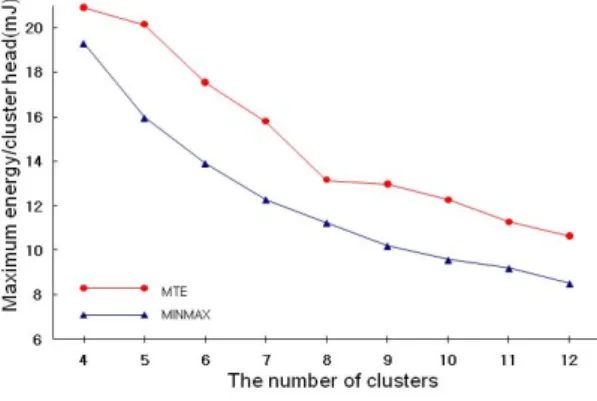
As the number of clusters are increased, dissipated energy in each cluster head is decreased. This is
Fig. 1. Performance Comparison between MINMAX and MTE Strategy
due to the fact that the amount of traffic to be transmitted to the base station decreases as the number of sensor nodes assigned for each cluster head decreases. Fig. 1 shows the number of cluster heads vs. minimized maximum energy consumed in each cluster head. Energy consumption of sensor nodes those are assigned to their closest cluster head is not considered.
Some sensor node i cannot be assigned to some cluster head j in any way because of propagation loss, so domain reduction can be greatly performed and search space is gracefully reduced for the variable xij. In constraint satisfaction, this constraint is called a node inconsistency. Node inconsistency can be eliminated by simply removing those values from the domains of each variable that does not satisfy unary predicate. In wireless CDMA network, the signal-to-interference ratio (SIR) at the cluster heads for each sensor nodes should be considered because some sensor nodes those do not meet minimum SIR cannot be assigned to the cluster heads.
For comparison with MTE method, objective function of MTE can be represented as equation (11). It is well known that equation (11) can be solved with mixed integer programming(MIP).
min
∈
∈
(11)
VI. Conclusion and Future Work
The problem of energy-efficient clustering to extend network lifetime in wireless sensor networks is modeled as a constraint satisfaction problem, which is a kind of artificial intelligence and solved to get suboptimal solutions. To minimize the maximum energy of each cluster head, we have suggested the necessity of heterogeneous sensor network by analysis and simulations in which cluster heads have more communication energy to transmit to the base station than sensor nodes have.
Under this routing architecture, we have performed energy-efficient clustering based on MINMAX algorithm with constraint programming, and showed better performance than MTE strategy with mixed integer programming. This process also represents assignments of sensor nodes to appropriate cluster heads while several energy constraints are satisfied.
A good farthest-sensor variable ordering and a closest-cluster head value ordering rule have been developed for the efficient backtracking algorithm.
For future work, dynamic clustering in the heterogeneous sensor network is suggested, in which the locations of cluster heads are dynamically changed with time according to the proposed algorithms in addition to the residual energy of cluster heads.
References
[1] W.B. Heinzelman, A.P. Chandrakasan, H.
Balakrishnan, "An Application-Specific Protocol Architecture for Wireless Microsensor Networks,"
IEEE Trans. on Wireless Communications, vol. 1, no.
4, pp. 660-670, Oct. 2002.
[2] O. Younis, S. Fahmy, "Distributed Clustering in
Ad-hoc Sensor Networks: A Hybrid,
Energy-Efficient Approach," INFOCOM 2004.
[3] A. Manjeshwar, D.P. Agrawal, "TEEN: A Routing Protocol for Enhanced Efficiency in Wireless Sensor Networks," IPDPS 2001.
[4] S. Lindsey, C. Raghavendra, K.M. Sivalingam,
"Data Gathering Algorithms in Sensor Networks Using Energy Metrics," IEEE Trans. Parallel and Distributed Systems, vol. 13, no. 9, pp.924-935, 2002.
[5] D. Culler, D. Estrin, M. Srivastava, "Introduction:
Overview of Sensor Networks," IEEE Computer, pp.41-49, Aug. 2004.
[6] P.K. Agarwal, C.M. Procopiuc, "Exact and Approximation Algorithms for Clustering,"
Symposium on Discrete Algorithms, Jul. 1997.
[7] J.H. Chang, L. Tassiulas, "Maximum Lifetime Routing in Wireless Sensor Networks," IEEE/ACM Trans. on Networking, vol. 12, no. 4, pp. 609-619, Aug. 2004.
[8] S. Ghiasi, A. Srivastava, X. Yang, M. Sarrafzadeh,
"Optimal Energy Aware Clustering in Sensor Networks", Sensors 2002-2, pp.258-269, 2002.
[9] C. Chiasserini, I. Chlamtac, P. Monti, A. Nucci,
"An Energy-Efficient Method for Nodes Assignment in Cluster-Based Ad Hoc Networks," Wireless Networks 10, pp.223-231, 2004.
[10] J. Ai, D. Turgut, L. Boloni, "A Cluster-based Energy Balancing Scheme in Heterogeneous Wireless Sensor Networks," Lecture Notes in Computer Science 3420, ICN2005, 2005.
[11] M. Younis, K. Akkaya, A. Kunjithapatham,
"Optimization of Task Allocation in a Cluster-Based Sensor Network," IEEE Int'l Symposium on Computers and Communication, Jul. 2003.
[12] I. Kang, R. Poovendran, "Maximizing Network Lifetime of Broadcasting Over Wireless Stationary Ad Hoc Networks," Mobile Networks and Applications 10, pp. 879-896, Springer Science, 2005.
[13] T. Rappaport, Wireless Communications:
Principles & Practice, Prentice-Hall, 1996.
[14] S. Sohn, G.S. Jo, "Optimization of Base Stations Positioning in Mobile Networks," Lecture Notes in Computer Science 3981, ICCSA2006, 2006.
[15] S.C. Brailsford, C.N Potts, B.M. Smith,
"Constraint Satisfaction Problems: Algorithms and Applications," Europian Journal of Operational Research 119, pp.557-581, 1999.
[16] R. Bejar, C. Domshlak, C. Fernandez, C. Gomes, B. Krishnamachari, B. Selman, M. Valls, "Sensor Networks and Distributed CSP: Communication, Computation and Complexity," Artificial Intelligence 161, pp.117-147, 2005.
[17] M. Sun, "Solving the Uncapacitated Facility Location Problem Using Tabu Search," Computers &
Operations Research 33, pp.2563-2589, 2006.
[18] P.V. Hentenryck, "Search and Strategies in
OPL," ACM Transactions on Computational Logic, Vol.1, No.2, pp. 285-320, Oct. 2000.
BIOGRAPHY
Surgwon Sohn (Member)
1985 : BS degree in Electronic Engineering, Inha University.
1987 : MS degree in Information Engineering, Inha University.
2007 : PhD degree in Computer Engineering, Inha University.
1999~ : Associate Professor, Hoseo University.
Kwang-Rok Han (Member)
1984 : BS degree in Electronic Engineering, Inha University.
1986 : MS degree in Information Engineering, Inha University.
1989 : PhD degree in Information Engineering, Inha University.
1991~ : Professor, Hoseo University.