Vol. 21, No. 4, pp. 57-61, August 2017
차량 누적거리에 의한 연비 특성 연구
Study on Fuel Economy Characteristics by Cumulative Distance of Vehicle
임재혁*†․김기호*․이민호*
Jae-Hyuk Lim*†, Ki-Ho Kim* and Min-Ho Lee*
(Received 30 May 2017, Revision received 08 August 2017, Accepted 08 August 2017)
Abstract: The vehicle label fuel economy is used as an energy management indicator nationwide. It induces technology development of automobile manufacturers and plays a role of providing information when purchasing a consumer vehicle. However, consumers who purchase a new vehicle continued to complain that the label fuel economy is different from the mandatory fuel economy rate. The domestic fuel economy measurement method is the same as the North American measurement method. The results of the two test modes (urban (FTP-75 mode), highway (HWFET mode)) are calculated in five test modes reflecting various environmental conditions and driving patterns 5-cycle correction formula is used which is equivalent to the fuel efficiency value. In this study, to solve the consumers' curiosity about the fuel economy of new vehicle, we use domestic fuel economy measurement method to measure the new car condition within 150 km of driving distance and the cumulative driving distance condition of domestic label fuel economy test vehicle. A comparative evaluation of fuel economy was carried out for a durability vehicle of 6,500 ± 1,000 km. A result, mean value of the fuel economy of the four gasoline vehicles increased by 2.7 % in the city center mode and by 2.5 % in the highway mode in the durable vehicle compared new vehicle. And in the case of the diesel vehicle it increased by 2.5 % and 3.9 % respectively. The harmful exhaust gas emitted from the vehicle also resulted in more emissions of both gasoline and diesel vehicles in new vehicles. It is considered that the increase of the frictional force of the vehicle driving system and the lubricating oil system would have an effect on the reduction of the fuel economy of the new vehicle, and it was found that the fuel economy and the exhaust gas were improved by proper cumulative distance (domesticate) to the new vehicle.
Key Words:Label fuel economy, 5-cycle correction formula, Emission
*†임재혁(교신저자) : 한국석유관리원 석유기술연구소
E-mail : [email protected], Tel : 043-240-7957
*김기호, 이민호 : 한국석유관리원 석유기술연구소
*†Jae-Hyuk Lim(corresponding author) : R&D center, Korea Petroleum Quality & Distribution Authority, 33, Yangcheong 3-gil, Ochang-eup, Cheongwon-gu, Cheongju-si, Chungcheongbuk -do, 363-883, Korea.
E-mail : [email protected], Tel : 043-240-7957
*Ki-Ho Kim, Min-Ho Lee : R&D center, Korea Petroleum Quality & Distribution Authority.
1. 서 론
자동차에 표시되는 연비는 크게는 자동차 엔진
제어나 관련 요소부품의 기술 개발 유도 및 에너
지관리의 지표로서 활용되고 있고, 다른 한편으로
는 소비자의 자동차 구매 시 정보제공에 일익을
담당하고 있다. 또한 전 세계적으로 에너지 자원 고갈에 대한 문제와 지속적으로 강화되고 있는 배출가스 규제가 적용되면서 더욱 향상된 효율의 엔진시스템 연구와 대체 에너지 자원인 수송용 대체연료의 개발이라는 많은 기술력 확보를 필요 로 하고 있다. 특히 자동차 제작사들은 연비 및 CO
2배출량 규제에 대응하기 위하여 다양한 연비 개선 기술에 대하여 연구하고 있으며, 몇몇 나라 에서는 실도로 교통 상황을 반영한 자동차 시험 법을 개발하려고 노력하고 있다.
1,2,3.4)현재 우리나라 표시연비 제도는 2012년에 미국 의 5-cycle 시험방법을 국내 차량 기준에 맞게 재 설정하여 도입하였다. 이 제도는 미국과 마찬가지 로 본래는 다양한 환경조건 및 주행패턴이 반영 된 5개의 시험모드를 모두 주행함으로써 측정된 결과 값을 표시연비로 계산하는 방법이다. 그러나 소요되는 자원의 급격한 증가에 따른 충격을 완 화하기 위하여 2개의 시험모드(도심(FTP-75 mode), 고속도로(HWFET mode))의 결과 값을 5-cycle 시 험법으로 계산된 연비 값과 동등한 수준으로 산 출하는 5-cycle 보정식을 사용하고 있다.
5,6)5-cycle 시험법의 도입에 의하여 기존 표시연비 대비 약 20 % 가량 하향 조정되었음에 불구하고 차량을 구매하는 소비자들은 정부의 표시연비와 체감연비가 아직까지 상이하다는 불만이 지속되 고 있다. 특히 신차를 구매하는 소비자들의 불만 이 상당수 각종 자동차 동호회 및 포털 게시판에 심심치 않게 찾아볼 수 있는 실정이다.
본 연구에서는 휘발유 차량 4대, 경유차량 4대 를 국내 표시연비 시험방법과 동일한 시험절차 및 시험장비를 이용하여 누적거리 150 km 이내의 신차상태와 국내 표시연비 시험차량 누적 주행거 리 조건인 6,500 ± 1,000 km 상태의 내구차량에 대 한 연비 비교평가를 통해 연비 특성을 조사하였다.
2. 시험장치 및 시험방법
2.1 시험장치
본 시험에 사용된 차대동력계는 자동차를 실
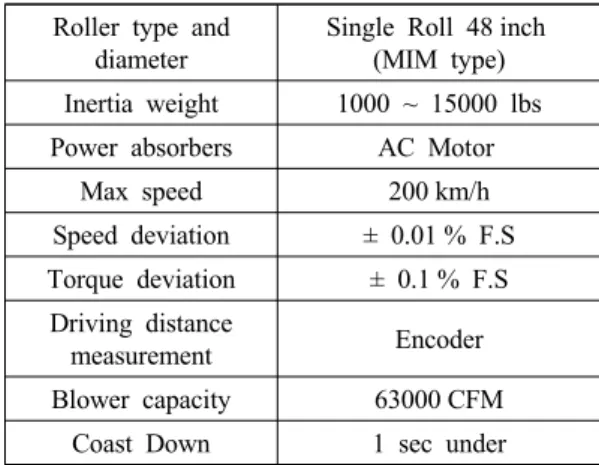
국내 차량 총중량 3.5 ton 미만의 소형, 승용 및 화 물자동차에 대하여 연비 및 배출가스를 측정 할 수 있도록 형식 승인된 장비이다. 동력계의 개략 도 및 제원을 Fig. 1과 Table 1에 나타내었다.
Fig. 1 The schematic diagram of chassis- dynamometer system
Table 1 Specifications of chassis-dynamometer Roller type and
diameter
Single Roll 48 inch (MIM type) Inertia weight 1000 ~ 15000 lbs Power absorbers AC Motor
Max speed 200 km/h Speed deviation ± 0.01 % F.S Torque deviation ± 0.1 % F.S Driving distance
measurement Encoder Blower capacity 63000 CFM
Coast Down 1 sec under
차대동력계는 자동차가 실제도로를 주행할 때 정지 → 가속 → 정속 → 감속 등을 반복하는 과정 을 대표화한 실측 주행모드를 사용하여 주행할 수 있도록 자동차에 부하를 가해주는 장치이다.
시험에 사용한 차대동력계는 AC동력계(AVL 저온 시험용 차대동력계)로 관성중량(Inertia weight), 동 력흡수계(Power absorption unit), 제어기(Controller) 로 구성되어 있다.
배출가스 측정장치(HORIBA Co. MEXA series)
는 자동차의 배출가스 중 CO, THC, NOx, CO
2,
및 CO
2는 비분산적외선분석법(Nondispersive Infrared), THC는 수소염 이온화법(Heated Flame Ionization Detector), NOx는 화학발광법(Chemiluminescence Detector), CH
4는 GC-FID(Gas chromatography-FID) 를 사용한다.
시험에 사용된 차량은 휘발유차량 4대, 경유차 량 4대 총 8대이며 높은 판매율 및 점유율, 다양 한 제작사 및 배기량을 고려하여 선정하였다.
2.2 시험방법
시험차량을 실도로 상황과 동일한 부하조건을 설정하기 위해 차대동력계에서 Coast-Down을 실 시하였다. 또 차량의 상태를 동일한 조건으로 유 지하기 위해 본 시험 전 매회 동일 운전모드로 예 비 주행하는 Preconditioning을 실시하였다. 그리고 시험온도 조건에서 12시간 이상 Soaking시킨 후 본 시험을 수행하였다. 모든 시험은 결과의 경향 성과 신뢰성을 위해 동일 드라이버로 진행되었다.
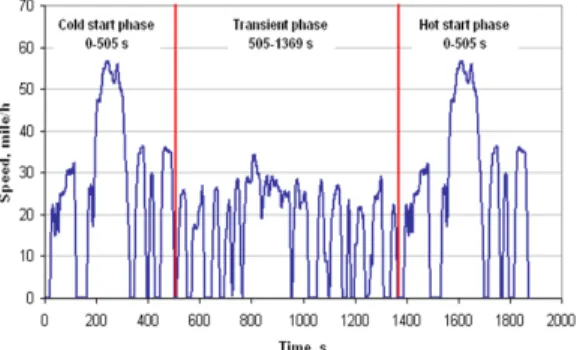
Fig. 3 The driving pattern FTP-75 mode
Fig. 4 The driving pattern HWFET mode
Table 2 The Driving Conditions FTP-75 & HWFET mode
Test mode Dis tance (km)
Max.
speed (km/h)
Average speed (km/h)
Ambient condition (Temp) FTP
-75 City 17.84 93 34.1 25 ℃ HWF
ET High
way 16.50 96 77.7 25 ℃
시험 모드는 연비시험 모드인 FTP-75 및 HWFET 모드로서 주행패턴과 주행조건을 Fig. 3, Fig. 4와 Table 2에 나타내었다.
3. 시험결과 및 고찰
3.1 누적거리별 휘발유 차량의 도심연비 특성
150 km 이내 신차상태에서의 연비를 측정하고 국내 표시연비 시험차량 누적거리 조건인 6,500 ± 1,000 km 상태를 위해 약 1 ~ 2개월 동안 시험차량 에 대한 길들이기를 시행하였다. 시험결과의 형평 성을 위해 전문적 길들이기의 특정조건이 아닌 무작위 거리누적을 위해 여러 운전자가 번갈아가 며 주행거리를 축적하였다. Fig. 5는 4대의 휘발유 차량의 150 km 이내의 신차상태 도심 연비결과와 6,500 ± 1,000 km 내구주행 즉, 길들이기를 시행한 도심 연비결과를 비교하여 나타낸 것이다.
그래프의 청색 막대가 150 km 이내의 휘발유
차량 도심 연비결과, 적색 막대가 6,500 ± 1,000 km
내구차량의 도심 연비결과이며, 차량의 내구 주행
에 따라 최소 0.4 %, 최대 5.5 %, 4대 평균 2.7 %의
연비증가 결과를 보였다. 4대의 시험차량 모두 신
차상태의 도심모드에서 연비가 좋지 않게 측정되
었으며, 차량에서 배출되는 THC, CO, NOx 등의
유해 배기가스도 내구주행 차량보다 신차 상태의
시험차량에서 소폭 더 많이 측정되는 결과를 보
였다. 이는 차량 구동계통 및 각종 윤활유 계열의
마찰력 증가로 인한 연비감소 및 배출가스 증가
를 야기시켰을 것이라고 판단된다.
0 5 10 15 20
A B C D
km/l
Gasoline Vehicle
City(0km) City(6,500km)
Fig. 5 Comparison of New Vehicle Fuel Economy and 6,500 km Fuel Economy(Gasoline Vehicle, City)
3.2 누적거리별 휘발유 차량의 고속도로 연비 특성
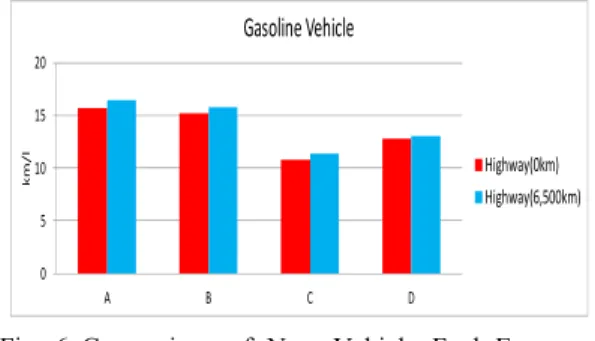
Fig. 6은 150 km 이내의 휘발유 차량 고속도로 연비 결과와 6,500 ± 1,000 km 내구주행 차량의 고 속도로 연비결과를 비교하여 나타낸 것이다. 도심 결과와 유사하게 4대의 시험차량 모두 내구주행 차량 대비 신차상태의 고속도로모드에서 연비가 좋지 않게 측정되었으며, 내구주행에 따라 최소 0.1 %, 최대 4.7 %, 4대 평균 2.5 % 수준으로 연비 가 증가되었다. 고속도로모드에서도 신차 상태에 서의 배출가스가 더 많이 측정되었으며, 도심결과 와 마찬가지로 차량 구동계통 및 각종 윤활유 계 열의 마찰력 증가로 인한 영향이라고 할 수 있다.
0 5 10 15 20
A B C D
km/l
Gasoline Vehicle
Highway(0km) Highway(6,500km)
Fig. 6 Comparison of New Vehicle Fuel Economy and 6,500 km Fuel Economy(Gasoline Vehicle, Highway)
3.3 누적거리별 경유 차량의 도심연비 특성
4대의 경유 차량에 대해 150 km 이내의 신차 상태의 도심 연비결과와 6,500 ± 1,000 km의 내구
0 5 10 15 20
E F G H
km/l
Diesel Vehicle
City(0km) City(6,500km)
Fig. 7 Comparison of New Vehicle Fuel Economy and 6,500 km Fuel Economy(Diesel Vehicle, City)
경유 차량 역시 휘발유 차량과 유사하게 주행 거리가 축적된 내구차량의 연비가 신차상태의 연 비보다 최소 1.0 %, 최대 4.7 %, 평균 2.5 % 증가하는 등 4대의 차량에서 모두 증가하는 모습을 보였다.
배출가스 또한 휘발유 차량의 도심 및 고속도로 결과와 마찬가지로 내구주행을 함으로써 점차 감 소되는 모습을 보였다.
3.4 누적거리별 경유 차량의 고속도로 연비 특성
Fig. 8은 경유 차량의 고속도로모드에서의 내구차 량과 신차상태의 연비결과를 비교하여 나타내었다.
내구차량에서의 연비는 도심결과와 마찬가지로 신차량에 비해 최소 2.0 %, 최대 5.1 %, 평균 3.9 % 가량 증가하였다. 배출가스 또한 150 km 이내의 신차량 대비 내구차량에서 모두 감소하였다. 경유 차량의 고속도로 연비결과에서 휘발유 차량의 도 심 및 고속도로 연비, 경유 차량의 도심 연비보다
0 5 10 15 20
E F G H
km/l
Diesel Vehicle
Highway(0km) Highway(6,500km)
Fig. 8 Comparison of New Vehicle Fuel Economy
and 6,500 km Fuel Economy(Diesel Vehicle,
내구차량의 연비 증가폭이 약간 높았지만 모두 시험실 오차범위 기준인 2 % 이내의 결과로써 큰 차이가 없음을 알 수 있었다.
4. 결 론
국내 표시연비 시험방법을 통해 총 8대의 시험 차량을 150 km 이내 신차상태의 연비측정과 6,500
± 1,000 km의 내구차량의 연비측정을 통해 각각의 시험모드에 대한 특성을 확인하고 분석한 결과, 다음과 같은 결론을 얻을 수 있었다.
1) 휘발유 차량의 6,500 ± 1,000 km 상태 내구차 량의 연비가 150 km 이내의 신차량 대비 도심모 드에서 약 2.7 %, 고속도로모드에서는 약 2.5 %의 연비가 증가하는 결과를 보였으며, 차량에서 배출 되는 THC, CO, NOx 등의 유해가스는 내구차량에 서 모두 감소하는 모습을 보였다.
2) 경유 차량에서의 연비 또한 내구차량의 연비 가 신차량 대비 도심모드에서 약 2.5 %, 고속도로 모드에서는 약 3.9 %의 연비 증가를 보였으며, 휘 발유 차량과 마찬가지로 배출가스는 신차량 대비 내구차량에서 모두 감소하였다.
3) 휘발유 차량 4대, 경유 차량 4대 총 8대를 연비 분석한 결과 연료 유형 및 배기량, 도심모드 및 고속도로모드 즉, 주행 패턴에 관계없이 모두 150 km 이내의 신차상태에서의 연비는 국내 표시 연비 시험차량 누적 주행거리 조건인 6,500 ± 1,000 km 상태의 내구차량대비 내구차량에 비해 좋지 않은 연비 결과를 보였는데, 이는 구동계통 및 윤활유 계열의 마찰력 증가로 인한 영향이라 고 판단된다.
4) 본 연구에서는 현재 해당차량들의 주행거리 를 15,000 km까지 축적하고 있는 중이며, 향후 연 비시험을 통해 150 km, 6,500 km, 15,000 km의 차 량 누적거리에 의한 연비 특성을 좀 더 심층적으 로 비교 분석할 예정이다.
후 기
본 연구는 2016년도 정부(산업통상자원부)의 재 원으로 한국에너지기술평가원 주관 "산업기술혁신 산업 (에너지기술개발사업, No. 20152010103660)"
으로 수행되었으며, 관계 기관의 지원 및 협조에 감사드립니다.
References