• 검색 결과가 없습니다.

Exploring the Characteristics of STEAM Program Developed by Docents and its educational impact in the Natural History Museum

N/A
N/A
Protected

Academic year: 2021

Share "Exploring the Characteristics of STEAM Program Developed by Docents and its educational impact in the Natural History Museum"

Copied!
16
0
0

로드 중.... (전체 텍스트 보기)

전체 글

(1)

Received 7 April, 2014; Revised 17 April, 2014; Accepted 25 April, 2014;

*Corresponding author : Park Young-shin, Chosun University. 309, Pilmun- daero, Dong-gu, Gwangju, 501-759, Korea

Phone: +82-62-230-7379 E-mail: [email protected]

“This study was supported by research fund of Chosun University, 2011 (2011-205747-01)”

ⓒ The Korean Society of Earth Sciences Education. All rights reserved.

This is an Open-Access article distributed under the terms of the Creative Commons Attribution Non-Commercial License (http://

creativecommons.org/licenses/by-nc/3.0) which permits unrestricted non-commercial use, distribution, and reproduction in any medium, provided the original work is properly cited.

Exploring the Characteristics of STEAM Program Developed by Docents and its educational impact in the

Natural History Museum

Park Young-shin

1*

․Park Jin-hee

1

․Ryu Hyo-suk

2

1 Department of Earth Science, Chosun University ․ 2 Science Education Division, Ewha womans University ABSTRACT

The purpose of this study was to explore the characteristics of STEAM program developed and implemented by two docents and its educational impact for the use of natural history museum. Two docents developed this program with the help of science educators who ran five times of workshop during five months. The STEAM program implemented in the natural history museum demonstrated the following characteristics. The exhibitions in museum were reached by visitors only for learning science concepts (S) out of five components in STEAM. The other components, T (technology) and E (engineering), were delivered through lectures in the room, not exhibition hall. M (Mathematics)was achieved by guessing the animal's size, or calculating the walking or running speed with the clue of foot prints. The three phases of STEAM program (presentation of context, creatively design the investigation, and emotional touch) were explicitly implemented but partially successful. Two docents participating in this study responded that they formed new or extended the understandings about STEAM education, but they had the difficulties in implementing STEAM program for various type of visitors. All visitors who participated in this study displayed the favorable responses in educational impact by STEAM program in natural history museum. The heavier emphasis on E and T of STEAM program is recommended through community-based learning. In addition, educator professional program through which docents can bridge theory into practice is suggested for revitalization of STEAM education.

Key words : STEAM, natural history museum, docent, exhibition, visitors

Ⅰ. INTRODUCTION

We face that many issues full of benefits and chal- lenges resulted from both globalization and a knowl- edge-based economy and scientific and technological innovations have become increasingly important in the 21st century (Chun, Jeong, Jeong, Lee, & Lim, 2012;

National Research Council, 2011; 2012). In solving those issues we face, the skills of integrating knowl- edges to creative solutions are necessary along with various perspectives such as environmentally, econom- ically, socially, and ethically (Baek et al., 2012; NRC,

2012; National Science Teacher Association 2013;

Park, 2012; Yakman & Kim, 2007). More competent

and creative persons are required to solve problems

when redefining questions, framing questions to be in-

vestigated, designing the investigation, and collecting

and interpret the data to be concluded with meaningful

implication at the end with integrating disciplines

(NRC, 1996; 2000; 2012). More than anything else,

since technology as well as mathematics are pervasive

in almost every aspect of daily life, the ability of in-

tegrating science with other disciplines (technology, en-

gineering, mathematics) as one of core competencies is

(2)

very critical to thrive in our highly technological world. Therefore, we can state that the goal of science education is to prepare students with core competencies of collaborating and communicating creatively in pub- lic awareness as well as obtaining subject matter knowledge. Students need to be more practical com- petent persons who can demonstrate core competencies necessary to challenge and solve problems they face rather than theoretical persons. To meet this goal, edu- cation policy in Korea as well as USA put the em- phasis of STEAM (Science, Technology, Engineering, Arts, and Mathematics)/STEM implementation in cur- rent education system; in and out of the classroom (Baek et al., 2012; H. Park, 2012; Y. Park, 2012)

It is necessary to mention STEM in USA first be- fore STEAM in Korea. The terms of STEM is now widely used in the world now but it was originally used by NSF(National Science Foundation) first. NSF used STEM term to include all education-related pro- grams across NSF’s different agencies, but it is now widely used in different contexts of meta-discipline which means an integration of formerly separate sub- jects into a new and coherent filed of study (Vasquez, Sneider, & Comer, 2013). Many researches have re- ported that students needs to be able to function and thrive in highly technological world to be STEM liter- ate; identifying effective approaches in STEM is the

“knowledge and understanding of scientific and mathe- matical concepts and processes required for personal decision making, participation in civic and cultural af- fairs, and economics productivity” (NRC, 2011, p5).

Therefore, STEM literacy covers four different liter- acies to be integrated in cognitive knowledge, skills of experimental procedures and creative argumentation, at- titudes to be a broad variety of viewer by adding, in- terconnecting, and applying these four disciplines to solve problems throughout person’s lifetime, which starts to put the emphasis on classroom first. In addi- tion, STEM education has been emphasized to meet the goal of science education for the decade in the USA but STEAM education beyond STEM has been focused in Korea as well as in USA nowadays (Baek et al., 2012; Y. Park, 2012; Riley, 2012; Sousa &

Pilecki, 2013). STEAM include ‘Arts’ in addition to the components of prior STEM. ‘Arts’ is defined in the field of ‘liberal arts’ including ‘fine arts’, ‘physical arts’ and ‘language arts’, and ‘Arts’ is also exaggerated as one of critical factors to be creative (NSTA, 2010;

Park, 2012; Sousa & Pilecki, 2013).

The educational impact of STEAM has been re- ported in many areas as follows. Students’ interest in doing science has been increased (Kang et al., 2010;

Chung, 2012; Y. Park, 2012). Students who took the STEAM program displayed preference to the certain professional occupation introduced in STEAM pro- gram, indicating that the higher preference to pro- fessional career students have through STEAM pro- gram, the higher academic achievement as well as atti- tude to science students show (Yun et al., 2006; Y.

Park, 2012). In addition, students’ self regulation abil- ity in learning has been increased (Kang et al., 2010).

Students’ abilities to solve the problems creatively through the integrated thinking skills (Sanders, 2009) with the use of technology in collaboration have been promoted. These educational impacts on students through STEAM program have been researched in the context of real classrooms in Korea. Surely there have been researches releasing the positive impact on teach- ers’ practices through STEAM program.

When preparing scientifically literate citizen through STEAM education, learning context out of the class- room as well as in the classroom needs to be researched to see how STEAM program can be implemented and what impact STEAM program can be given on leaners, since students are exposed to learning contexts in or out of the classroom at the same time. The teaching and learning science out of the classroom is an in- formal setting of learning and science museum (includ- ing science center) can be representative (Falk &

Dierking, 1992; Jung, 2010; Park & Lee, 2011, 2012),

therefore, active implementation of STEAM program in

science museum is another essential to reinforce STEAM

education in Korea. To meet this goal of reinforcing

STEAM education in the context of science museum,

the following two points must be considered. First,

there is little research about STEAM program im-

(3)

Stage Procedu re C on ten t

Developing STEAM program

The researchers interacted with two docents through five times of workshop during five months.

Two docents

- form new understandings about STEAM.

- develop STEAM program for the use of natural history museum

Implementing STEAM program

Researchers observed two docents' interact with visitors at the museum.

Two docents implement one developed STEAM program:

2 hours in 'A' natural history museum.

Title: 'The footprint is Black Box'

Exploring the educational impact by STEAM program

Researchers surveyed visitors as well as participating docents to withdraw educational impacts through STEAM program

The researchers interviewed and surveyed

- two docents to see how their theories and practices about STEAM were formed and changed.

- visitors to see their responses to STEAM program Fig. 1. Research procedure.

plementation in science museum, so providing exem- plary case of development of STEAM program and its application into science museum may suggest the de- velopment direction of STEAM education in informal learning context as well as formal one. Second, since there is not well prepared educator like docents who directly interact with visitors who could develop and implement science program into the context of science museum (Park & Lee, 2011, 2012; Lee & Park, 2013), it is suggestable to provide professional development program to equip docents to be expertise in theory and practice of STEAM education. On the basis of two conditions (case of STEAM program by trained do- cents), the researchers in this study helped two docents to develop and implement STEAM program in the context of science museum and investigated what char- acteristics of STEAM program in science museum could be withdrawn and how participating docents could become experts in STEAM education.

Ⅱ. RESEARCH METHODOLOGY

There are three stages where the researchers did in- vestigation to answer the research questions (Fig. 1).

In the first stage (Development of STEAM pro- gram), the researchers contacted two docents by con- venience sampling. Two docents, Docent Park and

Kim, had almost 10 years working experience at 'A' natural history museum and their main roles were in- teracting with visitors through touring exhibitions and running educational program. The researchers ran five times of workshops (once per month) through which two docents began to learn what STEAM is, why peo- ple pay attention to STEAM education, what compo- nents of STEAM is composed of, what strengths and weakness of STEAM program in the classroom are, how they can use exhibition of museum for STEAM program and so on. Two docents and three researchers interacted each other through off-line workshop and on-line email when necessary. The title of the devel- oped STEAM program was 'The footprint is black box'. The researchers collected the data related to two docents' understandings about STEAM education through survey and conversation at this stage of research. The main points of STEAM program emphasized by the re- searchers were that five explicit disciplines of STEAM must be included and three opportunities of learners’

recognizing the context, designing the investigation, and experiencing the emotional touch.

In the second stage (Implementation of STEAM pro-

gram), two docents implemented STEAM program two

hours long into the setting of 'A' natural history mu-

seum and interacted with visitors (consisting of four

beginning docents, 15 students, and eight adults) at the

exhibitions hall as well as the lecture room. Two do-

(4)

cents shared the roles of one (Docent Kim) leading the visitors in the lecture room and the other (Docent Park) touring visitors in the hall of exhibition. The re- searchers observed how two docents interacted with visitors and recorded their interactions by video. All verbal practices were transcribed and all physical prac- tices were observed to be used as one of evidences supporting researchers’ claim through triangulation.

In the third stage (exploration of educational impact of STEAM), the researchers explored the educational impact on visitors as well as participating docents after STEAM program. The researchers developed two dif- ferent surveys for visitors and two docents and they filled out the surveys after STEAM program two hours long. Unstructured interview was also conducted for the groups of visitors and two docent who led the lesson. All survey and interviews were aimed to see if STEAM program was influential to visitors. All Interviews were transcribed and surveys was also ana- lyzed to be used as evidences for revealing what edu- cational impacts on visitors and two docents by STEAM program were emerged. The validity and reli- ability of data collection and data analysis were con- structed by researchers’ discussion to be consensus through cross checking.

Ⅲ. RESULTS

The characteristics of STEAM program developed and implemented by two docents for the use in the natural history museum were explored and its educa- tional impact on visitors as well as participating two docents were investigated. The results of this study were described according to each research question.

1. The Characteristics of STEAM Program in ‘A’ Natural history Museum

The researchers used four different analysis to make decision how well STEAM program has been devel- oped to meet the goal of scientific literacy as follows;

(1) whether all five components of STEAM was in- cluded in the program, (2) whether the STEAM pro-

gram consisted of three opportunities of ‘recognizing the real problem’ to solve, ‘designing the investigation’

creatively to solve the problem, and ‘experiencing the emotional touch’ such as feeling interest, self-efficacy, self-confidence, and sense of accomplishment to pro- mote their learning. All of emotional touch covers all positive emotions in doing science (Baek et al., 2012), (3) how STEAM program can be differently im- plemented in the natural history museum according to various levels of visitors, and finally (4) how often sci- ence exhibitions in the natural history museum can be utilized during STEAM program.

1) The five components of STEAM program in the natural history museum

The title of STEAM program implemented into ‘A’

natural history museum was ‘The footprint is black box’, whose story dealt with one mammal which left the footprint in falk village. The task was to find out what kind of animal came down to damage the crops and how the village people would prevent those ani- mals from damaging the crops. The following overview in STEAM program indicated that the five components of STEAM were successfully included.

[S] We can recognize the animal’s structural features, its walking speed and size, and its moving style on the basis of appearance and size of animals’ footprint when compared to mammalian species. [M] Guessing the size of the mammal can be predicted depending on the size of footprint or the size of stride, which is connected to that of human being [E] to find out the principles applied to the technology in sports-engineering, and [A]

Footprint is analyzed through environmental factor for the classification of mammals and through daily life factor for its adaptation, all of which can give clues for us to infer and describe the story of how the footprint was formed through physical experience activities. Finally, [T] we can discuss technically the way of developing wooden fence to reduce the damage made by the mammals, or we can analyze the reason why the mammals recently increase to come down to the private houses to harm damage , then we can find ways to preserve the environment and protect the crops from animals’ damage.

[S] science [T] technology [E] engineering [A] arts [M] mathematics

The STEAM program developed by two docents

(5)

Fig. 2. STEAM implementation in lecture room and exhibition hall

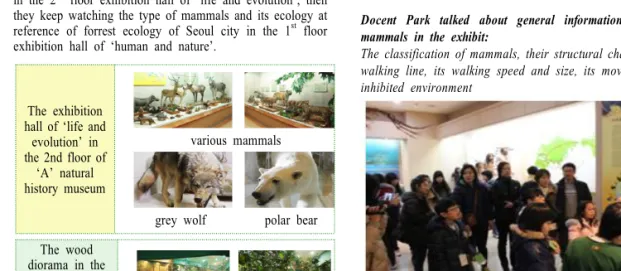
Visitors observe different stuffed animals whose foot shapes are different.

Visitors observe each stuffed animal’s foot shape, size, length, and body size displayed at reference of ‘mammals’

in the 2

nd

floor exhibition hall of ‘life and evolution’, then they keep watching the type of mammals and its ecology at reference of forrest ecology of Seoul city in the 1

st

floor exhibition hall of ‘human and nature’.

The exhibition hall of ‘life and

evolution’ in the 2nd floor of

‘A’ natural history museum

various mammals

grey wolf polar bear

The wood diorama in the

exhibition of

‘human and nature’ in the 1st floor of ‘A’

natural history museum

forrest ecology of Korea in the type of diorama

partial ecology of diorama

Docent Park talked about general information of stuffed mammals in the exhibit:

The classification of mammals, their structural characteristics, walking line, its walking speed and size, its moving, and its inhibited environment

Fig. 3. The component of STEAM : science displayed that five different components of STEAM

have been well embedded in this overview. More de- tails about how five components of STEAM were em- bedded as follows.

Science: Visitors participating in this study, at first, observed different stuffed mammals displayed in the exhibit hall, where they could gain general information about each mammal and its inhabited environment

(Fig. 3).

Technology: People in the village suggested to in-

stall electric fences to prevent the mammals from

harming damage crops in the farm. Docent Park in-

troduced what problems the people in the village faced

and how they could solve the problems with the use of

real photos and maps (Fig. 4).

(6)

Visitors needed to discuss where electric fences would be installed on the basis of information about the kind of animals and their sizes.

(The upper map describes the tracks of wild pig which damaged the farm.

The two bottom photos show the electric fences built to reduce crop damage by wild pig. Those electric fences are supported partially by the city and this project is conflicted by the association of wild animal protection)

Fig. 4. The component of STEAM : Technology

Soccer player of Korea, Jisung Park, is flat-footed which is the worst for soccer player.

There is the arch of the foot for normal people but it is not for people who are flat-footed.

These people with a flatfoot are divided into two groups. Some people are flexible flat-footed and their arch of the foot works normally when seated but abnormally when standing. Others who are rigid flat-footed are suffering from joint pain by nature or other reasons of athletics joint. Normal people’s arch of the foot can absorb the impact from walking or running, but people who are flat-footed don’t have this absorbtion much so they cannot do sports very well. This flatfoot is also a problem for the soldiers who need to walk for a long time. Bongju Lee, who was a marathon runner, was also flat-footed, so the sports company designed special running shoes for cushioning the impact.

Docents introduced the principles and skills which can be applied in sports-engineering for athletics.

Docents shared the story how athletics overcame their barrier of flatfoot to be the best runner or player. Special designed athletics’

shoes are introduced.

Fig. 5. The component of STEAM : Engineering Engineering: The style of walking or running can be

inferred from the footprints left on the farm. The shape of footprints can look different when walking or run- ning and they can recognize which animal is good at running or jumping with the shape of footprints. This inferred knowledge can be applied in designing the athletics’ running shoes overcoming their flat-footed.

This chance of introducing ‘engineering’ of STEAM can stimulate any student of visitors to have interest in becoming athletics’ shoes designer as career guidance (Fig. 5).

Arts: The arts of STEAM means the followings;

fine arts, language arts for communication, liberal arts

such as sociology, history, and politics, and physical

arts such as sports or dance. Arts in the STEAM pro-

gram in this study included creative activity through

which students at lower elementary level express their

ideas with their own language. Participating two do-

cents introduced another ‘arts’ through which adults or

students in high schools write a poem or story with the

theme of footprints (Fig. 6).

(7)

Kids at young age designed hanker chief by stamps of various animals’ footprints. Kids can classify the animals by footprints’ size and shape.

Kids do activity of coloring: green color for grass-eating animals, red color for carnivorous animals Visitors at young age could do activity to make t-shirts by stamping footprints and create its story.

Fig. 6. The component of STEAM : Arts

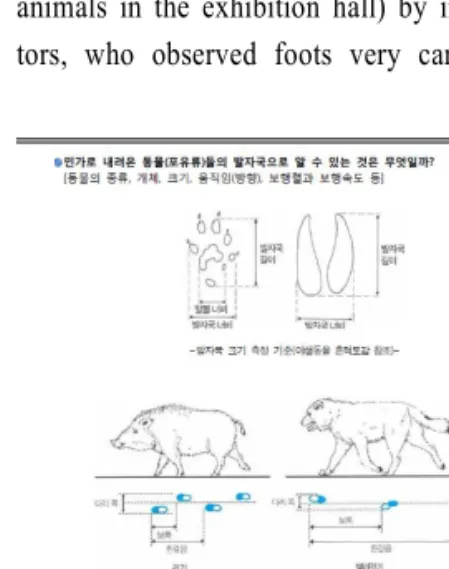
Docents asked visitors what they could know from the footprints left in the farm. The answers included the type of animals, its size, its moving direction, and its walking speed. visitors could compare the animals’ size, infer animals’

moving behaviors by comparing even strides of footprints left in the farm.

Docents guided visitors to infer what they could know as much as possible with the use of footprints.

(The drawing in the left describes what and how we can guess from the clue of footprint. We can guess the kind of animals from the width and length of footprint, its size, its moving direction, and walking and running speed from the strides of footprints)

Fig. 7. The component of STEAM : Mathematics Mathematics: Students at young age in this study

could calculate the size of animals by even strides from footprints left in the farm. Students in middle or high schools could calculate the walking speed as well as inferring animals’ moving direction with the use of footprints (Fig. 7).

Generally, the STEAM program (its title was

‘footprints is black box’) implemented in the natural history museum included five components, S, T, E, A, and M with different weight, SteAm program (strong S, A, and M, but weak T and E). Participating two do- cents introduced much knowledge about the character- istics of animals (all about animals by using the stuffed animals in the exhibition hall) by interacting with visi- tors, who observed foots very carefully to solve the

given problem. Visitors also had chances to infer hab-

itat environment of animals displayed as the stuffed

ones in the exhibition hall and communicate their find-

ings with other visitors. Visitors also guessed size of

animals, calculated walking or running speed with the

use of footprints. ‘S’ and ‘A’ as well as ‘M’ can be

emphasized much in the STEAM program implemented

in the natural history museum. However, how to design

athletics shoes overcoming flat-footed fault and how to

install electric fences preventing animals from invading

and eating the crops in the village were introduced ver-

bally only in the lecture room of natural history mu-

seum without any activity. Therefore, STEAM program

of ‘footprint is black box’ was what S, A, and M com-

ponents are more weighted and T and E components

(8)

1. Presentation of Context why footprints in the farm?

This is the report in the session of environment column. visitors became to know why the crops in the village were damaged and recognized the footprints in the farm were the clue for this damage. Visitors were guided to discuss which animals’ footprints could be inferred, what evidence could support their findings, and how they could prevent those animals from damaging the crops.

Fig. 8. The phase of STEAM : Presentation of Context are less weighted (Bybee, 2013).

2) The three phases of STEAM in the natural history museum

STEAM program is expected to provide the follow- ing three opportunities for the successful STEAM one.

First, visitors need to be aware of what problems they face and feel responsibility to solve the problems in the given ‘presentation of context’. Second, visitors need to have chance to ‘design the investigation crea- tively’ to find out the solution. Third, visitors

‘experience the emotional touch’ by doing science and engineering. These three opportunities do not have to come as a sequence, but usually they happen as a sequence. The details of how three phases are em- bedded in the STEAM program as follows.

Presentation of Context

First, docent Park introduced the current issue through the environment report as well as video, which illustrated that the farmers had damage on their crops from the appearance of wild pigs and motivated visi- tors to have interest in those mammals (Fig. 8).

In this phase of STEAM, visitors had chance to be aware of what the problem was and they felt responsi- bility to save the crops from the wild animals. The fol- lowing excerpt explained how docent Park interacted with visitors by motivating them to recognize the prob- lem they faced.

Docent Park: since my husband also runs the farm,

I became to know that the crops were damaged by the wild animals. I found this article from the newspaper saying that there were many wild animals damaging the crops (showing the article to the visitors) [omitted]

As you know, wild animals damaged the crops, ac- tually my husband harvested the half of sweet potatoes which he expected to do due to wild animals. I felt that I need to find out the ‘reason’ of why wild ani- mals came down to the village to damage the crops and felt responsibility to find out the solution to save the crops. What do you think? Why did wild animals come down to the village? Is this footprint wild pig’s or what? These footprints are marked down to the vil- lage? Which way is this animal moving? How can we stop this animal from coming down from the moun- tain? Can you find the solution so that I can tell it to my husband? (Docent Park’s introduction of pre- sentation of context in STEAM program, where visitors were recognized the problem).

Docent Park tried to motivate visitors by connecting

the problem to the daily life through which they were

stimulated to find out the solution. In addition, Docent

Park motivated visitors (especially students) to have in-

terested in dealing with this problem by providing

more detail questions so that visitors could answer

easily with their own prior knowledge. The following

conversation indicated how docent Park stimulated visi-

tors to be interested in understanding the problem in

detail.

(9)

Docent Park: All animals walk by four foots? How can we know animal’s size only by the footprints left in the farm? Ok let’s measure how big your foot size is. I have string ruler, OK, what about you? You seem to have 200 mm of shoe size, so your real foot size will be 180 mm?

Visitor A (student): Yes, my foot size is 180 mm.

Docent Park: 180 mm? OK, then would you stand up please? I wonder how tall you are. I will measure your height. I got 70 cm from the foot to your waist.

Anybody can calculate what number you need to multi- ply to your foot size to get this number?

Visitor B (student): around four times?

Docent Park: OK, you got this number after multi- plying four to this foot size. Then we can get the height from the foot to the hip of this animal by meas- uring the length footprint? We can guess animal’s size with the footprint? What do you think?

(Docent Park stimulated students to be interested in understanding the problem in detail with their own pri- or knowledge).

Next, two docents guided visitors to be more logic and knowledgable to solve the problem. Visitors had chances to use their prior knowledge to understand the problem logically and scientifically as follows. Visitors became to know the kinds of animals, their size, their characteristics, and their habitat environment from the footprints left in the farm and visitors also compared different footprints to have various information related to various feet. Visitors started to make decision which animal was the main invader to damage the crops. This presentation of context phase was run by two docents alternatively in the lecture room.

Creatively Design the Investigation

Two docents guided visitors to the stuffed mammals in the exhibition hall and visitors in groups were asked to confirm what they discussed in the lecture room and made decided what kinds of animals were invaders to damage the crops only by the footprints. Visitors in

groups observed the stuffed mammals, decided which one might be the invader to the village, and what sol- ution visitors could suggest to protect the farm from wild animals. Visitors inferred which animal damaged, what kind of animal was, if that animal was fast run- ner, if that animal was slow walker, and how tall they were. Visitors drew the map and decided how long the fence must be, how tall the fence must be, if the fence must be wooden one or electric one, and such as. Two docents at this time introduced if visitors could find the flat-footed from the footprints left in the farm and asked them what would happen to the athletics if they would be flatfoots. Docent Kim talked about how soc- cer player, Jisung Park, could be best player and how marathon runner, Bongju Lee, could be best by over- coming their flatfoots. However, this interaction was implemented verbally only by showing the photos or drawing without real practical implementation of en- gineering or technology. In addition, the chance of in- troducing ‘engineering’ of designing the shoes for ath- letics was not related to solve the problem in this STEAM program. The following interview and re- sponses from survey released how hard two docents were struggling to embed ‘technology’ and ‘engineering’

into the STEAM program.

Docent Kim: I had difficulty in connecting the issue of footprints to the components of engineering. The in- troduction of using engineering for athletics’ shoes was fun to share with visitors but this was not related to the footprint issue. I am sure that I knew that en- gineering component of STEAM program is very essen- tial one but I am not sure yet how to include it natu- rally into STEAM program and how to relate it with the current issue we are dealing with (Interview with Docent Kim)

Question: What was the most difficult in developing and implementing STEAM program?

Docent Park: I wanted to keep visitors motivated in their learning, but I felt there was disconnection in their learning when I introduced the part of

‘engineering’ in the footprint STEAM program. The

(10)

story of athletics’ shoes designed ergonomically was pretty good to make visitors interested in this program of STEAM and I thought that I was successful to in- clude each component of STEAM into one. I liked the story of engineering part of athletics' shoes applied by the story of footprints, which was really interesting, but it was not used directly for solving the problem. So what? This is OK or not? (From the survey of Docent Park)

Docent Kim: We (two docents) worked together, we were very confident to talk about the characteristics of animals for science, their walking speed or their size calculating for mathematics, and inferring habitat envi- ronment from the footprints as well as making shirts with footprints' stamps for arts. However, we just cov- ered engineering and technology of STEAM verbally without any practice. The lecture[about athletics] was pretty interesting to visitors, but I wonder if I can say this is STEAM program (From the survey of Docent Kim)

Two docents responded that engineering and tech- nology components of STEAM were the most difficult one to include into the STEAM program by covering them verbally only without concrete practices through activities. In addition, two docents wondered if all components of STEAM must be connected to the proc- ess of finding out the solution. Two docents mentioned that all components except engineering were connected each other to prevent animals from damaging the crops, but they believed that engineering of STEAM program was used only to motivate visitors to have in- terest in principles related to flat-footed to design ergo- nomic shoes for athletics. Two docents also mentioned to build electric fences with appropriate length and height verbally with visitors. Therefore, engineering as well technology of STEAM in the natural history mu- seum was not practical through activity but learned by visitors verbally with much interest during the phase of 'creative design investigation'.

Emotional Touch

There was another phase of STEAM, 'emotional tou-

ch' phase where visitors were expected to understand science learning by hearts (Park, 2010). In this phase, visitors could learn positive attitude toward science, form positive self-efficacy, develop alternative per- spective of science such as societal one, political one, and economic as well as environmental one. First, visi- tors as a group or in a team created the shirts or hand- kerchiefs with different stamps of footprints; different coloring stamps for different characteristics of animals.

Young students began to learn animals' habitude, such as grouping, food chain, and migrating and adopting themselves to new environment by printing different coloring stamps of footprints as well as creating stories related to animals' lives.

Second, visitors in a group or as a team were also guided to suggest how to stop animals from coming down and damaging the crops. At this point, visitors needed to consider the following some conditions be- fore installing the electric fences. If the animals are re- duced in their number, what would happen to food chain? What position of people in the farm will be about building electric fences? What position of ecolo- gist will be? How can we regulate their positions each other? Visitors could learn alternative perspectives when understanding science, which is possible by hearts, not by mind nor by hands (Park, 2006). Two docents guid- ed this opportunity of emotional touch in STEAM pro- gram with visitors in the lecture room at the end of program. Two visitors (father and son) presented their suggestion of how to stop animals from damaging the crop and they also commented pros and cons in instal- ling electric fences for farmers. Economic as well as environmental views needed to be considered to install the electric fences as a solution in this program.

3) Various teaching strategies according to various levels of visitors

The STEAM program included a few different

teaching strategies for various levels of visitors ranging

from the young to the old. In the phase of creatively

design the investigation, visitors (students at high

school levels) had chances of using scientific principles

related to the flat-footed to design the ergonomic shoes

(11)

Docent Park explained the relationship between foot size and body size with the use of the stuffed animals in the exhibition hall.

Fig. 9. Two docents' interaction with visitors in the exhibition even though implemented verbally. Two docents and

visitors, first, discussed the effectiveness, appropriacy, accuracy, and felicitousness of shoes for flat-footed.

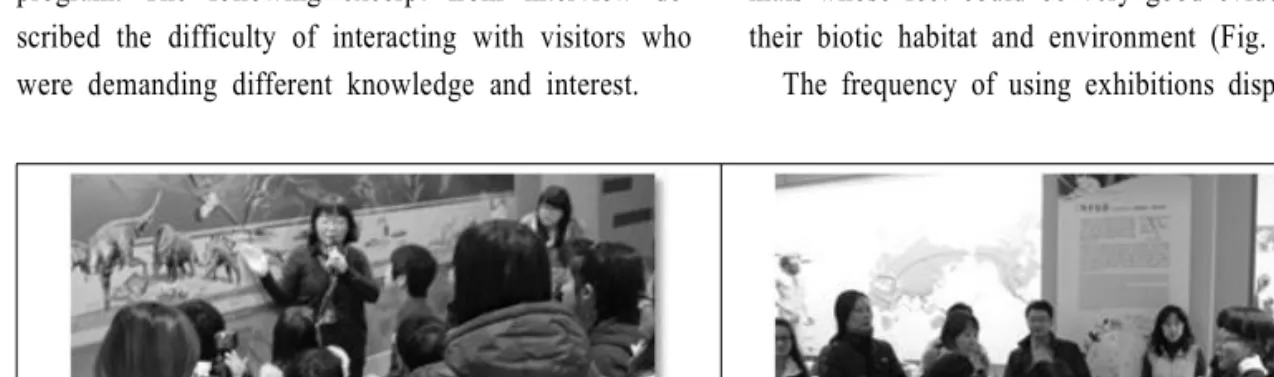
Then, visitors sketched their own designed shoes with the considerations in its shape and size briefly. Visitors of high school students at this point could think of be- coming engineering designer or biomechanics to pro- duce athletics' shoes. This STEAM program could work as a good resource to motivate visitors of students to have interest in the field of natural science and en- gineering as occupations. Visitors of young learners es- timated the animals' size but students at middle or high school students calculated the exact size from the size of footprints mathematically. Young students created the story by printing various of animals' foot stamps in terms of fine arts but adult created the poem or story related to footprints in the woods in terms of liberal arts. Visitors of adults discussed the pros and cons of installing electric fences with alternative views; eco- nomically, ecologically, and personally as a farmer or an animal lover. Two docents stated that it would be very critical for people to take actions of human activ- ity on nature including animals, which was one of re- markable features of STEAM program. However, two docents mentioned that it is always challenging for them to interact with various level of visitors with dif- ferent teaching strategies even in implementing STEAM program. The following excerpt from interview de- scribed the difficulty of interacting with visitors who were demanding different knowledge and interest.

I could not have enough time to figure out what type of visitors came for STEAM program. I ran STEAM program with the focus on family type of visi- tors and I made family have interest in footprints left in the farm and to observe feet of the stuffed animals in the exhibition hall. Their mission was to fill out the worksheet by inferring the characteristics of animals from footprints and completed the activity of making shirts with the footprint stamps. This was low level tar- geting to family unit only. In a way, I failed to regu- late different level of program with various type of vis- itors (Docent Kim's response to the question in survey)

4) The exhibit availability in natural history museum for STEAM program

At the early state of STEAM program, two docents actively used the exhibitions displayed in the hall to stimulate visitors to pursue the solution and get them knowledgeable about mammals. Two docents ques- tioned visitors of the features of the stuffed mammals displayed in the type of diorama and let them observe and infer the relationship between footprints left in the farm and the stuffed feet of mammals (Fig 9).

Two docents also helped visitors fill out the work- sheet of mission and perform the activity of book art, which made visitors understand the concepts of mam- mals whose feet could be very good evidence to infer their biotic habitat and environment (Fig. 10).

The frequency of using exhibitions displayed in the

(12)

Young visitors in a group performed their assigned worksheet of mission Fig. 10. Visitors' mission to fill out the worksheet by observing the exhibit

hall was very low since two docents used the ex- hibition to deliver the ‘concepts’ in ‘S’ related to mammals only to visitors at the early stage of STEAM program. When two docents tried to implement other two components of STEAM, ‘E’ for athletics’ shoes and ‘T’ for electric fences, they could not use ex- hibitions appropriately. Visitors moved to one of lec- ture rooms to calculate the walking speed or body size from the size of footprints left in the farm and two do- cents explained the implementation of ‘E’ and ‘T’ ver- bally only without any hands-on activity, such as sketching or designing shoes fit for athletics whose feet are flat or installing the electric fences which could stop the animals from damaging the crops. Therefore, the stuffed animals of exhibitions were used mainly for delivering concepts/information in STEAM program overall.

2. Educational Impacts of STEAM Program on Visitors and Docents

Two educational impacts by STEAM program de- veloped and implemented by two docents in one of natural history museum were released as follows. One educational impact was on two docents and the other on visitors participating in this study.

1) Educational impact on participating two docents about STEAM education

First, two docents responded that they newly formed and extended the pre-existing perception about STEAM

education. At the beginning of this study, two docents were told that STEAM education is very pivotal educa- tional policy by media and they were asked to imple- ment STEAM program into science museum they be- longed to. The reason why two docents were involved in the workshop run by the research team was that they were eager to learn more what STEAM would be and how it could be implemented in the setting of sci- ence museum. Two docents became knowledgeable of what components of STEAM were essential and how they could implement it. Docent Kim indicated that keeping visitors motivated in finding out the solution was very challenging but important in STEAM pro- gram by providing the familiar learning situation, which was also emphasized in STEAM of PBL (Project Based Learning) approach (Stanley, 2012) for its suc- cess implementation in the classroom.

For the success of STEAM program, I found out

that it is very critical to stimulate visitors to pursue the

solution by giving them real problem or issue possible

in their daily life. So I used the current issue from

newspaper which visitors might be familiar with and I

tried to use the mammal exhibition in the hall to get

them be knowledgeable as much as they could before

brainstorming of how to solve the problem. First of all,

I think that it is essential to make them exposed to the

situation of problem by letting them reminded of con-

cepts well known to them (Docent Kim’s response to

the question in survey)

(13)

In addition, two docents perceived that ‘A’ of STEAM does not mean ‘fine art’ only but all possible areas including liberal arts and language arts as well.

Two docents tried to implement the activity of printing shirts or handkerchiefs by stamps for ‘A’ part of STEAM, but they developed another activity for ‘A’

for adults and students at high school levels, who in- ferred what biotic habitat and environment situation could be withdrawn and what kinds of animals could be surviving in those areas or who performed the ac- tivity of writing a poem or essay with the story of ani- mals whose footprints were left in the farm. The fol- lowing excerpt from interview by docent Park in- dicated that there was extension of her perception about STEAM program.

I thought that we need to produce the concrete products through hands-on activity at the end of STEAM program. That’s why I planned to implement stamp printing shirts and handkerchiefs at the begin- ning, but I became to learn that inferring thinking skill and writing skill can be also the products of ‘A’ in STEAM program. I am not much confident to deliver these skills of inferring and writing to visitors pro- fessionally but I at least tried to do this time. I am very proud of myself. I feel I did great job of STEAM program in museum (Docent Park’s interview).

Secondly, two docents indicated that their perception and knowledge about STEAM program were more ac- tively formed and changed through practices of devel- oping and implementing STEAM program by interact- ing with the researcher team. Two docents added that it would not be possible for them to be confident of developing and implementing STEAM program unless they had learned how to implement it through its real application with the researchers’ help. Two docents struggled to develop STEAM program with optional teaching strategies demanded by various level of visi- tors and they selected and employed strategy appro- priate for the family unit of visitors. They responded that they were successful in implementing STEAM program to some as planned but in a way they failed

to do. The following excerpts from two docents’ inter- views supported their perception changed or maintained through their practices of developing and implementing STEAM program (Fang, 1996; Park, 2008).

In another way, STEAM program is very good for us to implement it into science museum full of various type of visitors. I could employ ‘A’ of writing to stu- dents, ‘A’ of inferring to adults’ and ‘A’ of printing shirts to young kids for perfect STEAM. This is what I preplanned and I felt safe when this happened natu- rally while I was interacting with all visitors during the class (Docent Park’s interview).

I intended to deliver much concept for visitors dur- ing STEAM program, which was possible while visitors observed the stuffed animals in the exhibition hall. I was active in explaining mammals’ features to visitors, but I could not use any exhibition at all when I talked about math, technology, and engineering part. So I thought that I completed STEAM partially. As you mentioned before, visitors seemed not to understand the parts of technology and engineering completely without concrete practices of hands-on. Some happened as planned, however others did not happen as planned.

I was right in a way and I was wrong in another way (Docent Kim’s interview).

Thirdly, two docents put the emphasis of running professional development program for experts in suc- cessful STEAM education of science museum. Two docents responded that it was possible for them to de- velop and implement STEAM program with re- searchers’ help. They figured out that STEAM program could not be perfect at the current educational situation of natural history museum, so there must be another help from engineering or technology experts for the practical STEAM education. Without those experts’

help in engineering or technology, two docents stated

that they could only make unbalanced STEAM pro-

gram, with more weighted science and art and less

weighted technology and engineering. The following

excerpt from interviews supported this claim.

(14)

I can help other docents when they ask me about STEAM program now. I am the leader of docent groups and I feel responsibility for training them about STEAM education which has been emphasized in the country for the years. Educational policy puts the em- phasis of implementing STEAM program into science museum as well as classroom. But how? We are the very persons who interact with visitors in science mu- seum, but we do not know how to develop and imple- ment STEAM program. We did not have a chance to take workshops or courses for being experts in STEAM education. But I was lucky to meet you and I was trained to do this job. I expect other educators like you to offer professional development as we did through workshop for STEAM education in science museum (Docent Park’s interview).

2) Educational impact on visitors participating in STEAM program

Four docents, eight adults, and fifteen students visi- tors were surveyed and interviewed as a group about asking educational influence by STEAM program and the following results were developed from data analysis. All participants agreed that STEAM program was successful in motivating them to feel responsible in finding out the solution and saving the crops. All visitors also responded that STEAM program was very attracting them to keep researching their assigned task and they added that it was fun to observe exhibition displayed in the hall with the shared certain purposes as a group.

I like science learning in museums better than in classroom. I had more chances to talk and ask ques- tions to teachers [docents in this study]. I enjoyed to- day’s activity and I felt like a detective or scientist when I used footprints as evidence to infer which ani- mals were coming down to the farm. It was interesting to calculate body size with the use of foot size. It was awesome that athletics could overcome their weakness of flat foot with the engineered shoes. It was interest- ing to know which footprints were flat ones or not (positive educational impact on one of students from

his survey).

I used to sit in the coffee shop whenever we visit science museum when my kid was busy in doing some- thing in science center, but I joined the group of visi- tors today and I helped my son to do better in his mis- sion task. I could explain my son what to present after observing exhibitions in the hall. I also presented what I observed in the exhibition hall. My son did not know who Bongju Lee, marathon runner, was. My son asked me who he was when we were chatting about which animals’ foots are good at running fast or jumping high such as (One parent’s interview).

Four docents who were participating as visitors showed their educational impact as follows. At first, four docents were unfamiliar with STEAM education but they became to learn what STEAM program looked alike and what professional skills they needed in implementing STEAM program.

It was good opportunity for me [one of docents as visitors] to see how STEAM program was implemented by two docents who were much more able persons when compared with us. We were asked to develop les- son plan of STEAM program for using it in our mu- seum, but frankly I don’t know what STEAM is and how we develop and implement it. Now I have passion to learn more about STEAM program and I am con- fident to develop STEAM program after watching two docents running STEAM program. I hope to have pro- fessional program in this center so that docents like me could have chance to learn STEAM education (One docent’s interview in a group of visitors).

Overall, we can state that STEAM program had

very positive impact on visitors on the basis of their

responses. All visitors showed consensus that STEAM

education could produce the talented persons as envi-

sioned in Standards (NRC, 2012; 2011) and Korean

STEAM educational policy by responding that they

could be more creative (23 out of 27), they could learn

more skills related to solve the problem from daily life

(15)

(25 out of 27), and they could build more upright char- acter through STEAM program (23 out of 27).

Participants also responded that they had fun in learn- ing more concepts about mammals and learning how to infer some information from their observations.

Ⅳ. Conclusions and Implication

First, the heavier on engineering and technology through practical hands-on activities must be empha- sized for idea STEAM program in the natural history museum. Two docents were confident in explaining features of mammals with the stuffed animals dis- played in the exhibition hall, which was targeting for

‘science’. Visitors had chances to estimate the size of animals or calculate the walking speed from the foot- prints, which was targeting for ‘mathematics’. Two do- cents used two different strategies for ‘arts’, printing the stamps of various footprints with young kids and inferring biotic habitat and environment situation with adults. However, two docents interacted with visitors for ‘engineering’ and ‘technology’ by designing ath- letics’ shoes and building electric fences verbally.

Therefore, more weighted ‘E’ and ‘T’ of STEAM must be included for the successful STEAM education in the natural history museum.

Second, the STEAM program in the natural history museum can contain strong science concept part con- nected to the exhibitions. Two docents used the stuffed animals displayed in the exhibition hall to encourage them to connect concepts from exhibition to their prior concepts necessary to understand the problems they faced fully. The exhibitions in the natural history mu- seum containing exhibition panels were used for

‘science’ concepts, which made two docents interact with visitors actively in the area of exhibition hall at the first stage of STEAM program, ‘presentation of context’. The other ‘E’, ‘T’, ‘M’, and ‘A’ components were learnt in the lecture room. If STEAM program is implemented in science center full of many hands-on tools or equipment, ‘E’ or ‘T’ can be easier to include than others. Therefore, the consideration of which com-

ponent of STEAM must be more highlighted can de- pend on the type of science learning context. For this, the experts who develop STEAM program need to fig- ure out which component of STEAM should be high- lighted or which component of STEAM should be add- ed or made up depending on various type of science learning contexts such as classroom, science center, or natural history museum.

Third, STEAM program for the natural history mu- seum can include different teaching strategies depend- ing on various type of visitors in ages, gender, or interest. Two docents employed the inferring strategy for adults and the stamp printing strategy for young kids for ‘A’ component of STEAM. Young visitors in a family unit interacted with parents to estimate ani- mals’ size from the size of footprint and students at secondary school calculated the walking speed of ani- mals from the distance between footprints for ‘M’.

Appropriate teaching strategy must be adopted by do- cents or persons who interact with visitors depending on various type of visitors for the effective STEAM program in the natural history museum.

Fourth, the educator professional development pro- gram consisting of theory and practice at the same time are recommended for the successful STEAM pro- gram implementation. Two docents as well as other docents participating in this study appealed for taking training course to be expert in STEAM education.

Docents who were involved in this study indicated that

they were asked to develop STEAM program and im-

plement it but they were afraid of doing practices since

they did not know what to develop and how to imple-

ment for STEAM program. Two docents showed very

positive reaction in that they took the chance of being

expert in STEAM education with the help of re-

searchers and other four docents also responded pos-

itively that they became to know what STEAM educa-

tion was. All of docents in this study hoped that there

would be another chance for them to be involved in

educator training workshop to be expert in STEAM ed-

ucation, where they could learn theory to be connected

to practices.

(16)

Acknowledgment

I would like to thank three anonymous reviewers for their critical reviews. This study was supported by re- search fund of Chosun University, 2011 (2011- 205747-01).

Reference

Baek, Y. S., Park, H. J., Kim, Y., Noh, S. G., Park, J.-Y., Lee, J., Jeong, J.-S., Choi, Y. & Han, H. (2012). A Study on the Action Plans for STEAM Education.

Report of KOFAC. Seoul, Korea.

Bybee, R. W. (2013). The case for STEM education:

Challenges and opportunities. Arlington, VA: NSTA press.

Falk, J. H., & Dierking, L. D. (1992). The museum experi- ence. Washington, DC: Whalesback Books.

Fang, Z. (1996). A review of research on teacher beliefs and practice, Educational Researcher, 38, 47-65

Hong, Y. K. (2009). Designing the integrated Mathematics and Science program and its effectiveness. Journal of Curriculum Integration, 3(2), 42-66.

Jung, J. H. (2012). Qualitative Inquiry on Fun Appearing in PBL: 3S-Fun. Kyung Hee University. Doctoral Thesis.

Jung, K. (2010). Introduction to science museum. Kongju, Korea: Press of Kongju National University.

Kang, C., Jeong, K. S. & Kwon, D. (2010). The effects of thematic integrated learning(Jump Leader Program) on the elementary school children's self-directed learning ability and integrated thinking disposition. Journal of Learner-Centered Curriculum Instruction, 10(3), 1-19.

Kang, I., Jung, J., Seo. B & Chung, D. (2010). The project learning for the change in enjoyment of classroom.

Seoul, Korea: Imaginative Channel.

Chun, S., Jeong, S., Jeong, J., Lee, K., & Lim, W. (2012).

Development Study of Smart Class Models for STEAM. The annual report of Korea Foundation for the Advancement of Science and Creativity (KOFAC).

Seoul, Korea.

Lee, J-H & Park, Y-S. (2013). The study on the experienced docent’s expertise in science exhibit interpretation by life history research. Journal of Korean Earth Science Society, 33(4), 257-273.

National Research Council (2012). A framework for K-12 science education. The National Academy Press, Washington, DC, USA.

National Research Council (2011). Successful STEM educa- tion: A workshop summary. A. Betty, Rapporteur.

Committee on highly successful schools or programs

for K-12 STEM education, board on science education and board on testing and assessment. Division of be- havioral and social sciences and education. Washing- ton, DC: The National Academies Press.

National Science Teachers Association (2010). The NSTA learning center https://learningcenter.nsta.org/discuss/

default.aspx?tid=DVLs6fWHFNk_E

National Science Teachers Association (2013). Science for the next generation: Preparing for the new standards.

NSTA press, Arlington, VA, USA,

Park, H. (2012). STEAM education of Korea: The consid- eration for STEAM education in Korea, The paper from the biannual meeting of Korean Association for Science Education. February.

Park, Y-S. (2008). Preservice teachers’ beliefs about teaching and learning science through field experience. Journal of the Society for the International Gifted in Science, 2(1), 53-69.

Park, Y-S. (2010). Secondary beginning teachers’ views of scientific inquiry: With the view of hands-on, minds- on, and hearts-on. Journal of Korean Earth Science Society, 31(7), 798-812.

Park, Y-S. (2012). Developing STEAM program for climate change and water shortage. Report of KOFAC. Seoul, Korea.

Park, Y-S. & Lee, J-H. (2011). Analyzing the status quo of docent training program and searching its development direction in science museum of Korea. Journal of Korean Earth Science Society, 32(7), 881-901.

Park, Y-S. & Lee, J-H. (2012). The Study of Docent System Improvement for Revitalization of Science Museum.

Journal of Korean Earth Science Society, 32(2), 200- 215.

Riley, S. M. (2012). STEAM point: A guide to integrating science, technology, engineering, the arts and mathe- matics through common core. Westminster, MD:

Education Closet.

Sanders, M. (2009). STEM, STEM Education, STEM mania.

The Technology Teacher, 68(4), 20-26.

Sousa, D. A., & Pilecki, T. (2013). From STEM to STEAM:

Using brain-compatible strategies to integrate the arts.

Thousand Oaks, CA: Corwin, A sage company.

Vasquez, J. A., Sneider, C., & Comer, M. (2013). STEM les- son essentials: Integrating science, technology, en- gineering and mathematics. Porsmouth, NH: Heinemann.

Yakman, G., & Kim, J. (2007). Using BADUK to Teach Purposefully Integrated STEM/STEAM Education, 37th Annual Conference International Society for Exploring Teaching and Learning, October, Atlanta, USA.

Yoon, J., Park, S. J. & Myeong, J. O. (2006). A Survey of

Primary and Secondary School Students' Views in

Relation to a Career in Science. Journal of the Korean

Association for Science Education. 26(6), 675-690.

수치

Fig.  3.  The  component  of  STEAM  :  sciencedisplayed  that  five  different  components  of  STEAM
Fig.  5.  The  component  of  STEAM  :  EngineeringEngineering:  The  style  of  walking  or  running  can  be
Fig.  7.  The  component  of  STEAM  :  MathematicsMathematics:  Students  at  young  age  in  this  study
Fig.  8.  The  phase  of  STEAM  :  Presentation  of  Contextare  less  weighted  (Bybee,  2013).
+2

참조

관련 문서

By simple analysis to fine the relation between the characteristics of subjects and use of PERS for the recent 6 months, marital status, religion,

This study the changes in structure and mechanical characteristics by the analysis on mechanical characteristics of the welding part and the post weld

Wrestler anaerobic exercise on body composition and function by analyzing the impact of physical man wrestler necessary for the efficient exercise

First, the general characteristics of the two groups were analyzed by frequency analysis and correlation analysis, which is technical statistics, and the

1 John Owen, Justification by Faith Alone, in The Works of John Owen, ed. John Bolt, trans. Scott Clark, "Do This and Live: Christ's Active Obedience as the

This paper examines the characteristics of Anchanghu's literature and the significance of literary history by intensively analyzing the Korean poetry,

Further studies should be performed to identity the related factors with the quality of home care service and educational program should be developed to

Such characteristics influenced the views on colors and each period showed the following views on colors: In Three Kingdoms of Korea, natural and light