Impact of extended-criteria donor lungs
according to preoperative recipient status and age in lung transplantation
Jee Won Suh1, Jin Gu Lee2, Moo Suk Park3, Song Yee Kim3, Su Jin Jeong4, Hyo Chae Paik2
1Department of Thoracic and Cardiovascular Surgery, Yongin Severance Hospital, Yonsei University College of Medicine, Yongin, Korea
2Department of Thoracic and Cardiovascular Surgery, Severance Hospital, Yonsei University College of Medicine, Seoul, Korea
3Division of Pulmonology, Department of Internal Medicine, Severance Hospital, Yonsei University College of Medicine, Seoul, Korea
4Division of Infectious disease, Department of Internal Medicine, Severance Hospital, Yonsei University College of Medicine, Seoul, Korea
Background: Organ donor shortage remains as one of the limiting factors for lung trans- plantation. Given the increase in waiting time, preoperative condition has worsened and affects surgical outcomes. This study aimed to evaluate the immediate postoperative and long-term outcomes of lung transplantation in extended-criteria donor (ECD) lungs compared with standard-criteria donor (SCD) lungs.
Methods: A total of 246 patients who had undergone double-lung transplantation during the study period were enrolled. SCD was defined based on the following characteris- tics: age <55 years, <20 pack-years smoking history, and PaO2/fraction of O2 ratio >300 mmHg. Organ donors who do not fulfill these criteria were classified as ECD. Pre- and postoperative data for outcomes and survival data were analyzed.
Results: ECD showed significant association with extracorporeal membrane oxygen- ation weaning in the operating room (hazard ratio [HR], 0.531; 95% confidence interval [CI], 0.291–0.970; P=0.039) considering recipient’s age and status at operation. The ECD group showed comparable survival rate with the SCD group (HR, 1.413; 95% CI, 0.885–
2.255; P=0.148), with adjustment of other factors. However, when the recipient had Kore- an Network for Organ Sharing (KONOS) status 0 at the time of transplantation (HR, 1.662;
95% CI, 1.025–2.568; P=0.039), G3 primary graft dysfunction at 72 hours after surgery (HR, 2.508; 95% CI, 1.416–4.440; P=0.002) was a risk factor that decreased survival.
Conclusions: The outcome of ECD is not inferior to that of SCD. Therefore, ECD lung should be considered a potential donor organ following active donor management rather than a contraindication of transplantation in highly selected recipients.
Keywords: Lung transplantation; Donor; Extended criteria donor
Received June 17, 2020 Revised August 6, 2020 Accepted September 7, 2020 Corresponding author: Hyo Chae Paik Department of Thoracic and Cardiovascular Surgery, Severance Hospital, Yonsei University College of Medicine, 50-1 Yonsei-ro, Seodaemun-gu, Seoul 03722, Korea
Tel: +82-2-2228-2145 Fax: +82-2-393-6012 E-mail: [email protected]
© The Korean Society for Transplantation This is an Open Access article distributed under the terms of the Creative Commons Attribution Non-Commercial License (http://creativecommons.org/licenses/
by-nc/4.0/) which permits unrestricted non-commercial use, distribution, and reproduction in any medium, provided the original work is properly cited.
pISSN 2671-8790 eISSN 2671-8804
INTRODUCTION
Lung transplantation is the only treatment option for pa- tients with end-stage lung disease. Organ donor shortage remains as one of the limiting factors for the widespread usage of lung transplantation. This shortage of organ donors is due to the low rate of organ donations from brain dead donors (BDDs) and the low procurement rate of lungs. In Korea, organ donation from BDDs was low at 1.78 per million population (20.5%, 92/449); in truth, only 92 of the 255 patients who waited for lung transplantation had undergone lung transplantation in 2018 [1]. Given the increase in the waiting time caused by the shortage of donated organs, the numbers of waiting-list patients who required hospital admission and who required extracor- poreal membrane oxygenation (ECMO) and mechanical ventilation before transplantation are increasing [2]. In 2018, the proportion of lung transplant patients who re- ceived ECMO or mechanical ventilator support at the time of transplantation was 55.4%, which was more than half of all transplantations performed in South Korea [1]. The pre- operative condition of the waiting patient also affects the outcomes of surgery.
A large number of BDDs had not fulfilled the standard criteria for lung donation. Thus, many transplant programs had started to discuss and considered extended-criteria donors (ECD). Marginal donor or ECD is defined as an or- gan donor who does not completely satisfy the standard lung donor criteria, and the criteria differ slightly depend- ing on published results or institution, but the ECDs are generally older, have more smoking history, and have lower PaO2/fraction of O2 (P/F) ratio than the ideal donor. ECDs showed no significant difference on the short-term out- come and long-term survival in most previous studies, but in some studies, smoking history of more than 20 pack- years (PYR) showed decreases in the survival rate [3], and
a P/F ratio of 300 mmHg or less increased the risk of G3 PGD at postoperative 48 hours [4]. Besides, since the char- acteristics of the recipients have a significant effect on the course of transplantation [5-7], it is also important to un- derstand how these marginal donors affect the outcomes of high-risk recipients.
Our institution has been actively using ECD organs, and since 2014, more than 25% of all lung transplants used ECD lungs every year. Thus, this study aimed to evaluate the immediate postoperative and long-term outcomes of lung transplantation in ECD lungs compared with stan- dard-criteria donor (SCD) lungs. In addition, this study will discuss the safety of ECD lungs and appropriate indica- tions of recipients using ECD lungs and investigate ways to increase the pool of organ donation, distribute it to ap- propriate recipients, and help in the proper distribution of limited donor organs.
METHODS
The retrospective study of patients’ electronic data and the study protocol were approved by the Institutional Re- view Board of Severance Hospital (IRB No. 4-2020-0363).
Informed consent was waived. This study was conducted in compliance with the principles of the Declaration of Hel- sinki.
Description of Participants
A total of 267 patients who had undergone double-lung transplantation from January 1, 2010, to May 31, 2019, were identified. Of these patients, 21 who received com- bined-organ transplantation, single-lung transplantation, and re-transplantation were excluded. Finally, 246 patients were enrolled in this study. Pre- and postoperative data for outcomes and survival data were analyzed. The SCD group included recipients with the following donor lung charac- teristics: age <55 years, <20 PYR smoking history, and P/F ratio >300 mmHg. Recipients who received donor organs that do not fulfill these criteria were classified to the ECD group.
Data Collection
Data for analyses included recipient’s age, sex, smoking status, pre-existing diseases, and preoperative mechanical support and donor’s age, sex, smoking status, duration of mechanical ventilation, and organ size mismatch. A Ko- HIGHLIGHTS
• Extendedcriteria donor (ECD) lungs are not inferior to standardcriteria donor lungs.
• Recipient characteristics such as preoperative Korean Network for Organ Sharing (KONOS) status 0 have a more important effect on patient’s outcome.
• ECD lungs did not affect G3 primary graft dysfunction at 72 hours after transplant.
rean Network for Organ Sharing (KONOS) status 0 means that the recipients received ventilator support or ECMO support at the time of transplantation. Operative data in- cluding ischemic time and operation time were collected.
Postoperative outcome data included weaning of ECMO in the operating room (OR), length of mechanical ventilation, and PGD 72 hours after surgery.
Surgical Technique and Postoperative Management The surgical technique and postoperative management were the same as described in a previous study [8]. The surgical technique for transplantation was performed via a clamshell incision. In our hospital, since March 2013, peripheral veno-arterial ECMO via the right femoral vein and the right femoral artery was performed in all patients for cardiopulmonary support. The ECMO apparatus was inserted after gaining access to the intrathoracic space.
Upon completion of anastomosis, reperfusion of the donor lung was performed with a delivered fraction of inspired oxygen (FiO2) value of 0.2, with mechanical ventilation.
Patients with P/F ratio >200 mmHg, ECMO, and stable he- modynamic status were weaned from ECMO in the OR af- ter the transplantation procedure. If the P/F ratio was less than 200 mmHg, the catheter was inserted into the right internal jugular vein, and the ECMO mode was changed to the veno-venous mode. After the graft function was stabi- lized, the patients were weaned from ECMO in the inten- sive care unit.
We performed routine fiberoptic bronchoscopy on the first day after surgery to implement pulmonary toileting and to evaluate bronchial anastomosis. Bacterial culture and Aspergillus antibody test of the bronchoalveolar lavage fluid obtained during bronchoscopy and weekly sputum cultures were also performed in these patients.
All patients received triple immunosuppressive therapy consisting of mycophenolate mofetil, prednisone, and tac- rolimus. Prophylactic regimens for Pneumocystis carinii (trimethoprim-sulfamethoxazole), fungi (itraconazole), and cytomegalovirus (valganciclovir) were initiated. Antibiotic therapy with fourth-generation cephalosporins (cefepime) and teicoplanin was initiated, with the dosing regimen adjusted on the basis of the results from the antibiotic sensitivity of cultures established from the perioperative samples. Based on our protocol, antibiotics were typically used for 2 weeks, unless the bacterial cultures tested pos- itive, in which case antibiotics were used until the bacterial cultures tested negative.
Statistical Analysis
Statistical analyses were performed using IBM SPSS ver.
23 (IBM Corp., Armonk, NY, USA). Clinical parameters were described as mean±standard deviation for continuous vari- ables, and some non-metric independent variables were described as median (interquartile range). Categorical vari- ables were described as frequencies (%) for categorical variables. Student t-test was used to compare continuous variables for parametric test and Mann-Whitney U-test for non-parametric test, and the chi-square test was used to compare categorical variables. Survival was calculated by the Kaplan-Meier method and compared with log-rank test. Cox proportional hazard model was used to identify risk factors with recipient age, recipient status at the time of transplantation, weaning from ECMO in the OR, G3 PGD at 72 Hours after transplantation, and donor group as co- variates. Risk factors were significantly associated with survival at P<0.05.
Table 1. Baseline characteristics of the donors and recipients
Variable SCD (n=179) ECD (n=67) P-value Recipient age (yr) 50.46±13.35 55.27±10.47 0.004
Age >65 years 16 (8.9) 9 (13.4) 0.344
Male sex 108 (60.3) 40 (59.7) 0.928
Status 0 60 (33.5) 29 (32.6) 0.156
Disease entity 0.108
IPF 96 (53.6) 37 (55.2)
CTD-ILD 21 (11.7) 13 (19.4)
Bronchiectasis 17 (9.5) 4 (6.0)
PAH 8 (4.5) 0
BOS after BMT 16 (8.9) 3 (4.5)
Emphysema 1 (0.6) 3 (4.5)
LAM 7 (3.9) 2 (3.0)
Others 13 (7.3) 5 (7.5)
Donor age (yr) 39.43±10.89 51.03±10.38 <0.001 Donor smoking Hx (PYR) 8.02±5.73 27.99±17.09 <0.001 PF ratio 470.72±80.25 409.58±115.77 <0.001 Values are presented as mean±standard deviation or number (%).
SCD, standard-criteria donor; ECD, extended-criteria donor; IPF, idiopathic pulmonary fibrosis; CTD-ILD, connective tissue disease-associated interstitial lung disease; PAH, pulmonary arterial hypertension; BOS, bronchiolitis obliterans syndrome; BMT, bone marrow transplantation;
LAM, lymphangioleiomyomatosis; Hx, history; PYR, pack-years; P/F, PaO2/ fraction of O2.
RESULTS
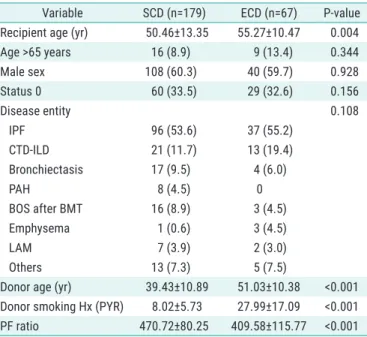
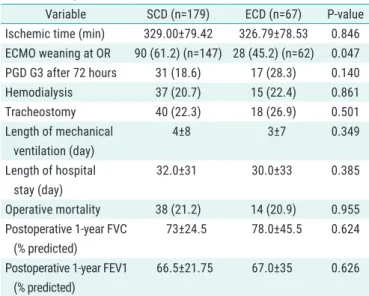
The ECD and SCD groups were composed of 67 (27.2%) and 179 (72.8%) patients, respectively. In the ECD group, 31 donors (46.3%) were ≥55 years old, 26 donors (38.8%) had a smoking history >20 PYR, and 17 donors (25.4%) had P/F ratio <300 mmHg. Donor and recipient characteristics in each group are described in Table 1 and postoperative outcomes are shown in Table 2. The recipients were sig- nificantly younger (50.46±13.35 vs. 55.27±10.47, P=0.004) and the rate of ECMO weaning in the OR was significantly
higher (61.2% vs. 45.2%, P=0.047) in the SCD group than in the ECD group. Other preoperative characteristics and op- erative outcomes were not significantly different between the two groups.
In the logistic regression model, ECD was significantly associated with risk for failure of ECMO weaning in the OR (hazard ratio [HR], 0.522; 95% confidence interval [CI], 0.286–0.951; P=0.034), but ECD was not associated with risk of G3 PGD at 72 hours after transplantation in the uni- variate analysis (HR, 1.734; 95% CI, 0.875–3.436; P=0.114).
In the multivariate analysis, ECD also showed significant association with risk for failure of ECMO weaning in the OR (HR, 0.531; 95% CI, 0.291–0.970; P=0.039) but no associ- ation with risk of G3 PGD at 72 hours after transplantation (HR, 1.652; 95% CI, 0.827–3.302; P=0.155) considering recipient’s age and status at operation (Table 3).
Overall survival rate of ECD was not significantly differ- ent (3-year survival rate, 60.4% vs. 43.8%; P=0.120) (Fig. 1) from that of SCD. The ECD group showed comparable sur- vival rate with the SCD group (HR, 1.413; 95% CI, 0.885–
2.255; P=0.148) (Table 4), with adjustment for recipient age, recipient status at transplantation, ECMO weaning in the OR, and G3 PGD 72 hours after transplantation. How- ever, when the recipient had KONOS status 0 at the time of transplantation (HR, 1.622; 95% CI, 1.025–2.568; P=0.039), G3 PGD at 72 hours after surgery (HR, 2.508; 95% CI, 1.416–4.440; P=0.002) was a risk factor that decreased survival (Table 4).
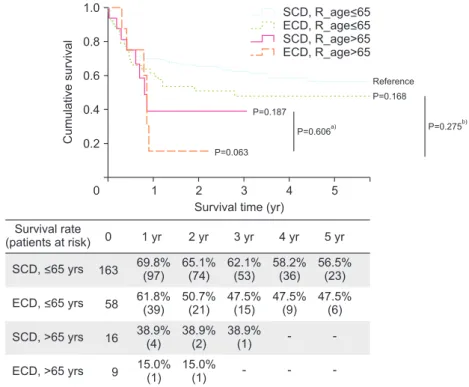
A subgroup analysis was performed to confirm the effect of ECD according to recipient factor which affected survival rate in the hazard model. The survival of the ECD and SCD groups was compared by dividing the age of the recipients into >65 years and ≤65 years. The ECD group tended to have lower survival rate than the SCD group, Table 2. Postoperative outcomes
Variable SCD (n=179) ECD (n=67) P-value Ischemic time (min) 329.00±79.42 326.79±78.53 0.846 ECMO weaning at OR 90 (61.2) (n=147) 28 (45.2) (n=62) 0.047 PGD G3 after 72 hours 31 (18.6) 17 (28.3) 0.140
Hemodialysis 37 (20.7) 15 (22.4) 0.861
Tracheostomy 40 (22.3) 18 (26.9) 0.501
Length of mechanical ventilation (day)
4±8 3±7 0.349
Length of hospital stay (day)
32.0±31 30.0±33 0.385
Operative mortality 38 (21.2) 14 (20.9) 0.955 Postoperative 1-year FVC
(% predicted)
73±24.5 78.0±45.5 0.624
Postoperative 1-year FEV1 (% predicted)
66.5±21.75 67.0±35 0.626
Values are presented as mean±standard deviation or number (%).
SCD, standard-criteria donor; ECD, extended-criteria donor; ECMO, extracorporeal membrane oxygenation; OR, operating room; PGD, primary graft dysfunction; FVC, forced vital capacity; FEV1, forced expiratory volume in 1 second.
Table 3. Risk analysis for ECMO weaning at the OR and PGD G3 72 hours after operation
Variable Univariate Multivariate
HR 95% CI P-value HR 95% CI P-value
ECMO weaning at OR
R_age >65 years 0.900 0.383–2.115 0.810 0.913 0.384–2.171 0.837
R_status 0 0.748 0.425–1.318 0.316 0.774 0.437–1.374 0.382
ECD 0.522 0.286–0.951 0.034 0.531 0.291–0.970 0.039
PGD G3 after 72 hours
R_age >65 years 1.021 0.361–2.892 0.968 1.092 0.379–3.147 0.870
R_status 0 1.859 0.970–3.559 0.062 1.789 0.929–3.444 0.082
ECD 1.734 0.875–3.436 0.114 1.652 0.827–3.302 0.155
ECMO, extracorporeal membrane oxygenation; OR, operating room; PGD, primary graft dysfunction; HR, hazard ratio; CI, confidence interval; R_age, recipient age; R_status 0, recipient Korean Network for Organ Sharing status 0 at the time of operation; ECD, extended-criteria donor.
but no significant difference in survival rate was found between the ECD and SCD groups when the recipient was
≤65 years old (Fig. 2). Second, the survival rates of the ECD and SCD groups were compared by dividing patients whether they have KONOS status 0 or not at the time of
transplantation. No significant difference was found in the survival rate between the ECD and SCD groups according to recipient status, but when the recipient had KONOS status 0, both ECD and SCD groups had significantly lower survival rate than patients who had no KONOS status 0 from SCD (Fig. 3).
DISCUSSION
This study was conducted to determine the feasibility of ECD lungs and the appropriate usage of ECD lungs. We
P=0.120 1.0
0.8
0.6
0.4
Cumulativesurvival 0.2
0
Survival rate (patients at risk)
Survival time (yr)
SCD group
ECD group 179
67
Overall survival
SCD ECD
1 2 3 4 5
67.6%
(101) 63.2%
(76)
60.4%
(54)
56.6%
(36)
54.9%
(23)
0 1 yr 2 yr 3 yr 4 yr 5 yr
56.5%
(30)
46.7%
(21)
43.8%
(15)
43.8%
(9)
43.8%
(5)
Fig. 1. Overall survival. SCD, standard-criteria donor; ECD, extended-crite- ria donor.
Table 4. Risk analysis for overall survival
Variable Multivariate
HR 95% CI P-value
R_age >65 yr 1.565 0.848–2.887 0.152
R_status 0 1.622 1.025–2.568 0.039
ECD 1.413 0.885–2.255 0.148
ECMO weaning at OR 0.952 0.552–1.644 0.861
PGD G3 after 72 hours 2.508 1.416–4.440 0.002 HR, hazard ratio; CI, confidence interval; R_age, recipient age; R_status 0, recipient Korean Network for Organ Sharing status 0 at the time of operation; ECD, extended-criteria donor; ECMO, extracorporeal membrane oxygenation; OR, operating room; PGD, primary graft dysfunction.
P=0.187
P=0.063
P=0.606a) 1.0
0.8
0.6
0.4
Cumulativesurvival 0.2
0
Survival rate (patients at risk)
Survival time (yr)
163
58
16
9
1 2 3 4 5
69.8%
(97)
65.1%
(74)
62.1%
(53)
58.2%
(36)
56.5%
(23)
0 1 yr 2 yr 3 yr 4 yr 5 yr
61.8%
(39)
50.7%
(21)
47.5%
(15)
47.5%
(9)
47.5%
(6)
SCD, >65 yrs
ECD, >65 yrs SCD, <65 yrs
ECD, <65 yrs
Reference P=0.168
P=0.275b)
38.9%
(4) 15.0%
(1)
38.9%
(2) 15.0%
(1)
38.9%
(1) - -
- -
-
SCD, R_age<65 ECD, R_age<65 SCD, R_age>65 ECD, R_age>65
Fig. 2. Survival rate according to recipi- ents aged >65 years and donor group. R_
age, recipient age. a)P-value between the standard-criteria donor (SCD) group and extended-criteria donor (ECD) group among recipients aged >65 years; b)P-value between recipients aged >65 years and >65 years in the ECD group.
found no significant differences in early postoperative outcomes including length of mechanical ventilation and length of hospital stay between the ECD and SCD groups.
In the risk analysis, ECD lungs affected ECMO weaning in the OR but not G3 PGD at 72 hours after transplantation.
As regards overall survival, no significant difference was found between the two groups, but it was significantly low in recipients with KONOS status 0 at transplantation; more- over, it tended to be worse in the ECD group.
After the emergence of the ECD concept, the proportion of ECD in transplanted lungs has increased. The defini- tion of ECD differs slightly depending on the institution or study, but most are based on age, smoking history, and P/
F ratio. According to Yeo et al. [9], more than 60% of BDD lungs used in Korea from 2012 to 2016 were categorized as ECD. In our study, the proportion of recipients who had received ECD lungs was 26.6%, and when divided by year, the use of ECD lungs increased from 2012 and gradually increased since then, showing a rate approximately 30% in recent years (Supplementary Table 1). Lungs from BDDs have a lower procurement rate than other organs. In Korea, the lung utility rate of BDDs was 20.5% in 2018, which was higher than the previous rate of less than 20%, but is still less than half compared with that of other thoracic organs, such as the heart. According to Yeo et al. [9], 74% of all BDDs in Korea were not evaluated for lung transplantation,
82 (8%) of which were SCD and 337 (33%) were ECD.
There were several previous studies of older donors.
According to some studies, organs from donors aged 55–
64 years did not affect short-term and long-term outcomes [10,11]; however, donors aged >65years showed slightly decreased long-term outcome [11]. On the contrary, Schul- tz et al. showed lower chronic lung allograft dysfunction (CLAD)-free survival in donors aged ≥55 years [12]. More- over, Hayes et al. [13] used United Network for Organ Shar- ing (UNOS) data and showed that organs from older do- nors did not affect outcomes of recipients aged ≥50 years, but younger recipients showed limited outcomes. Some studies reported about the effect of donor smoking history on posttransplant outcomes. Based on UNOS data, Reyes et al. [3] had shown that organs from donors with smok- ing history >20 PYR appeared to have slightly worse long- term survival with a not powerful effect. Schultz et al. [12]
reported that current or former smokers have decreased overall survival but have no influence on CLAD-free sur- vival after transplantation. In terms of PaO2, Zych et al. [4]
had shown that the rate of G3 PGD at 48 hours after trans- plantation was significantly higher in donors with P/F ratio
<300 mmHg, and other early and late outcomes had no difference [4]. In addition, Reyes et al. [3] had shown that survival is not inferior in lungs with P/F ratio as low as 230 mmHg.
1.0
0.8
0.6
0.4
Cumulativesurvival 0.2
0
Survival rate (patients at risk)
Survival time (yr)
119
38
60
29
1 2 3 4 5
75.6%
(79)
70.5%
(60)
66.5%
(45)
63.2%
(30)
60.9%
(18)
0 1 yr 2 yr 3 yr 4 yr 5 yr
61.9%
(21)
52.7%
(16)
47.9%
(10)
47.9%
(6)
47.9%
(4)
SCD, status 0
ECD, status 0 SCD,
not status 0 ECD,
not status 0
Reference
P=0.114 P=0.003
P=0.013 P=0.387b)
50.9%
(22) 48.1%
(9)
48.0%
(16) 37.4%
(5)
48.0%
(11)
SCD, not status 0 ECD, not status 0 SCD, status 0 ECD, status 0
P=0.935a)
37.4%
(5)
42.0%
(6)
42.0%
(5) 37.4%
(3)
37.4%
(2)
Fig. 3. Survival rate according to recipients with Korean Network for Organ Sharing (KONOS) status 0 at transplantation and donor group. a)P-value between the stan- dard-criteria donor (SCD) group and extend- ed-criteria donor (ECD) group of recipients with status 0 at transplantation; b)P-value between recipients with status 0 at trans- plantation and no status 0 at transplantation in the ECD group.
In our study, the characteristics of recipients rather than the characteristics of donors had influenced the posttransplantation outcome. G3 PGD at 72 hours after transplantation and preoperative recipient of status 0 were found to be significant risk factors to decreased survival.
Other previous studies presented that recipients’ char- acteristics determined the outcomes of transplantation.
Pretransplantation mechanical ventilation has been asso- ciated with posttransplantation mortality [6]. The Toronto group reported that the 30-day mortality rate was higher in
“non-guideline” recipients than in “guideline” recipients of ECD lungs [14]. Sommer et al. [5] also studied outcomes of ECD lungs according to the allocation of recipients, and they showed that marginal-donor lungs for stable recipi- ents were acceptable. In a previous study based on UNOS data, patients who received ECD lungs had low survival rate; especially, those with lung allocation score ≥70 who received ECD have the lowest survival rate [15].
This study has some limitations. First, given the single institutional setting and retrospective design, the results of this study cannot represent all outcomes of ECD. Second, because factors constituting the ECD are not considered separately, identifying the detailed risk for each factor is difficult. Third, patients’ long-term outcomes were com- pared only with simple survival, and the outcomes of ECD such as quality of life were not qualitatively compared.
In conclusion, the outcome of ECD is not inferior to that of SCD. However, recipient characteristics such as age and KONOS status at the time of operation are thought to have a more important effect on patient’s outcome. Therefore, ECD lung should be considered a potential donor organ following active donor management rather than a contrain- dication of transplantation in highly selected recipients.
ACKNOWLEDGMENTS Conflict of Interest
No potential conflict of interest relevant to this article was reported.
ORCID
Jee Won Suh https://orcid.org/0000-0003-0287-0651 Jin Gu Lee https://orcid.org/0000-0003-2767-6505 Moo Suk Park https://orcid.org/0000-0003-0820-7615 Song Yee Kim https://orcid.org/0000-0001-8627-486X Su Jin Jeong https://orcid.org/0000-0003-4025-4542
Hyo Chae Paik https://orcid.org/0000-0001-9309-8235 Author Contributions
Conceptualization: HCP, JWS. Data curation: HCP, JWS, JGL, MSP, SYK, SJJ. Formal analysis: JWS. Investigation:
HCP, JWS. Methodology: JWS, JGL, MSP, SYK, SJJ. Visual- ization: JWS. Writing–original draft: JWS. Writing–review
& editing: HCP.
Supplementary Materials
Supplementary materials can be found via https://doi.
org/10.4285/kjt.2020.34.3.185.
REFERENCES
1. Korean Network for Organ Sharing (KONOS). 2018 An- nual data report, in Korean Network for Organ Sharing [Internet]. Seoul: KONOS; 2018 [cited 2020 Aug 20].
Available from: https://www.konos.go.kr/konosis/com- mon/bizlogic.jsp.
2. Neizer H, Singh GB, Gupta S, Singh SK. Addressing donor-organ shortages using extended criteria in lung transplantation. Ann Cardiothorac Surg 2020;9:49-50.
3. Reyes KG, Mason DP, Thuita L, Nowicki ER, Murthy SC, Pettersson GB, et al. Guidelines for donor lung selec- tion: time for revision? Ann Thorac Surg 2010;89:1756- 64.
4. Zych B, García Sáez D, Sabashnikov A, De Robertis F, Amrani M, Bahrami T, et al. Lung transplantation from donors outside standard acceptability criteria: are they really marginal? Transpl Int 2014;27:1183-91.
5. Sommer W, Kühn C, Tudorache I, Avsar M, Gottlieb J, Boethig D, et al. Extended criteria donor lungs and clin- ical outcome: results of an alternative allocation algo- rithm. J Heart Lung Transplant 2013;32:1065-72.
6. Moreno P, Alvarez A, Santos F, Vaquero JM, Baamonde C, Redel J, et al. Extended recipients but not extended donors are associated with poor outcomes follow- ing lung transplantation. Eur J Cardiothorac Surg 2014;45:1040-7.
7. Sommer W, Ius F, Salman J, Avsar M, Tudorache I, Kühn C, et al. Survival and spirometry outcomes after lung transplantation from donors aged 70 years and older.
J Heart Lung Transplant 2015;34:1325-33.
8. Suh JW, Lee JG, Jeong SJ, Park MS, Kim SY, Paik HC.
Risk of bronchial dehiscence in lung transplant recip-
ients with carbapenemase-producing klebsiella. Ann Thorac Surg 2020;110:265-71.
9. Yeo HJ, Yoon SH, Lee SE, Jeon D, Kim YS, Cho WH, et al. Current status and future of lung donation in Korea.
J Korean Med Sci 2017;32:1953-8.
10. Dahlman S, Jeppsson A, Scherstén H, Nilsson F. Ex- panding the donor pool: lung transplantation with do- nors 55 years and older. Transplant Proc 2006;38:2691- 3.
11. Bittle GJ, Sanchez PG, Kon ZN, Claire Watkins A, Raja- gopal K, Pierson RN 3rd, et al. The use of lung donors older than 55 years: a review of the United Network of Organ Sharing database. J Heart Lung Transplant 2013;32:760-8.
12. Schultz HH, Møller CH, Zemtsovski M, Ravn J, Perch
M, Martinussen T, et al. Donor smoking and older age increases morbidity and mortality after lung transplan- tation. Transplant Proc 2017;49:2161-8.
13. Hayes D Jr, Black SM, Tobias JD, Higgins RS, Whitson BA. Influence of donor and recipient age in lung trans- plantation. J Heart Lung Transplant 2015;34:43-9.
14. Pierre AF, Sekine Y, Hutcheon MA, Waddell TK, Keshav- jee SH. Marginal donor lungs: a reassessment. J Tho- rac Cardiovasc Surg 2002;123:421-7.
15. Mulligan MJ, Sanchez PG, Evans CF, Wang Y, Kon ZN, Rajagopal K, et al. The use of extended criteria donors decreases one-year survival in high-risk lung recipients:
a review of the United Network of Organ Sharing Data- base. J Thorac Cardiovasc Surg 2016;152:891-8.