• 검색 결과가 없습니다.

An Updated Nomogram for Predicting Invasiveness in Preoperative Ductal Carcinoma In Situ of the Breast

N/A
N/A
Protected

Academic year: 2022

Share "An Updated Nomogram for Predicting Invasiveness in Preoperative Ductal Carcinoma In Situ of the Breast"

Copied!
8
0
0

로드 중.... (전체 텍스트 보기)

전체 글

(1)

INTRODUCTION

Invasive breast cancer can be transferred to the lymph nodes, such that evaluation of axillary lymph node metastasis using

clinical examination, sentinel lymph node biopsy (SLNB), or ax- illary lymph node dissection (ALND) is necessary:

1

SLNB can be used to identify axillary lymph node metastasis in patients with early breast cancer.

2,3

Ductal carcinoma in situ (DCIS) is a localized tumor within the ducts without invasion of the base- ment membrane. By definition, pure DCIS has no potential to spread tumor cells to the axillary lymph nodes. Therefore, ac- cording to international guidelines, routine use of SLNB and ALND is not recommended for patients with DCIS.

1,3

Howev- er, in actual practice, controversy remains as to whether SLNB should be performed in DCIS diagnosed via preoperative bi- opsy.

4-6

A major concern for surgeons is that additional axillary surgery for the evaluation of metastasis to the axillary lymph nodes may be necessary in cases with preoperative DCIS when invasive foci are identified in the permanent pathology. When DCIS is preoperatively diagnosed with a core needle biopsy (CNB),

An Updated Nomogram for Predicting Invasiveness in Preoperative Ductal Carcinoma In Situ of the Breast

Sanghwa Kim

1

*, Jihong Kim

2

*, Hyung Seok Park

2

, Ha Yan Kim

3

, Kwanbum Lee

2

, Jeea Lee

2

, Haemin Lee

2

, Jee Ye Kim

2

, Seung Il Kim

2

, Young Up Cho

2

, and Byeong-Woo Park

2

1

Department of Breast and Endocrine Surgery, Hallym University Sacred Heart Hospital, Hallym University College of Medicine, Anyang;

2

Department of Surgery, Yonsei University College of Medicine, Seoul;

3

Biostatistics Collaboration Unit, Department of Biomedical Systems Informatics, Yonsei University College of Medicine, Seoul, Korea.

Purpose: To validate and update a nomogram for predicting ductal carcinoma in situ (DCIS) upstaging in preoperative biopsy.

Materials and Methods: Medical records of 444 preoperative DCIS patients were evaluated and used to validate a previous ver- sion of the Severance nomogram for predicting DCIS upstaging in preoperative biopsy. Patients were divided into two groups ac- cording to the final postoperative pathology. Univariate and multivariate analyses with the chi-square test, Student’s t-test, and binary logistic regression method identified new significant variables. The updated nomogram was evaluated with the C-index and Hosmer—Lemeshow goodness of fit test.

Results: The area under a receiver operating characteristic curve for comparison with the previous nomogram was 0.48. In post- operative pathology, the pure DCIS and invasive cancer groups comprised 345 and 99 cases, respectively. Approximately 22.3% of patients preoperatively diagnosed with DCIS were upstaged to invasive cancer. Significant variables in the univariate analysis were operation type, human epidermal growth factor receptor 2 overexpression, comedo necrosis, sonographic mass, mammographic mass, preoperative biopsy method, and suspicious microinvasion in preoperative biopsy. In multivariate analysis, operation type, sonographic mass, mammographic mass, and suspicious microinvasion were risk factors for upstaging. The updated model with these variables showed moderate discrimination and was appropriate in the calibration test.

Conclusion: The previous nomogram did not effectively discriminate upstaging of preoperative DCIS in an independent cohort.

An updated version of the nomogram appears to provide more accurate information for predicting preoperative DCIS upstaging.

Key Words: Breast neoplasms, prediction, ductal carcinoma in situ, upstaging

pISSN: 0513-5796 · eISSN: 1976-2437

Received: May 17, 2019 Revised: August 26, 2019 Accepted: September 6, 2019

Corresponding author: Hyung Seok Park, MD, PhD, Department of Surgery, Yon- sei University College of Medicine, 50-1 Yonsei-ro, Seodaemun-gu, Seoul 03722, Korea.

Tel: 82-2-2228-2100, Fax: 82-2-313-8289, E-mail: [email protected]

*Sanghwa Kim and Jihong Kim contributed equally to this work.

•The authors have no potential conflicts of interest to disclose.

© Copyright: Yonsei University College of Medicine 2019

This is an Open Access article distributed under the terms of the Creative Com- mons Attribution Non-Commercial License (https://creativecommons.org/licenses/

by-nc/4.0) which permits unrestricted non-commercial use, distribution, and repro- duction in any medium, provided the original work is properly cited.

Yonsei Med J 2019 Nov;60(11):1028-1035

https://doi.org/10.3349/ymj.2019.60.11.1028

(2)

an invasive component can be under-estimated because of sam- pling limitations. In a meta-analysis of 52 studies, approximate- ly 26% of cases of DCIS diagnosed using CNB were upstaged to invasive cancer.

7

Thus, a previous study suggested routine use of SLNB in patients with DCIS.

8

However, SLNB is not a risk- free procedure, and although it has lower morbidity rates than ALND, a risk of complications remains (e.g., seroma, lymphede- ma of the arm, pain, and sensory deterioration in the axillary re- gion). Therefore, shared decision-making in terms of perform- ing or omitting SLNB at the time of surgery for patients with preoperative DCIS is crucial.

To enhance shared decision-making, predicting upstaging of preoperative DCIS can be helpful for patients and surgeons.

Several studies have been conducted to establish a nomogram for predicting the possibility of preoperative DCIS upstaging to invasive ductal carcinoma after surgery.

9-14

However, previous nomograms have had several limitations, including the lack of external validation, lack of clinical utility based on sophisticat- ed variables, and lack of popularity or accessibility. Therefore, we conducted this study to validate a previous nomogram using an independent external cohort, to reanalyze factors associated with DCIS underestimation, and to establish an updated nomogram.

MATERIALS AND METHODS

Patient cohort

We used the Breast Cancer Registry database of Severance Hos- pital, Yonsei University Health System, to perform a retrospec- tive analysis. The computerized medical database was construct- ed in MS Access (Microsoft, Seattle, WA, USA) and contained information on patient clinical characteristics, pathologic data of preoperative or postoperative evaluations, treatment meth- ods, recurrence data, preoperative evaluation findings, includ- ing those of physical examination, mammography, and ultraso- nography, and follow-up data.

From 2009 to 2012, 538 patients were preoperatively diagnosed with DCIS and underwent definitive surgery. Patients were ex-

cluded from the analysis if they had no available data on the type of treatment or molecular characteristics, such as hormone re- ceptors and human epidermal growth factor receptor 2 (HER2) status (Fig. 1).

Patients underwent breast-conserving surgery or mastecto- my at their surgeons’ discretion based on the size, location, and multiplicity of the tumor, as well as according to the patient’s preference. Along with breast surgery, axillary lymph node eval- uation was performed via SLNB and/or standard level I/II ALND.

After surgery, patients who underwent breast-conserving sur- gery received adjuvant radiotherapy with a median boost dose of 10 Gy that covered the whole breast with or without the re- gional nodal area. Adjuvant endocrine therapy was adminis- tered, if indicated.

Patient characteristics, including age, preoperative biopsy methods, clinical findings, pathologic findings, and treatment methods, were reviewed. We enrolled 115 additional patients who underwent surgery from 2013 to 2015 for independent ex- ternal validation of the nomogram. This study was reviewed and approved by the Institutional Review Board of Severance Hos- pital, Yonsei University Health System (IRB No. 4-2018-1027).

Preoperative biopsy methods

Patients were categorized according to preoperative biopsy into CNB and vacuum-assisted biopsy (VAB) groups. CNB was per- formed with a 14-gauge semi-automated core needle under ul- trasound guidance. In general, four to six core pieces were ob- tained by radiologists specializing in breast imaging during CNB.

VAB was performed with an 8- or 11-gauge vacuum-assisted large CNB system under stereotactic or ultrasound guidance.

Clinical examination and radiology

Preoperative imaging evaluation including mammography and ultrasonography was performed by experienced radiologists, and the initial report of the preoperative imaging studies was an- alyzed in conjunction with the final pathology to review the cor- relation between imaging studies and the final pathology. The final assessment of the imaging studies was recorded with the Breast Image and Reporting Data System developed by the Amer- ican College of Radiology (https://www.acr.org/-/media/ACR/

Files/RADS/BI-RADS/BIRADS-Reference-Card.pdf). The size of lesions on ultrasonography was reviewed using medical re- cords. A preoperative physical examination was performed by experienced surgeons, and a palpable mass was described with or without information on the location or size of the lesions in the medical database.

Histopathology

Final pathology records were reviewed to analyze histopatho- logical variables, including suspicious invasive foci in preoper- ative pathologic findings, presence of comedo necrosis, DCIS nuclear grade, Van Nuys Prognostic Index, hormone receptor status, amplification of HER2/neu, Ki-67 proliferative index lev- Preoperative diagnosed DCIS and underwent

definitive surgery between 2009 to 2012;

538 cases

Postoperative diagnosed DCIS;

345 cases

Postoperative diagnosed invasive cancer;

99 cases

Exclude unavailable data of treatment or molecular character;

94 cases

Fig. 1. Patient cohort. DCIS, ductal carcinoma in situ.

(3)

el, and number of metastatic axillary lymph nodes. Comedo ne- crosis was considered to be either absent or present. Nuclear grade was determined according to the College of American Pa- thologists guidelines. Estrogen receptor (ER), progesterone receptor (PR), and HER2/neu expression in primary breast can- cer was evaluated based on formalin-fixed, paraffin-embedded whole sections of surgically resected breast cancer specimens using immunohistochemistry (IHC). The cut-off value for ER and PR positivity was over 1% staining in IHC. A staining level of 3+ on IHC was defined as positive for HER2/neu overexpres- sion and/or when amplification was evident in a fluorescence in situ hybridization assay.

Statistical analysis

Using data from 444 patients with preoperative DCIS, we ana- lyzed categorical variables using the chi-square test or Fisher’s exact test. Continuous variables were analyzed using Student’s t-test. The significant factors estimated by the aforementioned analyses were confirmed using univariate logistic regression. To identify factors independently associated with invasion, binary logistic regression analysis adjusted for significant factors in the univariate analysis was performed. To reduce the risk of mul- ticollinearity, some of the closely correlated variables were ex- cluded from the multivariate analysis. The significant factors from the multivariate analysis were used to construct the up- dated nomogram.

Nomogram performance was quantified with respect to dis- crimination and calibration using the C-index and Hosmer—

Lemeshow goodness of fit test in internal validation. The nomo- gram was externally validated using independent data sets.

Discrimination was quantified using the means of the area un- der the receiver operating characteristic (ROC) curve. The cal- ibration of the model was assessed graphically, and the area under the curve (AUC) was estimated. p values <0.05 were con- sidered significant; all tests were two-sided. Statistical analyses were conducted using commercially available statistical soft- ware (SPSS Statistics 24; IBM Corp., Armonk, NY, USA).

RESULTS

Clinicopathologic characteristics

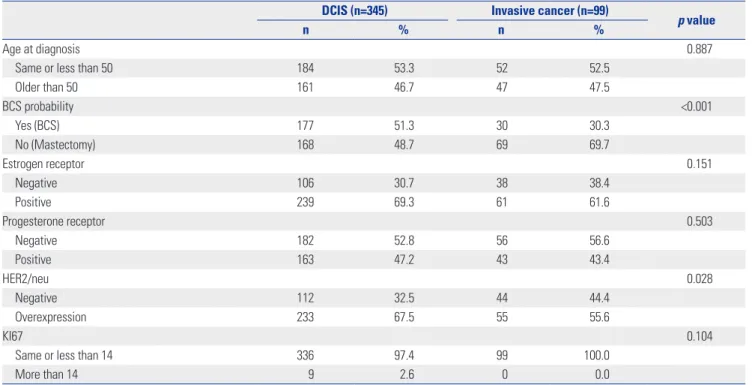
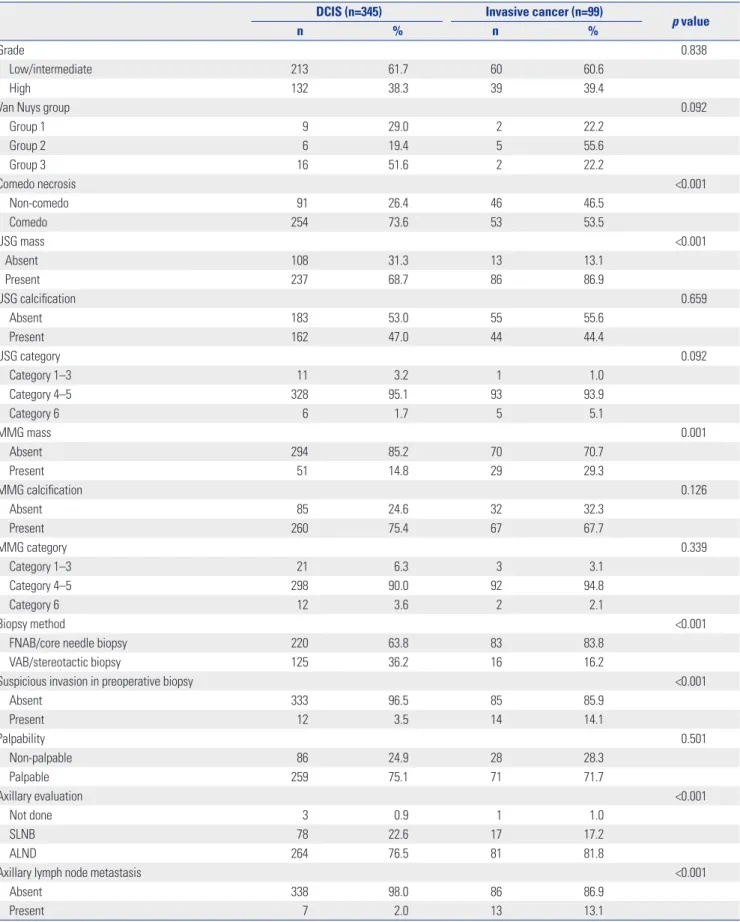
Patient and tumor characteristics are shown in Table 1. A total of 345 patients were found to have pure DCIS, whereas 99 pa- tients had invasive cancer. Approximately one-fifth (22.3%) of preoperative DCIS cases was upstaged to invasive cancer in the final pathology. Axillary evaluation was performed in almost all patients (99.1%). Axillary lymph node metastasis was found in 2.0% of patients in the DCIS group and in 13.1% of patients in the invasive cancer group. Age at diagnosis (p=0.887), pro- portion of palpability of the lesion in physical examination (p=0.501), presence of calcification on imaging (sono calcifica- tion p=0.659, mammo calcification p=0.126), and ER status (p=0.151) did not differ significantly between the groups.

Factors associated with prediction of invasive cancer Table 1 shows the predictive factors associated with invasiveness in 444 patients with preoperative DCIS. Operation type (p<0.001), presence of comedo necrosis (p<0.001), existence of mass find- ing on sonography (p<0.001) or mammography (p=0.001), pre-

Table 1. Clinicopathologic Characteristics of the Training Data Set (n=444)

DCIS (n=345) Invasive cancer (n=99)

p value

n % n %

Age at diagnosis 0.887

Same or less than 50 184 53.3 52 52.5

Older than 50 161 46.7 47 47.5

BCS probability <0.001

Yes (BCS) 177 51.3 30 30.3

No (Mastectomy) 168 48.7 69 69.7

Estrogen receptor 0.151

Negative 106 30.7 38 38.4

Positive 239 69.3 61 61.6

Progesterone receptor 0.503

Negative 182 52.8 56 56.6

Positive 163 47.2 43 43.4

HER2/neu 0.028

Negative 112 32.5 44 44.4

Overexpression 233 67.5 55 55.6

KI67 0.104

Same or less than 14 336 97.4 99 100.0

More than 14 9 2.6 0 0.0

(4)

Table 1. Clinicopathologic Characteristics of the Training Data Set (n=444) (Continued)

DCIS (n=345) Invasive cancer (n=99)

p value

n % n %

Grade 0.838

Low/intermediate 213 61.7 60 60.6

High 132 38.3 39 39.4

Van Nuys group 0.092

Group 1 9 29.0 2 22.2

Group 2 6 19.4 5 55.6

Group 3 16 51.6 2 22.2

Comedo necrosis <0.001

Non-comedo 91 26.4 46 46.5

Comedo 254 73.6 53 53.5

USG mass <0.001

Absent 108 31.3 13 13.1

Present 237 68.7 86 86.9

USG calcification 0.659

Absent 183 53.0 55 55.6

Present 162 47.0 44 44.4

USG category 0.092

Category 1–3 11 3.2 1 1.0

Category 4–5 328 95.1 93 93.9

Category 6 6 1.7 5 5.1

MMG mass 0.001

Absent 294 85.2 70 70.7

Present 51 14.8 29 29.3

MMG calcification 0.126

Absent 85 24.6 32 32.3

Present 260 75.4 67 67.7

MMG category 0.339

Category 1–3 21 6.3 3 3.1

Category 4–5 298 90.0 92 94.8

Category 6 12 3.6 2 2.1

Biopsy method <0.001

FNAB/core needle biopsy 220 63.8 83 83.8

VAB/stereotactic biopsy 125 36.2 16 16.2

Suspicious invasion in preoperative biopsy <0.001

Absent 333 96.5 85 85.9

Present 12 3.5 14 14.1

Palpability 0.501

Non-palpable 86 24.9 28 28.3

Palpable 259 75.1 71 71.7

Axillary evaluation <0.001

Not done 3 0.9 1 1.0

SLNB 78 22.6 17 17.2

ALND 264 76.5 81 81.8

Axillary lymph node metastasis <0.001

Absent 338 98.0 86 86.9

Present 7 2.0 13 13.1

DCIS, ductal carcinoma in situ; BCS, breast-conserving surgery; HER2/neu, human epidermal growth factor receptor 2; USG, breast sonography; MMG, mam-

mography; FNAB, fine needle aspiration biopsy; VAB, vacuum-assisted biopsy; SLNB, sentinel lymph node biopsy; ALND, axillary lymph node dissection.

(5)

operative biopsy method (p<0.001), and suspicious microinva- sion in preoperative biopsy (p<0.001) were significantly related to upstaging to invasive cancer in the postoperative pathology.

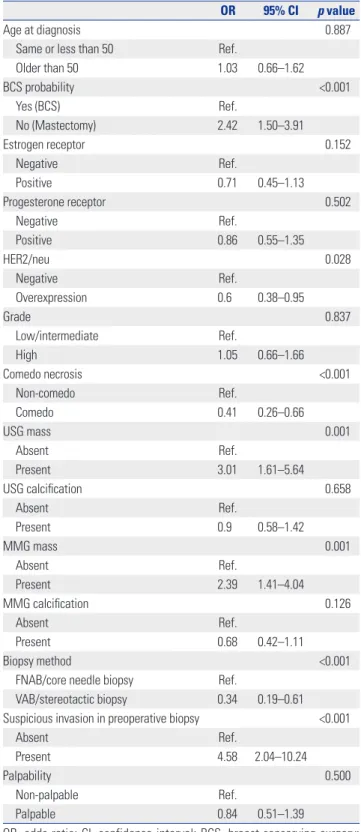
Univariate logistic regression analysis of the 444 patients with- out missing data revealed seven significant variables: operation type [odds ratio (OR)=2.42, 95% confidence interval (CI)=1.50–

3.91, p<0.001], HER2 overexpression (OR=0.6, 95% CI=0.38–0.95, p=0.028), presence of comedo necrosis in the tumor (OR=0.41, 95% CI=0.26–0.66, p<0.001), sonographic mass (OR=3.01, 95%

CI=1.61–5.64, p<0.001), mammographic mass (OR=2.39, 95%

CI=1.41–4.04, p=0.001), VAB/stereotactic biopsy as the preop- erative biopsy method (OR=0.34, 95% CI=0.19–0.61, p<0.001), and presence of suspicious microinvasive foci in preoperative biopsy (OR=4.58, 95% CI=2.04–10.24, p<0.001) (Table 2).

In multivariate analysis, operation type (OR=3.46, 95% CI=2.02–

5.91, p<0.001), sonographic mass (OR=2.75, 95% CI=1.40–5.38, p=0.003), mammographic mass (OR=2.23, 95% CI=1.24–4.01, p=0.007), and suspicious microinvasion in preoperative biop- sy (OR=3.96, 95% CI=1.59–9.84, p=0.003) were risk factors for upstaging to invasive cancer after surgery. In cases of DCIS with HER2 overexpression (OR=0.55, 95% CI=0.33–0.93, p=0.024) and comedo necrosis (OR=0.4, 95% CI=0.24–0.67, p<0.001), a diag- nosis of pure DCIS after surgery was highly likely (Table 3).

Nomogram establishment and validation

The updated nomogram is illustrated in Fig. 2. The detailed es- tablishment process of the nomogram was described in a pre- vious study.

10

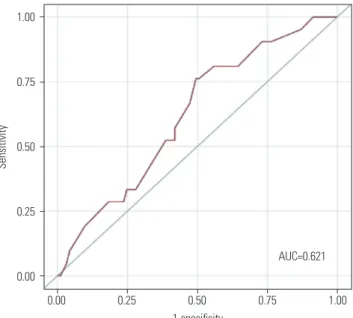
The valuation of the updated model with the six significant variables showed moderate discrimination (C-in- dex=0.75) and was appropriate in a calibration test (p=0.452). Ex- ternal validation with an independent data set of 115 patients showed moderate to strong discrimination, with a C-index of 0.66, and good fit, with a calibration test result of 0.92. The ROC curve is illustrated in Fig. 3, and the AUC was 0.621 (95% CI=

0.496–0.746).

DISCUSSION

It is important to predict the probability of invasive cancer be- fore surgery, since it has a large impact on the range of surgery and the complications that patients should endure. This pro- cess can facilitate shared decision making between surgeons and patients. Therefore, more accurate and accessible methods are needed to predict invasiveness in preoperative diagnosed DCIS. In 2013, we published a nomogram that predicted the in- vasiveness of breast cancer diagnosed as pre-operative DCIS, and several other studies utilized it in the past few years.

10,12-14

However, since the previous model had some limitations, it had to be updated using recent data. Therefore, we conducted this study to update the new nomogram. This updated nomogram was found to be more accurate in predicting invasive potential than the previous model and to be potentially more helpful for

many surgeons and patients.

A previous study established a nomogram to predict the like- lihood of postoperative invasive ductal carcinoma in DCIS at

Table 2. Univariate Logistic Regression Analysis of the Training Data Set OR 95% CI p value

Age at diagnosis 0.887

Same or less than 50 Ref.

Older than 50 1.03 0.66–1.62

BCS probability <0.001

Yes (BCS) Ref.

No (Mastectomy) 2.42 1.50–3.91

Estrogen receptor 0.152

Negative Ref.

Positive 0.71 0.45–1.13

Progesterone receptor 0.502

Negative Ref.

Positive 0.86 0.55–1.35

HER2/neu 0.028

Negative Ref.

Overexpression 0.6 0.38–0.95

Grade 0.837

Low/intermediate Ref.

High 1.05 0.66–1.66

Comedo necrosis <0.001

Non-comedo Ref.

Comedo 0.41 0.26–0.66

USG mass 0.001

Absent Ref.

Present 3.01 1.61–5.64

USG calcification 0.658

Absent Ref.

Present 0.9 0.58–1.42

MMG mass 0.001

Absent Ref.

Present 2.39 1.41–4.04

MMG calcification 0.126

Absent Ref.

Present 0.68 0.42–1.11

Biopsy method <0.001

FNAB/core needle biopsy Ref.

VAB/stereotactic biopsy 0.34 0.19–0.61 Suspicious invasion in preoperative biopsy <0.001

Absent Ref.

Present 4.58 2.04–10.24

Palpability 0.500

Non-palpable Ref.

Palpable 0.84 0.51–1.39

OR, odds ratio; CI, confidence interval; BCS, breast-conserving surgery;

HER2/neu, human epidermal growth factor receptor 2; USG, breast sonogra-

phy; MMG, mammography; FNAB, fine needle aspiration biopsy; VAB, vacu-

um-assisted biopsy.

(6)

diagnosis.

10,15

The application of the previous nomogram was checked by Jakub, et al.

13

in their study, which showed poor cal- ibration (p=0.002). We also performed an external validation of the previous nomogram using independent datasets, and it did not show high performance. The AUC of the ROC curve for com- parison with the previous version of the nomogram was 0.48

(Supplementary Fig. 1, only online). The reason for this was that DCIS underestimation was approximately 40% among the pa- tients assessed with the previous nomogram, which was 22% in the validation group.

10,15

This was due to the difference in patient populations between the previous data and the validation data.

The previous study was conducted using data from 2000 to 2008, and the independent cohort used data from patients who were diagnosed from 2009 to 2012. The number of actual DCIS pa- tients increased recently because the proportion of patients who were diagnosed via breast screening increased, which led to an increased number of patients diagnosed with DCIS. In addition,

No (mastectomy)

Present

Present Present

Yes (BCS) 0

0

0.1 0.2 0.3 0.4 0.5 0.6 0.7 0.8 0.9

10

50 20

100 30

150 40

200 50

250 60

300

70 80

350

90

400

100

450 Positive

Absent

Absent Negative

Absent

Absent

Present Points

BCS probability

HER2/neu

Comedo necrosis

Sonographic mass

MMG mass

Suspicious invasion

Total points

Probability

Fig. 2. An updated nomogram. BCS, breast-conserving surgery; HER2/neu, human epidermal growth factor receptor 2; MMG, mammographic.

Fig. 3. Receiver operating characteristic curve for external validation with the independent data set (n=115). AUC, area under the curve.

1.00

0.75

0.50

0.25

0.00

0.00 0.25 0.50 0.75 1.00

1-specificity

Sensitivity

AUC=0.621 Table 3. Multivariate Logistic Regression Analysis of Factors associated

with Upstaging of Preoperative Ductal Carcinoma In Situ in the Training Data Set

OR 95% CI p value

BCS probability <0.001

Yes (BCS) Ref.

No (Mastectomy) 3.46 2.02–5.91

HER2/neu 0.024

Negative Ref.

Overexpression 0.55 0.33–0.93

Comedo necrosis <0.001

Non-comedo Ref.

Comedo 0.4 0.24–0.67

USG mass 0.003

Absent Ref.

Present 2.75 1.40–5.38

MMG mass 0.007

Absent Ref.

Present 2.23 1.24–4.01

Suspicious invasion in preoperative biopsy 0.003

Absent Ref.

Present 3.96 1.59–9.84

OR, odds ratio; CI, confidence interval; BCS, breast-conserving surgery;

HER2/neu, human epidermal growth factor receptor 2; USG, breast sonogra-

phy; MMG, mammography.

(7)

diagnostic skills for pathologists may have improved over time, which may have influenced the accuracy of preoperative diag- nosis. Hence, the previous nomogram may be over-fitted. Ac- cordingly, we re-analyzed the risk factors that underestimated invasive cancer with DCIS in preoperative diagnosis.

Consequently, the significant predictive factors were sono- graphic mass, mammographic mass, comedo necrosis, overex- pression of HER2/neu, suspicious microinvasion in preopera- tive examination, and operation type. Most of the patients who underwent mastectomy had breast cancer of large size or multi- centricity. Previous studies have attempted to include the size of lesions as a predictor of risk in nomograms.

11,13,15

Lesion size and multi-centricity on imaging were not used in this study be- cause they are often difficult to measure and inaccurate because of the ambiguity of the extent of microcalcification on mam- mography, non-circumscribed margin, or hypoechoic microcal- cified lesions on ultrasound, as well as background enhance- ment of magnetic resonance imaging. Instead of lesion size and multi-centricity, we inferred the impact of breast cancer size and multi-centricity based on the operation type. In validation us- ing an external independent cohort, the updated nomogram showed moderate-to-strong discrimination of upgrading pre- operative DCIS, and its performance was higher than that of the previous nomogram (AUC for external validations, 0.62 vs. 0.4).

Our previous study identified palpability, calcification on so- nography, sonographic mass, previous biopsy methods, and presence of suspicious microinvasion foci as related factors to predict invasive cancer in postoperative pathology.

10

The palpa- bility and existence of calcification on sonography were not sig- nificant in the current study. This may have been due to DCIS being increasingly detected via screening over time.

16,17

DCIS underestimation on biopsy has been reported to de- crease as the amount of tissue acquired increases, and the DCIS underestimation rate in VAB is lower than that in CNB.

18

The previous nomogram also included biopsy methods as a predic- tor of risk.

10,15

Regarding the preoperative biopsy method, VAB/

stereotactic biopsy showed lower upstaging of invasive cancer than CNB in univariate analysis (VAB vs. CNB: 11.3% vs. 27.4%, OR=0.34, 95% CI=0.19–0.61, p<0.001). However, no significance was found in the multivariate analysis in this study. Hence, pre- operative biopsy method was excluded from the predictors of risk in the establishment of the nomogram. Nevertheless, it tend- ed to lower the underestimation of invasive cancer (OR=0.56, 95% CI=0.29–1.07, p=0.077). Further study is needed to evalu- ate the role of VAB in the detection of invasiveness in preoper- ative DCIS.

Sonographic mass and mammographic mass may be relat- ed to each other. Therefore, we checked their relationship using McNemar’s test, and they showed different values and low con- cordance (p<0.001). Hence, both factors were used as predictors of risk.

Some studies have reported that subtypes of DCIS, such as non-cribriform type, papillary type, solid type, and comedo ne-

crosis, are related to upstaging to invasive cancer.

11

In this study, we reviewed the presence of comedo necrosis but not other sub- types, and comedo necrosis showed significant association with pure DCIS after surgery (OR=0.4, 95% CI=0.24–0.67, p=0.003).

This study has some limitations. This was a retrospective and single-institution study. The study was analyzed and validated using similar imaging and pathology interpreted in the same in- stitution. This mostly uniform design in a single institution could be a definite advantage. However, pathological and image inter- pretation methods vary according to institution, and these may not be reflected in our nomogram.

In conclusion, the previous version of the nomogram did not effectively discriminate upstaging of preoperative DCIS in an independent cohort. Our updated version of the nomogram pro- vides more accurate information for predicting upstaging of preoperative DCIS.

ACKNOWLEDGEMENTS

This research was supported by Basic Science Research Pro- gram through the National Research Foundation of Korea (NRF) funded by the Ministry of Education (2016R1D1A1B03934564).

AUTHOR CONTRIBUTIONS

Conceptualization: Hyung Seok Park. Data curation: Jihong Kim, Sanghwa Kim, and Hyung Seok Park. Formal analysis: Ha Yan Kim, Jihong Kim, Sanghwa Kim, and Hyung Seok Park. Funding acquisi- tion: Hyung Seok Park. Investigation: Jihong Kim, Sanghwa Kim, and Hyung Seok Park. Methodology: Ha Yan Kim, Sanghwa Kim, Jihong Kim, and Hyung Seok Park. Project administration: Hyung Seok Park.

Resources: Kwanbum Lee, Jeea Lee, Haemin Lee, Jee Ye Kim, Hyung Seok Park, Seung Il Kim, Young Up Cho, and Byeong-Woo Park. Soft- ware: Ha Yan Kim and Hyung Seok Park. Supervision: Hyung Seok Park. Validation: Ha Yan Kim. Visualization: Ha Yan Kim, Sanghwa Kim, Jihong Kim, and Hyung Seok Park. Writing—original draft: Sanghwa Kim and Hyung Seok Park. Writing—review & editing: Jihong Kim, Sanghwa Kim, and Hyung Seok Park.

ORCID iDs

Sanghwa Kim https://orcid.org/0000-0002-1010-3201 Jihong Kim https://orcid.org/0000-0002-6535-4040 Hyung Seok Park https://orcid.org/0000-0001-5322-6036 Ha Yan Kim https://orcid.org/0000-0001-8063-0616 Kwanbum Lee https://orcid.org/0000-0001-6131-3930 Jeea Lee https://orcid.org/0000-0003-3145-2205 Haemin Lee https://orcid.org/0000-0002-3334-2598 Jee Ye Kim https://orcid.org/0000-0003-3936-4410 Seung Il Kim https://orcid.org/0000-0001-9673-2748 Young Up Cho https://orcid.org/0000-0003-2936-410X Byeong-Woo Park https://orcid.org/0000-0003-1353-2607

REFERENCES

1. Giordano SH, Elias AD, Gradishar WJ. NCCN guidelines updates:

breast cancer. J Natl Compr Canc Netw 2018;16(5S):605-10.

(8)

2. Veronesi U, Paganelli G, Viale G, Luini A, Zurrida S, Galimberti V, et al. A randomized comparison of sentinel-node biopsy with rou- tine axillary dissection in breast cancer. N Engl J Med 2003;349:

546-53.

3. Lyman GH, Somerfield MR, Bosserman LD, Perkins CL, Weaver DL, Giuliano AE. Sentinel lymph node biopsy for patients with early-stage breast cancer: American Society of Clinical Oncology Clinical Practice Guideline update. J Clin Oncol 2017;35:561-4.

4. Prendeville S, Ryan C, Feeley L, O’Connell F, Browne TJ, O’Sullivan MJ, et al. Sentinel lymph node biopsy is not warranted following a core needle biopsy diagnosis of ductal carcinoma in situ (DCIS) of the breast. Breast 2015;24:197-200.

5. Sakr R, Bezu C, Raoust I, Antoine M, Ettore F, Darcourt J, et al. The sentinel lymph node procedure for patients with preoperative di- agnosis of ductal carcinoma in situ: risk factors for unsuspected invasive disease and for metastatic sentinel lymph nodes. Int J Clin Pract 2008;62:1730-5.

6. Tan EY, Lo ZW, Ang CH, Teo C, Seah MD, Chen JJ, et al. Sentinel lymph node biopsy should be included with the initial surgery for high-risk ductal carcinoma-in-situ. Int Sch Res Notices 2014;2014:

624185.

7. Brennan ME, Turner RM, Ciatto S, Marinovich ML, French JR, Macaskill P, et al. Ductal carcinoma in situ at core-needle biopsy:

meta-analysis of underestimation and predictors of invasive breast cancer. Radiology 2011;260:119-28.

8. Sakr R, Antoine M, Barranger E, Dubernard G, Salem C, Daraï E, et al. Value of sentinel lymph node biopsy in breast ductal carcino- ma in situ upstaged to invasive carcinoma. Breast J 2008;14:55-60.

9. Coufal O, Selingerová I, Vrteˇlová P, Krsicˇka P, Gabrielová L, Fabian P, et al. A simple model to assess the probability of invasion in duc- tal carcinoma in situ of the breast diagnosed by needle biopsy.

Biomed Res Int 2014;2014:480840.

10. Park HS, Kim HY, Park S, Kim EK, Kim SI, Park BW. A nomogram for predicting underestimation of invasiveness in ductal carcino- ma in situ diagnosed by preoperative needle biopsy. Breast 2013;

22:869-73.

11. Lee SK, Yang JH, Woo SY, Lee JE, Nam SJ. Nomogram for predict- ing invasion in patients with a preoperative diagnosis of ductal car- cinoma in situ of the breast. Br J Surg 2013;100:1756-63.

12. Kondo T, Hayashi N, Ohde S, Yagata H, Yoshida A, Nakamura S, et al. A nomogram associated with high probability of invasive car- cinoma on the surgical specimen in patients with preoperative di- agnosis of ductal carcinoma in situ of the breast. J Clin Oncol 2014;

32(no. 15_Suppl):1595.

13. Jakub JW, Murphy BL, Gonzalez AB, Conners AL, Henrichsen TL, Maimone S 4th, et al. A validated nomogram to predict upstaging of ductal carcinoma in situ to invasive disease. Ann Surg Oncol 2017;24:2915-24.

14. Meurs CJC, van Rosmalen J, Menke-Pluijmers MBE, Ter Braak BPM, de Munck L, Siesling S, et al. A prediction model for under- estimation of invasive breast cancer after a biopsy diagnosis of ductal carcinoma in situ: based on 2892 biopsies and 589 invasive cancers. Br J Cancer 2018;119:1155-62.

15. Park HS, Park S, Cho J, Park JM, Kim SI, Park BW. Risk predictors of underestimation and the need for sentinel node biopsy in pa- tients diagnosed with ductal carcinoma in situ by preoperative needle biopsy. J Surg Oncol 2013;107:388-92.

16. Kang SY, Kim YS, Kim Z, Kim HY, Lee SK, Jung KW, et al. Basic findings regarding breast cancer in Korea in 2015: data from a breast cancer registry. J Breast Cancer 2018;21:1-10.

17. Duffy SW, Dibden A, Michalopoulos D, Offman J, Parmar D, Jen- kins J, et al. Screen detection of ductal carcinoma in situ and sub- sequent incidence of invasive interval breast cancers: a retrospec- tive population-based study. Lancet Oncol 2016;17:109-14.

18. Suh YJ, Kim MJ, Kim EK, Moon HJ, Kwak JY, Koo HR, et al. Com-

parison of the underestimation rate in cases with ductal carcino-

ma in situ at ultrasound-guided core biopsy: 14-gauge automated

core-needle biopsy vs 8- or 11-gauge vacuum-assisted biopsy. Br

J Radiol 2012;85:e349-56.

수치

Fig. 1. Patient cohort. DCIS, ductal carcinoma in situ.
Table 1. Clinicopathologic Characteristics of the Training Data Set (n=444)
Table 1. Clinicopathologic Characteristics of the Training Data Set (n=444) (Continued)
Table 2. Univariate Logistic Regression Analysis of the Training Data Set OR 95% CI p value
+2

참조

관련 문서

• In-situ gamma-ray spectrometry for radioactivity analysis of soil using NaI(Tl) and LaBr 3 (Ce) detectors/ Radiation Protection Dosimetry, 2019. • In-situ CeBr

Differential Expression of Desmoglein1, Desmoglein3, Epithelial Membrane Antigen, Ber-EP4 and CD10 in Basal Cell Carcinoma and Squamous Cell Carcinoma

Kameoka, “Sentinel lymph node biopsy for breast cancer patients using fluorescence navigation with indocyanine green,” World Journal of Surgical Oncology, Vol..

Objective: The purpose of this study was to analyze recent trend in incidence of basal cell carcinoma and squamous cell carcinoma in patients from the Gwangju City

For example, the public’s sentiments of risk regarding nuclear power plants exceeds the risk felt by an expert in the area, and therefore the public sentiment is a negative

Rumelhart, D. An interactive activation model of context effects in letter perception: An account of basic findings. High-level reading in the first and in

1 John Owen, Justification by Faith Alone, in The Works of John Owen, ed. John Bolt, trans. Scott Clark, &#34;Do This and Live: Christ's Active Obedience as the

Preoperative evaluation of pelvic lateral lymph node of patients with lower rectal cancer: comparison study of MR imaging and CT in 53 patients?.