INTRODUCTION
The use of breast-conserving therapy (BCT) has increased as a definitive surgical treatment for early breast cancer patients, and BCT is performed in about 70% of breast cancer operations in Korea.1 The wide use of BCT is based on previous random- ized trials showing favorable survival outcomes of BCT com- pared to mastectomy.2-5 For this reason, in 1990, the National
Institutes of Health (NIH) Consensus Development Conference on Treatment of Early-Stage Breast Cancer recommended BCT for the majority of women with early-stage breast cancer.6
In 2000, Perou, et al.7 determined the molecular subtypes of breast cancer, which were distinguished by differences in gene expression patterns. Breast cancer subtypes, classified accord- ing to molecular phenotype, show different clinicopathological features and influence the prognosis and response to treat- ment.8-13 Currently, immunohistochemistry (IHC)-based molec- ular classification is used as a surrogate for gene expression profiling.9-11 Molecular subtyping based on IHC could provide a standard method for determining treatment and surveillance strategies in breast cancer patients.10,12,13
Among breast cancer subtypes, triple-negative breast cancer (TNBC), in which tumors are negative for estrogen receptor (ER), progesterone receptor (PR), and human epidermal growth factor receptor 2 (HER2) expression, has drawn substantial at- tention due to its aggressive behavior, high risk of early relapse,
Comparisons of Oncologic Outcomes between
Triple-Negative Breast Cancer (TNBC) and Non-TNBC among Patients Treated with Breast-Conserving Therapy
Sanghwa Kim, Hyung Seok Park, Jee Ye Kim, Jegyu Ryu, Seho Park, and Seung Il Kim
Department of Surgery, Yonsei University College of Medicine, Seoul, Korea.
Purpose: The optimum local surgical strategy regarding breast-conserving therapy (BCT) for triple-negative breast cancer (TNBC) is controversial. To investigate whether BCT is appropriate for patients with TNBC, we evaluated the clinical outcomes of BCT in women with TNBC compared to those of women without TNBC, using a large, single-center cohort.
Materials and Methods: We performed a retrospective analysis of 1533 women (TNBC n=321; non-TNBC n=1212) who under- went BCT for primary breast cancer between 2000 and 2010. Clinicopathological characteristics, locoregional recurrence-free survival (LRFS), and overall survival (OS) were analyzed.
Results: Tumors from the TNBC group had a higher T stage (T2 37.4% vs. 21.0%, p<0.001), a lower N stage (N0 86.9% vs. 75.5%, p<0.001), and a higher histologic grade (Grade III 66.8% vs. 15.4%, p<0.001) than the non-TNBC group. There were no differences in 5-year LRFS rates between the TNBC and non-TNBC groups (98.7% vs. 97.8%, p=0.63). The non-TNBC group showed a slightly better 5-year OS than the TNBC group; however, the difference was not significant (96.2% vs. 97.3%, p=0.72). In multivariate anal- yses, TNBC was not associated with poor clinical outcomes in terms of LRFS and OS [hazard ratio (HR) for LRFS=0.37, 95% confi- dence interval (CI): 0.10–1.31; HR for OS=1.03, 95% CI: 0.31–3.39].
Conclusion: TNBC patients who underwent BCT showed non-inferior locoregional recurrence compared to non-TNBC patients with BCT. Thus, BCT is an acceptable surgical approach in patients with TNBC.
Key Words: Breast neoplasms; mastectomy, segmental; triple negative breast neoplasms Yonsei Med J 2016 Sep;57(5):1192-1198
http://dx.doi.org/10.3349/ymj.2016.57.5.1192 pISSN: 0513-5796 · eISSN: 1976-2437
Received: June 22, 2015 Revised: January 18, 2016 Accepted: January 21, 2016
Corresponding author: Dr. Seung Il Kim, Department of Surgery, Yonsei Univer- sity College of Medicine, 50-1 Yonsei-ro, Seodaemun-gu, Seoul 03722, Korea.
Tel: 82-2-2228-2112, Fax: 82-2-313-8289, E-mail: [email protected]
•The authors have no financial conflicts of interest.
© Copyright: Yonsei University College of Medicine 2016
This is an Open Access article distributed under the terms of the Creative Com- mons Attribution Non-Commercial License (http://creativecommons.org/licenses/
by-nc/3.0) which permits unrestricted non-commercial use, distribution, and repro- duction in any medium, provided the original work is properly cited.
and poor overall survival (OS).12,13 There are no proven effective target therapies for the TNBC subtype of breast cancer, making it a clinical challenge for optimal patient management.14,15 Mul- tiple studies showed a high risk of local recurrence after BCT in patients who had several clinical risk factors including specific molecular markers or gene expression patterns, such as those exhibited by the TNBC or HER2-enriched subtypes.16-20 Con- versely, other studies have argued that BCT could safely replace mastectomy regardless of the breast cancer subtype.20-25 Thus, the use of BCT for TNBC is an ongoing concern for surgeons in this era of molecular subtyping for breast cancer. For this rea- son, we compared the clinical outcomes between patients with TNBC and those with non-TNBC, both of whom underwent BCT, to evaluate the oncologic safety of BCT.
MATERIALS AND METHODS
Patient cohort
We used the Breast Cancer Registry database of Severance Hos- pital, Yonsei University Health System to perform a retrospec- tive analysis. The patient cohort consisted of 1533 women who underwent BCT due to primary breast cancer between 2000 and 2010. Patients were excluded from the analysis if they re- ceived neoadjuvant chemotherapy, presented with initial dis- tant metastases, or had large-size tumors, non-epithelial-origin or special-type tumors (e.g., phyllodes tumor, lymphoma, sar- coma, Paget’s disease, and inflammatory breast cancer), un- available data on the type of surgery or radiotherapy, or un- available data on the molecular subtype of a tumor distinguished as luminal type, HER2-enriched type, or TNBC.
Patients with breast cancer received either BCT or mastecto- my according to the operator’s decision, which involved the size, location, and multiplicity of the tumor and the patient’s prefer- ence. Along with breast surgery, sentinel lymph node biopsy or standard level I/II axillary lymph node dissection was per- formed. After surgery, all enrolled patients received adjuvant radiotherapy with a median boost dose of 10 Gy that covered the whole breast with or without the regional nodal area.26 Ad- juvant endocrine therapy or chemotherapy was administered, if indicated. Criteria according to the sixth edition of the Ameri- can Joint Committee on Cancer’s Cancer Staging Manual were used for TNM staging.27 Most HER2-positive tumors were not treated with neoadjuvant or adjuvant trastuzumab, as the use of trastuzumab was not sanctioned by the Korean National Health Insurance Service before 2009.
Patient characteristics including age, T stage, N stage, patho- logic type, histologic grade, adjuvant hormone therapy, and ad- juvant chemotherapy were reviewed. This study was reviewed and approved by the Institutional Review Board of Severance Hospital, Yonsei University Health System (IRB No. 4-2015-0132).
Tumor classification
Tumors with <10% ER/PR staining on IHC were considered to be ER/PR negative. We defined HER2-positive tumors as those with 3+ overexpression via immunohistochemical testing (IHC) or HER2 amplification via fluorescence in situ hybridization (FISH). Cases with HER2 expression levels of 0–1+ and 2+ with non-amplification via FISH were considered as HER2-negative.
We categorized breast cancer based on ER, PR, and HER2 sta- tus, using the presence or absence of tumor markers via IHC or FISH as follows: TNBC (ER-, PR-, and HER2-negative) or non- TNBC [either luminal type (ER- and/or PR-positive and any HER2 status) or HER2-enriched type (ER- and PR-negative and HER2-positive)]. Tumors that were ER- and PR-negative and HER2-unknown were excluded. Histological grade was assessed using the modified Bloom-Richardson classification.
Statistical analysis
Categorical variables were analyzed using the chi-square test or Fisher’s exact test, and continuous variables were analyzed us- ing Student’s t-test. Locoregional recurrence-free survival (LRFS) was measured from the date of the definitive surgery to the date of the first documented locoregional recurrence. The OS was calculated from the date of the definitive surgery to the date of death. Death without any other identifiable cause was consid- ered in the OS analysis. LRFS and OS were plotted using the Ka- plan-Meier method and compared using the log-rank test.
Cox proportional hazard models were used for multivariate analyses to determine the association of the TNBC subtype with survival outcomes, after adjusting for potentially confounding variables.
p-values of <0.05 were considered statistically significant; all tests were two-sided. Statistical analyses were carried out using commercially available statistical software (SPSS Statistics 20, IBM, Chicago, IL, USA).
RESULTS
Clinicopathological characteristics of the patient groups
The number of breast cancer patients who received BCT at our institution increased between 2000 and 2010 (Supplementary Fig. 1, only online). BCT has been performed in half of all breast cancer operations since 2006.
Fig. 1 shows the proportion of molecular subtypes in BCT pa- tients during the study period. From 2000, the proportions of TNBC and non-TNBC breast cancer patients who underwent BCT (≈20%) were similar.
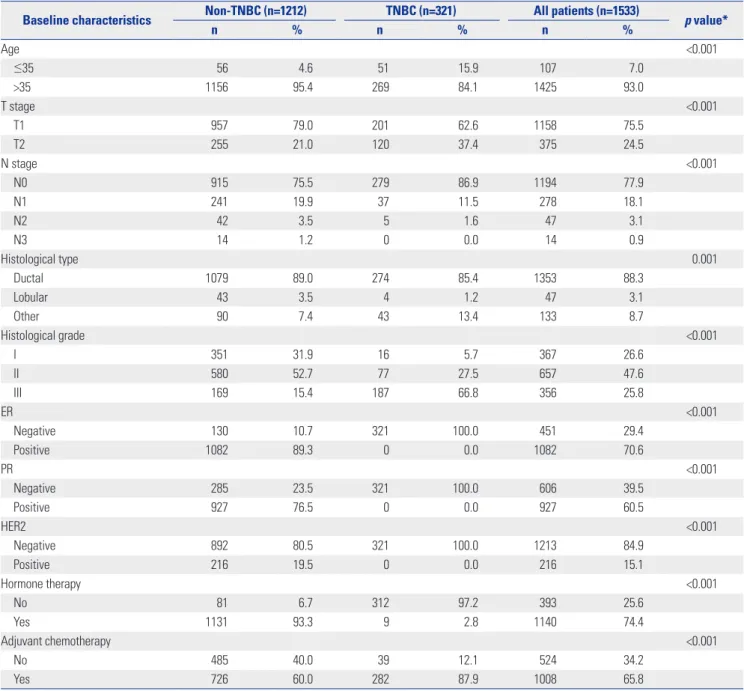
Baseline characteristics of the patients and tumor classifica- tion according to subtype are described in Table 1. Of 1533 tu- mors, 1212 were non-TNBC, and 321 were of the TNBC subtype.
The mean age of all patients was 48.7±9.5 years at diagnosis;
however, the age distribution was different between the two
groups: the TNBC group had more young patients than the non-TNBC group. There were 51 patients (15.9%) younger than 35 years of age in the TNBC group and 56 patients (4.6%) young- er than 35 years of age in the non-TNBC group, respectively (p<0.001). The TNBC group had larger tumors (T2 37.4% vs.
21.0%, p<0.001), fewer nodal metastases (N0 86.9% vs. 75.5%, p<0.001), and more tumors with a higher histological grade (Grade III 66.8% vs. 15.4%, p<0.001) than the non-TNBC group.
The patients with TNBC had more tumors with other histologi- cal types than the patients with non-TNBC (13.4% vs. 7.4%, p=0.001). In the non-TNBC group, approximately one in ten patients (10.7%) had ER-negative tumors, and one quarter of the patients (23.5%) had PR-negative (p<0.001) tumors. In ad- dition, tumors from 216 non-TNBC cases were positive for am- plification of HER2 (19.5%).
Adjuvant hormone therapy was administered to 1131 pa- tients (93.3%) in the non-TNBC group compared to only 2.8%
of patients in the TNBC group. More patients with TNBC re- ceived adjuvant chemotherapy than patients with non-TNBC, and this difference was significant (87.9% vs. 60.0%, p<0.001).
Clinical outcomes
The median follow-up period of all patients was 57 months (range 0–156). Figs. 2 and 3 illustrate the Kaplan-Meier plots of LRFS and OS comparing the two groups. Locoregional recur- rence developed in seven cases (2.2%) with TNBC and in 28 cases (2.3%) with non-TNBC, and this was not significantly dif- ferent. LRFS for the TNBC group was comparable to the non- TNBC group based on log-rank test results (5-year LRFS of TNBC vs. non-TNBC: 98.7% vs. 97.8%, p=0.63) (Fig. 2). Thirteen patients (4.0%) in the TNBC group and 39 patients (3.2%) in the non-TNBC group died during the follow-up period. The non- TNBC group tended to show slightly better survival than the TNBC group; however, the difference was not statistically sig- nificant (96.2% vs. 97.3%, p=0.72) (Fig. 3).
On multivariable analyses, the TNBC group did not show a significantly increased risk of locoregional recurrence and death compared to the non-TNBC group [hazard ratio (HR) for LRFS=0.37, 95% confidence interval (CI): 0.10–1.31; HR for OS=1.03, 95% CI: 0.31–3.39] (Table 2). Only the nodal stage in- dependently affected OS, though it was not predictive of the prognosis of LRFS.
DISCUSSION
Based on several randomized-controlled trials, BCT has been proven to have clinical outcomes equivalent to mastectomy and has become the standard local treatment option for women with early-stage breast cancer.2-5 Given the aggressive features of TNBC, however, there is a concern that a more aggressive treat- ment approach should be considered.15 The current study dem- onstrated that clinical outcomes in terms of LRFS and OS in pa- tients with TNBC who underwent BCT were not different from those with non-TNBC.
The use of BCT for breast cancer patients has increased sig- nificantly at our institution since 2006. According to the Korean Breast Cancer Society (KBCS) registry data, while the propor- tion of patients who underwent total mastectomy decreased from 71.2% in 2000 to 33.8% in 2011, the proportion of patients who underwent BCT surgery increased from 27.9% in 2000 to 65.7% in 2011.1 These data are concordant with our results.
TNBC generally comprises 10–20% of breast cancers28 with a reported prevalence of 12.5% in a large, California population- based study by Bauer, et al.,29 despite racial differences in the prevalence of TNBC.11,30 In agreement with these studies, our data showed a 10–20% proportion of TNBC in the breast cancer population, except for two years, 2000 and 2004. The data re- garding the rates of locoregional recurrence and distant recur- rence for TNBC patients with BCT are incongruent. In our study, the LRFS rates of TNBC and non-TNBC patients were not sig- nificantly different; however, the OS rate of TNBC patients was slightly reduced until 6 years after the BCT, which might have been due to the aggressive behavior of TNBC. Interestingly, TNBC patients had a better clinical outcome if they survived longer than 6 years after treatment, compared to non-TNBC patients. After we adjusted for confounding factors in the prog- nosis, such as age, stage, histologic grade, and systemic therapy, the multivariate analysis revealed that TNBC was unlikely to be an independent prognostic factor affecting the decision to un- dergo BCT in breast cancer patients. This indicates that tumor subtype (TNBC or non-TNBC) alone does not influence LRFS in breast cancer patients with BCT. Similarly, Haffty, et al.25 showed no difference in the ipsilateral breast relapse-free sur- vival between the patients with TNBC and other subtypes with conservative management. Patients classified as TNBC were younger and had larger tumors than other subtypes yet had similar LN metastasis rates.25 The triple-negative subtype was Fig. 1. Molecular subtype proportions according to breast cancer sub-
type with breast-conserving therapy. TNBC, triple-negative breast can- cer; HER2, human epidermal growth factor receptor 2.
100%
90%
80%
70%
60%
50%
40%
30%
20%
10%
0% 2000 2001 2002 2003 2004 2005 2006 2007 2008 2009 2010 Total TNBC Luminal type HER2-enriched
an independent predictor of distant metastasis.25 In contrast, Arvold, et al.31 showed that TNBC patients had a significantly increased risk of local recurrence compared with luminal sub- types. In addition, 91% of the patients in that study received ad- juvant systemic therapy; the data were stratified according to the luminal subtype by histologic grade; and the study com- pared five breast cancer subtypes and age quartiles and dem- onstrated that young age remained an independent risk factor for locoregional recurrence.31 A similar study by Nguyen, et al.19 also reported that the breast cancer subtype, as approximated based on ER, PR, and HER-2 status, was significantly associated with both local and distant recurrence after BCT. In that study,
the luminal B and HER2-enriched subtypes had more instanc- es of lymph node metastasis and lymphovascular invasion than TNBC, although the TNBC group had larger tumors and re- ceived more chemotherapy.19 Meta-analysis of 22 studies by Wang, et al.20 reported that the TNBC subtype was associated with increased risks of both ipsilateral locoregional recurrence and distant metastasis compared to non-TNBC subtypes. In the TNBC cohort, however, patients who received BCT were less likely to develop ipsilateral locoregional recurrence and distant metastasis than those who underwent a mastectomy.20
In a previous study that compared the characteristic features of TNBC and other subtypes, the TNBC group was character-
Table 1. Baseline Patient and Tumor Characteristics
Baseline characteristics Non-TNBC (n=1212) TNBC (n=321) All patients (n=1533)
p value*
n % n % n %
Age <0.001
≤35 56 4.6 51 15.9 107 7.0
>35 1156 95.4 269 84.1 1425 93.0
T stage <0.001
T1 957 79.0 201 62.6 1158 75.5
T2 255 21.0 120 37.4 375 24.5
N stage <0.001
N0 915 75.5 279 86.9 1194 77.9
N1 241 19.9 37 11.5 278 18.1
N2 42 3.5 5 1.6 47 3.1
N3 14 1.2 0 0.0 14 0.9
Histological type 0.001
Ductal 1079 89.0 274 85.4 1353 88.3
Lobular 43 3.5 4 1.2 47 3.1
Other 90 7.4 43 13.4 133 8.7
Histological grade <0.001
I 351 31.9 16 5.7 367 26.6
II 580 52.7 77 27.5 657 47.6
III 169 15.4 187 66.8 356 25.8
ER <0.001
Negative 130 10.7 321 100.0 451 29.4
Positive 1082 89.3 0 0.0 1082 70.6
PR <0.001
Negative 285 23.5 321 100.0 606 39.5
Positive 927 76.5 0 0.0 927 60.5
HER2 <0.001
Negative 892 80.5 321 100.0 1213 84.9
Positive 216 19.5 0 0.0 216 15.1
Hormone therapy <0.001
No 81 6.7 312 97.2 393 25.6
Yes 1131 93.3 9 2.8 1140 74.4
Adjuvant chemotherapy <0.001
No 485 40.0 39 12.1 524 34.2
Yes 726 60.0 282 87.9 1008 65.8
TNBC, triple-negative breast cancer; ER, estrogen receptor; PR, progesterone receptor; HER2, human epidermal growth factor receptor 2.
*Non-TNBC vs. TNBC.
ized by younger patients, larger and higher grade tumors, and more instances of lymph node metastasis.15 Our results showed that TNBC patients were younger, had larger tumors with a
higher histologic grade than non-TNBC patients, and had clini- copathological features that were similar to TNBC patients in prior studies, except in terms of lymph node metastasis. TNBC
Fig. 2. Univariate analysis of locoregional recurrence-free survival after breast-conserving therapy according to TNBC and non-TNBC subtypes.
TNBC, triple-negative breast cancer; LRFS, locoregional recurrence-free survival.
LRFS rate
Time (months) TNBC
Non-TNBC
5 yr LRFS of TNBC: 98.7%
5 yr LRFS of non-TNBC: 97.8%
p=0.63
0 12 24 36 48 60 72 84 96 108 120 100
90
80
70
60
Fig. 3. Univariate analysis of overall survival after breast-conserving ther- apy according to TNBC and non-TNBC subtypes. OS, overall survival;
TNBC, triple-negative breast cancer.
OS rate
Time (months) TNBC
Non-TNBC
5 yr OS of TNBC: 96.2%
5 yr OS of non-TNBC: 97.3%
p=0.72
0 12 24 36 48 60 72 84 96 108 120 100
90
80
70
60
Table 2. Multivariate Analysis for Locoregional Recurrence-Free Survival and Overall Survival Multivariate
analysis
Locoregional recurrence-free survival Overall survival Hazard
ratio
95% CI
p value Hazard ratio
95% CI
p value
Lower Upper Lower Upper
Subtype
Non-TNBC Ref. Ref.
TNBC 0.37 0.10 1.31 0.12 1.03 0.31 3.39 0.96
Age
≤35 Ref. Ref.
>35 0.73 0.21 2.53 0.62 0.96 0.34 2.76 0.94
T stage
T1 Ref. Ref.
T2 1.45 0.66 3.21 0.36 1.09 0.58 2.05 0.80
N stage
N0 Ref. Ref.
N+ 0.82 0.33 2.03 0.67 2.06 1.08 3.92 0.03
Histological grade
I/II Ref. Ref.
III 1.32 0.55 3.17 0.53 1.51 0.75 3.06 0.25
Hormone therapy
No Ref. Ref.
Yes 0.45 0.15 1.38 0.16 0.99 0.32 3.06 0.98
Adjuvant chemotherapy
No Ref. Ref.
Yes 0.72 0.30 1.75 0.47 1.26 0.53 2.99 0.60
TNBC, triple-negative breast cancer; CI, confidence interval.
patients had less metastasis to the lymph nodes and underwent more adjuvant chemotherapy, which might have been respon- sible for the better outcome of these patients. Dent, et al.15 also showed that TNBC had a more aggressive clinical course, though this feature was transient. These features of TNBC could support our result, which showed favorable outcomes for TNBC compared to non-TNBC after BCT.
However, there were limitations to the retrospective study de- sign. First, as trastuzumab was approved for use by the Korean National Health Insurance only after the mid-2000s, testing for HER2 expression and prescribing trastuzumab were not rou- tinely performed. Thus, there was a lack of information regard- ing the administration of trastuzumab and HER2 evaluations in the registry prior to that time. Second, certain TNBC patients received hormone therapy. In the current study, about 2.8% of TNBC patients were treated with hormone therapy, and their tumors were weakly positive for hormone receptor expression (1–9%) on IHC. The tumors with weak hormone receptor posi- tivity were regarded as negative. Whether the hormone recep- tor positivity of 1–9% in these patients was real or an artifact has been disputed among many physicians.32 At our institution, hor- mone receptor expression over 1% was considered as positive according to the guidelines from the American Society of Clini- cal Oncology and the College of American Pathologists in 2010, which recommended a threshold of 1% or more for classifying breast cancer as ER-positive.33 Changes in the definition of the threshold of hormone receptor expression can influence clini- cal outcomes.
The complexity of clinical, biological, and histopathological information on breast cancer creates difficulties for managing locoregional disease. Moreover, there are no specifıc locore- gional treatment guidelines for TNBC.34 However, this study showed non-inferior locoregional recurrence in patients with early TNBC and comparable outcomes between TNBC and non- TNBC. Our findings support the hypothesis that BCT is an ac- ceptable surgical approach in patients with TNBC.
REFERENCES
1. Kim Z, Min SY, Yoon CS, Lee HJ, Lee JS, Youn HJ, et al. The basic facts of korean breast cancer in 2011: results of a nationwide sur- vey and breast cancer registry database. J Breast Cancer 2014;17:
99-106.
2. Veronesi U, Cascinelli N, Mariani L, Greco M, Saccozzi R, Luini A, et al. Twenty-year follow-up of a randomized study comparing breast-conserving surgery with radical mastectomy for early breast cancer. N Engl J Med 2002;347:1227-32.
3. van Dongen JA, Voogd AC, Fentiman IS, Legrand C, Sylvester RJ, Tong D, et al. Long-term results of a randomized trial comparing breast-conserving therapy with mastectomy: European Organiza- tion for Research and Treatment of Cancer 10801 trial. J Natl Can- cer Inst 2000;92:1143-50.
4. Poggi MM, Danforth DN, Sciuto LC, Smith SL, Steinberg SM, Liewehr DJ, et al. Eighteen-year results in the treatment of early breast carcinoma with mastectomy versus breast conservation
therapy: the National Cancer Institute Randomized Trial. Cancer 2003;98:697-702.
5. Fisher B, Anderson S, Bryant J, Margolese RG, Deutsch M, Fisher ER, et al. Twenty-year follow-up of a randomized trial comparing total mastectomy, lumpectomy, and lumpectomy plus irradiation for the treatment of invasive breast cancer. N Engl J Med 2002;347:
1233-41.
6. NIH consensus conference. Treatment of early-stage breast can- cer. JAMA 1991;265:391-5.
7. Perou CM, Sørlie T, Eisen MB, van de Rijn M, Jeffrey SS, Rees CA, et al. Molecular portraits of human breast tumours. Nature 2000;
406:747-52.
8. Ahn SG, Lee HM, Lee SA, Jeong J, Lee HD. Long-term survival analysis of korean breast cancer patients at a single center: im- proving outcome over time. Yonsei Med J 2014;55:1187-95.
9. Brenton JD, Carey LA, Ahmed AA, Caldas C. Molecular classifica- tion and molecular forecasting of breast cancer: ready for clinical application? J Clin Oncol 2005;23:7350-60.
10. Tang P, Skinner KA, Hicks DG. Molecular classification of breast carcinomas by immunohistochemical analysis: are we ready? Di- agn Mol Pathol 2009;18:125-32.
11. Carey LA, Perou CM, Livasy CA, Dressler LG, Cowan D, Conway K, et al. Race, breast cancer subtypes, and survival in the Carolina Breast Cancer Study. JAMA 2006;295:2492-502.
12. Park S, Koo JS, Kim MS, Park HS, Lee JS, Lee JS, et al. Characteris- tics and outcomes according to molecular subtypes of breast can- cer as classified by a panel of four biomarkers using immunohis- tochemistry. Breast 2012;21:50-7.
13. Voduc KD, Cheang MC, Tyldesley S, Gelmon K, Nielsen TO, Ken- necke H. Breast cancer subtypes and the risk of local and regional relapse. J Clin Oncol 2010;28:1684-91.
14. Chen X, Yu X, Chen J, Zhang Z, Tuan J, Shao Z, et al. Analysis in early stage triple-negative breast cancer treated with mastectomy without adjuvant radiotherapy: patterns of failure and prognostic factors. Cancer 2013;119:2366-74.
15. Dent R, Trudeau M, Pritchard KI, Hanna WM, Kahn HK, Sawka CA, et al. Triple-negative breast cancer: clinical features and pat- terns of recurrence. Clin Cancer Res 2007;13(15 Pt 1):4429-34.
16. Harissis HV, Ziogas D, Baltogiannis G. Mastectomy vs breast-con- serving surgery: an old dilemma comes again for early breast cancer. Ann Surg Oncol 2010;17:1966-7.
17. Kreike B, Halfwerk H, Armstrong N, Bult P, Foekens JA, Veltkamp SC, et al. Local recurrence after breast-conserving therapy in rela- tion to gene expression patterns in a large series of patients. Clin Cancer Res 2009;15:4181-90.
18. Zaky SS, Lund M, May KA, Godette KD, Beitler JJ, Holmes LR, et al. The negative effect of triple-negative breast cancer on outcome after breast-conserving therapy. Ann Surg Oncol 2011;18:2858-65.
19. Nguyen PL, Taghian AG, Katz MS, Niemierko A, Abi Raad RF, Boon WL, et al. Breast cancer subtype approximated by estrogen receptor, progesterone receptor, and HER-2 is associated with lo- cal and distant recurrence after breast-conserving therapy. J Clin Oncol 2008;26:2373-8.
20. Wang J, Xie X, Wang X, Tang J, Pan Q, Zhang Y, et al. Locoregional and distant recurrences after breast conserving therapy in pa- tients with triple-negative breast cancer: a meta-analysis. Surg Oncol 2013;22:247-55.
21. Zumsteg ZS, Morrow M, Arnold B, Zheng J, Zhang Z, Robson M, et al. Breast-conserving therapy achieves locoregional outcomes comparable to mastectomy in women with T1-2N0 triple-nega- tive breast cancer. Ann Surg Oncol 2013;20:3469-76.
22. Bhatti AB, Khan AI, Siddiqui N, Muzaffar N, Syed AA, Shah MA, et al. Outcomes of triple-negative versus non-triple-negative breast
cancers managed with breast-conserving therapy. Asian Pac J Cancer Prev 2014;15:2577-81.
23. Gangi A, Chung A, Mirocha J, Liou DZ, Leong T, Giuliano AE.
Breast-conserving therapy for triple-negative breast cancer. JAMA Surg 2014;149:252-8.
24. Abdulkarim BS, Cuartero J, Hanson J, Deschênes J, Lesniak D, Sa- bri S. Increased risk of locoregional recurrence for women with T1-2N0 triple-negative breast cancer treated with modified radi- cal mastectomy without adjuvant radiation therapy compared with breast-conserving therapy. J Clin Oncol 2011;29:2852-8.
25. Haffty BG, Yang Q, Reiss M, Kearney T, Higgins SA, Weidhaas J, et al. Locoregional relapse and distant metastasis in conservatively managed triple negative early-stage breast cancer. J Clin Oncol 2006;24:5652-7.
26. Cho JH, Park JM, Park HS, Park S, Kim SI, Park BW. Oncologic safety of breast-conserving surgery compared to mastectomy in patients receiving neoadjuvant chemotherapy for locally ad- vanced breast cancer. J Surg Oncol 2013;108:531-6.
27. Singletary SE, Connolly JL. Breast cancer staging: working with the sixth edition of the AJCC Cancer Staging Manual. CA Cancer J Clin 2006;56:37-47.
28. Boyle P. Triple-negative breast cancer: epidemiological consider- ations and recommendations. Ann Oncol 2012;23 Suppl 6:vi7-12.
29. Bauer KR, Brown M, Cress RD, Parise CA, Caggiano V. Descriptive analysis of estrogen receptor (ER)-negative, progesterone recep- tor (PR)-negative, and HER2-negative invasive breast cancer, the so-called triple-negative phenotype: a population-based study from the California cancer Registry. Cancer 2007;109:1721-8.
30. Ismail-Khan R, Bui MM. A review of triple-negative breast cancer.
Cancer Control 2010;17:173-6.
31. Arvold ND, Taghian AG, Niemierko A, Abi Raad RF, Sreedhara M, Nguyen PL, et al. Age, breast cancer subtype approximation, and local recurrence after breast-conserving therapy. J Clin Oncol 2011;29:3885-91.
32. Yi M, Huo L, Koenig KB, Mittendorf EA, Meric-Bernstam F, Kuer- er HM, et al. Which threshold for ER positivity? a retrospective study based on 9639 patients. Ann Oncol 2014;25:1004-11.
33. Hammond ME, Hayes DF, Dowsett M, Allred DC, Hagerty KL, Badve S, et al. American Society of Clinical Oncology/College Of American Pathologists guideline recommendations for immuno- histochemical testing of estrogen and progesterone receptors in breast cancer. J Clin Oncol 2010;28:2784-95.
34. Moran MS. Should triple-negative breast cancer (TNBC) subtype affect local-regional therapy decision making? Am Soc Clin Oncol Educ Book 2014:e32-6.