Author contributions: B.L. and D.H.H. performed the conception and design. B.L. performed the carried out the experiments. B.L. and D.H.H. per- formed the acquisition of data. B.L. and D.H.H. performed the analysis and in- terpretation. B.L. performed the drafting the article. B.L. and D.H.H. performed the statistical analysis. I.S. and H.L. performed the study supervision.
This is an Open Access article distributed under the terms of the Creative Commons Attribution Non-Commercial License, which permits unrestricted non-commercial use, distribution, and reproduction in any medium, provided the original work is properly cited.
Copyright © Korean J Physiol Pharmacol, pISSN 1226-4512, eISSN 2093-3827
INTRODUCTION
Post-traumatic stress disorder (PTSD) is a chronic stress- induced psychiatric condition that develops immediately or a long time after exposure to a traumatic, life-threatening event [1,2]. The characteristic signs of PTSD include hyperarousal, insensibility, fear, and nightmares [3,4]. The onset of PTSD often precedes and increases the risk for the subsequent development of anxiety disorders, and PTSD enhances susceptibility to anxiety [5]. Altered serotonin (5-HT) levels, a core neurochemical feature
of PTSD, contribute to multiple PTSD-related behaviors, includ- ing hypervigilance, impulsivity, aggression, depression, and anxiety [6]. Central 5-HT appears to have a positive effect on fear conditioning [7]. Many studies have also shown that hyperarousal and dysregulation of the hypothalamic-pituitary-adrenal (HPA) axis are closely associated with the development of PTSD, which produces marked changes in affective behavior that are indicative of or consistent with anxiety-like symptoms [8,9].
The single prolonged stress (SPS), which models a traumatic, stressful event, has been used widely because it has high valid-
Original Article
Tetramethylpyrazine reverses anxiety-like behaviors in a rat model of post-traumatic stress disorder
Bombi Lee
1,2,*, Insop Shim
3, Hyejung Lee
1, and Dae-Hyun Hahm
3,*
1
Acupuncture and Meridian Science Research Center,
2Center for Converging Humanities,
3Department of Physiology, College of Medicine, Kyung Hee Univer- sity, Seoul 02447, Korea
ARTICLE INFO
Received February 8, 2018 Revised June 20, 2018 Accepted June 25, 2018
*Correspondence Bombi Lee
E-mail: [email protected] Dae-Hyun Hahm E-mail: [email protected] Key Words
Anxiety
Post-traumatic stress disorder Serotonin
Single prolonged stress Tetramethylpyrazine
ABSTRACT Post-traumatic stress disorder (PTSD) is a trauma-induced psychiatric
disorder characterized by impaired fear extermination, hyperarousal, and anxiety
that may involve the release of monoamines in the fear circuit. The reported pharma-
cological properties of tetramethylpyrazine (TMP) include anti-cancer, anti-diabetic,
anti-atherosclerotic, and neuropsychiatric activities. However, the anxiolytic-like ef-
fects of TMP and its mechanism of action in PTSD are unclear. This study measured
several anxiety-related behavioral responses to examine the effects of TMP on symp-
toms of anxiety in rats after single prolonged stress (SPS) exposure by reversing the
serotonin (5-HT) and hypothalamic-pituitary-adrenal (HPA) axis dysfunction. Rats
were given TMP (10, 20, or 40 mg/kg, i.p.) for 14 days after SPS exposure. Administra-
tion of TMP significantly reduced grooming behavior, increased the time spent and
number of visits to the open arm in the elevated plus maze test, and significantly
increased the number of central zone crossings in the open field test. TMP adminis-
tration significantly reduced the freezing response to contextual fear conditioning
and significantly restored the neurochemical abnormalities and the SPS-induced de-
crease in 5-HT tissue levels in the prefrontal cortex and hippocampus. The increased
5-HT concentration during TMP treatment might be partially attribute to the trypto-
phan and 5-hydroxyindoleacetic acid mRNA level expression in the hippocampus of
rats with PTSD. These findings support a role for reducing the altered serotonergic
transmission in rats with PTSD. TMP simultaneously attenuated the HPA axis dysfunc-
tion. Therefore, TMP may be useful for developing an agent for treating psychiatric
disorders, such those observed in patients with PTSD.
ity when examining trauma-induced learning or anxiety [10,11].
Rats exposed to SPS show enhanced dysregulation of the HPA axis [12,13], increased fear conditioning, and increased anxiety- like behavior on the elevated plus maze (EPM) test [11]. These responses imitate the clinical symptoms observed in patients with PTSD [10].
Tetramethylpyrazine (TMP) is one of the most important active ingredients in the Asian traditional medicine herb Ligus- ticum wallichii Franch [14]. TMP can pass through the blood- brain barrier and is widely used in the treatment of neurovascular and cardiovascular diseases [15-17]. For example, TMP exerts neuroprotective, antioxidant, anti-apoptotic, and anti-inflamma- tory effects in central nervous system-related disorders, such as forebrain ischemia, Parkinson’s disease, and Alzheimer’s disease [18-20]. Some studies have shown that TMP protects against ischemic brain damage and promotes cell proliferation [21]. TMP also protects learning and memory functions and rescues cho- linergic dysfunction in D-galactose-lesioned mice [22], a chronic cerebral hypoperfusion model [23], and rats given streptozotocin injections [24]. It has multiple functions, including the preven- tion of oxidative stress-induced neuronal death, calcium channel blockade, protection against kainite-induced excitotoxicity, and enhanced mitochondrial biosynthesis [25-27]. TMP increases the expression of Bcl-2, but decreases that Bax, in the spinal cord, thereby exerting an anti-apoptotic effect [28,29]. Therefore, we hypothesized that TMP would protect against the development of anxiety-like behaviors, which represent the symptoms of PTSD, in a rat model of PTSD using SPS.
Therefore, this study used the EPM test, open field test (OFT), and contextual fear conditioning and fear extinction to investi- gate the effects of TMP on the anxiety-related behaviors in rats exposed to SPS. We also examined how the behavioral effects were associated with the underlying mechanism of the serotoner- gic system in the brain. To investigate the possible mechanisms underlying the anti-PTSD-like effects of TMP further, we also studied HPA axis activation after chronic TMP treatment.
METHODS
Animals and tetramethylpyrazine administration
Six-week-old adult male Sprague-Dawley rats (Samtako Animal Co., Seoul, Korea), weighing 220-250 g, were used in all of the ex- periments. The rats were housed in a limited access rodent facility with up to five rats per polycarbonate cage. The rats were sus- tained on a 12-h light/dark cycle (lights on at 8:00 am, lights off at 8:00 pm) under a controlled temperature (23±5°C) and relative humidity (55±5%) conditions. All of the animals adapted to this condition during the 7 days after their arrival. All of the methods were approved by the Animal Care and Use Committee of Kyung Hee University [KHUASP(SE)-15-115]. All of the procedures were
executed according to the Guide for the Care and Use of Labora- tory Animals issued by the Korea National Institute of Health.
After exposure to SPS, TMP (10, 20, and 40 mg/kg, body weight, Sigma-Aldrich Chemical Co., St. Louis, MO, USA) and fluoxetine (10 mg/kg, FLX, fluoxetine hydrochloride; Sigma), which was used as the positive control, were intraperitoneally ( i.p.) injected at a volume of 1 ml/kg for 14 days. The standard doses of TMP and FLX in the rat and considering the long-term treatment used in the present study was based on previous study [20]. In total, six to seven animals were allotted to each group. TMP and FLX were dissolved in 0.9% saline before use. As a vehicle control, animals in the saline-treated (SAL) group were intraperitoneally given the equivalent volumes in saline without SPS exposure.
Another group was pretreated with TMP (40 mg/kg, i.p., TMP group) without SPS exposure. The entire experimental schedules of SPS and behavioral examinations are shown in Fig. 1.
Single prolonged stress
Rats were subjected to SPS according to a slightly modified ver- sion of the procedure described by Enman’s groups [1,30]. Briefly, rats were controlled for 2 h by a holder and then were subjected to a forced swimming condition for 20 min. The rats were dried and allowed to recuperate for 15 min, and then were moved to a sepa- rate chamber where they were exposed to isoflurane until loss of consciousness (<1 min). Isoflurane exposure was conducted by placing a cotton ball soaked with isoflurane into an open conical tube and placed into the chamber (2-4 rats simultaneously). Rats were housed in pairs undisturbed for the next 7 days, with the exception of cage changes. All further experimental procedures began after the 7-day isolation period. Control animals were weighed daily and housed in pairs.
Elevated plus maze test
The EPM test was carried out according to a method described previously [30]. Briefly, the rats were transferred to the EPM, which consisted of a 4-armed wooden platform in the shape of a plus sign. The apparatus was painted with black enamel and was raised 50 cm above the floor. All arms were 50 cm in length, 10 cm in width, and joined in the center to create a 10 cm
2center platform. Two arms facing away from each other were protected, whereas the remaining two arms remained open. At the start of each experiment, the rat could move freely for 5 min. The video footage of these sessions was scored. The ratio of the total time spent in the open and closed arms were used to measure anxiety.
The anxiety index was calculated as follows:
Anxiety index
=1–
[ ( Time spent in the open arms
)
+(
Number of entries to the open arms) ]
Total time on the maze Total exploration on the maze 2
Anxiety index values range from 0 to 1 where an increase in
the index expresses increased anxiety-like behavior.
Open field test
The rats completed the OFT before the EPM. The OFT was performed according to a previously described method [31]. The open field area consisted of an enclosed square area made of dark opaque Plexiglas (60 × 60 cm) surrounded by walls (30 cm in height). All of the locomotor activities (animal movements) were measured with a computerized video-tracking system using the S-MART program (PanLab Co., Barcelona, Spain). The locomo- tor activity was evaluated in terms of total distance traveled in the container, and exploratory activity was evaluated based on measurements of the total number of line crossings during 5 min.
Painted white lines divided the area into 16 squares (15×15 cm each). Time spent, and number of zone crossings in the central and peripheral zones were observed. The number of rearing events for each rat was also recorded to analyze locomotor activ- ity in the OFT.
Contextual fear conditioning and extinction
A separate group of rats that did not undergo the EPM testing (n=4-5 for each group) was tested for contextual fear conditioning and extinction, after the SPS procedure. Contextual fear condi- tioning tests took place over 3 days, and followed the procedures according to a method described previously [32]. Briefly, on the
acquisition day, rats were placed in a foot shock chamber (30 cm long×26 cm wide×22 cm high) with an overhead camera, and were allowed to explore freely for 2 min. After 2 min, a total of 10 electric shocks (0.75 mA, 2 s duration) were delivered at intervals of 74 s through the testing chamber floor. The rats then remained in the chamber for an additional 5 min with no shocks delivered.
On test days 1-2, rats were placed for 8 min in same chambers as on acquisition day, with no shocks delivered, to determine the extent of contextual fear learning and extinction of contextual fear conditioning. This behavior was chosen because it was previ- ously shown to induce a re-experiencing of the aversive event and to facilitate behavioral sensitization. The percentage of freezing responses was calculated by dividing the freezing time by the total time. Freezing behavior was defined as complete immobility except for minor movements required for respiration.
Corticosterone, corticotropin-releasing hormone, adrenocorticotroic hormone, and 5-HT measurement
After the 15 days of rest designed to allow the development of PTSD, corticosterone (CORT), corticotropin-releasing hormone (CRH), and adrenocorticotroic hormone (ACTH) in the plasma, and 5-HT concentration in the brain tissue were assayed accord- ing to a previously described procedure [31]. Four rats from each group were deeply anesthetized through inhalation with isoflu- rane (1.2%), and were sacrificed one day after behavioral test- ing. The plasma was quickly collected via the abdominal aorta,
Fig. 1. Experiments used to deve lop sin gle prolonged stress (SPS)-in du ced an xiety-like behaviors, and tetrame- thy lpyrazine (TMP) treatment in rats.
Different groups of rats (n=6 or 7 ani-
mals per group) were used for all experi-
ments.
and the medial prefrontal cortex (mPFC), hippocampus (HPC), striatum (STR), and amygdala (AMYG) were rapidly removed from the rat brain in a randomized order. Special care was taken to avoid pre-sacrifice stress and the rats were killed rapidly. The
CORT, CRH, ACTH, and 5HT concentration were evaluated by a competitive enzyme-linked immunoassays (ELISAs) using a CORT antibody (Novus Biologicals, LLC., Littleton, CO, USA), a CRH antibody (Novus Biologicals), a ACTH antibody (Novus
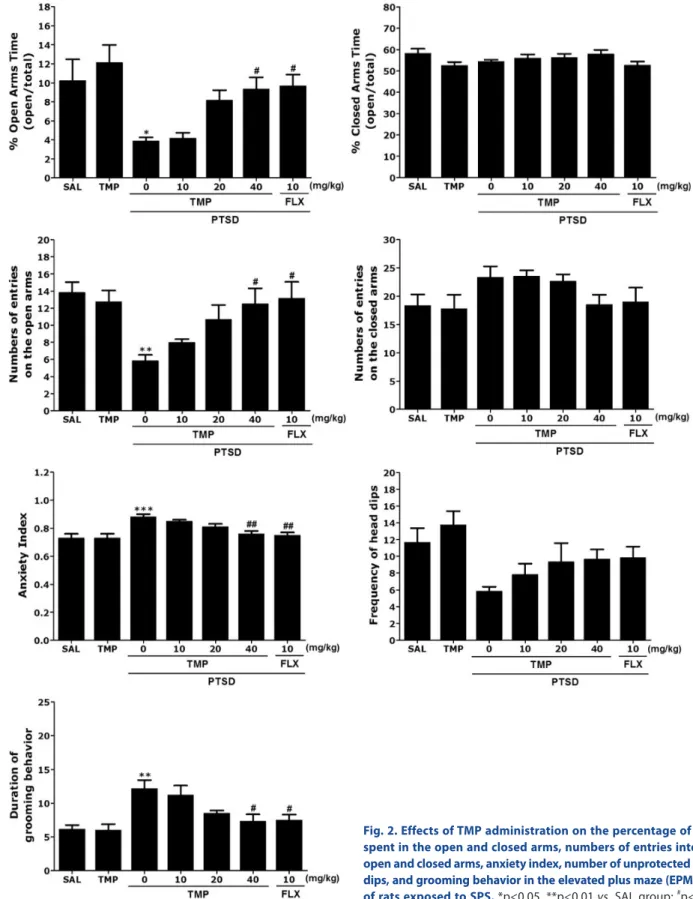
Fig. 2. Effects of TMP administration on the percentage of time spent in the open and closed arms, numbers of entries into the open and closed arms, anxiety index, number of unprotected head dips, and grooming behavior in the elevated plus maze (EPM) test of rats exposed to SPS. *p<0.05, **p<0.01 vs. SAL group;
#p<0.05,
##
p<0.01 vs. PTSD group. ***p<0.001.
Biologicals), and a 5-HT antibody (Abcam, Cambridge, MA, USA) according to the manufacturer’s protocols.
Total RNA isolation and reverse transcription- polymerase chain reaction
The expression of tryptophan (TRP), 5-hydroxyindoleacetic acid (5-HIAA), and vesicular monoamine transporter-2 (VMAT- 2) mRNA expression were measured by RT-PCR according to a method described previously [31]. In brief, total RNA was ex- tracted from the HPC of each rat using TRIzol reagent (Life Tech- nologies, Carlsbad, CA, USA) according to the manufacturer’s instructions. cDNA was synthesized from 2 mg total RNA using reverse transcriptase (Takara Bio, Otsu, Japan) with random hex- amers (COSMO Genetech, Seoul, Korea). Then it was amplified at 60°C for 28 cycles for TRP, at 60°C for 30 cycles for 5-HIAA, and at 56°C for 35 cycles for VMAT-2 using Taq DNA polymerase (Takara, Kyoto, Japan) on a thermal cycler (MJ Research, Water- town, MA, USA). Data were normalized against glyceraldehyde 3-phosphate dehydrogenase (GADPH) expression in the corre- sponding sample.
Statistical analysis
All of the measurements were performed by an independent investigator blind to the experimental conditions, and the results are expressed as mean±standard error of the mean. Differences within or between normally distributed data were analyzed with analysis of variance (ANOVA) with SPSS (version 13.0; SPSS, Inc., Chicago, IL, USA) and Tukey’s post hoc tests. Between-subjects two-way ANOVA was used to analyze the effects of TMP treat- ment and time. In all of the analyses, differences were considered statistically significant at p-value <0.05.
RESULTS
Effects of tetramethylpyrazine on anxiety-like behaviors following single prolonged stress exposure
Rats exhibited an obvious anxiety phenotype characterized by reduced open-arm exploration during the EPM test. Statisti- cal analyses of the behavioral results showed that the percentage of time spent in the open arms of the maze significantly dif- fered among the 7 groups [F(6,39)=5.035, p<0.01] (Fig. 2). The ANOVA also revealed a significant effect of the number of open arm entries among the 7 groups [F(6,39)=5.049, p<0.01]. Post- hoc comparisons indicated that the percentage of time spent and the number of entries in the open arms of the maze decreased significantly in the PTSD group compared with the control group (p<0.05 and p<0.01). However, rats in the PTSD+TMP40 group showed significant restoration of the time spent and the number
of entries in the open arms of the maze compared with that of the PTSD group (p<0.05). The percentage of time spent and the number of entries in the closed arms of the maze did not differ significantly among the seven groups [F(6,39)=1.466, p=0.230 and F(6.39)=1.948, p=0.116]. TMP administration after SPS elicited anxiogenic or anxiolytic behavior. These findings indicated that increased time spent and number of entries in the open arms of the maze in the PTSD+TMP40 group was comparable to the ex- ploratory behavior in the PTSD+FLX group. Overall, the anxiety index, calculated based on the number of visits to and time spent in the open and closed arms, also differed among the 7 groups of rats, with lower values in the TMP-treated rats (p<0.01). Anxiety reduction, indicated by open arm exploration in the EPM, was defined as an increase in the numbers of entries into the open arms relative to total entries into either open or closed arm, and an increase in the proportion of time spent in the open arms rela- tive to total spending time in either open or closed arm. Also, unprotected head dips were defined as peering over the edge of an open arm with head, neck, and shoulders. Administering TMP significantly increased the frequency of unprotected head dips compared with that in the PTSD group, although this result was only marginally significant. Grooming behavior has been reported to be a response to novelty or other stressors and might vary in accordance with stress intensity. However, the duration of grooming behavior was reversed by 40 mg/kg TMP when admin- istered after SPS exposure (p<0.05).
Effects of tetramethylpyrazine on locomotion and exploratory behavior following single prolonged stress exposure
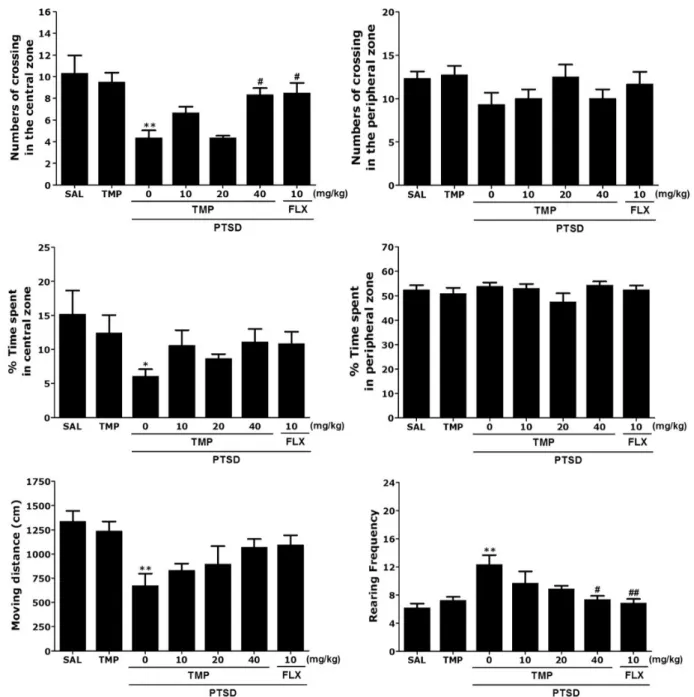
The OFT was used to assess the exploratory behavior and locomotion of the rats who underwent the SPS procedure (Fig.
3). Rats exposed to SPS spent significantly less time in the cen- tral zone and correspondingly more time in the peripheral zone compared to the saline (SAL) group (p<0.05). There was also a significant decrease in the number of central zone crossings fol- lowing the SPS procedure (p<0.01). Our results indicated that SPS-treated rats developed exploratory activities that were closely associated with the anxiety-like behaviors observed in the OFT.
However, the TMP-treated rats (40 mg/kg) displayed a significant
increase in the number of central zone crossings compared with
rats in the PTSD group (p<0.05), indicating that the anxiety-like
behaviors of the PTSD+TMP40 group were similar to those of
the PTSD+FLX group. A one-way ANOVA was performed, and
PTSD-related differences were discovered in locomotor activity
(motor function) and the total number of rearing (exploratory
activities) in the OFT. A significant difference in locomotor activ-
ity was observed between saline-treated rats, the PTSD group,
and the TMP-treated groups [F(6,39)=3.858, p<0.01] and the total
times reared [F(6,39)=5.251, p<0.01]. Rats exposed to SPS had
significantly decreased moving distance and rearing frequency
in the open field compared with the SAL group (p<0.01). Admin- istering TMP significantly increased the moving distance com- pared with that in the PTSD group, although this result was only marginally significant. However, rats in the PTSD+TMP40 group showed a significant restoration of the rearing frequency in the open field compared with that in the PTSD group (p<0.05).
Effects of tetramethylpyrazine on SPS-induced contextual fear conditioning and extinction
The effects of TMP administration on the contextual freezing behavior of rats are shown in Fig. 4. Unconditioned freezing du-
ration in response to foot shock was not different between groups [F(5,35)=0.235, p=0.547]. In contrast, two way ANOVA across the three testing sessions revealed a significant main effect of treat- ment [F(5,35)=10.45, p<0.01], a significant main effect of time [F(5,35)=29.54, p=0.745] and a significant interaction between treatment and time [F(5,35)=2.450, p<0.05] for freezing behavior.
In the contextual freezing measurement, the freezing time sig- nificantly increased after exposure to SPS (p<0.01 on days 1 and 2). The percentage of time spent displaying freezing behavior was significantly decreased in the group treated with 40 mg/kg TMP on days 1 and 2, respectively (p<0.05). These results indicate that a persistent fear response to the original context was associated
Fig. 3. Effects of TMP administration on locomotion and exploratory behavior in the open filed test (OFT) of rats exposed to SPS. Changes in
the time spent in the central and peripheral zones, numbers of crossing in the central and peripheral zones, locomotor activity, and number of rearing
events in the open field test of rats exposed to SPS. *p<0.05, **p<0.01 vs. SAL group;
#p<0.05,
##p<0.01 vs. PTSD group.
with the traumatic events that occurred there and that repeated TMP treatment ameliorated the context-dependent freezing be- havior in the rats.
Effects of tetramethylpyrazine on 5-HT concentration in the brain following single prolonged stress
exposure
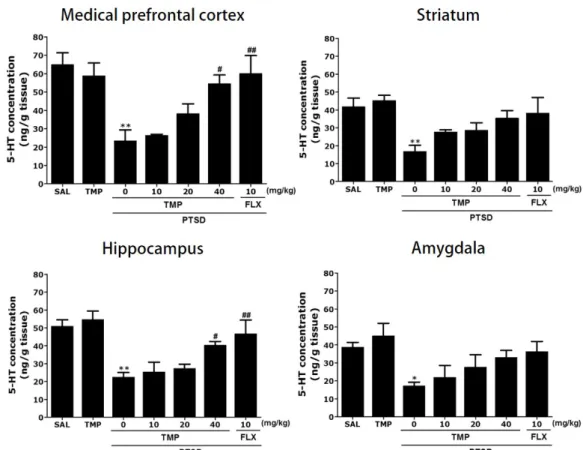
Fig. 5 shows differences in the regional levels of 5-HT among the group. The post-hoc test results indicated a significant de- crease in 5-HT levels in the mPFC of the PTSD groups compared to the SAL (p<0.01). Daily administration of TMP significantly increased the SPS-induced decrease in the 5-HT concentration in the mPFC compared with the PTSD group (p<0.05). The post-hoc test results indicated a significant decrease in 5-HT levels in the HPC of the PTSD groups compared to the SAL (p<0.01). Daily administration of TMP significantly increased the SPS-induced decrease in the 5-HT concentration in the HPC compared with the PTSD group (p<0.05).
After treatment with TMP, the levels of 5-HT in the STR were significantly reversed, by 211.94% of that in the PTSD group, although this result was only marginally significant. After treat-
ment with TMP, the levels of 5-HT in the AMYG were signifi- cantly reversed, by 214.12% of that in the PTSD group, although this result was only marginally significant. Additionally, 5-HT concentrations in the brain regions of rats receiving 10 mg/kg FLX were similar to those of rats receiving 40 mg/kg TMP.
Effects of tetramethylpyrazine on expression of TRP, 5-HIAA, and VMAT-2 mRNA in the hippocampus following single prolonged stress exposure
To examine the effect of TMP on the expression of TRP, 5-HIAA, and VMAT-2 mRNAs in rat hippocampus injured by SPS, the mRNAs expression of TRP, 5-HIAA, and VMAT- 2 was analyzed by RT-PCR (Fig. 6). The mRNA level of TRP in the PTSD group decreased significantly compared with that in the SAL group (p<0.01), the expression levels in the PTSD group were similar to those in the SAL group after treatment with 40 mg/kg TMP (p<0.05). The mRNAs level of 5-HIAA and VMAT- 2 in the PTSD group decreased significantly compared with that in the SAL group (p<0.01 and p<0.05). The expression levels of 5-HIAA mRNA in the PTSD group was significantly restored to a level similar to those in the SAL group after treatment with 40
Fig. 4. Effects of TMP on freezing behavior from contextual fear conditioning testing after exposure to SPS in rats. The percentage of time
spent freezing was determined on acquisition, day 1, and day 2. **p<0.01 vs. SAL group;
#p<0.05,
##p<0.01 vs. SPS group.
Fig. 5. Effects of TMP on the serotonin (5-HT) concentration in the brains of rats exposed to SPS. *p<0.05, **p<0.01 vs. SAL group;
#p<0.05,
##