ISSN 1225-6552
http://dx.doi.org/10.7853/kjvs.2012.35.3.215
< Original Article >
Veterinary Service
Available online at http://kosves.re.kr
*Corresponding author: Ba-Ra-Da Koh, Tel. +82-62-613-7673, Fax. +82-62-613-7649, E-mail. [email protected]
소, 돼지, 가금육류의 신속한 동정을 위한 TaqMan
Ⓡprobe를 이용한 real-time PCR 개발
고바라다*ㆍ김지연ㆍ나호명ㆍ박성도ㆍ김용환
광주시보건환경연구원 동물위생연구부
Development of TaqMan
Ⓡprobe-based real-time PCR for rapid identification of beef, pork and poultry meat
Ba-Ra-Da Koh*, Ji-Yeon Kim, Ho-Myung Na, Seong-Do Park, Yong-Hwan Kim
Department of Veterinary Research, Gwangju Metropolitan City Institute Health & Environment, Gwangju 500-210, Korea (Received 9 August 2012; revised 10 September 2012; accepted 12 Septemper 2012)
Abstract
Species-specific TaqManⓇ probe-based real-time PCR assays were developed for detection of beef, pork, chicken, duck, goose and turkey. The primer and probe sets used in this study were designed to be complementary to fibroblast growth factor (FGF) for cattle and pig, mitochondrial NADH de- hydrogenase (ND) subunit 3 and ND2 for chicken and duck, 12S rRNA for goose and turkey, respectively. As internal positive control we used conserved region in the ribosomal 18S RNA gene to ensure the accuracy of the detection of target DNA by real-time PCR. We confirmed that real-time PCR assays with the primer and probe sets were positive for cattle, pig and chicken intended target animal species with no cross-reactivity with other non-target animal species. Only >50 ng DNA of beef show cross-reactivity in the determination of duck. Using species-specific primer and probe sets, it was possible to detect amounts of 0.1 ng DNA of cattle and pig, 1.0 pg DNA of chicken, duck and turkey, and 0.1 pg DNA of goose for raw samples, respectively. The detection limits were 0.1 ng DNA of cattle, 1.0 ng DNA of pig and 1.0 pg DNA of chicken for DNA mixtures (beef, pork and chicken) extracted from heat-treated (121oC/5 min) meat samples. In conclusion, it can be suggested that the TaqManⓇ probe-based assay developed in this study might be a rapid and specific method for the identification of meat species in raw or cooked meat products.
Key words : Real-time PCR, Meat identification, FGF, ND3, 12S rRNA
서 론
축산물 가공품의 표시사항에 표기된 식육의 종류 는 정확하여야 한다. 이는 축산물의 안전성 측면에서 중요하며 알레르기 유발 물질 중 난류(달걀)와 돼지 고기는 표시사항에 반드시 표시하도록 하고 있다. 이 와 같은 사항은 육류를 가려먹어야 하는 소비자에게 는 상당히 중요한 정보이다(Ballin, 2010; Koh 등, 2011).
육류를 사용한 식품의 표시사항을 검증하기 위해서 주로 유전자를 검사하는 방법이 이화학적 방법 또는 액체크로마토그래피 검사보다 우수하다고 보고하고 있다(Ashoor와 Osman, 1988; Ballin, 2010). 단백질은 동물이 도축되고 난 후에는 생물학적 활성이 사라지 고, 세포 분류에 따라 특성이 달라지며, 열과 압력 처 리 과정을 거치는 동안 변성되기 때문에 가공된 시료 에서 동물 종을 감별하기는 어려운 실정이다(Montiel- Sosa 등, 2000).
DNA에 기반을 둔 검사 방법 중 현재까지 가장 널
리 활용되는 분자생물학적 방법은 신속성, 민감도 및 특이도가 우수한 polymerase chain reaction (PCR)과 real-time PCR이다(Cammà 등, 2012; Koh 등, 2011;
Tanabe 등, 2007).
통상적인 PCR 방법으로 국내ㆍ외 여러 연구자가 다양한 동물 종을 감별할 수 있는 PCR (Park 등, 2012), PCR-restriction fragment length polymorphism (Montiel-Sosa 등, 2000), random amplified polymorphic DNA (Rastogi 등, 2007), multiplex PCR (Koh 등, 2011) 등이 보고되었다.
최근에는 식품에 사용된 동물 종을 감별하는데 re- al-time PCR이 사용되고 있다. Real-time PCR은 두 가지 이 방법이 있는데, TaqManⓇ과 같은 probe (Cammà 등, 2012; Dooley 등, 2004; Jonker 등, 2008; López-Andreo 등, 2005; Tanabe 등, 2007)와 SYBRⓇ Green과 같은 DNA interchelating dyes (López-Andreo 등, 2006; Martín 등, 2009; Walker 등, 2003)이다. 이중나선 DNA와 결합 하는 SYBRⓇ Green과 같은 형광물질을 사용하는 re- al-time 방법은 저렴하고 각각의 probe 설계 없이 사 용할 수 있지만, 표적 DNA 이외에 비특이적인 PCR 산물과 결합하기 때문에 결과 해석에 문제가 발생할 수 있어서 PCR 반응조건 설정에 유의하여야 한다 (Klein, 2002). Probe를 이용한 real-time PCR은 상당히 까다로운 probe 디자인 조건, 최적의 반응조건을 찾 기 위한 시간과 노력 그리고 고가의 시약이 소요되는 단점이 있지만, 표적 염기서열에 특이적으로 반응하 는 장점이 있다(Crockett과 Wittwer, 2001).
따라서 이번 연구에서는 식육 및 열처리 식육에 사 용된 동물 종을 특이적이고 신속하게 감별하기 위해 서 표적 유전자로써 소와 돼지는 핵 내 유전자인 fi- broblast growth factor (FGF), 가금류 중 닭과 오리는 mitochondrial DNA (mtDNA)의 NADH dehydrogenase (ND) subunit 3, ND2 그리고 거위와 칠면조는 12S rRNA 를 이용하였고 내재성 유전자(Internal positive control, IPC)가 포함된 TaqManⓇ probe을 이용한 re- al-time PCR법을 개발하였다.
재료 및 방법
공시재료 및 DNA 추출
소, 돼지 그리고 가금류 감별을 위해 사용된 11개 동물 종은 소(Bos taurus), 면양(Ovis aries), 산양
(Capra hircus), 말(Equus caballus), 개(Canis famil- iaris), 고양이(Felis catus), 돼지(Sus scrofa domestica), 닭(Gallus gallus), 오리(Anas platyrhynchos×Cairina mu- schata), 거위(Anser anser) 그리고 칠면조(Meleagris gallipavo)이다. 검사의 유효성을 확인하기 위해 도축 장에서 소고기 37건, 돼지고기 30건, 닭고기 31건 그 리고 오리고기 21건을 각각 채취하였다. 또한, 동물 원에서 사육 중인 말, 면양, 산양, 거위 그리고 칠면 조의 혈액 각각 1점을 채취하였으며, 개와 고양이의 혈액은 동물병원의 진료 시에 채취한 혈액 각각 1건을 항응고제 처리하지 않고 채취하여 실험에 이용하였다.
가열된 소, 돼지 그리고 닭고기에서 유전자 검출 여부를 확인하기 위하여 10 g의 근육시료를 121oC에 서 5분 동안 가열 처리하였다.
소 등 11개 동물 종의 원료육, 혈액 그리고 열처리 육으로부터 DNA 추출은 Koh 등(2011)의 방법에 따라 실시하였다. 추출된 DNA는 NanoDropⓇ ND-1000 UV- Vis Spectrophotometer (NanoDrop Technologies, USA)를 이용하여 260:280 nm에서 정량하여 실험에 사용하였다.
검출한계
소, 돼지, 닭, 오리, 거위 그리고 칠면조에 대한 re- al-time PCR의 검출한계를 조사하기 위해 원료육 또는 혈액에서 추출된 DNA를 10 ng/μl부터 0.01 pg/μl까지 10배 계단 희석하여 실험하였다.
121oC에서 5분 동안 열처리된 소, 돼지 그리고 닭 고기의 검출한계 실험을 위해서 이들 동물 종의 시료 부터 추출된 DNA 농도는 100 ng/μl로 정량하였다.
DNA 혼합물은 이들 3개 축종의 100 ng/μl DNA 용액 을 10 ng/μl로 정량한 후 0.01 pg/μl까지 10배 계단 희 석하여 실험 전까지 -20oC에 냉동 보관하였다.
Real-time PCR을 위한 primer와 probe 설계 소, 돼지 그리고 가금류 4종에 대한 FGF와 mtDNA의 염기서열은 NCBI GenBank에서 제공된 자료를 이용하 였다. DNA 염기서열 정렬은 ClustalX 프로그램(Ver.
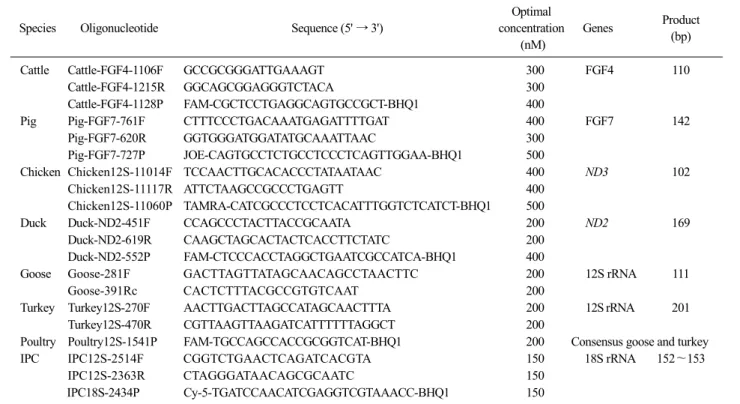
1.8)을 사용하였다. 소, 돼지, 닭, 오리 그리고 칠면조의 특이적인 primer와 probe는 Table 1과 같이 설계하였고, Bioneer (Korea)에 의뢰하여 합성하였다.
IPC primer는 Koh 등(2011)이 제시하였던 IPC12S- 2514F와 IPC12S-2363R을 사용하였으며, probe는 소 등 11개 동물 종의 공통부위를 선정하여 직접 설계하였다.
Table 1. Sequences of the oligonucleotide primers and probes used in the species-specific real-time PCR assays
Species Oligonucleotide Sequence (5' → 3')
Optimal concentration
(nM)
Genes Product (bp)
Cattle Cattle-FGF4-1106F GCCGCGGGATTGAAAGT 300 FGF4 110
Cattle-FGF4-1215R GGCAGCGGAGGGTCTACA 300
Cattle-FGF4-1128P FAM-CGCTCCTGAGGCAGTGCCGCT-BHQ1 400
Pig Pig-FGF7-761F CTTTCCCTGACAAATGAGATTTTGAT 400 FGF7 142
Pig-FGF7-620R GGTGGGATGGATATGCAAATTAAC 300
Pig-FGF7-727P JOE-CAGTGCCTCTGCCTCCCTCAGTTGGAA-BHQ1 500
Chicken Chicken12S-11014F TCCAACTTGCACACCCTATAATAAC 400 ND3 102
Chicken12S-11117R ATTCTAAGCCGCCCTGAGTT 400
Chicken12S-11060P TAMRA-CATCGCCCTCCTCACATTTGGTCTCATCT-BHQ1 500
Duck Duck-ND2-451F CCAGCCCTACTTACCGCAATA 200 ND2 169
Duck-ND2-619R CAAGCTAGCACTACTCACCTTCTATC 200
Duck-ND2-552P FAM-CTCCCACCTAGGCTGAATCGCCATCA-BHQ1 400
Goose Goose-281F GACTTAGTTATAGCAACAGCCTAACTTC 200 12S rRNA 111
Goose-391Rc CACTCTTTACGCCGTGTCAAT 200
Turkey Turkey12S-270F AACTTGACTTAGCCATAGCAACTTTA 200 12S rRNA 201
Turkey12S-470R CGTTAAGTTAAGATCATTTTTTAGGCT 200
Poultry Poultry12S-1541P FAM-TGCCAGCCACCGCGGTCAT-BHQ1 200 Consensus goose and turkey
IPC IPC12S-2514F CGGTCTGAACTCAGATCACGTA 150 18S rRNA 152∼153
IPC12S-2363R CTAGGGATAACAGCGCAATC 150
IPC18S-2434P Cy-5-TGATCCAACATCGAGGTCGTAAACC-BHQ1 150
그리고 거위 유전자 검출을 위한 primer도 Koh 등(2011) 이 제시하였던 primer를 사용하였다. 다만, Goose-391Rc 는 기존 primer (Goose-391R)에 의한 비특이 반응 제거 를 위해서 3' 말단에 있는 adenine을 제거하고 이번 실 험에 사용하였다.
동물 종별 특이적인 primer와 probe는 소 FGF4 (Gen- Bank accession no. AB633213), 돼지 FGF7 (GenBank ac- cession no. AF052657), 닭 ND3 (GenBank accession no.
X52392) 그리고 오리 ND2 (GenBank accession no. EU- 585672)의 정보를 기준으로 준비하였다. 거위와 칠면조 의 특이적인 primer는 12S rRNA 부위를 기준으로 준 비하였으며, GenBank accession number는 EU932689 와 EF153719이며, 이들 probe는 2개 축종의 공통부위 를 선정하여 설계하였다.
동물 종별 probe의 5' 말단에 표지된 형광물질은 소, 오리, 거위 그리고 칠면조에 6-carboxyfluoresin (FAM), 돼지에 6-carboxy-4',5'-dichloro-2',7'-dimethoxy-fluorescein (JOE), 닭에 6-carboxytetramethylrhodamine (TAMRA) 그 리고 IPC에 indodicarbocyanine (Cy-5)이며, 모든 probe의 3' 말단에는 black hole quencher (BHQ1)를 표지하였다.
Real-time PCR 반응 조건
Real-time PCR을 위한 소 primer는 300 nM, probe는
400 nM 되도록 첨가하였으며, 나머지 다른 동물 종 의 적정 농도는 Table 1에 기술하였다. Real-time PCR 반응액은 Premix Ex Taq (2×, Perfect Real time, Takara, Japan)과 ROX (50×, Takara, Japan), 11개 동물 종에 대 한 특이성 검사를 위한 주형 DNA는 2 μl를 첨가하였 고, 검출한계 실험을 위한 주형 DNA는 1 μl를 첨가하였 고, 총 반응액은 20 μl로 하였다. IPC primer와 probe는 Table 1과 같이 150 nM이 되도록 첨가하여 실험하였다.
유전자 증폭기는 7500 FAST Real-time PCR system (Applied Biosystems, USA)을 사용하여 95oC에서 1분간 1회 pre-denaturation 실시한 후, 95oC에서 15초, 55oC에 서 1분 주기를 40회 반복하였다. 증폭결과는 7500 soft- ware (Ver. 2.0.5, Applied Biosystems, USA) 프로그램 을 이용해 확인하였다.
결 과
혈액 또는 원료육의 동물 종별 특이도
11개 동물 종(소, 면양, 산양, 말, 돼지, 개, 고양이, 닭, 오리, 거위, 칠면조)을 대상으로 소, 돼지 그리고 4종 가금류의 real-time PCR에 대한 특이도를 조사하 였다. 소, 돼지, 닭, 오리, 거위 그리고 칠면조에 대한
Table 2. The CT values of specificity and sensitivity tests obtained with the species specific primer-probe sets
Species DNA
concentration (ng/μl)
Cattle Pig Chicken Duck Goose Turkey
FGF4 IPC FGF7 IPC ND3 IPC ND2 IPC 12S
rRNA IPC 12S rRNA IPC Target species 10 30.73 18.73 28.31 19.65 20.56 19.37 18.96 17.71 19.34 19.26 23.26 23.45
1 34.47 22.32 32.00 23.16 23.93 22.85 24.41 22.95 23.36 23.18 26.65 26.75 0.1 37.71 25.47 35.86 26.36 27.28 26.17 27.97 26.43 26.99 26.68 30.45 30.35 0.01 -* 28.66 38.10 30.45 30.92 29.41 32.58 30.82 30.33 28.66 34.16 33.20 0.001 - 32.15 - 33.68 35.25 32.84 35.70 33.88 33.65 33.31 36.26 36.24
0.0001 - 35.40 - 37.67 - 36.59 38.70 36.46 36.79 35.52 - -
0.00001 - 38.86 - 38.39 - - - 37.26 - -
Cattle 100 27.33 15.61 - 14.26 - 16.48 - 16.05 - 16.04 - 16.03
Sheep 5 - 19.92 - 18.53 - 20.12 - 19.53 - 20.85 - 24.48
Goat 15 - 18.94 - 17.23 - 18.48 - 22.13 - 18.02 - 18.23
Horse 10 - 18.92 - 17.54 - 19.14 - 23.23 - 19.07 - 19.29
Pig 50 - 18.18 25.82 18.14 - 17.12 - 16.98 - 16.59 - 16.64
Dog 1 - 22.24 - 20.82 - 22.07 - 22.13 - 18.02 - 18.23
Cat 2 - 17.11 - 19.83 - 21.41 - 20.83 - 22.11 - 25.74
Chicken 100 - 15.72 - 14.62 16.94 15.88 - 15.23 - 16.96 - 20.73
Duck 100 - 15.81 - 14.79 - 15.89 15.69 15.18 - 16.64 - 20.25
Goose 100 - 15.86 - 14.84 - 16.71 - 15.68 16.19 16.71 - 20.76
Turkey 100 - 15.34 - 14.29 - 20.31 - 15.75 - 16.47 19.98 20.31
*No amplification. The CT values were as follow: above 38.0 (cattle), 37.0 (pig, chicken, duck) and 36.0 (IPC) were considered as negative.
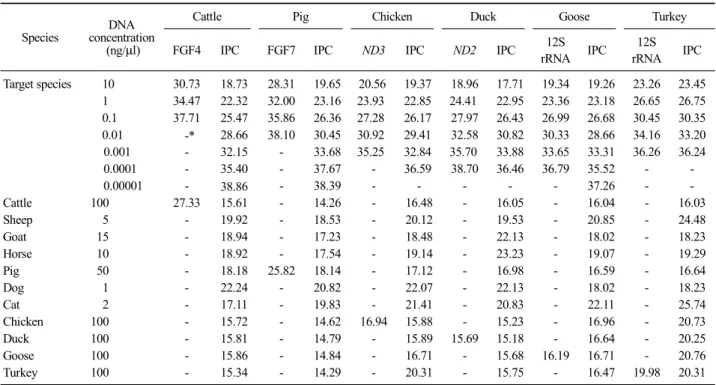
축종별 특이적인 real-time PCR에서 다른 동물 종과 교차반응없이 해당 동물 종에서만 유전자가 검출되 었으며, 해당 동물 종의 cycle threshold (CT) 값은 각 각 소 27.33, 돼지 25.82, 닭 16.94, 오리 15.69, 거위 16.19 그리고 칠면조 19.98이었다(Table 2). 동시에 모 든 동물 종에 대한 IPC real-time PCR에서 해당 유전 자가 모두 검출되었으며, 모든 동물 종에 대한 IPC의 CT 값 범위는 14.26∼25.74이었다(Table 2).
혈액 또는 원료육의 동물 종별 검출한계
동물 종별 real-time PCR에 대한 검출한계는 Table 2 와 같았다. 즉, 핵내 유전자인 FGF에 대한 검출한계 는 소와 돼지에서 0.1 ng/μl이었으며, CT 값은 37.71과 35.86이었다. 닭 ND3, 오리 ND2 및 칠면조 12S rRNA 유전자의 검출한계는 1.0 pg/μl이었으며, CT 값은 35.25, 35.70 및 36.26이었다. 거위 12S rRNA 유전자 의 검출한계는 0.1 pg/μl이었으며, CT 값은 36.79이었 다. IPC의 검출한계는 1.0 pg/μl∼10.0 fg/μl 범위였다.
Fig. 1은 닭의 ND3와 IPC 유전자에 대한 검출한계 실 험결과로 각각 1.0 pg/μl과 0.1/μl까지 증폭곡선이 확 인되었다.
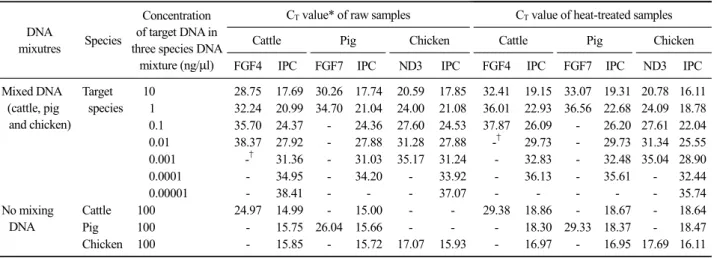
원료육의 소, 돼지 그리고 닭고기에서 추출한 DNA를
혼합한 후 10배 계단 희석하여 실험한 검출한계 결과는 Table 3에 기술하였다. 축종별 검출한계는 각각 소 FGF4 유전자 0.1 ng/μl (CT 35.70), 돼지 FGF7 유전자 1.0 ng/μl (CT 34.70) 그리고 닭 ND3 유전자 1.0 pg/μl
(CT 35.17)이었다.
소, 돼지, 닭 열처리육에 대한 검출한계
열처리육에 대한 축종별 검출한계는 각각 소 FGF4 유전자 0.1 ng/μl (CT 37.87), 돼지 FGF7 유전자 1 ng/μl (CT 36.56), 그리고 닭 ND3 유전자 1.0 pg/μl (CT
35.04)이었다(Table 3). IPC의 검출한계는 0.1 pg/μl∼
10.0 fg/μl 범위였다.
소, 돼지, 닭, 오리고기에 대한 유용성 평가
소, 돼지 그리고 닭에 특이적인 real-time PCR의 유 용성 검사를 위해 소고기 37건, 돼지고기 30건, 닭고 기 31건 그리고 오리고기 21건을 실험한 결과 소, 돼 지 및 닭의 종 특이적인 real-time PCR은 해당 동물 종 이외의 다른 시료에서는 증폭이 관찰되지 않았다.
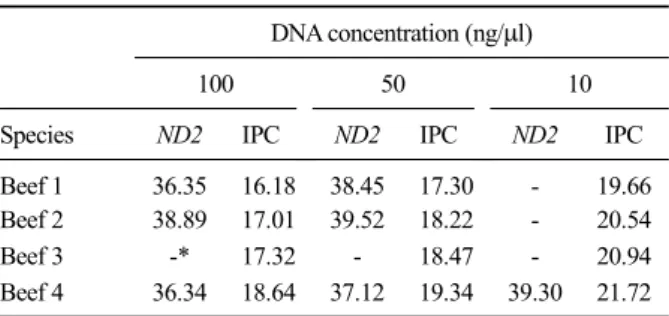
그러나 오리의 특이적인 real-time PCR 실험결과 4건 의 소고기에서 교차반응이 관찰되었다(Table 4). IPC
Table 3. Detection limit for DNA mixtures extracted from raw and heat-treated cattle, pig and chicken
DNA
mixutres Species
Concentration of target DNA in three species DNA
mixture (ng/μl)
CT value* of raw samples CT value of heat-treated samples
Cattle Pig Chicken Cattle Pig Chicken
FGF4 IPC FGF7 IPC ND3 IPC FGF4 IPC FGF7 IPC ND3 IPC
Mixed DNA (cattle, pig and chicken)
Target species
10 28.75 17.69 30.26 17.74 20.59 17.85 32.41 19.15 33.07 19.31 20.78 16.11 1 32.24 20.99 34.70 21.04 24.00 21.08 36.01 22.93 36.56 22.68 24.09 18.78 0.1 35.70 24.37 - 24.36 27.60 24.53 37.87 26.09 - 26.20 27.61 22.04 0.01 38.37 27.92 - 27.88 31.28 27.88 -† 29.73 - 29.73 31.34 25.55 0.001 -† 31.36 - 31.03 35.17 31.24 - 32.83 - 32.48 35.04 28.90
0.0001 - 34.95 - 34.20 - 33.92 - 36.13 - 35.61 - 32.44
0.00001 - 38.41 - - - 37.07 - - - 35.74
No mixing DNA
Cattle 100 24.97 14.99 - 15.00 - - 29.38 18.86 - 18.67 - 18.64
Pig 100 - 15.75 26.04 15.66 - - - 18.30 29.33 18.37 - 18.47
Chicken 100 - 15.85 - 15.72 17.07 15.93 - 16.97 - 16.95 17.69 16.11
*The CT values were as follow: above 38.0 (cattle), 37.0 (pig, chicken) and 36.0 (IPC) were considered as negative. †No amplification.
Fig. 1. Sensitivity of the real-time PCR assays based on the 10-fold dilution series of chicken from 10 ng/μl to 0.1 pg/μl. The detection limit was 1 pg per PCR reaction for chicken and IPC. Lanes 1) 10 ng/μl; 2) 1 ng/μl; 3) 0.1 ng/μl; 4) 0.01 ng/μl; 5) 1 pg/μl; 6) 0.1 pg/μl.
는 모든 시료에서 증폭이 확인되었다.
오리의 특이적인 real-time PCR에서 교차반응이 나 타난 소고기 4건에 대한 DNA 농도별 실험결과 cut-off 값을 37.0 이하를 양성으로 설정할 경우 100 ng에서 시료 2건의 CT 값이 36.34와 36.35로 교차반 응이 관찰되었지만, 50 ng과 10 ng일 때는 4건 모두 에서 교차반응이 관찰되지 않았다(Table 5).
원료육, 열처리육의 검출한계 실험과 유용성 평가 결과에 따라 cut-off 값은 소는 38.0 cycle 이하이며, 돼지, 닭 그리고 오리의 cut-off 값은 37.0 cycle 이하, IPC의 cut-off 값은 36.0 cycle 이하를 양성으로 판정 하였다.
고 찰
mtDNA는 핵 내 DNA보다 세포당 수천 개의 copy number가 있기 때문에 주로 육가공품에 사용된 원료육 의 감별을 위한 PCR법에 사용되는데(Bottero와 Dal- masso, 2011), 일반적으로 ND2 (Kesmen 등, 2012), ND5 (Kesmen 등, 2009), cytochrome b (Cammà 등, 2012; Dooley 등, 2004; Jonker 등, 2008; Tanabe 등, 2007), 12S rRNA (Koh 등, 2011; Martín 등, 2009) 그 리고 D-loop (Montiel-Sosa 등, 2000) 유전자가 동물 종 감별에 사용되고 있다. 이번 연구에서 원료육과 열처리 식육에 사용된 동물 종을 특이적이고 신속하 게 동정하기 위해서 TaqManⓇ probe을 이용한 re- al-time PCR법으로 핵 내에 존재하는 FGF 유전자와 mtDNA에 존재하는 ND2, ND3 및 12S rRNA 부위를 이용하여 소, 돼지 그리고 4종의 가금류를 감별하였 다. 이번 연구에서 핵 내 DNA를 이용한 소와 돼지의 검출한계보다 mtDNA를 이용한 가금류의 검출한계가 10∼100배 정도 민감도가 우수하였다. mtDNA의 검 출한계는 Jonker 등(2008)에 의해서 검출된 결과보다 대등하거나 우수하였지만, 다른 연구자들의 실험결과 보다는 민감도가 우수하지 않았다(Cammà 등, 2012;
López-Andreo 등, 2005; Tanabe 등, 2007).
이번 연구에서 오리의 특이적인 real-time PCR에서 소 고기의 DNA 농도가 100 ng 이상의 일부 시료에서 교차 반응이 관찰되었지만, 50 ng과 10 ng으로 희석된 시료 에서는 교차반응이 관찰되지 않았다. López-Andreo 등 (2005)의 결과에 따르면 real-time PCR법에서 DNA 농 도가 60 ng 이상이면 다른 동물 종에서 일부 형광신
Table 5. Cross-reaction of the real-time PCR using duck- specific detectors
DNA concentration (ng/μl)
100 50 10
Species ND2 IPC ND2 IPC ND2 IPC
Beef 1 36.35 16.18 38.45 17.30 - 19.66 Beef 2 38.89 17.01 39.52 18.22 - 20.54
Beef 3 -* 17.32 - 18.47 - 20.94
Beef 4 36.34 18.64 37.12 19.34 39.30 21.72
*No amplification. CT value of above 37.0 was considered as negative.
Table 4. Real-time PCR results for raw meat samples (beef, pork, chicken and duck)
PCR system Species
No. of positive samples Cattle Pig Chicken Duck
Beef (n=37) 37 - - 4
Pork (n=30) -* 30 - -
Chicken (n=31) - - 31 -
Duck (n=21) - - - 21
*No amplification. All meat samples were positive for IPC PCR system.
호가 검출되었다. Dooley 등(2004)은 200 ng 이상의 DNA를 사용하면 PCR 반응이 저해되기 때문에 tem- plate DNA는 50 ng으로, 증폭횟수는 30 cycle로 제한 하였고, Jonker 등(2008)은 template DNA가 125 ng 이 상일 경우 교차반응이 관찰될 수 있지만, 실제 식육 가공품에서 이 정도의 고농도 DNA가 포함되어 있지 않기 때문에 문제가 되지 않는 것으로 보고하였다.
따라서 이번 연구결과에 따라 동물 종 감별을 위한 DNA 농도는 10 ng 수준에서 실험하는 것을 권장한 다. 비록 이번 연구에서 동물 종 감별을 위해서 40 cycle을 표준으로 적용하였지만, 소고기나 돼지고기 에 저가의 육류인 닭고기가 0.1% 이상 혼입되더라도 Table 3에 근거하여 원료육과 가열 처리육의 CT 값이 각각 31.28과 31.34 이하이기 때문에 증폭횟수를 35 회로 제한하여도 실험결과에 미치는 영향은 크지 않 으리라고 생각한다.
Cammà 등(2012)과 Tanabe 등(2007)은 mtDNA 부위 를 TaqManⓇ probe로 사용한 소, 돼지 및 닭고기 등의 동정 실험에서 다른 시료와 교차반응이 없이 해당 동물 종을 감별하였고, 이러한 결과는 이번 연구에서도 유사 하였다. Walker 등(2003)이 기술한 SYBRⓇ Green을 이 용한 real-time PCR에서 소에 특이적인 primer가 토끼와 개에서 그리고 돼지의 특이적인 primer는 거위와 토끼에 서 교차반응이 검출된다고 보고하였다. López-Andreo 등(2006)은 mtDNA 또는 satellite DNA와 repetitive ele- ment와 같이 핵 내에 존재하는 multi-copy DNA 염기서 열 부위를 이용하여 다른 동물 종과 교차반응없이 동 물 종을 감별하였다.
따라서 근연종이나 다양한 동물 종 감별에 있어서 re- al-time PCR법은 특이도과 민감도가 모두 우수한 기법 이지만, 특이도는 일차적으로 primer와 probe에 의해서 결정되며, 여러 동물 종에 대해서도 반드시 교차반응 검 사를 수행하여야 한다(Kesmen 등, 2009). 이번 연구의
유용성 평가결과와 특이성 실험결과 소, 돼지, 닭의 pri- mer와 probe는 11종의 동물에 대해서 교차반응이 없는 것으로 확인되었다. 다만 오리의 primer와 probe는 소고 기의 DNA에서 교차반응이 관찰되었지만 적정한 수준 의 농도로 희석된 양을 사용하다면 교차반응은 관찰되 지 않을 것이다. 거위와 칠면조에 대한 primer와 probe 는 오리와 마찬가지로 교차반응이 나타날 수 있기 때문 에 추가적인 유용성 평가가 필요하다.
또한, 이번 연구에서 121oC에서 5분간 열처리된 소, 돼지 그리고 닭고기에서 추출된 3종의 DNA 혼합물 의 검출한계는 mtDNA를 사용한 닭의 경우만 1.0 pg 으로 Cammà 등(2012)이 보고한 5.0 pg보다 우수하였 지만, 소와 돼지는 핵 내 DNA를 검출부위로 사용하 였기 때문에 검출한계가 다른 연구자의 결과보다 민 감하지 못했다. 원료육의 단일 DNA와 3종 동물의 혼 합 DNA 그리고 열처리된 식육의 혼합 DNA의 검출 한계는 소와 닭고기는 각각 0.1 ng/μl과 1.0 pg/μl으로 동일하였지만, 돼지의 경우 혼합된 시료에서 검출한 계는 10배 정도 민감도가 좋지 않았다.
이번 연구에서 소와 돼지는 핵 내 유전자인 FGF 유전자를 사용하였기 때문에 18S rRNA와 mtDNA 유 전자의 CT 값보다 높았으며, FGF 유전자와 mtDNA의 CT 값 차이는 약 10.0 이상으로 DNA 양은 약 1,024배 이상 차이를 보였다. 이러한 결과는 표적 유전자와 IPC 유전자의 copy 수의 차이에 의한 것으로 생각한다 (López-Andreo 등, 2005).
이와 같이 이번 연구에서 종 특이적인 real-time PCR법을 개발하여 적용한 바, 다른 동물 종에 대해서는 교차반응 없이 해당 동물 종의 유전자와 IPC를 동시에 증폭하여 DNA의 존재여부를 확인할 수 있었다. 이러한 결과는 동일 tube 내에서 IPC를 동시에 증폭하는 Cammà 등(2012)과 Laube 등(2007)의 방법과 유사하였다.
결론적으로 이번 연구에서 개발된 종 특이적인 pri- mer/probe를 이용한 real-time PCR은 원료육과 가열된 식육가공품의 표시사항 오류나 부적절한 다른 식육의 혼입을 검사하는데 상당히 유용하고 신뢰할 만한 방법으로 판단된다. 향후 좀 더 많은 시료를 대상으로 유용성에 대한 추가적인 평가가 있어야 할 것으로 생각한다.
결 론
이번 연구에서 식육 및 육가공품 중 소, 돼지, 닭, 오 리, 거위 그리고 칠면조 고기 감별을 위하여 종 특이적 인 primer와 probe를 사용한 real-time PCR법을 개발하 여 11종의 동물(소, 면양, 산양, 말, 돼지, 개, 고양이, 닭, 오리, 거위 그리고 칠면조)에 적용한 바, 교차반응없이 해당 동물 종에서만 유전자와 11개 동물 종에 대한 18S rRNA 유전자가 모두 검출되었다. 종 특이적인 re- al-time의 검출한계는 소와 돼지에서 0.1 ng/μl, 닭과 칠면조에서 1.0 pg/μl 그리고 오리와 거위에서 0.1 pg/μl이었다. 그리고 121oC에서 5분간 열처리된 소, 돼지 그리고 닭고기에서 추출된 3종 DNA 혼합물의 검출한계는 각각 소 0.1 ng/μl, 돼지 1.0 ng/μl 그리고 닭 1.0 pg/μl이었다. 오리의 특이적인 real-time PCR에 대한 유용성 평가결과 소고기의 DNA 농도가 50.0 ng 이하인 경우에 교차반응이 관찰되지 않았다.
감사의 글
이번 연구는 광주광역시보건환경연구원의 2009년 도 연구사업 지원으로 수행되었습니다.
참 고 문 헌
Ashoor SH, Osman MA. 1988. Liquid chromatographic quanti- tation of chicken and turkey in unheated chicken-tur- key mixtures. J Assoc Off Anal Chem 71: 403-405.
Ballin NZ. 2010. Authentication of meat and meat products. Meat Science 86: 577-587.
Bottero MT, Dalmasso A. 2011. Animal species identification in food products: evolution of biomolecular methods.
Vet J 190: 34-38.
Cammà C, Domenico MD, Monaco F. 2012. Development and validation of fast Real-Time PCR assays for species
identification in raw and cooked meat mixtures. Food Control 23: 400-404.
Crockett AO, Wittwer CT. 2001. Fluorescein-labeled oligonucleo- tides for real-time PCR: using the inherent quenching of deoxyguanosine nucleotides. Anal Biochem 290: 89-97.
Dooley JJ, Paine KE, Garrett SD, Brown HM. 2004. Detection of meat species using TaqMan real-time PCR assays. Meat Sci 68: 431-438.
Jonker KM, Tilburg JJ, Hägelea GH, de Boer E. 2008. Species identification in meat products using real-time PCR.
Food Addit Contam Part A Chem Anal Control Expo Risk Assess 25: 527-533.
Kesmen Z, Gulluce A, Sahin F, Yetim H. 2009. Identification of meat species by TaqMan-based real-time PCR assay.
Meat Science 82: 444-449.
Kesmen Z, Yetim AE, Sahin F, Yetim H. 2012. Detection of chicken and turkey meat in met mixtures by using re- al-time PCR assays. J Food Sci 77: C167-173.
Klein D. 2002. Quantification using real-time PCR technology:
applications and limitations. Trends Mol Med 8: 257- 260.
Koh BRD, Kim JY, Na HM, Park SD, Kim YH. 2011.
Development of species-specific multiplex PCR assays of mitochondrial 12S rRNA and 16S rRNA for the identification of animal species. Korean J Vet Serv 34:
297-301.
Laube I, Zagon J, Spiegelberg A, Butschke A, Kroh LW, Broll H. 2007. Development and design of a ‘ready-to-use’
reaction plate for a PCR-based simultaneous detection of animal species used in foods. Food Sci Technol Int 42: 9-17.
López-Andreo M, Garrido-Pertierra A, Puyet A. 2006. Evalua- tion of post-polymerase chain reaction melting temper- ature analysis for meat species identification in mixed DNA samples. Agric Food Chem 54: 7973-7978.
López-Andreo M, Lugo L, Garrido-Pertierra A, Prieto MI, Puyet A. 2005. Identification and quantitation of spe- cies in complex DNA mixtures by real-time polymer- ase chain reaction. Anal Biochem 339: 73-82.
Martín I, García T, Fajardo V, Rojas M, Pegels N, Hernández PE, Martín IG. 2009. SYBR-Green real-time PCR ap- proach for the detection and quantification of pig DNA in feedstuffs. Meat Sci 82: 252-259.
Montiel-Sosa JF, Ruiz-Pesini E, Montoya J, Roncalés P, López-Pérez MJ, Pérez-Martos A. 2000. Direct and highly species-specific detection of pork meat and fat in meat products by PCR amplification of mitochon- drial DNA. J Agric Food Chem 48: 2829-2832.
Park YC, Ahn CY, Jin SO, Lim JY, Kim KH, Lee JH, Cho TY, Lee HJ, Park KS, Yoon HS. 2012. Identification of raw materials in processed meat products by PCR using spe- cies-specific primer. J Fd Hyg Safety 27: 68-73.
Rastogi G, Dharne MS, Walujkar S, Kumar A, Patole MS, Shouche YS. 2007. Species identification and authentica- tion of tissues of animal origin using mitochondrial and
nuclear markers. Meat Science 76: 666-674.
Tanabe S, Hase M, Yano T, Sato M, Fujimura T, Akiyama H.
2007. A real-time quantitative PCR detection method for pork, chicken, beef, mutton, and horseflesh in foods. Biosci Biotechnol Biochem 71: 3131-3135.
Walker JA, Hughes DA, Anders BA, Shewale J, Sinha SK, Batzer MA. 2003. Quantitative intra-short interspersed element PCR for species-specific DNA identification.
Anal Biochem 316: 259-269.