Production of gamma-Aminobutyric Acid (GABA) by Lactobacillus plantarum subsp. plantarum B-134 Isolated from Makgeolli, Traditional Korean Rice Wine
Hyun-Ju Lee1, Jae-Young Son1, Sang-Jae Lee1, Han-Seung Lee1, Bae-Jin Lee3, In-Soon Choi2 and Jae Hak Sohn1*
1Major in Food Biotechnology, Division of Bioindustry, College of Medical & Life Sciences, Silla University, Busan 46958, Korea
2Department of Bioscience, College of Medical & Life Sciences, Silla University, Busan 46958, Korea
3Marine Bioprocess Co., Ltd., Busan 46048, Korea
Received September 30, 2016 /Revised May 8, 2017 /Accepted May 21, 2017
This study is to isolate and identify γ-amino butyric acid (GABA) producing lactic acid bacteria (LAB) from Makgeolii, traditional Korean rice wine and then establish the optimal culture conditions for GABA production. Sixty four LAB from Makgeolli were isolated according to the characteristics of the shape and color of the colony grown on MRS agar plate. The GABA production of the isolated strain cultured in MRS broth contained 1% MSG (mono-sodium glutamate) were determined and evaluated by TLC and HPLC analysis. Strain B-134 was selected for highest GABA production. From the analy- sis of 16S rRNA and glutamate decarboxylase B (gadB) gene sequences, strain B-134 was tentatively identified as a Lactobacillus plantarum subsp. plantarum B-134. Effects of culture parameters, including glutamic acid level, culture temperature, NaCl level, and pH on GABA production were investigated for culture optimization. The optimum culture condition for GABA production by B-134 were culture temperature of 37℃, pH of 5.7, NaCl content of 0% (w/v) and MSG content of 3% (w/v), which pro- duced 25 mM of GABA during cultivation time of 48 hr. From these results, strain B-134 is expected to be utilized as useful microorganisms for GABA-enriched health beneficial food.
Key words : Gamma-aminobutyric acid (GABA), Lactobacillus plantarum subsp. plantarum, Makgeolli, lactic acid bacteria, mono-sodium glutamate
*Corresponding author
*Tel : +82-51-999-5629, Fax : +82-51-999-5458
*E-mail : [email protected]
This is an Open-Access article distributed under the terms of the Creative Commons Attribution Non-Commercial License (http://creativecommons.org/licenses/by-nc/3.0) which permits unrestricted non-commercial use, distribution, and reproduction in any medium, provided the original work is properly cited.
Journal of Life Science 2017 Vol. 27. No. 5. 567~574 DOI : https://doi.org/10.5352/JLS.2017.27.5.567
서 론
γ-amino butyric acid (GABA)는 자연계인 미생물, 식물 및 동물에 널리 분포하는 비단백질 아미노산이다[4, 6, 9, 11, 39, 49]. GABA는 glutamate decarboxylase (GAD)의 촉매작용에 의해 L-glutamic acid에서 GABA로 탈탄산화에 의해 생합성 된다[32, 35]. GAD (gadA와 gadB encoding gene)와 gluta- mate:GABA antiporter (gadC encoding gene)로 구성된 세포 내재 GAD system은 GABA 생산을 담당한다. 즉, glutamate 는 antiporter에 의해 세포내로 유입되고 세포내재 GAD의 탈 탄산화에 의해 GABA가 생산된다. 결과적으로 생산된 GABA 는 antiporter를 통하여 세포로부터 배출된다[3].
GABA를 생산하는 미생물들 중 흥미롭고 특이한 것은 고농 도의 GABA를 생산하는 대부분이 유산균이라는 사실이다. 이 러한 유산균의 분리원은 주로 발효식품들인데 국내의 경우
김치[26, 34, 40], 젓갈[16], 막걸리[21] 등으로부터 국외의 경우 요구르트와 치즈[29, 33, 36, 44], sourdough [38], paocai [25], 발효스시[18] 등으로부터 분리되었다. GABA를 생산하는 세 균속은 Lactobacillus, Lactococcus, Weissella, Leuconostocs, Streptococcus, Enterococcus, Streptomyces 등이 보고되었으며 Lactobacillus 속의 종이 높은 비율을 차지하고 있다. 또한 진균 속은 Rizopus, Monascus, Neurospora, Aspergillus 등에서 GABA 생산이 보고되었다[9].
최근에는 glutamate 생산균주인 Corynebacterium gluta- micum과 GABA생산 유산균의 혼합배양을 통한 two-step [52]
그리고 C. glutamicum내로 GAD 유전자를 도입하여 gluta- mate의 추가적인 첨가 없이 one-step으로 포도당으로부터 GABA를 직접 생산하는 연구가 활발히 진행되고 있다[42, 47].
GABA는 포유동물의 뇌와 척수에 존재하는 중추신경계의 억제성 신경전달물질로 뇌 혈류를 개선하여 산소공급을 증가 시켜 뇌의 대사기능을 촉진시켜 신경 안정작용을 하는 것으로 알려져 있다[19]. 또한 연수의 혈관중추에 작용하여 바소프레 신의 분비를 억제시키고, 혈관을 확장시켜 항고혈압 작용을 하고, 이 외에도 이뇨효과, 항당뇨, 불안증세 완화, 우울증 완 화, 기억력과 학습능력향상 등과 같은 여러 생리활성이 보고 되고 있다[1, 14, 28, 30, 50, 54]. 때문에 GABA 성분을 함유한 gammalone, 치즈, gabalon tea 및 shochu 등의 건강기능성에
대한 연구가 진행되고 있다[9].
식품이나 기능성식품, 의약품 등에 GABA의 이용 가치를 높이기 위한 균주의 개량과 발효공정개발이 활발히 진행되고 있다. 또한 GABA를 생성하는 유산균을 이용하여 발효식품인 포도주, 간장, sufu, 식초, 증류주, 발효야채, 육제품, 막걸리, paocai, 피클, 김치 및 젓갈 등에 기능성을 강화하고 상품가치 를 높이기 위한 노력을 경주하고 있다[12, 13, 15, 17, 25, 29, 41, 45, 48].
전통주인 막걸리는 전분질을 다량 포함하고 있는 곡물에 물을 배합하여 고두밥을 만든 후 자연적으로 미생물이 번식된 누룩과 효모를 첨가하여 발효시켜 제조된다. 막걸리는 당질, 비타민 B군 및 단백질을 함유하고 있고 누룩의 protease에 의 한 다양한 종류의 유리아미노산을 생성하여 맛의 품질에 영향 을 미친다[51]. 막걸리의 발효과정 중 효모 외에 다양한 종의 유산균은 RFLP법에 의해 확인되었으며 이중 L. plantarum, L.
casei 및 L. brevis로부터 GABA 생성을 확인한 바 있다[21].
본 연구에서는 우리나라 전통주인 막걸리로부터 유산균을 분리하여 GABA 생성능력을 조사하였으며 선발된 GABA생 성 우수균주의 동정 및 GABA 생산을 위한 최적배양조건을 연구하여 그 결과를 보고하고 자 한다.
재료 및 방법
유산균의 분리
막걸리유래 유산균의 분리를 위한 시료는 시중에서 판매되 고 있는 12종의 막걸리를 구입하여 사용하였다. 각 시료는 멸 균생리식염수(0.85% NaCl)를 이용하여 연속희석한 후 bro- mocresol purple이 첨가된 BCP (glucose 1.0 g, L-cystein 0.1 g, peptone 5.0 g, tween 80 1.0 g, yeast extract 2.5 g, bromoc- resol purple 0.1%, agar 15.0 g, distilled water 1 l) 한천배지에 도말하여 30℃에서 48시간 배양하였다. 유산균의 분리는 성장 된 균체주위에 purple 색이 없는 균체를 형태학적 특성에 따라 무작위로 선발하여 Lactobacilli MRS 배지(MRS, Difco, USA)를 이용하여 순수분리 하였다. 순수 배양체는 10% glycerol (v/v) 용액에 부유하여 -70℃에 보존하였다.
GABA 생산 균주의 탐색
막걸리로부터 분리된 유산균으로부터 GABA 전환능력은 다음과 같이 수행하였다. 분리균주의 전배양은 MRS 액체배지 에서 한 백금이를 접종하여 30℃에서 24시간 배양하였다. 이 후 전배양액은 1% (w/v) mono-sodium glutamate (MSG, Sigma, USA)가 첨가된 MRS 액체배지에 1%를 접종하여 30℃
에서 48시간 진탕배양(150 rpm)하였다. 각 배양액은 원심분리 (4℃, 15,000 rpm, 10분)를 통하여 상등액을 회수한 후 thin layer chromatography (TLC) 및 HPLC 분석방법에 의하여 GABA 생산을 확인하였다.
분류동정
GABA 생산균주는 MRS agar plate에 도말하여 24시간 배 양한 후 형태학적 특성을 비교하였으며 Analytical Profile Index (API) 50 CHL kit와 16S rRNA sequencing을 통하여 분류학적 및 유전학적 특성을 동정하였다. 생화학적 특성은 API 50 CHL kit에서 제시된 실험지침서에 의해 분석하였다.
16S rRNA의 염기서열결정은 Lee 등[24]의 방법에 따라 염기 서열을 결정한 후 계통분석을 수행하였다. 또한 GAD 염기서 열분석은 Shin 등[43]에 의해 기술된 방법에 의하여 염기서열 을 결정한 후 NCBI protein blast search를 통하여 분석하였다.
GABA 생성을 위한 최적조건
균주는 MRS agar plate에 도말하여 30℃에서 24시간 배양 하였다. 전배양액은 MRS 액체배지에 한 백금이를 접종하여 30℃에서 24시간 진탕배양(150 rpm)하였다. 각 실험에 사용한 전배양액은 A660에서 OD 1.0으로 조정한 후 10-1로 희석한 것 을 5% (v/v) 접종하였다.
GABA 생산을 위한 최적온도의 조사는 1% (w/v) MSG가 첨가된 MRS 액체배지에 전배양액을 접종한 후 25, 30 및 37℃
로 조절된 진탕배양기에서 배양하였다. GABA 생산을 위한 최적 pH 조사를 위한 배지는 완충용액(pH 4~5, acetate buf- fer; pH 6, citrate-phosphate buffer; pH 7, phosphate buffer;
pH 8, Tris-HCl buffer, [10])을 이용하여 pH를 조절하여 1%
(w/v) MSG가 첨가된 MRS 액체배지를 제조하여 전배양액을 접종한 후 30℃조절된 진탕배양기에서 배양하였다. GABA 생 산을 위한 최적 NaCl 농도의 조사는 0, 1, 2, 3% (w/v) NaCl 농도를 달리하여 1% (w/v) MSG가 첨가된 MRS 액체배지를 제조하여 전배양액을 접종한 후 30℃조절된 진탕배양기에서 배양하였다. GABA 생산을 위한 최적 MSG 농도의 조사는 0, 1, 2, 3, 5, 10% (w/v) MSG 농도를 달리하여 MRS 액체배지를 제조하였으며 전배양액을 접종한 후 30℃로 조절된 진탕배양 기에서 배양하였다. 최적 배양 조건에 따른 균주의 성장과 GABA 생산 조사를 위해 0% (w/v) NaCl, 3% (w/v) MSG, pH 5.7로 조절하여 MRS 액체배지를 제조하였으며 전배양을 접종한 후 37℃에서 진탕배양하였다. 배양기간 동안 배양액 일정량을 회수하여 흡광광도(A660), pH, MSG 및 GABA 함량 을 측정하였다.
GABA 분석
배양액의 글루탐산(glutamic acid) 및 GABA의 정성분석은 TLC 분석법에 의해 확인하였다[53]. 전개용매는 n-butyl alco- hol: acetic acid: distilled water (4:1:1, v/v/v)를 혼합하였고, 발색시약으로 0.2% ninhydrin을 사용하여 GABA spot을 확인 하였다.
글루탐산과 GABA 함량은 HPLC (Young-Lin Co. Korea)를 통해 측정하였다[23]. o-phthaldialdehyde (OPA) 용액(pH 9.3)
Table 1. Production of GABA by three candidate strain
No. Isolates GABA production (mM)
1 2 3
B-115 B-116 B-134
9.22 8.86 9.46
* Cultures conditions were fixed as follows: pH 6.6, temperature 37℃, and incubation time 48 hr, MSG concentration 1% (w/v).
Fig. 1. TLC profile of monosodium glutarmate (MSG) and γ- aminobutyric acid (GABA) from lactic acid bacteria cul- tured in MRS broth contained 1% (w/v) MSG at 30℃
for 48 hr (M : MSG standard 1 mg/ml, G : GABA stand- ard 1 mg/ml, 1 : MRS broth with 1% (w/v) MSG, 2 : strain B-115, 3: strain B-116, 4: strain B-134).
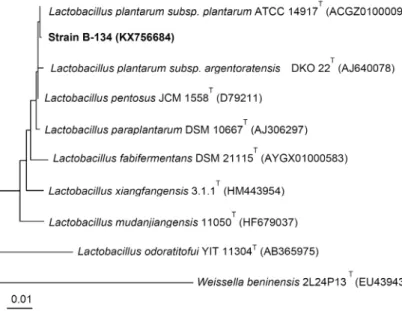
Fig. 2. Neighbour-joining tree showing the relation- ship of strain B-134 to other members of the genus Lactobacillus based on 16S rRNA gene sequences. The sequence of Weissella beni- nensis 2L24P13T (EU439435) was used as the out group. Bootstrap values ≥70% based on 1,000 resamplings are shown at nodes. Bar, 0.01 substitutions per nucleotide position.
은 5.0 ml의 methanolic OPA (2.56 g OPA, 50 ml methanol), 20 ml borate buffer (pH 9.9; 0.2 M boric acid: 0.2 M sodium hydroxide=50:50 (v/v))와 50 ul 2-mercaptoethanol을 섞어서 제조하였다. 제조한 OPA 용액 380 ul와 시료 120 ul를 충분히 섞고 8분간 상온에서 반응 후 유도체화된 시료 20 ul를 col-
umn에 주입하였다. HPLC column은 XTerra column (Waters: RP185 m, 4.6 mm × 150 mm)을 사용하였으며, flow rate는 1 ml/min로 하였고, 358 nm에서 측정하였다. 이동상으 로는 용매 A는 0.05 M sodium acetate (pH 7.2)를, 용매 B는 0.1 M sodium acetate, acetonitrile (HPLC grade) 그리고 methanol (HPLC grade)이 각각 46:44:10(v/v/v)으로 섞은 것 (pH 7.2)을 사용하였다. 이동상의 농도 구배는 분석 시작부터 30분 경과까지 용매 A를 100%로 하였고, 40분경과 후까지 용 매 B가 100%, 45분경과 후 까지는 다시 용매 A가 100%가 되게 하였다.
결과 및 고찰
균주의 분리 및 선별
시중에서 판매되고 있는 막걸리로부터 유산균은 BCP배지 를 이용하여 64균주를 분리하였다. 분리균을 대상으로 1%
MSG가 포함된 MRS 액체배지에서 48시간 배양한 후 TLC 방 법에 의해 분석한 결과 64균주 중 47균주에서 GABA생산을 확인하였으며 이중 GABA생산능력이 우수한 3균주를 후보균 주로 선발하였다(Fig. 1). 선발된 후보균주의 배양여액은 HPLC를 이용하여 GABA 함량을 분석한 결과 B-134 균주를 GABA생산 우수균주로 최종 선발하였다(Table 1). B-134 균주 는 형태학적으로 그람양성의 간균이며 API 50 CHL에 의한 동정결과 L. plantarum subsp. plantarum ATCC 14817 균주와 99.1%의 유사도를 나타내었다(자료 미제시). 또한 16S rRNA 염기서열에 기초한 계통분석결과 B-134균주는 L. plantarum subsp. plantarum ATCC 14817T (ACGZ01000098)과 99.93%의 유사도를 나타내었다(Fig. 2). GABA 전환능력을 갖는 B-134 균주의 유전체내에 glutamate decarboxylase (GAD) 유전자는 PCR 및 sequencing을 통하여 염기 및 아미노산서열(1334 bp, 443 a.a)을 결정하였으며 NCBI BLAST search를 통하여 유사
A
B
Time (hr)
Time (hr)
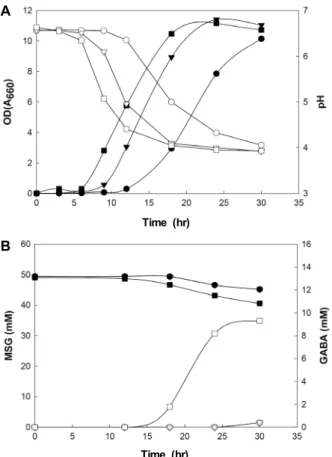
Fig. 3. Effects of temperature on the cell growth, pH (A), con- centration of MSG and GABA (B) of strain B-134 in MRS broth contained 1% MSG. Legends : A; Cell growth (25℃
●, 30℃ ▼, 37℃ ■), pH (25℃ ○, 30℃ ▽, 37℃ □), B;
MSG (25℃ ●, 30℃ ▼, 37℃ ■), GABA (25℃ ○, 30℃
▽, 37℃ □).
A
B
Time (hr)
Time (hr)
Fig. 4. Effects of pH on the cell growth, pH (A), concentration of MSG and GABA (B) of strain B-134 in MRS broth contained 1% MSG. Legends : A; Cell growth (pH 5.7
●, pH 6.1 ▼, pH 6.6 ■, 7.6 ◆), pH ( pH 5.7 ○, pH 6.1 ▽, pH 6.6 □, pH 7.6 ◇), B; MSG (pH 5.7 ●, pH 6.1 ▼, pH 6.6 ■, 7.6 ◆), GABA (pH 5.7 ○, pH 6.1 ▽, pH 6.6 □, pH 7.6 ◇).
성이 높은 균주를 대상으로 유사도 비교 및 계통분석을 수행 한 결과 B-134균주의 gadB는 L. plantarum subsp. plantarum ATCC 14917과 100% 일치하는 것을 확인하였다(자료미제시).
이러한 결과로부터 B-134균주는 L. plantarum subsp. planta- rum B-134로 명명하였다.
GABA 생산 유산균은 발효식품인 김치, 치즈, 젓갈, 미강 등을 대상으로 다양한 종들이 분리되었으며[9] 막걸리로부터 GABA 생산 유산균은 이 등(2015)에 의해 보고된바 있다[21].
기존 L. plantarum subsp. plantarum 으로부터 GABA 생성에 대한 보고는 확인되지 않았다. GABA 생산 유산균 중 L. plan- tarum은 가자미식혜 [31], 김치[20, 37], 미강[22], 치즈[7, 8, 44], 벌꿀[46], 막걸리[21]로부터 보고된 바 있다. L. plantarum은 가 장 흔히 발견되는 매우 다양한 아종을 갖고 있으며 분류학적 으로 큰 차이가 없는 경우에도 프로바이오틱스로서의 특징이 상이한 경우가 많다[2, 9].
GABA 생산을 위한 배양조건
분리한 B-134 균주로부터 GABA 생산을 위한 최적성장조
건을 확립하기 위한 변수는 온도, pH, NaCl 및 MSG 농도를 선정하여 조사하였으며 그 결과는 Fig. 3, 4, 5에 정리하였다.
B-134 균주의 GABA 생산을 위한 최적온도는 37℃로 결정되 었으며 GABA 함량은 24시간째에 8 mM로 나타났다(Fig. 3).
또한 최적 GABA 생산시 pH는 pH 6.8에서 24시간째에 pH 4.0으로 감소되었다. 기존 GABA 생산 유산균인 L. plantarum 의 최적온도에 대한 연구에서, 치즈로부터 분리된 L. planta- rum DSM19463은 30~36℃에서 최대 59 μM/h GABA를 생산 하였다[8]. 벌꿀에서 분리한 L. plantrum Taj-Apis 362의 경우 최적성장은 30℃에서 나타났으나 최적 GABA 생산은 37℃에 서 2.5 mM GABA로 나타났으며 37℃ 이하 및 이상의 온도에 서 GABA 생산은 감소하였음을 보고하였다[46]. 이러한 결과 들은 본 결과와 유사한 것으로 판단된다.
pH 변화에 따른 B-134 균주의 생장과 GABA 생산을 조사한 결과는 Fig. 4에 도식화하였다. B-134 균주는 pH 6.1과 6.7에서 최적성장을 보인 반면 GABA 함량은 pH 5.7에서 16시간째에 6.3 mM로 증가하기 시작하여 36시간까지 15 mM 수준으로
A
B
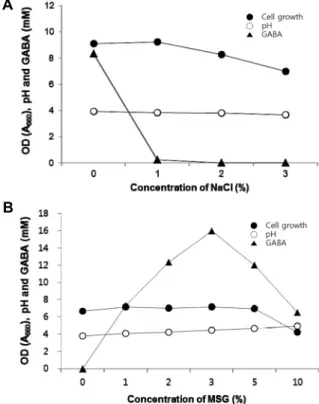
Fig. 5. Effect of initial NaCl (B) and glutamic acid (A) concen- tration on cell growth, pH and GABA production of strain B-134. Cultures conditions were fixed as follows:
A; pH 6.6, temperature 37℃, incubation time 30 hr, and MSG concentration 1% (w/v) B; pH 6.6, temperature 37
℃, and incubation time 48 hr.
Time (hr)
Fig. 6. Effect of incubation time on growth, pH, MSG contents and GABA production by strain B-134. Cultures con- ditions were fixed as follows: pH 5.7, temperature 37℃, incubation time 48 hr, and MSG concentration 3% (w/v).
도달하였다. 반면 pH 6.1로 조절된 배지에서 GABA 함량은 16시간까지 pH 5.7과 유사한 증가를 보였으나 이후 뚜렷하게 증가하지 않았다. 이는 GABA의 생산에 있어 미생물의 성장보 다는 배양배지의 pH가 GABA의 생산에 유의한 상관관계가 있는 것으로 판단된다. GAD의 생화학적 특성은 미생물 종에 의존하며 최적 pH는 4.0~8.0 범위로 알려져 있다[9]. GABA의 최적생산을 위해서는 확보된 균주의 pH 조건의 확립이 중요 한 변수중의 하나로 판단된다. Di Cagno [8]에 의해 보고된 L. plantarum은 pH 6.0에서 최대 4.8 mM의 GABA를 생산하였 으며 24시간째에 초기 pH 6에서 3.7까지 감소하였다고 보고하 였다. 또한 Tajabadi 등[46]에 의해 보고된 L. plantarum은 pH 5.5에서 최적성장을 하였으며 pH 5~5.5사이에서 최대 2.0 mM 의 GABA를 생산하였다고 보고하여 본 연구의 결과와 유사한 것으로 판단된다. 반면 L. paracasei NFRI 7415는 pH 5.0에서 최대인 210 mM의 GABA를 생산하였다[18]. L. brevis GABA 057는 pH 4.2에서 10%의 MSG를 GABA로 전환하였다[5]. 그 리고 L. lactis는 pH 7.5~8.0의 범위에서 최대 7.2 g/l의 GABA 를 생산하지만 pH 8 이상에서는 생산력이 감소하는 것으로 보고하였다[27].
가공된 해양소재를 배지성분으로 사용할 경우 염분이 GABA 생산에 어떠한 영향을 주는지 알아보기 위해, NaCl
농도를 0~3% (w/v)로 달리하였을 때 B-134 균주는 2% NaCl 농도에서 최적성장을 보였으나 GABA 생산은 NaCl이 첨가되 지 않은 0% NaCl 조건에서 8.3 mM로 최대 값을 보였다(Fig.
5A). 이러한 결과로부터 B-134 균주는 NaCl 농도가 증가함에 따라 GAD 효소의 활성이 억제되는 것으로 판단된다.
MSG 농도를 0~10%까지 달리하였을 때 B-134균주의 성장 과 GABA 전환을 조사하여 Fig. 5B에 도식화하였다. 결과에 따르면, B-134 균주는 5% MSG 농도까지 유의한 성장을 보였 으나 그 이상의 농도에서는 성장이 감소되었다. 반면 GABA 생산은 3% MSG에서 15 mM 수준까지 증가하였다. 또한 3%
MSG 이상으로 첨가할 경우 B-134 균주의 GABA 생산은 감소 하였다. Tajabadi 등[46]은 L. plantarum Taj-Apis 362를 0~600 mM MSG 농도로 달리하여 배양하였을 때, 최적 성장은 50 mM MSG에서 그리고 GABA 생산은 400 mM MSG에서 2.3 mM까지 생산하였다고 보고하였다.
최적조건하에서 GABA 생산
B-134균주의 최적 GABA 생산을 위한 배양조건인 pH 5.7, 0% NaCl 및 3% (w/v) MSG를 첨가한 MRS 배지에 접종하여 37℃에서 48시간까지 진탕배양하며 시간에 따라 흡광도, pH, MSG 및 GABA 농도를 측정하여 Fig. 6에 도식화하였다. B-134 균주의 생장은 24시간째에 최대 흡광도를 나타내었으며 pH는 초기 pH 5.7에서 8시간째에 감소하기 시작하여 24시간째에 pH 4.0에 도달한 이후 유지하였다. 기질인 MSG 농도는 배양 8시간째부터 감소하기 시작하여 48시간째에 143.9 mM까지 감소하였다. 반면 GABA 농도는 8시간 이후 증가하기 시작하 여 24시간째에 19.7 mM 그리고 48시간째에 25.4 mM까지 점 진적으로 증가하였다.
기존 보고에서 L. plantarum의 최적 GABA 생산 농도는 0.14~7.15 mM의 범위[9]를 나타낸 결과와 비교하여 B-134균 주는 상대적으로 높은 수율을 나타내었다. 또한 김치로부터 분리된 L. buchneri MS는 MRS 배지에서 25 mM (2.59 g/l)의
GABA를 생산하는 것으로 보고되어 본 결과와 유사한 수준의 생산성을 보였다. 반면 고농도의 GABA를 생산하는 균주로 Dhaka 등[9]은 paocai에서 분리된 Lactobacillus brevis NCL912 와 발효스시에서 분리된 L. paracasei NFRL 7451이 각각 346 mM (35.7 g/l)와 302 mM (31.14 g/l)의 GABA를 생산하는 것으로, 그리고 진균인 M. purpureus CAM001균주는 쌀에서 28.4 g/kg의 GABA를 생산하는 것으로 보고되었다.
최근 GABA에 대한 기능성 연구에서 다양한 효능들이 보고 되고 있어 향후 기능성 식품 및 의약품소재로 발전할 가능성 이 높은 것으로 판단된다. 또한 단순히 GABA 소재를 첨가하 기 보다는 GABA 생성 유산균을 활용한 복합발효를 통하여 포도주, 간장, sufu, 식초, 증류주, 발효야채, 육제품, 막걸리, paocai, 피클, 김치 및 젓갈 등에 활용하여 상품가치를 높이기 위한 연구개발이 또한 진행되고 있다[9]. 따라서 기존제품의 다양한 품질향상과 관능적인 차별화를 위해서는 GABA 생성 유산균과 조화를 이룰 수 있도록 선발하는 것이 무엇보다 중 요한 것으로 판단된다.
감사의 글
본 연구는 교육부에서 지원하는 지역혁신창의인력양성사 업(2014H1C1A1066945)의 지원을 받아 수행되었음을 밝힙니 다.
References
1. Bjork, J. M., Moeller, F. G., Kramer, G. L., Kram, M., Suris, A., Rush, A. J. and Petty, F. 2001. Plasma GABA levels corre- late with aggressiveness in relatives of patients with uni- polar depressive disorder. Psychiat. Res. 101, 131-136.
2. Bringel, F., Castioni, A., Olukoya, D. K., Felis, G. E., Torriani, S. and Dellaglio, F. 2005. Lactobacillus plantarum subsp. argentoratensis subsp. nov., isolated from vegetable matrices. Int. J. Syst. Evol. Microbiol. 55, 1629-1634.
3. Castanie-Cornet, M. P. and Foster, J. W. 2001. Escherichia coli acid resistance: cAMP receptor protein and a 20 bp cis-acting sequence control pH and stationary phase ex- pression of the gadA and gadBC glutamate decarboxylase genes. Microbiology 147, 709-715.
4. Choi, J. W., Oh, S. M., Lee, K. S. and Lee, W. H. 1993. Fuzzy control of a fed-batch fermentation with substrate inhibition kinetics. J. Fuzzy Log. Intell. Syst. 3, 3-18.
5. Choi, S. I., Lee, J. W., Park, S. M., Lee, M. Y., Ji, G. E., Park, M. S. and Heo, T. R. 2006. Improvement of γ-aminobutyric acid (GABA) production using cell entrapment of Lactobacil- lus brevis GABA 057. J. Microbiol. Biotechnol. 16, 562-568.
6. Chung, H. J., Jang, S. H., Cho, H. Y. and Lim, S. T. 2009.
Effects of steeping and anaerobic treatment on GABA (γ- amino butyric acid) content in germination waxy hull-less barely. LWT-Food Sci. Technol. 42, 1712-1716.
7. Coda, R., Rizzello, C. G. and Gobbetti, M. 2010. Use of sour-
dough fermentation and pseudo-cereals and leguminous flours for the making of a functional bread enriched of γ- aminobutyric acid (GABA). Int. J. Food Microbiol. 137, 236-245.
8. Di Cagno, R., Mazzacane, F., Rizzello, C. G., Angelis, M.
D. E., Giuliani, G., Meloni, M., Servi, B. D. E. and Marco, G. 2010. Synthesis of γ-aminobutyric acid (GABA) by Lactobacillus plantarum DSM19463: functional grape must beverage and dermatological applications. Appl. Microbiol.
Biotechnol. 86, 731-741.
9. Dhakal, R., Bajpai, V. K. and Baek, K. H. 2012. Production of GABA (γ-aminobutyric acid) by microorganisms: A review. Braz. J. Microbiol. 43, 1230-1241.
10. Gerhardt, P., Murray, R. G. E., Willis, A. and Krieg, N. R.
1994. Methods for General and Molecular Bacteriology, pp.
138-142, 4th ed., In: Breznak, J. A. and Costilow, R. N. (eds.), Physiocochemical factors in growth. American Society for Microbiology, Washington, D.C. USA.
11. Ghoneum, M. 1999. NK immunrestoration of cancer paient by MGN-3, a modified arabinoxylan rice bran. IJAAM 1, 1-10.
12. Han, B. Z., Rombouts, F. M. and Robert Nout, M. J. 2001.
A chinese fermented soybean food. Int. J. Food Microbiol. 65, 1-10.
13. Hayakawa, K., Kimura, M., Kasaha, K., Matsumoto, K., Sansawa, H. and Yamori, Y. 2004. Effect of a γ-aminobutyric acid-enriched dairy product on the blood pressure of spon- taneously hypertensive and normotensive Wistar-Kyoto rats. Bri. J. Nutr. 92, 411-417.
14. Iimure, T., Kihara, M., Hirota, N., Zhou, T., Hayashi, K. and Ito, K. 2009. A method for production of c-amino butyric acid (GABA) using barley bran supplemented with glutamate. Food Res. Int. 42, 319-323.
15. Inoue, K., Shirai, T., Ochiai, H., Kasao, M., Hayakawa, K., Kimura, M. and Sansawa, H. 2003. Blood-pressure-lowering effect of a novel fermented milk containing γ-aminobutyric acid (GABA) in mild hypertensives. Eur. J. Clin. Nutr. 57, 490-495.
16. Jeun, J. H., Kim, H. D., Lee, H. S. and Ryu, B. H. 2004.
Isolation and identification of Lactobacillus sp. produced γ- aminobutyric acid(GABA) from traditional salt fermentation Anchovy. Kor. J. Food Nutr. 17, 72-79.
17. Kim, J. Y., Lee, M. Y., Ji, G. E., Lee, Y. S. and Hwang, K.
T. 2009. Production of γ-aminobutyric acid in black rasp- berry juice during fermentation by Lactobacillus brevis GABA100. Int. J. Food Microbiol. 130, 12-16.
18. Komatsuzaki, N., Shima, J., Kawamotoa, S., Momosed, H.
and Kimurab, T. 2005. Production of g-aminobutyric acid (GABA) by Lactobacillus paracasei isolated from traditional fermented foods. Food Microbiol. 22, 497-504.
19. Krogsgaard-Larsen, P. 1989. GABA receptors. pp. 349-383.
In: Williams, M., Glenmon, R. A. and Timmermans, P. M.
W. M. (eds.) Receptor phamacology and function. Marcel Dekker Inc, New York.
20. Lee, E. J. and Lee, S. P. 2015. Optimization of γ -Aminobutyric Acid (GABA) production using immobilized
Lactobacillus plantarum K154 in submerged culture of Ceriporia lacerate. Kor. J. Food Sci. Technol. 47, 438-445.
21. Lee, H. L., Kang, K. W., Seo, D. H., Jung, J. H., Jung, D.
H., Kim, G. W., Park, S. Y., Shin, W. C., Shim, H. S. and Park, C. S. 2015. Diversity of lactic acid bacteria (LAB) in Makgeolli and their production of γ-aminobutyric acid. Kor.
J. Food Sci. Technol. 47, 204-210.
22. Lee, H. S., Kwon, S. Y., Lee, S. O. and Lee, S. P. 2016.
Production of fermented Omija (Schizandra chinensis) bev- erage fortified with high content of gamma-amino butyric acid using Lactobacillus plantarum. Kor. J. Food Preserv. 23, 326-334.
23. Lee, S. J., Lee, H. S. and Lee, D. W. 2015. Production of γ- aminobutyric acid using immobilized glutamate de- carboxylase from Lactobacillus plantarum. Microbio. Biotechnol.
Lett. 43, 300-305.
24. Lee, Y. R., Lim, J. M., Kim, K. Y., Mun, S. B., Kwak, I. and Sohn, J. H. 2012. Isolation and characteristics of fucoidan degrading bacterium from marine J. Life Sci. 22, 1724-1728.
25. Li, H., Gao, D., Cao, Y. and Xu, H. 2008. A high γ-aminobu- tyric acid producing Lactobacillus brevis isolated from Chinese traditional paocai. Ann. Microbiol. 58, 649-653.
26. Lu, X., Xie, C. and Gu, Z. 2008. Isolation of γ-aminobutyric acid producing bacteria and optimization of fermentative medium. Biochem. Eng. J. 41, 48-52.
27. Lu, X., Xie, C. and Gu, Z. 2009. Optimization of fermentative parameters for GABA enrichment by Lactococcus lactis.
Czech. J. Food Sci. 27, 433-442.
28. Mody, I., Dekoninck, Y., Otis, T. S. and Soltesz, I. 1994.
Bringing the cleft at GABA synapses in the brain. Trends Neurosci. 17, 515-525.
29. Nomura, M., Kimoto, H., Someya, Y., Furukawa, S. and Suzuki, I. 1998. Production of gamma-aminobutyric acid by cheese starters during cheese ripening. J. Dairy Sci. 81, 1486-1491.
30. Okada, T., Sugishita, T., Murakami, T., Murai, H., Murai, H., Saikusa, T., Horino, T. and Takahashi, T. 2000. Effect of the dfatted rice germ enriched with GABA for sleepless- ness, depression, autonomic disorder by oral administration.
Nippon Shokuhin Kagaku Kogaku Kaishi 47, 596-603.
31. Park, J. E., Oh, S. H. and Cha, Y. S. 2015. Lactobacillus planta- rum LG42 isolated from Gajami Sik-Hae inhibits adipo- genesis in 3T3-L1 adipocyte. BioMed Res. Int. 2013, 1-7.
32. Park, K. B. and Oh, S. H. 2005. Production and character- ization of GABA rice yogurt. Food Sci. Biotechnol. 14, 518-522.
33. Park, K. B. and Oh, S. H. 2006. Isolation and characterization of Lactobacillus buchneri strains with high gamma-amino- butyric acid producing capacity from naturally aged cheese.
Food Sci. Biotechnol. 15, 86-90.
34. Park, K. B. and Oh, S. H. 2007. Production of yogurt with enhanced levels of gamma-aminobutyric acid and valuable nutrients using lactic acid bacteria and germinated soybean extract. Biores. Technol. 98, 1675-1679.
35. Park, K. B. and Oh, S. H. 2007. Cloning, sequencing and expression of a novel glutamate decarboxylase gene from a newly isolated lactic acid bacterium, Lactobacillus brevis
OPK-3. Biores. Technol. 98, 312-319.
36. Park, K. B. and Oh, S. H. 2007. Production of yogurt with enhanced levels of gamma-aminobutyric acid and valuable nutrients using lactic acid bacteria and germinated soybean extract. Biores. Technol. 98, 1675-1679.
37. Park, S. Y., Kim, K. S., Lee, M. K. and Lim, S. D. 2013.
Physiological characteristics and GABA production of Lactobacillus plantarum K255 isolated from Kimchi. Kor. J.
Food Sci. An. 33, 595-602.
38. Rizzello, C. G., Cassone, A., Cagno, R. D. I. and Gobbetti, M. 2008. Synthesis of angiotensin I-converting enzyme (ACE)-inhibitory peptides and γ-aminobutyric acid (GABA) during sourdough fermentation by selected lactic acid bacteria. J. Agric. Food Chem. 56, 6936-6943.
39. Satya, N. V. and Nair, P. M. 1990. Metabolism, enzymology and possible roles of 4-aminobutyrate in higher plants.
Phytochemistry 29, 367-375.
40. Seok, J. H., Park, K. B., Kim, Y. H., Bae, M. O., Lee, M.
K. and Oh, S. H. 2008. Production and characterization of kimchi with enhanced levels of gamma-aminobutyric acid.
Food Sci. Biotechnol. 17, 940-946.
41. Shelp, B. J., Bown, A. W. and Mclean, M. D. 1999. Metabo- lism and functions of gamma-aminobutyric acid. Trends Plant Sci. 4, 446-452.
42. Shi, F. and Li, Y. 2011. Synthesis of γ-aminobutyric acid by expressing Lactobacillus brevis-derived glutamate de- carboxylase in the Corynebacterium glutamicum strain ATCC 13032. Biotechnol Lett. 33, 2469-2474.
43. Shin, S. M., Kim, H. N., Joo, Y. J., Lee, S. J., Lee, Y. J., Lee, S. J. and Lee, D. W. 2014. Characterization of glutamate de- carboxylase from Lactobacillus plantarum and its C-terminal function for the pH dependence of activity. J. Agric. Food Chem. 62, 12186-12193.
44. Siragusa, S., Angelis, M. D., Cagno, R. D., Rizzello, C. G., Coda, R. and Gobbetti, M. 2007. Synthesis of γ-aminobutyric acid by lactic acid bacteria isolated from a variety of Italian cheeses. Appl. Environ. Microbiol. 73, 7283-7290.
45. Skeie, S., Lindberg, C. and Narvhus, J. 2001. Development of amino acids and organic acids in Norvegia, influence of milk treatment and adjunct Lactobacillus. Int. Dairy J. 11, 399-411.
46. Tajabadi, N., Ebrahimpour, A., Baradaran, A., Rahim, R. A., Mahyudin, N. A., Manap, M. Y. A., Bakar, F. A. and Saari, N. 2015. Optimization of γ-aminobutyric acid production by Lactobacillus plantarum Taj-Apis362 from honeybees.
Molecules 20, 6654-6669.
47. Takahashi, C., Shirakawa, J., Tsuchidate, T., Okai, N., Hatada, K., Nakayama, H., Tateno, T., Ogino, C. and Kondo, A. 2012.
Robust production of gamma-amino butyric acid using re- combinant Corynebacterium glutamicum expressing gluta- mate decarboxylase from Escherichia coli. Enzyme Microb.
Technol. 51, 171-176.
48. Tsai, J. S., Lin, Y. S., Pan, B. S. and Chen, T. J. 2006. Antihy- pertensive peptides and gamma-aminobutyric acid from prozyme 6 facilitated lactic acid bacteria fermentation of soymilk. Process Biochem. 41, 1282-1288.
초록:한국전통주인 막걸리로부터 분리한 Lactobacillus plantarum subsp. plantarum B-134의 gamma-aminobutyric acid (GABA)의 생산
이현주1․손재영1․이상재1․이한승1․이배진3․최인순2․손재학1*
(1신라대학교 의생명과학대 바이오산업학부 식품공학전공, 2신라대학교 의생명과학대 생물과학과, 3㈜마린바이오
프로세스)
본 연구는 막걸리로부터 γ-amino butyric acid (GABA) 생성 유산균을 분리 및 동정하고 최적 GABA 생산조건 을 확립하는데 그 목적이 있다. 막걸리로부터 64균주의 유산균은 MRS 배지에서 성장된 집락의 색과 모양의 특성 에 따라 분리하였다. 분리균주의 GABA 생산은 1% MSG가 첨가된 MRS 액체배지에서 배양하여 TLC와 HPLC 방법에 의해 평가되었다. B-134 균주는 GABA생성을 위한 우수균주로 선발하였다. 16S rRNA 유전자 및 gluta- mate decarboxylase B (gadB) 유전자의 염기서열분석을 통하여, B-134 균주는 Lactobacillus plantarum subsp. plan- tarum B-134 균주로 명명하였다. GABA 생성을 위한 온도, pH, NaCl 및 MSG 농도를 달리하여 최적배양조건을 조사하였다. 그 결과 B-134 균주의 최적배양 조건은 온도 37℃, pH 5.7, NaCl 농도 0% (w/v), 그리고 MSG 농도 3% (w/v)로 결정되었으며 본 조건에서 48시간 배양시 25 mM의 GABA를 생산하였다. 이러한 결과로부터 B-134 균주는 GABA함유 건강기능식품개발을 위한 유용한 균주로 판단된다.
49. Ueno, H. 2000. Enzymatic and structural aspects on gluta- mate decarboxylase. J. Mol. Catal. B: Enzym. 10, 67-79.
50. Wang, H. F., Tsai, Y. S., Lin, M. L. and Ou, A. S. 2006.
Comparison of bioactive components in GABA tea and green tea produced in Taiwan. Food Chem. 96, 648-653.
51. Woo, S. M., Shin, J. S., Seong, J. H., Yeo, S. H., Choi, J.
H., Kim, T. Y. and Jeong, Y. J. 2010. Quality characteristics of brown rice takju by different Nuruks. J. Kor. Soc. Food Sci. Nutr. 39, 301-307.
52. Yang, T., Rao, Z., Kimani, B. G., Xu, M., Zhang, X. and Yang,
S. T. 2015. Twostep production of gammaaminobutyric acid from cassava powder using Corynebacterium glutamicum and Lactobacillus plantarum. J. Ind. Microbiol. Biotechnol. 42, 1157- 1165.
53. Yu, J. J. and Oh, S. H. 2011. γ-aminobutyric acid production and glutamate decarboxylase activity of Lactobacillus sakei OPK2-59 isolated from Kimchi. J. Microbiology 47, 316-322.
54. Zhang, H., Yao, H. Y. and Chen, F. 2006. Accumulation of γ-amino butyric acid in rice germ using protease. Biosci.
Biotechnol. Biochem. 70, 1160-1165.