Effect of the Solvent Fractions of Zingiber officinale Roscoe against Thrombin- treated Tumor Invasion in Human Oral Squamous Carcinoma YD-10B Cells
Eun-Jung Kim
1* and Jun-Ho Kim
2*
1
Department of Biomedical Laboratory Science, Sangji University, Wonju 220-702, Korea
2
Department of Fine Chemistry and New Materials, Sangji University, Wonju 220-702, Korea Received June 27, 2016 /Revised July 28, 2016 /Accepted August 4, 2016
Oral squamous cell carcinoma (OSCC) is a common malignant tumor in the oral cavity, comprising up to 90% of oral cancer. Oral cancer is characterized by a marked tendency of local invasiveness and is good for early detection and treatment; therefore, it is recognized as a good model for cancer prevention. The present study investigated the antioxidant, thrombin inhibitory, and anti-invasive ac- tivities of the solvent fractions of Zingiber officinale Roscoe. Samples were fractionated into hexane, chloroform
,ethyl acetate, butanol, and water fractions, and each of these was assayed individually.
The water fraction showed the highest extraction yield at 9.79%(w/w). Anti-oxidative activity was an- alyzed by DPPH assay. Thrombin inhibitory activity was used to analyze thrombin inhibitor assay.
Cell viability was detected by the MTS assay. The activity and mRNA expression of MMP-2 and MMP-9 in human oral squamous carcinoma YD-10B cells were examined by zymography and RT- PCR. The antioxidative activities of hexane and water fractions were 92.38% and 92.96%, respectively.
In the thrombin inhibitory activity test, water fraction was the highest, with a value of 65.86%. MMP-2/
-9 activation was increased in phorbol 12-myristate 13-acetate (PMA)-induced YD-10B cells. MMP-9 ac- tivation was increased in thrombin-treated YD-10B cells. In PMA- or thrombin-treated YD-10B cells, the increased mRNA expression and protein activation of MMP-2/-9 were significantly inhibited in the hexane fraction. Therefore, the hexane fraction obtained from a Zingiber officinale Roscoe water ex- tract is a promising therapeutic anti-invasive agent in oral cancer.
Key words : Human oral cancer cells, tumor growth, thrombin, tumor invasion, Zingiber officinale Roscoe
*Corresponding authors
*Tel : +82-33-730-7683, Fax : +82-33-730-7683
*E-mail : [email protected] (Eun-Jung Kim)
[email protected] (Jun-Ho Kim)
This is an Open-Access article distributed under the terms of the Creative Commons Attribution Non-Commercial License (http://creativecommons.org/licenses/by-nc/3.0) which permits unrestricted non-commercial use, distribution, and reproduction in any medium, provided the original work is properly cited.
Journal of Life Science
2016 Vol. 26. No. 11. 1289~1297 DOI : http://dx.doi.org/10.5352/JLS.2016.26.11.1289서 론
구강암은 전체 암의 약 3~5% 정도로, 이 중 편평세포암종 (Squamous cell carcinoma, SCC)은 약 90%를 차지하고 있다 [10, 13, 14]. 구강편평세포암종의 발생은 환경, 유전적 배경, 호르몬 등의 다양한 원인 인자들의 복잡한 상호 연관성과 함 께 유전적인 손상이 지속적으로 진행되어 다단계의 발생과정 을 거친다. 또한 다른 암과는 달리 구강암은 조기 발견과 치료 가 용이하여 암 예방을 위한 좋은 모델로 인정받고 있다[13, 14, 26].
혈전은 혈소판과 섬유소의 복합체로 이루어진 불용성 고분 자물질이다. 혈관 내 출혈이 발생하면 출혈부위에 혈소판과 섬유소원에 의한 응집체가 형성되며 여기에 thrombin이 작용
하여 섬유소원으로부터 생긴 섬유소와 혈소판으로 이루어진 혈전이 생성되며 지혈과정이 끝난다[6]. 응고 기전에 있어서 가장 중심적인 역할을 하는 것이 thrombin이며 이들 작용과 연관된 인자들(ex, Factor Xa)에 관련된 연구들이 증가되고 있 다[27]. 하지만 아직까지는 thrombin의 혈전형성에 대한 기전 은 정확하지 않다. 최근에는 암 침윤 및 전이과정에 있어 thrombin이 기질 금속단백분해효소(matrix metalloproteinases, MMPs)들과 혈소판과의 기능적인 상관관계가 있는 것으로 밝 혀지고 있다[1, 4, 25]. 또한 종양세포에서 thrombin이 MMP-9 발현과 암세포 침윤 및 전이를 조절하는 것으로 보고하고 있 다[5, 11, 12, 24, 28].
생강(Zingiber officinale Roscoe)은 생강과에 속하는 다년생
초본식물로 그의 근경을 칭하시기도 하며, 원산지가 인도, 말
레이시아 등 고온다습한 동남아시아로 알려져 있다. 생강은
한약처방의 거의 절반에 약재로 쓰이고 있을 정도로 다양한
약효를 나타내며 사용하는 방법도 다양하다. 특유의 맛과 향
기를 지니고 있어 제약, 식품, 제과, 화장품 등 이용범위도 넓
어지고 있으며, 매운맛의 주성분인 6-gingerol은 항산화 및 항
염증의 특성을 가진 것으로 잘 알려져 있다[2, 8, 9]. 또한 생강
은 혈소판응집 억제효과, 혈액응고를 막는 효과와 혈관을 확
장하는 효과와 함께 항암효과 등 다양한 약리효과를 나타내는
것으로 알려져 있다[14, 19]. 하지만 아직 구강암세포에서의 생강에 의한 암전이 효과 연구는 보고된 바가 없다. 따라서 본 연구에서는 생강의 유기용매 분획물의 항산화 효과, 항트 롬빈 효과 및 암 형성과 암 전이 능력이 우수하다고 이미 보고 된 YD-10B 인간구강암세포주에서의 암 침윤 억제 효과를 조 사하였다.
재료 및 방법
생강 추출 및 분획물 제조
본 실험에 사용한 생강은 국내에서 수확된 것을 가락시장에 서 구입하여 실험에 사용하였다. 시료는 깨끗이 수세하여 0.5 cm의 크기로 세절한 후 72 hr 동안 40℃ 온도에서 열풍 건조시 켜 분말 상태로 냉동고에 저장 하면서 사용하였다.
생강 일정량에 20배(wt/vol)의 증류수를 가하고 환류 냉각 시키면서 3 hr 동안 가열 추출 후 aspirator를 이용하여 감압여 과(Whattman, No. 1) 하였고 얻어진 여액은 초기 중량의 10%
가 되도록 감압농축시킨 다음 열수추출물 시료로 사용하였다.
또한 열수추출물을 같은 부피의 헥산(hexane), 클로로포름 (chloroform), 에틸 아세테이트(ethyl acetate), 부탄올(butanol) 로 차례로 3번씩 추출 후 각각의 추출물을 농축 시키고, 동결 건조하여 분획물을 얻었다. 실험에 사용한 열수추출물(100 mg/ml)과 함께 준비한 분획별 시료는 50% DMSO와 증류수 에 100 mg/ml로 준비하여 항산화활성과 암 침윤억제 측정에 사용하였으며, 50% DMSO에 10 mg/ml의 농도로 준비하여 트롬빈 저해활성 측정에 사용하였다.
전자공여능 측정
Blois [3] 및 Kim 등[18]의 방법에 따라 준비한 생강 유기용 매 분획물의 0.4 ml를 시험관에 넣고, 1×10
-4M의 1,1-di- phenyl-2-picrylhydrazyl (DPPH) ethanol 용액 5.6 ml을 가하 여 6 ml이 되도록 하였다. 이 혼합액을 4분간 반응시키고 다시 여과한 다음, 총 반응시간이 10분이 되면 525 nm에서 흡광도 를 측정하였다(UV-1201, Shimadzu Co., Japan). 전자공여능은 다음 식에 의해 산출하였다.
전자공여능={1-(O.D.
시료/ O.D.
증류수)}×100
트롬빈 저해활성 측정
트롬빈에 대한 저해활성은 Doljak [7]의 실험 방법을 이용 하였다. 즉, 10 mM HEPES, 150 mM NaCl, 0.1% bovine se- rum albumin을 포함하는 HBSA 완충용액(pH 7.5) 40 μl에 트 롬빈용액(0.5 NIH units/ml) 50 μl를 첨가하고 섞는다. 준비한 생강 열수추출물이나 분획물(10 mg/ml) 10 μl를 첨가하고 실 온에서 15분간 배양 후, H-D-phenylalanine-L-pipecolyl-L- ar- ginine-paranitroaniline dihydrochloride를 이용하여 준비한 기질 용액(0.5 mM) 50 μl을 가하고 5분 동안 incubation시킨
후 405 nm에서 흡광도 변화를 측정하였다(UV-1601PC, Shimadzu, Japan). thrombin 활성 저해율은 다음 식에 의해 산출하였으며, 사용한 흡광도는 대조구의 흡광도를 제외한 수 치를 이용하였다. 저해율(%) = [1 - (시료 첨가구의 흡광도)/
(시료 무첨가구의 흡광도)]×100
세포 및 시약
YD-10B 인간구강암세포는 한국세포주은행(Korea Cell Line Bank [KCLB], Seoul, Korea)에서 분양 받아 사용하였다.
세포는 DMEM (Gibco-BRL, Life technologies Inc., Grand Island, New York, USA)배지에 10% FBS (Gibco-BRL), 1%
penicillin/streptomycin (Gibco-BRL)을 첨가하여 37℃, 5%
CO
2조건의 배양기에서 계대 배양하였다. 1,1-diphenyl-2-pic- rylhydrazyl (DPPH) 및 thrombin는 (Sigma-Aldrich, St.
Louis, MO, USA)에서 구입하여 사용하였다.
Cell Viability assay
생강 유기용매 분획물에 따른 세포독성을 조사하기 위해 Cell Counting Kit-8 (CCK-8; Dojindo Laboratories, Kuma- moto, Japan)을 이용하여 측정하였다. 96-well plate에 well (200 μl)당 YD-10B 세포는 5×10
3개의 수로 접종하여 12 hr 동안 배양한 후, 유기용매 분획물을 적정농도로 처리하였다.
그리고 추가적으로 37℃ 배양기에서 48 hr 동안 반응시킨 후, CCK-8 용액을 세포배양액에 10 μl/well을 첨가하고 3 hr 동안 37℃ 배양기에서 반응하였다. 반응 후, microplate reader (Molecular Devices, Sunnydale, CA, USA)를 이용하여 450 nm에서 흡광도를 측정하였다.
Gelatin Zymography
40 μg/ml 농도의 생강 유기용매 분획물과 0.5 μM PMA 또는2.5 U/ml thrombin을 단독 또는 동시에 처리된 혈청 없는 배지에서 YD-10B (5×10
5) 세포를 24 hr 동안 배양한 후, 배지를 모아 Centriprep YM-10 (Millipore, Billerica, MA, USA)을 사 용하여 농축하였다. 20 μg농도의 농축된 단백질은 non-re- ducing sample buffer (0.5 M Tris-Cl pH 6.8, 5% SDS, 20%
glycerol, 1% bromophenol blue)와 함께 혼합하여 0.1% gela- tin이 포함된10% sodium dodecyl sulfate-polyacrylamide gel electrophoresis (SDS-PAGE)에서 전기영동 하였다. 전기영동 후, washing buffer (50 mM Tris-Cl pH 7.5, 10 mM CaCl
2, 2.5% Triton X-100, 1.0 uM ZnCl
2)로 SDS을 제거하고 in- cubation buffer (50 mM Tris-Cl pH 7.5, 10 mM CaCl
2, 150 mM NaCl, 0.02% NaN
3)로 37℃에서 18 hr 동안 반응하였다.
Gel은 Coomassie Brilliant Blue (7% glacial acetic acid, 40%
Methanol, 0.25% coomassie blue)로 1 hr 동안 염색한 후, de-
staining solution (7% glacial acetic acid, 40% Methanol)으로
탈색하여 white band을 확인하였다.
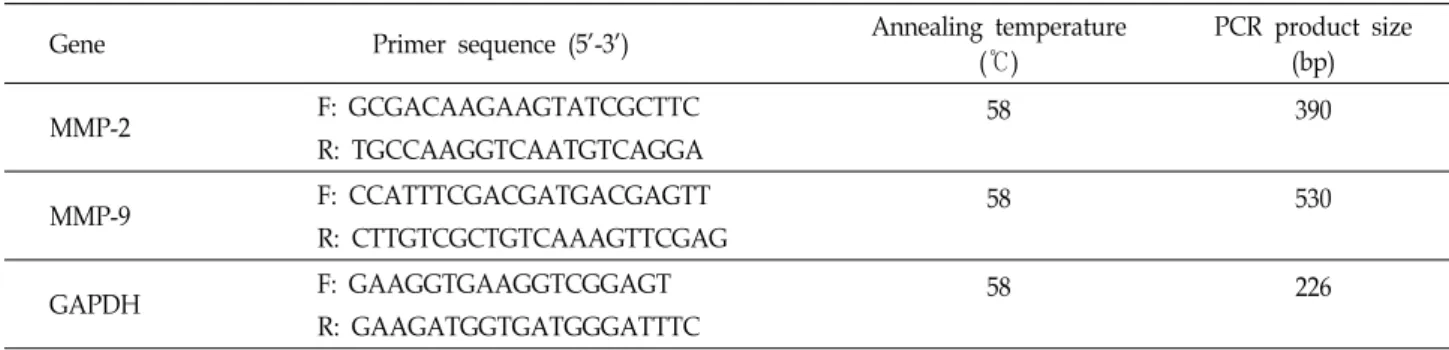
Table 1. Primers for RT-PCR
Gene Primer sequence (5’-3’) Annealing temperature (℃)
PCR product size (bp)
MMP-2 F: GCGACAAGAAGTATCGCTTC
R: TGCCAAGGTCAATGTCAGGA
58 390
MMP-9 F: CCATTTCGACGATGACGAGTT
R: CTTGTCGCTGTCAAAGTTCGAG
58 530
GAPDH F: GAAGGTGAAGGTCGGAGT
R: GAAGATGGTGATGGGATTTC
58 226
Reverse transcription-polymerase chain reaction (RT-PCR)
세포로부터 TRIzol 시약(Invitrogen Co., Carlsbad, CA, USA)을 사용하여 총 RNA를 추출하였다. 1 μg의 RNA를 가지 고 ReverTra ACE PCR RT Master Mix Kit (TOYOBO Co., Osaka, Japan) 을 이용하여 PCR를 수행하였다. 본 실험에서는 MMP-2, MMP-9 및Glyceraldehyde-3-phosphate dehydroge- nase (GAPDH) primers (Table 1)을 사용하였고, Housekeep- ing 유전자인 GAPDH 유전자를 internal control로 사용하였 다. 증폭된 PCR 생성물은 ethidium bromide가 포함된 1.5%
agarose gel에 전기영동 하여 UV light상에서 확인하였다.
Statistical Analysis
3회 반복 실험을 통하여 얻은 결과는 mean ± SD로 나타내 었으며, 각 실험군 간의 통계학적 분석은 Student t-test를 실시 하여 유의한 결과를 얻었다.
결과 및 고찰
용매 별 분획물의 수득율
생강 300 g을 열수추출 후 여러 종류의 용매를 이용하여 추출한 분획물의 수율을 측정한 결과, hexane 분획물이 0.33%, chloroform 분획물 0.23%, ethyl acetate 분획물 0.12%, buta- nol 분획물 1.27%, H
2O 분획물 9.79%로 H
2O 분획물의 수득율 이 가장 높았다.
항산화 효과
활성산소란 전자쌍을 이루지 못한 자유라디칼의 불안정한 산소화합물로 살아 있는 생명체의 대사과정과 면역과정을 통 해 발생되는 화합물로 반응성이 커 질병이나 노화를 초래하며 우리가 앓고 있는 질환의 약 90%가 활성산소와 연관이 되어 있는 것으로 알려져 있다. 전자공여능 측정에 사용된 1,1-di- phenyl-2-picrylhydrazyl (DPPH)는 홀전자를 갖고 있는 활성 이 큰 물질로 다른 물질과 반응을 통해 수소원자를 받아들여 자신은 환원되어 안정한 상태로 되지만 반응한 물질은 전자를 공여하고 홀전자를 갖는 화학종으로 변한다. 홀전자를 갖는
화학종으로 변하고도 안정한 상태를 유지 할 수 있는 물질이 DPPH를 잘 환원 시킬 수 있다. 따라서 이 DPPH을 환원시키 는 능력이 크다면 높은 활성의 활성산소 및 유리 라디칼 제거 능력이 클 것으로 기대할 수 있다. DPPH 용액을 이용하여 생강 열수추출액과 유기용매 분획물의 활성산소 제거능력을 측정한 결과 열수추출액은 82.85%의 항산화 활성을 나타냈으 며, hexane 분획물은 92.38%, chloroform 분획물 80.80%, ethyl acetate 분획물 76.33%, butanol 분획물 84.93%, H
2O 분획물은 92.96%의 항산화활성을 나타냈다(Fig. 1). Hexane 분획물과 H
2O 분획물의 높은 항산화 활성으로부터 생강이 함유하고 있 는 항산화 물질에는 극성 물질과 비극성 물질이 함께 섞여 있는 것으로 예상된다. 두 추출물들의 항산화 효과는 기존에 알려진 홍화 chloroform 추출물[15]의 81.85%, 빈랑 chloro- form 추출물[17]의 87.13%, 황기 ethyl acetate 추출물[16]의 89.96%, 산사 butanol 추출물[22]의 91.74% 보다 높은 항산화 효과를 나타내고 있음을 알 수 있다.
Thrombin 저해활성
H-D-Phenylalanine-L-pipecolyl-L-arginine-paranitroani- line dihydrochloride를 기질로 이용하여 분획물들의 throm- bin 저해활성을 측정한 결과, 생강 열수추출액(10 mg/ml)이 61.69%의 트롬빈 저해효과를 나타냈으며, chloroform 분획물, ethyl acetate 분획물, H
2O 분획물은 열수추출물과 비슷한 61.59%, 65.40%, 65.86%의 저해활성을 나타냈지만, hexane 분 획물과 butanol 분획물은 각각 39.56%와 38.75%의 낮은 저해 율을 나타냈다(Fig. 2). 결과로부터 트롬빈 저해물질들이 chloroform 분획물, ethyl acetate 분획물, H
2O 분획물에 고르 게 분포되어 있음을 알 수 있다.
YD-10B 인간구강암세포에서의 세포독성 효과
본 연구에서 사용된 YD-10B 인간구강암세포주는 사람의 혀에서 발생한 편평세포암종으로서 moderately differentiat- ion을 나타내며 침윤성이 높은 세포주이다. 또한 누드마우스 의 혀에 YD-10B 세포를 이식하였을 때도 침윤성의 종양을 형 성하였다[14, 19].
YD-10B 인간구강암세포에서 생강 유기용매 분획물들의 세
Samples Mean ± SD WE
Fr.Hx Fr.CF Fr.EA Fr.B Fr.DW
82.85±3.26 92.38±0.15 80.80±1.66 76.33±0.58 84.93±0.67 92.96±0.23
F-value 54.25
******
p<0.001
Fig. 1. Electron donating activities of solvent fractions obtained from a Zingiber officinale R extracts by DPPH assay. WE: water extract, Fr.Hx: Hexane fraction, Fr.CF: Chloroform fraction, Fr.EA: Ethyl acetate fraction, Fr.B: Butanol fraction, Fr.DW:
H
2O fraction. Sample concentrations were 10 mg/ml. The control levels were set at 100%.
Samples Mean ± SD
WE Fr.Hx Fr.CF Fr.EA Fr.B Fr.DW
61.69±1.07 39.56±0.87 61.59±0.35 65.40±0.69 38.75±0.70 65.86±0.53
F-value 900.17
******
p<0.001
Fig. 2. Thrombin inhibitory activities of solvent fractions obtained from a Zingiber officinale R extracts. WE: water extract, Fr.Hx:
Hexane fraction, Fr.CF: Chloroform fraction, Fr.EA: Ethyl acetate fraction, Fr.B: Butanol fraction, Fr.DW: H
2O fraction.
Sample concentrations were 10 mg/ml. The control levels were set at 100%.
포독성 효과를 조사하기 위해, 시료들을 다양한 농도로 처리 하여 48 hr 동안 반응하였다. 그 결과 대조군과 비교했을 때, 40 μg/ml 농도 처리에서 열수 추출물, hexane, butanol 및 H
2O 분획물은 72.67%, 81.00%, 79.44% 및 78.40%로 모두 70%
이상의 생존율을 보였으며, chloroform 과 ethyl acetate 분획 물은 64.83%와 68.52%로 낮은 생존율을 나타냈다(Fig. 3). 이와 같은 결과를 바탕으로 열수 추출물, hexane, butanol 및 H
2O 분획물은 YD-10B세포의 생존율에 영향을 미치지 않음을 알 수 있었고, chloroform과 ethyl acetate 분획물은 YD-10B세포 의 증식 억제 효과를 보였다. 그러므로 40 μg/ml 농도에서는 열수 추출물, hexane, butanol 및 H
2O 분획물들이 YD-10B 인 간구강암세포에서 독성을 나타내지 않음을 알 수 있었으며, 암 침윤 및 전이 억제 효과가 세포에 영향을 주어 나타나는 효능이 아님을 알 수 있었다. 이는 기존에 보고된 추출물들에 의한 YD-10B세포주에서 나타낸 non-cytotoxic농도와 거의 유 사한 결과이다[13].
YD-10B 인간구강암세포에서 PMA에 의해 처리된 MMP- 2와 MMP-9의 mRNA 발현 및 단백질 활성 억제 효과
MMPs는 Zn
2+결합부위를 포함하고 있으며, 조직의 재형 성, 동맥경화 및 암 침윤 및 전이과정 등에 매우 중요한 역할을 한다. 이들은 Zymogen 형태로 분비되어 활성 되거나 TIMPs (tissue inhibitor of metalloproteinases) 및 다양한 억제제에 의해 그 활성이 억제된다. 또한 MMPs는 수 십여 가지 타입이 존재하며 이들에 대한 기능 연구도 활발하게 진행되고 있다.
이 들 중에서 MMP-2와 MMP-9이 가장 중추적인 역할을 하는
것으로 이미 널리 보고되고 있다[10, 13, 20, 21]. 하지만 이들의
다양한 질환과의 상호 연관된 기능과 기전에 대한 연구는 여
전히 부족한 실정이어서 이 들에 대한 연구가 활발히 진행되
고 있다. 본 연구에서는 생강 유기용매 분획물들의 YD-10B
인간구강암세포에서 PMA에 의한 암 침윤 및 MMP-2와
MMP-9 활성 증가에 미치는 효과를 조사하였다. 이를 위하여
40 μg/ml 농도의 생강 유기용매 분획물들과 0.5 μM 농도의
PMA을 단독 또는 동시에 처리하여 YD-10B세포를 혈청 없는
A B
C D
E F
Fig. 3. In vitro Cytotoxicity effects of solvent fractions obtained from Zingiber officinale R extracts in YD-10B cells. YD-10B cells were treated with solvent fractions obtained from a from Zingiber officinale R water extract at different concentrations for 48 hr. Data represent the mean ± S.D. of three independent experiments. (A) WE: Water extract. (B) Fr.Hx: Hexane fraction.
(C) Fr.CF: Chloroform fraction. (D) EA: Ethyl acetate fraction. (E) Fr.B: Butanol fraction. (F) Fr.DW: H
2O fraction.
배지에서 배양하였다. 그리고 24 hr 동안 배양한 후, 배지의 상층액은 gelatin zymography법을 통해 MMP-2 및 MMP-9 단백질의 활성을 관찰하였고, 배양된 세포에서는 RT-PCR법 을이용하여 MMP-2 및 MMP-9 mRNA 발현을 분석하였다.
그 결과는 Fig. 4에서 나타난 것처럼, PMA를 단독 처리한 세포 에서는 아무것도 처리하지 않은 세포에 비해 MMP-2 및 MMP-9의 단백질 활성 및 mRNA 발현이 유의하게 증가함을 확인하였다. 또한 PMA와 생강 유기용매 분획물을 동시 처리 한 세포에서 hexane 분획물이 PMA에 의해 유도된 MMP-2 및 MMP-9의 단백질 활성 및 mRNA 발현 모두에서 가장 뚜렷 하게 억제함을 확인할 수 있었다.
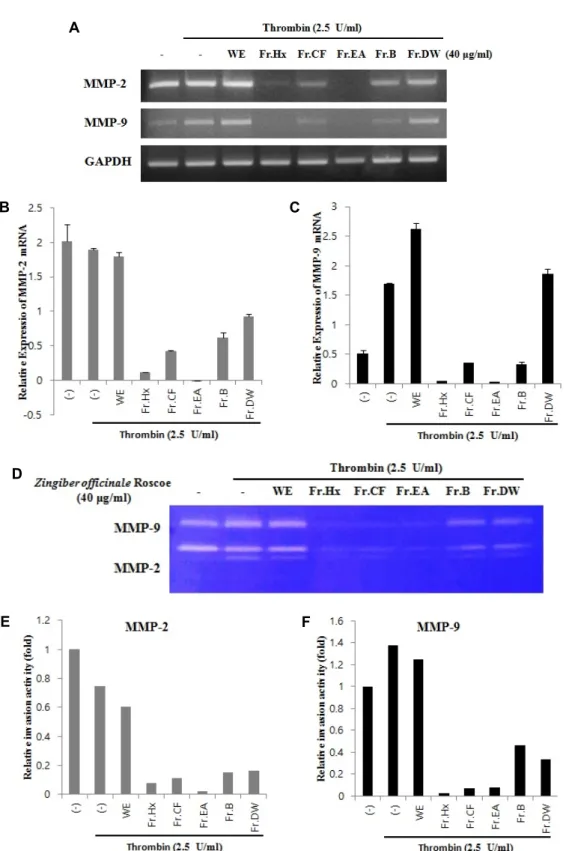
YD-10B 인간구강암세포에서 thrombin에 의해 처리된 MMP- 2와 MMP-9의 mRNA 발현 및 단백질 활성 억제 효과
본 연구에서는 생강 유기용매 분획물들의 YD-10B 인간구 강암세포에서 thrombin에 의한 암 침윤 및 MMP-2와 MMP-9 활성 증가에 미치는 효과를 조사하였다. 이를 위하여 40 μg/
ml 농도의 생강 유기용매 분획물들과 2.5 U/ml Thrombin을
단독 또는 동시에 처리하여 YD-10B세포를 혈청 없는 배지에
서 배양하였다. 그리고 24 hr 동안 배양한 후, 배지의 상층액은
MMP-2 및 MMP-9 단백질의 활성을 관찰하였고, 배양된 세포
에서는 MMP-2 및 MMP-9 mRNA 발현을 분석하였다. 그 결
과는 Fig. 5에서 나타난 것처럼, thrombin를 단독 처리한 세포
에서는 아무것도 처리하지 않은 세포에 비해 MMP-9의 단백
질 활성 및 mRNA 발현이 유의하게 증가함을 확인하였다. 또
한 thrombin과 생강 유기용매 분획물을 동시 처리한 세포에서
hexane 분획물이 thrombin에 의해 유도된 MMP-9의 단백질
활성 및 mRNA 발현 모두에서 가장 유의하게 억제함을 확인
할 수 있었다. 그리고 MMP-2의 단백질 활성 및 mRNA 발현
은 YD-10B세포에서는 MMP-9에 비해 endogenous하게 이미
높은 활성 및 발현을 보였으며 또한thrombin를 단독 처리한
YD-10B세포에서 약한정도로 억제되는 경향을 확인할 수 있었
다. 하지만 thrombin과 생강 유기용매 분획물을 동시에 처리
했을 경우에근 hexane 분획물이 MMP-9과 유사한 결과를 나
A
B C
D
E F
Fig. 4. Effect of solvent fractions obtained from a Zingiber officinale R extracts on mRNA expressions and protein activities of MMP-2/9
in PMA-treated YD-10B cells. YD-10B cells were treated with the indicated concentration (40 μg/ml) of solvent fractions
obtained from a Zingiber officinale R water extract 2 hr prior to PMA (0.5 uM) stimulation. (A) 24 hr later, the levels of
MMP-2/9 mRNA were determined by RT-PCR. GAPDH were used as the internal control. (B, C) The relative expressions
of MMP-2/9 mRNA were analyzed the band intensity using a GelQuant.NET program. (D) Activities of MMP-2/9 protein
in the conditioned media were determined by gelatin zymography. (E, F) The relative invasion activity of MMP-2/9 mRNA
were analyzed the band intensity using a GelQuant.NET program. WE: Water extract, He: Hexane fraction, CF: Chloroform
fraction, EA: Ethyl acetate fraction, B: Butanol fraction, DW: H
2O fraction.
A
B C
D
E F
Fig. 5. Effect of solvent fractions obtained from a Zingiber officinale R extracts on the activities of MMP-2/9 in thrombin-treated
YD-10B cells. YD-10B cells were treated with the indicated concentration (40 μg/ml) of solvent fractions obtained from a
from Zingiber officinale R water extract 1 hr prior to Thrombin (2.5 U/ml) stimulation. (A) 24 hr later, the levels of MMP-2/9
mRNA were determined by RT-PCR. GAPDH were used as the internal control. (B, C) The relative expressions of MMP-2/9
mRNA were analyzed the band intensity using a GelQuant.NET program. (D) Activities of MMP-2/9 protein in the con-
ditioned media were determined by gelatin zymography. . (E, F) The relative invasion activity of MMP-2/9 mRNA were
analyzed the band intensity using a GelQuant.NET program. WE: Water extract, He: Hexane fraction, CF: Chloroform fraction,
EA: Ethyl acetate fraction, B: Butanol fraction, DW: H
2O fraction.
타냈다. 그러므로 이와 같은 결과를 통하여 thrombin과 생강 유기용매 분획물을 동시에 처리한 YD-10B 구강암세포에서는 hexane 분획물이 MMP-9 및 MMP-2의 단백질 활성 및 mRNA 발현을 가장 유의하게 억제함을 알 수 있었다.
생강 유기용매 분획물의 항산화 효과, 트롬빈 억제 효과 및 인간구강암세포, YD-10B세포에서의 MMP-2와 MMP-9의 발 현 및 활성 억제에 의한 암 침윤 및 전이 억제 효과를 확인하였 다. 본 연구를 통하여 생강 추출 hexane 분획물은 가장 우수한 항산화 효과를 보였으며 또한 YD-10B 구강암세포에서 MMP- 2 및 MMP-9의 발현과 활성을 억제함으로써 암 침윤 및 전이 를 억제하는 것으로 나타났다. 이와 같은 결과는 hexane 분획 물이 구강 암의 예방 및 치료제 개발을 위한 우수한 후보 물질 로서의 가능성을 제시하고 있으며 hexane 분획물에 대한 유효 한 성분분석과 이들에 대한 in vivo에서의 암전이 억제 효능 및 기전 연구들이 추가적으로 더 필요할 것으로 사료된다.
References
1. Back, M., Ketelhuth, D. F. and Agewall, S. 2010. Matrix met- alloproteinases in atherothrombosis. Prog. Cardiovasc. Dis.
52, 410-428.
2. Bang, M. H., Song, J. C., Kim, S. L., Hur, H. S. and Baek, N. I. 2001. Isolation of natural antioxidants from the root of Zingiber officinale R. J. Kor. Soc. Agric. Chem. Biotechinol.
44, 202-205.
3. Blois, M. S. 1958. Antioxidant determinations by the use of a stale free radical. Nature 181, 1119-1120.
4. Chernov, A. V. and Strongin, A. Y. 2011. Epigenetic regu- lation of matrix metalloproteinases and their collagen sub- strates in cancer. Biomol. Concepts 2, 135-147.
5. Choi, Y. H. and Kim, S. O. 2012. Grnistein suppresses TPA-induced matrix metalloproteinases activity and cell in- vasion in human breast adenocarcinoma cells. J. Life Sci. 22, 964-969.
6. Daka, M. D. and Semba, C. P. 1995. Thrombolytic therapy in venous occlusive disease. J. Vasc. Interv. Radiol. 6, 73-77.
7. Doljak, B., Stegnar, M. U., Urleb, S., Kreft, A., Umek, M., Ciglaric, B. S. and Popovic, T. 2001. Screening for selective thrombin inhibitor in mushrooms. Blood Coagul. Fibrinolysis.
12, 123-128.
8. Lee, H. R., Lee, J. H., Park, C. S., Ra, K. R., Ha, J. S., Cha, M. H., Kim, S. N., Choi, Y., Hwang, J. and Nam, J. S. 2014.
Physicochemical properties and antioxidant capacities of different parts of Ginger (Zingiber officinale Roscoe). J. Kor.
Soc. Food Sci. Nutr. 43, 1369-1379.
9. Ling, H., Yang, H., Tan, S. H., Chui, W. K. and Chew, E.
H. 2010. 6-shogaol, and active constituent of ginger, inhibits breast cancer cell invasion by reducing matrix metal- loproteinase-9 expression via blockade of nuclear factor-kB activation. British J. Pharmcol. 161, 1763-1777.
10. Hwang, Y. S., Park, K. K. and Chung, W. Y. 2012. Kalopa- naxsaponin a inhibits the invasion of human oral squamous
cell carcinoma by reducing metalloproteinase-9 mRNA sta- bility and protein trafficking. Biol. Pharm. Bull. 35, 289-300.
11. Kaufmann R, Junker, U., Junker, K., Nuske, K., Ranke, C., Zieger, M. and Scheele, J. 2002. The serine proteinase throm- bin promotes migration of human renal carcinoma cells by a PKA-dependent mechanism. Cancer Lett. 180, 183-190.
12. Kim, J., Lee, J. W., Kim, S. I., Choi, Y. J., Lem W. K., Jeong, M. J., Cha, S. H., Lee, H. J., Chun, W. and Kim, S. S. 2011.
Thrombin-induced migration and matrix mettaloprotei- nase-9 expression are regulated by MAPK and PI3K path- waysin C6 glioma cells. Kor. J. Physiol. Pharmacol. 15, 211- 216.
13. Kim, J. H. and Kim, E. J. 2016. Effect of Anti-oxidant, Anti-inflammatory and Anti-invasive of PMA-induced ma- trix metalloproteinase (MMP-2) and MMP-9 activities of Water Extract and Solvent Fractions of Saururus chinensis.
J. Life Sci. 26, 584-591.
14. Kim, E. J., Che, Z. M., Park, Y. J., Hwang, Y. S., Kim, K.
Y., Jung, D. W., Jeon, N. K., Choi, Y. W., Lee, E. J. and Kim, J. 2009. Morphogenesis and biological significance of spindle cell transformation in a spindle cell carcinoma.
Cancer Lett. 275, 61-71.
15. Kim, J. H. 2011. Physiological effects of hot water extract and solvent fractions of Carthamus tinctorius L. J. Exp.
Biomed. Sci. 17, 157-165.
16. Kim, J. H. 2012. Studies on the biological activity of Astragalus membranaceus extracts. J. Exp. Biomed. Sci. 18, 35- 41.
17. Kim, J. H. and Oh, H. S. 2010. Biological activities of solvent fractions isolated from Areca catechu L. J. Exp. Biomed. Sci.
16, 271-277.
18. Kim, Y. J., Kim, C. K. and Kwon, Y. J. 1997. Isolation of antioxidative components of Perillae semen. Kor. J. Food Sci.
Technol. 29, 38-43.
19. Lee, E. J., Kim, J., Lee, S. A., Kim, E. J., Chun, Y. C., Ryu, M. H. and Yook, J. I. 2005. Characterization of newly estab- lished oral cancer cell lines derived from six squmous cell carcinoma and two epidermoid carcinoma cells. Exp. Mol.
Med. 37, 379-390.
20. Mignatti, P. and Fifkin, D. B. 1993. Biology and biochemistry of proteinases in tumor invasion. Physiol. Rev. 73, 161-195.
21. Mook, O. R., Frederiks, W. M. and Van Noorden, C. J. 2004.
The role of gelatinases in colorectal cancer progession and metastasis. Biochem. Biophys. Acta 1705, 69-89.
22. Oh, H. S. and Kim, J. H. 2008. Physiological functionalities of solvent fractions isolated from Crataegi fructus. J. Exp.
Biomed. Sci. 14, 249-255.
23. Park, K. Y., Lee, S. J., Lee, K. I. and Rhee, S. H. 2005. The antitumor effects in sarcoma-180 tumor cell of mice ad- ministered with japanese apricot, garlic ginger doenjang.
Kor. J. Food Cookery Sci. 21, 599-606.
24. Radjabi, A. R., Sawada, K., Jagadeeswaran, S., Eichbichler, A., Kenny, H. A., Montag, A., Bruno, K. and Lengyel, E.
2008. Thrombin induces tumor invasion through the in-
duction and association of matrix metalloproteinase-9 and
β1-integrin on the cell surface. J. Biol. Chem. 283, 2822-2834.
초록:YD-10B 인간구강암세포주에서 생강 유기용매 분획물의 항산화, 트롬빈억제 및 thrombin에 의 해 처리된 암 침윤 및 전이 억제 효과
김은정
1*․김준호
2*