123
불균일 무선 센서네트워크에서의 분산 클러스터링 프로토콜 성능
Quoc Kien Nguyen*, 전태현* 정회원
Performance of Distributed Clustering Protocol in Heterogeneous Wireless Sensor Networks
Quoc Kien Nguyen*, Taehyun Jeon* Regular Member
요 약
무선 센서 네트워크 하에서 불균일 네트워크의 에너지 효율은 주요 이슈 중의 하나로 고려된다. 불균일 네트워크에서, 개별 노드 초기 에너지의 무작위 분포는 네트워크 불안정을 초래할 수 있다. 따라서 네트워크 상 각 노드의 동작 시간 증가와 에너지 소비의 공평성 유지를 위해서는 적합한 방법이 마련되어야 한다. 본 논문에서는 서로 다른 시나리오의 불균일 네트워크 하의 분산 클러스터 링 프로토콜(DCP)의 성능 평가를 보여준다. 본 시뮬레이션 결과는 불균일 네트워크에서의 LEACH 프로토콜 결과와 비교하였다.
추가적으로 불균일 네트워크에서의 시스템 성능을 균일 네트워크와 비교함으로써, 불균형 초기 에너지가 시스템의 개별 노드의 수 명에 미치는 영향을 설명한다. 시뮬레이션 수행 결과 균일 및 불균일 네트워크에서 LEACH 프로토콜과의 성능 비교 결과는 DCP의 성능이 모든 경우에 성능 우위에 있음을 나타내었다.
Key Words : Wireless sensor network, heterogeneous, LEACH, clustering, energy efficiency
ABSTRACT
Energy efficiency in heterogeneous network is considered as one of the main issues when deploying the wireless sensor network. In heterogeneous network, the random distribution of initial energy at each node could lead to an instability of the network. Therefore, a resonable policy must be established in order to maintain the fairness in energy consumption and extend the working time of each node in the network. In this paper, we evaluate the performance of the distributed clustering protocol (DCP) in heterogeneous network on different scenarios. Simulation results are compared with the results of a LEACH protocol in a heterogeneous network. In addition, the performance of system in heterogeneous network are also compared with the homogeneous network to illustrate the effect of imbalance in the initial energy on the life time of each node in the system. The result illustrates that the DCP protocol demonstrates better performance than LEACH protocol in both the heterogeneous and the homogeneous networks.
※ 이 연구는 서울과학기술대학교 교내연구비의 지원으로 수행되었음.
*서울과학기술대학교 전기정보공학과, 교신저자: 전태현 ([email protected]) 접수일자 : 2016년 9월 23일, 최종게재확정일자 : 2016년 9월 28일
I. Introduction
Energy efficiency is considered as one of the main issues in heterogeneous networks. In this type of network, the random distribution of initial energy at each node could lead to an instability of the network. Therefore, a reasonable policy must be established in order to maintain the fairness in energy consumption and extend the working time of each node in the network. In wireless
sensor networks, there exist a lot of protocols that are used to transmit data and a lot of research effort have been focused on dealing with energy efficiency issues [1,2]. In this paper, we evaluate the performance of the distributed clustering protocol (DCP) in heterogeneous network on different scenarios. We assume that each node has different and limited initial energy. This reflects many situations of real field applications in the heterogeneous wireless sensor networks. The simulation for heterogeneous 한국위성정보통신학회논문지 제11권 제3호 (K11-3-22)
한국위성정보통신학회논문지 제11권 제3호
124 system is performed and the results are compared with the homogeneous system case where all the nodes are equipped with the same amount of initial energy. The results are also compared with other heterogeneous protocols to illustrate the benefit of the DCP. Since the considered protocol has a function of checking residual energy at each node, it can help to prolong the survival time of the nodes in the heterogeneous network where the initial energy is provided in an unequal way for each node.
The remainder of this paper is organized as follows. In section II, the description of the system model is presented. The simulation scenarios and results are discussed in sections III and IV, respectively. Finally, conclusions are given in section V.
Ⅱ. System Model
1. Previous Works
In this section, the energy dissipation model is described.
Since DCP is based on LEACH system model [3], it has the same radio energy dissipation model. The sensor nodes are distributed uniformly in the area of a circle or rectangle. The energy is consumed for receiving and transmitting data. The energy consumption depends on the length of data packet and the complexity of the signal processing session. In addition, the transmitting energy depends not only on the length of the packet, but also on the distance from the source to the destination. These characteristics are summarized as the following mathematical expressions.
×
(1)
× ×
(2)The DCP is proposed in order to deal with the issue when the header node tends to run out of energy quickly [2]. The residual energy checking process in DCP helps to distribute fairly the cluster-head role to every node in a cluster. This leads to the longer survival period all over the network even in heterogeneous one.
2. Residual Energy Checking Procedures
In DCP, the residual energy checking procedure is performed at each node, it is generated independently from the data station or the sink node. This process is meaningful in controlling the energy that is consumed
during working period. Furthermore, each node can control their consumed energy and wisely decide to be cluster-head or not. The residual energy of the cluster-head candidate is compared with the average residual energy of cluster. In case the native node’s residual energy is smaller than the average energy of the cluster, it cannot become a cluster-head. The scanning process must be established again in order to find out another cluster-head. If a node cannot be the cluster-head because of the low residual energy level, it is not considered in the next rounds. This process can help to guarantee that the working loads are distributed in a balanced way over the sensor nodes in the system. The side effect of the considered algorithm is that the number of cluster-heads may decrease due to the lack of residual energy. However, in the real field low cost applications, energy efficiency is in higher priority than data rate in wireless sensor networks. Therefore, the residual energy checking algorithm can be implemented in a low cost application with low demand of data rate.
Ⅲ. Simulation Scenario
1. Homogeneous Network
All the nodes have the same initial energy. Most of the sensor nodes are assumed to have the same initial energy for operation. Each station has the same initial energy and that energy is limited.
2. Heterogeneous Network
In the heterogeneous case, all the nodes have different initial energy [4]. The initial energy is randomly distributed to each node. Therefore, there will be fluctuations in survival time. The initial energy includes a fixed initial energy and random additional amount of energy. In addition, the nodes position are distributed randomly. The data center is assumed to be located far from the corresponding nodes in the network diagram.
The additional energy is utilized in order to simulate the situation when not all the batteries of the nodes are replaced. It is quite close to the real situation when only some parts of the sensor networks are updated or replaced. Furthermore, because of the imbalance in providing initial energy, each node has to check carefully its residual energy before it decides to be cluster-head.
Performance of Distributed Clustering Protocol in Heterogeneous Wireless Sensor Networks
125
Ⅳ. Results
1. Homogeneous Network
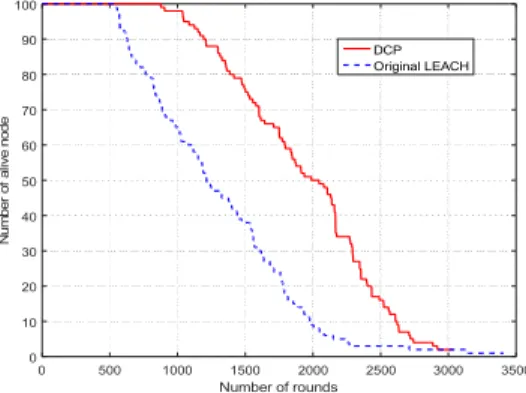
The homogeneous system’s survival time for both LEACH and DCP are illustrated in Fig. 1. The simulation running on Matlab shows the difference between the original LEACH and the DCP. We assume that the number of terminals in the system is 100 nodes while the size of the covered area is 150m x 150m, the pre-set cluster radius is set to 50 meters.
Number of rounds
0 500 1000 1500 2000 2500 3000 3500
Number of alive node
0 10 20 30 40 50 60 70 80 90 100
DCP Original LEACH
Fig. 1. Survival node over working rounds in rectangular homogeneous network.
In Fig. 1, we can see that the DCP guarantees longer stable time for all terminals. It means that the fairness in distributing cluster-head to every node is better than LEACH. The fairness in load distribution is based on the limited broadcasting area of each cluster and the randomness in the selection of a cluster head. After each loop, the pseudo address of each terminal is reset, then the new cluster setup section is established. In cluster based protocol, each cluster-head takes responsibility in compressing data before sending it to the data sink. In our simulation, it is assumed that the cluster-head can process collected data into a packet and send it to a sink. As the number of alive nodes decreases, the throughput of the system also decreases. Therefore, the proposed protocol can achieve higher total throughput with prolonged stable time.
2. Heterogeneous Network
The results show the similar trend in the performance for the heterogeneous system. Although there exist a chance that the random part of energy causes the deviation in survival time, our proposed protocol can avoid the quick death of low energy nodes with residual energy tracking procedure. Furthermore, the survival time is extended because all the nodes can be proposed as a
header node based on their residual energy. In Fig. 2, we compare the survival time of the nodes in the network that deploys DCP and LEACH, respectively. It can be easily seen that the DCP maintains improved survival time as shown in the homogeneous network. This longer survival time is achieved by the additive random energy. The Fig. 3 also compares the life time of network between LEACH and DCP in circle shape network. The survival time in terms of the number of round before the first node deads in heterogeneous network is summarized in Table 1 for various types of network area shape for the LEACH and the DCP based heterogeneous networks.
Number of rounds
0 1000 2000 3000 4000 5000 6000 7000
Number of alive node
0 10 20 30 40 50 60 70 80 90 100
DCP Original LEACH
Fig. 2. Survival node over working rounds in rectangular heterogeneous network.
Number of rounds
0 1000 2000 3000 4000 5000 6000 7000
Number of alive node
0 10 20 30 40 50 60 70 80 90 100
DCP Original LEACH
Fig. 3. Survival node over working rounds in circular heterogeneous network.
No. of test
No. of rounds before the first node dies Rectangle network Circular network
LEACH DCP LEACH DCP
1 558 1051 694 1634
2 542 853 657 1344
3 513 1034 618 1550
4 555 999 688 1499
5 536 1196 700 1433
6 534 792 683 1496
7 520 1087 758 1437
8 518 1056 643 1519
9 560 1087 734 1454
10 569 898 656 1211
Means 540.5 1005.3 683.1 1457.7 Table. 1. Comparison of the number of round before the
first node dies in heterogeneous network.
한국위성정보통신학회논문지 제11권 제3호
126
Ⅴ. Conclusion
In this paper, performance of the distributed cluster-based protocol (DCP) is evaluated in both heterogeneous and homogeneous networks. Simulation results confirm that the DCP algorithm outperforms the conventioanl LEACH algorithm. This protocol can be deployed in a practical application which requires the energy efficiency with higher priority. In other words, it can be used to replace the existing protocol, which is unsuitable and inefficient to deal with the energy efficiency issue in the heterogeneous networks.
References
[1] H. R. Wendi, P. C. Anantha and B. Hari, “Energy-Efficient Communication Protocol for Wireless Microsensor Networks,” Proceedings of the 33rd International Conference on System Sciences, Hawaii, USA, 2000.
[2] Q. K. Nguyen and T. Jeon, “Distributed clustering protocol for wireless sensor network,” International Journal of Sensor Networks, vol. 19, no. 3-4, pp. 242-250, 2015.
[3] G. Dongfeng and X. Lijun, “LEACH Clustering Routing Protocol for WSN,” Proceedings of the International Conference on Information Engineering and Applications, pp. 153-160, 2013.
[4] G. Smaragdakis, I. Mata and A. Bestavros, “SEP: A Stable Election Protocol for clustered heterogeneous wireless sensor networks,” Second International Workshop on Sensor and Actor Network Protocols and Applications (SANPA), Boston, Massachusetts, USA, 2004.
저자
Quoc Kien Nguyen
․2008년: Hanoi University of Science and Technology Electronic and Telecommunication Department 졸업 (학사)
․2013년:서울과학기술대학교 전기정
보공학과 졸업(석사)
․2015년 ∼ 현재:서울과학기술대학교 전기정보공학과 재학 (박사)
<관심분야> : Cognitive radio, 5G, Wireless sensor network
전 태 현(Taehyun Jeon) 정회원
․1989년:연세대학교 전기공학과 졸업 (학사)
․1993년:미네소타대학교 전기공학과 대학원 졸업(석사)
․1997년:미네소타대학교 전기공학과 대학원 졸업(박사)
․1997년 ∼ 1998년:Motorola 연구원
․1998년 ∼ 2001년:Texas Instruments 연구원
․2002년 ∼ 2005년:한국전자통신연구원(ETRI) 선임연구원
․2005년 ∼ 현재:서울과학기술대학교 전기정보공학과 교수 <관심분야> : 유무선 통신시스템, 근거리 무선통신, 이동통신