위성 영상감시 센서망을 위한 스마트 비젼 센서
김원호* 종신회원, 임재유*
Smart Vision Sensor for Satellite Video Surveillance Sensor Network
Won-Ho Kim* Lifelong Member, Jae-Yoo Im*
요 약
본 논문은 위성통신 기반의 위성 영상감시 센서 네트워크 적용을 위한 스마트 비젼 센서에 대해 기술한다. 스마트 비젼센서 단말은 현장에서 산불, 연기, 침입자 움직임 등의 이벤트를 자동감지하면서 높은 성능 신뢰도, 견고한 하드웨어 내구성, 용이한 유지보수, 끊김없는 통신유지 기능들이 요구된다. 이러한 요구사항들을 만족시키기 위하여 스마트 비젼 센서가 내장된 초소형 위성통신 단말 을 제안하며 위성 송수신 기능과 더불어 고 신뢰도의 임베디드 영상분석 및 영상압축 기능을 처리한다. 제안하는 비젼 센서 알고리 즘의 컴퓨터 시뮬레이션과 비젼 센서 시제품 시험을 통하여 영상감시 성능을 검증하였으며 실용성을 확인하였다.
Key Words : Satellite sensor network, smart vision sensor, video surveillance system, ultra-small aperture terminal
ABSTRACT
In this paper, satellite communication based video surveillance system that consisted of ultra-small aperture terminals with small-size smart vision sensor is proposed. The events such as forest fire, smoke, intruder movement are detected automatically in field and false alarms are minimized by using intelligent and high-reliable video analysis algorithms. The smart vision sensor is necessary to achieve high-confidence, high hardware endurance, seamless communication and easy maintenance requirements. To satisfy these requirements, real-time digital signal processor, camera module and satellite transceiver are integrated as a smart vision sensor-based ultra-small aperture terminal. Also, high-performance video analysis and image coding algorithms are embedded. The video analysis functions and performances were verified and confirmed practicality through computer simulation and vision sensor prototype test.
※본 연구는 2014년도 지식경제부의 재원으로 한국에너지 기술평가원(KETEP)의 지원을 받아 수행한 연구 과제입니다.
I. Introduction
Satellite communication-based alarm and surveillance systems were recently developed to prevent individual or nation-wide disasters. The SASS project was to develop a satellite based alarm and surveillance system by ESA [1]. The system has been designed to provide connectivity between alarm and surveillance systems on one side and security centers and other receivers, for example to protect the owners of the property, on the other. The SASS system concept is based on inexpensive, small and easy to install satellite terminals with built-in alarm, video, audio and data transmission capability. The terminals are linked via a geostationary satellite to a gateway station. The
ATR proposed hybrid application of ad-hoc networks and satellite networks, and carried out study for disaster monitoring and structure health monitoring with Japanese WINDS satellite [2].
Additionally, commercial systems were introduced to monitor disaster events based on satellite such as AFIANT’s satellite remote video surveillance system, ORBIT’s SASS system, and BSS Inc.’s video monitoring using Telenor satellite with Inmarsat BGAN terminal.
They used remote cameras and monitors in central office for disaster visual monitoring utilizing satellite communication.
Visual monitoring by human is very hard labor, and human’s ability to concentrate becomes decreased abruptly
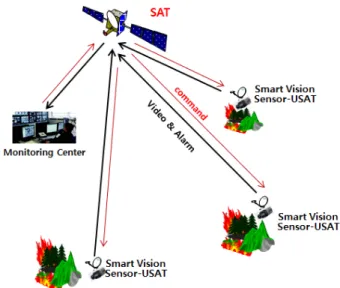
after monitoring of 20 minutes. Missed alarms and inefficient surveillance work are resulted from these reasons. To complement these problems, intelligent disaster surveillance systems based on computer vision processing were recently developed to prevent disasters and accidents [3]-[13]. Two types of camera systems are commonly used for video surveillance. One is a charge-coupled device color camera system, and the other is an infrared thermal camera system. Color camera systems are cost-effective, but their operations are limited under no-light and heavy fog conditions [3]-[10]. Infrared thermal camera systems are advantageous for unattended disaster and security surveillance. Monitoring is possible regardless of illumination and climate conditions, and the quantity of data to be processed is one-third that of color videos [11]-[13]. For practical application, the compact DSP hardware system is necessary to achieve low cost, high hardware endurance, and easy maintenance requirements. In this paper, we propose smart vision sensor embedded ultra-small aperture terminal based video surveillance system utilizing satellite communication network as shown in figure 1.
Fig 1. Proposed forest-fire satellite surveillance sensor network using smart vision sensor embedded ultra small aperture terminal
The proposed system consists of remote ultra-small aperture terminals including smart vision sensor and video monitor in central office. The video monitor in central office is designed to display geographical position to be monitored and field video.
Ⅱ. Design of Smart Vision Sensor Embedded Ultra-Small Aperture
Terminal
The architecture of proposed smart sensor embedded ultra-small aperture terminal is shown in figure 2. The wireless smart vision sensor consists of camera, video processor, GPS receiver and satellite transceiver.
Technical features of smart vision sensor embedded ultra-small aperture terminal are as follows. Proposed scheme of vision sensor embedded ultra small aperture terminal is shown in figure 2.
Fig 2. Proposed scheme of vision sensor embedded ultra-small aperture terminal
A. Single Hardware Form
A camera and high-performance digital signal processor (video analysis & video compression) and satellite transceiver are integrated in single hardware architecture.
B. Camera
Color HD or SD-level CCD/CMOS camera module is used to acquire video stream. Optionally infrared thermal camera module is used to acquire video under all-weather condition.
C. DSP based Video Processor
Embedded video analysis and video compression (MJPEG or H.26x) are processed by using video processor.
The video processor is implemented by using high-performance DSP (Digital Signal Processor) which has 32MB DRAM and 4MB flash memory as shown in figure 3. Clock frequency of processor is 720MHz. The video encoder and decoder have conversion function between NTSC signal and digital video data. In addition, Location information is obtained by using GPS receiver to deliver event position to central monitoring system.
Serial Port FPGA
Video Decoder Digital Signal Processor Video Encoder
NTSC Video NTSC Video
GPIO(Alarm)
User Data Memory
Fig 3. Functional block diagram of video processor
D. Implemented Prototype of Vision Sensor
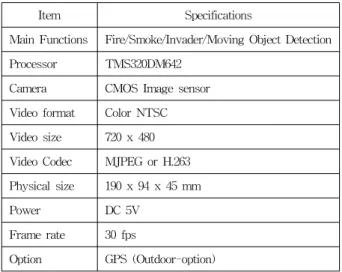
The implemented prototype of smart vision sensor is shown in figure 4, and main specifications are listed in table 1.
Fig 4. Prototype of smart vision sensor
Table 1. Main specifications of smart vision sensor
Item Specifications
Main Functions Fire/Smoke/Invader/Moving Object Detection Processor TMS320DM642
Camera CMOS Image sensor Video format Color NTSC Video size 720 x 480 Video Codec MJPEG or H.263 Physical size 190 x 94 x 45 mm
Power DC 5V
Frame rate 30 fps
Option GPS (Outdoor-option)
E. Satellite Transceiver
Satellite transceiver consists of L/S-band or Ka-band RF equipments, digital modem, small-size antenna. Data capacity per terminal is 128k~1Mbps and It has functions of IP based surveillance video and autonomous alarm transmission.
III. Video Surveillance Algorithms of Smart Vision Sensor
To implement intelligent video surveillance requirements, DSP embedded video analysis algorithms are developed to monitor disaster or security events such as fire, smoke, moving human. Proposed algorithms are simulated by using MATLAB program and finally tested by using implemented video board of vision sensor.
A. Flame Detection Algorithm
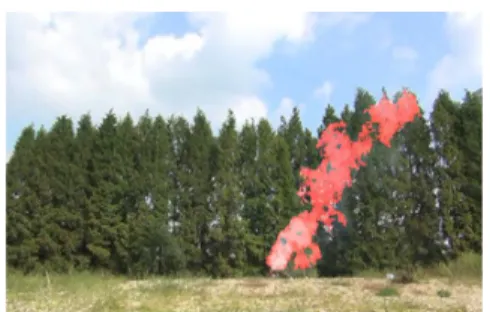
The proposed color flame detection algorithm firstly select the candidate flame regions by using frame difference and color conditions. Secondly wavelet transformation is performed for those candidate regions for 100 frames. Then flame regions or non-flame regions are distinguished by analyzing wavelet transform coefficients. Simulation results showed that the proposed algorithm is able to remove false detection by performing 97.9% of detection rate while false detection rate is bounded to 7.3%. 15-test videos including 96-fire frames are simulated.
Fig 5. Simulation result image using color flame detection algorithm
In addition, IR camera-based simple flame detection algorithm optimized with a compact embedded DSP system to achieve early detection. To reduce the computational load, block-based calculations are used to select the candidate flame region and measure the temporal motion of flames. These functions are used together to obtain the early flame detection algorithm. The proposed simple algorithm was simulated to verify the required function and performance in real-time using IR test videos. The findings indicated that the system detected the flames within 5 to 20 seconds, and had a correct flame detection ratio of 100% with an acceptable
Fig 6. Simulation result image using IR flame detection algorithm
B. Smoke Detection Algorithm
The proposed color smoke detection method is to distinguish smoke regions and background using dynamic movement and color features of smoke pixels. The simulation results showed that correct smoke detection ratio of 93.3% and false smoke detection ratio of 13%.
5-test videos including 180-smoke frames are simulated.
Fig 7. Functional block diagram of smoke detection algorithm
Fig 8. Simulation result image using smoke detection algorithm
C. Moving Human Detection Algorithm
This algorithm is to detect moving object and human recognition based on background subtraction and 1D correlation. First it does background subtraction to extract moving object and then proposed 1D correlation method to recognize human bodies as shown in figure 9.
The simulation result shows rate of moving human detection at outdoor is 98.4% while false rate is 0.46%.
13-test videos including 2,486-human frames are simulated.
Fig 9. Flow diagram of moving human detection
Fig 10. Simulation result image using moving human detection algorithm
The proposed surveillance algorithms were verified practicality through testing using video processor of vision-sensor as shown in figure 11.
Fig 11. Test picture for smoke detection using DSP board of vision sensor
IV. Conclusion
In this paper, smart vision sensor-based disaster or security video surveillance system utilizing satellite communication was proposed. To design compact hardware platform of smart vision sensor based ultra-small aperture terminal, real-time digital signal processor, camera module, satellite transceiver are integrated. Also, simple and high-performance video analysis algorithms are implemented to detect events such as fire, smoke, object movement. The proposed algorithms were verified and confirmed practicality through computer
simulation and DSP-based vision-sensor prototype test.
The future research will be performed to enhance algorithm performance, and to implement more compact hardware platform of vision sensor embedded ultra-small aperture terminal.
REFERENCES
[1] http://telecom.esa.int/telecom/www/object/index. cf m?fobjectid = 12163.
[2] https://www.aprsaf.org/data/w_csa_data/csa_thai/C SAWGWS 200606_09.pdf.
[3] Tjokorda Agung Budi, “Fire alarm system based on video processing”, Proceedings of International Conference on Electrical Engineering Informatics, pp. 1-7, 2011.
[4] Hidenori Maruta, Yusuke Iida, Fujio Kurokawa, “Anisotropic LBP Descriptors for Robust Smoke Detection,” Industrial Electronics Society, Vienna, Nov, 10-13, 2013.
[5] Tjokorda Agung Budi, “Fire alarm system based on video processing,” Proceedings of International Conference on Electrical Engineering Informatics, pp. 1-7, 2011.
[6] Celik, T., “Fast and efficient method for fire detection using image processing,” ETRI journal, vol.32, pp.881-890, 2010.
[7] Ramzmi S.M, N.Asirvadam V.S., “Vision-based flame detection: motion detection & fire analysis,” Proceedings of IEEE Student Conference on Research and Development, pp.
187-191, 2010.
[8] Zhibin, M., Chunyu, Y., Xi, Z., “Machine vision based flame detection using multi-features,” Proceeding of 24th Chinese Control and Decision Conference, pp. 2844-2848, 2012.
[9] Zhengwen Xie, Qiang Wang, “Large space fire detection in laboratory-scale based on color image segmentation,”
Proceedings of ninth International Symposium on Distributed Computing and Applications to Business Engineering and Science, pp.572-575, 2010.
[10] Wirth M., Zaremba R, “Flame region detection based on histogram back-projection,” Proceedings of Canadian Conference on Computer and Robot Vision, pp.167-174, 2010.
[11] S.Briz, J.M. Aranda, J. Melendz, F. Lopez, “Reduction of false alarm rate in automatic forest flame infrared surveillance systems,” Remote Sensing of Environment, Elsevier Science Inc., pp. 19-26, 2003.
[12] B.C. Arrue,; A. Ollero, J.M de Dios, “An intelligent system for false alarm reduction in infrared forest flame detection,”
IEEE intelligent system, pp. 64-73, 2000.
[13] Ignacio Bosch et al, “Infrared image processing and its application to forest flame surveillance,” Proceeding of IEEE Conference on Advanced Video and Signal Based Surveillance, pp. 283-288, 2007.
저자
김 원 호(Won-Ho Kim) 종신회원
․1985년 2월:경북대 전자공학 학사
․1987년 2월:경북대 전자공학 석사
․1999년 2월:충남대 전자공학 박사
․1989년 2월 ~ 1999년 8월:한국전자 통신연구원(ETRI) 선임연구원
․1999년 8월 ~ 현재:공주대학교 전기 전자제어공학부 교수
․2011년 10월 ~ 현재:공주대학교 IT융합기술연구소 소장 <관심분야> : 영상 및 통신 신호처리, 위성멀티미디어통신,
지능형 영상감시 및 비젼센서
임 재 유(Jae-Yoo Im)
․2014년 2월 : 공주대학교 전기전자제 어공학부 학사졸업
․2014년 3월 ~ 현재 : 공주대학교 전기 전자제어공학과 석사과정
<관심분야> : 영상신호처리, 마이크로프로세서 응용