• 검색 결과가 없습니다.

Role of Nox4 in Neuronal Differentiation of Mouse Subventricular Zone Neural Stem Cells

N/A
N/A
Protected

Academic year: 2021

Share "Role of Nox4 in Neuronal Differentiation of Mouse Subventricular Zone Neural Stem Cells"

Copied!
9
0
0

로드 중.... (전체 텍스트 보기)

전체 글

(1)

Role of Nox4 in Neuronal Differentiation of Mouse Subventricular Zone Neural Stem Cells

Ki-Youb Park

1

*, Yerin Na

1

and Man Su Kim

2

1

Korea Science Academy of KAIST 105-47 Baegyanggwanmun-ro, Busanjin-Gu, Busan 614-100, Korea

2

College of Pharmacy, Inje University, Gimhae 50834, Korea

Received July 22, 2015 /Revised November 26, 2015 /Accepted December 21, 2015

Reactive oxygen species (ROS), at appropriate concentrations, mediate various normal cellular func- tions, including defense against pathogens, signal transduction, cellular growth, and gene expression.

A recent study demonstrated that ROS and ROS-generating NADPH oxidase (Nox) are important in self-renewal and neuronal differentiation of subventricular zone (SVZ) neural stem cells in adult mouse brains. In this study, we found that endogenous ROS were detected in SVZ neural stem cells cultured from postnatal mouse brains. Nox4 was predominantly expressed in cultured cells, while the levels of the Nox1 and Nox2 transcripts were very low. In addition, the Nox4 gene was highly upregu- lated (by up to 10-fold) during neuronal differentiation. Immunocytochemical analysis detected the Nox4 protein mainly in neurons positive for the neuronal specific tubulin Tuj1. After differentiation, endogenous ROS were detected exclusively in neuron-like cells with processes. In addition, perturba- tion of the cellular redox state with N-acetyl cysteine, a ROS scavenger, during neuronal differ- entiation greatly inhibited neurogenesis. Lastly, knockdown of Nox4 using short hairpin RNA de- creased neurogenesis. These findings suggest that Nox4 may be a major ROS-generating enzyme in postnatal SVZ neural stem cells, and Nox4-mediated ROS generation may be important in their neuro- nal differentiation.

Key words : NADPH oxidase-4 (Nox4), neural stem cells (NSCs), neuronal differentiation, reactive oxygen species (ROS), subventricular zone (SVZ)

*Corresponding author

*Tel : +82-51-606-2225, Fax : +82-51-606-2226

*E-mail : [email protected]

This is an Open-Access article distributed under the terms of the Creative Commons Attribution Non-Commercial License (http://creativecommons.org/licenses/by-nc/3.0) which permits unrestricted non-commercial use, distribution, and reproduction in any medium, provided the original work is properly cited.

Journal of Life Science 2016 Vol. 26. No. 1. 8~16 DOI : http://dx.doi.org/10.5352/JLS.2016.26.1.8

Introduction

In recent years, the roles of reactive oxygen species (ROS) in stem cell proliferation and self-renewal have been eluci- dated in diverse cell types. An increased level of ROS in hematopoietic stem cells from polycomb group knockout mice leads to a decrease in self-renewal of these cells [18].

Superoxide from mitochondria reduces proliferation of mouse cerebral cortical neural progenitor cells [9]. However, in mouse cerebellum–derived neural stem cells (NSCs), su- peroxide production is necessary for their proliferation in- duced by angiotensin II [28]. In the subventricular zone (SVZ) and subgranular zone (SGZ), two brain regions that maintain neurogenesis throughout adulthood, ROS pro- duction is reportedly required for stem cell proliferation [15,

33]. In this case, SVZ NSCs were cultured from adult mice.

However, when SVZ NSCs from neonatal mice were used, a negative effect of ROS on proliferation was observed [3, 13]. Therefore, it seems that ROS can have both positive and negative effects on stem cell self-renewal depending on cell types and possibly the age of the animals.

Differentiation into various cell types, another important characteristic of stem cells, is also regulated by ROS [7, 29].

During neuronal differentiation of mouse embryonic stem cells, ROS are produced by NADPH oxidases (Nox) [31]. In neuronal differentiation of human adipose tissue–derived adult stem cells, ROS seem to facilitate an early stage of dif- ferentiation and inhibit a later stage [6]. Neuronal differ- entiation of bone marrow–derived mesenchymal stem cells requires ROS generation, which activates epidermal growth factor receptor [21]. ROS are also involved in neuronal differ- entiation of NSCs. ROS activate WNT/β-catenin signaling in human neural progenitor cells during fate decision [8].

ROS generation mediates BMP2-induced neuronal differ-

entiation of mouse neural crest stem cells [16]. In adult

mouse SGZ NSCs, the number of mitochondria and the ROS

level increase immediately after induction of differentiation

(2)

[30]. In adult mouse SVZ NSCs, ROS are involved in neuro- genesis through the PI3K-Akt signaling pathway [15]. All these reports are consistent in describing ROS as a key factor in neuronal differentiation of stem cells.

ROS are generated mainly through two routes, oxidative phosphorylation in mitochondria and Nox enzymes [29].

While in the former case ROS are byproducts of cellular res- piration, the latter case is deliberate ROS production, which is tightly regulated. Among Nox family members, Nox1–5 and dual oxidases (Duox) 1 and 2 are expressed in most mammals [27]. In mouse brain, Nox2 and Nox4 transcripts were mainly detected, while Nox1 expression was very low [11]. In an in vitro culture system, Nox1, 2, and 4 were ex- pressed in neurons [26]. Among these Nox isoforms, Nox2 was reported to generate ROS during proliferation of SVZ and SGZ NSCs [4, 15] and to be required for neurogenesis in SVZ NSC cultures [15]. The Nox4 gene is most abundantly expressed among Nox isoforms in a murine neural stem cell line, C17.2 [28] and neural crest stem cells [16]. Furthermore, Nox4 is involved in differentiation of neural crest stem cells [16], differentiation of embryonic stem cells to smooth mus- cle cells [32] and mesenchymal stem cells to neuronal-like cells [12]. Yet, the role of Nox4 in proliferation and differ- entiation of SVZ NSCs has not been reported.

Here, we report that (1) Nox4 was predominantly ex- pressed among Nox isoforms in SVZ NSCs cultured from mouse neonates, (2) Nox4 expression increased during neu- ronal differentiation, (3) the ROS scavenger N-acetyl cysteine (NAC) reduced neurogenesis in SVZ NSC cultures, and (4) knockdown of Nox4 significantly decreased neurogenesis of NSCs. This is the first description of a role of Nox4 in mouse SVZ NSCs.

Materials and Methods

Mouse SVZ NSC culture

Mouse SVZ NSCs were cultured following the previously reported procedure [17]. Postnatal day 5 to 7 mouse pups (CD1 mice obtained from Orient Bio) were euthanized and brains were obtained. After coronal sectioning of the brain, a brain slab was placed in L15 medium (Gibco, Thermo Fisher, Waltham, MA, USA). SVZ tissues were dissected from the brain slab using a dissecting microscope (Olympus, Tokyo, Japan). SVZ tissues were treated with 0.25% trypsin (Gibco, ThermoFisher, Waltham, MA, USA) at 37°C for 20 min and triturated 20-30 times. Cells were pelleted at 300

× g for 5 min, resuspended in N5 medium and plated into a 12-well plate (1 pup or 2 SVZ tissues per well). The compo- sition of the proliferation N5 medium was as follows:

DMEM/F12 (Gibco, ThermoFisher, Waltham, MA, USA), 5%

fetal bovine serum (GenDEPOT, Texas, USA), N2 supple- ment (GenDEPOT, Texas, USA), 35 μg/ml bovine pituitary extract (GenDEPOT, TX, USA), 20 ng/ml epidermal growth factor (EGF, Invitrogen, ThermoFisher, Waltham, MA, USA), 20 ng/ml basic fibroblast growth factor (bFGF, Gibco, ThermoFisher, Waltham, MA, USA), and antibiotic/anti- mycotic (Gibco, ThermoFisher, Waltham, MA, USA). Plated cells (passage 0) reached confluency in about 1 week. All national guidelines for animal care and use of laboratory animals were followed.

ROS measurements

NSCs were trypsinized and cell pellets were resuspended in 10 μM 2',7'-dichlorodihydrofluorescein diacetate (DCFDA) solution in phosphate-buffered saline (PBS). Cells were in- cubated at 36°C for 30 min, rinsed with PBS and plated onto a 96-well plate. For differentiated NSCs, 1 μM DCFDA sol- ution in PBS was applied to the adherent cells on an 8-well Lab-Tek CC2 chamber slide (Nunc, ThermoFisher, Waltham, MA, USA). For imaging, green fluorescence and bright field images were taken under a fluorescence microscope (Olym- pus, Tokyo, Japan). For quantitative measurements of DCFDA staining, cells were treated with different concen- trations of NAC (Sigma, St. Louis, MO, USA) for 3-4 hr and then transferred to a 96-well plate. Fluorescence intensity was detected with a GENiso Pro microplate reader and ana- lyzed with Magellan V6.5 software (both from Tecan (Männedorf, Switzerland)). To normalize the signal to the background, blank wells containing cells treated with PBS instead of DCFDA were included.

NSCs were treated with different concentrations of ROS inhibitors (diphenyleneiodonium (DPI) (Sigma, St. Louis, MO, USA), apocynin (Sigma, St. Louis, MO, USA), and Necrox-5 (Santa Cruz Biotechnology, Dallas, TX, USA)) in N5 medium for 3.5 hr. Cells were incubated in 1 μM DCFDA solution in PBS for 30 min and then, trypsinized and plated onto a 96-well plate for ROS quantitation.

Neuronal differentiation of cultured SVZ NSCs

NSCs were passaged 5 to 7 times in the proliferation me-

dium N5 and then plated on a laminin-coated plate or 8-well

Lab-Tek CC2 chamber slide (Nunc, ThermoFisher, Waltham,

(3)

MA, USA) in N5 medium. For plate and slide coating, 5 μg/ml laminin (Invitrogen, ThermoFisher, Waltham, MA, USA) solution in PBS was added to cover the surface and incubated for 4 hr to overnight at 37°C. Before plating cells, the surface was rinsed with PBS. One day after plating, when the cells became confluent, cultures were briefly rinsed with the differentiation medium N6 (N5 medium without EGF, bFGF, and serum) to remove any traces of N5 medium and then fresh N6 medium was added. Every 4 days, medium was replaced with fresh N6.

RNA extraction and quantitative real-time reverse- transcription PCR

Total RNA was extracted from proliferating or differ- entiating NSCs by using a QIAshredder column and RNeasy kit (both from Qiagen (Hilden, Germany). To remove ge- nomic DNA, RNase-free DNase (Qiagen, Hilden, Germany) was added during RNA extraction. To obtain cDNA, a First Strand cDNA Synthesis kit (Roche, Basel, Switzerland) or GoScript reverse transcriptase (Promega, Madison, WI, USA) was used with oligo (dT) by following manufacturers’ proto- cols. For quantitative real-time reverse- transcription PCR (qRT-PCR), approximately 50 ng cDNA was used per re- action with a Real Helix qPCR kit (Nanohelix, Daejeon, Korea). The PCR program was 95°C, 15 min; then 40 cycles of 95°C, 20 s; 58°C, 30 s; 72°C, 30 s. Primer sequences were as following: Nox1 (forward: 5‘-ACCTGCTCATTTTGC- AACCGTA-3’, reverse: 5‘-AGAGATCCATCCATGGCCTG- TT-3’), Nox2 (forward: 5‘-CGACAAGGATTCGAAGACAA- CTG-3’, reverse: 5‘-AATACCGGTCAGAAATCCCGACT-3’), Nox4 (forward: 5‘-CATGGTGGTGGTATTGTTCCTCA-3’, re- verse: 5‘-GCCAGGAGGGTGAGTGTCTACAT-3’), Dlx2 (for- ward: 5‘-GGCCTCACCCAAACTCAG-3’, reverse: 5‘-AGGC- ACAAGGAGGAGAAGC-3’), and GAPDH (forward: 5‘-CA- AGGCTGTGGGCAAGGT-3’, reverse: 5‘-TCACCACCTTCT- TGATGTCATCA-3′).

Immunocytochemistry

A previously reported procedure was used [17], except that overnight incubation with primary antibodies at 4°C was used. Primary and secondary antibodies and their dilu- tions were as following: rabbit anti-Nox4 (Santa Cruz Biotechnology, Dallas, Texas, USA) at 1:50 dilution, mouse anti-Tuj1 (Novex, ThermoFisher, Waltham, MA, USA) at 1:500 dilution, mouse anti-GFAP (Millipore, Billerica, MA, USA) at 1:500 dilution, rabbit anti-Olig2 (Millipore, Billerica,

MA, USA) at 1:500 dilution (all primary antibodies were di- luted in blocking solution (see below)), Alexa-488–con- jugated anti-mouse, and Alexa-594–conjugated anti-rabbit secondary antibodies (1:500 in PBS; both from Jackson ImmunoResearch, West Grove, PA, USA). The composition of the blocking solution was as follows: 10% goat serum (Cell Signaling, Danvers, MA, USA) and 0.1~0.3% triton X-100 (Sigma, St. Louis, MO, USA) in PBS. Images were tak- en using a fluorescence microscope (Olympus, Tokyo, Japan). To count the number of Tuj1-positive cells, 7 non- overlapping images were taken per well and neuronal-like Tuj1-positive cells were manually counted from 3 or 4 wells for each condition [22].

Knockdown of Nox4 using short hairpin RNA (shRNA) Passage 4 NSCs were transduced with viral particles con- taining lentiviral vector encoding shRNA against mouse Nox4 gene (Nox4 shRNA). Its target sequence is GCAAT- AAGAGTTTCTAATT. Non-silencing GIPZ™ lentiviral shRNAs were used as a negative control (negative control shRNA). Both viral particles were purchased from Dharma- con (Lafayette, CO, USA). For Nox4 shRNA, clone ID was VGM5520 and for negative control shRNA, RHS4348 was purchased. After transduction, cells were passaged several times and then transferred to laminin-coated 8-well Lab-Tek CC2 chamber slide (Nunc, ThermoFisher, Waltham, MA, USA). At 6 days post transduction, the medium was switch- ed to N6 for differentiation. After 5 day of differentiation, GFP fluorescence was observed in cultures using a fluo- rescence microscope (Olympus, Tokyo, Japan). After count- ing GFP-positive cells, the cultures were subject to im- munocytochemistry by following the same procedure as de- scribed above.

Results

Nox4 expression in mouse SVZ cultures

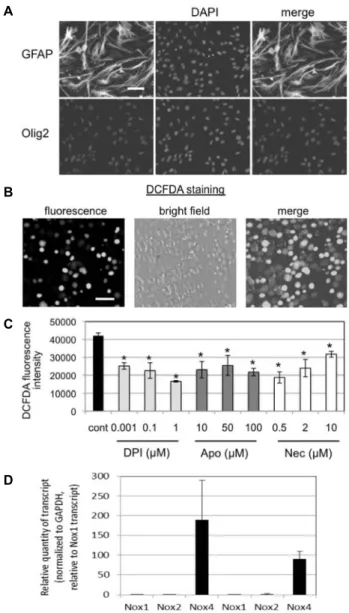
Before examining ROS and Nox, we confirmed that the cultured SVZ cells are neural stem cells by staining them with antibodies against GFAP [5] and Olig2 [19, 25] (Fig.

1A). About 46%(±6.5%) of the culture cells were GFAP+ and

about 95%(±2.0%) were Olig2+ (results from counting 3

wells). To examine the roles of ROS in SVZ NSCs, we first

used the ROS indicator DCFDA to examine the production

of ROS in NSCs cultured from postnatal mouse brain. Most

cells grown under proliferation conditions in N5 medium

(4)

A

B

C

D

Fig. 1. ROS generation and expression of Nox isoforms in SVZ NSC cultures in proliferating condition. A. Cultured SVZ NSCs were stained with neural stem cell markers, GFAP and Olig2. Scale bar=20 μm. B. After culturing NSCs in proliferating medium, cells were incubated in DCFDA dye solution and imaged for green fluorescence and bright field images. Fluorescence in cells indicates ROS generation. Scale bar=20 μm. C. Inhibition of ROS pro- duction in SVZ NSCs by ROS inhibitors (diphenyleneio- donium (DPI), apocynin (Apo), and Necrox-5 (Nec)).

Cells were incubated with inhibitors for 3.5 hr followed by DCFDA staining. DCFDA fluorescence intensity was measured and subtracted with blank condition. Data are mean and S.D. from four different wells of cells for each condition (*p<0.005, compared to no inhibitor control (cont)). D. NSCs were passaged twice (passage2) or 7 times (passage 7) in proliferating medium before RNA extraction. Expression level of ROS generating enzyme Nox isoforms was measured through qRT-PCR. Average and S.E. from three independent experiments are shown.

had green fluorescence, indicating the presence of endoge- nous ROS (Fig. 1B). Fluorescence intensity was heteroge- neous in the cell population, which is consistent with pre- vious studies that reported different SVZ NSC sub- populations with a high or low level of ROS [11, 15]. Since major sources of ROS are Nox enzyme and mitochondria, we tested Nox inhibitors, DPI and apocynin [15] as well as mitochondria ROS inhibitor Necrox-5 [14]. Those ROS in- hibitors significantly decreased ROS level in SVZ NSC cul- ture cells by approximately 50% (Fig. 1C). Therefore, it seems both Nox and mitochondria contribute endogenous ROS production in SVZ NSCs. Next, we examined which Nox isoform(s) are involved in generation of endogenous ROS in SVZ NSCs. Since Nox1, 2, and 4 are expressed in mouse brain [11], we checked these candidates by qRT-PCR. The expression of Nox4 was high in NSCs grown under pro- liferating conditions, while the levels of Nox1 and 2 tran- scripts were very low at both early (passage 2) and late pas- sages (passage 7) (Fig. 1D). The expression level of Nox4 tended to be lower in passage 7 than in passage 2, but the difference was not statistically significant (p=0.39). These re- sults suggest that ROS in proliferating NSCs might be gen- erated by Nox4.

Increased expression of Nox4 during neuronal differentiation

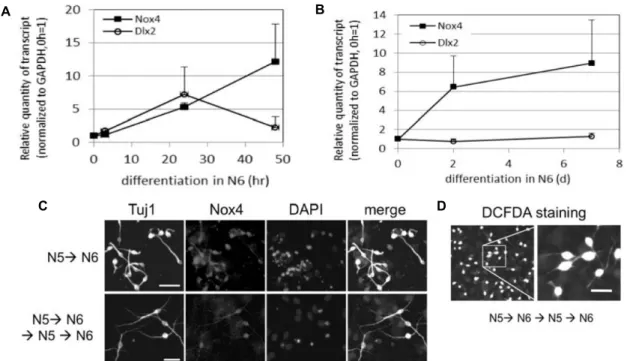
ROS generated by Nox2 are required for proliferation and neurogenesis of adult mouse SVZ NSCs [15]. In postnatal SVZ NSC cultures, cellular proliferation was not sig- nificantly affected by various oxidizing and reducing chem- icals (data not shown). Therefore, we focused on the roles of ROS and Nox4 in neuronal differentiation. During short- term differentiation (up to 48 hr), the level of the Nox4 tran- script greatly increased (Fig. 2A): 5.3, and 12.2 fold at 24 and 48 hr, respectively, compared to 0 hr. Consistent with the previous report [20], the expression of neuronal tran- scription factor Dlx2 peaked at approximately 24 hr, which confirms successful neuronal differentiation. Since the Nox4 level kept increasing even at 48 hr (Fig. 2A), longer time points were also tested. In an independent experiment, the relative increase of the Nox4 transcript level was 6.4 and 8.9 fold at 2 and 7 days of differentiation, respectively (Fig. 2B).

The difference between days 2 and 7 was not statistically significant (p=0.7). Thus, Nox4 gene upregulation appears to begin at the early stage of neuronal differentiation.

To confirm the qRT-PCR data, immunocytochemistry was

(5)

A B

C D

Fig. 2. Increased expression of Nox4 during neuronal differentiation. A. Short-term differentiation. After growing NSCs in proliferating condition (N5), the medium was switched to differentiation medium (N6). At different time points (0,3, 24, and 48 hr) after the medium switch, RNA was extracted from NSC cultures for qRT-PCR. Transcript levels of Nox4 and neuronal transcription factor Dlx2 were normalized to GAPDH. B. Long-term differentiation. Same procedure as in A with longer time points (0, 2, and 7 days) after medium switch to differentiation N6 medium. Data are mean and S.E. from three independent experiments both in A and B. C. Immunocytochemistry to detect Nox4 protein. Upper panel, NSC cultures were grown in N5 and medium was switched to N6 for 5 days. Lower panel, repeated medium switch: cells were kept in (1) N5, (2) N6 for 5 days, (3) N5 for 2 days, and then, (4) N6 for 5 days. Green for neuronal marker Tuj1, red for Nox4, and blue for nucleus staining DAPI. Scale bar=20 μm. D. DCFDA staining to detect ROS in differentiated NSC cultures after repeated medium switch:

cells were kept in (1) N5, (2) N6 for 4 days, (3) N5 for 2 days, and then, (4) N6 for 4 days. Scale bar=5 μm.

performed to check the levels of the Nox4 protein. At 5 days of differentiation, Nox4 was detected in neuronal-specific tu- bulin Tuj1-positive cells (Fig. 2C, upper panel). Recently, re- peated switches between proliferation medium (N5) and dif- ferentiation medium (N6) have been demonstrated to in- crease the rate of neurogenesis [20]. When this procedure was followed, Nox4 was also detected in neurons with long neuronal processes (Fig. 2C, lower panel). These results sup- port the notion that an increase in Nox4 expression during differentiation of SVZ NSCs occurs mainly in neurons.

Further, we examined ROS generation in differentiated NSCs by staining them with DCFDA. Neuronal-like cells with processes were positive for DCFDA fluorescence (Fig.

2D), indicating that ROS were indeed generated in neurons.

Therefore, it is tempting to suggest that the increased ex- pression of Nox4 in differentiated neurons increases ROS generation.

Inhibition of neurogenesis by N-acetyl cysteine

To investigate the function of endogenous ROS in neuro-

genesis, we examined the effect of the ROS scavenger NAC

on differentiating SVZ NSCs. First, the inhibitory effect of

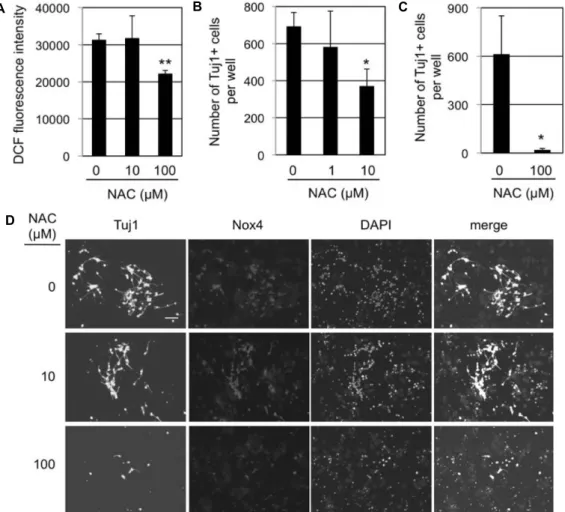
NAC on ROS generation was confirmed (Fig. 3A). A high

concentration of NAC (100 μM) decreased DCFDA fluo-

rescence in proliferating NSCs by one third, compared to

0 μM NAC. A low concentration of NAC (10 μM) did not

significantly reduce DCFDA fluorescence (p=0.4). Next, we

examined the effect of NAC on neurogenesis. After NSCs

were grown in N5 proliferation medium, medium was

switched to N6 differentiation medium containing 0, 1, or

10 μM NAC. After 5 days of differentiation, neurogenesis

was inhibited by treatment with 10 μM NAC, but not with

1 μM NAC (Fig. 3B). In a separate experiment, NSCs were

treated with 0 or 100 μM NAC during 5 days of differ-

entiation. The high concentration of 100 μM NAC greatly

decreased neurogenesis. The number of neurons was only

approximately 3% of that in the control 0 μM NAC (Fig.

(6)

A B C

D

Fig. 3. Effect of reducing agent NAC on neuronal differentiation of SVZ NSCs. A. NSCs cultured in proliferating medium containing different concentrations of NAC (0, 10, and 100 μM) for 3~4 hr were subjected to DCFDA staining. DCFDA fluorescence intensity was measured and subtracted with blank condition. Data are mean and S.D. from four different wells of cells for each condition (**p<0.005). B. NSCs were differentiated in N6 medium containing 0, 1, or 10 μM NAC for 5 days before immunocytochemistry. C. The same procedure as in B was performed with 0 or 100 μM NAC. Tuj1-positive cells were counted from three wells of each condition in both B and C. Data are mean and S.D. from three wells in both B and C (*p<0.05).

D. NSCs were differentiated in N6 medium containing 0, 10, or 100 μM NAC for 5 days before immunocytochemistry.

Representative images show neuronal marker Tuj1, Nox4, and nucleus (DAPI). Scale bar=50 μm.

3C). The figure 3D shows reduced neurogenesis by NAC.

All these results suggest that the normal level of ROS might be critical for neuronal differentiation.

Inhibition of neurogenesis by knockdown of Nox4 To investigate the role of Nox4 in neurogenesis in a more direct way, SVZ NSCs were transduced with lentiviral vec- tors encoding short hairpin RNA against Nox4 (LV-Nox4 shRNA). We chose Nox4 shRNA lentiviral vector that was already tested for the knockdown efficiency in a previous report [16]. Since LV-Nox4 shRNA and LV-negative control shRNA vectors contain GFP, infected cells were positive for GFP. After transduction, cells were grown in proliferating N5 medium for 6 days before medium switch to differ-

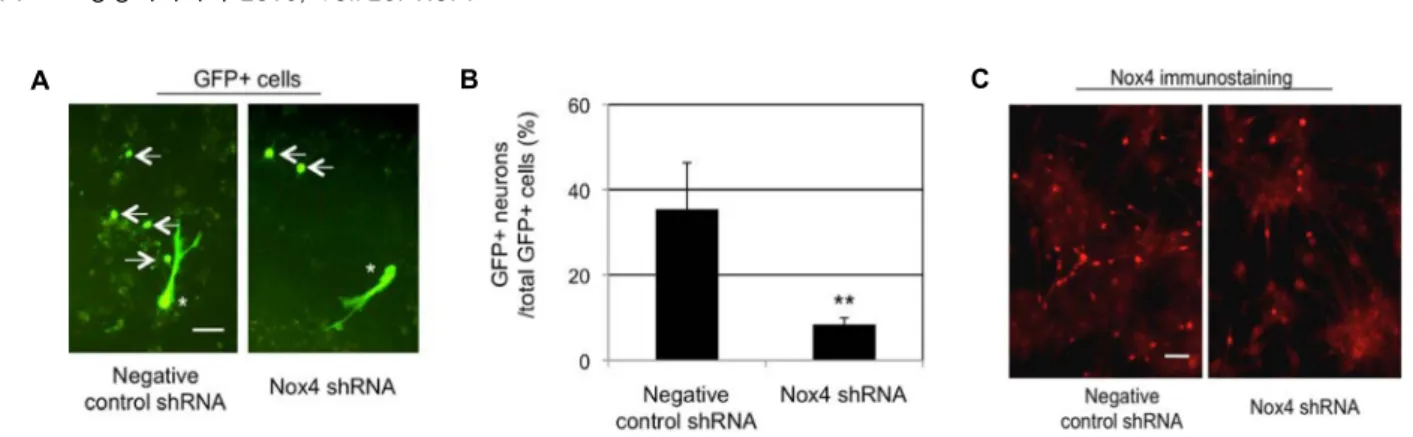
entiation N6 medium. At 5 day of differentiation, GFP-pos- itive neurons with small cell bodies and long neuronal proc- esses were observed (Fig. 4A). In NSCs transduced with con- trol viruses, the number of neurons was 35% of total number of transduced cells (Fig. 4B). However, in NSCs transduced with LV-Nox4 shRNA, only 8% of transduced cells with len- tiviral vectors were neurons (Fig. 4B). The decrease of Nox4 staining in NSCs transduced with LV-Nox4 shRNA, com- pared to NSCs transduced with control vector confirms the knockdown of Nox4 by the lentiviral vector (Fig. 4C).

Therefore, it seems that knockdown of Nox4 reduces neuro-

genesis, suggesting that Nox4 might be an important factor

in the neurogenesis of SVZ NSCs.

(7)

A B C

Fig. 4. Reduced neurogenesis by Nox4 shRNA. A. NSCs were transduced with LV-negative control shRNA-GFP or LV- Nox4shRNA-GFP. At 5 days post differentiation, GFP-positive cells were imaged from live cultures. Neurons are marked with arrows and non-neuronal cells with asterisks (*). Scale bar=20 μm. B. Transduced NSCs as in A were imaged and GFP-positive cells were counted from 4 wells in each condition. Data are mean and S.D. from 4 wells (**p<0.005). C. After examining GFP fluorescence, the same samples were subject to immunocytochemistry for Nox4. Representative images are shown. Scale bar=20 μm.

Discussion

ROS have been thought to be toxic byproducts of cellular respiration in mitochondria. However, numerous studies have shown that ROS play key roles in normal physiology of the vascular and immune systems and in signal trans- duction, including oxygen sensing [1]. More recently, ROS have been reported to be involved in stem cell maintenance and fate decision [2]. Specifically, neuronal differentiation of neural stem cells is regulated by a ROS-mediated signal transduction pathway [29]. Yet, there have been few reports of ROS-generating enzymes in stem cell biology [16, 32].

In this study, we investigated the role of ROS and a ROS-generating enzyme in SVZ NSCs dissected from post- natal mouse brain. Consistent with previous studies, ROS appeared to be a key part of neuronal differentiation of SVZ NSCs. However, the ROS-generating enzyme detected in this study was different from that identified in the previous work. Le Belle et al. [15] subjected adult SVZ NSC neuro- sphere cultures to hypoxia and observed an elevation of Nox2 expression. However, we examined Nox1, 2, and 4 iso- forms and found that only Nox4 was prominently expressed in postnatal SVZ NSCs monolayer cultures. Therefore, it seems that age and/or culturing procedure might have af- fected the expression pattern of Nox isoforms in the two studies. It will be interesting to examine the Nox expression pattern in brains of mice of different ages and under differ- ent culture conditions.

In this work, we showed that the level of Nox4 transcript was strongly increased during neurogenesis of SVZ NSCs.

In addition, we detected ROS in differentiated neurons and

a ROS scavenger inhibited neurogenesis. Furthermore, knockdown of Nox4 resulted in reduced neurogenesis. From these results, it is tempting to propose that the lack of growth factors and serum in differentiation medium might have led to upregulation of the Nox4 gene, which caused elevation of ROS production, and then ROS served as a sig- nal for NSCs to start neuronal differentiation. ROS signaling in neurogenesis might be mediated by the PI3K–Akt path- way as shown previously in adult SVZ NSCs [15]. Since Nox4 enzyme activity seems to be regulated at the transcrip- tional level [24], the upregulation of the Nox4 gene might result in an increase in total Nox4 enzymatic activity fol- lowed by an increase of ROS production. Epigenetic regu- lation of the Nox4 gene in other cell systems has been re- ported [23, 34] and histone modifications have been demon- strated to be key factors in neurogenesis of SVZ NSCs [10, 20]. Therefore, it will be worth studying epigenetic regu- lation of the Nox4 gene during neuronal differentiation.

Neurogenesis of neural stem cells is initiated, regulated, and facilitated by a plethora of intrinsic and extrinsic factors.

Recently, ROS have been added to the list. The results of this study suggest that Nox4 might be a major ROS-generat- ing enzyme in neurogenesis in postnatal SVZ NSC cultures.

Still, more work needs to be done to fully identify the molec-

ular mechanisms of Nox4 gene regulation and the players

downstream of ROS during neuronal differentiation. In the

future, a more complete picture of neuronal differentiation

process should help to efficiently generate neurons on a dish

for therapeutic applications such as cell replacement therapy

for neurodegenerative diseases.

(8)

Acknowledgment

This work was supported by the Korea Science Academy of KAIST with funds from the Ministry of Science, ICT and Future Planning and by Basic Science Research Program through the National Research Foundation of Korea (NRF) funded by the Ministry of Science, ICT and Future Planning (2015R1C1A1A02037078).

References

1. Alfadda, A. A. and Sallam, R. M. 2012. Reactive oxygen spe- cies in health and disease. J. Biomed. Biotechnol. 2012, 936486.

2. Bigarella, C. L., Liang, R. and Ghaffari, S. 2014. Stem cells and the impact of ros signaling. Development 141, 4206-4218.

3. Chuikov, S., Levi, B. P., Smith, M. L. and Morrison, S. J.

2010. Prdm16 promotes stem cell maintenance in multiple tissues, partly by regulating oxidative stress. Nat. Cell Biol.

12, 999-1006.

4. Dickinson, B. C., Peltier, J., Stone, D., Schaffer, D. V. and Chang, C. J. 2011. Nox2 redox signaling maintains essential cell populations in the brain. Nat. Chem. Biol. 7, 106-112.

5. Doetsch, F., Garcia-Verdugo, J. M. and Alvarez-Buylla, A.

1997. Cellular composition and three-dimensional organ- ization of the subventricular germinal zone in the adult mammalian brain. J. Neurosci. 17, 5046-5061.

6. Domenis, R., Bergamin, N., Gianfranceschi, G., Vascotto, C., Romanello, M., Rigo, S., Vagnarelli, G., Faggiani, M., Parodi, P., Kelley, M. R., Beltrami, C. A., Cesselli, D., Tell, G. and Beltrami, A. P. 2014. The redox function of ape1 is involved in the differentiation process of stem cells toward a neuronal cell fate. PLoS One 9, e89232.

7. Forsberg, K. and Di Giovanni, S. 2014. Cross talk between cellular redox status, metabolism, and p53 in neural stem cell biology. Neuroscientist 20, 326-342.

8. Haack, F., Lemcke, H., Ewald, R., Rharass, T. and Uhrmacher, A. M. 2015. Spatio-temporal model of endogenous ros and raft-dependent wnt/beta-catenin signaling driving cell fate commitment in human neural progenitor cells. PLoS Comput.

Biol. 11, e1004106.

9. Hou, Y., Ouyang, X., Wan, R., Cheng, H., Mattson, M. P.

and Cheng, A. 2012. Mitochondrial superoxide production negatively regulates neural progenitor proliferation and cer- ebral cortical development. Stem Cells 30, 2535-2547.

10. Hwang, W. W., Salinas, R. D., Siu, J. J., Kelley, K. W., Delgado, R. N., Paredes, M. F., Alvarez-Buylla, A., Oldham, M. C. and Lim, D. A. 2014. Distinct and separable roles for ezh2 in neurogenic astroglia. Elife 3, e02439.

11. Infanger, D. W., Sharma, R. V. and Davisson, R. L. 2006.

Nadph oxidases of the brain: Distribution, regulation, and function. Antioxid. Redox Signal. 8, 1583-1596.

12. Kanda, Y., Hinata, T., Kang, S. W. and Watanabe, Y. 2011.

Reactive oxygen species mediate adipocyte differentiation in mesenchymal stem cells. Life Sci. 89, 250-258.

13. Kim, J. and Wong, P. K. 2009. Loss of atm impairs pro- liferation of neural stem cells through oxidative stress-medi- ated p38 mapk signaling. Stem Cells 27, 1987-1998.

14. Kim, S. R., Kim, D. I., Kim, S. H., Lee, H., Lee, K. S., Cho, S. H. and Lee, Y. C. Nlrp3 inflammasome activation by mi- tochondrial ros in bronchial epithelial cells is required for allergic inflammation. Cell Death Dis. 5, e1498.

15. Le Belle, J. E., Orozco, N. M., Paucar, A. A., Saxe, J. P., Mottahedeh, J., Pyle, A. D., Wu, H. and Kornblum, H. I.

2011. Proliferative neural stem cells have high endogenous ros levels that regulate self-renewal and neurogenesis in a pi3k/akt-dependant manner. Cell Stem Cell 8, 59-71.

16. Lee, J. E., Cho, K. E., Lee, K. E., Kim, J. and Bae, Y. S. 2014.

Nox4-mediated cell signaling regulates differentiation and survival of neural crest stem cells. Mol. Cells 37, 907-911.

17. Lim, D. A., Huang, Y. C., Swigut, T., Mirick, A. L., Garcia- Verdugo, J. M., Wysocka, J., Ernst, P. and Alvarez-Buylla, A. 2009. Chromatin remodelling factor mll1 is essential for neurogenesis from postnatal neural stem cells. Nature 458, 529-533.

18. Liu, J., Cao, L., Chen, J., Song, S., Lee, I. H., Quijano, C., Liu, H., Keyvanfar, K., Chen, H., Cao, L. Y., Ahn, B. H., Kumar, N. G., Rovira, II., Xu, X. L., van Lohuizen, M., Motoyama, N., Deng, C. X. and Finkel, T. 2009. Bmi1 regu- lates mitochondrial function and the DNA damage response pathway. Nature 459, 387-392.

19. Menn, B., Garcia-Verdugo, J. M., Yaschine, C., Gonzalez- Perez, O., Rowitch, D. and Alvarez-Buylla, A. 2006. Origin of oligodendrocytes in the subventricular zone of the adult brain. J. Neurosci. 26, 7907-7918.

20. Park, D. H., Hong, S. J., Salinas, R. D., Liu, S. J., Sun, S.

W., Sgualdino, J., Testa, G., Matzuk, M. M., Iwamori, N.

and Lim, D. A. 2014. Activation of neuronal gene expression by the jmjd3 demethylase is required for postnatal and adult brain neurogenesis. Cell Rep. 8, 1290-1299.

21. Park, J. E., Seo, Y. K., Yoon, H. H., Kim, C. W., Park, J.

K. and Jeon, S. 2013. Electromagnetic fields induce neural differentiation of human bone marrow derived mesen- chymal stem cells via ros mediated egfr activation. Neuro- chem. Int. 62, 418-424.

22. Price, J. D., Park, K. Y., Chen, J., Salinas, R. D., Cho, M.

J., Kriegstein, A. R. and Lim, D. A. 2014. The ink4a/arf locus is a barrier to direct neuronal transdifferentiation. J. Neurosci.

34, 12560-12567.

23. Sanders, Y. Y., Liu, H., Liu, G. and Thannickal, V. J. 2015.

Epigenetic mechanisms regulate nadph oxidase-4 expression in cellular senescence. Free Radic. Biol. Med. 79, 197-205.

24. Serrander, L., Cartier, L., Bedard, K., Banfi, B., Lardy, B., Plastre, O., Sienkiewicz, A., Forro, L., Schlegel, W. and Krause, K. H. 2007. Nox4 activity is determined by mrna levels and reveals a unique pattern of ros generation.

Biochem. J. 406, 105-114.

25. Shen, Q., Wang, Y., Kokovay, E., Lin, G., Chuang, S. M.,

Goderie, S. K., Roysam, B. and Temple, S. 2008. Adult svz

stem cells lie in a vascular niche: A quantitative analysis

of niche cell-cell interactions. Cell Stem Cell 3, 289-300.

(9)

초록:쥐의 뇌실 하 영역(SVZ) 신경 줄기 세포의 신경 세포로의 분화 과정에서 Nox4의 역할

박기엽

1

*․나예린

1

․김만수

2

(

1

KAIST 부설 한국과학영재학교,

2

인제대학교 약학대학)

적절한 농도의 활성산소종(ROS)은 병원체에 대한 세포의 방어, 신호 전달, 세포 성장 및 유전자 발현을 포함한 다양한 정상 세포 기능을 매개한다. 최근의 연구는 ROS와 ROS를 생성하는 NADPH 산화 효소(Nox)가 성인 쥐 뇌의 뇌실 하 영역(SVZ)에 있는 신경 줄기세포의 자가 복제와 신경 세포 분화에 중요하다는 것을 보여 주었다.

본 연구에서 세포 내 ROS가 갓 태어난 쥐의 뇌에서 적출되어 배양된 SVZ 신경 줄기세포에서 검출된 것으로 나타 났다. Nox 유사 유전자들 중 Nox4가 배양된 세포에서 주로 발현되었고, Nox1과 Nox2는 거의 발현되지 않았다.

또한, Nox4 유전자는 신경 세포 분화 동안 최대 10배까지 발현이 크게 증가하였다. Immunocytochemistry결과 Nox4 단백질은 신경 세포 특이적인 tubulin인 Tuj1-양성 신경 세포에서 주로 발견되었다. 이와 맥을 같이 하여, 내인성 ROS는 분화 후 축삭돌기를 가지고 있으며 신경 세포로 보이는 세포에서만 검출되었다. 또한, ROS를 제거 하는N-acetyl cysteine에 의해 세포 산화 환원 상태가 교란되었을 때, 신경 세포로의 분화가 크게 감소하였다. 마지 막으로, shRNA를 이용하 여 Nox4를 knockdown한 세포에서 신경 세포로의 분화가 감소하였다. 이러한 연구 결 과는 Nox4가 갓 태어난 쥐의 SVZ 신경 줄기 세포의 주요한 ROS 생성 효소이고, Nox4에 의한 ROS생성이 신경 세포 분화에 중요하다는 것을 암시한다.

26. Sorce, S. and Krause, K. H. 2009. Nox enzymes in the central nervous system: From signaling to disease. Antioxid. Redox Signal. 11, 2481-2504.

27. Sumimoto, H. 2008. Structure, regulation and evolution of nox-family nadph oxidases that produce reactive oxygen species. FEBS J. 275, 3249-3277.

28. Topchiy, E., Panzhinskiy, E., Griffin, W. S., Barger, S. W., Das, M. and Zawada, W. M. 2013. Nox4-generated super- oxide drives angiotensin ii-induced neural stem cell pro- liferation. Dev. Neurosci. 35, 293-305.

29. Vieira, H. L., Alves, P. M. and Vercelli, A. 2011. Modulation of neuronal stem cell differentiation by hypoxia and reactive oxygen species. Prog. Neurobiol. 93, 444-455.

30. Walton, N. M., Shin, R., Tajinda, K., Heusner, C. L., Kogan, J. H., Miyake, S., Chen, Q., Tamura, K. and Matsumoto, M.

2012. Adult neurogenesis transiently generates oxidative stress. PLoS One 7, e35264.

31. Wei, W., Lu, Y., Hao, B., Zhang, K., Wang, Q., Miller, A.

L., Zhang, L. R., Zhang, L. H. and Yue, J. 2015. Cd38 is required for neural differentiation of mouse embryonic stem cells by modulating reactive oxygen species (ros). Stem Cells.

33, DOI: 10.1002/stem.2057.

32. Xiao, Q., Luo, Z., Pepe, A. E., Margariti, A., Zeng, L. and Xu, Q. 2009. Embryonic stem cell differentiation into smooth muscle cells is mediated by nox4-produced h2o2. Am. J.

Physiol. Cell Physiol. 296, C711-723.

33. Yoneyama, M., Kawada, K., Gotoh, Y., Shiba, T. and Ogita, K. 2010. Endogenous reactive oxygen species are essential for proliferation of neural stem/progenitor cells. Neurochem.

Int. 56, 740-746.

34. Zelko, I. N. and Folz, R. J. 2015. Regulation of oxidative stress in pulmonary artery endothelium: Modulation of ec-sod and nox4 expression using hdac class i inhibitors.

Am. J. Respir. Cell Mol. Biol. 53, 513-524.

수치

Fig.  1.  ROS  generation  and  expression  of  Nox  isoforms  in  SVZ  NSC  cultures  in  proliferating  condition
Fig.  2.  Increased  expression  of  Nox4  during  neuronal  differentiation.  A.  Short-term  differentiation
Fig.  3.  Effect  of  reducing  agent  NAC  on  neuronal  differentiation  of  SVZ  NSCs
Fig.  4.  Reduced  neurogenesis  by  Nox4  shRNA.  A.  NSCs  were  transduced  with  LV-negative  control  shRNA-GFP  or  LV-  Nox4shRNA-GFP

참조

관련 문서

In Jangsu stream, blue-green algae were temporarily increased by 59% due to the eutrophication and reduction of water level in July, but no toxins

We found that FoxO1 is constantly increased in MCF-7/ADR, adriamycin-resistant breast cancer cells, and FoxO1 has a critical role in the MDR1 gene expression (16).. There is

Approved clinical use of bone marrow stem cells for myocardial infarction treatment... Cardiac

In this study, we found that Pin1 plays a pivotal role in insulin- induced AP-1 activation through its interaction with p70S6K and prolongs activity of

In this context, the present study found that the emphasis of art education was changing from expression-oriented practical classes to systematic

A Study on the Evaluation of Space Recognition Space Recognition Space Recognition in the Space Recognition in the in the in the Concourse of Hospital using the

Meterials and Methods: Our study involved three stem cell sources-subacromial bursal tissue, bone marrow, and umbilical cord-derived stem cells. Under consent we

Recent stem cell studies have reported that cultured hematopoietic stem cells (HSCs) are reactivated through fetal hemoglobin expression by treatment with