• 검색 결과가 없습니다.

Improvement Scheme of Airborne LiDAR Strip Adjustment

N/A
N/A
Protected

Academic year: 2021

Share "Improvement Scheme of Airborne LiDAR Strip Adjustment"

Copied!
15
0
0

로드 중.... (전체 텍스트 보기)

전체 글

(1)

https://doi.org/10.7848/ksgpc.2018.36.5.355

Improvement Scheme of Airborne LiDAR Strip Adjustment

Lee, Dae Geon

1)

· Lee, Dong-Cheon

2)

Abstract

LiDAR (Light Detection And Ranging) strip adjustment is process to improve geo-referencing of the ALS (Airborne Laser Scanner) strips that leads to seamless LiDAR data. Multiple strips are required to collect data over the large areas, thus the strips are overlapped in order to ensure data continuity. The LSA (LiDAR Strip Adjustment) consists of identifying corresponding features and minimizing discrepancies in the overlapping strips. The corresponding features are utilized as control features to estimate transformation parameters. This paper applied SURF (Speeded Up Robust Feature) to identify corresponding features. To improve determination of the corresponding feature, false matching points were removed by applying three schemes: (1) minimizing distance of the SURF feature vectors, (2) selecting reliable matching feature with high cross-correlation, and (3) reflecting geometric characteristics of the matching pattern. In the strip adjustment procedure, corresponding points having large residuals were removed iteratively that could achieve improvement of accuracy of the LSA eventually. Only a few iterations were required to reach reasonably high accuracy. The experiments with simulated and real data show that the proposed method is practical and effective to airborne LSA. At least 80 % accuracy improvement was achieved in terms of RMSE (Root Mean Square Error) after applying the proposed schemes.

Keywords : Airborne LiDAR Data, Strip Adjustment, SURF Matching, Data-driven LSA

Original article

Received 2018. 09. 20, Revised 2018. 10. 11 Accepted 2018. 10. 24

1) Member, Department of Geoinformation Engineering, Sejong University (E-mail: [email protected])

2) Corresponding Author, Member, Department of Geoinformation Engineering, Sejong University (E-mail: [email protected])

1. Introduction

1.1 Characteristics of LSA methods

LSA (LiDAR Strip Adjustment) methods are categorized into “data-driven” and “sensor model-driven” (or system- driven) approach. Data-driven and sensor model-driven are the generic terms of the strip adjustment and calibration, respectively. In general, data-driven and sensor model- driven approach are referred to simplified and rigorous method, respectively. The data-driven method is based on establishing 3D coordinate transformation between adjacent

strips while the sensor model-driven method aims to calibrate physical sensor parameters. The data-driven method utilizes measurement of the discrepancies between corresponding features in the overlapping strips. On the other hand, the sensor model-driven method is based on a model of the sensor system relating the coordinates of the point clouds to their raw observations including time, origin and attitude of the platform and range measured from GPS (Global Positioning System) and INS (Inertial Navigation System), and laser scanner (Pfeifer et al ., 2005; Schenk, 2001; Toth, 2009).

For rigorous calibration of the ALS (Airborne Laser

This is an Open Access article distributed under the terms of the Creative Commons Attribution Non-Commercial License (http://

(2)

Scanner) systems, individual raw measurements from each sensor ( i.e . GPS, INS and laser scanner) are required.

However, such measurements from the ALS system are not available to the end users in most cases (Kersting and Habib, 2012). Therefore, the data-driven method is often used as an alternative (or indirect) way for ALS system calibration.

As for accuracy of the LSA, the absolute accuracy of the LiDAR (Light Detection And Ranging) points might not be guaranteed even though the data-driven method provides seamless data. Therefore, if reference surface data with high accuracy ( i.e . precisely surveyed well-defined features) is available, the overall absolute accuracy would be improved (Toth, 2009). Concept of the LSA is similar to independent model method of the aerial triangulation, however, there is no unique or standard method for LSA because of variety of the matching methods.

1.2 Literature review of LSA

Since the ALS systems were commercialized in late 1990s, many studies have been carried out for LSA. Maas (2000) suggested a method to establish correspondence by minimizing the normal distances between point clouds in one strip and DSM (Digital Surface Model) surfaces formed with TIN (Triangular Irregular Networks) in the other strip. Filin (2003), and Filin and Vosselman (2004) presented an error recovery model based on the system-driven approach that utilizes natural and man-made surfaces as control features.

Pfeifer et al . (2005) proposed a method to determine the tie surfaces ( i.e . corresponding features) by applying planar surface segmentation in the overlapping strips. Habib et al . (2008) utilized linear features to find correspondence between overlapping strips. Habib et al . (2009) proposed a method for point-to-surface feature matching that is ICPatch (Iterative Closest Patch) correspondence for quality control of the LiDAR data. Bang et al . (2010) introduced alternative methods for ALS system calibration based on the simplified and quasi- rigorous scheme. The simplified method utilizes coordinates of the LiDAR points in overlapping parallel strips to estimate biases in the system parameters without raw measurements while the quasi-rigorous method is based on the heading angle and elevation variations of the platform trajectories by utilizing time-tagged points and positions of the trajectory.

Habib et al . (2010) analyzed influence of the ALS system calibration to both relative and absolute accuracy using geo-referenced aerial images. Han et al . (2012) presented a modified ICP (Iterative Closest Point) algorithm to improve relative accuracy between strips and absolute accuracy by utilizing digital maps. The ICP assumes that one point set is a subset of the other. If this assumption is not valid, false matches result in the negatively influences to the correct solution (Gruen and Akca, 2005). Zhang et al . (2013) proposed a method for strip adjustment using LiDAR intensity images and aero-triangulated images to determine the corresponding points by matching between intensity and aerial images. Lee et al . (2014) presented 3D coordinate transformation between LiDAR strips by cross-correlation surface matching to extract corresponding point features with sub-pixel accuracy. Glira et al . (2015) applied ICP algorithm developed by Besl and McKay (1992) for on-the-job calibration of the ALS system by utilizing the raw scanner and trajectory measurements to correct the trajectory errors of each strip.

Recently, UAV (Unmanned Aerial Vehicle) based laser scanner systems are available. Therefore, LSA methods specialized for LiDAR data obtained from the UAVs are to be expected widely employed. Glira et al . (2016) introduced a rigorous and flexible LSA method referred to as spline trajectory correction model to estimate time-dependent UAV’s trajectory errors that based on individually modeled errors ( i.e . coordinates of the origin and scanner mirror angles) for each strip. The key issue of either data-driven or sensor model- driven approach is to establish correspondence between strips. Therefore, determination of the reliable corresponding features is crucial task for LSA.

1.3 Objectives

Accuracy of the LiDAR data obtained from airborne ALS systems is influenced by various error sources such as specifications of the laser scanner, GPS and INS, system calibration, bore-sight alignment, and flight condition.

Numerous strips are required to collect data over large

areas due to limited scan-width. The adjacent strips are

overlapped in order to ensure continuity of the data. One of

the major factors that degrade quality of the LiDAR data is

discrepancies between strips. Such discrepancies have to be

(3)

minimized through the strip adjustment. However, LSA is quite complex process because LiDAR data provides limited information. (Filin and Vosselman, 2004). As for matching to determine corresponding features in the overlap strips, SURF (Speeded Up Robust Feature) that is one of the most widely used matching methods was intensively investigated to improve matching and LSA, in this paper.

2. Methodology

2.1 Overview of proposed method

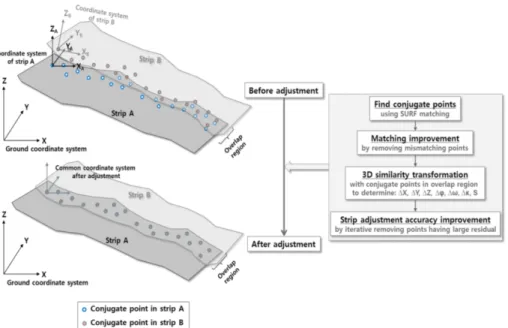
The main tasks of this paper are to establish correspondence between adjacent strips by matching, and strip adjustment through coordinate transformation. SURF algorithm and 3D transformation were employed for feature matching and LSA, respectively. Fig. 1 shows overview of the proposed method and following efforts were made to improve accuracy of the LSA:

● Removing incorrectly identified corresponding points by analyzing matching quality and characteristics

● Updating adjustment parameters by iterative removing errors

● Accuracy analysis of the parameters and transformed coordinates after LSA

Feature matching is essential for photogrammetric tasks including identification of conjugate points ( i.e . pass or tie points) for aerial triangulation, DSM generation, determination of model key features for 3D modeling, and seamline detection for image mosaicking. Existing matching algorithms can be applicable to the LiDAR data. However, LiDAR data are irregularly distributed points while images are regularly gridded raster ( i.e . pixel) form. Point density and distribution, and resampling method of the LiDAR data influence to the final results. In this paper, SURF was used to establish correspondence. SURF is robust to the geometric changes including scale, rotation and translation. Mismatched features (or false matchings) were excluded from the matching candidates to determine corresponding points that later were to be utilized as control points. Following three criteria were employed to improve matching quality:

● Upper percentile of similarity measures of the descriptors between matching features

● High cross-correlation of the descriptors between matching features

● Geometric characteristics of the matching pattern between adjacent strips

Fig. 1. Scheme to improve accuracy of LiDAR strip adjustmen t

(4)

The accuracy of the LSA depends on matching and adjustment process including following factors:

● Quality of the corresponding feature identification

● Robustness of the corresponding feature matching

● Adequateness of the mathematical model for adjustment

● Accuracy of the adjustment parameters

2.2 Feature matching

Matching is to find correspondences between different data sets. In most cases, matching is preceded by feature detection and description, and consists of following steps (Hassaballah et al ., 2016):

● Selection of interest points ( i.e . distinctive features such as corners, intersections and blobs)

● Representation of feature vectors at neighborhood of each interest point

● Matching based on distance between feature vectors SURF is an improved algorithm of the SIFT (Scale- Invariant Feature Transform) proposed by Lowe (2004). The advantages of the SURF over the SIFT are fast in computation

and less influence on geometric and topographic changes.

SURF consists of three procedures that are feature detection, descriptor generation, and matching based on similarity of the descriptors (Bay et al ., 2008).

2.2.1 Derivatives of Hessian matrix

Hessian matrix ( H ), which is symmetric and composed of the second-order partial derivatives, is utilized for feature detection. The Hessian matrix was developed to describe the local curvature of a function with multi-variables. The role of the Hessian matrix in SURF is to detect critical points ( e.g . interest points and corner points). Fig. 2 is visualization of different versions of the Hessian matrices.

denotes convolution of the Gaussian second-order derivative, i.e . , and similarly for and . denotes location of the LiDAR points, and σ is referred to the standard deviation of the Gaussian function that represents scale space. There are three types of the Hessian matrix that are original ( i.e . continuous),

Hessian matrix Original Hessian Discretized Hessian Approximate Hessian

2D view

3D view

Characteristics ? Circular shape

? Spatically continuous

? Continuous values

? Squre shape

? Spatially discretized

? Continuous values

? Squre shape

? Spatially discretized

? Approximate values

Fig. 2. Representation of Hessian matrices

(5)

discretized, and approximate version as shown Fig. 3. The original Hessian is continuous with circular shape. Discretized Hessian is spatially discretized with square shape. Approximate Hessian is used for the practice. Thus, , , and with filter size N were used as partial derivatives for the implementation (Bay et al ., 2008). The relationship between standard deviation (σ) of the Gaussian function and the discretized filter size ( N ) in spatial domain is defined as Eqs. (1) or (2) (Haralick and Shapiro, 1992; Schenk, 1999).

N = 3·(2 2 )·σ (1) N = 2·{ceil (3 σ)}+1 (2)

where ceil( x ) denotes a ceiling function that takes the smallest integer greater than or equal to the value x . The reason for using three times of the standard deviation ( i.e . 3σ) is that this range of the Gaussian function includes more than 99% portion of the total as shown in Fig. 3. Therefore, 3σ is considered as maximum range to represent the original operator.

Fig. 3. Relationship between continuous and digital filter with respect to std. dev.

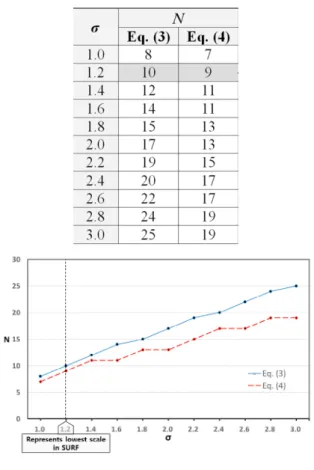
Table 1 shows the filter sizes corresponding to the standard deviation determined by Eqs. (1) and (2). As the standard deviation increases, difference of the filter sizes result from two equations is getting larger as shown in Table 1 and Fig. 4. However, the difference is not significant

since σ = 1.2 ( i.e . equivalent to N = 9 of the discrete filter) is used in SURF that represents the lowest scale ( i.e . highest resolution) in scale space.

Table 1. Relationship between std. dev. (σ) and filter size ( N )

Fig. 4. Plot of Table 1

Determinants of the discretized ( H ) and approximate Hessian matrix (H

approx

) are computed using Eqs. (3) and (4), respectively.

det(H) = L

xx

·L

yy

– (L

xy

)

2

(3)

det(H

approx

) = D

xx

·D

yy

– (D

xy

)

2

(4)

When the approximate matrix is utilized, correction term

has to be applied since det(H) ≠ det(H

approx

). Therefore,

weight factor that controls balance between discrete and

approximate Hessian matrix is required. In other words, the

weight factor compensates for the difference caused from

(6)

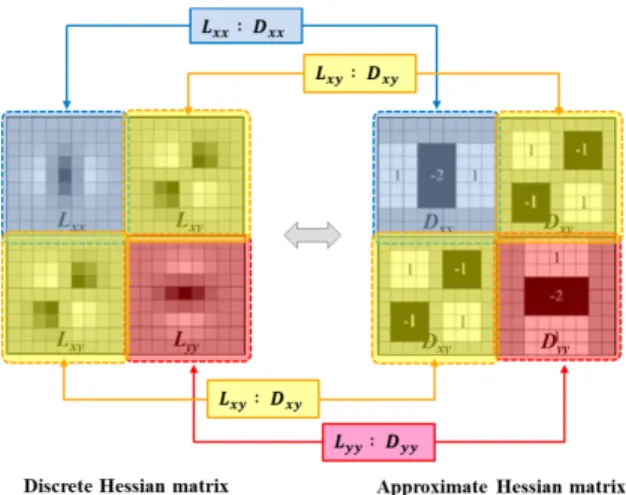
approximations of the derivatives, and the weight factor is ratio between corresponding derivatives of the Hessian matrices. In consequence, the weight factor could facilitate the approximate Hessian matrix for practice without losing equilibrium and computational efficiency. Fig. 5 shows role of the weight factor, and it can be determined using ratio based on the similarity measure between each corresponding sub- matrix.

Fig. 5. Corresponding partial derivatives between discrete and approximate Hessian matrices

The ratios between diagonal sub-matrices; L

xx

and D

xx

, and D

yy

and L

yy

are the same, but the ratio between off-diagonal sub-matrices; L

xy

and D

xy

are different from the ratio between diagonal sub-matrices. The similarity measures could be computed by using standard deviation, Forbenius norm, and correlation of each sub-matrix as Eqs. (5), (6) and (7) respectively.

● Standard deviation: (D

xx

)

std

/ (L

xx

)

std

= (D

yy

)

std

/ (L

yy

)

std

(D

xy

)

std

/ (L

xy

)

std

(5)

● Forbenius norm: ||D

xx

||

F

/ ||L

xx

||

F

= ||D

yy

||

F

/ ||L

yy

||

F

||D

xy

||

F

/ ||L

xy

||

F

(6)

● Correlation: {D

xx

·L

xx

}

corr

= {D

yy

·L

yy

}

corr

≠ {D

xy

·L

xy

}

corr

(7)

Standard deviation, Forbenius norm and correlation are computed by Eqs. (8), (9) and 10 respectively.

(8)

(9)

(10) where m and n are numbers of row and column of the matrix, respectively. a

ij

and b

ij

are an elements, and ā and b− are averages of each matrix. The ratio of the standard deviations and Forbenius norms of the matrix are the same because averages of the sub-matrices of the Hessian matrices are zero. In this matter, Eq. (4) can be rewritten including the weight factor as Eq. (11).

det( H

approx

) = D

xx

·D

yy

– (w·D

xy

)

2

(11) Table 2 shows that w is 0.912 from both standard deviation and Forbenius norm, and w is 0.918 from correlation. In practice, w = 0.9 can be applicable to compute determinant of the approximate Hessian matrix.

Table 2. Ratios between elements of Hessian matrices and weight factor (σ = 1.2 and N = 9) (a) Standard deviation and Forbenius norm of Hessian sub-matrices

Measure

Discrete Hessian ( L ) Approximate Hessian ( D ) Ratio ( D/L )

L

xx

L

yy

L

xy

D

xx

D

yy

D

xy

D

xx

/L

xx

D

yy

/L

yy

D

xy

/L

xy

Standard deviation 0.02 0.02 0.01 1.06 1.06 0.67 67.09 67.09 73.51

Forbenius norm 0.14 0.14 0.08 9.49 9.49 6.00 67.09 67.09 73.51

(7)

Table 2. Ratios between elements of Hessian matrices and weight factor (σ = 1.2 and N = 9)

(a) Standard deviation and Forbenius norm of Hessian sub- matrices

Although the weight factor has to change depending on the scale ( i.e . different σ), Bay et al . (2008) claimed that constant weight factor would not have a significant impact on the results. The process is performed in scale space to determine the final interest points (Lowe, 2004).

2.2.2 Generation of descriptors

Haar wavelet response was utilized as feature descriptor for matching by analyzing similarity of the surroundings of the interest points as shown in Fig. 6. The descriptor of SURF that is based on the Haar wavelet is generated through following procedure:

Determining main orientation: Create search window at each interest point and apply Haar wavelet to compute amount of variations by rotating every 5

o

to determine main orientation.

Computing x and y variations: Divide search windows with 4×4 regions ( i.e . total 16 regions) and Haar wavelet is applied along x- and y-direction as shown in Fig. 5. The

local window coordinate system is defined at step ① with respect to the main orientation.

Generating descriptors: Generate 4-dimensional descriptor vectors represented by Eq. (12) for 16 regions.

In consequence, total 64 descriptors ( i.e . 4 descriptors for 16 regions) are generated.

(12)

where is 4D descriptor vectors. d

x

and d

y

are variations for x- and y-direction, respectively.

(a) d x along x -direction (b) dy along y -direction Fig. 6. 3D view of Haar wavelet processing

2.3 Similarity Measure of Interest Points 2.3.1 Similarity measure

Bay et al . (2008) proposed Mahalanobis distance (Mahalanobis, 1936) and Euclidean distance to evaluate (b) Correlation between Hessian sub-matrices

Measure

{L

xx

, D

xx

}

corr

{L

yy

, D

yy

}

corr

{L

xy

, D

xy

}

corr

L

xx

D

xx

L

yy

D

yy

L

xy

D

xy

Correlation 0.71 0.71 0.78

(c) Weight factors computed from standard deviation Forbenius norm, and correlation

Measure

Weight factor (w)

Standard deviation 67.09 / 73.51 = 0.912 67.09 / 73.51 = 0.912

Forbenius norm 67.09 / 73.51 = 0.912 67.09 / 73.51 = 0.912

Correlation 0.71 / 0.78 = 0.918 0.71 / 0.78 = 0.918

(8)

similarity of the descriptors defined with Eqs. (13) and (14), respectively. For the LiDAR strips, the similarity measure was performed at every interest point extracted by SURF in the overlapping strips

(13)

where d

m

is Mahalanobis distance. and are the descriptor vectors of features extracted from LiDAR strip i and strip j, respectively. S is covariance matrix. If the covariance matrix is identity matrix, the Mahalanobis distance is equivalent to the Euclidean distance ( ).

(14)

Most of the matching methods based on SURF utilize Euclidean distance for 64 descriptors. This study proposed to use correlation between descriptors using Eq. (15).

(15) where is correlation coefficient, and and are average of and , respectively.

Matching pattern could reflect geometric relation between adjacent strips. In this regard, another proposed scheme is to analyze matching patterns of the matched pairs because Mahalanobis distance and correlation do not consider the geometric relations between matched features. The matching pattern is based on the geometric similarity of the matching pairs. If the corresponding points are correctly matched, the matched pairs have similar geometric characteristics such as distance and direction between pairs. To estimate dominant distance and direction of the matching pairs, modes ( i.e . most probable values) were computed using Eqs. (16) and (17).

for all matched pairs (16)

for all matched pairs (17) where and are modes of distance and direction for all matched points Ci and Cj , respectively.

i and j denote strip i and strip j , respectively. The results

from all three schemes were compared using test data sets.

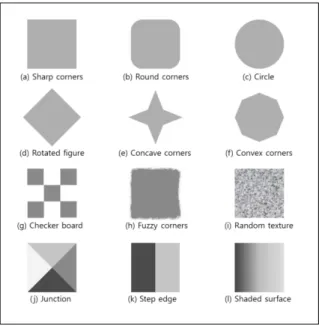
Fig. 7 shows test data, and Fig. 8 shows results from three different schemes. The test data set depicts various shapes and geometric characteristics of the objects.

Fig. 7. Test image for mating quality evaluation

(a) Matching result before removing mismatching

(b) Matching result after selecting top 20 % matching points

(9)

(c) Matching result after selecting correlation 0.9 matching points

(d) Matching result after selecting matching pattern Fig. 8. Matching results

2.3.2 Evaluation of matching schemes

Since there is geometric transformation in terms of translation, scale and rotation, not only similarity of the descriptors but also similarity of the geometric pattern has to be taken into account to improve matching. The matching was performed with test image and geometrically transformed target image. The target image was generated with translations of +20 pixels and +10 pixels in x- and y-direction, respectively, and scale factor of 0.75, and rotation angle of 25°. In order to improve matching, mismatched points were removed based on the Euclidean distance and correlation of the descriptors, and overall matching pattern as described in previous section. Fig.

8(a) shows the matching result before removing mismatched points, while Figs. 8(b), 8(c) and 8(d) show results by applying schemes for removing mismatched points. Matching is based on the similarity of the descriptors around the interest points regardless geometric characteristics between data hence certain constraints are necessary to determine correct correspondence. In this paper, three schemes were suggested.

The first one is to select top percentage (so called top N %) out

of matched points that is widely used in SURF. The second is to select points with high correlation value. Based on the visual inspection of the results, many of the mismatched points were removed.

As shown in Figs. 8(b) and 8(c) show some of experimental results of top N % and correlation with threshold of 20 % and 0.9, respectively are almost identical. However, still mismatched points exist even though the threshold values in both cases are quite enough. Also it is noticed that large rotation (25° in this example) results in mismatching as shown in Fig. 8(d). The experimental results show that the proposed scheme to improve matching could be feasible because the geometric variations between LiDAR strips are not extreme. In consequence, mismatched points can be removed effectively. Extreme rotation between data might deteriorate matching quality especially for matching pattern. However, the rotations between adjacent strips are small in airborne LiDAR. There is a trade-off between processing time and dimension of the descriptor in matching. Fewer dimensions are desirable for fast matching. However, lower dimensional feature vectors are less distinctive than their high-dimensional counterparts that results in reducing matching reliability (Bay et al ., 2008). Improvement of the matching quality was achieved by sequential process with order of upper top 20 %, cross-correlation of 0.9, and finally matching pattern criteria.

3. Mathematical Model for LSA

This paper deals with data-driven approach that is based on the 3D transformation of the point clouds between adjacent strips. The general mathematical model of the LSA is given by Eq. (18).

minimize (e)= || S

A

: {(X

i

, Y

i

, Z

i

)

A

| i=1, …, n} – T[S

B

: {(X

j

, Y

j

, Z

j

)

B

| j=1, …, m}] || (18)

where e is discrepancies between strips. ( X, Y, Z ) are

coordinates of a LiDAR point. S

A

and S

B

denote point clouds

in strip A and strip B , respectively. n and m are number of

points in each strip (Note: n and m are the same number if

there is one-to-one correspondence.). T represents the 3D

transformation that consists of translations, rotations and

(10)

scale. These parameters are determined by minimizing discrepancies through the least-square adjustment. Accuracy improvement of the adjustment could be achieved by iterative removing corresponding points having large residuals.

In addition, the overall accuracy of the strip adjustment is estimated by RMSE (Root Mean Square Error) of the coordinates at each step of the iteration using Eq. 19. The RMSE was computed from all points in the overlap area. The permissible RMSE depends on the required accuracy.

(19)

where ( ∆Xc, ∆Yc, ∆Zc ) are differences of the coordinates at corresponding points. N is number of corresponding points in the overlapping strip. In this procedure, some of the mismatched points are eliminated to improve LSA.

4. Results and Analysis

4.1 Test Data

The proposed method was implemented with simulated and real LiDAR data (Dongtan area in Korea) as shown in Fig. 9. Dongtan data was collected in 2008. Both data are composed of two strips. The area coverages of each strip are 140 m x 70 m (9800 ㎡) with 18 points/㎡ and 211 m x 165 m (34815 ㎡) with 4 points/㎡, respectively. The point density produces GSDs (Ground Sample Distances) as 0.25 m and 0.50 m, respectively. Irregularly distributed point clouds were rearranged to the regular grid using nearest neighbor interpolation. The shaded regions with dot lines are overlapping areas. The results from matching and strip adjustment are presented for each data set.

(a) Simulated data (GSD: 0.25m) (b) Real data (GSD: 0.50m) Fig. 9. Test LiDAR data

4.2 Experimental Results

Presentation of the results from matching and LSA followed

by detail analyses of each experiment.

4.2.1 Corresponding feature matching

(a) Initial matching (b) Upper 20 % of Euclidian distance

(c) Cross-correlation of 0.9 (d) Matching pattern Fig. 10. Matching improvement results of simulated data

(a) Initial matching (b) Upper 20 % of Euclidian distance

(c) Cross-correlation of 0.9 (d) Matching pattern Fig. 11. Matching improvement results of real data 4.2.2 Improvement of LSA

(a) Simulated data (b) Real data

Fig. 12. Final corresponding points after iterative LSA

(11)

Table 3. Adjustment parameters and their dispersions (a) Simulated data

Corresponding pts

Parameter Rotation (

o

) Translation (m) Scale

ω φ κ X

T

Y

T

Z

T

S

Systematic

error 0.20 -0.30 0.50 1.00 -2.00 0.50 1.00

36pts (Before iteration)

Adjustment 3.63 -0.23 1.06 1.95 -1.79 -2.60 1.00

Error 3.43 0.07 0.56 0.95 0.21 -3.10 0.00

Dispersion 128.79 7.96 7.71 2.13 2.37 8.90 0.13

25pts (After iterative adjustment)

Adjustment 0.14 -0.29 0.47 0.83 -2.09 0.52 1.00

Error -0.06 0.01 -0.03 -0.17 -0.09 0.02 0.00

Dispersion 0.88 0.03 0.03 0.01 0.01 0.05 0.00

Improvement | Error | 3.37 0.06 0.53 0.78 0.12 3.08 0.00

Dispersion 127.91 7.93 7.68 2.12 2.36 8.85 0.13

(b) Real data

Corresponding pts Parameter Rotation (

o

) Translation (m) Scale

ω φ κ X

T

Y

T

Z

T

S

Systematic error 0.20 -0.30 0.50 1.00 -2.00 0.50 1.00

100 pts (Before iteration)

Adjustment 0.10 -0.12 0.36 0.77 -1.77 0.96 1.00

Error -0.10 0.18 -0.14 -0.23 0.23 0.46 0.00

Dispersion 0.37 4.29 0.36 0.25 0.24 1.71 0.01

66 pts

(After iterative adjustment)

Adjustment 0.18 -0.29 0.51 0.95 -2.09 0.57 1.00

Error -0.02 0.01 0.01 -0.05 -0.09 0.07 0.00

Dispersion 0.01 0.08 0.01 0.01 0.01 0.03 0.00

Improvement | Error | 0.08 0.17 0.13 0.18 0.14 0.39 0.00

Dispersion 0.36 4.21 0.35 0.24 0.23 1.68 0.01

(i) Rotations (ii) Translations and scale (a) Simulated data

(i) Rotations (ii) Translations and scale

(b) Real data

(12)

Table 4. Accuracy of 3D coordinate after LSA in terms of RMSE

(a) Simulated data

RMSE X (m) Y (m) Z (m)

Planimetric Vertical 36 pts

(Before iteration)

0.38 0.39 0.55 1.69

25 pts

(After iterative adjustment)

0.09 0.07 0.11 0.05

Improvement 0.44 1.64

(b) Real data

RMSE X (m) Y (m) Z (m)

Planimetric Vertical 100 pts

(Before iteration)

0.15 0.13

0.20 0.16

66 pts

(After iterative adjustment)

0.02 0.03

0.04 0.03

Improvement 0.16 0.13

(a) Simulated data (b) Real data Fig. 14. Plots of accuracy 3D coordinates after LSA

4.3 Analysis

4.3.1 Corresponding feature matching

Identifying and removing false matching candidates are significant tasks to improve matching quality, and eventually affect accuracy of the LSA. Three strategies were applied to determine feasible matching that are: (1) upper N % of the descriptor vector Euclidian difference, (2) higher cross-

correlation coefficient, and (3) matching pattern analysis based on the distance and direction. As for the implementation, upper 20 % and correlation coefficient of 0.9 were applied.

Constraints of the matching pattern in terms of the tolerance were 10pixel ( i.e . GSD) and 5° for Euclidian distance and direction, respectively. Fig. 10 and Fig. 11 show results from each matching scheme for simulated and real data sets. Initial matching in Figs. 10 and 11 is results from SURF without removing mismatching. The results from combining all three schemes are shown in Fig. 12. Since initial matching includes significant level of false matchings, it is required to matching.

As shown in (b), (c), (d) of Figs. 10 and 11, even though each scheme removes false matchings effectively, the results are not perfect. However, the improvement is remarkable when all three schemes are combined as shown in Fig. 12.

4.3.2 Improvement of LSA

Even though false matching features were removed, another

attempt to improve accuracy of the LSA was made. Matching

points that have relatively larger residuals were iteratively

removed until satisfying accuracy specification. Hence, more

robust matching feature could be determined with increasing

accuracy of LSA. In this regard, the proposed methodology

would be mutually beneficial to be robust matching as well

as reliable LSA. Fig. 12 shows the final corresponding points

used for precise LSA by iterative adjustment process. Table

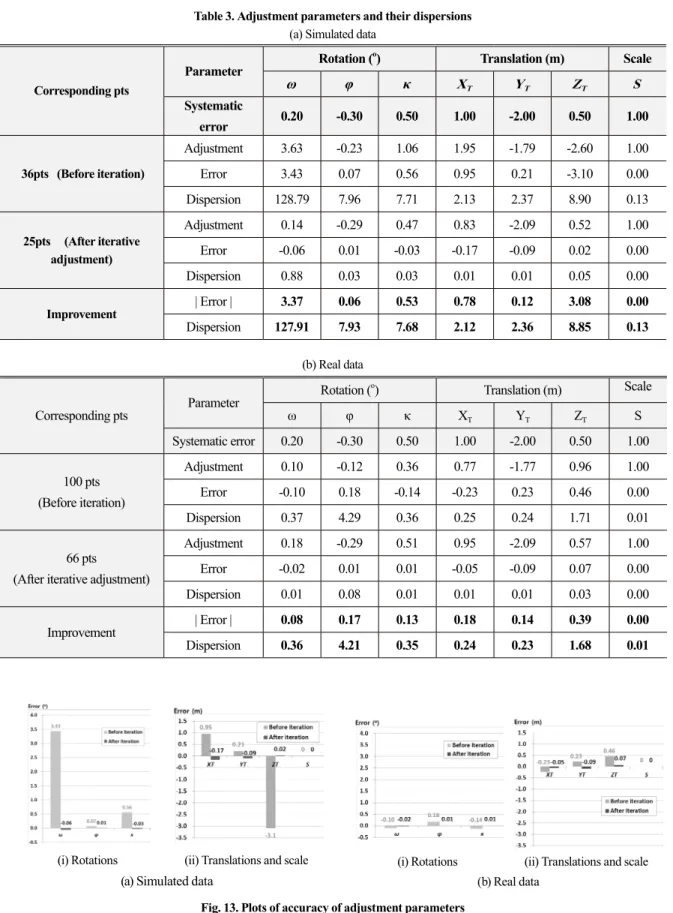
3 shows parameters of the LSA for each data set. Dispersion

indicates reliability of the estimated parameters. There

are noticeable improvements in both data after iterative

adjustment. Such results were possible due to removing points

with large residuals and updating adjustment parameters

accordingly. Specifically, 31 % of the corresponding points

( i.e . 11points out of 36points) and 34 % of the corresponding

points ( i.e . 34points out of 100points) that have low reliability

in matching were removed during the process for simulated

and real data, respectively. In addition, since the simulated

data has overlapping strips with West-East direction ( i.e .

X -direction), it is obvious that the dispersion of ω-rotation has

to be larger than that of other rotation parameters. As for the

real data, on the other hand, dispersion of φ-rotation is larger

because of overlapping strips with North-South direction ( i.e .

Y-direction).

(13)

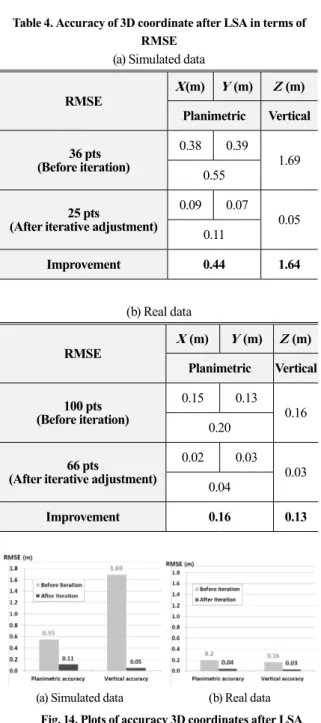
Fig. 13 shows the final results after removing points having large RMSE through the iterative processing. Accuracy of the LSA was analyzed with two aspects: (1) Errors of the adjustment parameters that are shown in Table 3, and (2) RMSE of the 3D coordinates after LSA that are shown in Table 4 and Fig. 11. The results show that errors of the adjustment parameters were drastically reduced by applying proposed method. The systematic errors of rotation angles are below 0.5°, translations are below 2.00 m. Absolute errors of rotations of the simulated and real data are smaller than 0.06°

and 0.02°, respectively. Absolute errors of translations of the simulated and real data are smaller than 0.17 m and 0.09 m, respectively. However, it is obvious that the scale factor is not affected by geometric transformation because scales of the LiDAR data between strips are the same. After performing adjustment, planimetric RMSE and vertical RMSE of the simulated data are 0.11 m and 0.05 m, respectively, while planimetric RMSE and vertical RMSE of the real data are 0.04m and 0.03 m, respectively. The improvements of the adjustment parameters and accuracy of the coordinates are graphically visualized in Figs. 13 and 14 respectively.

5. Concluding Remarks

This paper demonstrates detection and identification of the corresponding features by SURF matching algorithm and LSA using corresponding points as control features. The most significant issue is to determine corresponding features in the overlapping strips using point clouds regardless of the mathematical model of the LSA. In this regard, this paper describes details of the matching, especially SURF algorithm, to find correspondence and establish geometric relations between LiDAR strips.

The experiments demonstrate that determination of the reliable correspondence features requires appropriate constraints to achieve feasible LAS with required accuracy.

The matching constraints and iterative process not only improves accuracy of LSA but also provides benefit to eliminate false matching features. Based on the experiments, following conclusions and consideration for the future work were drawn:

(1) Even though SURF is robust method in terms of

geometric invariance ( i.e . rotation, shift and scale invariant), it is necessary to consider selecting feasible corresponding features for LSA. In this regard, false corresponding points were effectively removed by constraints that are based on the stochastic and geometric characteristics between matching entities. In addition, iterative processing could improve overall accuracy of the LSA.

(2) Since in most cases, overlapping areas of the LiDAR strips are narrow and elongate to the flying direction, reliability of the rotation parameters depends on the configuration of the strips. In this matter, the strips should have sufficient overlapping regions to utilize geometrically stable corresponding features.

(3) Significant improvement of the LSA accuracy was achieved. For simulated data, 80 % (from 0.55 m to 0.11 m) and 97 % (from 1.69 m to 0.05 m) for planimetric and vertical accuracy improvement, while for real data, 80 % (from 0.20 m to 0.04 m) and 81 % (from 0.16 m to 0.03 m) for planimetric and vertical accuracy improvement in terms of RMSE, respectively.

(4) Drawback of the data-driven approach is that the individual physical error sources are not reflected to the model. However, data-driven method is effective and practical to implement compared with sensor model-driven approach that requires raw measurements from each sensor which are not available to the end users in most cases.

Acknowledgments

This research was supported by Basic Science Research Program through the National Research Foundation of Korea(NRF) funded by the Ministry of Education(No.2015R1 D1A1A01056933)

References

Bang, K., Habib, A., and Kersting, A. (2010), Estimation of biases in LiDAR system calibration parameters using overlapping strips, Canadian Journal of Remote Sensing , Vol. 36, No. 2, pp. 335-354.

Bay, H., Ess, A., Tuytelaars, T., and Van Gool, A. (2008),

Speeded-Up Robust Features (SURF), Computer Vision

(14)

and Image Understanding , Vol. 110, No. 3, pp. 346–359.

Besl, P. and McKay, N. (1992), A method for registration of 3D shapes, IEEE Transactions on Pattern Analysis and

Machine Intelligence , Vol. 14, No. 2, pp. 239-256.

Filin, S. (2003), Analysis and implementation of a laser strip adjustment model, International Archives of Photogrammetry and Remote Sensing , Vol. 34, Part3/

W13, pp. 65-70.

Filin, S. and Vosselman, G. (2004), Adjustment of airborne laser altimetry strips, International Archives of

Photogrammetry and Remote Sensing , Vol. 34, Part3/

W13, pp. 285-289.

Glira, P., Pfeifer, N., Briese, C., and Ressl, C. (2015), Rigorous strip adjustment of airborne laser scanning data based on the ICP algorithm, ISPRS Annals of the Photogrammetry, Remote Sensing and Spatial Information Sciences, 28

September-3 October, La Grande Motte, France, Vol. II-3, Part. W5, pp. 73-80.

Glira, P., Pfeifer, N., and Mandlburger, G. (2016), Rigorous strip adjustment of UAV-based laser scanning data including time-dependent correction of trajectory errors, Photogrammetric Engineering and Remote Sensing , Vol.

21, No. 12, pp. 945-954.

Gruen, A. and Akca, D. (2005), Least squares 3D surface matching, ISPRS Journal of Photogrammetry and Remote Sensing , Vol. 59, No. 3, pp. 151-174.

Habib, A., Bang, K., Kersting, A., and Chow, J. (2010), Alternative methodologies for LiDAR system calibration,

Remote Sensing , Vol. 2, No. 3, pp.874-907.

Habib, A., Bang K., Kersting, A., and Lee, D.C. (2009), Error budget of LiDAR systems and quality control of the derived data, Photogrammetric Engineering and Remote Sensing , Vol. 75, No. 9, pp. 1093-1108.

Habib, A., Kersting, A., Ruifanga, Z., Al-Durgham, M., Kim, C., and Lee, D.C. (2008), LiDAR strip adjustment using conjugate linear features in overlapping strips, Proceedings of International Archives of the Photogrammetry, Remote Sensing and Spatial Information Sciences , 3–11 July, Beijing, China, Vol. 37,

Part B1, pp. 385-390.

Han, D., Yu, K., and Kim, Y. (2012), Georegistration of airborne LiDAR data using a digital topographic map,

Journal of the Korean Society of Surveying Geodesy Photogrammetry and Cartography , Vol. 30, No. 3, pp.

323-332. (in Korean with English abstract)

Haralick, R. and Shapiro, L. (1992), Computer and Robot Vision: Volume 1 , Addison-Wesley, Reading, MA, New

Jersey, Hoboken.

Hassaballah, M., Abdelmgeid, A., and Alshazly, H. (2016), Image features detection, description and matching, In:

Awad, A. and Hassaballah, M. (eds.), Image Feature Detections and Descriptors , Springer, Switzerland, pp.

11-45.

Kersting, A. and Habib, A. (2012), A comparative analysis between rigorous and approximate approaches for LiDAR system calibration, Journal of the Korean Society of Surveying Geodesy Photogrammetry and Cartography , Vol. 30, No. 6-2, pp. 593-605.

Lee, D., Yoo, E., Yom, J.H., and Lee, D.C. (2014), Strip adjustment of airborne laser scanner data using area-

based surface matching, Journal of the Korean Society of Surveying, Geodesy, Photogrammetry and Cartography , Vol. 32, No. 6, pp. 625-635.

Lowe, D. (2004), Distinctive image features from scale- invariant key points, International Journal of Computer

Vision , Vol. 60, No. 2, pp. 91–110.

Maas, H. (2000), Least squares matching with airborne laser scanning data in a TIN structure, International Archives of Photogrammetry and Remote Sensing , Vol. 33, Part.

B3, pp. 548-555.

Mahalanobis, P. (1936), On the generalised distance in statistics, Proceedings of the National Institute of Sciences of India , Vol. 2, No. 1, pp. 49-55.

Pfeifer, N., Elberink, S., and Filin, S. (2005), Automatic tie elements detection for laser scanner strip adjustment, International Archives of Photogrammetry and Remote Sensing , Vol. 36, Part 3/W3, pp. 1682-1750.

Schenk, T. (1999), Digital Photogrammetry, Volume 1 : Background, Fundamentals, Automatic Orientation Procedures , TerraScience, Laurelville, OH.

Schenk, T. (2001), Modeling and Analyzing Systematic

Errors of Airborne Laser Scanner s, Technical Notes

in Photogrammetry, No. 19, Department of Civil and

Environmental Engineering and Geodetic Science, The

(15)

Ohio State University, Columbus, OH.

Toth, C. (2009), Strip adjustment and registration, In: Shan, J.

and Toth C. (eds.), Topographic Laser Ranging and Scanning: Principles and Processing , CRC Press, Boca

Raton, FL, pp. 235-268.

Zhang, Y., Xiong, X., and Hu, X (2013), Rigorous LiDAR strip adjustment with triangulated aerial imagery, Remote Sensing and Spatial Information Sciences , 11–13

November, Antalya, Turkey, Vol. II-5/W2, pp. 361-366.

수치

Fig. 1. Scheme to improve accuracy of LiDAR strip adjustmen t
Fig. 3. Relationship between continuous   and digital filter with respect to std. dev.
Table 2. Ratios between elements of Hessian matrices and weight factor (σ = 1.2 and  N  = 9) (a) Standard deviation and Forbenius norm of Hessian sub-matrices
Table 2. Ratios between elements of Hessian matrices and  weight factor (σ = 1.2 and  N  = 9)
+4

참조

관련 문서