• 검색 결과가 없습니다.

A Study on the General Characteristics and Instrumental Analysis of Natural Omija Extract

N/A
N/A
Protected

Academic year: 2021

Share "A Study on the General Characteristics and Instrumental Analysis of Natural Omija Extract"

Copied!
8
0
0

로드 중.... (전체 텍스트 보기)

전체 글

(1)

ISSN 2288-1069 (Online)

http://dx.doi.org/10.12925/jkocs.2013.30.2.225

A Study on the General Characteristics and Instrumental Analysis of Natural Omija Extract

Ki-Chun Sung

․Ki-Jun Kim․Yong-Ryul Kim․Sang-Sung Nam

✝✝

Department of Chemical Engineering, Daejin University, Pocheon 487-711, Korea

✝✝

Faculty of Energy Resources Engineering, Resources Recycling Ecotechnology, Jungwon University, 95, Munmy-Ro, Goesa-eup, Goesan-gun, Chungbuk, 367-805, Korea

(Received April 12, 2013 ; Revised June 25, 2013 ; Accepted June 25, 2013)

Abstract : Omija component was known to possess natural odor, taste, color, and various general characteristics. Omija extraction was extracted using ethanol as a solvent. Omija extract showed a red-purple color of some viscous liquid state. Some conclusions from natural Omija extract were obtained as follow. The result of antimicrobial experiment to add Omija extract, the number of microbial population showed negative reaction from 3 days after it cultivated. This phenomenon could confirm that Omija component affected to antimicrobial effect. The result of dyeing experiment to add Omija extract, fiber dyeing effect showed with some ivory color after dyed to cotton and silk. Also, this phenomenon could confirm that Omija component affected to natural dyeing effect from observated dye state with biological microscope(BM). The result of instrumental analysis, inorganic components of K(109.60ppm), Na(3.500ppm), Ca(1.205ppm), Mg(0.900ppm), Li(0.350ppm), Si(0.380ppm), Cu(0.250ppm), Fe(0.125ppm), Zn(0.090ppm), etcs from Omija were ascertained with ICP/OES, and organic components of benzene(10.808), borny lacetate(11.289), phenol(14.183), β-terpinene(15.840), α-terpinolene(17.616) etcs from Omija were ascertained with GC/MSD.

Keywords : Natural Omija extract , antimicrobial experiment , dyeing experiment, biological microscope(BM), instrument analysis(ICP/OES, GC/MSD).

1. INTRODUCTION

Natural Omija (五味子) belongs to magnoliaceae has natural odor, taste, color, and the others general characteristics [1]. It is called Omija because it contain five tastes including sour, sweet, bitter, salty, and pungent taste[2].



Corresponding author

(E-mail : [email protected])

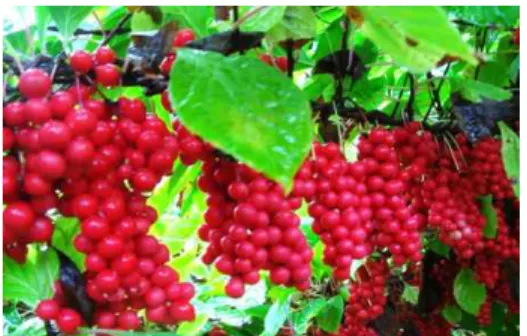
Omija blooms annually in about the middle of June, and it forms a size and a shape from the middle of July[2]. Omija is used as a mellow fruit in the middle of september such as it is shown in Fig.1.

Omija is known to be some difference to

natural odor, taste, color, and the others

pharmaceutical and chemical characteristics

according to species or cultivate circumstances

[3]. In general, Omija is composed of water,

protein, fat, and the others organic and

(2)

inorganic component etcs[3]. Omija is consisted of three main parts of pericap, fruit and seed such as it is shown in Fig. 2.

Fig. 1. A mellow fruit of Omija.

Fig. 2. Three main parts of Omija.

Pericap of Omija is made up as anthocyanin color, and it is changed from purple color in red color[4]. Fruit of Omija is contained in organic components of citric acid, malic acid, succinic acid, tannic acid, and glucose etcs.

and its show various tastes[5].

Seed of Omija consisted of various aromatic components of benzene and phenol etcs, and it contained in essential oil components such as lignan and citral etcs [6].

Glucose component in fruit of Omija can obtain Omija-wine by fermentation process of enzyme such as it is shown in Fig. 3.[7].

Historically, Omija has come to be used in various materials of traditionally oriental medicine food of Omija-tea, Omija-wine, Omija-drink, Omija-confection, Omija- vermicelli etcs, and it is interested in new materials of chinese medicine, chinese cosmetics, traditionally natural dye as well as chinese food[3].

Specially, Omija has come to be recognized that it has various pharmaceutical and chemical characteristics. Accordingly, Omija is used to adopt in various field including traditional oriental medicine to use for efficacy and effect of antimicrobial, anticancer, antioxidation, antiaging, etcs, and chinese cosmetics and traditional natural dye etc[8-12]. Also, Omija is known that aromatic components of flavonoid, phenol, terpene etc have control action against microbe as physiological activity, and anthocyanine color shows environmental affinity as traditional natural dye[13].

In tendency of domestic research, Cho et al.[14] studied on the physiological activity of Omija extract, and Ko etc[15] studied on the dropping of blood sugar of Omija extract, and Song[16] studied on the pharmaceutical effect of Omija in cosmetics and the application of Omija in cosmetics industry.

This research extracted Omija component

from natural Omija, and tested using Omija

extract on the antimicrobial experiment

(pharmaceutical characteristics) and dyeing

experiment(chemical characteristics), and

instrument analysis of Omija extract analyzed

in order to confirm inorganic components with

ICP/OES, and analyzed in order to confirm

organic components with GC/MSD.

(3)

2. EXPERIMENTAL 2.1. EXTRACTION EXPERIMENT

This experiment pulverized natural Omija(This purchased at korean traditional market) 100.0g to grind containing Omija pericap, fruit and seed in the ceramic bowl, and mixed in 93.0% ethanol (C

2

H

5

OH : Korea), 900.0mL as solvent.

Next experiment concentrated to heat this mixture in the natural extract equipment(made in Korea) at below 85℃, and reacted for about 6 hrs.

Solid components of Omija extraction solution removed using 200 mesh sieve, and Omija extract was finally obtained after it separated ethanol with rotary vaccum evaporator (model No. NE-100S, Eyela Co., Japan).

2.2. ANTIMICROBIAL EXPERIMENT (Pharmaceutical Effect)

Natural Omija extract tested for verification of pharmaceutical effect using microbes such as staphylococcus aureus (Bacteria ; requested cooperation from microorganism center in Han Kuk Cosmetics Co. Ltd) and aspergillus niger(Fungus ; also, requested cooperation from the same company).

Microbes were cultivated in the mueller hilton broth (Difco .Lab. Co., USA), and incubated in the incubator (model No. Pl.

Labtec. Co., Korea). Incubated microbes then analyzed number of microbial population to measure with optical electron microscope (model No. Li-Lh. 100-3, Olympus Co., Japan) and colony counter apparatus (Korea).

2.3. DYEING EXPERIMENT (Natural Dyeing Effect)

In order to test the natural dyeing effect, dyeing experiment was carried out to use natural Omija extract to cotton and silk as fiber. This experiment used the alum mordant

❲Al

2

(SO

4

)

3

• 13-14 H

2

O ; Sam Chun Chemical Co., Ltd ; Korea❳ in order to

conduct dyeing experiment against fiber, and dyed color(cotton and silk) was measured with color difference meter of spectraflash (model No. SF-600 plus CT. Co., USA) and biological microscope(model No. BA-210, Motic Incorporation Ltd., Hong Kong).

Fiber(cotton and silk) purchased from Young shin Textile Co. Ltd., (Korea).

2.4. INSTRUMENTAL ANALYSIS 2.4.1. ICP/OES MEASUREMENT

In order to confirm inorganic components, this experiment dissolved to dilute Omija extract(0.1g) in 5%-HNO

3

solution(100.0 mL), and analyzed this sample solution with ICP/OES. ICP/OES analysis measured inorganic components from Omija using standard inorganic elements (28-inorganic elements) including Ag, Al, As, B, Ba, Be, Ca, Co, Cd, Cr, Cu, K, Li, Fe, Mg, Mn, Mo, Na, Ni, Pb, Se, Si, Sr, Ti, Tl, V, Zn.

2.4.2. GC/MSD MEASUREMENT

In order to confirm organic components, this experiment dissolved to dilute Omija extract (0.1g) in di-ethyl ether❲(C

2

H

5

)

2

O❳(100.0mL), and analyzed this sample solution with GC/MSD. GC/MSD used Hp-5MS detector (model No. Agilent 19091 S-433) and Hp-5MS column (30m * 250µm * 0.25µm).

Split flow operated in 50.0mL/min while saver flow operated in 20.0mL/min, temperature controlled with MSD transfer heater.

Helium gas(He-gas) used as carrier gas. Flow rate of He-gas operated in 1.0mL/min and pressure carried in 7.06psi. Detecter injection temperature of this sample measured in 250-280℃ respectively.

3. RESULTS AND DISCUSSION

3.1. RESULT OF EXTRACTION EXPERIMENT

Result of extraction experiment, Omija

extract was obtained about 18.0g after it made

(4)

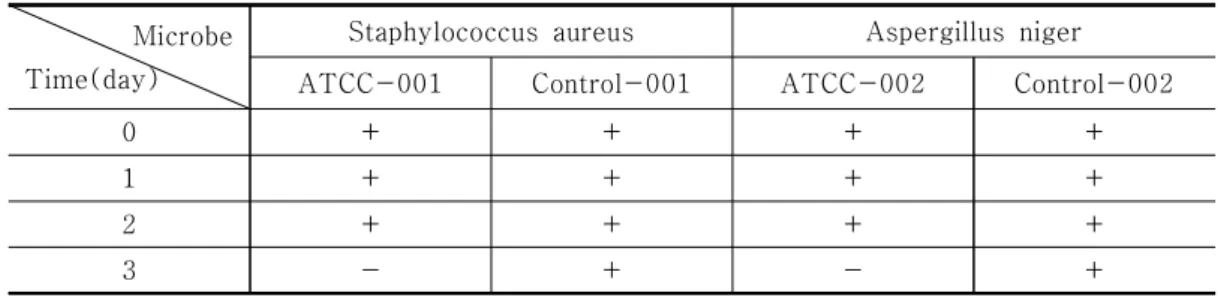
Microbe Time(day)

Staphylococcus aureus Aspergillus niger

ATCC-001 Control-001 ATCC-002 Control-002

0 + + + +

1 + + + +

2 + + + +

3 - + - +

-Positive reaction(+) : This means positive reaction that microbe shows activity in culture test.

-Negative reaction(-) : This means negative reaction that microbe does not shows activity in the culture test.

Table 1. Result of Antimicrobial Experiment against Omija Extract Shown according to Culture Time and Temperature of Microbe (Culture Temp. : 36℃) to separate the ethanol. And, Omija extract

showed some viscous liquid state and red-purple color. Accordingly, the yield of Omija extract was obtained about 1.8% from following formula (1).

3.2. RESULT OF ANTIMICROBIAL EXPERIMENT (Pharmaceutical Effect) This experiment dissolved to dilute Omija extract(0.5g) in distilled water(100.0mL), and mixed 0.5%-Omija extract solution(1.0mL) in mueller hilton broth (10.0mL), and incubated microbes of staphylococcus aureus (ATCC-001) and aspergillus niger (ATCC-002) as fixed microbial population (1~2 x 10

3

CFU/mL) by plate culture method [17,18].

Also, Control-001, 002 prepared to compare with ATCC-001, 002 without addition of Omija extract. Result of antimicrobial experimenet against Omija extract was tested such as it shown in Table 1.

Result of antimicrobial experiment against Omija extract could confirm that ATCC-001,002 showed positive reaction untill 2 days after cultivated, however it showed

negative reaction from 3 days. Also, result of antimicrobial experiment by plate culture method, ATCC-001 and 002 could confirm that number of microbial population did’t show from 3 days after it has cultivated such as it shown in Fig. 3.

But, Control-001, 002 showed positive reaction, and number of microbial population rapidly increased from 3 days after it has cultivated such as it shown in Fig. 4.

Finally, Omija extract could know that it was pharmaceutical effect to control the growth against microbes.

3.3. RESULT OF DYEING EXPERIMENT (Natural Dyeing Effect)

This experiment dyed with 0.5%-Omija

extract solution to the cotton and silk as fiber

using alum mordant [Al

2

(SO

4

)

3

․ 13-14H

2

O],

and dyed fiber (cotton and silk) measured DL

*

(degree of brightness), Da

*

and Db

*

(direction

of color), and DE* (color difference) with

color difference meter of spectraflash. Result of

color dyed to fiber measured such as it shown

in Table 2.

(5)

A. Staphylococuss(ATCC-001) B. Aspergillus(ATCC-002) Fig. 3. Result of antimicrobial experiment against staphylococuss(ATCC-001) and aspergillus

(ATCC-002) added Omija extract according to culture time and temp.

A. Staphylococuss(Control-001) B. Aspergillus(Control-002) Fig. 4. Result of antimicrobial experiment against staphylococuss(Control-001) and aspergillus

(Control-002) did not add Omija extract according to culture time and temp.

Table 2. Result of Color Dyed to Fiber Using Natural Omija Extract by Mordant Method

Fiber Mordant Method DL

*

Da

*

Db

*

DE

*

Cotton

First mordant 45.500 1.200 6.500 45.97

After mordant 87.750 1.600 12.000 88.58

Silk

First mordant 45.800 1.750 6.000 46.22

After mordant 84.900 2.500 13.200 85.92

Remark : First mordant : This used alum mordant when dyed to fiber.

After mordant : This used alum mordant again after dyed to fiber.

(6)

Color difference (DE

*

) was calculated between degree of brightness and direction of color, and it is calculate by following formula (2).

DE

*

=[(DL

*

)

2

+(Da

*

)

2

+ (Db

*

)

2

]

0.5

(2) Following picture took cotton and silk to dye with biological microscope(BM), and it showed into some ivory color, and it shown in Fig. 5 and Fig. 6.

Fig. 5. This picture took a dyed cotton using Omija extract to apply after alum mordant with biological microscope (BM).

Fig. 6. This picture took a dyed silk using Omija extract to apply after alum mordant with biological microscope (BM).

Finally, Omija extract could confirm that it apply to fiber (cotton and silk) as a natural

dye.

3.4. RESULT OF INSTRUMENTAL ANALYSIS

3.4.1. ICP/OES ANALYSIS

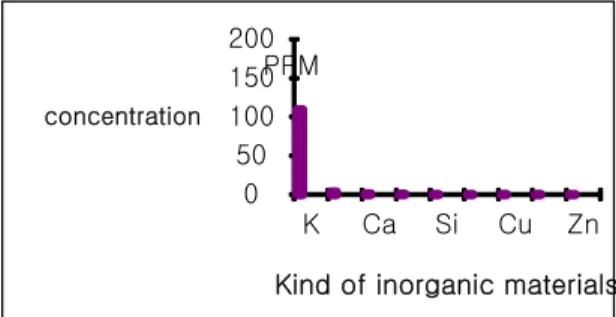
Result of ICP/OES analysis, inorganic components such as K(109.600ppm), Na(3.500ppm), Ca(1.205ppm), Mg(0.900ppm), Si(0.380ppm), Li(0.350ppm), Cu(0.250ppm), Fe(0.125ppm), Zn(0.090ppm), etc in Omija material confirmed as shown in Fig, 7.

0 50 100 150 200

concentration

K Ca Si Cu Zn

Kind of inorganic materials PPM

Fig. 7. Analysis result of inorganic materials in Omija component.

3.4.2. GC/MSD ANALYSIS

Result of GC/MSD analysis, organic components such as benzene(10.808), bornyl acetate(11.289), phenol(14.183), β-terpinene (15.840), α-terpinolene(17.616), etcs in Omija material confirmed as shown in Fig. 8.

Fig. 8. Analysis result of organic materials in

Omija component.

(7)

4. CONCLUSIONS

The general characteristic of Omija extract that was gotten to concentrate and to extract from natural Omija component could obtain some conclusions as follow.

1. Natural Omija extract that was gotten to concentrate and to extract from Omija component (100.0g) was obtained about 18.0g. Finally, yield of Omija extraction was obtained about 1.80%, and Omija extract showed some viscous liquid state and red-purple color.

2. Antimicrobial experiment against staphylococcus aureus (ATCC-001) and aspergillus niger (ATCC-002) as microbes showed in negative reaction from 3 days after it has cultivated, but in case of

Control-001, 002 did not add Omija extract, number of microbial

population rapidly increased according to cultivation time. This phenomenon confirmed that Omija component has pharmaceutical effect to control the growth against microbe.

3. Dyeing experiment against fiber(cotton and silk) showed into some ivory color. And dyeing test used first and after alum mordant [Al

2

(SO

4

)

3

․ 13-14H

2

O] to fiber.

Chemical dyeing effect against fiber

confirmed that Omija extract was possible as natural dye and took a dyeing

fiber state with biological microscope(BM).

4. The result of instrument analysis, inorganic components of K(109.600ppm), Na (3.500ppm), Ca(1.205ppm), Mg(0.900ppm), Li(0.350ppm), etcs from Omija extract were ascertained with ICP/OES, and organics components of benzene(10.808), bromyl acetate(11.298), phenol(14.183), β -terpinene(15.840), α-terpinolene (17.616) etcs from Omija extract were

ascertained with GC/MSD.

Acknowledgement

This research was accomplished by 2013 years research support of Daejin University, and expresses sincerely thanks of this support.

References

1. M. B. Arnao, A. Cano, J.F. Alcolea, and M. Acosta, Estimation of Free Radical -Quenching Activity of Leaf Pigment Extracts, Phytochem. Anal ., 12, 138(2001).

2. EL-Feraly F. S., Cheatham S. F., and Breedlove R. L., Antimicrobial Neolignans of Sassafras Randaiense Roots, J. Natural Product , 46, 493 (1983).

3. K. C. Sung, A study on the Pharmaceutical & Chemical Characteristics and Analysis of Natural Omija Extract, J.of the Korean Oil Chemists’ Soc., 28(3), 291 (2011).

4. Y. J. Cho, I. S. Ju, and B. C. Kim, Biological Activity of Omija Extract, J.

Korean Soc. Appl. Biol, Chem ., 50(3), 199 (2007).

5. Y. Ikeya, H. Taguchi, I. Yosioka, and H.

Kobayashi, The Constituents of Schizandra Chinensis B. V. Isolation and Structure Determination of Five Lignans Gomisim A,B,C, F and G, and the Absolute Structure of Schizandrin, Chem. Pharm.

Bull., 27(6), 1395 (1979).

6. Y. Ikeya, H. Taguchi, I. Yosioka, and H.

Kobayashi, The Constituents of Schizandra Chimensis B. Ⅳ. Isolation and Structure Determination of Five New Lignans Gomisim A, B, C, F and G, and the Absolute Structure of Schizandrin, Chem.

Pharm. Bull., 27(11), 2695 (1979).

7. K. C. Sung, A Study on the

Pharmaceutical and Chemical

Characteristics of Natural Grape Extract, J.

(8)

of Korean Oil Chemists’ Soc. , 26(3), 342 (2009).

8. S. H. Lee and Y. S. Lee, Isolation of the Antimicrobial Compounds from Omija Extract, Korean J. Food. Sci. Technol ., 35(3), 483 (2003).

9. H. J. Kwon and C. S. Park, Biological Activities of Extracts from Omija, Korean J. Food Technol., 15(4), 587 (2008).

10. H. K. Kim, M. G. Na, S. H. Ye, and H.

S. Han, Extraction Characteristics and Antioxidative Activity of Schizandra Chinensis Extract, Korean J. Food Culture, 19(5), 484 (2004).

11. M. Nomura, M. Nakachiyama, T. Hida, Y. Ohtaki, K. Sudo, T. Aizawa, M.

Aburada, and K. Miyamoto, Gomisim A, A Lignan Component of Schizandra Fruit, Inhibits Development of Preneoplastic Lessions in Rat Liver by 3’-methyl-1,4-dimethyl-aminoazobenzene, Cancer Lett . 76, 11 (1994).

12. Y. J. Cho, I. S. Ju, and B. C. Kim, Biological Activity of Omija Extract, J.

Korea Soc. Appl. Biol. Chem, 50(3), 199 (2007).

13. K. C. Sung, A Study on the Pharmaceutical & Chemical Characteristics and Analysis of Natural Omija Extract, J.

of the Korean Oil Chemists’ Soc., 28(3), 292 (2011).

14. Y. J. Cho et al, Biological Activity of Omija Extract, J. Korean Soc. Appl. Biol.

Chem., 50(3), 198 (2007).

15. B. B. Ko and S. K. Park, A Study on the Blood Sugar Drop Effect of Omija Extract, J. Korean Soc. Appl. Biol. Chem., 47(2), 258(2004).

16. M. Y. Song, A Study on the Cosmetics Pharmaceutical Effect of Schizandra Chnensis and Application of Cosmetics Industry, Master Thesis, Daegu Oriental Medicine Graduated School, 1 (2007).

17. G. H. Lee, S. H. Kim, and S. R. Hong,

"Experiment of Microbiology", Bureau of Publication, Won Kwnag University, 51 (1992).

18. S. J. Park, "Microbiology Experiment",

Books Publication World Science, 136

(2001).

수치

Fig.  1.  A  mellow  fruit  of  Omija.
Table  1.  Result  of  Antimicrobial  Experiment  against  Omija  Extract  Shown  according  to  Culture  Time  and  Temperature  of  Microbe                                                          (Culture  Temp
Table  2.  Result  of  Color  Dyed  to  Fiber  Using  Natural  Omija  Extract  by  Mordant  Method
Fig.  6.  This  picture  took  a  dyed  silk  using  Omija  extract  to  apply  after  alum  mordant  with  biological  microscope  (BM).

참조

관련 문서

Quality Characteristics of Gastrodia elata Extract Glutinous Rice Porridge Jochung and Principal Component Analysis of Antioxidant Activity.. Ki-Won Lee 1 , Du-Yeon

Jeju Agriculture Technology Center, A Research Task on the Safety and High-Yield cultivation Techniques Development of Jeju Model Bokbunja Rubus, Govp 1200815272, 3 (2007).. Ministry

Han, Extraction Characteristic and Antioxidative Activity of Schizandra Chinensis Extracts, Korean J.. Park, A Study on Hypoglycemic Effects of Crude Extracts of

It was confirmed that water lily leaves can be used as a natural dye resource for dyeing wool and silk fabrics because its colorants showed excellent affinity and

Effect of mixed natural extract treatment on quality characteristics of fresh-cut lettuce during storage.. Hyeon-Jeong Lee 1 , Ji-Young Choi 1 , Su-Hyeon Heo 1 , Su-In Bae 1 ,

The purpose of this study was to investigate the quality characteristics and descriptive analysis of Yanggaeng prepared with Lycii fructus extract (LD).. For

The objective of this study was to investigate dyeing characteristics of silk, cotton and rayon fabrics using dyeing solution extracted from different

This study examined the dyeing characteristics and spectrum of cotton and silk by using dyeing solution extracted from aronia.. The measurement results of