244
F
ORESTS
OCIETYGermination and Biochemical Changes in Accelerated Aged and Osmoprimed Pinus thunbergii Seeds
Du Hyun Kim
*, Sim Hee Han and Jae Cheon Lee
Department of Forest Resources Development, Korea Forest Research Institute, Suwon 441-350 Korea
Abstract :
The aim of this study was to investigate relationship among seed viability and enzymes activities involved in scavenging reactive oxygen species (ROS), especially, superoxide dismutase (SOD), glutathione reductase (GR), and catalase (CAT). In other respects, osmopriming has been demonstrated to reinvigorate aged seeds. Various viabilities of seeds that were ranged from 80 to 100% of germination rate could be produced using osmopriming and accelerated aging treatments. Priming treatment of
Pinus thunbergiiseeds for 3 days at 15
oC with a polyethylene glycol solution at -1.2 MPa improved their subsequent germination at 25
oC. Accelerated aging (3, 6, 9, and 12 days at 41
oC and 100% relative humidity) decreased seed germination percentage depending on aging treatment duration. Electrolyte conductivities of seeds were measured as assay of membrane integrity. The conductivity from electrolyte leakage of
P. thunbergiiseed was also correlated with seed germinability. Conductivity for control seeds that had 95% of germination percentage was 3.48 µS g
−1, but jumped as doubled (7.98 µS g
−1) in 12-day-aged seed that had 80% of germination percentage. Our results demonstrate that aging of
P. thunbergiiseeds is associated with changes in the electrolyte leakage, lipid peroxidation, and antioxidant defense system. Priming of aged seeds progressively restored the initial germinative ability and resulted in a marked decrease in the levels of MDA and conductivity of seed leachate. These effects of priming were also well recovered of GR and CAT activities in aged seed. The improved seed quality by priming treatment appears at least partly attributable to reduced lipid peroxidation, resulting from enhanced antioxidative enzyme activities that are suggesting the antioxidant defense systems play a key role in seed vigor.
Key words :accelerated aging, Pinus thunbergii, electrolyte leakage, germination, lipid peroxidation, anti- oxidative enzyme, priming
Introduction
Seeds during storage lost their ability to germinate.
Lipid peroxidation, enzyme inactivation, protein degra- dation, and disruption of cellular membranes were reported as major causes (McDonald, 1999a; Narayana Murthy
et al., 2003; Ratajczak and Pukacka, 2005; Pukacka and Ratajczak, 2007). Accelerated aging conditions such as high temperature and high seed water moisture lead to biochemical deterioration during seed aging (McDonald, 1999a). In these cases, lipid peroxidation and the loss of membrane phospholipids are major cause of seed aging under accelerated aging conditions; the consequence of formation of an increase amount of free oxygen radicals (Goel and Sheoran, 2003).
The electrical conductivity (EC) test is acknowledged as one of the best tests for the evaluation of the loss of
cell membrane integrity by the concentration of electro- lytes released by seeds during imbibition. Cell membrane integrity is considered one of the primary physiological events of seed deterioration process (Matthews and Pow- ell, 2006). There were several reports on the increase of EC in relation of seed vigor loss in pine seeds (Demelash
et al., 2004; Singh and Bonner, 2001; Tammela
et al., 2000) and beech seeds (Pukacka and Ratajczak. 2007).
The major cause of the loss of membrane integrity is believed to be the peroxidation of unsaturated fatty acid, which may take place with participation of reactive oxy- gen species (ROS) (McDonald, 1999a). Lipid peroxida- tion starts with the generation of free radicals and peroxides. The produced free radicals and peroxides may cause injury to cellular components like membrane lip- ids, proteins and nucleic acids during quiescence and germination states. In fresh seeds, free radicals and per- oxides are generally kept at low levels by cooperative reactions of antioxidant enzymes (Chang and Sung, 1998 and McDonald, 1999a). If the production of free radicals
*Corresponding author E-mail: [email protected]
and peroxides exceeds the rate of their removal, seeds become oxidatively stressed and seed viability is reduced.
Major ROS-scavenging enzymes include superoxide dis- mutase (SOD), glutathione reductatse (GR) and catalase (CAT). SOD is a key enzyme in the regulation of the amount of superoxide radicals and peroxides. Hydrogen peroxide (H
2O
2) can react in the Haber-Weiss reaction forming hydroxyl radicals (Mittler
et al., 2004) that cause lipid peroxidation. CAT is implicated in the removal of H
2O
2. The removal of H
2O
2through a series of reactions is known as an ascorbate- glutathione cycle in which ascorbate and glutathione participate in a cyclic transfer of reducing equivalents resulting in the reduction of H
2O
2to water (H
2O) using electrons derived form nic- otinamide adenine dinucleotide phosphate (NADPH) (Goel and Sheoran, 2003). In the present study, mem- brane integrity and lipid peroxidation were measured using EC and malondialdehyde (MDA), respectively.
Levels of MDA and activities of antioxidant enzymes in aged seed were analyzed to see their relationship.
Priming of seeds is used extensively to improve ger- mination performance. Through priming, seed deteriora- tion caused by lipid peroxidation is prevented via greater dehydrogenase activity and lower peroxide formation (McDonald, 1999b). Moreover, increase in various free radical scavenging enzymes, such as superoxide dismu- tase, catalase and peroxidase have also been reported (Bailly
et al., 1998; Chiu
et al, 2006; Jeng and Sung, 1994). The role of antioxidant enzymes in priming pro- cesses are investigated for artificially aged seed and sub- sequent primed seed in aged seeds at the present time.
The native species,
Pinus thunbergii, which survives on the seaside, was mainly recommended for rehabilita- tion of reclaimed coastal lands with extreme environ- mental conditions (Kwon
et al., 2004). Long-term storage of pine seeds is essential for silvicultural purposes, espe- cially in Korea, where good seed years are rare. There- fore information about germination of pine seed depending on seed aging has significant economic value.
The aim of the present study were (1) to characterize the sensitivity of
P. thunbergiiseed to aging conditions, and (2) to investigate whether seed deterioration is asso- ciated with electrolyte leakage, lipid peroxidation, and antioxidative enzyme activities in aging or subsequent priming treated seed. For this purpose,
P. thunbergiiseeds were artificially aged at 41
oC at 100% RH and subsequently osmoprimed.
Materials and Methods 1. Plant material
Seeds were collected in 2005 from the seed orchard in Jeju Island operated by Forest Research Institute, Korea.
The seeds were extracted, cleaned, and stored in dark- ness and at -18
oC until use in 2006. Before the storage, damaged and insect infected seeds were discarded, and the empty seeds were eliminated using the water floating method.
2. Germination test
Germination tests were performed on two layers of fil- ter paper saturated with water in 9-cm-diameter glass petri dishes. Four 50-seed replicates for each treatment were used. Experiments were carried out in a tempera- ture-controlled growth chamber at 25
oC under constant light. Germination count was performed daily for 28 days. The seed was considered as germinated if the radi- cle protruded 2 mm or longer from the seed coat fol- lowing the ISTA rules (ISTA, 2006).
The parameters gathered include: germination percent- age, mean germination time (MGT) and germination value (GV). MGT was calculated using the formula: MGT=n
id
i/n, where n is the total number of germinated seeds during the germination test, n
iis the number of germinated seeds on each day d
iand i is the number of days during the germination period (between 0 and 28 days) (Yoush- eng and Sziklai, 1985). GV is the product of peak value (PV) and average daily germination (MDG) (Czabator, 1962) while PV is the quotient of the highest value of the cumulative germination percentage, divided by the number of days from the beginning of the test.
3. Artificial accelerated aging
For the artificial accelerated aging (AA) tests, seeds were placed on a wire mesh screen and suspended over 100 mL of water inside a plastic accelerated aging box (11 cm×11 cm×4 cm). Boxes were placed at 41
oC and 100% relative humidity for 3, 6, 9, and 12 days (coded as AA3, AA6, AA9 and AA12, respectively) in an incu- bator. After this aging period, seeds were used for ger- mination tests, PEG priming treatment, and electrical conductivity, lipid peroxidation, and antioxidant enzymes.
4. PEG priming treatment
Seeds were primed using osmotic solutions at -0.4 and -1.2 MPa for three days in darkness at 15
oC using poly- ethylene glycol (PEG 8000). The water potential of the PEG solution for osmopriming treatments was deter- mined using the calculation method of Michel (1983).
5. Electrical conductivity
The electrical conductivity of the leachate from whole
imbibed seeds was determined on four replications of 10
seeds (0.1 g) soaked in 50 mL distilled water for 24
hours at 24
oC. The electrical conductivity of leachates in
leaked solution was measured using conductivity meter
(CONSORT Model C533, Belgium).
6. Lipid peroxidation
Lipid peroxidation was determined by measuring the amount of malondialdehyde (MDA) produced by thiobarbituric acid reaction as described by Heath and Packer (1968). Seeds (weighed 0.1 g prior to imbibi- tion) imbibed for three days, were homogenized in 5 mL of 62.5 mM phosphate buffer (pH 7.8). The crude extract was mixed with the same volume of 0.5% (w/
v) thiobarbituric acid solution containing 20% (w/v) trichloroacetic acid. The mixture was heated at 95
oC for 30 min and then quickly cooled in an ice-bath. The mixture was centrifuged at 3000×g for 10 min and the absorbance of the supernatant was monitored at 532 and 600 nm using UV-120 (SHIMADZU, Japan). After subtracting the non-specific absorbance (600 nm), MDA concentration was determined by its molar extinction coefficient (155 mM
−1cm
−1) and the results expressed as mol MDA g
−1FW.
7. Antioxidative enzyme activities
Seeds imbibed for 3 days (0.1 g prior to imbibition) were homogenized under ice-cold condition with 5 mL of 50 mM phosphate buffer (pH 7.0), 10 mM ascorbic acid (AsA) and 1.0% (w/v) polyvinylpyrrolidone. The homogenate was centrifuged at 20,000×g for 30 min, and the supernatant was collected for enzyme assays.
Superoxide dismutase (SOD) was assayed on the basis of the inhibition of reduction of nitro-blue tetrazolium in the presence of xanthine at 530 nm according to the method of Beauchamp and Fridovich (1971). Activity of glutathione reductase (GR) was assayed as described in Carlberg and Mannervik (1985). The assay was carried out in a reaction mixture containing 50 mM phosphate buffer (pH 7.8), 0.1 mM NADPH, 0.5 mM GSSH and 0.1 mL enzyme extract. The change in A
340was recorded for 5 min after the addition of enzyme extract. Catalase (CAT) activity was determined by following a two-step procedure (Fossati
et al., 1980). The rate of dismutation of H
2O
2to H
2O and molecular oxygen is proportional to the concentration of catalase. Samples containing cata- lase were then incubated in the presence of a known concentration of H
2O
2. After one minute incubation, the reaction was quenched with sodium azide. The amount of H
2O
2remaining in the reaction mixture was then determined by the oxidative coupling reaction of 4-ami- nophenazone (4-aminoantipyrene) and 3,5-dichloro-2- hydroxybenzenesulfonic acid (DHBS) in the presence of H
2O
2and catalyzed by horseradish peroxidase (HRP).
The resulting quinoneimine dye was measured at 520 nm. All the activities of enzyme were measured using UV-120 (SHIMADZU, Japan).
8. Statistical Analysis
The data were statistically analyzed using Analysis of Variance of a Completely Randomized Design. Means were compared using the Duncan multiple range test (DMRT) at the 5% level. Statistical analyses were done using SAS System for Windows, Version 8.01 (SAS Institute, USA).
Results
Germination percentage and germination value (GV) of the seeds decreased with artificial aging treatment (Figure 1A). Final germination percentage reduced after 12 days of aging. The longer the treatment, the greater was the reduction of seed viability. GV showed greater
Figure 1. Germination percentage, germination value (GV) (A), and mean germination time (MGT), electrolyte leakage (EC) (B) after 3, 6, 9, 12 days of accelerated aging (AA) treatment at 41
oC and 100% RH in
Pinus thunbergiiseeds. Values presented are mean±SE (n=4). The different
letters are significantly different among accelerated aging
duration at p < 0.05, Duncan's Multiple Range Test.
reduction (101 to 56) of seed viability than germination percentage (95 to 80%). GV was dramatically decreased after 6 days of aging even though germination percent- age did not show significant changes. Electrical conduc- tivity (EC) and mean germination time (MGT) increased progressively with the aging treatment (Figure 1B). Level of EC in control seed was 3.48 µS g
−1. After 12 days of aging, EC of
P. thunbergiiseeds increased to 7.98 µS g
−1that is twice higher than the control non-aged seeds. The mean MGT of artificial aging treated seeds for 12 days were about 1 day longer than that of control seeds.
The activities of superoxide dismutase (SOD) and glu- tathione reductase (GR) decreased with the aging dura- tion (Figure 2A). SOD activity decreased from 0 to 6 days of aging, and it ranged from 297 to 222 unit g
−1. From 7 to 12 days, SOD was maintained from 222 to 224
unit g
−1. GR activity remained constantly until 6 days of aging and then decreased reaching 3164 and 2770 nmol g
−1at 9 and 12 days of aging, respectively. Contrary to SOD and GR activities, catalase (CAT) activity did not show a significant change in statistically, but it decreased with the aging duration, and it ranged from 762 to 710 unit g
−1. By contrast, MDA content increased markedly from 11.2 to 16.7 µmol g
−1with the increase of aging duration, i.e. the longer the duration of the treatment, the higher was their MDA content (Figure 2B).
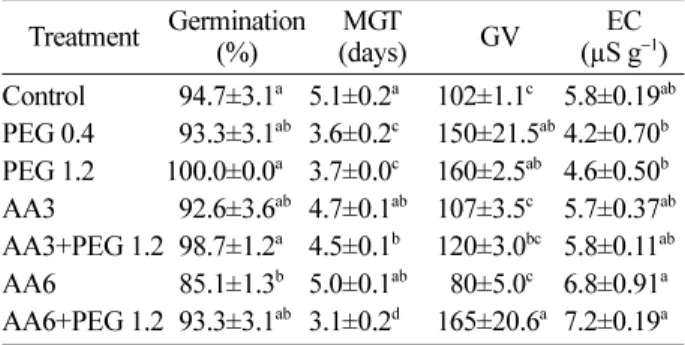
PEG priming at -1.2 MPa (PEG 1.2) improved the germination, MGT, and GV as compared with the con- trol. Aging treated seeds for 3 and 6 days could be recovered by 5.6, 27.5 and 56.9% after PEG priming at -1.2 MPa in germination percentage, MGT, and GV, as compared to the controls, respectively. PEG priming treatments were effective in decreasing electrolyte con- ductivity (EC) of seed leachates, which shows mem- brane stability. However, PEG priming treatment for aging treated seeds did not show any difference in EC.
Among comparison of all the seed treatments, the lowest EC of seed leachate was observed in seeds primed with -0.4 MPa (PEG 0.4) and -1.2 MPa (PEG 1.2) PEG treat- ments (Table 1).
Table 2 represents the changes of antioxidant enzyme activity and MDA content in aging and priming treated seeds. The activity of SOD was decreased by accelerated aging treatment. Especially, priming treatment resulted in a decrease of SOD activity. There was no significant difference for all of the seed treatments in terms of GR activity. However, the activities of GR and CAT exhib-
Figure 2. Changes in activities of superoxide dismutase (SOD), glutathione reductase (GR) and catalase (CAT), and malondialdehyde (MDA) content in artificial aged
Pinus thunbergii
seeds. Values presented are mean±SE (n=5). The different letters are significantly different among accelerated aging duration at p<0.05, Duncan's Multiple Range Test. ns: not significant.
Table 1. Germination percentage, mean germination time (MGT), germination value (GV) and electrolyte conductivity (EC) of PEG primed and accelerated aging treated
Pinus thunbergiiseeds at 41
oC and 100% RH.
Treatment Germination (%) MGT
(days) GV EC
(µS g
−1) Control
094.7±3.1a5.1±0.2
a102±1.1
c5.8±0.19
abPEG 0.4
093.3±3.1ab3.6±0.2
c150±21.5
ab4.2±0.70
bPEG 1.2 100.0±0.0
a3.7±0.0
c160±2.5
ab4.6±0.50
bAA3
092.6±3.6ab4.7±0.1
ab107±3.5
c5.7±0.37
abAA3+PEG 1.2098.7±1.2
a4.5±0.1
b120±3.0
bc5.8±0.11
abAA6
085.1±1.3b5.0±0.1
ab 080±5.0c6.8±0.91
aAA6+PEG 1.2093.3±3.1
ab3.1±0.2
d165±20.6
a7.2±0.19
aAll values are means of four replicates ± standard error (SE).
Values in the same column with different letters are signifi-
cantly different from each other at p<0.05, Duncan's Multiple
Range Test. PEG 0.4: primed at PEG solution of -0.4 MPa,
PEG 1.2: primed at PEG solution of -1.2 MPa, AA3: acceler-
ated aging treated for 3 days, AA3+PEG 1.2: primed at PEG
solution of -1.2 MPa for 3 days of aged seed, AA6: accelerated
aging treated for 6 days, AA6+PEG 1.2 : primed at PEG solu-
tion of -1.2 MPa for 6 days of aged seed.
ited similar tendencies, i.e., GR and CAT activities increased with priming treatment. The activity of CAT was decreased by accelerated aging treatment. However, PEG primed seeds showed dramatic increase of CAT activities. The MDA content of PEG primed seeds exhibited different tendencies with enzyme activities after PEG priming treatment. The MDA content of PEG primed seeds was significantly lower than that of control and aging treated seeds (P<0.05).
Discussion
Aging of seeds leads to changes in seed quality, such as decrease in seed vigor followed by a loss of seed via- bility as previously shown by McDonald (1999a) and Lehner
et al. (2008). As expected, the accelerated aging of
P. thunbergiiseeds carried out at 41
oC and 100% RH lost their ability to germinate according to duration of aging treatment (Figure 1). In our experiment, germina- tion was relatively high even after 12 days of aging treatment. Whereas, germination value (GV) and mean germination time (MGT) showed more clearly decrease of viability (Figure 1). The decline in germination per- centage and an increase in mean germination time with accelerated aging were observed in the present study in accordance with previous studies on
Pinus strobus(Singh and Bonner, 2001),
Pinus patula(Demelash
etal
., 2004),
Pinus taedaand
Pinus roxburghii(Vananga- mudi
et al, 1998), and
Pinus rigidaseed (Han
et al., 2006).
The first process during seed deterioration due to
aging is excessive leakage of cytoplasmic components as a result of loss of membrane integrity (Smith and Ber- jak, 1995). This is clearly evident from the increased leachate conductivity value with aging in this study (Fig- ure 1). Our study, thus, supports the utility of leachate conductivity as a routine supplement or a quick alterna- tive to assess the germination capacity (viability) and the mean germination time (vigour) of pine seeds as sug- gested by other authors (Bonner, 1991; Rehman,
et al. 1999; Demelash
et al., 2004; Singh and Bonner, 2001).
The main enzymes involved in cell detoxification are superoxide dismutase (SOD), glutathione reductase (GR), catalase (CAT) (Bailly, 2004; Mittler, 2002). The ability of seeds to scavenge ROS is considered to be involved in seed storability (Bailly, 2004). In addition, aging is associated with a depletion of antioxidant enzyme activ- ities in cotton (Goel
et al., 2003), beech (Pukacka and Ratajczak, 2007) and sunflower seeds (Bailly
et al., 1998). Lipid peroxidation has been demonstrated to occur during aging in Norway maple (Pukacka, 1991), beech (Pukacka and Ratajczak, 2007),
Pinus sylvestris(Tammela
et al., 2000) and sunflower seeds (Bailly
etal
., 1998). Our data re-confirmed these earlier findings.
In our study, SOD, GR, and CAT activities decreased and MDA content increased according to duration of aging treatment. The results presented here with pine seed show that loss of seed viability is related to the increase of lipid peroxidation evaluated by MDA content (Figure 2).
Priming can reverse some of the sub-optimal temper- ature-induced deteriorative events, and thus improve seed performance (McDonald, 1999b; Chiu
et al., 2006;
Kim
et al., 2008). Priming-enhanced seed performances are related to the repair and the build up of nucleic acid, enhanced synthesis of protein and repair of membranes (McDonald, 1999b). In this study, we found that PEG priming were significantly increased germination ability in aged seed (Table 1). These results were taken in con- junction with the improved germination and GV and shortened MGT. Enhanced antioxidative systems also contribute to improve quality in primed seed (Chiu
etal
., 2006). Priming enhanced CAT activities in our study.
Especially, the increase of GR and CAT activities in primed seed for 6-day-aged seed supports priming effects such as the recover of seed deterioration. And also priming treatment decreased MDA content for aging treated seed (Table 2). The enzymes involved in the antioxidant defense system exhibit different sensitiv- ities to aging depending on the species and the condi- tions of storage. In wheat seeds, SOD was more sensitive than CAT to a treatment at 45
oC and 100% RH (Lehner
et al., 2008), whereas in sunflower seeds placed in the same conditions CAT activity was more sensitive Table 2. Changes of superoxide dismutase (SOD), glutathione
reductase (GR) and catalase (CAT) activities, and MDA content of PEG primed and accelerated aging treated Pinus thunbergii seeds at 41
oC and 100% RH.
Treatment SOD
(unit g
−1) GR
(nmol g
−1) CAT
(unit g
−1) MDA (µmol g
−1) Control 297±24
a3489±219
ns762±70
bc11.2±0.7
bcPEG 0.4 276±16
ab4164±113 1441±51
a10.9±0.3
cPEG 1.2 243±13
ab4171±119 1454±50
a11.4±0.2
bcAA3 269± 6
ab3389±179
0686± 7cd14.4±0.5
aAA3+PEG 1.2 201± 7
bc4200±109
0523±47d13.3±0.7
abcAA6 222± 4
abc3561±154
0715±15cd15.9±0.5
aAA6+PEG 1.2 156± 3
c3975± 59
0954± 8b14.0±1.0
abAll the values are means of five replicates ± standard error (SE).
Values in the same column with different letters are signifi-
cantly different from each other at p < 0.05, Duncan's Multiple
Range Test. ns: not significant. PEG 0.4: primed at PEG solu-
tion of -0.4 MPa, PEG 1.2: primed at PEG solution of -1.2
MPa, AA3: accelerated aging treated for 3days, AA3+PEG
1.2: primed at PEG solution of -1.2 MPa for 3 days of aged
seed, AA6: accelerated aging treated for 6 days, AA6+PEG 1.2
: primed at PEG solution of -1.2 MPa for 6 days of aged seed.
than that of GR and SOD being almost unchanged (Bailly
et al., 1996). Alteration of SOD activity was also observed during aging of seeds of
Acer platanoides(Pukacka, 1991). The decrease of SOD activity of 6-day- aged seeds with priming did not reflect enhanced via- bility. However, the increase of GR and CAT activities was obvious in primed seeds in our results. Chiu
et al. (2006) reported that priming produced high germinabil- ity and decreased MDA. The total peroxide accumula- tion could explain why priming improves the viability and vigor in seeds. It was also observed that the increased MDA content by aging treatment decreased with subsequent priming treatments.
Conclusion
Our results demonstrate that aging of
P. thunbergiiseeds is associated with changes in the electrolyte leak- age, lipid peroxidation, and antioxidant defense system.
There was a clear relation between increased electrolyte leakage with seed aging. Hence we suggest the leachate conductivity test as a routine supplemental test or as a quick alternative test to predict the viability of
P. thun-bergii
seed. The improved seed quality by priming treat- ment appears at least partly attributable to reduced lipid peroxidation, resulting from enhanced anti-oxidative activi- ties. The improved germination and emergence responses might be also related to the priming-enhanced activities of GR and CAT enzymes. Accelerated aging procedure could be a good indicator for understanding various met- abolic changes associated with seed deterioration. How- ever, accelerated aging cannot be used as the only model to understand the mechanisms involved in seed aging.
Further investigations are required for natural aging con- ditions.
Literature Cited
1. Bailly, C., Benamar, A., Corbineau, F. and Come, D. 1996.
Changes in malondialdehyde content and in superoxide dismutase, catalase and glutathione reductase activities in sunflower seeds as related to deterioration during accelerated aging. Physiologia Plantarum 97: 104-110.
2. Bailly, C., Benamar, A. and Corbineau, F. and Come, D. 1998. Free radical scavenging as affected by accel- erated ageing and subsequent priming in sunflower seeds. Physiologia Plantarum 104: 646-652.
3. Bailly, C. 2004. Active oxygen species and antioxidants in seed biology. Seed Science Research 14: 93-107.
4. Beauchamp, C. and Fridovich, I. 1971. Superoxide dis- mutase: Improved assays and an assay applicable to acrylamide gels. Analytical Biochemistry 44: 276-297.
5. Bonner, F.T. 1991. Estimating seed quality of southern
pines by leachate conductivity. Research paper SO-263:
1-4. USDA, Forest Service, New Orleans.
6. Carlberg, I. and Mannervik, B. 1985. Glutathione reduc- tase. Methods in Enzymology 113: 485-490.
7. Chang, S.M. and Sung, J.M. 1998. Deteriorative changes in primed shrunken-2 sweet corn seeds during storage.
Seed Science and Technology. 26: 613-626.
8. Chiu, K.Y., Chuang, S.J. and Sung, J.M. 2006. Both anti-oxidation and lipid-carbohydrate conversion enhance- ments are involved in priming-improved emergence of
Echinacea purpureaseeds that differ in size. Scientica Horticulturae 108: 220-226.
9. Czabator, F.J. 1962. Germination value: An index com- bining speed and completeness of pine seed germina- tion. Forest Science 8: 386-396.
10. Demelash, L., Tigabu, M. and Odn, P.C. 2004. Evalu- ating the relative storability of IDS-treated and untreated
Pinus patulaseeds by accelerated ageing. Journal of Tropical Forest Science 16: 206-217.
11. Fossati, P., Prencipe, L. and Berti, G. 1980. Use of 3,5- dichloro-2-hydroxy benzenesulfonic acid /4-aminophenazone chromogenic system in direct enzyme assay of uric acid in serum and urine. The Clinical Chemistry Meth- odology 26: 227-231.
12. Goel, A. and Sheoran, I.S. 2003. Lipid peroxidation and peroxide-scavenging enzyme in cotton seeds under natural ageing. Biologia Plantarum 46: 429-434.
13. Han, S.H., Koo, Y.B. and Kim, C.S. 2006. Viability determination of
Pinus rigidaseeds using artificially accelerated aging. Korean Journal of Agricultural and Forest Meteorology 8: 10-14.
14. Heath, R.L. and Parker, L. 1968. Photoperoxidation in isolated chloroplasts. I. Kinetics and stoichiometry of fatty acid peroxidation. Archives of Biochemistry and Biophysics 125: 189-198.
15. ISTA. 2006. International Rules for Seed Testing. Edi- tion 2006. International Seed Testing Association, Swit- zerland.
16. Jeng, T.L. and Sung, J.M. 1994. Hydration effect on lipid peroxidation and peroxide scavenging enzyme activity of artificially aged peanut seed. Seed Science and Technology 22: 531-539.
17. Kim, D.H., Han, S.H., Lee, J.C., Song, S.H. and Lee, J.M. 2008. Effects of seed treatment on viability of aged
Cryptomeria japonicaseeds after storage. Acta Horiculturae 771: 61-65.
18. Kwon, J.O., Lee, K.J. and Jang, S.H. 2004. The plant- ing models of maritime forest by the plant community structure analysis in the seaside, Incheon - a case study on
Pinus thunbergiicommunity and
P. densifloracom- munity. Journal of the Korean Institute of Landscape Architecture. 31: 53-63.
19. Lehner, A. Mamadou, N., Poels, P., Cme, D., Bailly, C.
and Corbineau, F. 2008. Changes in soluble carbohy-
drates, lipid peroxidation and antioxidant enzyme activ- ities in the embryo during ageing in wheat grains.
Journal of Cereal Science 47: 555-563.
20. Matthews, S. and Powell, A. 2006. Electrical conduc- tivity vigour test: Physiological basis and use. Seed Testing International 131: 34-37.
21. McDonald, M.B. 1999a. Seed deterioration: Physiology, repair and assessment. Seed Science and Technology.
27: 177-237.
22. McDonald, M.B. 1999b. Seed Priming. pp. 287-325.
In: Black, M. and Bewley J.D. (Eds). Seed Technology and its biological basis, Sheffield Academic Press, Sheffield, UK.
23. Michel, B.E. 1983. Evaluation of the water potentials of solutions of polyethylene glycol 8000 both in the absence and presence of other solutes. Plant Physiology 72: 66-70.
24. Mittler, R., Vanderauwera, S., Gollery, M. and Van Breu- segem, F. 2004. Reactive oxygen gene network of plant. Trends in Plant Science 9: 490-498.
25. Narayana Murthy, U.M., Kumar, P.P. and Sun, W.Q.
2003. Mechanisms of seed ageing under different stor- age conditions for
Vigna radiate(L.) Wilczke: lipid peroxidation, sugar hydrolysis, Maillard reactions and their relationship to glass state transition. Journal of Experimental Botany 54: 1057-1067.
26. Pukacka, S. 1991. Changes in membrane lipid compo- nents and antioxidant levels during natural aging of seeds of
Acer platanoides. Physiologia Plantarum 82:
306-310.
27. Pukacka S. and Ratajczak, E. 2007. Age-related bio-
chemical changes during storage of beech (
Fagus syl- vaticaL.) seeds. Seed Science Research 17: 45-53.
28. Ratajczak E. and Pukacka, S. 2005. Decrease in beech (
Fagus sylvatica) seed viability caused by temperature and humidity conditions as related to membrane dam- age and lipid com position. Acta Physiologiae Plan- tarum 27: 3-12.
29. Rehman, S., Harris, P.J.C. and Bourne, W.F. 1999.
Effect of artificial aging on the germination, ion leak- age and salinity tolerance of
Acacia tortilisand
A.Coriacea
seeds. Seed Science and Technology 27: 141- 149.
30. Singh, O. and Bonner, F.T. 2001. Accelerated aging to evaluate seed vigour in eastern white pine (
Pinus stro- bus) seed. Journal of tropical forest science 13: 283-289.
31. Tammela, P., Hopia, A., Hiltunen, R., Vuorela, H. and Nygren, M. 2000. Aging in
Pinus sylvestrisL. seeds:
changes in viability and lipids. Biochemical Society Transactions 28: 878-879.
32. Vanangamudi, K., Zope, J.S. and Vozzo, J.A. 1998. Seed coat surface elemental compositions of accelerated aged seeds of
Pinus taedaand
Pinus roxburghiiby energy-dispersive x-ray spectroscopy. Journal of tropi- cal forest science 10: 297-303.
33. Yousheng, C. and Sziklai, O. 1985. Preliminary study on the germination of
Toona sinensis(A. Juss.) Roem.
seed from eleven Chinese provenances. Forest Ecology and Management 10: 269-281.
(Received February 8, 2010; Accepted April 15, 2010)