Note
Anti-tumor effect of Inonotus obliquus in xenograft animals with EBV+human gastric carcinoma
Seulki Lee and Hyosun Cho*
College of Pharmacy, Duksung Women’s University, Seoul 01369, Republic of Korea
Inonotus obliquus (차가버섯) 추출물의 EBV 양성 인간위암에 대한 in vivo 항종양 효능 연구
이슬기 ・ 조효선*
덕성여자대학교 약학대학
(Received September 12, 2016; Revised October 19, 2016; Accepted October 19, 2016)
ABSTRACT: Inonotus obliquus is a medicinal mushroom with a variety of biological activities. It has reported to have strong anti-cancer, antioxidant and anti-inflammatory properties. EBV+ gastric carcinoma is one of the most common EBV-associated cancers that were caused by latent EBV infection. In this study, we investigated the anti-cancer effects of ethanol extract of I. obliquus using in vivo xenograft animal models implanted with EBV+ human gastric carcinoma (SNU719). We also explored the molecular mechanisms responsible for its anti-cancer activity. The result indicated that the extract of I. obliquus had an anti-cancer effect in in vivo xenograft mice with EBV+ gastric carcinoma (SNU719). Extract of I. obliquus also showed a great effect on inducing the expression of p53, p21 and Bax in tumor tissue derived from EBV+ human gastric carcinoma, and these were correlated with increased expressions of the cleaved forms of caspase-9 and Parp. Also, I. obliquus attenuated the expression of viral proteins, BZLF-1 and LMP-2 in tumor tissue from EBV+
human gastric carcinoma.
Key words: Inonotus obliquus, EBV+human gastric carcinoma, caspase-9, p53, PARP
*For correspondence.
E-mail: [email protected];Tel.: +82-2-901-8678; Fax: +82-2-901-8386
A large number of edible mushrooms have been reported to have various biological activities. Among them, Inonotus obliquus is a medicinal fungus with a variety of pharmacological activities.
It has been widely used as a folk remedy for health and longevity in Asian countries (Saar, 1991). Inonotus obliquus, commonly known as chaga mushroom, has been used as a traditional remedy to treat cancers and digestive system diseases (Wasser, 2002; Kim et al., 2006). Recently, many studies have reported strong anti-cancer activities of I. obliquus (Cui et al., 2005; Choi et al., 2010; Chung et al., 2010). In addition, its anti-viral activity is lately reported. I. obliquus fungus extract exerted anti-HCV activity in cell cultures infected with hepatitis C virus (Shibnev et al., 2011).
Epstein-Barr virus (EBV) is a human gamma-1 herpesvirus with lifetime latency (Young and Rickinson, 2004), which leads to serious malignancies, such as Burkitt’s lymphoma, Hodgkin’s disease, and gastric carcinoma (Young et al., 1989;
Nishikawa et al., 2014). In fact, about 10% of GCs are known to be EBV-associated gastric carcinoma (Tokunaga et al., 1993). In this study, we examined the anti-cancer effect of I.
obliquus in in vivo xenograft models implanted with EBV+
human gastric carcinoma (SNU719).
Ethanol extract of I. obliquus (IO) was provided by National
Institute of Horticultural and Herbal Science, Rural Development
Administration (Eumseong, Republic of Korea). Extract of
specimen was diluted with distilled water for oral administration
in the animal experiment. EBV+ human gastric carcinoma
(SNU719) was cultured in RPMI (Gibco) supplemented with
Fig. 1. Anti-tumor effect of ethanol extract of Inonotus obliquus in a xenograft NOD/SCID mice bearing EBV+ human gastric carcinoma (SNU719). Ten NOD/SCID mice were implanted with EBV+ human gastric carcinoma, SNU719, and they were randomly divided into 2 groups (n=5/group). Two weeks after implantation, mice were orally administrated with drinking water or I. obliquus extract (IO, 30 mg/kg/day). Tumor size was measured every two days.
10% heat-inactivated fetal bovine serum (Hyclone), 100 U/ml penicillin/streptomycin (Gibco) at 37°C in a humidified 5%
CO
2/ air atmosphere. Animal experiment was conducted in accordance with the National Research Council’s Guide (IACUC, Republic of Korea) for the Care and Use of Laboratory Animals. The experimental protocol was approved by the Animal Experiments Committee of Duksung Women’s University.
NOD/SCID mice (female, 5 weeks old; Raonbio Co. LtD.) were used as xenograft animal models. Mice were individually accommodated in a pathogen free controlled environment (23~27°C under a 12 h day/12 h night cycle) and provided food and water ad lib.
To investigate the anti-tumor effect of ethanol extract of I.
obliquus (IO) in vivo, xenograft mice were randomly divided into two groups and subcutaneously injected with EBV+
gastric carcinoma cells (5 × 10
6cells/mouse), SNU719, into the dorsum next to the right hind leg. After 2 weeks, each group was orally administrated drinking water or ethanol extract of I.
obliquus (IO) (30 mg/kg) for 2 weeks. Tumors were identified and measured every other day using a standard caliper; tumor size was calculated using [tumor length (mm) × tumor width (mm)
2]/2 as previously described (Lee et al., 2015a, 2015b).
After tumor size had reached 2,000 mm
3, animals were euthanized and tumors were harvested.
Figure 1 shows that IO extract inhibited the growth of EBV+
human gastric carcinoma (SNU719) on day 15 (DW; 467.1 mm
3, IO extract; 328.8 mm
3) through day 17 (DW; 469.6 mm
3,
IO extract; 332.1 mm
3), and the growth inhibition was significant compared to drinking water group.
Nakata group informed that inotodiol from I. obliquus mediates anti-tumor promoting activity in vivo carcinogenesis test (Nakata et al., 2007). Therefore, we speculated the anti- tumor effect of I. obliquus in EBV+ human gastric carcinoma.
Next, the molecular mechanisms for anti-cancer activity of I.
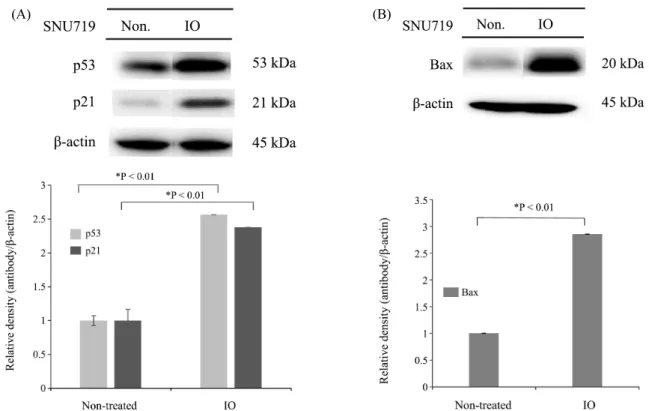
obliquus (IO) have been examined. p53 and Bax play critical roles in cell apoptosis and p21 is a key factor in cell cycle regulation (Li et al., 2012). Therefore, tumor tissues were harvested from three groups of animals bearing EBV+ human gastric carcinoma and then lysed using buffer solution. The expression levels of p53, p21 and Bax were then assessed in lysate proteins from each group. We found increased expressions of p53, p21 and Bax in EBV+ human gastric carcinoma bearing animals fed with IO extract (Fig. 2A and B). In fact, Inotodiol, one of the major compounds from I. obliquus was shown to induce the apoptosis of A549 cell lines through the up-regulation of p53 and Bax expression (Zhong et al., 2011).
The induction of cell apoptosis includes not only p53-related signaling but also the activations of caspases and poly ADP- ribose polymerase (Parp) (Koh et al., 2005). Caspases start with two different apoptotic pathways, the extrinsic and intrinsic pathways. The intrinsic pathway is triggered by endogenous stimuli, such as DNA damage and oxidative stress and mainly signals through activated form of cleaved caspase- 9 (Matt and Hofmann, 2016). In Fig. 3, there is a dramatic increase of caspase-9 expression in EBV+ human gastric carcinoma from animals fed with IO extract compared to animals fed with drinking water. Inotodiol-rich extract was reported to inhibit cell proliferation through apoptosis induction by activating caspase-3 (Nomura et al., 2008). Therefore, we suggest that I.
obliquus induces the intrinsic pathway of apoptosis through the
activation of caspase-9 and -3. Of note, IO extract significantly
amplified the expressions of the cleaved forms of caspase-9
(Fig. 3A), which reflects our in vivo results in Fig. 1. Poly
ADP-ribose polymerase (Parp) is a family of proteins involved in
DNA repair and programmed cell death. Cleavage of Parp by
caspases is typically known to inactivate Parp activity (Koh et
al., 2005). In Fig. 3B, we found that the expressions of cleaved
Parp were clearly upregulated in EBV+ human gastric
carcinoma bearing animals fed with IO extract. Importantly, IO
(A) (B)
Fig. 2. Expression of p53, p21 and Bax in tumor tissues from mice implanted with EBV+ human gastric carcinoma (SNU719). EBV+ human gastric carcinoma tumor tissue was excised from each animal fed Inonotus obliquus extract (IO) or drinking water (Non.) and prepared for western blot analysis. The protein expressions of (A) p53, p21 and (B) Bax were identified and the relative intensities were measured. β-Actin was used as the loading control.
(A) (B)
Fig. 3. Expressions of (cleaved) caspase-9 and (cleaved) Parp proteins in tumor tissues from mice implanted with EBV+ human gastric carcinoma (SNU719).
EBV+ human gastric carcinoma tumor tissue was excised from each animal fed Inonotus obliquus extract (IO) or drinking water (Non.) and prepared for western blot analysis. The expressions of (A) (cleaved) caspase-9 and (B) (cleaved) parp were identified and relative intensities were measured. β-Actin was used as the loading control.
Fig. 4. Expressions of BZLF-1 and LMP-2 proteins in tumor tissues from mice implanted with EBV+ human gastric carcinoma (SNU719). EBV+ human gastric carcinoma tumor tissue was excised from each animal fed I. obliquus extract (IO) or drinking water (Non.) and prepared for western blot analysis. The protein expressions of BZLF-1 and LMP-2 were identified and relative intensities were measured. β-Actin was used as the loading control.
extract intensely increased the expression of cleaved Parp (Fig. 3B).
In addition, we analyzed the expression of EBV proteins (BZLF-1 and LMP-2) in EBV+ tumor tissues derived from IO extract and drinking water fed group by performing Western blot assays using anti-BZLF-1 and LMP-2 antibodies (Fig. 4).
EBV BZLF-1 is a key factor for EBV lytic reactivation and LMP-2 protein is known to be essential for EBV latency (Lee et al., 2015c). As shown in Fig. 4, the expressions of BZLF-1 and LMP-2 were moderately repressed by IO extract, suggesting IO extract has a potential for anti-EBV effect. In fact, Taji group reported that triterpenoids from I. obliquus had inhibitory effects on Epstein-Barr virus early antigen (EBV-EA) activation induced by 12-O-tetradecanoylphorbol-13-acetate (TPA) (Nakata et al., 2007; Taji et al., 2008). In summary, our study is the first report to show the anti-tumor effect of I. obliquus using in vivo xenograft animals bearing human gastric carcinoma, especially in presence of EBV.
적 요
차가버섯(Inonotus obliquus)은 다양한 생리활성을 가진 약 용버섯으로 항암, 항산화, 항염효능 등을 가진 것으로 보고되 었다. EBV 양성 위암은 EBV관련 암 중 가장 빈번하게 나타나 는 형태로 EBV 잠복감염이 그 원인이다. 본 연구에서는 차가 버섯 주정추출물의 경구투여를 통해 EBV 양성 인간위암
(SNU719) 세포주를 면역결핍 쥐에 주입 후 생기는 고형암 생 성억제에 대한 효능을 연구하였다. 또한, 실험종료 후, 각각의 종양조직을 절제하여 항종양 억제기전을 탐구하였다. In vivo 종양생성억제 실험에서 차가버섯은 유의적으로 고형암 생성 억제 효능을 보였다. 차가버섯이 투여된 동물유래 종양조직에 서 세포자멸사와 관련된 p53, p21 및 Bax의 발현이 크게 증가 하였으며, 이는 cleaved caspase-9와 cleaved Parp 발현의 상승 과 동반하여 항종양 효능이 세포자멸사를 통해 나타남을 제시 하였다. 또한, 이러한 항종양 효능은 세포주 내 잠복되어 있는 EBV 바이러스 유전자인 BZLF-1 및 LMP-2의 발현에도 영향 을 미치는 것으로 밝혀졌다.
Acknowledgements
This work was supported by the Duksung Women’s University Research Grants 3000002594.
References
Choi, S.Y., Hur, S.J., An, C.S., Jeon, Y.H., Jeoung, Y.J., Bak, J.P., and Lim, B.O. 2010. Anti-inflammatory effects of Inonotus obliquus in colitis induced by dextran sodium sulfate. J. Biomed. Biotechnol.
2010, 943516.
Chung, M.J., Chung, C.K., Jeong, Y., and Ham, S.S. 2010. Anticancer activity of subfractions containing pure compounds of Chaga mushroom (Inonotus obliquus) extract in human cancer cells and
in Balbc/c mice bearing Sarcoma-180 cells. Nutr. Res. Pract. 4, 177–182.
Cui, Y., Kim, D.S., and Park, K.C. 2005. Antioxidant effect of Inonotus obliquus. J. Ethnopharmacol. 96, 79–85.
Kim, Y.O., Park, H.W., Kim, J.H., Lee, J.Y., Moon, S.H., and Shin, C.S. 2006. Anti-cancer effect and structural characterization of endo-polysaccharide from cultivated mycelia of Inonotus obliquus.
Life Sci. 79, 72–80.
Koh, D.W., Dawson, T.M., and Dawson, V.L. 2005. Mediation of cell death by poly (ADP-ribose) polymerase-1. Pharmacol. Res. 52, 5–14.
Lee, S., Lee, H.H., Kim, J., Jung, J., Moon, A., Jeong, C.S., Kang, H., and Cho, H. 2015a. Anti-tumor effect of Cordyceps militaris in HCV-infected human hepatocarcinoma 7.5 cells. J. Microbiol.
53, 468–474.
Lee, H.H., Lee, S., Lee, K., Shin, Y.S., Kang, H., and Cho, H. 2015b.
Anti-cancer effect of Cordyceps militaris in human colorectal carcinoma RKO cells via cell cycle arrest and mitochondrial apoptosis. Daru. 23, 35.
Lee, M., Son, M., Ryu, E., Shin, Y.S., Kim, J.G., Kang, B.W., Cho, H., and Kang, H. 2015c. Quercetin-induced apoptosis prevents EBV infection. Oncotarget. 6, 12603–12624.
Li, T., Kon, N., Jiang, L., Tan, M., Ludwig, T., Zhao, Y., Baer, R., and Gu, W. 2012. Tumor suppression in the absence of p53-mediated cell-cycle arrest, apoptosis, and senescence. Cell. 149, 1269– 1283.
Matt, S. and Hofmann, T.G. 2016. The DNA damage-induced cell death response: A roadmap to kill cancer cells. Cell. Mol. Life Sci. 73, 2829–2850.
Nakata, T., Yamada, T., Taji, S., Ohishi, H., Wada, S., Tokuda, H., Sakuma, K., and Tanaka, R. 2007. Structure determination of inonotsuoxides A and B and in vivo anti-tumor promoting activity of inotodiol from the sclerotia of Inonotus obliquus.
Bioorg. Med. Chem. 15, 257–264.
Nishikawa, J., Yoshiyama, H., Iizasa, H., Kanehiro, Y., Nakamura, M.,
Nishimura, J., Saito, M., Okamoto, T., Sakai, K., Suehiro, Y., et al. 2014. Epstein-Barr virus in gastric carcinoma. Cancers (Basel).
6, 2259–2274.
Nomura, M., Takahashi, T., Uesugi, A., Tanaka, R., and Kobayashi, S.
2008. Inotodiol, a lanostane triterpenoid, from Inonotus obliquus inhibits cell proliferation through caspase-3-dependent apoptosis.
Anticancer Res. 28, 2691–2696.
Saar, M. 1991. Fungi in Khanty folk medicine. J. Ethnopharmacol. 31, 175–179.
Shibnev, V.A., Mishin, D.V., Garaev, T.M., Finogenova, N.P., Botikov, A.G., and Deryabin, P.G. 2011. Antiviral activity of Inonotus obliquus fungus extract towards infection caused by hepatitis C virus in cell cultures. Bull. Exp. Biol. Med. 151, 612–614.
Taji, S., Yamada, T., Wada, S., Tokuda, H., Sakuma, K., and Tanaka, R. 2008. Lanostane-type triterpenoids from the sclerotia of Inonotus obliquus possessing anti-tumor promoting activity.
Eur. J. Med. Chem. 43, 2373–2379.
Tokunaga, M., Land, C.E., Uemura, Y., Tokudome, T., Tanaka, S., and Sato, E. 1993. Epstein-Barr Virus in gastric carcinoma. Am. J.
Pathol. 143, 1250–1254.
Wasser, S.P. 2002. Medicinal mushrooms as a source of antitumor and immunomodulating polysaccharides. Appl. Microbiol. Biotechnol.
60, 258–274.
Young, L., Alfieri, C., Hennessy, K., Evans, H., O’Hara, C., Anderson, K.C., Ritz, J., Shapiro, R.S., Rickinson, A., Kieff, E., et al. 1989.
Expression of Epstein-Barr virus transformation-associated genes in tissues of patients with EBV lymphoproliferative disease. N.
Engl. J. Med. 321, 1080–1085.
Young, L.S. and Rickinson, A.B. 2004. Epstein-barr virus: 40 years on.
Nat. Rev. Cancer 4, 757–768.
Zhong, X.H., Wang, L.B., and Sun, D.Z. 2011. Effects of inotodiol extracts from Inonotus obliquus on proliferation cycle and apoptotic gene of human lung adenocarcinoma cell line A549.
Chin. J. Integr. Med. 17, 218–223.