• 검색 결과가 없습니다.

Betula Platyphylla var. Japonica Extract Prevent Ultraviolet C Light-induced Cell Damage in Chinese Hamster Fibroblast (V79-4) Cells

N/A
N/A
Protected

Academic year: 2021

Share "Betula Platyphylla var. Japonica Extract Prevent Ultraviolet C Light-induced Cell Damage in Chinese Hamster Fibroblast (V79-4) Cells"

Copied!
5
0
0

로드 중.... (전체 텍스트 보기)

전체 글

(1)

Copyright ⓒ 2008, The Korean Academy of Oral Biology

137

Journal of Oral Biology

Betula Platyphylla var. Japonica Extract Prevent Ultraviolet C Light- induced Cell Damage in Chinese Hamster Fibroblast (V79-4) Cells

Mi Kyoung Lee and Jeong Hee Kim*

Department of Oral Biochemistry and Institute of Oral Biology, College of Dentistry, Kyung Hee University, 130-701, Korea (Received October 28, 2008 ; Revised November 4, 2008 ; Accepted November 7, 2008)

The present study reports the protective properties of a total methanol extract of B. platyphylla var. japonica against ultraviolet (UV)-C irradiation. Pretreatment of Chinese hamster fibroblast (V79-4) cells with a total methanol extract significantly increased cell survival following 300 J/

m

2

of UV-C irradiation. The total methanol extract was further fractionated into 5 fractions: n-hexane, dichloro- methane, ethylacetate, n-butanol and water fractions.

Among these fractions, B. platyphylla var. japonica ethylacetate, butanol and water fractions showed signifi- cant protective effects against the cellular damage induced by UV-C irradiation. In order to elucidate the mechanism underlying this protective effect, DPPH (Editor note:

abbreviations should be spelled out at first use.) radical scavenging and lipid peroxidation inhibitory activity were measured. Significant radical scavenging and lipid peroxidation inhibitory activities were observed for the ethylacetate fraction. In summary, the present data demonstrate that an extract of B. platyphylla var. japonica has a significant protective effect against UV-C irradiation.

The underlying mechanism of this protective effect may involve radical scavenging and inhibition of lipid peroxidation by the B. platyphylla var. japonica extract.

Key words: Medicinal plant extract/protection/UV-C/cell damage

Introduction

The ultraviolet (UV) spectrum is subdivided into three wavelength bands, UV-A (400-320 nm), UV-B (320-290 nm) and UV-C (290-200 nm). Usually, UV-A and UV-B reach the earth surface because the atmospheric ozone layer blocks UV wavelengths below 320 nm. However, because of the reduction in ozone layer due to air pollutants in recent years, chances of human beings to be exposed to UV-C are becoming increased.

When DNA is exposed to UV at wavelength approaching its absorption maximum of about 260 nm, adjacent pyrimidines become covalently linked to form pyrimidine dimer (Herrlich et al., 2008). Energy absorbed by molecular oxygen seems to generate reactive oxygen species (ROS), however the mechanism of ROS generation is not elucidated yet. UV radiation can also result in DNA-protein and DNA-DNA cross-links (Marmur and Grossman, 1961;

Peak and Peak, 1986). Irradiation of DNA at 254 nm can also result in breakage of the polynucleotide chain (Resenstein and Ducore, 1983; Peak and Peak, 1986).

Consequently, these damages can induce various cellular responses including apoptosis, carcinogenesis and immune suppression in UV-irradiated cells (Ibuki et al., 2007;

Ullich, 2007; Herrlich et al., 2008). However, little is known about mechanisms of UV-induced cellular damage and the protection against the cellular damage.

Natural antioxidants have a wide range of biochemical activities, including inhibition of ROS generation, direct or indirect scavenging of free radicals, and alteration of intracellular redox potential (Finkel and Holbrook, 1991).

One of our laboratory’s interest is on the investigation of the mechanism of cellular response to various oxidative stress and other cell damaging agents. In addition, we are trying to develop a potential cellular damage-protective agent which

*Corresponding author: Prof. Jeong Hee Kim, Department of Biochemistry and Institute of Oral Biology College of Dentistry, Kyung Hee University.

Tel.: +82-2-961-0915, Fax.: +82-2-960-1457,

E-mail. [email protected]

(2)

can reduce cellular damages induced by various chemical and physical damages (Kim et al., 1998; Lee et al. 2003;

Han et al., 2006).

In this study, we would like to report our findings of protective effect of B. platyphylla var. japonica extract against UV-C induced cell damage. In order to investigate the underlying mechanism of UV-C protective effect, DPPH radical scavenging activity and the lipid peroxidation inhibitory effect are tested and reported.

Materials and Methods

Preparation of extracts and fraction samples

Dried bark from B. platyphylla var. japonica (100 g) was extracted at 80

o

C in 70 % methanol for 3 hr. The extract was then filtered and the filtrate was concentrated under low pressure using a vacuum rotary evaporator (Eyela, Japan).

The remaining residue was lyophilized in a freezing-dryer (Ilsin, Korea) and stored at –70

o

C. Approximately 10 g of powdered extract was recovered. The powder was dissolved in dimethyl sulfoxide (DMSO) and diluted with phosphate buffered saline (PBS, pH 7.4) to give final concentrations of total extract ranging from 0.8 to 100 µg/ml. The DMSO concentration was lower than 0.1 % in the culture media.

Fraction samples were prepared as the followings. Frozen- dried methanol extract sample was dissolved in d-H

2

O and the equal volume of n-hexane was added and extracted twice. Then the equal volume of dichloromethane (CH

2

Cl

2

), ethylacetate (EtOAc) and n-butanol (BuOH) were added to the water fraction one by one and the extraction procedure was performed twice. Each fraction samples were dried in a vacuum rotary evaporator (Eyela, Japan) and the water

fraction was frozen-dried using a freezing-drier (Ilsin, Korea).

Cell culture and UV irradiation

The Chinese hamster lung cell line V79-4 (ATCC CCL- 93) was grown in Dulbecco's modified Eagle's medium (DMEM) supplemented with 10 % (v/v) heat inactivated fetal bovine serum (FBS), 2 mM glutamine and antibiotics.

Cultures were maintained at 37

o

C in a humidified atmosphere of 95 % air and 5 % CO

2

. For UV-irradiation, V79-4 cells were plated in a 96 well plate as described above and irradiated with 300 J/m

2

of UV-C (254 nm) using a UV cross-linker (Stratagene, USA).

Cell viability assay

Cell viability was estimated by the MTT assay, which is based on the cleavage of a tetrazolium salt by mitochondrial dehydrogenases in viable cells (Hansen et al., 1989). V79-4 cells were treated with various concentrations of extract or fraction samples (4, 20, or 100 µg/ml, respectively) for 1 hr where stated. The absorbance was measured with the ELISA reader (Bio-Rad, USA) at 570 nm. The relative cell viability was determined by the amount of MTT converted to the insoluble formazan salt. The optical density of formazan formed in control cells was taken as 100 % of viability. Fifty % inhibitory concentration (IC

50

) values were determined as the concentration required to scavenge 50 % of the radical.

The data are expressed as mean percentage of viable cells as compared to the respective control cultures. All data represent means ± S.E. Statistical analysis was performed using analysis of variance followed by the Student’s t-test.

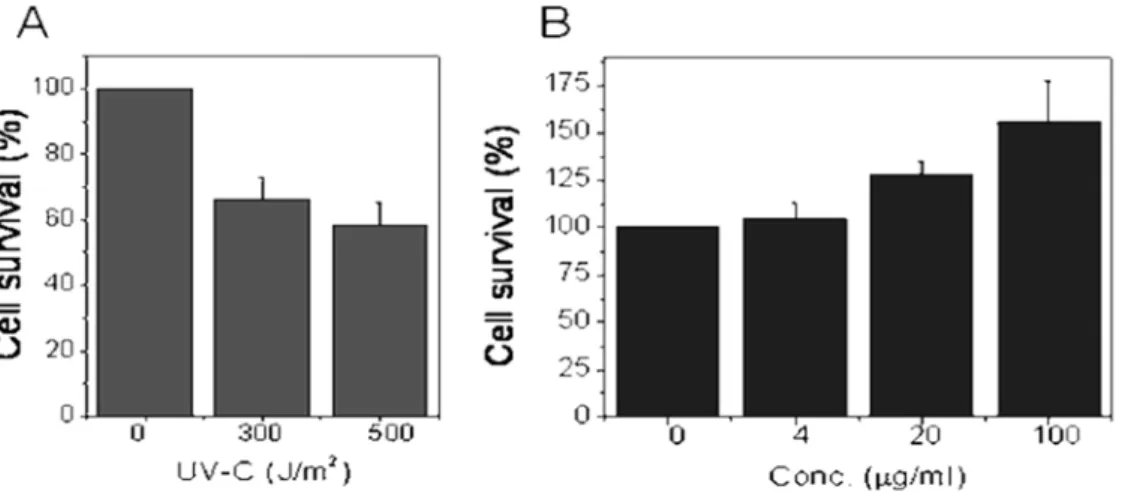
Fig. 1. Protective effect of B. platyphylla var. japonica total methanol extract against UV-C-induced cell damage. (A) Cells were treated with

0, 300 and 500 J/m

2

of UV-C and the relative cell survival rates were measured. (B) Cells were pre-treated with total methanol extracts for 1

hr prior to UV-C irradiation, and the relative cell survival was measured. Each experiment was performed at least 3 times and data are

expressed as average percent change from control ± S.D.

(3)

Results

Protective effect of total extract on UV-induced cell damages

Before we observe the protective effect of medicinal plant extract, we measured cell survival after UV-C irradiation.

As shown Fig. 1, the relative cell survival was decreased as the irradiated dose increased; 66.5 % and 58.5 % cells were survived after 300 and 500 J/m

2

of UV at 254 nm. In order to study UV protective effect of a medicinal plant, B.

platyphylla var. japonica total methanol extract, we pre- treated cells with the total extract 1 hr prior to the 300 J/m

2

of UV-irradiation. When cells were pre-incubated with total extract, cell survival was significantly increased (Fig. 1B).

At 4, 20 and 100 µg/ml of total extract treatment cell survival was increased to 104.4 %, 128.1 % and 155.9 %, respectively.

Protective effect of fraction samples against UV- induced cell damages

In order to narrow down the fractions which contain the protective activity against cell damaging stress, we prepared five fraction samples as described in materials and methods;

hexane, dichloromethane, ethylacetate, butanol and water fractions. Fraction samples were tested for the protective affect against UV-induced cell damage. Among 5 fraction samples, ethylacetate, butanol and water fractions revealed significant protective effect against UV-induced cellular damage (Fig. 2). At 20 µg/ml, ethylacetate fraction revealed 150.9 % cell survival compared to no-treatment control group. Butanol and water fraction showed 165.6 % and 122.6 % cell survival at the same concentration as that of ethylacetate fraction.

DPPH radical scavenging and Lipid peroxidation inhibition activity

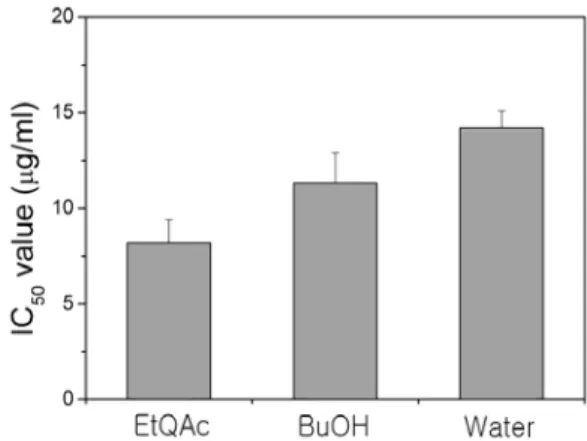
In order to investigate the possible mechanism involved in the protection activity against UV-induced cellular damage, DPPH radical scavenging and lipid peroxidation inhibition activity of the fraction samples were measured. Among fraction samples, 3 fractions which showed significant UV- induced cellular damage protective effect in previous experiment were tested for DPPH radical scavenging acti - vity and the IC

50

values were measured as shown in Fig. 3.

IC

50

values of each fraction sample were approximately 8.2 µg/ml, 11.3 µg/ml and 14.2 µg/ml for ethylacetate, butanol and water fractions, respectively. The data showed that ethylacetate fraction revealed the highest radical

Fig. 2. Protective effect of fraction samples against UV-induced cell damage. Cells were treated with fraction samples 1 hr prior to 300 J/m

2

of UV-irradiation. Each experiment was performed at least 3 times and data are expressed as average percent change from control ± S.D. White and gray bars indicate 4 and 20 µg/ml of samples, respectively.

Fig. 4. Lipid peroxidation inhibition activity of ethylacetate frac- tion of B. platyphylla var. japonica total methanol extract. Each experiment was performed at least 3 times and data are expressed as average percent change from control ± S.D.

Fig. 3. IC

50

values of fraction samples measured in DPPH radical

scavenging activity. Ethylacetate (EtOAc), buthanol (BuOH) and

water fraction samples (0.8~20 µg/ml) were added to DPPH solu-

tion and radical scavenging activity was measured at 520 nm. The

concentration acquires to reduce 50 % of DPPH radical was mea-

sured and plotted. Each experiment was performed at least 3 times

and data are expressed as average percent change from control ±

S.D.

(4)

scavenging activity.

We further tested the lipid peroxidation inhibition activity of ethylacetate fraction samples which showed the highest DPPH radical scavenging activity. As shown in Fig. 4, dose- dependent lipid peroxidation inhibition activity was obser- ved. At concentration of 0.8 µg/ml, approximately 3.0 %, at 4 µg/ml, approximately 31.0 % and at 20 µg/ml, approxi- mately 73.0 % of inhibition was observed.

Discussion

While solar light is indispensible in human being’s survival, researchers have concerned more about the negative results of UV radiation. Reports regarding UV- induced DNA and cellular damages were published and many attentions about the mechanism behind these UV- induced damages were drawn. It was suggested that UV- induced cell damage and UV-generated ROS can trigger directly and indirectly the cell signaling process (Heck et al., 2004). It was reported that c-Jun amino-terminal protein kinase (JNK) cascade, various tyrosine kinases and pho- spholipid and PI3K signaling processes were activated by UV light, thus causing induction of many target genes (Rosette and Karin, 1996; Heck et al., 2004). Transcription factors, activator protein (AP)-1 and nuclear factor (NF)- κB are reported to be activated in response to UV-irradiation (Herrlich et al., 2008). However the mechanism study about UV-induced damage somewhat lags behind.

Several studies reported the protective effect of natural plant-derived extracts and compounds. The protective activity of sulforaphane-containing broccoli sprout extract against UV-B-induced skin cancer was reported (Dinkova- Kostova et al., 2006). The animal received high dose of extract showed 50 % reduction in tumor burden, incidence and multiplicity. Treatment of Green tea polyphenol (GTP) resulted in inhibition of UV-B-induced protein oxidation in vitro and in vivo. GTP also inhibited UV-induced expression of matrix metalloproteinases (Vayalil et al, 2004). The protective effect of soybean oil and its methanolic extract against UV-C irradiation by using comet assay was reported. It was concluded that the potential antioxidants found in the extract may be responsible for the protective effect (Wang et al., 2003).

Previously we reported the anti-oxidative and anti-cancer activity of Betula platyphylla var. japonica extract (Ju et al., 2004). Recently, B. platyphylla var. japonica extract showed inhibitory effect on the development of atopic dermatitis- like skin lesions (Kim et al., 2008). Butanol fraction of B.

platyphylla var. japonica extract also showed protective effects on cartilage alterations in rabbit collagenase-induced osteoarthritis (Huh et al., 2008). In this study we reported that the protective effect of B. platyphylla var. japonica extract against UV-C irradiation. Methanolic total extract showed significantly increased cell survival against UV-C

irradiation. Among fraction samples, ethylacetate, butanol and water fractions increased the cell survival significantly.

Among 3 fractions butanol fraction showed the highest relative cell survival ratio even though all 3 samples showed significant increase in cell survival. However, among those 3 fraction samples, ethylacetate fraction revealed the highest DPPH radical scavenging and lipid membrane peroxidation inhibition activity. These discrepancies may need to be confirmed in subsequent studies. Taken together, it seems that the mechanism behind the protective effect against UV-C irradiation is free radical scavenging and cell membrane protection against peroxidation. Our data supports that the cellular damage induced by UV irradiation is caused by the ROS generated through UV irradiation in addition to direct DNA damage. Further studies are needed to be confirmed by in vivo study and to identify the active protective molecule in fraction sample.

Acknowledgement

This work was supported by the Seoul RNBD Program (10524) in Korea.

References

Dinkova-Kostova AT, Jenkins SN, Fahey JW, Ye L, Wehage SL, Liby KT, Stepheson KK, Wade KL, Talalay P.

Protection against UV-light-induced skin carcinogenesis in SKH-1 high-risk mice by sulforaphane-containing broccoli sprout extracts. Cancer Lett. 2006;240:243-252.

Finkel T, Holbrook NJ. Oxidants, oxidative stress and the biology of ageing. Nature. 2000;408:239-247.

Han DH, Lee MJ, Kim JH. Antioxidant and apoptosis-induction effect of ellagic acid. Anticancer Res. 2006;26:3601-3606.

Hansen MB, Nielsen SE, Berg K. Re-examination and further development of a precise and rapid dye method for measuring cell growth cell growth/cell kill. J Immunol Method.

1989;119: 203-210.

Heck DE, Gerecke DR, Vetrano AM, Laskin JD. Solar ultraviolet radiation as a trigger of cell signal transduction.

Toxicol Appl Pharmacol. 2004;195:288-297.

Herrlich P, Karin M, Weiss C. Supreme EnLIGHTenment:

Damage recognition and signaling in the mammalian UV response. Mol Cell. 2008;29: 279-290.

Huh JE, Baek YH, Kim YJ, Lee JD, Choi DY, Park DS.

Protective effects of butanol fraction from Betula platyphyla var. japonica on cartilage alterations in a rabbit collagenase- induced osteoarthritis. J Ethnopharmacol. 2008;16: 1741-1754.

Ibuki Y, Allanson M, Dixon KM, Reeve VE. Radiation sources providing increased UVA/UVB ratios attenuate the apopto- tic effects of the UVB waveband UVA-dose- dependently in hairless mouse skin. J Invest Dermatol. 2007;127:2236-2244.

Ju EM, Lee SE, Hwang HJ, Kim JH. Antioxidant and anticancer activity of extract from Betula platyphylla var.

japonica. Life Sci. 2004;74: 1013-1026.

Kim EC, Lee HS, Kim SK, Choi MS, Lee SE, Han JB, An HJ,

(5)

Um JY, Kim HM, Lee NY, Bae H, Min BI. J Ethnopharmacol.

2008;116: 270-278.

Kim JH, Lee EJ, Hyun JW, Kim SH, Mar WC, Kim JK.

Reduction of radiation-induced chromosome aberration and apoptosis by dithiothreitol. Arch Pharm Res. 1998;21:683- 687.

Lee SE, Shin HT, Hwang HJ, Kim JH. Antioxidant activity of extract from Alpinia Katsumadai seed. Phytother Res. 2003;17:

1041-1047.

Marmur J, Grossman L. Ultraviolet light induced linking of deoxyribonucleic acid strands and its reversal by photoreac- tivating enzyme. Proc Natl Acad Sci USA. 1961;47:778-787.

Peak MJ, Peak JG. DNA to protein crosslinks and backbone breaks caused by far- and near-ultraviolet and visible radiations in mammalian cells. Basic Life Sci. 1986;38:193-202.

Rossette C, Karin M. Ultraviolet light and osmotic stress:- activiation of JNK cascade through multiple growth factor

and cytokine receptors. Science. 1996;274: 1194-1197.

Rosenstein BS, Ducore JM. Induction of DNA strand breaks in normal human fibroblasts exposed to monochromatic ultraviolet and visible wavelengths in the 240-546 nm range.

Photochem Photobiol.1983; 38:51-55.

Ullrich SE. Sunlight and skin cancer: Lessons from the immune system. Mol. Carcinogen. 2007;46:629-633.

Vayalil PK, Mittal A, Hara Y, Elmets CA, Katiyar SK. Green tea polyphenols prevent ultraviolet light-induced oxidative damage and matrix metalloproteinases expression in mouse skin. J Invest Dermatol. 2004;122:1480-1487.

Wang H, Li Q, Ying J, Luo Z, Wang Y. The protective effect

and mechanism of soybean oil and its extracts on DNA

damage in human ECV304 cells exposed to UV-C. Biochem

Biophys Acta. 2003;1626:19-24.

수치

Fig. 1. Protective effect of B. platyphylla var. japonica total methanol extract against UV-C-induced cell damage
Fig. 2. Protective effect of fraction samples against UV-induced cell damage. Cells were treated with fraction samples 1 hr prior to 300 J/m 2  of UV-irradiation

참조

관련 문서